
lovethailand home >North Travel Attractions >Chiang Mai Travel Attractions >San Pa Tong >Makham Luang > Wat Saeng Sawang
TL;DR: Wat Saeng Sawang is located at Makham Luang Subdistrict, San Pa Tong District, Chiang Mai Province, open Daily, hours 08.00 – 17.00. Highlights include Formerly Wat Khuang Muen; relocated from a flood-prone lowland site in 1943 and renamed Wat Saeng Sawang.

Wat Saeng Sawang
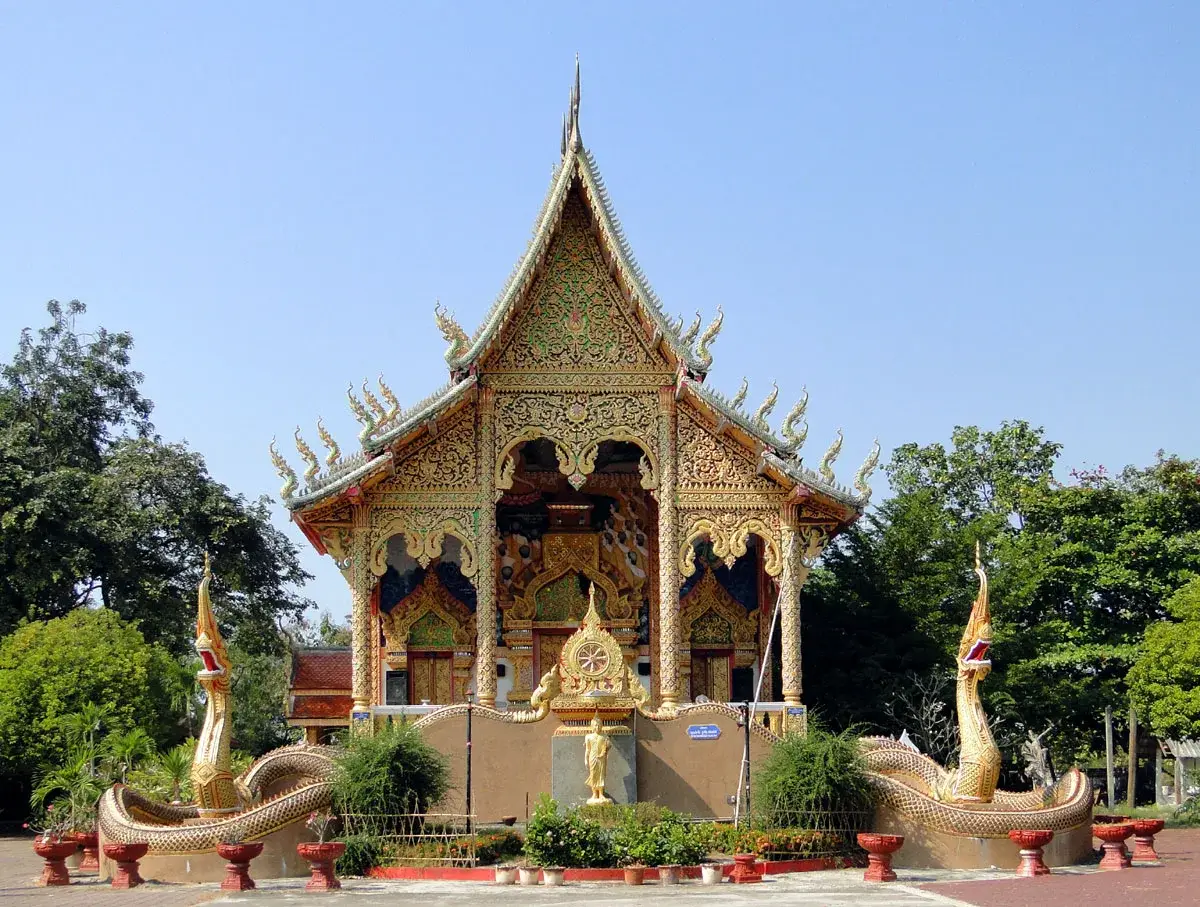
Open Days: Daily
Opening Hours: 08.00 – 17.00
Wat Saeng Sawang is a local Buddhist temple under the Mahanikaya order in Makham Luang Subdistrict, San Pa Tong District, Chiang Mai Province. The temple was formerly known as Wat Khuang Muen. Its history is especially meaningful because the temple was moved from its original low-lying site, where flooding and poor road conditions made travel difficult, to a more suitable location. In 1943, Khru Ba Khamma Panyo, the abbot of Wat Khuang Muen at that time, consulted with local residents and led the community in relocating the temple. The new temple was named Wat Saeng Sawang, a name that suggests brightness, clarity, and a new beginning for the community’s place of faith.
The importance of Wat Saeng Sawang lies in the story of community adaptation. The former temple site suffered from standing water and difficult access, making it inconvenient for local people to attend merit-making activities and Buddhist ceremonies. When the temple’s location no longer supported the religious life of the village, Khru Ba Khamma Panyo and the community made a collective decision to move the temple to higher and more practical ground. This relocation was not simply a physical move; it was an effort to preserve Buddhist faith, community cooperation, and local religious continuity.
The name “Saeng Sawang” fits the temple’s history. After leaving a flood-prone area, the temple entered a new phase in a more accessible and suitable place. The idea of brightness also has Buddhist meaning. Light often symbolizes wisdom, Dharma, understanding, and freedom from darkness. The temple name therefore carries both a practical meaning connected with relocation and a spiritual meaning connected with clarity and hope.
Wat Saeng Sawang was established in 1937 and has a recorded relocation history in 1943. During that period, communities in San Pa Tong were closely tied to agriculture, irrigation systems, village roads, and local temples. A village temple had to be accessible because it was the center of merit-making, religious ceremonies, and community gatherings. The relocation of Wat Saeng Sawang shows the strength of local cooperation and the importance of placing a temple where it can truly serve the people.
The temple land covers 6 rai under Nor Sor 3 document No. 2451, and the temple also has 3 plots of monastic land totaling 23 rai and 60 square wah. The temple boundaries relate to roads, walkways, and water channels. These details show that Wat Saeng Sawang is part of a living Lanna community landscape where religion, movement, water management, and village life are closely connected.
The main structures of Wat Saeng Sawang include a viharn, monks’ residence, and hall. These are essential elements of a community temple. The viharn is the main worship space for paying respect and participating in religious activities. The monks’ residence supports monastic life and daily Buddhist practice. The hall functions as a flexible community space for merit-making, Dharma listening, ceremonies, and village activities.
The viharn is the most meaningful area for visitors. It is where local residents come to worship, make merit, and calm the mind. In a Lanna community temple, the viharn is not only an architectural feature; it is the spiritual heart of the temple. Visitors should spend time quietly in this area to understand the atmosphere of a local temple that continues to serve its community.
The monks’ residence reflects the temple’s active religious life. Monks maintain the temple, perform chanting, receive invitations for ceremonies, guide laypeople, and support Buddhist practice in the community. A temple with resident monks is not simply a sightseeing site; it is an active religious institution within the daily life of local residents.
The hall supports shared temple activities. It is used for merit-making, Dharma listening, funeral rites, community meetings, and preparations for annual Buddhist events. This type of space shows the social role of a village temple. It is where monks and laypeople meet, where villagers cooperate, and where religious life becomes part of community life.
Wat Saeng Sawang also has a history of Buddhist education. A school for Dhamma studies was started in 1976. This gives the temple an educational dimension beyond ritual practice. In northern Thai communities, temples have long been connected with moral learning, Buddhist knowledge, discipline, and the passing on of values. This role strengthens the temple’s importance as more than a place for worship alone.
Khru Ba Khamma Panyo is the most important figure in the temple’s relocation history. As the abbot of Wat Khuang Muen, he guided the community during a period when the old site was no longer suitable. His leadership shows the role of a village abbot as both a religious leader and a community coordinator. The successful relocation of the temple reflects shared faith, practical problem-solving, and strong cooperation between monks and local residents.
Wat Saeng Sawang continues to serve the community as a place for merit-making, Buddhist holy day observances, Kathin robe-offering ceremonies, pha pa merit-making, Songkran activities, Buddhist Lent ceremonies, funeral merit-making, and family rites. During temple events, the temple becomes a shared space where elders, families, young people, and community volunteers work together.
The temple is part of a wider network of village temples in Makham Luang and San Pa Tong. Nearby temples include Wat Khuang Muen, Wat Makham Luang, Wat Mongkhon, Wat Phrabat Yang Wit, Wat San Khayom, Wat San Sai Mun, Wat Som Poi, and Wat Nong Ueng. These temples show how Buddhism remains deeply rooted at the village level in San Pa Tong. Travelers interested in local temple routes can combine several of these temples in one meaningful cultural trip.
The main things to appreciate at Wat Saeng Sawang are its relocation story, viharn, hall, temple courtyard, and community atmosphere. The value of the temple is not in grandeur, but in the way it reveals a community’s decision to protect and continue its religious life. The temple offers a quiet view of Chiang Mai beyond the heavily visited sites of the old city.
Visitors should worship at the main sacred area inside the viharn. Making merit at Wat Saeng Sawang can be understood as more than a request for blessings. It can also be a moment to reflect on resilience, cooperation, and the Buddhist meaning of light as wisdom and hope. This gives the temple a deeper cultural and spiritual dimension.
Wat Saeng Sawang is suitable for travelers interested in Lanna community temples, local history, temple relocation stories, and peaceful cultural routes outside Chiang Mai city. It is not a crowded tourist landmark, but it is meaningful for visitors who want to understand how village temples support daily life, faith, and local identity.
Getting There is easiest by private car or rental car. From Chiang Mai city, take the Chiang Mai–Hot Road, also known as Highway 108, toward San Pa Tong District, then continue into Makham Luang Subdistrict. The temple can be included in a half-day or full-day route with nearby temples and cultural places such as Wat Makham Luang, Wat Phrabat Yang Wit, Thung Fa Bot Market, Wiang Tha Kan Ancient Town, and Baan Tawai Handicraft Village.
The best time to visit is in the morning or afternoon before evening. These periods are suitable for worship, quiet walking, and continuing to nearby attractions in San Pa Tong. Travelers who want to visit Thung Fa Bot Market should plan their travel day according to the market schedule. A private vehicle is the most practical choice because it allows flexible stops at temples, restaurants, and local attractions.
Visitors should follow normal Thai temple etiquette. Dress modestly, keep voices low, avoid touching sacred objects without permission, do not disturb monks or local residents, and take photographs respectfully. If visiting during a ceremony or merit-making event, follow the guidance of the temple and the community. Wat Saeng Sawang is best appreciated as a living community temple rather than a simple sightseeing stop.
In summary, Wat Saeng Sawang is a meaningful community temple in Makham Luang Subdistrict, San Pa Tong District, Chiang Mai. Formerly known as Wat Khuang Muen, it was moved from a flood-prone lowland site to a more suitable location in 1943 under the leadership of Khru Ba Khamma Panyo and local residents. With a viharn, monks’ residence, hall, monastic land, and a history of Dhamma education, the temple offers a sincere view of Lanna Buddhist community life rooted in faith, adaptation, and continuity.
| Name | Wat Saeng Sawang |
| Location | Makham Luang Subdistrict, San Pa Tong District, Chiang Mai Province |
| Address | Ban Phrabat, Chiang Mai–Hot Road, Mu 5, Makham Luang Subdistrict, San Pa Tong District, Chiang Mai 50120 |
| Place Type | Local Buddhist temple under the Mahanikaya order |
| Temple Area | 6 rai, with 3 plots of monastic land totaling 23 rai and 60 square wah |
| Highlights | Formerly Wat Khuang Muen; relocated from a flood-prone lowland site in 1943 and renamed Wat Saeng Sawang |
| History | Established in 1937, formerly named Wat Khuang Muen, and relocated in 1943 under the leadership of Khru Ba Khamma Panyo and the local community |
| Former Name | Wat Khuang Muen |
| Name Origin | The name Saeng Sawang means brightness and suggests wisdom, hope, and a new beginning after the temple relocation |
| Distinctive Features | A Lanna community temple with a clear relocation history and basic religious structures supporting village merit-making and Buddhist activities |
| Travel Information | From Chiang Mai city, take the Chiang Mai–Hot Road toward San Pa Tong, then continue into Makham Luang Subdistrict; private car or rental car is most convenient |
| Current Status | The temple still appears in current temple listings for Makham Luang Subdistrict, San Pa Tong District, Chiang Mai Province, and in current business directory sources |
| Open Days | Daily |
| Opening Hours | 08.00 – 17.00 |
| Important Structures | Viharn, monks’ residence, and hall |
| Important Historical Figure | Khru Ba Khamma Panyo, who led the relocation from Wat Khuang Muen to Wat Saeng Sawang |
| Buddhist Education | Dhamma studies were started at the temple in 1976 |
| Main Contact Number | 053-824-595 |
| Nearby Tourist Attractions | 1. Wat Khuang Muen, about 1 km 2. Wat Phrabat Yang Wit, about 3 km 3. Wat Makham Luang, about 4 km 4. Thung Fa Bot Market / Kad Ngua San Pa Tong, about 5 km 5. Wiang Tha Kan Ancient Town, about 9 km |
| Nearby Restaurants | 1. Klin Kaprao Khao Ho Mok San Pa Tong, about 3 km, Tel. 093-243-8923 2. Delicious Pork Noodles Makham Luang, about 3 km, Tel. 087-195-3342 3. Kap Khao Maton, about 4 km, Tel. 084-615-7789 4. Charcoal Pork Leg Rice San Pa Tong, about 6 km, Tel. 081-881-5112 5. San Pa Tong Chicken Rice, about 7 km, Tel. 089-850-0231 |
| Nearby Accommodations | 1. Tai Resort Sanpatong, about 5 km, Tel. 063-096-7000 2. Home Thai Resort, about 7 km, Tel. 063-952-8228 3. P Resort & W Resort, about 8 km, Tel. 064-334-4566 4. Bannoi Himsuan, about 11 km, Tel. 090-329-6108 5. Kaomai Lanna Resort, about 12 km, Tel. 053-481-201, 086-428-7481 |
Frequently Asked Questions (FAQ)
Q: Where is Wat Saeng Sawang located?
A: Wat Saeng Sawang is located in Makham Luang Subdistrict, San Pa Tong District, Chiang Mai Province, along the cultural route connected with the Chiang Mai–Hot Road.
Q: What was the former name of Wat Saeng Sawang?
A: Wat Saeng Sawang was formerly known as Wat Khuang Muen.
Q: Why was Wat Khuang Muen relocated and renamed Wat Saeng Sawang?
A: The former site was low-lying, affected by standing water, and difficult to access. In 1943, Khru Ba Khamma Panyo and the community relocated the temple to a more suitable place and renamed it Wat Saeng Sawang.
Q: When was Wat Saeng Sawang established?
A: Wat Saeng Sawang was established in 1937 and has a recorded relocation history from Wat Khuang Muen in 1943.
Q: What important structures are found at Wat Saeng Sawang?
A: Important structures include a viharn, monks’ residence, and hall.
Q: What type of traveler is Wat Saeng Sawang suitable for?
A: It is suitable for travelers interested in Lanna community temples, local history, temple relocation stories, merit-making, and peaceful cultural routes in San Pa Tong.
Q: What is the best way to get to Wat Saeng Sawang?
A: A private car or rental car is the most convenient option. Take the Chiang Mai–Hot Road toward San Pa Tong, then continue into Makham Luang Subdistrict.
 Category: ●Places of Worship
 Group: ●Temple
Last Update : 4 WeekAgo
 Last Update : 4 WeekAgo
 Click to Access the Navigation Map GPS

 Muang Chiang Mai(121)Chom Thong(47)Mae Chaem(25)Chiang Dao(33)Doi Saket(68)Mae Taeng(85)Mae Rim(69)Samoeng(29)Fang(71)Mae Ai(59)Phrao(70)San Pa Tong(103)San Kamphaeng(66)San Sai(73)Hang Dong(73)Hot(32)Doi Tao(22)Omkoi(11)Saraphi(74)Wiang Haeng(15)Chai Prakan(28)Mae Wang(32)Mae On(22)Doi Lo(33)Galyani Vadhana(1)


