
lovethailand home >North Travel Attractions >Chiang Mai Travel Attractions >San Pa Tong >Makhun Wan > Wat Makhun Wan
TL;DR: Wat Makhun Wan is located at Ban Makhun Wan, Mu 5, Makhun Wan Subdistrict, San Pa Tong District, Chiang Mai Province, open Daily, hours 08.00 – 17.00.

Wat Makhun Wan
Open Days: Daily
Opening Hours: 08.00 – 17.00
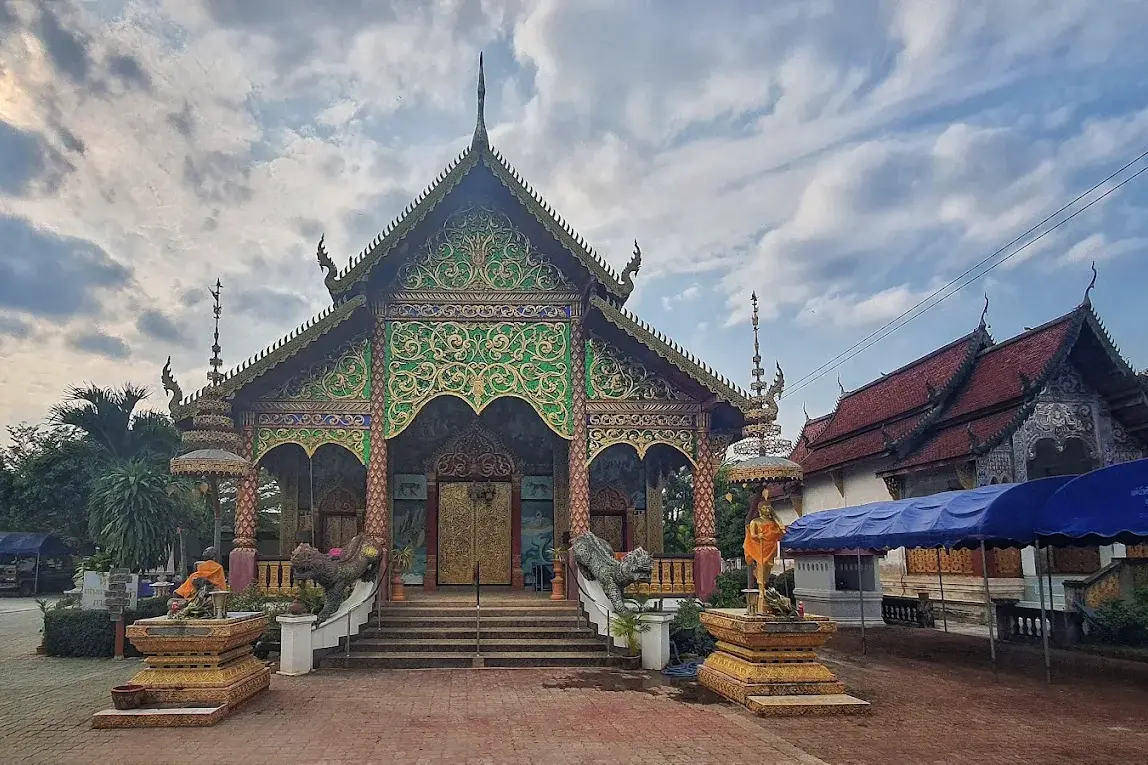
Wat Makhun Wan is a local Buddhist temple in Ban Makhun Wan, Mu 5, Makhun Wan Subdistrict, San Pa Tong District, Chiang Mai Province. The temple belongs to the Mahanikaya order and was officially permitted as a temple in 1846. It remains listed among the temples of Makhun Wan Subdistrict today. The temple is important because it reflects the close relationship between Buddhism, village life, local education, agriculture, and Lanna community identity in San Pa Tong. Visitors will find a quiet, modest, and meaningful local temple rather than a crowded tourist landmark.
The temple is located at No. 260, Ban Makhun Wan, Mu 5, Makhun Wan Subdistrict, San Pa Tong District, Chiang Mai 50120. The temple land covers 4 rai, 1 ngan, and 8 square wah under Nor Sor 3 document No. 217. The temple also has one plot of monastic land measuring 22 rai and 22 square wah. These land details show that Wat Makhun Wan has both a main religious compound and monastic land connected with the long-term management of the temple.
The boundaries of Wat Makhun Wan clearly show how the temple is embedded in local life. To the north, it borders Wat Makhun Wan School. To the south, it borders private garden land. To the east, it borders a public road. To the west, it borders private rice field land. These surroundings tell an important story. The temple stands among a school, a road, orchards, and rice fields, all of which are core elements of a northern Thai village landscape.
The temple’s northern boundary next to Wat Makhun Wan School gives the site additional social meaning. In many Lanna communities, temples and schools are closely connected. Temples support moral education, Buddhist observances, local ceremonies, and youth participation in religious events. Wat Makhun Wan therefore works not only as a place of worship, but also as part of the community structure that links religion, education, and village life.
Wat Makhun Wan has a clear historical foundation through its official establishment in 1846. This places the temple within the long development of San Pa Tong’s village communities, where Buddhist temples were built and maintained as centers of settlement, faith, and social cooperation. In Lanna society, the presence of a temple often signals the maturity of a village community because the temple becomes the place where people make merit, listen to Dharma, gather for ceremonies, and preserve local traditions.
The name “Wat Makhun Wan” is directly connected with Ban Makhun Wan and Makhun Wan Subdistrict. This makes the temple name part of the area’s identity. When people refer to the temple, they also refer to the village, the subdistrict, and the memory of the local community. The temple name is therefore more than a religious title; it is a marker of place, belonging, and continuity.
Phra Maha Charan Cittasamvaro is identified as the abbot of Wat Makhun Wan. In a community temple, the abbot plays an important role in maintaining the temple, leading Buddhist ceremonies, guiding laypeople, coordinating merit-making events, and preserving the connection between monks and villagers. This role is especially important in a temple that remains closely tied to the everyday life of the surrounding community.
Wat Makhun Wan is suitable for travelers who want to understand real Lanna community temple life. Unlike major tourist temples in Chiang Mai city, this temple offers a quieter and more local experience. Visitors can make merit, pay respect, walk around the temple grounds, and observe how a village temple continues to serve people in daily life. This makes Wat Makhun Wan valuable for cultural travelers interested in authenticity and local context.
The temple supports common Buddhist and community activities such as observances on Buddhist holy days, Dharma listening, Kathin robe-offering ceremonies, pha pa merit-making, Songkran activities, candle offerings for Buddhist Lent, salak phat offerings, funeral merit-making, and family ceremonies. These activities keep the temple alive as a social and religious center. They also show how local people continue to preserve Buddhist practice through shared participation.
Makhun Wan Subdistrict is associated with important local traditions such as Buddha relic bathing ceremonies, Loy Krathong, Songkran, salak phat offerings, candle offerings for Buddhist Lent, and other Buddhist ceremonies. Wat Makhun Wan, as a village temple in the subdistrict, is part of this wider cultural environment. Such traditions require cooperation among monks, local leaders, residents, schools, and public agencies, making the temple an essential part of community life.
The most meaningful aspect of visiting Wat Makhun Wan is its atmosphere as a local temple beside a school and agricultural land. This setting gives visitors a direct sense of northern Thai rural life. The temple is not arranged mainly for tourism; it is a living place of faith used by local people. For this reason, it offers a more grounded view of Chiang Mai than many larger temples on the main tourist route.
Visitors should pay respect at the main worship area and move through the temple with calmness. Worship at an old village temple is not only a personal religious act, but also a way to acknowledge the faith that local residents have preserved for generations. Modest clothing, quiet behavior, and respectful photography are appropriate throughout the visit.
Wat Makhun Wan plays a social role as a spiritual center for Ban Makhun Wan. For elderly residents, it is a place for merit-making and Dharma listening. For families, it is a place for ceremonies connected with life events. For young people, it is a place where Buddhist customs and local traditions can be learned through participation. This is why the temple remains important even though it is not widely promoted as a major tourist attraction.
Wat Makhun Wan can also be included in a San Pa Tong cultural route. Nearby places include Wat Phra Chao Song Ong, Wat Muang Phi Nong, Wat Pa Ngio, Thung Fa Bot Market or Kad Ngua San Pa Tong, Wiang Tha Kan Ancient Town, and Baan Tawai Handicraft Village. This route is suitable for travelers who want to combine village temples, local markets, archaeological sites, and Lanna craft culture in one trip.
Getting There is easiest by private car or rental car. From Chiang Mai city, take the Chiang Mai–Hot Road, also known as Highway 108, toward San Pa Tong District. Continue into Makhun Wan Subdistrict and Ban Makhun Wan, Mu 5. The temple name can be used directly in map applications. Drive carefully on local roads, especially around school hours, Buddhist holy days, and community temple events.
For a meaningful visit, morning or afternoon before evening is recommended. This allows enough time to pay respect, walk around the temple, and continue to nearby temples or attractions in San Pa Tong. Travelers can combine Wat Makhun Wan with Wat Phra Chao Song Ong, Wat Muang Phi Nong, Wat Pa Ngio, Thung Fa Bot Market, or Wiang Tha Kan Ancient Town for a half-day or full-day cultural route.
Visitors should follow normal Thai temple etiquette. Dress modestly, keep voices low, avoid touching sacred objects without permission, do not disturb monks or local residents, and take any personal rubbish away from the temple grounds. If visiting during a ceremony, follow the guidance of the temple and community. Wat Makhun Wan is best appreciated as a living place of faith, not just a sightseeing stop.
In summary, Wat Makhun Wan is a historically meaningful community temple in Makhun Wan Subdistrict, San Pa Tong District, Chiang Mai. Officially established in 1846, the temple has clear land boundaries, monastic land, and a strong relationship with the surrounding school, public road, gardens, and rice fields. For travelers seeking a quieter and more local view of Chiang Mai, Wat Makhun Wan offers a sincere encounter with Lanna village faith and community life.
| Name | Wat Makhun Wan |
| Location | Ban Makhun Wan, Mu 5, Makhun Wan Subdistrict, San Pa Tong District, Chiang Mai Province |
| Address | 260 Ban Makhun Wan, Mu 5, Makhun Wan Subdistrict, San Pa Tong District, Chiang Mai 50120 |
| Coordinates | 18.57668, 98.91116 |
| Place Type | Local Buddhist temple under the Mahanikaya order |
| Temple Area | 4 rai, 1 ngan, 8 square wah, with one plot of monastic land measuring 22 rai and 22 square wah |
| Highlights | An old community temple beside a school, public road, gardens, and rice fields, reflecting its role as a village spiritual center |
| History | Officially permitted as a temple in 1846 |
| Name Origin | The temple name is directly connected with Ban Makhun Wan and Makhun Wan Subdistrict |
| Distinctive Features | A village temple surrounded by a school, public road, orchards, and rice fields, suitable for merit-making and learning about Lanna community life |
| Travel Information | From Chiang Mai city, take the Chiang Mai–Hot Road toward San Pa Tong, then continue into Makhun Wan Subdistrict and Ban Makhun Wan, Mu 5; private car or rental car is most convenient |
| Current Status | The temple still appears in current temple listings for Makhun Wan Subdistrict, San Pa Tong District, Chiang Mai Province, and current business directory sources |
| Open Days | Daily |
| Opening Hours | 08.00 – 17.00 |
| Main Areas / Zones | Main worship area, temple courtyard, community activity area, and temple grounds connected with Wat Makhun Wan School |
| Abbot / Caretaker | Phra Maha Charan Cittasamvaro |
| Main Contact Number | 053-837-291, 083-324-1104 |
| Nearby Tourist Attractions | 1. Wat Phra Chao Song Ong, about 3 km 2. Wat Muang Phi Nong, about 4 km 3. Wat Pa Ngio (Makhun Wan), about 5 km 4. Thung Fa Bot Market / Kad Ngua San Pa Tong, about 6 km 5. Wiang Tha Kan Ancient Town, about 11 km |
| Nearby Restaurants | 1. Nong Fluke Restaurant, about 2 km, Tel. 053-829-528 2. Mala in Front of the Farm San Pa Tong, about 4 km, Tel. 096-121-3413 3. Kap Khao Maton, about 5 km, Tel. 084-615-7789 4. ZAPALiMENE San Pa Tong, about 7 km, Tel. 096-236-9197, 064-874-2594 5. Song Nakhon Restaurant San Pa Tong, about 8 km, Tel. 098-771-7581 |
| Nearby Accommodations | 1. Home Thai Resort, about 7 km, Tel. 063-952-8228 2. P Resort & W Resort, about 8 km, Tel. 064-334-4566 3. Khuangchan Resort, about 9 km, Tel. 089-835-3057 4. Tai Resort Sanpatong, about 10 km, Tel. 063-096-7000 5. Kaomai Lanna Resort, about 14 km, Tel. 053-481-201 |
Frequently Asked Questions (FAQ)
Q: Where is Wat Makhun Wan located?
A: Wat Makhun Wan is located at 260 Ban Makhun Wan, Mu 5, Makhun Wan Subdistrict, San Pa Tong District, Chiang Mai Province 50120.
Q: When was Wat Makhun Wan officially established?
A: Wat Makhun Wan was officially permitted as a temple in 1846.
Q: Who is the abbot of Wat Makhun Wan?
A: Phra Maha Charan Cittasamvaro is identified as the abbot of Wat Makhun Wan.
Q: Why is Wat Makhun Wan important to the local community?
A: The temple is a spiritual center of Ban Makhun Wan and is closely connected with the local school, public road, gardens, rice fields, and community traditions.
Q: What type of traveler is Wat Makhun Wan suitable for?
A: It is suitable for travelers interested in quiet Lanna community temples, merit-making, local culture, and cultural routes in San Pa Tong.
Q: What is the best way to get to Wat Makhun Wan?
A: A private car or rental car is the most convenient option. Take the Chiang Mai–Hot Road toward San Pa Tong, then continue into Makhun Wan Subdistrict and Ban Makhun Wan, Mu 5.
Q: What nearby places can be visited with Wat Makhun Wan?
A: Nearby places include Wat Phra Chao Song Ong, Wat Muang Phi Nong, Wat Pa Ngio, Thung Fa Bot Market, and Wiang Tha Kan Ancient Town.
 Category: ●Places of Worship
 Group: ●Temple
Last Update : 4 WeekAgo
 Last Update : 4 WeekAgo
 Click to Access the Navigation Map GPS

 Muang Chiang Mai(121)Chom Thong(47)Mae Chaem(25)Chiang Dao(33)Doi Saket(68)Mae Taeng(85)Mae Rim(69)Samoeng(29)Fang(71)Mae Ai(59)Phrao(70)San Pa Tong(103)San Kamphaeng(66)San Sai(73)Hang Dong(73)Hot(32)Doi Tao(22)Omkoi(11)Saraphi(74)Wiang Haeng(15)Chai Prakan(28)Mae Wang(32)Mae On(22)Doi Lo(33)Galyani Vadhana(1)


