
lovethailand home >North Travel Attractions >Chiang Mai Travel Attractions >Wiang Haeng >Saen Hai > Wat Uthai Tharam
TL;DR: Wat Uthai Tharam is located at 53 Ban Pang Por, Moo 5, Saen Hai Subdistrict, Wiang Haeng District, Chiang Mai Province 50350, Thailand, open Daily, hours 08.00 – 17.00.

Wat Uthai Tharam
Open Days: Daily
Opening Hours: 08.00 – 17.00
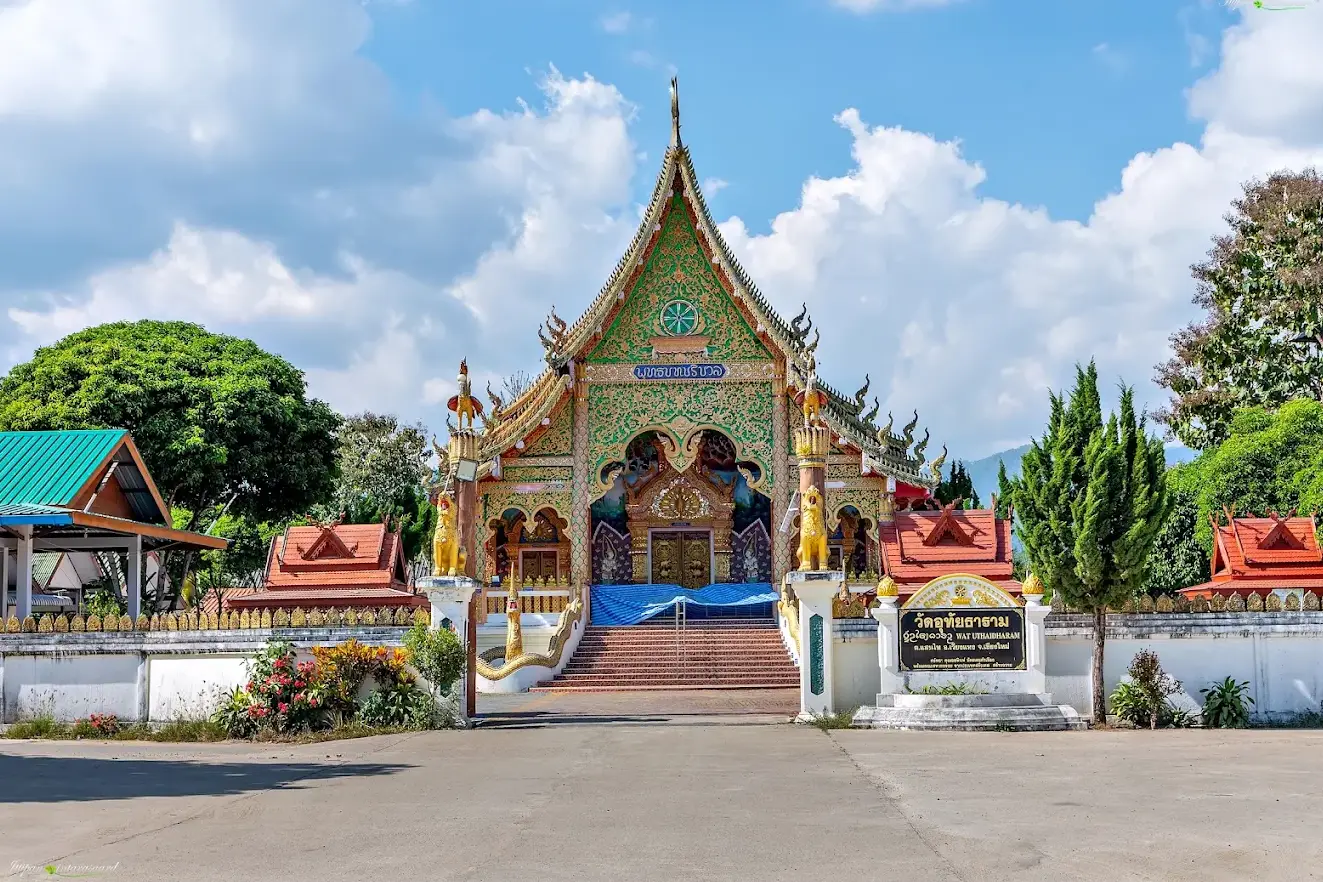
Wat Uthai Tharam, historically known as Wat Pang Por, is a community Buddhist temple at No. 53, Ban Pang Por, Moo 5, Saen Hai Subdistrict, Wiang Haeng District, Chiang Mai Province. The temple traces its history to B.E. 2464, equivalent to 1921, when Phra Liang Metho and local residents established the original monastery under the name Wat Pang Por. After a major fire damaged the old temple, the community relocated the monastery approximately 200 metres to the northeast and constructed a new temple on the site of an older abandoned monastery. The rebuilding was completed in B.E. 2476, or 1933, and the new temple was named Wat Uthai Tharam in memory of Phra Uthai Intapanyo, the monk who led the villagers during the reconstruction.
Wat Uthai Tharam stands within Ban Pang Por, a long-established agricultural community in Saen Hai Subdistrict. The temple is surrounded by a landscape of irrigation channels, rice fields, village roads, and mountain terrain typical of Wiang Haeng. Historical boundary records describe an irrigation channel and rice fields to the north, a pathway to the south, a road to the east, and another irrigation channel to the west. This setting shows how closely the monastery developed alongside local agriculture and community water management.
Understanding Ban Pang Por provides essential context for understanding the temple. The village was formerly known as Ban Pong On. Early settlers included families who migrated from Mueang Khong in Chiang Dao District and from Mae Rim District. Local history records that the first settlement consisted of around 15 households. The area was once covered with po trees, whose material was used to construct temporary shelters.
The word “pang” in northern usage refers to a temporary shelter or stopping place, while “po” refers to the plant that grew abundantly in the area. The two words eventually became the village name Ban Pang Por. In the past, before modern roads reached Wiang Haeng, travelers relied on walking, pack cattle, elephants, and carts. Ban Pang Por became a natural stopping place on these difficult mountain routes.
In this historical setting, establishing a monastery was far more important than simply creating a place of worship. A village temple provided religious ceremonies, moral education, community gatherings, accommodation for monks, and a shared spiritual center for residents living far from Chiang Mai city.
The first Wat Pang Por was founded in 1921 by Phra Liang Metho together with local residents. The monastery took the name of the village and served as its principal Buddhist institution. At the time, Wiang Haeng remained geographically isolated, and travel through the surrounding mountain ranges was difficult. The temple therefore became one of the main institutions supporting community continuity.
During the period of Phra Singkaeo Jantawangso, the original temple was damaged by fire. Rather than abandoning the monastery, villagers decided to rebuild it. The new location was approximately 200 metres northeast of the old site and was notable because an older abandoned temple had previously occupied the land.
Construction continued until 1933. When the new monastery was completed, villagers changed its name from Wat Pang Por to Wat Uthai Tharam in memory of Phra Uthai Intapanyo, who had taken a leading role in mobilizing the community to build the new temple. The modern name therefore commemorates an individual whose leadership was central to the temple's survival after the fire.
This sequence—foundation in 1921, destruction by fire, relocation, and completion of a new temple in 1933—gives Wat Uthai Tharam an unusually clear community history. It demonstrates the determination of residents to preserve their Buddhist center despite the loss of the original monastery.
The present temple grounds historically cover approximately 1 rai and 2 ngan. Wat Uthai Tharam also has two parcels of monastic land totaling approximately 1 rai and 84 square wah. These properties supported the long-term religious functions of the monastery and formed part of the institutional resources of the temple.
The original boundary description shows that the temple was integrated into an agricultural landscape. Irrigation channels on two sides supplied the surrounding farmland, while roads and pathways linked the monastery directly with the village. Saen Hai remains a highland agricultural subdistrict where rice fields, orchards, vegetables, garlic, chili, and other crops remain important parts of local livelihoods.
The historically documented monastic structures include a sermon hall and monks' residence. The sermon hall supports Buddhist sermons, merit-making ceremonies, lay gatherings, and community events. The monks' residence provides living and study space for resident monks and helps sustain year-round religious activity.
Important sacred objects recorded at Wat Uthai Tharam include a Phra Singh 3 Buddha image in Chiang Saen artistic style and a Buddha image in the Mara-Vijaya posture. These are among the principal objects visitors should respectfully observe and worship when entering the temple.
Chiang Saen Buddha imagery is an important part of northern Thai Buddhist art and is closely associated with the broader development of Lanna artistic traditions. The Mara-Vijaya posture represents the moment when the Buddha overcame Mara before enlightenment and is one of the most important iconographic forms in Theravada Buddhist temples.
Ban Pang Por remains an active community today. It is officially listed as Moo 5 of Saen Hai Subdistrict. The village has educational facilities, a child development center, agricultural land, and public infrastructure. Ban Pang Por School continues to provide education from early childhood through primary and lower-secondary levels.
The relationship between temple and school has also been visible through the role of Phrakhru Praphat Nothai. He previously served as chairman of the Ban Pang Por School Basic Education Commission and continues to play an important role in local religious and community affairs.
As of September 2026, Phrakhru Praphat Nothai continues to serve as the ecclesiastical head of Saen Hai Subdistrict. He was formally invited to present certificates to graduates of the Saen Hai Elderly School, illustrating the continuing role of Buddhist clergy in education, community welfare, and intergenerational activities.
The publicly listed contact number associated with Phrakhru Praphat Nothai is 081-724-2510. The same number appears in ecclesiastical records from Chiang Mai, providing a practical contact for religious coordination and temple inquiries.
Contemporary evidence also confirms that Wat Uthai Tharam remains an active religious site. On November 9, 2025, Wiang Haeng District held a major merit-making ceremony at the temple with the district chief, government officials, state agencies, local administrators, village leaders, and residents participating. This shows that Wat Uthai Tharam continues to function not only as Ban Pang Por's community temple but also as a venue for district-level Buddhist ceremonies.
Saen Hai Subdistrict preserves several important northern Buddhist traditions, including Songkran, Yi Peng, Salak Phat merit-making, Poy Tian, and the annual bathing ceremony of Phra Borommathat Saen Hai. These traditions create a wider religious landscape in which temples throughout the subdistrict support one another through festivals, merit-making, and monastic administration.
Songkran, or the northern Thai New Year, remains one of the periods when villagers visit temples to make merit, pay respect to Buddha images, and ask blessings from elders. Yi Peng reflects the distinctive Lanna tradition associated with lanterns, merit-making, and the full moon of the northern second lunar month.
Salak Phat is another important northern Thai merit-making tradition in which households prepare offerings that are distributed to monks by drawing lots. The ceremony strengthens relationships between families and monasteries and often brings together residents from several nearby communities.
The annual bathing ceremony of Phra Borommathat Saen Hai remains one of the most important religious events in Wiang Haeng. Saen Hai Municipality continued to organize the festival officially in 2026, demonstrating the vitality of Buddhist tradition within the subdistrict.
Wat Phra That Saen Hai is the most important nearby religious attraction to combine with Wat Uthai Tharam. It stands in Ban Mahathat, immediately north of Ban Pang Por, and is regarded as a major spiritual landmark of Wiang Haeng. Its annual relic-bathing festival attracts residents from throughout the district.
Ban Mahathat itself historically developed from Ban Pang Por. As the population increased, the northern section was separated into a new village. The new community took the name Ban Mahathat because of the sacred relic temple located there. Visiting Wat Uthai Tharam and Wat Phra That Saen Hai together therefore reveals the historical relationship between two neighboring communities that once formed a single settlement.
Wat Muang Pok and Wat Sam Phu are additional Maha Nikaya temples in Saen Hai. Wat Muang Pok has a registered history dating to 1920 and remains an active temple. Together with Wat Uthai Tharam and Wat Phra That Saen Hai, these monasteries illustrate the development of Buddhist community institutions throughout the early twentieth century.
The natural landscape also contributes to the character of Saen Hai. The Mae Taeng River flows through Ban Muang Pok, Ban Mahathat, and Ban Pang Por. Mae Lat Waterfall is another local natural attraction that can be included in a wider Wiang Haeng itinerary.
Wat Uthai Tharam is most rewarding for travelers who value community history rather than monumental architecture. Its significance lies in the relationship between monastery and village: the fire that destroyed the original temple, the collective decision to rebuild, the memory of Phra Uthai Intapanyo, and the continuing religious role of the monastery all form part of one continuous story.
Visitors should pay particular attention to the Phra Singh 3 Chiang Saen-style Buddha image and the Mara-Vijaya Buddha image. The sermon hall, monks' residence, irrigation channels, nearby rice fields, and village setting should also be viewed as parts of the temple's historical landscape.
Appropriate temple etiquette is important. Visitors should dress modestly, remove footwear where required, avoid entering monks' residential areas without permission, and keep noise to a minimum. Permission should be requested before photographing monks or private religious ceremonies.
Photography is most meaningful when the temple is shown in relation to the surrounding village landscape. Irrigation channels, farmland, roads, mountains, and monastery buildings together explain Wat Uthai Tharam's identity more accurately than isolated architectural images.
Ban Pang Por is approximately 13 km from central Wiang Haeng, making the temple relatively convenient for travelers staying in the district center. Food, cafes, and accommodation are available both within Saen Hai and in neighboring areas.
Mon Lanchang in Saen Hai operates as both a restaurant and accommodation property, while Mon Pun Saen Hai offers rooms, individual houses, a camping area, food, and scenic mountain views. These are practical options for travelers who prefer to stay within Saen Hai rather than returning to the district center.
Additional dining options are available in Mueang Haeng, including Khon Mueang Haeng, Wiang Haeng Coffee, Kang Tong Cafe, and IC Cafe. Travelers continuing north toward Piang Luang can also find a broader selection of resorts and guesthouses.
A two-day, one-night itinerary works particularly well. On the first day, travelers can visit Wat Uthai Tharam, Ban Pang Por, Wat Phra That Saen Hai, and the surrounding Saen Hai communities before staying locally or in central Wiang Haeng. The second day can be used for Piang Luang or additional natural attractions before returning to Chiang Mai.
The cool season is generally the most comfortable period for visiting Wiang Haeng. Mountain temperatures are lower than in Chiang Mai city, while the agricultural landscape is particularly pleasant. The rainy season brings lush vegetation but also wet roads and occasional mist.
Travelers driving from Chiang Mai should ensure that brakes, tyres, fuel, and overall vehicle condition are suitable for mountain travel. The route to Wiang Haeng includes many curves and elevation changes, making daytime travel preferable.
Getting There from Chiang Mai city is easiest by private or rental vehicle. Travel north toward Chiang Dao and continue along the mountain route into Wiang Haeng District. From central Wiang Haeng, continue approximately 13 km toward Saen Hai Subdistrict and Ban Pang Por. The temple stands within the village near Ban Pang Por School, agricultural land, and community irrigation channels.
Wat Uthai Tharam is best suited to travelers interested in community temple history, Lanna Buddhist art, village development, and the cultural landscape of Wiang Haeng. It is not a large commercial attraction, and its value is best understood by reading its history and observing how the monastery remains connected with the community.
From its foundation as Wat Pang Por in 1921, through the destruction of the original monastery by fire, to its rebuilding and renaming in 1933, Wat Uthai Tharam represents the resilience of a rural Buddhist community. Today, the temple continues to host important ceremonies, remains connected with Saen Hai's ecclesiastical administration, and retains its role in education, community activities, and religious life. This combination of history and living tradition makes Wat Uthai Tharam one of the more meaningful cultural stops in Wiang Haeng.
| Name | Wat Uthai Tharam / Wat Pang Por |
| Temple Type | Public Buddhist Temple, Maha Nikaya Order |
| Temple Registry Code | 350200206 |
| Address | 53 Ban Pang Por, Moo 5, Saen Hai Subdistrict, Wiang Haeng District, Chiang Mai Province 50350, Thailand |
| Former Name | Wat Pang Por |
| Original Foundation | B.E. 2464 / 1921, founded by Phra Liang Metho together with local residents |
| Temple Relocation | Relocated approximately 200 metres northeast after a fire damaged the original monastery |
| New Temple Completed | B.E. 2476 / 1933 |
| Name Origin | Renamed Wat Uthai Tharam in memory of Phra Uthai Intapanyo, who led the rebuilding of the temple |
| Temple Area | Approximately 1 rai and 2 ngan |
| Monastic Land | Two parcels totaling approximately 1 rai and 84 square wah |
| Historical Boundaries | Irrigation channel and rice fields to the north, pathway to the south, road to the east, and irrigation channel to the west |
| Important Structures | Sermon Hall and Monks' Residence |
| Sacred Objects | Phra Singh 3 Buddha image in Chiang Saen style and a Mara-Vijaya Buddha image |
| Abbot / Ecclesiastical Leader | Phrakhru Praphat Nothai, ecclesiastical head of Saen Hai Subdistrict |
| Main Contact Number | 081-724-2510 |
| Open Days | Daily |
| Opening Hours | 08.00 – 17.00 |
| Current Status | Active Buddhist temple and venue for community and district-level religious ceremonies |
| Travel Information | Travel from Chiang Mai via Chiang Dao to Wiang Haeng, then continue approximately 13 km toward Saen Hai and Ban Pang Por. Private or rental vehicle is recommended. |
| Nearby Tourist Attractions | 1. Wat Phra That Saen Hai, about 3 km 2. Ban Mahathat, about 3 km 3. Wat Muang Pok, about 5 km 4. Wat Sam Phu, about 8 km 5. Mae Lat Waterfall, about 15 km 6. Central Wiang Haeng, about 13 km |
| Nearby Restaurants & Cafes | 1. Mon Lanchang, about 5 km, Tel. 097-918-0175 2. Mon Pun Saen Hai, about 6 km, Tel. 081-407-8497 3. Khon Mueang Haeng, about 13 km 4. Wiang Haeng Coffee, about 13 km 5. Kang Tong Cafe, about 13 km, Tel. 065-269-6646 6. IC Cafe, about 13 km, Tel. 095-787-5123 |
| Nearby Accommodations | 1. Mon Pun Saen Hai, about 6 km, Tel. 081-407-8497 2. Mon Lanchang, about 5 km, Tel. 097-918-0175 3. Khum Wiang Haeng, about 13 km, Tel. 053-477-177 4. Baan Suan Chomview Resort, about 20 km, Tel. 084-487-5399 5. Huean Mok Kham Resort, about 20 km, Tel. 053-476-190 6. Piang Luang Guesthouse, about 20 km, Tel. 053-476-066 |
Frequently Asked Questions (FAQ)
Q: Where is Wat Uthai Tharam located?
A: Wat Uthai Tharam is located at No. 53, Ban Pang Por, Moo 5, Saen Hai Subdistrict, Wiang Haeng District, Chiang Mai Province 50350.
Q: What was Wat Uthai Tharam originally called?
A: The temple was originally called Wat Pang Por. It was founded in 1921 by Phra Liang Metho and local residents before being relocated after a major fire.
Q: Why was the temple renamed Wat Uthai Tharam?
A: The new temple was named in memory of Phra Uthai Intapanyo, who led local residents in rebuilding the monastery after the fire. Construction was completed in 1933.
Q: What sacred objects can visitors see at Wat Uthai Tharam?
A: Historically recorded sacred objects include a Phra Singh 3 Buddha image in Chiang Saen style and a Buddha image in the Mara-Vijaya posture.
Q: Who currently leads Wat Uthai Tharam?
A: Phrakhru Praphat Nothai is closely associated with Wat Uthai Tharam and currently serves as the ecclesiastical head of Saen Hai Subdistrict. The publicly listed contact number is 081-724-2510.
Q: Is Wat Uthai Tharam still active?
A: Yes. The temple continues to host Buddhist ceremonies and community activities. Wiang Haeng District held a major religious ceremony at the temple in November 2025, and Phrakhru Praphat Nothai remained active in Saen Hai community events in 2026.
Q: What nearby places can be combined with Wat Uthai Tharam?
A: Wat Phra That Saen Hai and Ban Mahathat are the closest cultural stops, followed by Wat Muang Pok, Wat Sam Phu, Mae Lat Waterfall, and central Wiang Haeng.
Q: Is an overnight stay recommended?
A: Yes. Staying one night in Saen Hai, central Wiang Haeng, or Piang Luang gives travelers more time to explore temples and communities while avoiding unnecessary mountain driving after dark.
 Category: ●Places of Worship
 Group: ●Temple
Last Update : 4 WeekAgo
 Last Update : 4 WeekAgo
 Click to Access the Navigation Map GPS

 Muang Chiang Mai(121)Chom Thong(47)Mae Chaem(25)Chiang Dao(33)Doi Saket(68)Mae Taeng(85)Mae Rim(69)Samoeng(29)Fang(71)Mae Ai(59)Phrao(70)San Pa Tong(103)San Kamphaeng(66)San Sai(73)Hang Dong(73)Hot(32)Doi Tao(22)Omkoi(11)Saraphi(74)Wiang Haeng(15)Chai Prakan(28)Mae Wang(32)Mae On(22)Doi Lo(33)Galyani Vadhana(1)


