
lovethailand home >North Travel Attractions >Chiang Mai Travel Attractions >Mae On >On Klang > Wat Lao Chantha Rang Si
TL;DR: Wat Lao Chantha Rang Si is located at 114, Ban Thung Lao, Moo 1, On Klang Subdistrict, Mae On District, Chiang Mai 50130, Thailand, open Daily, hours 08:00 - 17:00.

Wat Lao Chantha Rang Si
Open Days: Daily
Opening Hours: 08:00 - 17:00
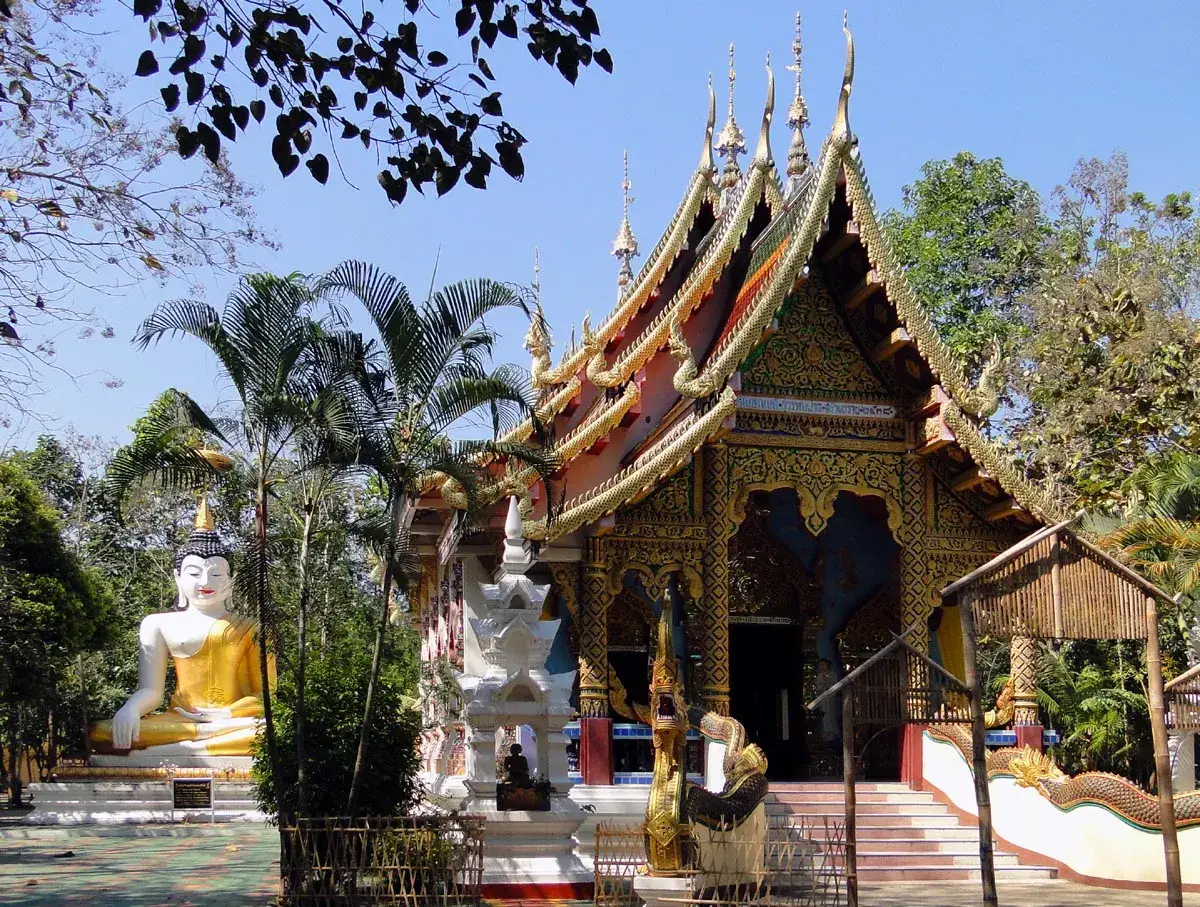
Wat Lao Chantha Rang Si is located at 114, Ban Thung Lao, Moo 1, On Klang Subdistrict, Mae On District, Chiang Mai 50130, Thailand. It is a public non-royal Buddhist temple of the Mahanikaya order and is currently registered under temple code 350230205. The temple occupies approximately 16 rai and 2 ngan of land and received permission for its construction on 14 January 1995. Although it is considerably younger than many historic Lanna monasteries, Wat Lao Chantha Rang Si has developed a distinctive identity through education and cultural preservation. It serves as an important spiritual center for the local community, has been developed as a model community-learning temple, hosts Lanna-script classes every Sunday, and is the home of the Ban Thung Lao Village Cultural Council. These roles make the monastery an important place where Buddhism, language, education, local culture and community life come together.
Wat Lao Chantha Rang Si remains listed in the current Buddhist temple register for On Klang Subdistrict. Other nearby monasteries in the same subdistrict include Wat Thung Lao, Wat Ban Wak, Wat Pao Sam Kha, Wat Phra That Doi Pha Tang and Wat On Klang. The presence of several temples within a relatively compact agricultural area reflects the traditional northern Thai pattern in which individual communities develop their own centers of Buddhist worship and social life.
The official construction permission granted on 14 January 1995 marks an important stage in the development of the present monastery. With approximately 16 rai and 2 ngan of land, the temple has sufficient space not only for religious activities but also for community learning and cultural programs. Its spacious and green environment supports the peaceful character for which the monastery is known.
Ban Thung Lao and the wider On Klang area occupy a landscape of plains surrounded by rice fields and mountains. Agriculture has long shaped local life, particularly rice cultivation, livestock raising and mixed farming. Wat Lao Chantha Rang Si therefore developed within a working rural community rather than as a temple created for tourism.
On Klang is now an important administrative and residential area within Mae On District. Government offices, schools, health facilities, shops and transportation routes are concentrated in and around the subdistrict. From here, roads connect toward Ban Sahakon, Muang On Cave, the San Kamphaeng Hot Springs area and the mountain route toward Mae Kampong.
This location gives Wat Lao Chantha Rang Si an advantage as a cultural stop. Unlike remote mountain temples, it can be reached easily from the main Mae On travel corridor and incorporated into a wider itinerary without requiring difficult road conditions or long walks.
The monastery’s strongest contemporary role is as a community learning center. In traditional Lanna society, temples functioned as places of education, manuscript preservation and cultural transmission as well as religious worship. Wat Lao Chantha Rang Si continues this older concept in a modern form by giving community knowledge an active place within the temple grounds.
The Sunday classes in Lanna script are especially significant. Lanna script, commonly called tua mueang in northern Thailand, was used for centuries to record Buddhist scriptures, palm-leaf manuscripts, literature, medicine, astrology, ritual knowledge and local historical texts. Learning the script therefore involves much more than memorizing a historic writing system.
For younger generations, the ability to read Lanna script creates direct access to a cultural archive that would otherwise remain inaccessible. A person who understands the script can begin to read old religious manuscripts, recognize traditional vocabulary and understand the relationship between the northern Thai language, Buddhism and local literature.
This is increasingly important because standard Thai and digital communication now dominate everyday life. Fewer people naturally learn Lanna script at home. Without regular teaching, old manuscripts may remain physically preserved while becoming unreadable to the descendants of the communities that created them.
By teaching the script every Sunday, Wat Lao Chantha Rang Si keeps the knowledge in active circulation. The temple does not treat Lanna writing merely as an exhibit or historic curiosity. It becomes a skill that can still be studied, practiced and passed from one generation to another.
The location of the classes within a Buddhist monastery is also historically appropriate. Monks and novices were once among the principal readers and writers of Lanna Dhamma script. Sermons, Buddhist narratives and palm-leaf texts were produced and used within monasteries, making the temple one of the traditional centers of literacy in northern Thailand.
The educational value extends beyond writing. Through Lanna script, students encounter northern vocabulary, oral pronunciation, local history, Buddhist terminology and cultural concepts. Language therefore becomes a pathway into a much wider understanding of local identity.
Another defining role of the monastery is its connection with the Ban Thung Lao Village Cultural Council. Having a cultural organization based within temple grounds creates a direct link between monks, community leaders, elders, local specialists, young people and those involved in preserving traditional practices.
Village cultural councils are important because local traditions survive primarily through community participation. Northern Thai food, language, craft, ritual practice, music, dance and Buddhist customs cannot be preserved only through official policy. They depend on people who continue to teach and use them.
Wat Lao Chantha Rang Si therefore represents a modern version of the traditional relationship between temple and village. In earlier generations, temples were schools, meeting places and repositories of manuscripts. Today many educational functions have moved into formal schools, but the monastery can still provide learning opportunities in areas that conventional curricula may not cover in depth.
This makes the temple especially suitable for culturally oriented travelers. Its importance is not based primarily on monumental architecture or antiquity. Instead, visitors can observe how a contemporary Buddhist monastery helps a community preserve language and identity.
The temple’s green and spacious setting supports these roles. With more than 16 rai of land, the monastery offers room for religious activity, community gatherings and learning without the congested atmosphere found at heavily visited urban temples.
Phra Khru Chantharangsi Phithak serves as abbot of Wat Lao Chantha Rang Si. The position involves responsibility not only for monastic affairs but also for maintaining a temple environment where community activities can take place. The temple’s educational and cultural work depends on cooperation between monastic leadership and local residents.
The wider Mae On setting gives the monastery additional travel value. Mae On is well known for hot springs, caves, mountain villages and natural attractions, but the agricultural communities around On Klang reveal another side of the district. Wat Lao Chantha Rang Si adds language and cultural learning to an area more commonly associated with nature tourism.
Several temples are located nearby. Wat Ban Wak is approximately 1 km away, while Wat Phra That Doi Pha Tang is around 2.5 km from the monastery. Traveling between them reveals a landscape in which Buddhist temples, schools, homes and agricultural land remain closely interwoven.
Wat Phra That Doi Pha Tang is particularly suitable as the next stop because it contains one of the important sacred relic sites of Mae On. Beginning at Wat Lao Chantha Rang Si allows visitors to focus on community culture and Lanna learning before moving to a temple with a stronger sacred-landmark identity.
Doi Nangmo is approximately 2.9 km away and provides a natural landscape component to the route. Muang On Cave lies about 4.1 km from the temple, while Wat Tham Muang On is approximately 4.4 km away.
Muang On Cave is one of Mae On’s better-known natural attractions. The limestone cave contains stalactites, stalagmites, Buddhist images and areas of religious significance. Combining the cave with Wat Lao Chantha Rang Si creates a route that moves naturally from cultural learning into geology and sacred landscape.
Travelers with more time can continue toward the San Kamphaeng Hot Springs area. A full-day route can therefore include a community temple in the morning, a relic temple or cave around midday, and a relaxing geothermal attraction later in the day.
On Klang also retains a strong agricultural character, and this is reflected in the growing number of restaurants, cafés and accommodation properties that use rice-field and mountain scenery as part of the visitor experience.
Lap Khom Mae On is a well-known local restaurant serving northern Thai dishes and lies close to the temple area. Villa At On Organic Farm Cafe & Restaurant in Ban Wak combines dining, a café, farm activities and accommodation, making it particularly suitable for families.
Krua Jira and Krua Patnaree offer Thai food along the wider Mae On route, while Thung Na Kafae provides a café and restaurant setting surrounded by rural scenery. These choices allow visitors to remain in Mae On rather than returning to Chiang Mai city for meals.
Accommodation close to the monastery includes The Oriental Village, approximately 0.3 km away, Sabai Sabai Retreat at around 0.7 km, Lakeview Resort at approximately 1.3 km, Raksri Homestay Resort at about 2.1 km and Solhem Farm at around 2.4 km.
Staying in On Klang provides a useful base for exploring Mae On because the area lies between the San Kamphaeng approach, Muang On Cave, the hot springs and the road leading farther into the mountains toward Mae Kampong.
The Oriental Village is one of the closest accommodation options and stands within a short distance of Wat Lao Chantha Rang Si. Its location makes it easy to include a temple visit at the beginning or end of the day.
Villa At On Organic Farm offers a different type of experience. The property combines an organic farm, restaurant, café, family activities and farm-stay accommodation. Its educational approach to agriculture pairs naturally with the community-learning identity of Wat Lao Chantha Rang Si.
The monastery is also suitable for families wishing to introduce children to local culture. Instead of presenting a temple visit only as an act of worship, adults can use Lanna script as a starting point to explain how northern Thai people once wrote, how Buddhist manuscripts were recorded and why local languages remain important.
For schools, universities and cultural-study groups, the temple has particular potential as part of an educational itinerary. A visit can connect Lanna writing with palm-leaf manuscripts, oral language, Buddhism and community cultural organization.
The model learning-center role is especially relevant as Mae On changes rapidly. The district remains rural in many places, but tourism, new businesses and movement from Chiang Mai city continue to increase. Regular cultural education helps maintain continuity between generations as the surrounding economy and lifestyle evolve.
The cultural value of a temple does not depend only on the age of its buildings. A monastery established in the 1990s can be highly significant when it actively protects knowledge that is at risk of disappearing. Wat Lao Chantha Rang Si demonstrates this through its Lanna-script teaching and community cultural work.
Reliable public sources do not currently provide sufficiently detailed information about the age, artistic style or construction history of individual structures such as the viharn, ubosot, principal Buddha image, chedi, bell tower or preaching hall. The strongest reason to visit is therefore the temple’s living cultural role rather than an architectural checklist.
This can actually be an advantage for travelers interested in local life. The temple remains a community space rather than a heavily commercialized attraction. Visitors can experience the rhythms of a working monastery and learning center instead of following a fixed tourist circuit.
The Sunday Lanna-script classes give the monastery regular educational activity beyond major religious festivals. Teachers, students, parents and community members return to the temple repeatedly, keeping local knowledge connected with everyday life.
A normal cultural visit of around 30–60 minutes is sufficient for worship, observing the grounds and understanding the temple’s community role. On Sundays, visitors should take particular care not to disturb ongoing classes.
Those interested in learning Lanna script should approach the activity as a genuine educational program rather than a tourist performance. Respect for teachers and students helps preserve the purpose of the classes.
Morning is an excellent time to visit before continuing to Wat Phra That Doi Pha Tang or Muang On Cave. Afternoon visits also work well because On Klang remains conveniently connected with the main Mae On road.
The cool season is particularly comfortable for exploring Mae On, while the rainy season brings green rice fields and mountain scenery. During hotter months, an early or late visit avoids the strongest midday heat.
Visitors should dress modestly and maintain a respectful manner. If cultural classes, community meetings or Buddhist ceremonies are taking place, those activities should take priority over sightseeing and photography.
Wat Lao Chantha Rang Si functions primarily as a Buddhist and community institution rather than a commercial attraction. Visitors should approach the monastery for worship and learning, respecting the rhythm of local life.
Getting There from Chiang Mai city, travel east through San Kamphaeng toward Mae On and continue into On Klang Subdistrict before following the local road to Ban Thung Lao, Moo 1. A private car is the most convenient option. The temple is located at approximately latitude 18.74960 and longitude 99.24335. From here, visitors can easily continue to Wat Ban Wak, Wat Phra That Doi Pha Tang, Muang On Cave, the hot springs area and the road toward Mae Kampong.
A half-day itinerary can combine Wat Lao Chantha Rang Si with Wat Phra That Doi Pha Tang and a local lunch. A full-day itinerary can add Muang On Cave and the San Kamphaeng Hot Springs. Staying overnight in On Klang allows a slower journey toward Mae Kampong the following day.
This route positions Wat Lao Chantha Rang Si as a cultural starting point before travelers move toward natural attractions. Beginning with Lanna script and community cultural preservation gives a deeper understanding of Mae On before exploring caves, mountains and hot springs.
Overall, Wat Lao Chantha Rang Si has at least four important dimensions. It is a functioning Mahanikaya Buddhist temple and spiritual center; it is a model community learning space; it actively supports the teaching of Lanna script every Sunday; and it houses the Ban Thung Lao Village Cultural Council.
These combined roles make the monastery distinctive. Rather than relying on antiquity or monumental architecture, Wat Lao Chantha Rang Si uses a modern temple environment to preserve older knowledge. It gives younger generations access to the writing system of their ancestors and provides a practical space where local culture remains active.
For travelers wishing to understand Mae On beyond Mae Kampong, hot springs and caves, Wat Lao Chantha Rang Si offers an important cultural perspective. Its Sunday Lanna-script classes, community-learning role and connection with Ban Thung Lao’s cultural organization show how Buddhism and Lanna heritage can continue to function together in everyday community life.
| Name | Wat Lao Chantha Rang Si |
| Location | 114, Ban Thung Lao, Moo 1, On Klang Subdistrict, Mae On District, Chiang Mai 50130, Thailand |
| Latitude | 18.74960 |
| Longitude | 99.24335 |
| Temple Registration Code | 350230205 |
| Temple Type | Public non-royal Buddhist temple, Mahanikaya order |
| Construction Permission | 14 January 1995 |
| Area | Approximately 16 rai and 2 ngan |
| Abbot | Phra Khru Chantharangsi Phithak |
| Open Days | Daily |
| Opening Hours | 08:00 - 17:00 |
| Highlights | Peaceful community temple, community-learning center, Lanna-script preservation and cultural activities of Ban Thung Lao |
| Learning Program | Lanna-script, or Tua Mueang, classes every Sunday |
| Cultural Organization | Home of the Ban Thung Lao Village Cultural Council |
| Community Role | Spiritual center, local learning space, Lanna-language and cultural preservation center, and community activity venue |
| Getting There | Travel from Chiang Mai through San Kamphaeng toward Mae On, enter On Klang Subdistrict and continue to Ban Thung Lao, Moo 1. A private vehicle is the most convenient option. |
| Current Status | Active temple listed in the current Buddhist temple register for On Klang, Mae On |
| Nearby Attractions and Temples | 1. Wat Ban Wak, about 1 km 2. Wat Phra That Doi Pha Tang, about 2.5 km 3. Doi Nangmo, about 2.9 km 4. Muang On Cave, about 4.1 km 5. Wat Tham Muang On, about 4.4 km |
| Nearby Restaurants and Cafes | 1. Lap Khom Mae On, about 1.5 km, Tel. +66 85 525 2692, +66 83 576 3409 2. Villa At On Organic Farm Cafe & Restaurant, about 2 km, Tel. +66 83 046 6494 3. Krua Jira, about 3 km, Tel. +66 87 193 9709 4. Thung Na Kafae, about 3.8 km, Tel. +66 64 001 0014 5. Krua Patnaree, about 4 km, Tel. +66 96 696 3740 |
| Nearby Accommodation | 1. The Oriental Village, about 0.3 km, Tel. +66 95 532 6174 2. Sabai Sabai Retreat, about 0.7 km, Tel. +66 94 634 7670 3. Lakeview Resort, about 1.3 km 4. Raksri Homestay Resort, about 2.1 km, Tel. +66 81 948 7054 5. Solhem Farm, about 2.4 km, Tel. +66 86 356 1454 |
Frequently Asked Questions (FAQ)
Q: Where is Wat Lao Chantha Rang Si located?
A: The temple is located at 114, Ban Thung Lao, Moo 1, On Klang Subdistrict, Mae On District, Chiang Mai 50130, Thailand.
Q: When was Wat Lao Chantha Rang Si authorized for construction?
A: Permission to construct the temple was granted on 14 January 1995. The temple occupies approximately 16 rai and 2 ngan.
Q: What makes Wat Lao Chantha Rang Si distinctive?
A: Its strongest features are its role as a community learning center, its Sunday Lanna-script classes and its function as the home of the Ban Thung Lao Village Cultural Council.
Q: What is the Lanna script taught at the temple?
A: Lanna script, locally known as Tua Mueang, is the traditional writing system historically used for Buddhist manuscripts, literature, medicine and other forms of northern Thai knowledge.
Q: Why is Wat Lao Chantha Rang Si important to Ban Thung Lao?
A: The monastery combines Buddhist worship with cultural education and community organization, making it a spiritual and learning center for the village.
Q: Who is the abbot of Wat Lao Chantha Rang Si?
A: Phra Khru Chantharangsi Phithak serves as abbot of Wat Lao Chantha Rang Si.
Q: What nearby places can be visited together with Wat Lao Chantha Rang Si?
A: Nearby options include Wat Ban Wak, Wat Phra That Doi Pha Tang, Doi Nangmo, Muang On Cave and Wat Tham Muang On, with the San Kamphaeng Hot Springs area also suitable for a longer itinerary.
Q: What type of traveler is Wat Lao Chantha Rang Si best suited to?
A: It is particularly suitable for travelers interested in Lanna culture, traditional writing, community heritage, Buddhism and local learning rather than only monumental temple architecture.
 Category: ●Places of Worship
 Group: ●Temple
Last Update : 3 WeekAgo
 Last Update : 3 WeekAgo
 Click to Access the Navigation Map GPS
Wat Lao Chantha Rang Si Map
Recommend

 Muang Chiang Mai(121)Chom Thong(47)Mae Chaem(25)Chiang Dao(33)Doi Saket(68)Mae Taeng(85)Mae Rim(69)Samoeng(29)Fang(71)Mae Ai(59)Phrao(70)San Pa Tong(103)San Kamphaeng(66)San Sai(73)Hang Dong(73)Hot(32)Doi Tao(22)Omkoi(11)Saraphi(74)Wiang Haeng(15)Chai Prakan(28)Mae Wang(32)Mae On(22)Doi Lo(33)Galyani Vadhana(1)


