
lovethailand home >North Travel Attractions >Chiang Mai Travel Attractions >Mae Wang >Mae Win > Wat Wimuttikaram
TL;DR: Wat Wimuttikaram is located at Ban Mae Mut, Moo 6, Mae Win Subdistrict, Mae Wang District, Chiang Mai 50360, Thailand, open Daily, hours 08:00 - 17:00.

Wat Wimuttikaram
Open Days: Daily
Opening Hours: 08:00 - 17:00
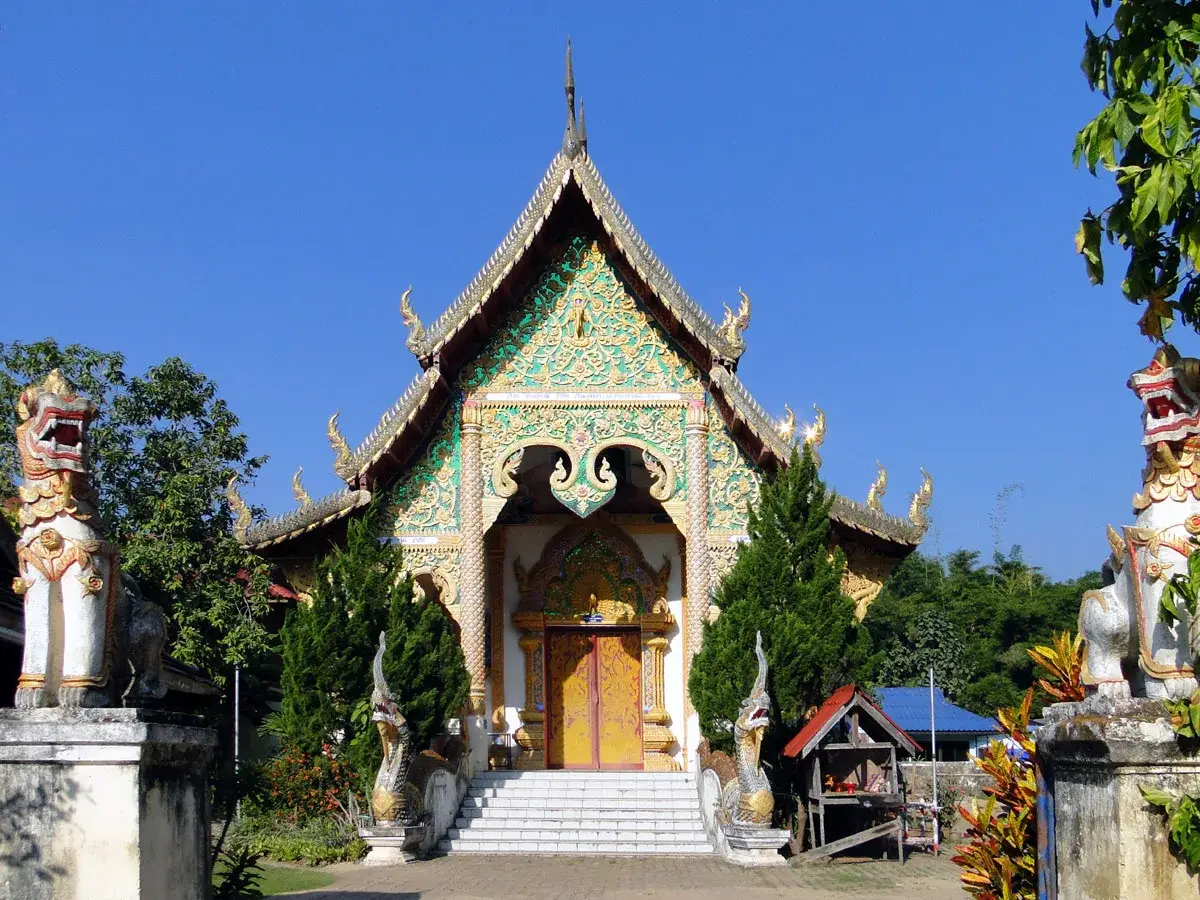
Wat Wimuttikaram is located in Ban Mae Mut, Moo 6, Mae Win Subdistrict, Mae Wang District, Chiang Mai 50360, Thailand. It is a public non-royal Buddhist temple of the Mahanikaya order, registered under temple code 350220403 and officially established in 1906. The monastery remains an active religious institution and a spiritual center of the Ban Mae Mut community. Phra Khru Suwat Wimuttiwihan Sotthinando serves as abbot and has also held an important ecclesiastical role within Mae Win Subdistrict. One of the temple’s most significant sacred landmarks is Phra That Chao Si Chom Mon, the focus of a documented Poy Luang celebration, Lanna destiny-extension rituals and monastic merit-making activities.
The name Wat Wimuttikaram is shared by temples in other parts of Thailand, so the words Mae Mut, Mae Win or Mae Wang are useful for identifying the correct monastery. This Wat Wimuttikaram stands in the mountainous western part of Mae Wang District, along the broader Highway 1013 corridor that connects San Pa Tong and Mae Wang with Mae Win, Mae Sapok and the highland communities farther west.
Current Buddhist temple directories continue to list Wat Wimuttikaram as a Mahanikaya public temple in Ban Mae Mut, Moo 6, under registration code 350220403. It forms part of the local temple network of Mae Win together with Wat Tham Doi Ton, Wat Matchimaram, Wat Sop Win and Wat Huai Pong. Its presence in current registers confirms that it remains a functioning Buddhist monastery rather than merely a historic name.
The temple was officially established in 1906. By 2026, Wat Wimuttikaram therefore has approximately 120 years of registered history. During this period, Mae Wang and Mae Win changed dramatically, developing from predominantly agricultural communities connected by local tracks and waterways into an area served by roads, public services and a growing tourism economy. Wat Wimuttikaram has remained closely connected with Ban Mae Mut throughout that transformation.
Ban Mae Mut is Moo 6 of Mae Win Subdistrict and has a present population of approximately 534 people, including around 254 men and 280 women. The temple therefore serves a clearly defined village community rather than an anonymous tourism district. Merit-making, ceremonies, funerary rites, Buddhist holy days and communal activities bring local families into contact with the monastery throughout the year.
The surrounding Mae Win landscape combines foothills, rivers, agricultural areas and mountain terrain. Ban Mae Mut lies within the transition between the lower Mae Wang valley and the higher western communities of Mae Win. The temple’s surroundings therefore feel very different from the dense urban temple environment of Chiang Mai city.
When Wat Wimuttikaram was established in 1906, village monasteries remained fundamental institutions of northern Thai society. Monks provided Buddhist teaching, spiritual guidance and ceremonial leadership. Temple grounds accommodated ordinations, sermons, funerals, family merit-making and collective village events. Wat Wimuttikaram emerged within this traditional relationship between monastery and community.
The word “vimutti” in Buddhism means liberation or release from mental bondage, while “aram” refers to a monastery or religious retreat. The name Wat Wimuttikaram therefore carries a meaning closely connected with the Buddhist ideal of spiritual liberation. Although detailed historical records explaining the original naming of the temple are not publicly available, the meaning itself reflects a distinctly Buddhist identity.
Phra Khru Suwat Wimuttiwihan Sotthinando is an important contemporary figure in the history of the monastery. An official record from Chiang Mai Provincial Administrative Organization identifies him as abbot of Wat Wimuttikaram and as the ecclesiastical head of Mae Win Subdistrict during a major temple ceremony in 2022.
His ecclesiastical role expands the importance of the temple beyond Ban Mae Mut. An abbot who also serves at subdistrict level helps coordinate the activities of monks and temples across Mae Win. Wat Wimuttikaram therefore functions not only as a village monastery but also as an important point within the local Sangha network.
The temple’s most clearly documented sacred landmark is Phra That Chao Si Chom Mon. Chiang Mai Provincial Administrative Organization recorded a major Poy Luang celebration for the sacred relic monument on 24 June 2022. The program also included a Lanna destiny-extension ceremony, a ceremony of respect for the abbot, and a celebration connected with his appointment as ecclesiastical head of Mae Win.
In Lanna Buddhist culture, a sacred relic monument serves as far more than an architectural feature. It becomes a focus for worship, offerings, circumambulation, communal merit-making and seasonal religious activity. The Poy Luang celebration at Wat Wimuttikaram demonstrates that Phra That Chao Si Chom Mon remains deeply meaningful to the local Buddhist community.
Poy Luang is a major northern Thai Buddhist celebration traditionally associated with the completion, restoration or consecration of an important religious structure. Such events bring together monks, lay supporters and neighboring communities. At Wat Wimuttikaram, the Poy Luang of Phra That Chao Si Chom Mon shows that the relic monument is one of the defining elements of the monastery’s religious identity.
The same event also included a traditional destiny-extension ceremony. Known in northern Thailand as suep chata, the ritual combines Buddhist chanting with Lanna ceremonial traditions intended to promote auspiciousness and well-being. Its presence at Wat Wimuttikaram illustrates how mainstream Buddhist practice and regional Lanna culture continue to coexist.
Destiny-extension ceremonies are often associated with important life events, New Year observances, temple celebrations or major community occasions. At Wat Wimuttikaram, the ceremony formed part of a larger program celebrating the relic monument and the abbot’s ecclesiastical appointment, combining individual merit-making, monastic leadership and community celebration.
The ability to hold such a large religious event also demonstrates the continuing communal function of the temple grounds. Although reliable public information about every individual building in the monastery is limited, the documented ceremonies show that Wat Wimuttikaram provides space for major gatherings, Buddhist rituals and community participation.
Like other active Mahanikaya village temples, Wat Wimuttikaram participates in the wider rhythm of Buddhist community life, including holy days, Buddhist Lent, the end of Lent, Kathin and local merit-making traditions. Detailed public schedules are not consistently published, but the documented Poy Luang event clearly establishes the temple as an active religious center.
The importance of the monastery becomes even clearer when it is viewed within Ban Mae Mut. Mae Win is a geographically and culturally diverse subdistrict. Agriculture remains important, while tourism, accommodation, cafés and outdoor activities have grown along the Mae Wang River and surrounding mountain routes. Buddhist temples remain key institutions connecting older village structures with these newer economic activities.
Several important community temples are distributed throughout Mae Win. Wat Tham Doi Ton serves the Mae Sapok area, Wat Matchimaram stands in Ban Mai Wang Pha Pun, Wat Wimuttikaram serves Ban Mae Mut, Wat Sop Win is connected with Ban Sop Win, and Wat Huai Pong serves its own community. Together they reveal the traditional Lanna pattern in which individual villages maintain their own monasteries.
Wat Wimuttikaram is particularly important within this network because its abbot has held a subdistrict-level Sangha position. Monastic meetings, merit-making events and activities involving several temples can therefore connect through the monastery, extending its role beyond local village ceremonies.
For visitors, Phra That Chao Si Chom Mon is the most meaningful sacred feature to prioritize. Paying respect at the relic monument connects a visit directly with the temple’s documented history and living tradition rather than treating the monastery simply as a roadside stop.
The monastery is best suited to travelers interested in functioning community temples and everyday Lanna Buddhist culture. It is not primarily a large commercial tourist attraction. Its appeal lies in the opportunity to visit a place where monks and residents still use the temple as part of ordinary community life.
Wat Wimuttikaram stands at an elevation of approximately 415 metres above sea level. This places it above the lower Mae Wang plain but below the higher mountain settlements deeper inside Mae Win. The environment therefore marks a transition from the lowland district toward the foothills and highlands.
The temple is located at approximately latitude 18.67013 and longitude 98.65633. Its location makes it convenient for combining a cultural visit with waterfalls, meditation temples and other attractions around Mae Win.
Mae Wang Waterfall is one of the most accessible nature attractions nearby. Combining the monastery with the waterfall provides a balanced itinerary that includes both Buddhist culture and the natural landscape of Mae Win.
Wat Tham Doi Ton is also located only a short distance away. The two temples have very different characters. Wat Wimuttikaram is closely associated with Ban Mae Mut, Phra That Chao Si Chom Mon and local Sangha administration, while Wat Tham Doi Ton is known for its natural cave, mountain setting and Vipassana meditation activities.
Visiting both temples provides a useful picture of the diversity of Buddhist places in Mae Win. One represents a community monastery tied closely to village life, while the other emphasizes seclusion, caves and meditation in a natural setting.
The area around Wat Wimuttikaram also contains small-scale farms, cafés and nature-based tourism businesses. Travelers can therefore build a relaxed route around the temple rather than treating it as an isolated destination.
Travel in Mae Win differs from travel inside Chiang Mai city. Distances on a map may appear short, but roads become increasingly curved and mountainous farther west. Wat Wimuttikaram’s relatively accessible location near the main Mae Win corridor makes it a convenient stop before proceeding deeper into the mountains.
Food and café choices around Mae Mut have expanded with local tourism. The Maewin Coffee is located close to the temple area. Wang Ya Woo Cafe operates in Mae Mut, while De Ba No Mee Bar & Restaurant, Ma Mueang Win and MEEDEE Restaurant & Cafe provide additional dining choices along the wider Mae Win route.
Accommodation is also available close to the monastery. Maewin Resort and Maewin Farmstay are located nearby, while Baan Mae Sapok homestay and Serenity Resort - Chiang Mai provide convenient options for travelers continuing toward Mae Sapok. Rimtharnn Homestay Maewin offers another base farther along the Mae Win corridor.
Staying overnight in Mae Win allows the area to be explored at a slower pace. One day can focus on Wat Wimuttikaram, Wat Tham Doi Ton and Mae Wang Waterfall, while a second day can continue toward Mae Sapok, Sop Win or other mountain communities.
A cultural route can also begin at Wat Matchimaram in Ban Mai Wang Pha Pun before continuing to Wat Wimuttikaram, Wat Tham Doi Ton and Wat Sop Win. This sequence reveals several different types of Buddhist community institutions within the same subdistrict.
The Poy Luang tradition gives Wat Wimuttikaram a particularly strong cultural identity. The celebration of Phra That Chao Si Chom Mon connects the physical sacred monument with collective merit-making, while the destiny-extension ceremony places the event firmly within Lanna cultural practice.
Visitors interested in northern Thai culture should therefore understand Wat Wimuttikaram as more than a temple founded in 1906. It is a place where regional ritual traditions, local Buddhist faith and contemporary monastic administration continue to meet.
The term “spiritual center” is especially appropriate here because Ban Mae Mut residents use the monastery as part of major life events and collective religious activity. Families come to temples for merit-making, funerary rites, offerings and community ceremonies, creating relationships that continue across generations.
The resident Sangha plays an essential role in maintaining this continuity. The abbot’s broader ecclesiastical responsibilities further strengthen the monastery’s connection with Buddhist affairs throughout Mae Win.
For a normal cultural visit, approximately 30–60 minutes is usually sufficient to pay respect, observe the sacred area and experience the atmosphere. Travelers who wish to understand the surrounding community can combine the visit with local cafés, accommodation and nature attractions.
Morning is particularly suitable for visiting because temperatures are generally more comfortable and the rest of the day remains available for waterfalls or mountain travel. The temple also works well as an afternoon stop when returning from Mae Sapok or the Mae Wang River area.
The rainy season brings lush greenery to Mae Win, although mountain roads and paths can become slippery. The cool season is generally comfortable for combining temple visits with outdoor attractions. Wat Wimuttikaram itself remains part of the year-round religious life of Ban Mae Mut.
Visitors should dress modestly and maintain a quiet manner because this remains an active Buddhist monastery. Shoes should be removed where required, and monks or worshippers should not be disturbed during ceremonies.
Photography should be approached respectfully during religious events, particularly ceremonies such as suep chata or major merit-making gatherings. The temple functions first as sacred and communal space and only secondarily as a place of interest to travelers.
Getting There from Chiang Mai city, take Highway 108 south through Hang Dong toward San Pa Tong. Turn onto Highway 1013 toward Mae Wang and Mae Win. Continue through Mae Wang District into Mae Win and proceed to Ban Mae Mut, Moo 6. Private car or rental vehicle is the most convenient option, especially for travelers planning to continue to Mae Wang Waterfall, Wat Tham Doi Ton or Mae Sapok.
Drivers should allow additional time after entering Mae Win because the road becomes more curved as the terrain rises. Highway 1013 nevertheless remains the principal travel corridor and has cafés, accommodation and local services at intervals along the route.
Reliable public information currently does not provide a confirmed direct telephone number for Wat Wimuttikaram. Travelers arranging a specific religious activity or large group merit-making visit may therefore need to coordinate through local community or Mae Win administrative contacts.
Among the temple’s physical features, Phra That Chao Si Chom Mon is the most clearly documented. Public sources do not currently provide sufficiently reliable descriptions of the principal Buddha image, viharn, ubosot, bell tower or preaching hall to describe these structures in detail without risking confusion with temples of similar names elsewhere.
This does not reduce the importance of the monastery. Wat Wimuttikaram’s strongest identity comes from its long-standing role in Ban Mae Mut, the sacred relic monument, Poy Luang and Lanna ritual traditions, and the ecclesiastical responsibilities associated with its abbot.
Seen within Mae Win as a whole, each temple contributes a different cultural perspective. Wat Matchimaram represents a much older community-monastery history, Wat Tham Doi Ton emphasizes natural caves and meditation, Wat Sop Win is closely connected with the Mae Wang River community, while Wat Wimuttikaram stands out through Phra That Chao Si Chom Mon and its role within the subdistrict Sangha network.
For travelers wanting to understand Ban Mae Mut itself, the monastery is an excellent starting point. From here, Buddhist heritage, village life, cafés, homestays, waterfalls and the mountain landscape can all be connected within a compact itinerary.
Wat Wimuttikaram can therefore be understood through at least four dimensions. Historically, it has been officially established since 1906. Religiously, it is centered on Buddhist worship and Phra That Chao Si Chom Mon. Culturally, it preserves Lanna traditions through Poy Luang and destiny-extension ceremonies. Socially and institutionally, it remains the spiritual center of Ban Mae Mut and an important point within the Mae Win monastic network.
The temple’s value does not depend on monumental fame. Its significance comes from remaining meaningful to the people who live around it. The sacred relic monument continues to anchor communal merit-making, the abbot connects village religious life with the wider Sangha, and the temple remains part of a living Mae Win community. For travelers interested in Buddhist culture rather than only scenery, Wat Wimuttikaram offers a useful and authentic perspective on this part of Chiang Mai.
| Name | Wat Wimuttikaram |
| Location | Ban Mae Mut, Moo 6, Mae Win Subdistrict, Mae Wang District, Chiang Mai 50360, Thailand |
| Latitude | 18.67013 |
| Longitude | 98.65633 |
| Elevation | Approximately 415 metres above sea level |
| Temple Registration Code | 350220403 |
| Temple Type | Public non-royal Buddhist temple, Mahanikaya order |
| Established | 1906 |
| Current Abbot | Phra Khru Suwat Wimuttiwihan Sotthinando |
| Open Days | Daily |
| Opening Hours | 08:00 - 17:00 |
| Important Sacred Feature | Phra That Chao Si Chom Mon |
| Major Traditions and Activities | Poy Luang celebration of Phra That Chao Si Chom Mon, Lanna destiny-extension ceremony, monastic merit-making and community Buddhist activities |
| Ecclesiastical Role | The abbot has served as ecclesiastical head of Mae Win Subdistrict, connecting the temple with the wider local Sangha network |
| Community Role | Spiritual center of Ban Mae Mut and a venue for Buddhist ceremonies, major merit-making events and community religious life |
| Getting There | Take Highway 108 from Chiang Mai through Hang Dong and San Pa Tong, then Highway 1013 toward Mae Wang and Mae Win before entering Ban Mae Mut, Moo 6 |
| Current Status | Active registered monastery serving Ban Mae Mut and the wider Mae Win Buddhist community |
| Nearby Attractions | 1. Maewin Farmer, about 0.3 km, Tel. +66 98 794 4479 2. Wat Tham Doi Ton, about 1.1 km, Tel. +66 53 106 126 3. Mae Wang Waterfall, about 1.5 km 4. Karen Elephant Habitat, about 2.2 km, Tel. +66 65 884 0802 5. Elephant Jungle Paradise Park, about 2.3 km, Tel. +66 61 327 8295 |
| Nearby Restaurants and Cafes | 1. The Maewin Coffee, about 0.6 km, Tel. +66 88 252 6636 2. De Ba No Mee Bar & Restaurant, about 0.7 km, Tel. +66 98 773 5874 3. Wang Ya Woo Cafe, about 1.2 km, Tel. +66 64 909 6135 4. Ma Mueang Win, about 2.3 km, Tel. +66 81 035 5395 5. MEEDEE Restaurant & Cafe, about 4.2 km, Tel. +66 96 174 6564 |
| Nearby Accommodation | 1. Maewin Resort, about 0.1 km, Tel. +66 89 982 0716 2. Maewin Farmstay, about 0.4 km, Tel. +66 98 794 4479 3. Baan Mae Sapok homestay, about 1.4 km 4. Serenity Resort - Chiang Mai, about 1.7 km, Tel. +66 63 265 3216 5. Rimtharnn Homestay Maewin, about 4.6 km, Tel. +66 62 245 3249 |
Frequently Asked Questions (FAQ)
Q: Where is Wat Wimuttikaram located?
A: Wat Wimuttikaram is located in Ban Mae Mut, Moo 6, Mae Win Subdistrict, Mae Wang District, Chiang Mai 50360, Thailand.
Q: When was Wat Wimuttikaram established?
A: The temple was officially established in 1906 and belongs to the Mahanikaya monastic order.
Q: Who is the abbot of Wat Wimuttikaram?
A: The abbot is Phra Khru Suwat Wimuttiwihan Sotthinando, who has also held an important ecclesiastical role in Mae Win Subdistrict.
Q: What is the most important sacred feature at Wat Wimuttikaram?
A: The most clearly documented sacred landmark is Phra That Chao Si Chom Mon, which has been the focus of a major Poy Luang celebration.
Q: Why is the Poy Luang of Phra That Chao Si Chom Mon important?
A: The celebration reflects the community’s devotion to the sacred relic monument. A major documented event in 2022 also included a Lanna destiny-extension ceremony and an ecclesiastical celebration.
Q: What role does Wat Wimuttikaram play in Ban Mae Mut?
A: The monastery is a spiritual center and a venue for Buddhist ceremonies, communal merit-making and local religious life, while also maintaining links with the wider Sangha network of Mae Win.
Q: What nearby places can be visited with Wat Wimuttikaram?
A: Nearby options include Wat Tham Doi Ton, Mae Wang Waterfall, Mae Sapok and other cultural and nature attractions along the Mae Win route.
Q: How do visitors reach Wat Wimuttikaram from Chiang Mai city?
A: Take Highway 108 through Hang Dong and San Pa Tong, then Highway 1013 toward Mae Wang and Mae Win. Continue to Ban Mae Mut, Moo 6. A private vehicle is the most convenient option for exploring the surrounding area.
 Category: ●Places of Worship
 Group: ●Temple
Last Update : 4 WeekAgo
 Last Update : 4 WeekAgo
 Click to Access the Navigation Map GPS

 Muang Chiang Mai(121)Chom Thong(47)Mae Chaem(25)Chiang Dao(33)Doi Saket(68)Mae Taeng(85)Mae Rim(69)Samoeng(29)Fang(71)Mae Ai(59)Phrao(70)San Pa Tong(103)San Kamphaeng(66)San Sai(73)Hang Dong(73)Hot(32)Doi Tao(22)Omkoi(11)Saraphi(74)Wiang Haeng(15)Chai Prakan(28)Mae Wang(32)Mae On(22)Doi Lo(33)Galyani Vadhana(1)


