
lovethailand home >North Travel Attractions >Chiang Mai Travel Attractions >Mae Chaem >Tha Pha > Wat Phra Bat (Tha Pha)
TL;DR: Wat Phra Bat (Tha Pha) is located at Ban Pa Nat, Mae Chaem - Hot Road, Tha Pha Subdistrict, Mae Chaem District, Chiang Mai Province, open Daily, hours 08.00 - 17.00.

Wat Phra Bat (Tha Pha)
Open Days: Daily
Opening Hours: 08.00 - 17.00
Wat Phra Bat (Tha Pha) is located at 70 Ban Pa Nat, on the Mae Chaem - Hot Road, Tha Pha Subdistrict, Mae Chaem District, Chiang Mai Province, postal code 50270. It is a local Buddhist temple under the Mahanikaya order and one of the important community temples in Tha Pha Subdistrict. The temple is best known for its revered Buddha footprint, which is the sacred object that gives the temple its name.
Wat Phra Bat was first built around 1908 by Khru Ba Techa. In 1910, more temple structures were added, and the temple became more complete as a functioning Buddhist monastery. Its location along the Mae Chaem - Hot Road also places it within one of the important community routes of Mae Chaem and Tha Pha.
The history of Wat Phra Bat is closely connected with the Buddha footprint. Local tradition says that the footprint was originally found near the Mae Raek stream. Lawa people or local villagers discovered it and later brought it into the temple compound for proper worship. This story gives the temple a strong spiritual identity and explains why the temple became known as Wat Phra Bat, meaning the Temple of the Buddha Footprint.
In northern Thai Buddhist belief, a Buddha footprint is a sacred symbol that recalls the presence and virtue of the Buddha. For local people, worshipping the footprint is not simply an act of paying respect to a stone mark. It is a way to remember the Buddha, preserve community faith, and keep an old local tradition alive.
The temple land covers 3 ngan and 15 square wah under Nor Sor 3 document number 129. The northern and southern boundaries each measure about 1 sen and 1 wa and border private rice fields. The eastern boundary measures about 15 wa and 1 sok and borders a public irrigation channel. The western boundary measures about 15 wa and 1 sok and borders private rice fields. This setting shows the typical relationship between a Mae Chaem village temple, rice fields, water channels, and rural community life.
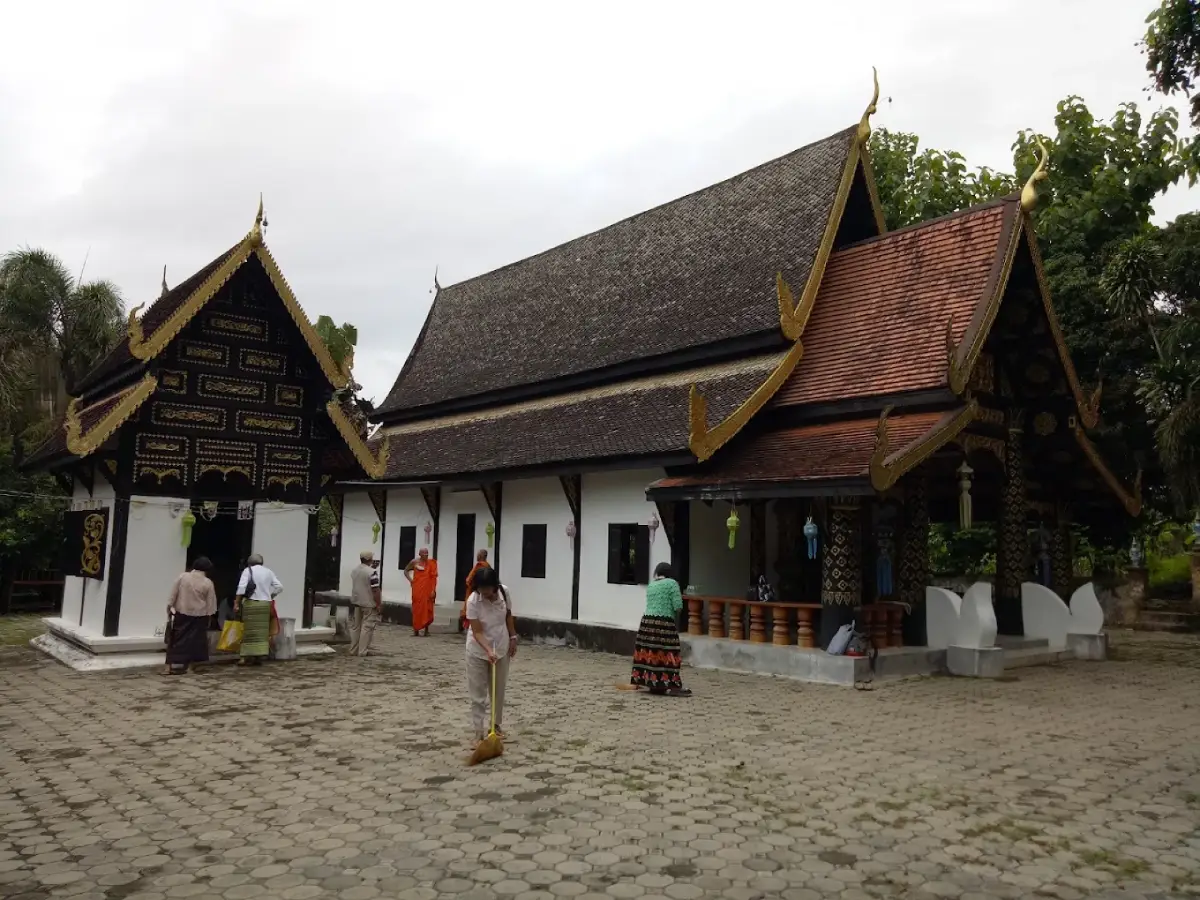
The temple structures include a viharn, a merit-making hall, and monks’ residences. The viharn is a half-masonry, half-wooden building with a Thai-style carved gable. It is not a large urban temple building, but it has strong value as a local religious structure used by the community for worship and ceremonies.
The most important sacred object at Wat Phra Bat is the Buddha footprint. Visitors should take time to pay respect quietly because this footprint is the central meaning of the temple. The temple’s importance comes less from size and more from the spiritual value attached to the footprint, its local legend, and the annual traditions that continue around it.
The most important tradition associated with Wat Phra Bat is the annual bathing ceremony of the Buddha footprint on Chet Peng, the full moon day of the seventh northern lunar month. Local people from Mae Chaem come to bathe the footprint as an act of devotion and blessing. This ceremony makes Wat Phra Bat more than an ordinary village temple because the Buddha footprint has become a focus of wider community faith.
The bathing of the Buddha footprint connects water, purity, respect, and Buddhist devotion. In the Lanna context, the use of water in sacred ceremonies expresses renewal and reverence. When the footprint is bathed, villagers are not only performing a ritual but also preserving a local tradition that has been passed down through generations.
Wat Phra Bat is part of the wider temple network of Tha Pha Subdistrict. Nearby temples include Wat Ban Lao, Wat Ban Thap, Wat Pa Daet, Wat Yang Luang, and Wat Kong Khaek. Each temple has its own story and role within its village. Wat Phra Bat is distinctive because of its Buddha footprint and the Chet Peng bathing tradition.
For travelers, Wat Phra Bat offers a quiet and meaningful way to understand Mae Chaem beyond rice terraces and mountain scenery. Mae Chaem is also a district of old temples, sacred legends, village rituals, and textile culture. Wat Phra Bat helps show this deeper cultural landscape through its connection with the Buddha footprint, the Mae Raek stream, rice fields, and the religious life of local people.
The temple is suitable for travelers who prefer calm community places rather than heavily promoted attractions. A visit can include paying respect to the Buddha footprint, observing the half-masonry and half-wooden viharn, and taking in the rural setting around the temple. Wat Phra Bat is especially meaningful when combined with other temples in Tha Pha Subdistrict.
Getting There is most convenient by private car, rental car, or a vehicle with a local driver. From Mae Chaem town, travel along the Mae Chaem - Hot Road toward Ban Pa Nat in Tha Pha Subdistrict. Travelers coming from Chiang Mai can reach Mae Chaem via Chom Thong and Doi Inthanon or by the Hot route, depending on the itinerary. Roads in the Mae Chaem area include mountain curves, so careful driving is recommended.
The best time to visit Wat Phra Bat is in the morning or late afternoon, when the weather is more comfortable and the atmosphere is quiet. Travelers who want to experience the temple’s living tradition should plan around Chet Peng, the full moon day of the seventh northern lunar month, when the Buddha footprint bathing ceremony is held.
Visitors should dress modestly, keep their voices low, respect monks and local worshippers, and avoid touching the Buddha footprint or sacred objects unnecessarily. If a ceremony is taking place, visitors should ask before taking photographs. Wat Phra Bat is an active sacred place used by the local community, so respectful behavior is essential.
Wat Phra Bat (Tha Pha) is a valuable stop for anyone who wants to understand Mae Chaem as a living cultural district. Its importance comes from the Buddha footprint, the temple’s early 20th-century history, Khru Ba Techa’s role in its founding, and the annual Chet Peng tradition. Together, these elements make Wat Phra Bat a meaningful place of faith, memory, and local identity.
| Name | Wat Phra Bat (Tha Pha) |
| Location | Ban Pa Nat, Mae Chaem - Hot Road, Tha Pha Subdistrict, Mae Chaem District, Chiang Mai Province |
| Address | 70 Ban Pa Nat, Tha Pha Subdistrict, Mae Chaem District, Chiang Mai 50270, Thailand |
| Highlights | A local Mahanikaya temple in Tha Pha Subdistrict with a revered Buddha footprint and the annual Chet Peng Buddha footprint bathing ceremony |
| History | Built around 1908 by Khru Ba Techa, with additional temple structures added in 1910 |
| Name Origin | Named after the Buddha footprint, the most important sacred object of the temple |
| Distinctive Features | Half-masonry, half-wooden viharn with a Thai-style carved gable, located within the rural landscape of Tha Pha and Mae Chaem |
| Important Sacred Objects | Buddha footprint, viharn, merit-making hall, and monks’ residences |
| Travel Information | Best reached by private car, rental car, or local driver from Mae Chaem town along the Mae Chaem - Hot Road toward Ban Pa Nat |
| Current Status | Open as a local Mahanikaya temple and active sacred place for worshipping the Buddha footprint |
| Open Days | Daily |
| Opening Hours | 08.00 - 17.00 |
| Main Areas / Zones | Viharn, Buddha footprint worship area, merit-making hall, and monks’ residences |
| Abbot / Caretaker | Phra Khru Phutthabot Sophit Sophanapanyo |
| Traditions / Rituals | Buddha footprint bathing ceremony on Chet Peng, the full moon day of the seventh northern lunar month, and Buddhist merit-making activities |
| Nearby Tourist Attractions | 1. Wat Ban Lao, about 1 km 2. Wat Ban Thap, about 2 km 3. Wat Pa Daet, about 3 km 4. Wat Yang Luang, about 5 km 5. Wat Kong Khaek, about 6 km |
| Nearby Restaurants | 1. Mae Chaem Gate Restaurant, about 4 km, Tel. 097-996-5568 2. Sikon Restaurant, about 5 km, Tel. 087-067-8193 3. Moo Inter Mae Chaem, about 5 km, Tel. 061-354-2369 4. Khuang Na Restaurant, about 6 km, Tel. 087-183-6931 5. Ban Ran Cake by Nom Chaem Cafe, about 5 km |
| Nearby Accommodations | 1. Phu Chaem House, about 3 km, Tel. 081-024-6223 2. Khuang Na Farmview, about 6 km, Tel. 087-183-6931 3. Muangchaem House, about 6 km, Tel. 080-739-1184 4. Maechaem Hotel And Resort, about 7 km, Tel. 053-828-025 5. Huean Him Pan Homestay, about 8 km |
Frequently Asked Questions (FAQ)
Q: Where is Wat Phra Bat (Tha Pha) located?
A: Wat Phra Bat (Tha Pha) is located at 70 Ban Pa Nat, on the Mae Chaem - Hot Road, Tha Pha Subdistrict, Mae Chaem District, Chiang Mai Province.
Q: Why is the temple called Wat Phra Bat?
A: The name comes from the Buddha footprint, the temple’s most important sacred object.
Q: When was Wat Phra Bat built?
A: Wat Phra Bat was first built around 1908 by Khru Ba Techa, with more temple structures added in 1910.
Q: What are the important features of Wat Phra Bat?
A: Important features include the Buddha footprint, the half-masonry and half-wooden viharn, the merit-making hall, and the monks’ residences.
Q: What tradition is Wat Phra Bat known for?
A: The temple is known for the annual bathing ceremony of the Buddha footprint on Chet Peng, the full moon day of the seventh northern lunar month.
Q: Who is the abbot of Wat Phra Bat?
A: The abbot is Phra Khru Phutthabot Sophit Sophanapanyo.
Q: How can travelers get to Wat Phra Bat?
A: Travelers can reach the temple by private car, rental car, or local driver from Mae Chaem town along the Mae Chaem - Hot Road toward Ban Pa Nat.
Q: What nearby places can be visited with Wat Phra Bat?
A: Nearby places include Wat Ban Lao, Wat Ban Thap, Wat Pa Daet, Wat Yang Luang, and Wat Kong Khaek.
 Category: ●Places of Worship
 Group: ●Temple
Last Update : 2 MonthAgo
 Last Update : 2 MonthAgo
 Click to Access the Navigation Map GPS
Wat Phra Bat (Tha Pha) Map
Recommend

 Muang Chiang Mai(121)Chom Thong(47)Mae Chaem(25)Chiang Dao(33)Doi Saket(68)Mae Taeng(85)Mae Rim(69)Samoeng(29)Fang(71)Mae Ai(59)Phrao(70)San Pa Tong(103)San Kamphaeng(66)San Sai(73)Hang Dong(73)Hot(32)Doi Tao(22)Omkoi(11)Saraphi(74)Wiang Haeng(15)Chai Prakan(28)Mae Wang(32)Mae On(22)Doi Lo(33)Galyani Vadhana(1)


