
lovethailand home >North Travel Attractions >Chiang Mai Travel Attractions >Mae Chaem >Chang Khoeng > Wat Buppharam
TL;DR: Wat Buppharam is located at No. 10, Moo 12, Ban Chang Khoeng Bon, Chang Khoeng Subdistrict, Mae Chaem District, Chiang Mai 50270, Thailand, open Daily, hours 08:00 - 17:00.

Wat Buppharam
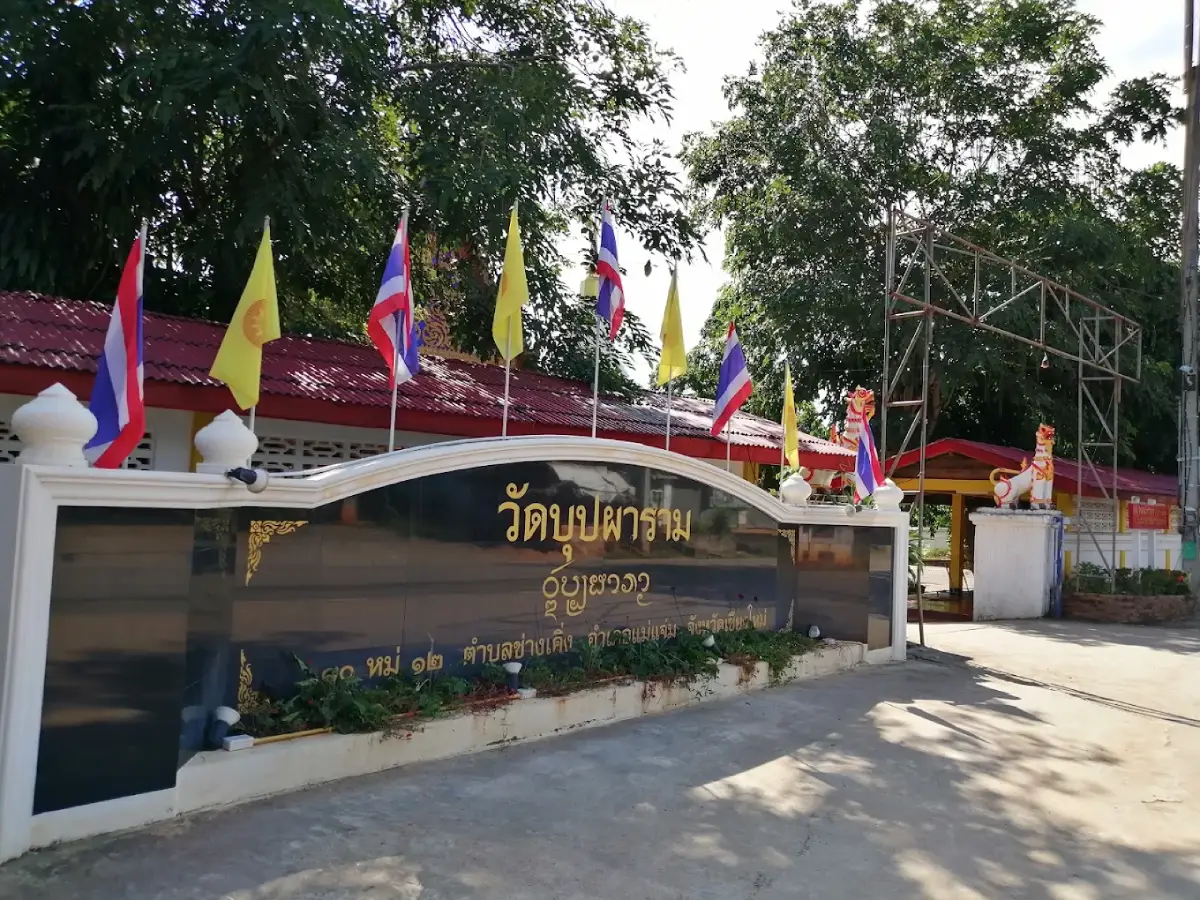
Open Days: Daily
Opening Hours: 08:00 - 17:00
Wat Buppharam is located at No. 10, Moo 12, Ban Chang Khoeng Bon, Charoen Niran Road area, Chang Khoeng Subdistrict, Mae Chaem District, Chiang Mai Province 50270. It is a community Buddhist temple under the Mahanikaya order. The temple was officially established in 1926 and received its royal boundary recognition, known in Thai as wisungkhamsima, in 1950. The current abbot is Phra Khru Mongkhon Wisit Sirimangkhalo. Wat Buppharam is one of the important community temples of Chang Khoeng and Mae Chaem because it functions not only as a place of worship but also as a centre of local faith, community activity, education, social support, and cultural continuity.
The temple stands in Ban Chang Khoeng Bon, a community within the Mae Chaem municipal area and Chang Khoeng Subdistrict. Its location is relatively accessible compared with more remote mountain temples in the district. Because it is close to the town area and local roads, Wat Buppharam is suitable for travelers who want to explore Mae Chaem’s community temples, local Buddhist culture, and nearby cultural sites in one route. It can be combined with Wat Phra That Chang Khoeng, Wat Ban Chiang, Wat Phutthoen, Wat Phrao Num, and Wat Pa Daet.
The history of Wat Buppharam is connected with the former temple site known as Wat Doi Huak. Local cultural records state that Wat Doi Huak was damaged by fire and abandoned for a long period. In 1926, Phra Khru Maha Mongkhon, also known as Sutjai Sumangkhalo, former ecclesiastical district chief of Mae Chaem, served as the monastic leader of the rebuilding effort. Khun Chan Chang Khoeng, also known as Fai Kapchai, the headman of Chang Khoeng Subdistrict, led the lay community. Together with monks, novices, and about 20 local households, they cleared approximately four rai of land and established a new temple named Wat Buppharam. Phra Khru Maha Mongkhon became the first abbot of the temple.
The name “Buppharam” carries a graceful meaning. “Buppha” means flowers, and “aram” means monastery or temple. The name can therefore be understood as “the monastery of flowers” or “the garden-like temple.” This meaning fits the temple’s role as a peaceful place of merit-making and community gathering. It also reflects the revival of Buddhist faith after the former temple at Doi Huak had been abandoned.
The establishment of Wat Buppharam in 1926 was important for Ban Chang Khoeng Bon because the temple was built through cooperation between monks, local leaders, and villagers at a time when the community was still small. The fact that about 20 households helped clear land and build the temple shows that Wat Buppharam arose from genuine community need. It was not merely a religious construction project but the creation of a shared centre for worship, education, culture, and public activity.
When the temple received its royal boundary recognition in 1950, its religious status became more complete. In Thai Buddhist practice, a recognized boundary allows the temple to perform formal monastic rites within a proper consecrated area. Wat Buppharam therefore developed from a temple built by local faith into a stable religious institution serving both the Sangha and the Mae Chaem community.
Wat Buppharam is especially notable for its social role. Cultural records describe the temple as an important social centre in Mae Chaem. Its activities have included a rice bank for people in need, an education fund for students, the sending of monks to teach Buddhism in schools, a village broadcasting system for religious and public information, and later a community radio role. These functions show that the temple has long supported both spiritual life and practical community welfare.
The rice bank reflects mutual assistance in an agricultural society. The education fund shows concern for children and future generations. Monks teaching in schools reflect the role of the Sangha in moral education. The broadcasting system and community radio role show how the temple adapted to become a communication centre for local people. Together, these activities make Wat Buppharam much more than a place for occasional worship.
The temple has also organized moral and ethical training for young people, annual Buddhist activities, a library, and a local community museum. These elements make Wat Buppharam a learning space where religion, local knowledge, and community identity are brought together. Visitors should therefore understand the temple as a living institution rather than as a static sightseeing site.
Architecturally and functionally, Wat Buppharam has the character of a northern Thai community temple. The compound includes an ubosot, a viharn, a sermon hall, monks’ residences, community activity spaces, a library, and a community museum. Public sources do not provide extensive architectural detail for each building, but the value of the temple lies strongly in its continuous use and in the close relationship between its religious spaces and the surrounding community.
Walking through Wat Buppharam, visitors can sense the atmosphere of a temple that remains part of daily local life. The temple is not separate from the community; it is woven into merit-making, meetings, youth activities, Buddhist ceremonies, and local traditions. This kind of temple is particularly valuable for travelers who want to understand Mae Chaem beyond viewpoints and rice terraces. It reveals how Buddhist temples continue to support social relationships in northern Thai communities.
Phra Khru Mongkhon Wisit Sirimangkhalo, the abbot of Wat Buppharam, is central to the temple’s present-day role. Current temple databases and local activity records show that Wat Buppharam remains an active Buddhist temple with resident monks and ongoing religious activities. In 2025, Mae Chaem Municipality organized its Buddhist Lent cultural preservation project at Wat Buppharam, including candle-making and the offering of Buddhist Lent candles to support the continuation of religious traditions.
Buddhist Lent activities at Wat Buppharam show the temple’s continuing role as a centre of annual tradition. The making and offering of Lent candles is a northern Thai Buddhist practice connected to the rainy-season retreat, when monks remain in their temples for study and practice. Local residents offer candles and necessities to support the monastic community. At Wat Buppharam, this tradition remains active and meaningful for the community.
Another recent activity took place during the Visakha Bucha, or Paet Peng, tradition in 2025, when Mae Chaem Municipality and the elderly school group joined a merit-making event at Wat Buppharam by offering ton khrua tan, a traditional northern Thai offering arrangement. This event shows how the temple connects different generations. Elderly residents participate in religious merit-making, younger generations witness cultural continuity, and the community preserves Buddhist customs together.
In northern Thai culture, khrua tan refers to offerings prepared for temple merit-making. Offering ton khrua tan is more than donating objects; it expresses faith, cooperation, and community solidarity. Wat Buppharam therefore functions as a cultural stage where living traditions are carried out by real people in a real community setting.
Compared with other important temples in Mae Chaem, Wat Buppharam is distinctive for its community-development role. Wat Ban Chiang is known for Phra Chao Saen Tong and historic remains. Wat Phutthoen is known for its water-bound ordination hall and sacred spring. Wat Pa Daet is admired for its old murals and historic atmosphere. Wat Buppharam stands out as a temple that grew with the Chang Khoeng Bon community and continues to serve education, welfare, local communication, and annual religious activities.
For travelers who want to understand Mae Chaem more deeply, Wat Buppharam should be included in a cultural temple route rather than treated as a quick roadside stop. A visit helps reveal the local structure of Buddhist community life, the role of monks in education and public welfare, and the way local traditions are maintained through temple activities.
A practical way to explore Wat Buppharam is to begin at the main temple entrance, continue toward the principal religious buildings, and then observe the community-use areas such as the sermon hall, library, museum, or activity grounds when accessible. If a religious ceremony or community event is taking place, visitors should move quietly and avoid disrupting the ritual. Wat Buppharam is an active temple, so respect for monks, residents, and sacred space is essential.
Visitors interested in tradition may plan a visit around major Buddhist occasions such as Buddhist Lent or Visakha Bucha. These periods reveal the temple’s living role most clearly, with merit-making, offerings, candle ceremonies, Dhamma activities, and community gatherings. Travelers who prefer a quieter visit should come in the morning or afternoon outside major ceremonies.
Getting There from Chiang Mai city can be done by taking Highway 108 through Hang Dong, San Pa Tong, and Chom Thong. From Chom Thong, continue on Highway 1009 toward Doi Inthanon, then take Highway 1192 down to Mae Chaem. This route is scenic and works well for travelers combining Doi Inthanon with Mae Chaem, but it includes mountain curves and steep sections, so careful driving is necessary.
An alternative route follows Highway 108 through Chom Thong toward Hot and Op Luang, then connects with Highway 1088 toward Mae Chaem. This route is useful for travelers approaching from southern Chiang Mai Province or those planning to visit Op Luang before Mae Chaem. Once in Mae Chaem, continue toward Chang Khoeng Subdistrict and Ban Chang Khoeng Bon, using Wat Buppharam’s coordinates for navigation.
Within Mae Chaem, private car, rental car, or motorcycle is the most convenient way to travel. Temples and cultural sites are scattered across different villages. Wat Buppharam can be combined with Wat Phra That Chang Khoeng, Wat Ban Chiang, Wat Phutthoen, Wat Phrao Num, and Wat Pa Daet within a half-day or full-day route, depending on how much time visitors spend at each site.
Nearby temples help complete the cultural context. Wat Phra That Chang Khoeng is very close to Wat Buppharam and is a good first stop in the Chang Khoeng temple route. Wat Ban Chiang is associated with important Mae Chaem Buddhist heritage. Wat Phutthoen is known for its water-surrounded ubosot and sacred spring. Wat Phrao Num and Wat Pa Daet add further historical and artistic depth to a Mae Chaem temple itinerary.
Nearby restaurants include Khuang Na Restaurant in Moo 12, Pema Cafe for coffee and drinks, Jam A Rom Ancient Tom Yum Noodle for noodles and simple meals, Sikon Restaurant for Thai and traveler-friendly dishes, and Mae Chaem Gate Restaurant for a relaxed meal outside the town centre. These options make it easy to combine a temple visit with lunch, coffee, or dinner in the Mae Chaem area.
Accommodation options in and around Mae Chaem include Loft Room 71 Mae Chaem, Take View Mueang Chaem Homestay, Phu Chaem House, Phu Pha Home, and Hug Khao at Mae Chaem. Staying overnight allows visitors to explore Wat Buppharam and nearby temples without rushing back to Chiang Mai on the same day.
The best time to visit Wat Buppharam is in the morning or late afternoon when the weather is milder. Morning is suitable for quiet worship and temple observation, while the afternoon works well for combining the temple with nearby cafes or other temples. During the rainy season, travelers should check road conditions and drive carefully because Mae Chaem routes include mountain roads and curves. In the cool season, Mae Chaem offers pleasant weather for slower cultural travel.
Visitors should dress modestly when entering Wat Buppharam. Shoulders and knees should be covered, shoes should be removed in designated sacred areas, and voices should be kept low. Do not enter monks’ residential areas without permission. If a ceremony or community activity is taking place, observe from an appropriate distance and ask permission before photographing people or religious activities.
Wat Buppharam is ideal for travelers who want to see a deeper side of Mae Chaem. The district is often known for mountains, rice terraces, and scenic viewpoints, but temples such as Wat Buppharam reveal the community structure behind that landscape. The temple’s story begins with a relocation from Wat Doi Huak, continues through community rebuilding, royal boundary recognition, education, social welfare, Buddhist training, and annual traditions, and remains active today as a living religious and cultural centre.
Overall, Wat Buppharam reflects the relationship between Buddhism and community life in Mae Chaem. Its value does not rest on a single monument or object, but on its continuous service to people. It is a place of worship, a community temple, a venue for tradition, a centre of learning, and a space of social support. Visiting Wat Buppharam helps travelers understand that Mae Chaem’s identity is found not only in its natural landscape but also in its temples, merit-making traditions, and the cooperation of local people who continue to sustain their community.
| Name | Wat Buppharam |
| Temple Type | Community Buddhist temple under the Mahanikaya order |
| Address | No. 10, Moo 12, Ban Chang Khoeng Bon, Chang Khoeng Subdistrict, Mae Chaem District, Chiang Mai 50270, Thailand |
| Coordinates | 18.498524, 98.369199 |
| Open Days | Daily |
| Opening Hours | 08:00 - 17:00 |
| Phone | +66 53 828 096 |
| Official Establishment | 1926 |
| Royal Boundary Recognition | 1950 |
| Abbot | Phra Khru Mongkhon Wisit Sirimangkhalo |
| Historical Background | The temple was relocated from the former Wat Doi Huak, which had been damaged by fire and abandoned, before being re-established at Ban Chang Khoeng Bon in 1926 |
| Name Meaning | “Buppharam” can be understood as “the monastery of flowers” or “the garden-like temple” |
| Main Role | Religious centre, community temple, education support space, moral-training venue, annual merit-making site, library, and local community museum |
| Main Areas / Zones | Ubosot, viharn, sermon hall, monks’ residences, library, community museum, and community activity areas |
| Important Traditions | Buddhist Lent candle offering, Visakha Bucha activities, Paet Peng tradition, and ton khrua tan offering |
| Current Status | Active Buddhist temple with resident monks and ongoing religious and cultural activities |
| Getting There | From Chiang Mai, take Highway 108 to Chom Thong, continue via Highway 1009 and Highway 1192 to Mae Chaem, or travel through Hot and Op Luang via Highway 1088. From Mae Chaem town, continue to Ban Chang Khoeng Bon in Chang Khoeng Subdistrict. |
| Nearby Tourist Attractions | 1. Wat Phra That Chang Khoeng — approx. 1 km 2. Wat Ban Chiang / Wat Chiang — approx. 2 km 3. Wat Phutthoen — approx. 3 km 4. Wat Phrao Num — approx. 3 km 5. Wat Pa Daet, Mae Chaem — approx. 3 km |
| Nearby Restaurants | 1. Khuang Na Restaurant — approx. 1 km, Tel. +66 87 183 6931 2. Pema Cafe — approx. 2 km, Tel. +66 88 229 5692 3. Sikon Restaurant — approx. 2 km, Tel. +66 87 067 8193 4. Jam A Rom Ancient Tom Yum Noodle — approx. 3 km, Tel. +66 81 167 5992 5. Mae Chaem Gate Restaurant — approx. 6 km, Tel. +66 85 671 3061 |
| Nearby Accommodations | 1. Loft Room 71 Mae Chaem — approx. 2 km, Tel. +66 61 273 1989 2. Take View Mueang Chaem Homestay — approx. 4 km, Tel. +66 96 102 4162 3. Phu Chaem House — approx. 5 km, Tel. +66 81 024 6223 4. Phu Pha Home — approx. 5 km, Tel. +66 64 350 2333 5. Hug Khao at Mae Chaem — approx. 7 km, Tel. +66 93 140 1254 |
Frequently Asked Questions (FAQ)
Q: Where is Wat Buppharam located?
A: Wat Buppharam is located at No. 10, Moo 12, Ban Chang Khoeng Bon, Chang Khoeng Subdistrict, Mae Chaem District, Chiang Mai Province 50270.
Q: What are the opening days and hours of Wat Buppharam?
A: Wat Buppharam is open daily from 08:00 to 17:00.
Q: Why is Wat Buppharam important?
A: Wat Buppharam is important as a Mahanikaya community temple that supports religion, education, moral training, annual traditions, community learning, and social welfare in Mae Chaem.
Q: When was Wat Buppharam established?
A: Wat Buppharam was officially established in 1926 and received royal boundary recognition in 1950.
Q: How is Wat Buppharam connected with Wat Doi Huak?
A: Wat Buppharam was relocated from the former Wat Doi Huak, which had been damaged by fire and abandoned, before the community rebuilt the temple at Ban Chang Khoeng Bon.
Q: Who is the abbot of Wat Buppharam?
A: The abbot of Wat Buppharam is Phra Khru Mongkhon Wisit Sirimangkhalo.
Q: Which nearby temples can be combined with Wat Buppharam?
A: Nearby temples include Wat Phra That Chang Khoeng, Wat Ban Chiang, Wat Phutthoen, Wat Phrao Num, and Wat Pa Daet in Mae Chaem.
Q: What should visitors keep in mind when visiting Wat Buppharam?
A: Visitors should dress respectfully, keep quiet in sacred areas, remove shoes where required, avoid entering monks’ residential areas without permission, and ask before photographing people or religious activities.
 Category: ●Places of Worship
 Group: ●Temple
Last Update : 1 MonthAgo
 Last Update : 1 MonthAgo
 Click to Access the Navigation Map GPS

 Muang Chiang Mai(121)Chom Thong(47)Mae Chaem(25)Chiang Dao(33)Doi Saket(68)Mae Taeng(85)Mae Rim(69)Samoeng(29)Fang(71)Mae Ai(59)Phrao(70)San Pa Tong(103)San Kamphaeng(66)San Sai(73)Hang Dong(73)Hot(32)Doi Tao(22)Omkoi(11)Saraphi(74)Wiang Haeng(15)Chai Prakan(28)Mae Wang(32)Mae On(22)Doi Lo(33)Galyani Vadhana(1)


