
lovethailand home >North Travel Attractions >Chiang Mai Travel Attractions >Doi Lo >Yang Khram > Wat Nong Lua
TL;DR: Wat Nong Lua is located at Ban Huai Rak Mai, Moo 4, Yang Kram Subdistrict, Doi Lo District, Chiang Mai 50160, Thailand, open Daily, hours 08:00 - 17:00.

Wat Nong Lua
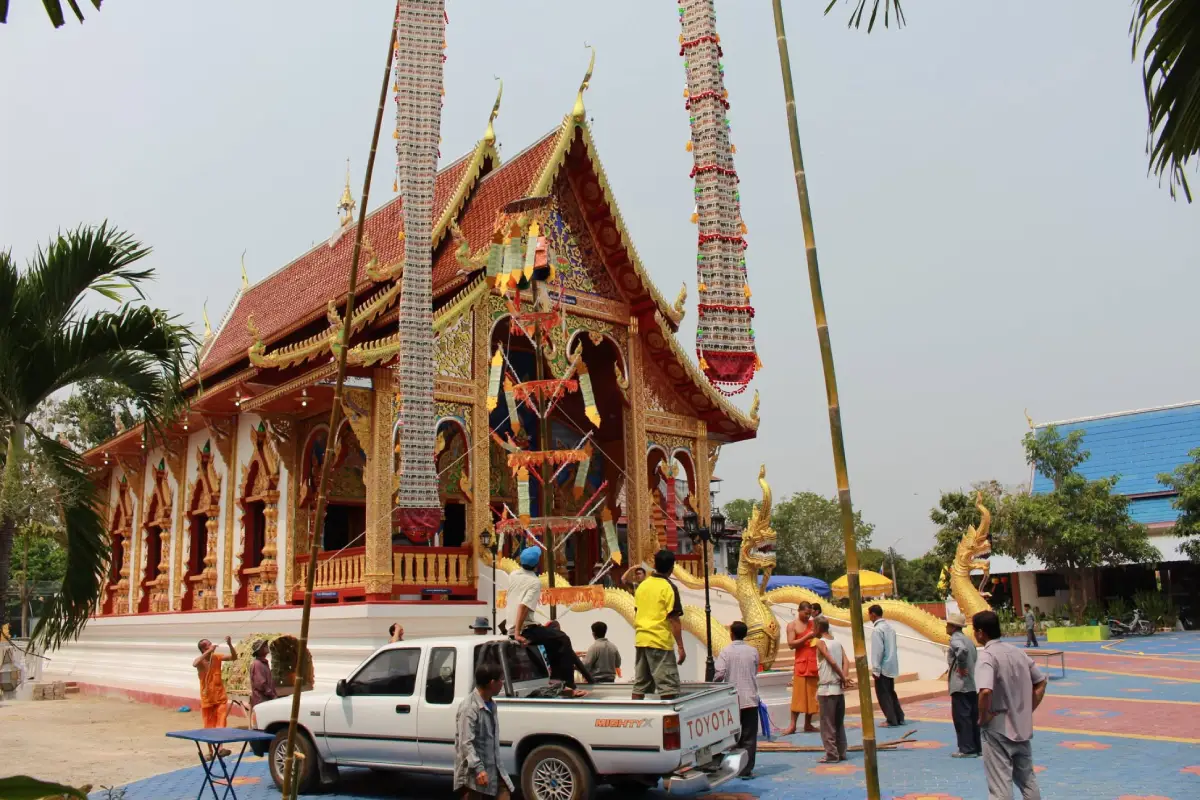
Open Days: Daily
Opening Hours: 08:00 - 17:00
Wat Nong Lua is a historic community Buddhist temple of the Maha Nikaya order located in Ban Huai Rak Mai, Moo 4, Yang Kram Subdistrict, Doi Lo District, Chiang Mai Province 50160. Its official temple code is 350240308. The monastery was formally established in 1872 and has served the surrounding community for more than 150 years. Its history is particularly notable for Buddhist education, a temple library, support for public schooling, and its close relationship with Wat Nong Lua School.
The temple is located at approximately 18.53935, 98.83108. Wat Nong Lua School stands immediately nearby at approximately 18.53987, 98.83023, reinforcing the strong historical connection between the monastery and formal education in the local community.
The temple is associated with Ban Huai Rak Mai, Moo 4, in Yang Kram Subdistrict. This part of Doi Lo consists of agricultural villages connected by local roads, farmland, Buddhist monasteries, and schools. Wat Nong Lua is therefore embedded directly within the social landscape of the village rather than functioning as an isolated tourist monument.
1872 is the official establishment year recorded in the temple's historical account. Wat Nong Lua therefore predates the creation of modern Doi Lo District by well over a century and has continued through major changes in local administration, transportation, education, and rural life.
For a northern Thai village in the nineteenth century, a Buddhist monastery was much more than a place of worship. It provided religious leadership, education, ceremonial space, social organization, and a common meeting point for the local community. The long survival of Wat Nong Lua reflects sustained support from generations of local residents.
The temple's historical leadership records begin with Phra Athikan Phrom, followed by Phra Khru Chai Ma Chayo. Phra Chanta Dhammasaro later served in an acting capacity from 1983 onward according to the surviving temple history.
A later historical account also names Phra Watthana Panyavajiro as abbot at the time that information was compiled. That record is important as part of the temple's administrative history, although it should not automatically be treated as confirmation of the current abbot in 2026 without a newer appointment record.
One of Wat Nong Lua's most important contributions has been Buddhist education. A Pariyatti Dhamma school in the Dhamma division began teaching at the temple in 1969, creating a local center where monks and novices could study Buddhist doctrine in a structured system.
This educational role was particularly important in a rural district at a time when travel to large monastic schools in Chiang Mai city was far more difficult. Local study allowed monks and novices to learn Buddhist doctrine, Buddhist history, ceremonial practice, and ethical teachings close to their home communities.
The Pariyatti school also continued the traditional Lanna relationship between monasteries and education. Long before modern state schools became widespread, Buddhist temples functioned as centers for reading, religious learning, local knowledge, and moral instruction.
Wat Nong Lua also maintained a library for interested readers. This detail is significant because it shows that the temple's educational role extended beyond formal monastic students to members of the wider community.
The combination of a Dhamma school and library made the monastery an important local learning center. Residents could encounter Buddhist education through sermons, formal study, books, and everyday interaction with monks.
The temple's contribution to general education was even broader. Historical records state that Wat Nong Lua provided land for the establishment of a public school. The relationship remains visible today through Wat Nong Lua School, which continues to operate next to the temple.
Wat Nong Lua School remains active in the 2026 academic year under Chiang Mai Primary Educational Service Area Office 4. It teaches children from kindergarten through primary school and has more than 100 students.
This continuity gives the temple unusual educational significance. The original support provided by the monastery helped establish a community school, and the school remains a functioning institution generations later.
The pattern reflects a broader history of Thai rural education. Many public schools were originally established on or beside temple land because monasteries already provided accessible community space, local leadership, and a trusted institutional setting.
Wat Nong Lua can therefore be understood through three interconnected roles: a Buddhist religious center, a center of monastic education, and a supporter of education for local children.
The temple remains officially registered today as a Maha Nikaya monastery under code 350240308. It is also part of the Yang Kram Sangha administrative area together with Wat Mai Phatthana, Wat Yang Kram, Wat Si Sai Mun, Wat Chetawan, Wat Si Daen Mueang, Wat Don Chai, and Wat Ban Tham.
This network of eight monasteries reflects the village-based structure of Buddhism in Yang Kram. Each temple serves a particular community while remaining connected through a common ecclesiastical administration.
For travelers, the main value of Wat Nong Lua lies in this living community history rather than in monumental tourism architecture. The monastery's long history, educational tradition, library, and close relationship with the neighboring school provide a clear picture of how Buddhist institutions functioned in rural Lanna society.
Publicly available records that can be confidently separated from similarly named temples in other provinces do not provide a complete architectural chronology for the viharn, ubosot, chedi, bell tower, sermon hall, or principal Buddha image at this specific Wat Nong Lua. Those details should therefore not be borrowed from other temples with similar names.
Visitors should focus on the worship areas open on the day of their visit, the general monastery grounds, and the relationship between the temple and surrounding community. This is a functioning village monastery rather than a museum complex.
The atmosphere is generally best suited to visitors interested in local Buddhist life, community history, and quieter rural travel. On ordinary days the temple can be calm, while Buddhist holy days and community ceremonies bring more residents into the grounds.
Wat Nong Lua participates in the ordinary rhythm of Buddhist community life, including Buddhist holy days, Makha Bucha, Visakha Bucha, Asalha Bucha, Buddhist Lent, the end of Buddhist Lent, Kathin, forest-robe offerings, ordination-related activities, funerals, and family merit-making.
Kathin is one of the major community ceremonies after Buddhist Lent. Supporters gather to offer robes and donations to the resident Sangha while helping maintain temple activities and facilities.
Forest-robe offerings may take place at different times according to community needs and are often organized to support religious, educational, or maintenance projects.
The temple's strong educational history gives these community events an additional dimension. Wat Nong Lua has not only served ceremonies but also helped create spaces in which religious knowledge and general education could develop together.
The neighboring Wat Nong Lua School provides the clearest modern example. In the 2026 academic year the school continues to teach students from kindergarten to primary level and remains part of the educational structure of Doi Lo.
This makes Wat Nong Lua particularly interesting for travelers interested in social history. The visitor can see how a Buddhist monastery helped shape not only religious life but also access to education in a rural community.
Wat Nong Lua is therefore different from temples whose tourism identity is based primarily on a famous chedi, monumental Buddha image, or elaborate decorative program. Its strongest identity lies in long-term service to the community.
The monastery remains part of an agricultural landscape. Ban Huai Rak Mai and surrounding Yang Kram communities are connected by local roads, farmland, schools, and village temples, creating a cultural setting very different from central Chiang Mai.
Getting There from Chiang Mai city is straightforward by private vehicle. Follow Highway 108 south through Hang Dong and San Pa Tong into Doi Lo District, then continue into Yang Kram Subdistrict and Ban Huai Rak Mai, Moo 4.
For navigation, search for “Wat Nong Lua, Yang Kram, Doi Lo, Chiang Mai” or use the approximate coordinates 18.53935, 98.83108. Including Yang Kram and Doi Lo in the search is important because similarly named temples exist elsewhere in Thailand.
Visitors should drive carefully near the monastery because Wat Nong Lua School is located directly beside the temple. Morning arrival and school dismissal periods may bring additional children, parents, motorcycles, and local traffic into the area.
Wat Yang Kram can be included in the same cultural route. Its formal establishment in 2002 provides an interesting contrast with Wat Nong Lua's nineteenth-century history.
Wat Mai Phatthana is another monastery in the Yang Kram Sangha network and can be combined easily with Wat Nong Lua for a multi-temple merit-making route.
Wat Don Chai, established in 1887, offers another historic community temple experience and demonstrates the concentration of long-established Buddhist institutions within Yang Kram.
Wat Ban Tham is particularly interesting for travelers who want to compare temple histories. Its story includes an abandoned monastery, wandering monks, community restoration, and a cave within the temple grounds.
Wat Si Daen Mueang traces its local history to 1849 and also has a strong connection with Buddhist education, making it a useful companion visit for understanding the educational roles of old village monasteries.
The Ganesha Himal Museum in Yang Kram adds a different cultural dimension to the route through its collection of Ganesha images and related art. Its published contact number is 053-024-287.
Current food and café options in Doi Lo include Hop Chafe Doi Lo, Tel. 086-190-2550; DOK JIK coffee homemade, Tel. 080-945-3376; Ta Ton Yon Coffee&Cafe, Tel. 052-000-566; Rin Coffee at Doi Lo, Tel. 089-953-8276; and Lake Restaurant, Tel. 081-606-1426.
Verified accommodation options include De Aerng Boutique Hotel, Tel. 061-316-0822; The Starly Night Cottage, Tel. 081-939-5610; Baan Rim Ping River Side Resort, Tel. 089-894-9172; and Pimprajan Homestay, Tel. 090-885-1545.
A practical half-day itinerary can begin at Wat Nong Lua in the morning, including time to observe the relationship between the temple and Wat Nong Lua School, before continuing to Wat Yang Kram, Wat Mai Phatthana, and the Ganesha Himal Museum.
A full-day itinerary can add Wat Don Chai, Wat Ban Tham, and Wat Si Daen Mueang. This creates a route through temples of very different ages and historical backgrounds within the same subdistrict.
Such an itinerary also demonstrates how Buddhist institutions in Yang Kram have evolved differently. Some temples date from the nineteenth century, some have histories of abandonment and revival, and others were formally established only in recent decades.
Wat Nong Lua's defining contribution to that landscape is education. Its Dhamma school began in 1969, its library served interested readers, and the monastery supported the creation of a public school.
The fact that Wat Nong Lua School remains active in 2026 shows that this educational legacy is not only a historical footnote. It remains visible in the structure of the present-day community.
This makes the monastery particularly valuable for understanding the traditional relationship between religion and education in northern Thailand. Buddhist temples were not separate from village society; they were often among its most important educational and social institutions.
Visitors familiar only with Chiang Mai's famous urban temples may therefore find Wat Nong Lua revealing. It offers a quieter, community-centered view of Buddhism in which the monastery, school, homes, and agricultural landscape remain closely connected.
Visitors should dress modestly, cover shoulders and knees inside sacred buildings, remove shoes where required, keep voices low, and avoid entering monks' residential areas without permission.
Photography should also respect the neighboring school and local residents. Children, monks, ceremonies, and private community activities should not be photographed intrusively.
General visiting hours are daily from 08:00 to 17:00. No official admission charge is published, and visitors may make voluntary merit donations.
Overall, Wat Nong Lua is a long-established Maha Nikaya monastery founded in 1872 whose strongest historical identity lies in education and community service. Its Pariyatti Dhamma school dates to 1969, its history includes a public library and support for a public school, and the neighboring Wat Nong Lua School continues to serve local children today.
For travelers exploring Doi Lo, the monastery offers more than a place to worship. It provides a direct view of how a northern Thai temple can influence religious life, education, community organization, and local identity across generations. More than 150 years after its establishment, Wat Nong Lua remains part of both the Buddhist and educational landscape of Ban Huai Rak Mai and Yang Kram.
| Name | Wat Nong Lua |
| Temple Type | Community Buddhist Temple, Maha Nikaya |
| Temple Code | 350240308 |
| Location | Ban Huai Rak Mai, Moo 4, Yang Kram Subdistrict, Doi Lo District, Chiang Mai 50160, Thailand |
| Coordinates | Approx. 18.53935, 98.83108 |
| Established | 1872 (B.E. 2415) |
| Historic Temple Leadership | Phra Athikan Phrom, Phra Khru Chai Ma Chayo, Phra Chanta Dhammasaro, and Phra Watthana Panyavajiro in later historical records |
| Pariyatti Dhamma Education | Dhamma division opened in 1969 |
| Community Learning Role | Historic temple library and support for the establishment of a public school |
| Associated School | Wat Nong Lua School, currently serving kindergarten and primary students in Yang Kram |
| Sangha Administration | Yang Kram Sangha Administrative Area, Doi Lo District |
| Highlights | Historic temple established in 1872 with a strong legacy of monastic education, community library services, and support for local schooling |
| Open Days | Daily |
| Opening Hours | 08:00 - 17:00 |
| Admission | No official admission fee is published |
| Getting There | Follow Highway 108 south from Chiang Mai through Hang Dong and San Pa Tong into Doi Lo, then continue to Ban Huai Rak Mai, Moo 4, Yang Kram. Search for “Wat Nong Lua, Yang Kram, Doi Lo, Chiang Mai” or use the coordinates. |
| Current Status | Active Maha Nikaya temple in the Yang Kram Sangha administrative area |
| Nearby Tourist Attractions | 1. Wat Yang Kram 2. Wat Mai Phatthana 3. Wat Don Chai 4. Wat Ban Tham 5. Wat Si Daen Mueang 6. Ganesha Himal Museum, Tel. 053-024-287 |
| Nearby Restaurants And Cafés | 1. Hop Chafe Doi Lo, Tel. 086-190-2550 2. DOK JIK coffee homemade, Tel. 080-945-3376 3. Ta Ton Yon Coffee&Cafe, Tel. 052-000-566 4. Rin Coffee at Doi Lo, Tel. 089-953-8276 5. Lake Restaurant, Tel. 081-606-1426 |
| Nearby Accommodations | 1. De Aerng Boutique Hotel, Tel. 061-316-0822 2. The Starly Night Cottage, Tel. 081-939-5610 3. Baan Rim Ping River Side Resort, Tel. 089-894-9172 4. Pimprajan Homestay, Tel. 090-885-1545 |
Frequently Asked Questions (FAQ)
Q: Where is Wat Nong Lua located?
A: Wat Nong Lua is located in Ban Huai Rak Mai, Moo 4, Yang Kram Subdistrict, Doi Lo District, Chiang Mai 50160, at approximately 18.53935, 98.83108.
Q: When was Wat Nong Lua established?
A: Wat Nong Lua was formally established in 1872, giving the monastery a history of more than 150 years.
Q: Why is Wat Nong Lua important for education?
A: The temple opened a Pariyatti Dhamma school in 1969, maintained a library for interested readers, and historically provided land for a public school.
Q: Is Wat Nong Lua School still operating?
A: Yes. Wat Nong Lua School remains active in the 2026 academic year under Chiang Mai Primary Educational Service Area Office 4 and teaches kindergarten and primary students.
Q: Who were the abbots of Wat Nong Lua?
A: Historical records name Phra Athikan Phrom, Phra Khru Chai Ma Chayo, Phra Chanta Dhammasaro, and later Phra Watthana Panyavajiro. A separate recent public appointment record is required to confirm the current abbot.
Q: What are the opening hours?
A: General visiting hours are daily from 08:00 to 17:00.
Q: Is there an admission fee?
A: No official admission fee is published. Visitors may make voluntary merit donations.
Q: What nearby places can be combined with Wat Nong Lua?
A: Nearby cultural stops include Wat Yang Kram, Wat Mai Phatthana, Wat Don Chai, Wat Ban Tham, Wat Si Daen Mueang, and the Ganesha Himal Museum.
 Category: ●Places of Worship
 Group: ●Temple
Last Update : 4 WeekAgo
 Last Update : 4 WeekAgo
 Click to Access the Navigation Map GPS

 Muang Chiang Mai(121)Chom Thong(47)Mae Chaem(25)Chiang Dao(33)Doi Saket(68)Mae Taeng(85)Mae Rim(69)Samoeng(29)Fang(71)Mae Ai(59)Phrao(70)San Pa Tong(103)San Kamphaeng(66)San Sai(73)Hang Dong(73)Hot(32)Doi Tao(22)Omkoi(11)Saraphi(74)Wiang Haeng(15)Chai Prakan(28)Mae Wang(32)Mae On(22)Doi Lo(33)Galyani Vadhana(1)


