
lovethailand home >North Travel Attractions >Chiang Mai Travel Attractions >Fang >Wiang > Wat Khuha Wari Kasem
TL;DR: Wat Khuha Wari Kasem is located at Ban San Pa Yang, Moo 10, Wiang Subdistrict, Fang District, Chiang Mai Province, open Daily, hours 08.00 – 17.00.

Wat Khuha Wari Kasem
Open Days: Daily
Opening Hours: 08.00 – 17.00
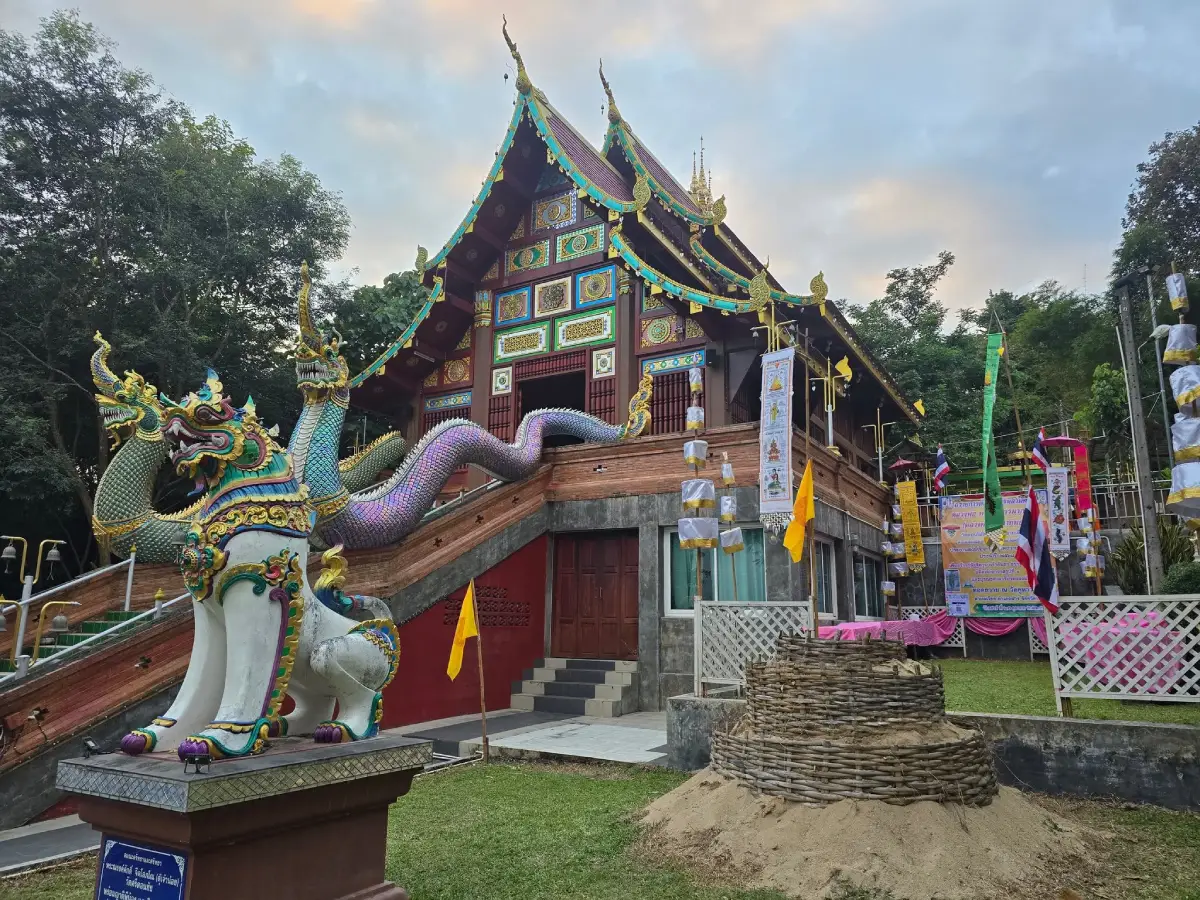
Wat Khuha Wari Kasem is located in Ban San Pa Yang, Moo 10, Wiang Subdistrict, Fang District, Chiang Mai Province. It is a local Buddhist temple under the Mahanikaya order. The temple was officially permitted to be established in 1887, and Phra Palat Sin Satisampanno serves as the abbot. Wat Khuha Wari Kasem is one of the long-established community temples of Wiang Subdistrict. Its most meaningful cultural feature is the memorial reliquary of Khruba Chao Kantha Dhammaputjacharn, which gives the temple a strong connection with local faith, community memory, and the cultural history of Ban San Pa Yang.
Wat Khuha Wari Kasem should be understood through the context of Ban San Pa Yang rather than as only a small local temple in Fang District. Ban San Pa Yang is Moo 10 of Wiang Subdistrict, an area connected with Fang town, local communities, transport routes, Buddhist temples, and cultural attractions. The temple stands within this living community landscape and functions as a spiritual center for local residents.
The temple was established in 1887, giving it a long history within the community. A temple founded in the late nineteenth century often reflects the settlement history, local faith, and social development of a village. Wat Khuha Wari Kasem was not created as a modern tourist attraction. It grew as a community temple where local residents could make merit, listen to Dhamma, perform Buddhist ceremonies, and maintain a shared spiritual identity.
The name “Khuha Wari Kasem” carries a calm and auspicious meaning. “Khuha” suggests a cave or quiet place, “Wari” refers to water, and “Kasem” suggests peacefulness and well-being. Together, the name gives the sense of a calm, refreshing, and spiritually meaningful place. This meaning fits the role of a community temple where people come to worship, make merit, and seek peace of mind.
Ban San Pa Yang is part of Wiang Subdistrict, one of the important areas of Fang District. The subdistrict is linked with Fang town, local markets, schools, government offices, temple communities, and natural travel routes. Many villages in Wiang have their own temples, and Wat Khuha Wari Kasem serves that role for Ban San Pa Yang. It connects Buddhist worship with village life and local memory.
The most distinctive cultural feature of the temple is the memorial reliquary of Khruba Chao Kantha Dhammaputjacharn. A memorial reliquary is not only a structure. It is a place of remembrance for a respected monk or spiritual figure connected with the faith of the community. Visitors should approach this area quietly and respectfully because it holds strong meaning for local residents.
The memorial reliquary gives Wat Khuha Wari Kasem more cultural depth than a general village temple. It allows visitors to see how local communities preserve the memory of monks and teachers who shaped their spiritual life. This makes the temple a meaningful stop for travelers interested in local Buddhist history, community faith, and the quieter side of Fang’s cultural landscape.
Wat Khuha Wari Kasem has the calm atmosphere of a local northern Thai temple. Visitors can begin by paying respect in the worship area, then walk quietly around the temple grounds and the memorial reliquary of Khruba Chao Kantha Dhammaputjacharn. The temple is not a large tourist site designed for crowds. Its value lies in its authenticity, community role, and long continuity of Buddhist life in Ban San Pa Yang.
Phra Palat Sin Satisampanno, the abbot of Wat Khuha Wari Kasem, plays an important role in maintaining the temple and supporting Buddhist activities in the community. Like many village temples, the temple depends on cooperation between the abbot, monks, temple committee, community leaders, and local residents. This cooperation keeps the temple active as a place of worship, merit-making, and community gathering.
Wiang Subdistrict is a useful base for travelers who want to explore Fang through both cultural and natural attractions. Wat Khuha Wari Kasem can be combined with other cultural places such as the Fang Cultural and Tourism Center, Wat Chedi Ngam, Wat Chong Paen, Wat Phrabat Udom, and Wat Phra That Chaloem Phrakiat. This route helps travelers see Fang beyond mountain scenery and hot springs.
The Fang Cultural and Tourism Center is especially useful for understanding the wider district. It presents stories of Fang town, old photographs, artworks, local products, and community identity. Visiting this center before or after Wat Khuha Wari Kasem helps travelers understand the historical and cultural background of the area.
Wat Chedi Ngam is another nearby cultural temple that can be included in the same route. It is known for Lanna Buddhist art, carved teak details, and a distinctive temple atmosphere. Wat Phra That Chaloem Phrakiat in Mon Pin Subdistrict is also suitable for a wider cultural route, with religious buildings, Buddha images, shrines, and views over Fang. Together, these places create a meaningful temple and cultural itinerary.
Annual Buddhist activities at community temples such as Wat Khuha Wari Kasem include Buddhist holy day merit-making, almsgiving, Dhamma listening, Buddhist Lent activities, forest robe offerings, Kathin, and memorial merit-making. These activities are important not only as religious ceremonies but also as social occasions that bring villagers together and maintain community relationships.
The main appeal of Wat Khuha Wari Kasem is its identity as an old community temple with a strong local memory. Visitors should focus on the worship area, temple grounds, the memorial reliquary of Khruba Chao Kantha Dhammaputjacharn, and the peaceful atmosphere of Ban San Pa Yang. This type of temple is best appreciated slowly and respectfully rather than as a quick photo stop.
The temple can also be connected with Fang Hot Springs and Doi Pha Hom Pok National Park. Fang Hot Springs is a natural geothermal attraction within the Doi Pha Hom Pok National Park area, while the national park is known for high mountains, cool weather, and northern forest landscapes. Combining the temple with these natural attractions creates a balanced route of faith, culture, food, and nature.
Getting There is easiest by private car or rental car. From Fang town, drive toward Wiang Subdistrict and Ban San Pa Yang, Moo 10. From Chiang Mai city, take Highway 107 through Mae Rim, Mae Taeng, and Chiang Dao toward Fang District, then continue into the Wiang area. Public transport can reach Fang town, but local transport may be needed to visit the temple and nearby attractions conveniently.
The best time to visit is in the morning or late afternoon. Morning visits are suitable for worship and merit-making before beginning a Fang itinerary. Afternoon visits work well before continuing to local restaurants, cafés, accommodations, Fang Hot Springs, or other attractions. During Buddhist holy days, robe offering, or Kathin periods, visitors should allow extra time and respect the temple’s ceremonial space.
Visitors should dress modestly, speak quietly, avoid disturbing monks or local worshippers, and remove shoes where required. Photography should be done respectfully, especially around the worship area, memorial reliquary, monks, local residents, and ceremonies. Wat Khuha Wari Kasem is a living community temple, so respectful behavior is essential.
Overall, Wat Khuha Wari Kasem is a meaningful Mahanikaya community temple in Ban San Pa Yang, Moo 10, Wiang Subdistrict, Fang District, Chiang Mai Province. Established in 1887 and currently led by Phra Palat Sin Satisampanno, the temple is important for its long community history, peaceful village atmosphere, and the memorial reliquary of Khruba Chao Kantha Dhammaputjacharn. It is suitable for travelers who want to worship, make merit, understand a local Lanna temple, and connect the visit with Fang’s cultural center, temples, hot springs, national park, restaurants, and accommodations.
| Name | Wat Khuha Wari Kasem |
| Location | Ban San Pa Yang, Moo 10, Wiang Subdistrict, Fang District, Chiang Mai Province |
| Temple Type | Local Buddhist Temple Under The Mahanikaya Order |
| Highlights | A long-established Ban San Pa Yang community temple founded in 1887, with the memorial reliquary of Khruba Chao Kantha Dhammaputjacharn as an important cultural and spiritual point |
| History | Permitted to be established as a temple in 1887 |
| Important Structures / Points | Worship Area, Temple Grounds, Monastic Area, And The Memorial Reliquary Of Khruba Chao Kantha Dhammaputjacharn |
| Sacred Objects / Worship Points | Worship Area Within The Temple And The Memorial Reliquary Of Khruba Chao Kantha Dhammaputjacharn |
| Distinctive Features | A historic local temple linking Buddhism, village faith, community memory, and the cultural route of Wiang Subdistrict |
| Local Importance | A spiritual center for Ban San Pa Yang, supporting worship, Buddhist holy day merit-making, robe offerings, Kathin, and local Buddhist activities |
| Travel Information | Best reached by private car or rental car from Fang town toward Wiang Subdistrict and Ban San Pa Yang, Moo 10; the temple can be combined with Wat Chedi Ngam, the Fang Cultural and Tourism Center, Fang Hot Springs, and Doi Pha Hom Pok National Park |
| Current Status | Still listed as a local Mahanikaya temple in Wiang Subdistrict, Fang District, Chiang Mai Province, and included in Wiang Subdistrict’s cultural tourism plan |
| Open Days | Daily |
| Opening Hours | 08.00 – 17.00 |
| Main Areas / Zones | Worship Area, Temple Grounds, Memorial Reliquary Of Khruba Chao Kantha Dhammaputjacharn, Ritual Area, And Monastic Area |
| Abbot | Phra Palat Sin Satisampanno |
| Nearby Tourist Attractions | 1. Wat Chedi Ngam, about 4 km 2. Fang Cultural And Tourism Center, about 5 km 3. King Fang Udomsin And Queen Samphio Monument, about 6 km 4. Wat Chong Paen, about 6 km 5. Wat Phra That Chaloem Phrakiat, Mon Pin Subdistrict, about 12 km 6. Fang Hot Springs, about 18 km 7. Doi Pha Hom Pok National Park, about 24 km |
| Nearby Restaurants | 1. Khao Soi Parichat Fang, about 5 km, Tel. 053-451-164 2. Khao Soi Mueang Fang, about 5 km, Tel. 063-159-9663, 096-683-7888, 094-493-1156 3. GREAT VIWE FANG, Fang Branch, about 6 km, Tel. 062-048-4222 4. Hong Nung Len Fang Chiang Mai, about 6 km, Tel. 083-201-8503, 095-134-6442 5. Ban Fang Coffee, about 8 km, Tel. 082-385-4599, 080-958-7918 6. Khao Soi Wan Rung, about 10 km, Tel. 099-292-8484 |
| Nearby Accommodations | 1. Phumanee Lahu Home Hotel, about 5 km, Tel. 086-431-3564 2. Fang Modern Hotel, about 6 km, Tel. 086-439-1843 3. TonFang Hotel, about 8 km, Tel. 063-781-5425 4. Huen San Fang, about 8 km, Tel. 081-881-6430, 063-790-0666 5. Ban Mueang Nuea Resort, about 13 km, Tel. 081-663-2569 6. Ban Phak Thanaphon, about 30 km, Tel. 090-672-7530 |
Frequently Asked Questions (FAQ)
Q: Where is Wat Khuha Wari Kasem located?
A: Wat Khuha Wari Kasem is located in Ban San Pa Yang, Moo 10, Wiang Subdistrict, Fang District, Chiang Mai Province.
Q: What is the historical importance of Wat Khuha Wari Kasem?
A: Wat Khuha Wari Kasem was permitted to be established as a temple in 1887, making it one of the long-established community temples of Wiang Subdistrict.
Q: What are the opening days and hours of Wat Khuha Wari Kasem?
A: The temple is open daily from 08.00 to 17.00.
Q: Who is the abbot of Wat Khuha Wari Kasem?
A: The abbot is Phra Palat Sin Satisampanno.
Q: What is the key cultural point at Wat Khuha Wari Kasem?
A: The key cultural point is the memorial reliquary of Khruba Chao Kantha Dhammaputjacharn, which is an important place of local remembrance and faith.
Q: Is Wat Khuha Wari Kasem suitable for travelers?
A: Yes. It is suitable for travelers who want to worship, make merit, visit a historic local temple, and understand the cultural route of Wiang Subdistrict in Fang.
Q: How can travelers get to Wat Khuha Wari Kasem?
A: The most convenient way is by private car or rental car from Fang town toward Wiang Subdistrict and Ban San Pa Yang, Moo 10.
Q: What nearby places can be visited with Wat Khuha Wari Kasem?
A: Travelers can combine the visit with Wat Chedi Ngam, the Fang Cultural and Tourism Center, Wat Chong Paen, Wat Phra That Chaloem Phrakiat, Fang Hot Springs, and Doi Pha Hom Pok National Park.
 Category: ●Places of Worship
 Group: ●Temple
Last Update : 1 MonthAgo
 Last Update : 1 MonthAgo
 Click to Access the Navigation Map GPS
Wat Khuha Wari Kasem Map
Recommend

 Muang Chiang Mai(121)Chom Thong(47)Mae Chaem(25)Chiang Dao(33)Doi Saket(68)Mae Taeng(85)Mae Rim(69)Samoeng(29)Fang(71)Mae Ai(59)Phrao(70)San Pa Tong(103)San Kamphaeng(66)San Sai(73)Hang Dong(73)Hot(32)Doi Tao(22)Omkoi(11)Saraphi(74)Wiang Haeng(15)Chai Prakan(28)Mae Wang(32)Mae On(22)Doi Lo(33)Galyani Vadhana(1)


