
lovethailand home >North Travel Attractions >Chiang Mai Travel Attractions >Chai Prakan >Si Dong Yen > Wat Nong Thian Kham
TL;DR: Wat Nong Thian Kham is located at Ban Phae, Moo 16, Si Dong Yen Subdistrict, Chai Prakan District, Chiang Mai 50320, open Daily, hours 08.00 - 17.00.

Wat Nong Thian Kham
Open Days: Daily
Opening Hours: 08.00 - 17.00
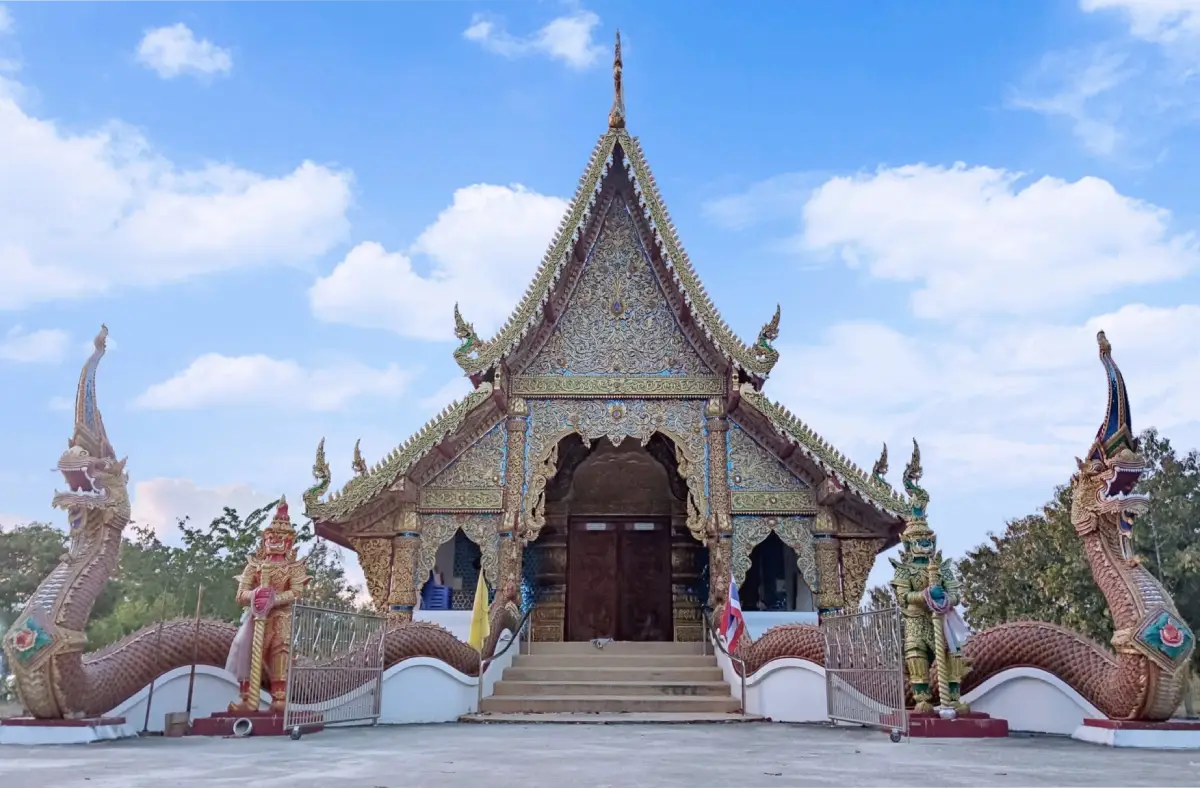
Wat Nong Thian Kham is a community Buddhist temple located in Ban Phae, Moo 16, Si Dong Yen Subdistrict, Chai Prakan District, Chiang Mai Province. It is a local temple under the Mahanikaya order. The temple land covers 16 rai and 24 square wa, with one additional monastic land plot measuring 3 rai, 2 ngan, and 51 square wa. Wat Nong Thian Kham is especially meaningful because it was originally an old temple that had once flourished, as suggested by traces of former structures in the area. After villagers moved away, the site became deserted for a long period. Later, as people returned to use the area for livestock, temporary shelters, and settlement, Ban Phae gradually formed and the villagers restored Wat Nong Thian Kham into an active community temple again.
The importance of Wat Nong Thian Kham lies in the revival of both temple and community. Ban Phae did not emerge only as an ordinary settlement; its story is connected with forested land, livestock, temporary shelters, and the gradual return of people to the area. Once the community grew, the old deserted temple was restored. In this sense, the temple represents the re-establishment of faith, memory, and village identity.
The name Nong Thian Kham is graceful and locally meaningful. The word Nong often refers to a pond or wetland. Thian suggests candlelight, illumination, and Buddhist worship. Kham in northern Thai usage is associated with value and auspiciousness. Although no detailed legend of the name is publicly confirmed, the name evokes water, light, merit, and the sacred atmosphere of a Lanna village temple.
Wat Nong Thian Kham was registered as a temple in 1941, giving it a formal place in the Thai Buddhist temple system for more than 80 years by 2026. However, the history of the site reaches further back because the temple is remembered as an older religious place that had once flourished before becoming abandoned. The story of a temple that prospered, fell silent, and was later restored gives Wat Nong Thian Kham a distinctive community history.
The abandonment of the temple reflects changes in settlement and land use. When villagers moved away, a once-active religious space became quiet and overgrown. Yet the memory of the site did not disappear completely. When people returned and Ban Phae grew into a village, the old temple was restored. The revival of Wat Nong Thian Kham therefore became the return of faith, shared memory, and community order.
Ban Phae, Moo 16, is located in Si Dong Yen Subdistrict, one of the important agricultural areas of Chai Prakan District. The subdistrict includes farming land, mountain scenery, water sources, and routes connecting Chiang Mai with Fang, Mae Ai, Doi Ang Khang, and other northern destinations. Wat Nong Thian Kham stands within a living rural landscape where Buddhism, agriculture, and local travel routes are closely connected.
The temple boundaries show its connection with the surrounding community. The northern side borders private land, the southern side borders local homes, while the eastern and western sides border public roads. This setting places the temple directly within the village landscape. It is not separated from everyday life, but forms part of the social and spatial fabric of Ban Phae.
The temple also has one plot of monastic land measuring 3 rai, 2 ngan, and 51 square wa. In a community temple, such land is not merely a land record. It represents a long-term religious resource that supports the temple’s ability to serve the Buddhist community.
The main structures of Wat Nong Thian Kham include a viharn, monks’ residences, a sermon hall, a merit-making pavilion, and a multi-purpose hall. Together, these buildings support many aspects of temple life. The viharn is used for worship, the monks’ residences support monastic life, the sermon hall is used for dhamma listening and gatherings, the merit-making pavilion supports ceremonies and family merit-making, and the multi-purpose hall allows the temple to host broader community activities.
The viharn is one of the most important spaces for visitors. It is where villagers pay respect to Buddha images, receive precepts, listen to sermons, and participate in Buddhist activities. In a Lanna community temple, the viharn is not only an architectural structure but a living space where faith becomes part of ordinary village life.
The monks’ residences reflect the continuity of monastic life. A temple with resident monks can maintain daily religious routines, accept invitations for village ceremonies, and support the moral life of the community. The connection between monks and lay supporters is central to the function of a village temple such as Wat Nong Thian Kham.
The sermon hall serves as a shared community space. It is used for dhamma listening, merit-making, meetings, and preparations for temple activities. In rural northern Thailand, such halls are familiar spaces where villagers come together to support the temple through labor, food preparation, offerings, and ceremony.
The merit-making pavilion is closely connected with family and community rituals. It supports ceremonies, memorial merit-making, annual merit activities, and other events that bring villagers together. This gives the temple an important role in emotional and spiritual life across different stages of community life.
The multi-purpose hall gives the temple flexibility. It can support religious events, community meetings, preparation for large merit-making ceremonies, and other public activities. This makes Wat Nong Thian Kham not only a ritual site, but also a functional public space for Ban Phae.
Important sacred and cultural objects at the temple include Buddha images and Lanna palm-leaf manuscripts. The Buddha images are the main focus of devotion, while the palm-leaf manuscripts are valuable cultural heritage. In Lanna culture, palm-leaf manuscripts preserve Buddhist teachings, local script, traditional knowledge, and stories passed down through generations.
Lanna palm-leaf manuscripts are significant because they represent the transmission of dhamma and local wisdom. In earlier times, monks, novices, and learned community members used palm-leaf manuscripts to preserve Buddhist texts, local chronicles, legends, and moral teachings. Their presence at Wat Nong Thian Kham gives the temple a deeper cultural dimension beyond ordinary worship.
Wat Nong Thian Kham serves Ban Phae in several ways. It is a spiritual center, a place for merit-making and dhamma listening, a venue for Buddhist ceremonies, a community gathering place, and a site that preserves the memory of an older temple restored through local faith. Its value comes from its living relationship with the village.
Si Dong Yen Subdistrict maintains traditions rooted in Buddhism and agriculture. Important local traditions include Buddhist Lent, the end of Buddhist Lent, Salak Phat, Northern Thai New Year, Yi Peng, new rice offerings, and the wooden support ceremony. These traditions keep local temples active throughout the year and connect Buddhist practice with seasonal cycles and village life.
Buddhist Lent is a period when monks remain in residence and laypeople make offerings, present candles, observe precepts, and support the temple. The end of Buddhist Lent leads into important merit-making events such as Kathin, robe offerings, and other community activities. These annual rhythms bring villagers back to the temple repeatedly.
Salak Phat is a distinctive Lanna merit-making tradition. Families prepare offerings, decorated merit gifts, and ritual items according to their means. The tradition reflects generosity, cooperation, and the relationship between monks and lay supporters. At a temple restored by community faith, this spirit of giving is especially meaningful.
Northern Thai New Year, or Pi Mai Mueang, is an important temple season when villagers make merit, bathe Buddha images, ask blessings from elders, and reconnect with family and community. Yi Peng brings candlelight, prayer, and full-moon merit-making into the temple calendar. These traditions help preserve Lanna identity through temple life.
The new rice offering tradition reflects the agricultural character of Si Dong Yen. When villagers bring newly harvested rice or farm produce to the temple, they express gratitude for the land, the harvest, family labor, and the Triple Gem. The wooden support ceremony symbolizes the wish to uphold Buddhism and sustain life.
Visitors to Wat Nong Thian Kham should appreciate it as a living community temple rather than a large commercial attraction. Important points to see include the viharn, monks’ residences, sermon hall, merit-making pavilion, multi-purpose hall, Buddha images, and Lanna palm-leaf manuscripts. A respectful visit should be quiet, modest, and mindful of the temple’s ongoing role in local life.
The temple is suitable for travelers interested in Lanna village temples, the history of restored abandoned temples, agricultural communities, and cultural travel in northern Chiang Mai. Its main appeal lies in the story of an old temple brought back to life through the faith of Ban Phae villagers.
Wat Nong Thian Kham can be combined with nearby temples and attractions such as Wat Pratu Khong, Wat Phra That Chom Khiri, Wat San Sai, Wat San Ton Pao, Wat Tham Tab Tao, Hinoki Land, and Doi Wiang Pha National Park. This route gives travelers a broader view of community temples, older sacred sites, natural landscapes, and modern attractions in Chai Prakan.
Wat Pratu Khong is a nearby temple in Si Dong Yen and is located about 4 kilometers from Wat Nong Thian Kham. Wat Phra That Chom Khiri is an important temple in the Mae Thalop area with a sacred stupa and associations with Khruba Srivichai. Wat Tham Tab Tao is known for its cave setting and local history. Together, these sites add religious, historical, and geographic depth to a Si Dong Yen travel route.
Hinoki Land is a popular modern attraction in Chai Prakan, while Doi Wiang Pha National Park offers mountain scenery, forest, and cooler northern air. Travelers can begin with merit-making at Wat Nong Thian Kham, then continue to temples, nature, cafés, and local accommodation in the Chai Prakan area.
The best time to visit is in the morning or late afternoon, when the weather is more comfortable and there is enough time to continue to nearby temples or attractions. The cool season is especially pleasant for travel in Chai Prakan, while the rainy season brings greener fields and mountain scenery. During rainy periods, visitors should drive carefully on local roads.
Getting There from Chiang Mai city is easiest by private car or rental car. Follow Highway 107 north through Mae Rim, Mae Taeng, Chiang Dao, and Chai Prakan, then continue into Si Dong Yen Subdistrict and Ban Phae, Moo 16. A private vehicle is the most convenient option for combining Wat Nong Thian Kham with Wat Phra That Chom Khiri, Wat San Sai, Wat Tham Tab Tao, Hinoki Land, and Doi Wiang Pha National Park.
Travelers without a private vehicle can use public transport on the Chiang Mai–Fang or Chiang Mai–Mae Ai route and continue locally from Chai Prakan to Si Dong Yen and Ban Phae. This requires more planning because many community temples are not located directly at main public transport stops. A private vehicle is recommended for a complete cultural route.
Visitors should dress modestly, keep quiet in the viharn, sermon hall, merit-making pavilion, and monk-use areas, and avoid disturbing ceremonies or local activities. If taking photos of people, ask permission first. Wat Nong Thian Kham is an active community temple, so respectful behavior is essential.
For food and accommodation, travelers can use restaurants, cafés, guest rooms, small resorts, and homestays in Si Dong Yen and Chai Prakan. The area is suitable as a stopover between Chiang Mai, Fang, Mae Ai, Doi Ang Khang, and Tha Ton. Staying overnight in Chai Prakan allows more time to explore local temples and nearby natural attractions without rushing.
In summary, Wat Nong Thian Kham is an important community temple in Ban Phae, Moo 16, Si Dong Yen Subdistrict, Chai Prakan District, Chiang Mai Province. It was once an old flourishing temple, later abandoned, and then restored by villagers as Ban Phae grew. With its viharn, monks’ residences, sermon hall, merit-making pavilion, multi-purpose hall, Buddha images, and Lanna palm-leaf manuscripts, the temple is suitable for travelers who want to understand restored village temples, Lanna faith, and the cultural landscape of northern Chiang Mai.
| Name | Wat Nong Thian Kham |
| Temple Type | Community Buddhist Temple, Mahanikaya Order |
| Location | Ban Phae, Moo 16, Si Dong Yen Subdistrict, Chai Prakan District, Chiang Mai 50320 |
| Temple Code | 350210209 |
| Registration Year | 1941 |
| Temple Land Area | 16 rai, 24 square wa under Nor Sor 3 document |
| Monastic Land | 1 plot measuring 3 rai, 2 ngan, and 51 square wa |
| Boundaries | North borders private land, south borders local homes, east borders a public road, and west borders a public road |
| History | Originally an old flourishing temple, later abandoned when villagers moved away. After Ban Phae grew into a community, villagers restored Wat Nong Thian Kham. |
| Community Context | Connected with Ban Phae, Moo 16, a village that developed from forest shelters, livestock areas, and later settlement. |
| Main Structures | Viharn, monks’ residences, sermon hall, merit-making pavilion, and multi-purpose hall |
| Sacred Objects / Heritage | Buddha images and Lanna palm-leaf manuscripts |
| Highlights | A restored old community temple with a history of abandonment, resettlement, and revival through Ban Phae villagers’ faith |
| Community Role | Spiritual center of Ban Phae, supporting merit-making, dhamma listening, Buddhist ceremonies, and community religious activities |
| Local Traditions | Buddhist Lent, end of Buddhist Lent, Salak Phat, Northern Thai New Year, Yi Peng, new rice offerings, and wooden support ceremony |
| Current Status | Active temple in the current temple registry of Si Dong Yen, Chai Prakan, Chiang Mai |
| Travel Information | From Chiang Mai city, follow Highway 107 toward Chai Prakan, then continue to Si Dong Yen Subdistrict and Ban Phae, Moo 16. Private car or rental car is the most convenient option. |
| Nearby Tourist Attractions | 1. Wat Pratu Khong, About 4 km 2. Wat Phra That Chom Khiri, About 7 km 3. Wat San Sai, About 8 km 4. Wat San Ton Pao, About 10 km 5. Wat Tham Tab Tao, About 12 km 6. Hinoki Land, About 13 km 7. Doi Wiang Pha National Park, About 24 km |
| Nearby Restaurants | 1. Khrua Pimthip Na Nong Nok Tae, About 5 km, Tel. 092-390-9211 2. Milk Shop Front Of Farm Chai Prakan Agricultural Cooperative, About 7 km, Tel. 092-884-9632 3. Cafe' De Mamana, About 8 km, Tel. 099-435-4061, 090-435-4061 4. Pa Phan Noodle Ban Chiang Man, About 10 km, Tel. 085-864-8001 5. Pizza & View Pang Chai Prakan, About 11 km, Tel. 082-198-8792 |
| Nearby Accommodations | 1. Pingkhong Resort, About 7 km 2. Baan Suan Ngoon Sirisuk Rooms, About 9 km, Tel. 092-398-8884, 098-750-0115, 086-919-9542 3. Phrom Prathan Resort, About 10 km 4. Anton Place, About 15 km, Tel. 091-853-1586 5. Pang Kham Pom Homestay Chai Prakan, About 20 km, Tel. 084-170-7943 |
Frequently Asked Questions (FAQ)
Q: Where is Wat Nong Thian Kham located?
A: Wat Nong Thian Kham is located in Ban Phae, Moo 16, Si Dong Yen Subdistrict, Chai Prakan District, Chiang Mai Province 50320.
Q: What type of temple is Wat Nong Thian Kham?
A: Wat Nong Thian Kham is a community Buddhist temple under the Mahanikaya order and is listed in the current temple registry of Si Dong Yen.
Q: What is the history of Wat Nong Thian Kham?
A: It was originally an old flourishing temple. After villagers moved away, the site became abandoned. Later, as Ban Phae grew into a community, villagers restored the temple.
Q: What main structures are found at Wat Nong Thian Kham?
A: The temple includes a viharn, monks’ residences, sermon hall, merit-making pavilion, and multi-purpose hall.
Q: What sacred objects and heritage items are found at the temple?
A: Important items include Buddha images and Lanna palm-leaf manuscripts.
Q: What kind of travelers should visit Wat Nong Thian Kham?
A: The temple is suitable for travelers interested in Lanna community temples, restored old temples, agricultural village life, and cultural travel in Chai Prakan.
Q: Why is Wat Nong Thian Kham important to the local community?
A: It serves as the spiritual center of Ban Phae, supporting merit-making, dhamma listening, Buddhist ceremonies, and community religious activities.
Q: What nearby places can travelers visit after Wat Nong Thian Kham?
A: Nearby places include Wat Pratu Khong, Wat Phra That Chom Khiri, Wat San Sai, Wat San Ton Pao, Wat Tham Tab Tao, Hinoki Land, and Doi Wiang Pha National Park.
 Category: ●Places of Worship
 Group: ●Temple
Last Update : 1 MonthAgo
 Last Update : 1 MonthAgo
 Click to Access the Navigation Map GPS
Wat Nong Thian Kham Map
Recommend

 Muang Chiang Mai(121)Chom Thong(47)Mae Chaem(25)Chiang Dao(33)Doi Saket(68)Mae Taeng(85)Mae Rim(69)Samoeng(29)Fang(71)Mae Ai(59)Phrao(70)San Pa Tong(103)San Kamphaeng(66)San Sai(73)Hang Dong(73)Hot(32)Doi Tao(22)Omkoi(11)Saraphi(74)Wiang Haeng(15)Chai Prakan(28)Mae Wang(32)Mae On(22)Doi Lo(33)Galyani Vadhana(1)


