
lovethailand home >South Travel Attractions >Trang Travel Attractions >Muang Trang >Thap Thiang > Kiw Ong Eia Shrine
TL;DR: Kiw Ong Eia Shrine is located at Thaklang Road, Thap Thiang Subdistrict, Mueang Trang District, Trang Province, open Daily, hours 05.00 – 17.00.
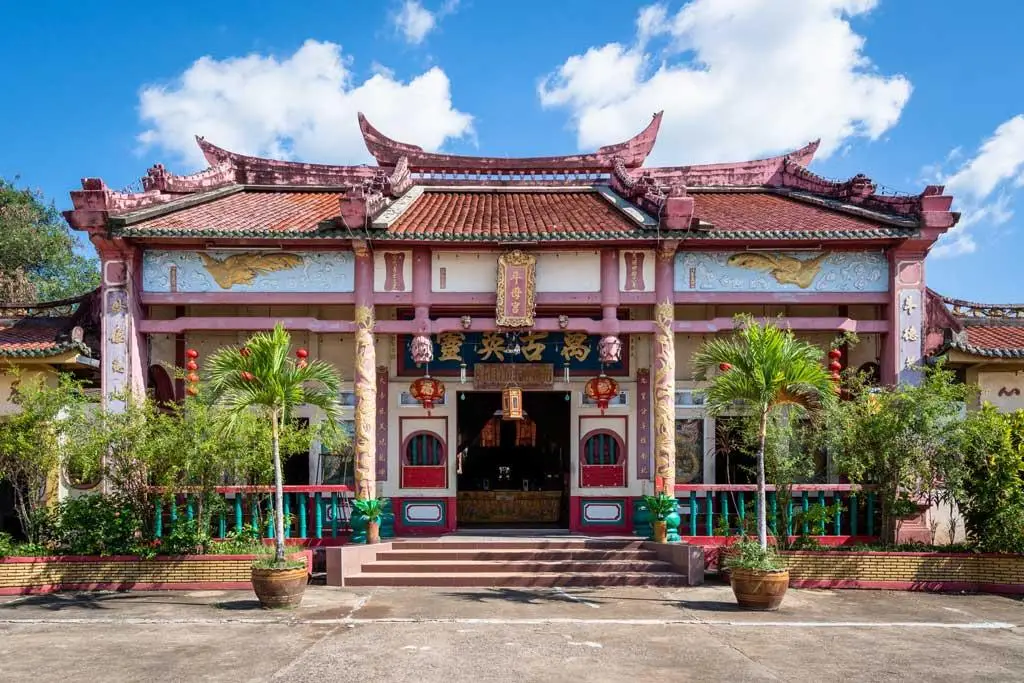
Kiw Ong Eia Shrine
Open Days: Daily
Opening Hours: 05.00 – 17.00
Kiw Ong Eia Shrine, also known as Kew Ong Ear Chinese Shrine, is one of the oldest and most important Hokkien Chinese shrines in Trang City. Located at 169 Thaklang Road, Thap Thiang Subdistrict, Mueang Trang District, Trang Province, the shrine is a center of faith for the Thai-Chinese community and a key religious site connected with Trang’s Vegetarian Festival, locally known as the Kin Phak tradition. Its main highlights are the worship of Kiw Ong Tai Te, the southern Chinese architectural style, the ritual grounds used during the festival, and its long role in preserving Chinese cultural identity in Trang.
Kiw Ong Eia Shrine is closely associated with Kiw Ong Tai Te, the Nine Emperor Gods or the nine celestial deities in Hokkien Chinese belief. Local people often call the shrine simply Kiw Ong or refer to it as a rong phra kin phak, meaning a shrine used for the Vegetarian Festival. This local name reflects the shrine’s deep connection with the annual ritual tradition that has shaped Trang’s Thai-Chinese community for generations.
For travelers who want to understand Trang beyond its beaches, islands, roast pork, breakfast culture, and old railway heritage, Kiw Ong Eia Shrine is an essential cultural stop. Trang’s city center contains strong traces of Chinese settlement, including old commercial streets, family-run businesses, food culture, and shrines. Kiw Ong Eia Shrine is not merely a place for worship; it is evidence of migration, trade, community organization, and faith among Hokkien Chinese families who helped shape the cultural landscape of Trang.
The history of Kiw Ong Eia Shrine is connected with Hokkien Chinese migration to Trang by river about 150 to 160 years ago. Chinese settlers traveled along the Trang River and landed near the old Tha Chin community. They brought an incense urn associated with the Nine Emperor Gods from China and used it for religious rites according to their tradition. As more people joined the Vegetarian Festival each year, the community eventually expanded the shrine space and established a more permanent religious center.
The present shrine developed from a smaller shrine in the past. The current structure was rebuilt in 1952 after the older wooden shrine deteriorated over time. The rebuilding was carried out through the cooperation of the shrine committee and local devotees. This community-based effort is central to the shrine’s identity. Kiw Ong Eia Shrine belongs not to one family or one group alone, but to the wider Thai-Chinese community of Trang.
The shrine’s spiritual importance lies in its role as the home of Kiw Ong Tai Te. Inside the shrine, several other deities and sacred figures are also worshipped, including Pak Tao Sae Kun, Lang Kuan Tai Te, Tua Pek Kong, Chao Pho Suea, Guanyin, the Heaven and Earth altar, and Ksitigarbha Bodhisattva. The presence of multiple deities reflects the Chinese religious worldview, where worship, astrology, ancestral memory, moral discipline, protection, and daily life are closely connected.
Kiw Ong Tai Te is the spiritual heart of the shrine. Devotees come to pray for protection, health, relief from hardship, good fortune, and peace of mind. On ordinary days, the shrine has a calm atmosphere suitable for respectful worship and quiet architectural observation. During the Vegetarian Festival, however, the shrine becomes a major ritual space filled with white-clad devotees, processions, firecrackers, chanting, candle and incense ceremonies, and ritual activities that connect the shrine with the entire city.
The Trang Vegetarian Festival is one of the province’s major cultural traditions. It has been practiced by Thai-Chinese communities in Trang for more than 150 years. In Trang Municipality, several major shrines participate, including Kiw Ong Eia Shrine, Chao Pho Muen Ram Shrine, Chao Pho Suea Shrine, Tai Sia Hud Jow Shrine, and Tham Kong Yia Shrine. Kiw Ong Eia Shrine is one of the most important ritual centers because of its association with Kiw Ong Tai Te and the long continuity of the Kin Phak tradition.
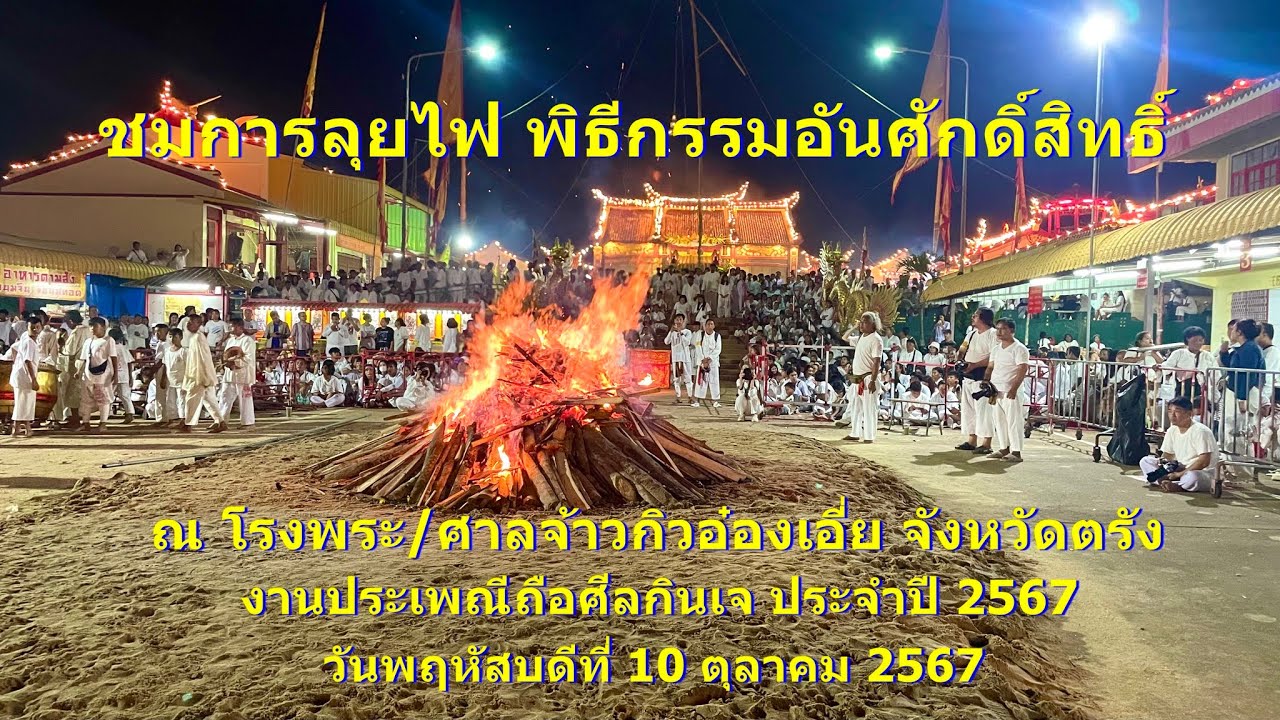
During the festival, devotees abstain from meat, purify body and mind, wear white, and participate in ritual activities according to each shrine’s schedule. Important rites in Trang’s Vegetarian Festival include raising the teng ko pole, installing 9 auspicious lamps, incense and candle processions, bridge-crossing rites for misfortune cleansing, fire-walking, knife-ladder climbing, and sacred processions through the city. These practices make Trang’s Vegetarian Festival one of the most visually powerful and spiritually intense Chinese-influenced traditions in southern Thailand.
What makes Kiw Ong Eia Shrine especially significant is its relationship with the city itself. On ordinary days, the shrine serves local worshippers. During the festival, however, the shrine becomes connected with streets, markets, homes, shops, and public spaces across Trang. Residents set up offering tables, light firecrackers, prepare flowers, fruits, tea, joss paper, and vegetarian food, and receive the sacred procession. The city becomes a ritual landscape, with the shrine at its spiritual center.
The architecture of Kiw Ong Eia Shrine reflects southern Chinese style. The shrine features a Chinese roof form with upturned eaves, a colorful façade, Chinese inscriptions, lanterns, ornamental columns, and auspicious decorative details. Visitors should take time to observe these features carefully. Red symbolizes good fortune, gold represents prosperity, dragons express power and protection, and lanterns represent spiritual light. The building is therefore both a place of worship and a visible expression of Chinese cultural meaning.
The important areas inside the shrine include the Heaven and Earth altar, the altar of the Nine Emperor Gods, Guanyin’s shrine, Tua Pek Kong’s shrine, the Ksitigarbha Bodhisattva shrine, and the open ritual ground used during the Vegetarian Festival. The layout allows the shrine to function in two ways: as a daily worship site for individuals and families, and as a large ceremonial ground during major festivals. This flexibility is one reason the shrine has remained important for so long.
Visitors should approach Kiw Ong Eia Shrine respectfully. Modest clothing is recommended. Those unfamiliar with the worship sequence can ask shrine staff or local devotees for guidance. Visitors should avoid walking in front of people who are praying, speaking loudly, touching offerings without permission, or taking photographs in restricted areas. The shrine is a living religious site, not simply a tourist backdrop, so respect for both the deities and the worshippers is essential.
Kiw Ong Eia Shrine is suitable for cultural travelers, people who wish to pray at a Chinese shrine in Trang, visitors interested in the Vegetarian Festival, and those who want to see Hokkien Chinese heritage in southern Thailand. On ordinary days, a visit may take about 30 minutes to 1 hour. During the Vegetarian Festival, travelers should allow more time because the city becomes busy, roads may be affected by processions, and ritual schedules need to be checked with the shrine or local authorities.
The location of Kiw Ong Eia Shrine is highly convenient. It stands on Thaklang Road in Trang Municipality, opposite Wat Tantayapirom, one of Trang’s important royal temples. It is also close to Trang Clock Tower, Trang Railway Station, Thaklang Market, local food areas, and other city landmarks. This makes the shrine easy to include in a walking or short-driving route through Trang city center.
Getting There from Trang Clock Tower is straightforward. Drive or ride through the city toward Thaklang Road for about 2 km. The shrine is located at 169 Thaklang Road, opposite Wat Tantayapirom. From Trang Railway Station, visitors can take a local vehicle or drive through the city streets to Thaklang Road in a short time. Those driving during the Vegetarian Festival should plan parking carefully because the area becomes crowded with devotees and visitors.
The best time to visit on ordinary days is from morning to early afternoon, when the weather is more comfortable and visitors can worship without rushing. Travelers who want to experience the Vegetarian Festival should check the annual schedule before traveling because the dates follow the Chinese lunar calendar and the timing of each ritual may change each year. During the festival, wearing white and following shrine instructions will make the experience more respectful and meaningful.
Kiw Ong Eia Shrine offers many attractive photography angles, including the front façade, Chinese roofline, inscriptions, lanterns, and decorative details. Photography should be done with care. Visitors should not disturb worshippers, stand too close to altars, or enter ritual areas without permission. During the festival, special care is needed around processions, firecrackers, and staff-controlled areas.
A useful city route can begin at Kiw Ong Eia Shrine, then continue across the road to Wat Tantayapirom. Travelers can then visit Thaklang Market for local food, continue to Trang Clock Tower, walk or ride to Trang Railway Station, and finish at the Phraya Ratsadanupradit Monument. This half-day route combines Chinese shrine culture, Buddhist heritage, local food, transport history, and civic memory in one compact city experience.
During the Vegetarian Festival, the visit requires a different approach. The shrine becomes busy, ceremonial spaces are active, and processions may move through the city. Visitors should dress respectfully, follow the flow of the crowd, stay behind safety lines, and avoid obstructing ritual participants. Travelers who participate with cultural sensitivity will understand that the festival is not only a spectacle but an act of devotion, purification, and community continuity.
Another strength of Kiw Ong Eia Shrine is that it brings generations together. Elderly devotees continue family worship traditions, working adults come to pray for health, trade, and protection, and younger people learn how Trang’s Chinese traditions are maintained. This makes the shrine a living cultural institution rather than only an old building. Its meaning is renewed through everyday worship and annual ritual practice.
From a conservation perspective, Kiw Ong Eia Shrine is an important cultural heritage site. Preserving the shrine means protecting the building, the ritual knowledge, the deity traditions, the ceremonial objects, and the collective memory of the Thai-Chinese community. The shrine’s continued use is part of its value. It remains meaningful because people still pray here, organize ceremonies here, and transmit the tradition to younger generations.
Kiw Ong Eia Shrine also helps travelers understand Trang as a multicultural city. Along and around Thaklang Road, Chinese shrines, Buddhist temples, old houses, food shops, markets, and historic streets exist close together. This proximity reflects how different beliefs and communities have long shared the same urban space. Visiting the shrine is therefore not only an act of sightseeing but also a way to read Trang’s social history through its religious places and streets.
In summary, Kiw Ong Eia Shrine is one of the most important sites of Chinese cultural heritage in Trang. It is an old Hokkien shrine on Thaklang Road, the home of Kiw Ong Tai Te and other sacred figures, a major ritual center for Trang’s Vegetarian Festival, and a cultural attraction that helps visitors understand the city in greater depth. Anyone who wants to see Trang beyond beaches and food should include this shrine in a city itinerary to experience faith, migration history, local identity, and southern Chinese architecture in the heart of Trang.
| Name | Kiw Ong Eia Shrine, also known as Kew Ong Ear Chinese Shrine |
| Location | Thaklang Road, Thap Thiang Subdistrict, Mueang Trang District, Trang Province |
| Address | 169 Thaklang Road, Thap Thiang Subdistrict, Mueang Trang District, Trang 92000, Thailand |
| Coordinates | 7.5667122727, 99.5955208157 |
| Highlights | An old Hokkien Chinese shrine in Trang, the worship site of Kiw Ong Tai Te, and a major center of Trang’s Vegetarian Festival |
| History | The shrine is linked to Hokkien Chinese migration along the Trang River about 150–160 years ago. The present shrine structure was rebuilt in 1952 after the older wooden shrine deteriorated. |
| Name Origin | The shrine name is associated with Kiw Ong Tai Te, the Nine Emperor Gods or nine celestial deities in Hokkien Chinese belief. |
| Distinctive Features | Southern Chinese architecture, Chinese roof form, red and gold decorative elements, Chinese inscriptions, lanterns, ritual courtyard, and multiple deity altars |
| Main Sacred Figures | Kiw Ong Tai Te, Pak Tao Sae Kun, Lang Kuan Tai Te, Tua Pek Kong, Chao Pho Suea, Guanyin, and Ksitigarbha Bodhisattva |
| Traditions / Rituals | Trang Vegetarian Festival, raising the teng ko pole, installing 9 auspicious lamps, incense and candle processions, bridge-crossing rites, fire-walking, knife-ladder climbing, and sacred processions through the city |
| Travel Information | From Trang Clock Tower, travel through the city toward Thaklang Road for about 2 km. The shrine is opposite Wat Tantayapirom and close to Trang Railway Station. |
| Current Status | An active Chinese shrine used for worship and community rituals by Trang’s Thai-Chinese community |
| Open Days | Daily |
| Opening Hours | 05.00 – 17.00 |
| Facilities / Main Areas | Heaven and Earth altar, Kiw Ong Tai Te altar, Guanyin shrine, Tua Pek Kong shrine, Ksitigarbha Bodhisattva shrine, ritual courtyard, and Vegetarian Festival activity areas |
| Main Contact Number | 075-210-701 |
| Visitor Etiquette | Dress modestly, keep quiet, avoid disturbing worshippers, do not touch offerings without permission, and follow shrine instructions, especially during the Vegetarian Festival |
| Nearby Tourist Attractions | 1. Wat Tantayapirom, about 0.1 km 2. Thaklang Market, about 0.5 km 3. Trang Clock Tower, about 2 km 4. Trang Railway Station, about 2 km 5. Phraya Ratsadanupradit Monument, about 3 km |
| Nearby Restaurants | 1. Jiraphan Chicken Biryani, about 0.3 km, Tel. 098-215-9983 2. Thaklang Roasted Duck, about 0.5 km, Tel. 064-726-4895 3. Baan Lek Tee 9, about 0.6 km, Tel. 088-784-3015 4. Kafae Thap Thiang, about 0.4 km, Tel. 084-064-4214 5. Chama Chama Thaklang Road, about 0.5 km, Tel. 085-536-1653 |
| Nearby Accommodations | 1. Thumrin Hotel, about 2 km, Tel. 075-211-011 2. Ban Ao Thong, about 2 km, Tel. 086-479-5466 3. Thumrin Thana Hotel, about 2.5 km, Tel. 075-211-211 4. Na Thap Thiang Boutique Resort, about 3 km, Tel. 075-581-555 5. Rua Rasada Hotel, about 5 km, Tel. 075-226-999 |
Frequently Asked Questions (FAQ)
Q: Where is Kiw Ong Eia Shrine located?
A: Kiw Ong Eia Shrine is located at 169 Thaklang Road, Thap Thiang Subdistrict, Mueang Trang District, Trang 92000, opposite Wat Tantayapirom.
Q: What are the opening hours of Kiw Ong Eia Shrine?
A: Kiw Ong Eia Shrine is open daily from 05.00 to 17.00.
Q: Why is Kiw Ong Eia Shrine important?
A: It is an old Hokkien Chinese shrine in Trang, the worship site of Kiw Ong Tai Te, and one of the main ritual centers of Trang’s Vegetarian Festival.
Q: How is Kiw Ong Eia Shrine connected with Trang’s Vegetarian Festival?
A: The shrine plays a major role in the Kin Phak tradition, with rituals such as raising the teng ko pole, incense and candle ceremonies, bridge-crossing rites, fire-walking, knife-ladder climbing, and sacred processions through the city.
Q: Which sacred figures are worshipped inside the shrine?
A: The shrine includes Kiw Ong Tai Te, Pak Tao Sae Kun, Lang Kuan Tai Te, Tua Pek Kong, Chao Pho Suea, Guanyin, and Ksitigarbha Bodhisattva.
Q: How do travelers get to Kiw Ong Eia Shrine from Trang Clock Tower?
A: From Trang Clock Tower, travel through the city toward Thaklang Road for about 2 km. The shrine stands opposite Wat Tantayapirom.
Q: How should visitors behave at Kiw Ong Eia Shrine?
A: Visitors should dress modestly, keep quiet, avoid disturbing worshippers, avoid touching offerings without permission, and follow shrine instructions.
Q: What nearby attractions can be combined with Kiw Ong Eia Shrine?
A: Nearby attractions include Wat Tantayapirom, Thaklang Market, Trang Clock Tower, Trang Railway Station, and Phraya Ratsadanupradit Monument.
 Category: ●Places of Worship
 Group: ●Other Sacred Sites
Last Update : 2 MonthAgo
 Last Update : 2 MonthAgo
 Click to Access the Navigation Map GPS
Kiw Ong Eia Shrine Map
Recommend

 Art, Culture and Heritage
 Historical Sites and Monuments(1)
 Landmarks and Memorials(2)
 Art, Craft Centres, Tradition(3)
 Museums(2)
 Temple(15)
 Mosque(1)
Other Sacred Sites(7)
 Research and Development
 Royal Project(1)
 Suburban Living
 Village, Community(5)
 Nature and Wildlife
 National Parks and Marine Reserves(6)
 Mountain (Doi)(8)
 Dam, Reservoir, Lake(1)
 Waterfalls(20)
 Hot Springs(1)
 Caves(11)
 Bays and Beaches(11)
 Islands(12)
 Other natural attractions(3)
 Entertainment and Agricultural
 Farms, Parks and Ecotourism(8)
 Outdoor and Adventure Activities(1)
 Travel Articles, Recipes
 Travel Review, Food Review(1)
 Southern Food Menu, Southern Food Recipes(1)


