
lovethailand home >South Travel Attractions >Trang Travel Attractions >Yan Ta Khao >Thung Khai > Peninsular Botanical Garden (Thung Khai)
TL;DR: Peninsular Botanical Garden (Thung Khai) is located at Thung Khai Subdistrict, Yan Ta Khao District, Trang Province, open Daily, hours 08.30 – 16.30.
Peninsular Botanical Garden (Thung Khai)
Open Days: Daily
Opening Hours: 08.30 – 16.30
Peninsular Botanical Garden (Thung Khai) in Trang Province is one of the most important nature-learning and plant-conservation attractions in southern Thailand. It is located in Thung Khai Subdistrict, Yan Ta Khao District, along the Trang–Palian Road, Highway 404, around kilometer marker 11 and about 13 km from Trang City. The garden is suitable for visitors interested in forests, plant diversity, lowland evergreen ecosystems, peat forest, wildlife, nature trails, and conservation-based travel. Its best-known highlight is Thailand’s first canopy nature trail, allowing visitors to walk above the forest floor and observe the forest structure from the level of the tree crowns.
This botanical garden gives travelers a deeper view of Trang beyond beaches, islands, caves, waterfalls, old streets, and food culture. Trang is not only a coastal province; it also contains fertile forests and distinctive wetland ecosystems. Peninsular Botanical Garden (Thung Khai) combines relaxation with learning. Visitors can experience shaded forest, diverse plant collections, natural sounds, walking trails, and a large green landscape located within easy reach of Trang City.
The garden lies within the Thung Khai forest area, where the landscape includes flat land, low hills, small streams, lowland evergreen forest, and peat forest. Its large area makes it a plant-conservation site, a research and education area, a field-learning destination for students, and a recreational place for visitors who want to enjoy nature without traveling far from Trang. Because the terrain is varied, each trail offers a slightly different experience, allowing visitors to choose routes according to time, interest, and physical ability.
The importance of Peninsular Botanical Garden (Thung Khai) goes beyond tourism. It functions as a southern plant-conservation area with several plant groups arranged for study and public learning. The garden includes an arboretum, medicinal herb garden, fern garden, carnivorous plant area, palm-family collections, dipterocarp and rubber-family plants, rare species, and southern plant collections. These areas allow visitors to understand the relationship between plants and real ecosystems, rather than seeing trees only as decorative landscape elements.
The visitor center is a practical starting point for a visit. Travelers can use this area to ask about trails, opening conditions, group activities, camping use, and safety rules before entering the nature routes. The garden also has a botanical library, plant museum, meeting room, and areas for tents or camp activities. These facilities make the site suitable for schools, organizations, and groups that want a structured nature-learning program. Some facilities, especially camping and group-use areas, should be arranged with staff in advance.
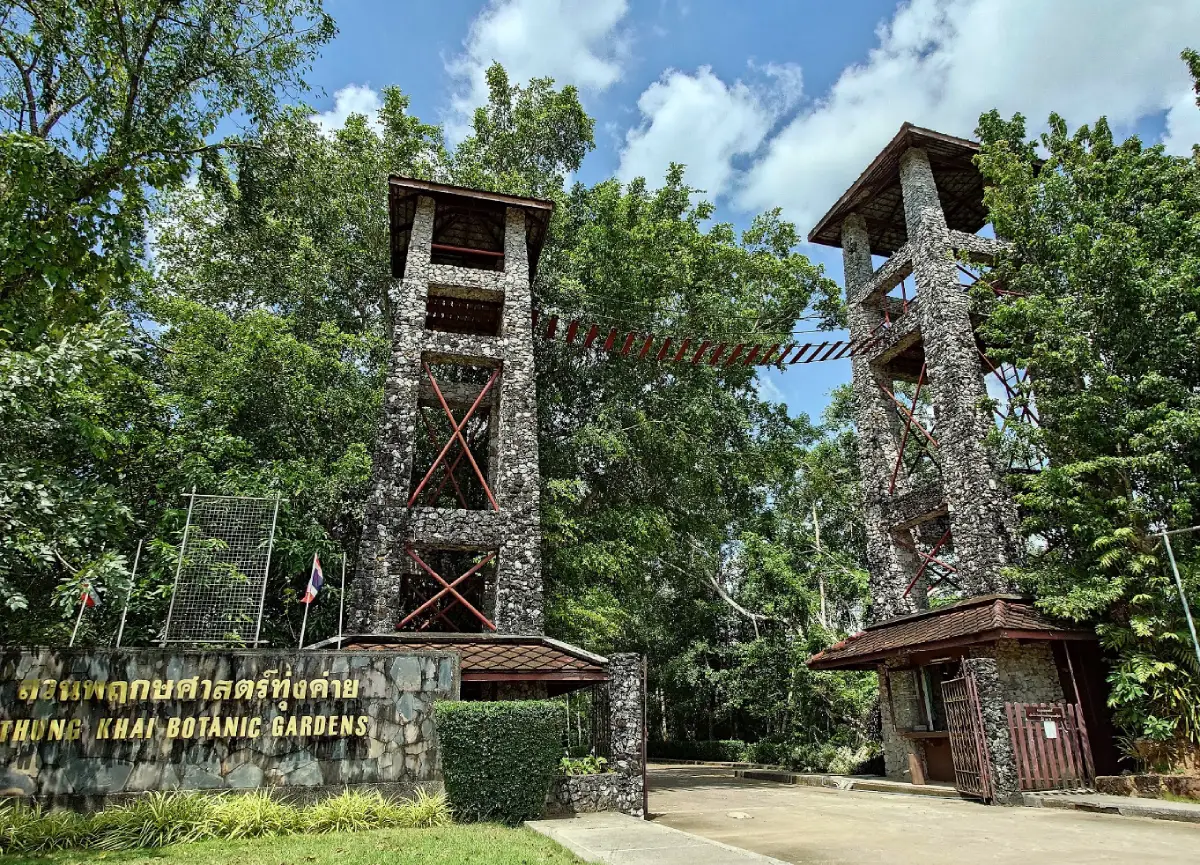
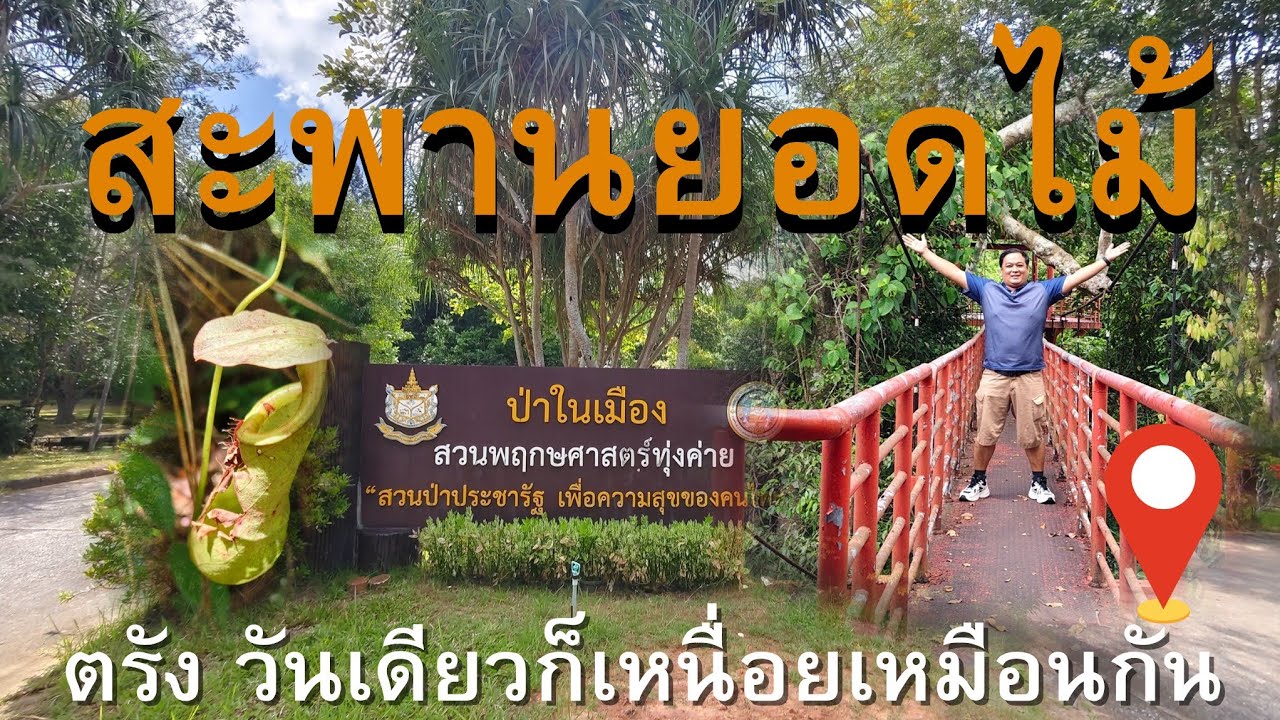
The most famous feature of the garden is the canopy nature trail. It was designed so visitors can study the forest from a level that cannot be seen clearly from the ground. The bridge system is about 175 m long and is connected by towers and several bridge sections. Its height reaches around 5–20 m, bringing visitors close to the forest canopy. From this level, visitors can observe trunks, branches, leaves, flowers, fruits, epiphytes, vines, and living organisms that use the upper forest structure.
Walking on the canopy trail is different from an ordinary forest walk. Visitors do not see the forest only from the forest floor; they can observe the layers of a humid evergreen forest from above. A tropical forest has several vertical layers, from ground plants and shrubs to mid-level trees and tall canopy trees. The canopy walkway helps visitors understand that a forest is not merely a dense group of trees. It is a layered ecosystem shaped by height, moisture, changing light, and many living organisms occupying different levels.
Morning is often the most refreshing time to experience the canopy walkway. Soft light passes through the leaves, while bird calls and insect sounds make the walk calm and immersive. Late afternoon before closing time can also be pleasant for softer light and forest photography, but visitors should allow enough time to return before the garden closes. Running, playing, or careless movement on the bridge should be avoided, and all safety guidance from staff should be followed.
In addition to the canopy walkway, the garden has several nature trails. These routes pass through lowland evergreen forest and peat forest, where many interesting plant species grow in humid conditions. Some trails are about 1,200 m long and take around 30–45 minutes to walk. This length is suitable for visitors who want a meaningful nature experience without a demanding trek. The trails are useful for students, families, and general travelers who want to learn from a real forest setting.
Lowland evergreen forest is especially valuable for nature education. It is humid, dense, and rich in different plant layers. Some plants are tall canopy trees, some grow near the forest floor, some are ferns, vines, or epiphytes living on trunks and branches. Walking through this type of forest shows that forest abundance is not created by large trees alone. It comes from the relationships among small plants, large trees, soil, water, light, and wildlife.
The peat forest area is another reason the garden has strong educational value. Peat forest is a wetland ecosystem with its own character. Soil, water, and plant growth are closely connected. Plants in wetland forest must adapt to moisture and environmental conditions different from dry-ground forest. Visitors walking through this area can see a type of nature rarely found in ordinary public parks and better understand why wetlands are important for biodiversity.
The medicinal herb garden is suitable for visitors interested in useful plants. Many herbs are connected with Thai and southern local knowledge. Studying herbs in a botanical garden helps visitors see that plants are valuable not only for beauty, but also for food, medicine, health, and community life. A living garden makes these ideas easier to understand than reading plant names from a book.
The arboretum and southern plant collections complete the garden’s botanical character. Many southern plant species are important ecologically, economically, and culturally. Walking through these areas helps visitors recognize trees that grow in southern conditions and understand their roles as food sources, wildlife habitat, shade, and part of the local landscape.
The fern garden and carnivorous plant area often attract strong interest because these plants have forms and survival strategies that differ from familiar garden plants. Ferns reflect moist and shaded environments, while carnivorous plants show how plants adapt to low-nutrient habitats. These displays are especially useful for children and young learners because they make natural science visible through real specimens.
Wildlife found in and around the botanical garden, including birds, squirrels, flying lemurs, mouse deer, junglefowl, and smaller animals, contributes to the living character of the forest. Bird calls, insect sounds, and movement in the trees make a nature walk more than a plant-viewing activity. Visitors should observe wildlife from a respectful distance, avoid feeding animals, avoid chasing them, and keep noise levels low.
Large forest trees are among the most meaningful features to observe. The garden contains notable mature trees, including large ironwood-type trees that show the age and continuity of the forest. A large tree takes a long time to grow, and standing beneath it helps visitors understand both the strength of nature and the need to conserve forest areas for future generations.
Peninsular Botanical Garden (Thung Khai) is suitable for many types of visitors. Families can bring children to learn about nature in a safe and accessible setting. Students can use the garden for field learning in science, biology, environment, and geography. Health-conscious visitors can walk gently along nature trails, while photographers can capture forests, the canopy walkway, plants, and natural details that differ from Trang’s urban or coastal images.
A visit should not be rushed. Travelers who want to see only the canopy walkway and a short trail can allow about 1–2 hours. Those who want to visit the visitor center, walk several routes, see the medicinal herb garden, arboretum, plant museum, and stop for photos should plan for around half a day. Giving enough time makes the visit more meaningful and reduces the risk of walking too quickly in a natural environment.
The best time to visit is from morning to before noon, when the weather is not too hot, the light is good for photography, and wildlife may be more active than during the heat of the day. Late afternoon can also be pleasant, but visitors should allow enough time to return before closing. During rain or after rain, walking should be more cautious because nature trails can be slippery and peat forest areas remain humid. Proper walking shoes are strongly recommended.
Useful items to bring include walking shoes, drinking water, a hat, mosquito repellent, a camera, and comfortable clothing. Groups planning camping, field study, meeting-room use, or educational activities should contact staff in advance to confirm conditions, suitable routes, and facility use. Activities in a natural area should always be planned carefully so they remain safe and do not disturb the ecosystem.
Good visitor behavior is essential because the garden is both a tourist attraction and a conservation area. Visitors should not collect plants, flowers, seeds, or plant parts. They should not feed wildlife, make loud noise, leave litter, or leave designated trails. Staying on the provided paths reduces damage to roots, ground plants, and wetland areas, and also helps staff maintain the site more effectively.
Getting There is easiest by private car, rental car, or hired local transport from Trang City. Travel along the Trang–Palian Road, Highway 404, toward Yan Ta Khao District. The garden is located in Thung Khai Subdistrict around kilometer marker 11 and about 13 km from Trang City. The route is straightforward and suitable for a half-day trip from town or as a stop before continuing toward Yan Ta Khao, Palian, or Kantang.
Visitors without a private vehicle can arrange hired transport from Trang City or through their accommodation. This is usually more convenient than relying on flexible public transport, because the garden visit may take several hours and must fit the opening hours. Families, school groups, and organized groups may find a van or hired vehicle more practical. After visiting the garden, travelers can continue to nearby places such as Trang Clock Tower, Trang Old Town, Na Muen Sri Weaving Museum, or Phraya Ratsadanupradit Mahitsaraphakdi Museum, depending on the planned route.
The garden is especially suitable for family travel and outdoor education. Children can learn from real plants, leaves, flowers, ferns, carnivorous plants, wetlands, and forest sounds. The canopy walkway adds excitement and makes the structure of a tropical forest easier to understand. Adults can also rest, breathe cleaner air, and spend time in a managed natural area that supports visitors.
For photographers, the garden offers several useful scenes: the canopy bridge, shaded walking trails, forest-floor plants, leaves in morning light, mature trees, peat forest, and educational nature-walk moments. Photography should respect the natural setting and other visitors. Those using larger cameras or photographing in groups should avoid blocking the walkway or narrow nature trails.
Compared with many other nature attractions in Trang, Peninsular Botanical Garden (Thung Khai) has strong practical advantages. It is easy to reach, close to Trang City, has clear nature trails, has visitor facilities, and teaches visitors about plants and ecosystems without requiring advanced trekking ability. Travelers with limited time can still experience forest nature within half a day, while those who want a more detailed visit can spend longer walking several routes and observing the garden’s biodiversity.
A practical one-day route can begin at Peninsular Botanical Garden (Thung Khai) in the morning, with time for the canopy walkway and nature trails. After that, travelers can return to Trang City for the clock tower, street art, old commercial area, or local lunch. In the afternoon, the route can continue to Na Muen Sri Weaving Museum or toward Kantang District. This plan combines nature, local culture, urban heritage, and Trang’s history in one day.
Peninsular Botanical Garden (Thung Khai) should be included in a Trang itinerary for travelers who want more than landmark photos. It helps visitors understand southern nature through real forests, living plants, and structured nature trails. Its appeal is not based on spectacle, but on ecological richness, learning value, and the rare experience of walking near the forest canopy. Travelers who enjoy nature, plants, and meaningful conservation-based travel will find this garden especially worthwhile.
In summary, Peninsular Botanical Garden (Thung Khai) is a major nature-learning site near Trang City. It includes a visitor center, arboretum, medicinal herb garden, botanical library, plant museum, meeting room, camping area, nature trails, lowland evergreen forest, peat forest, and Thailand’s first canopy nature walkway. It is suitable for conservation travel, plant study, light exercise, photography, family trips, and peaceful recreation in a large green area that preserves the biodiversity of southern Thailand.
| Name | Peninsular Botanical Garden (Thung Khai) |
| Other Names | Thung Khai Botanical Garden, Southern Botanical Garden, Peninsular Botanical Garden |
| Location | Thung Khai Subdistrict, Yan Ta Khao District, Trang Province |
| Address | Trang–Palian Road, Highway 404, Thung Khai Subdistrict, Yan Ta Khao District, Trang Province 92140, Thailand |
| Coordinates | 7.468080, 99.638333 |
| Area | About 2,600 Rai |
| Highlights | Thailand’s first canopy nature walkway, nature trails, lowland evergreen forest, peat forest, medicinal herb garden, arboretum, and southern plant-learning areas |
| History / Development | The Thung Khai forest area was historically associated with the camp of Chao Phraya Nakhon Noi’s forces during the suppression of the Wan Madli rebellion in the early Rattanakosin period. In 1993, the idea to establish a southern botanical garden in Thung Khai was supported to conserve, study, research, and present southern plant diversity to the public. |
| Landscape | Flat land with low hills, small streams, humid evergreen forest, lowland evergreen forest, and peat forest with diverse plants and wildlife |
| Canopy Walkway | A canopy nature trail about 175 m long, connected by towers and bridge sections, with heights of about 5–20 m for observing forest structure and plants at canopy level |
| Travel Information | Travel from Trang City along the Trang–Palian Road, Highway 404, toward Yan Ta Khao District. The garden is in Thung Khai Subdistrict around kilometer marker 11 and about 13 km from Trang City. Private car, rental car, or hired transport is recommended. |
| Current Status | Open as a botanical garden, nature-learning site, conservation attraction, and southern plant-study area |
| Open Days | Daily |
| Opening Hours | 08.30 – 16.30 |
| Admission Fee | General nature-trail walking is free of admission charge. Visitors planning group activities, camping, meeting-room use, or special services should call ahead before traveling. |
| Facilities | Visitor center, arboretum, medicinal herb garden, botanical library, plant museum, meeting room, tent area, camp activity area, nature trails, and parking |
| Main Areas / Zones | Visitor center, canopy nature walkway, medicinal herb garden, arboretum, fern garden, carnivorous plant area, palm-family plants, dipterocarp and rubber-family plants, lowland evergreen forest, peat forest, nature trails, and camp area |
| Caretaker | Department of National Parks, Wildlife and Plant Conservation, through botanical and plant-conservation units |
| Main Contact Number | 075-280-166 |
| Nearby Tourist Attractions | 1. Trang Clock Tower Commercial Area, about 10 km 2. Cinta Garden Market, about 11 km 3. Trang Street Art, about 12 km 4. Na Muen Sri Weaving Museum, about 15 km 5. Phraya Ratsadanupradit Mahitsaraphakdi Museum, about 15 km 6. Kantang Hot Spring Forest Park, about 20 km |
| Nearby Restaurants | 1. Cafe Amazon At Pornchai Rungrueangkit Service Station, about 1.5 km, Tel. 098-060-3083 2. Kai Yang Thung Khai, about 2 km, Tel. 062-236-7278 3. Tae Laeng Cafe Thung Khai, about 3 km, Tel. 063-296-9459 4. Steak A Fai, about 3 km, Tel. 081-740-9738 5. 248 Something Sweet, about 8 km, Tel. 080-629-7284 6. Wan Wan Dim Sum, about 8 km, Tel. 096-398-2656 |
| Nearby Accommodations | 1. My Heaven Resort, about 2 km, Tel. 094-492-4916 2. Thung Khai Resort Hotel, about 5 km, Tel. 075-280-084 3. BP Resort, about 9 km, Tel. 098-305-0935 4. W Smart Stay Trang, about 10 km, Tel. 061-454-9959 5. Baan Bangrak Residence, about 10 km, Tel. 099-482-3200 6. Sixty-Six Place, about 10 km, Tel. 086-475-7422 |
Frequently Asked Questions (FAQ)
Q: Where is Peninsular Botanical Garden (Thung Khai) located?
A: Peninsular Botanical Garden (Thung Khai) is located in Thung Khai Subdistrict, Yan Ta Khao District, Trang Province, along the Trang–Palian Road, Highway 404, around kilometer marker 11 and about 13 km from Trang City.
Q: What are the opening hours of Peninsular Botanical Garden (Thung Khai)?
A: The garden is open daily from 08.30 to 16.30. Morning to late morning is the best period for nature walks because the weather is cooler and the light is good for photography.
Q: What is the main highlight of the garden?
A: The main highlight is Thailand’s first canopy nature walkway, together with nature trails, lowland evergreen forest, peat forest, medicinal herb garden, arboretum, botanical library, plant museum, and southern plant-learning areas.
Q: What makes the canopy walkway special?
A: The canopy walkway is about 175 m long and reaches around 5–20 m in height, allowing visitors to observe forest structure, plants, epiphytes, and canopy-level ecology from above the forest floor.
Q: Is there an admission fee?
A: General nature-trail walking is free of admission charge. Visitors who want to use group activity areas, camping areas, meeting rooms, or special services should call the garden before traveling.
Q: How long should visitors spend at the garden?
A: A short visit to the canopy walkway and one short trail may take 1–2 hours. Visitors who want to explore the herb garden, arboretum, plant museum, and several trails should allow about half a day.
Q: How can travelers get to the garden?
A: From Trang City, travel along the Trang–Palian Road, Highway 404, toward Yan Ta Khao District. The garden is in Thung Khai Subdistrict around kilometer marker 11. Private car, rental car, or hired local transport is recommended.
Q: Who is this botanical garden suitable for?
A: It is suitable for families, students, plant enthusiasts, nature lovers, photographers, and travelers who want an accessible conservation-based nature attraction near Trang City.
Tel : 075280166
 Tel : 075280166
 Category: ●Entertainment and Agricultural
 Group: ●Farms, Parks and Ecotourism
Last Update : 1 MonthAgo
 Last Update : 1 MonthAgo
 Click to Access the Navigation Map GPS
Peninsular Botanical Garden (Thung Khai) Map
Recommend

 Art, Culture and Heritage
 Historical Sites and Monuments(1)
 Landmarks and Memorials(2)
 Art, Craft Centres, Tradition(3)
 Museums(2)
 Places of Worship
 Temple(15)
 Mosque(1)
 Other Sacred Sites(7)
 Research and Development
 Royal Project(1)
 Suburban Living
 Village, Community(5)
 Nature and Wildlife
 National Parks and Marine Reserves(6)
 Mountain (Doi)(8)
 Dam, Reservoir, Lake(1)
 Waterfalls(20)
 Hot Springs(1)
 Caves(11)
 Bays and Beaches(11)
 Islands(12)
 Other natural attractions(3)
Farms, Parks and Ecotourism(8)
 Outdoor and Adventure Activities(1)
 Travel Articles, Recipes
 Travel Review, Food Review(1)
 Southern Food Menu, Southern Food Recipes(1)


