
lovethailand home >South Travel Attractions >Trang Travel Attractions >Kan Trang >Kan Trang > First Para Rubber Tree of Thailand
TL;DR: First Para Rubber Tree of Thailand is located at Along Trangkhaphum Road Before Entering Kantang Town, In Front Of Kantang Agricultural Cooperative, Kantang Subdistrict, Kantang District, open Daily, hours 24 Hours.
First Para Rubber Tree of Thailand
Open Days: Daily
Opening Hours: 24 Hours
The First Para Rubber Tree of Thailand in Trang Province is located along Trangkhaphum Road before entering Kantang town, in front of Kantang Agricultural Cooperative. This roadside historical landmark marks the beginning of rubber cultivation in Thailand in 1899. It is closely linked to Phraya Ratsadanupradit Mahison Phakdi, also known as Khaw Sim Bee Na Ranong, the former governor of Trang who helped turn rubber into one of southern Thailand’s most important economic crops.
The First Para Rubber Tree of Thailand is a small but highly meaningful historical and agricultural landmark in Kantang District, Trang Province. At first glance, it may look like a quiet roadside stop with a large rubber tree, a sign, and a historical information board. Yet the place represents one of the most important turning points in the economic history of southern Thailand. From this early planting in Kantang, rubber cultivation gradually expanded and became deeply connected with local livelihoods, plantation work, trade, processing industries, and the identity of many southern communities.
The site is located along Trangkhaphum Road before entering Kantang town, in front of Kantang Agricultural Cooperative. It is easy to include in a short Kantang cultural route because it is close to other historical places linked with Phraya Ratsadanupradit Mahison Phakdi and the old port-town history of Kantang. Visitors usually stop here for photographs, read the historical sign, and continue to Phraya Ratsadanupradit Mahison Phakdi Museum, Kantang Railway Station, Kantang Old Town, and the local street art area.
Phraya Ratsadanupradit Mahison Phakdi, originally named Khaw Sim Bee Na Ranong, was one of the most influential figures in Trang’s local history. As governor of Trang, he did not focus only on administration. His work included transport development, agriculture, education, animal husbandry, urban planning, local occupations, and the strengthening of trade routes. In 1893, he moved the provincial center to Kantang and developed Kantang as a port town connected with overseas trade. This decision made Kantang an important economic gateway on Thailand’s Andaman side.
His best-known legacy is the introduction and promotion of rubber cultivation in Trang. In 1899, rubber was planted in Kantang District, creating the foundation for the later expansion of rubber plantations across southern Thailand. Over time, rubber became an essential crop for many families and communities. It provided income for plantation owners, rubber tappers, traders, processors, and related local businesses. Because of this lasting contribution, Phraya Ratsadanupradit Mahison Phakdi is widely honored as the father of Thai rubber, and Trang is remembered as the birthplace of rubber cultivation in Thailand.
The First Para Rubber Tree of Thailand is therefore not just a tree. It is a living historical marker that helps visitors understand how one agricultural experiment could reshape the economy of an entire region. The site shows that local development can begin with a practical idea, a suitable environment, and strong public leadership. It also reminds visitors that the story of Trang is not limited to beaches, islands, old-town streets, or morning food culture. Trang also played a central role in the history of Thai agriculture.
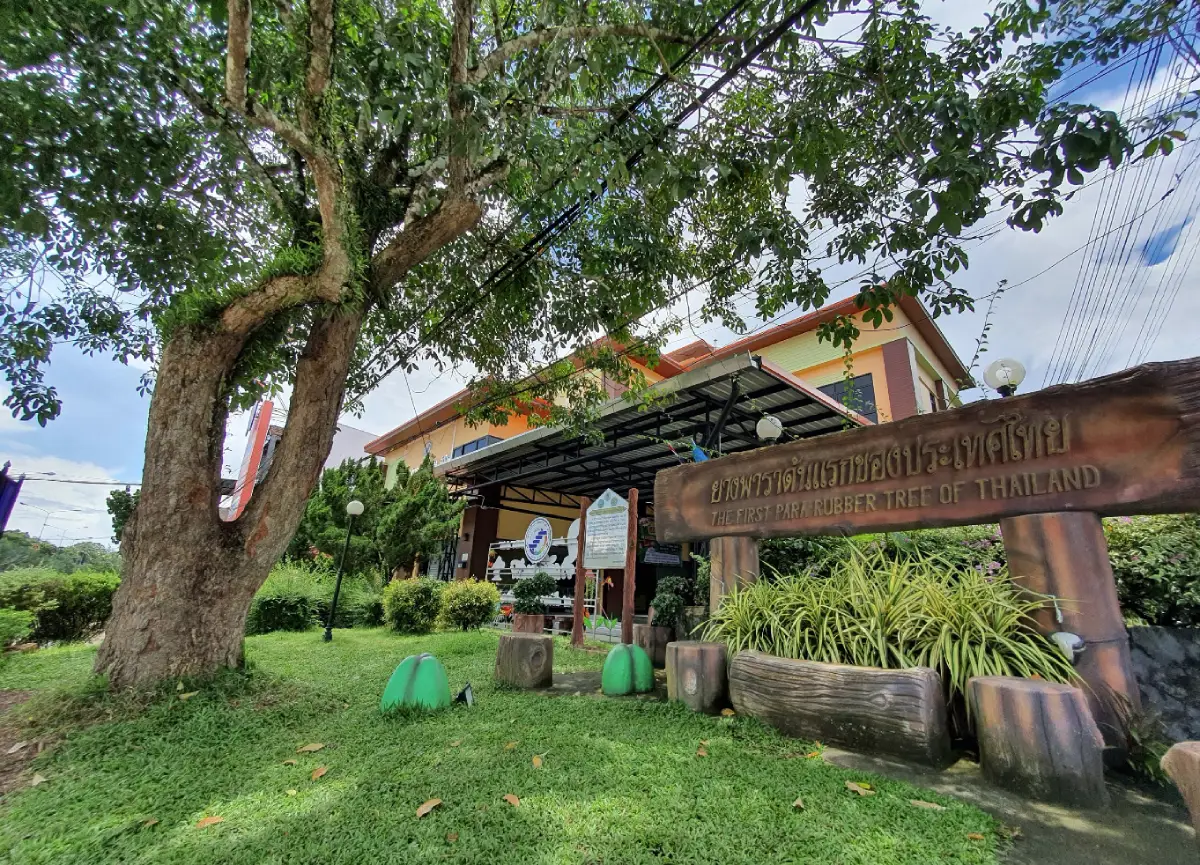
The area around the tree is an open-air memorial space. The large rubber tree, the Thai-language sign, the English landmark sign, and the historical board make it a simple but informative place to visit. Most travelers spend only a short time here, but the visit becomes more meaningful when they understand the wider context: the development of Kantang as a port town, the role of rubber in southern livelihoods, and the administrative vision of Phraya Ratsadanupradit Mahison Phakdi.
The nickname “yang thetsa” has long been associated with the early period of rubber cultivation in Trang. The term reflects the way local people connected rubber with Phraya Ratsadanupradit’s role as an important administrator. Rubber was not seen merely as a commercial crop. It became part of public memory, local respect, and the economic transformation of southern communities. For this reason, the first rubber tree in Kantang carries both agricultural and cultural significance.
Travelers who want to understand the full story should not visit the tree in isolation. Phraya Ratsadanupradit Mahison Phakdi Museum is one of the most important nearby places to combine with the visit. The museum occupies the former governor’s residence and displays wax figures, personal objects, and historical materials related to his life and work. Seeing the first rubber tree and then visiting the museum helps travelers connect the agricultural landmark with the person behind the development of Trang.
Kantang Railway Station is another important stop. Kantang was once an important port town, and the railway connected this coastal area with the wider southern railway network. The combination of port activity, railway transport, and rubber cultivation explains why Kantang became so important in the history of Trang. A visit to the first rubber tree can therefore be part of a half-day or full-day route focused on local history, trade, transport, and agriculture.
For visitors interested in photography, the main composition is the large rubber tree with the landmark sign in front. Morning and late afternoon are the best times to visit because the light is softer and the temperature is more comfortable. Since the tree stands beside a road, visitors should take photographs carefully, avoid standing in unsafe positions, and park only where it is appropriate. The site is open-air, so a hat, drinking water, or an umbrella is useful during hot weather.
The First Para Rubber Tree of Thailand is suitable for families, students, cultural travelers, agricultural visitors, and anyone planning a slow travel route through Kantang. The stop itself may take only 15 to 30 minutes, but its meaning is much larger than the time required. It helps explain how rubber shaped household income, land use, local labor, and the economy of southern Thailand over many generations.
Every 1 April is National Rubber Day in Thailand. The day recognizes the importance of rubber and honors the contribution of the early pioneers of Thai rubber cultivation. This makes the first rubber tree in Kantang especially relevant for travelers who want to understand how a local agricultural landmark became connected with a national economic story.
Getting There is straightforward from Trang city. Drive along the Trang–Kantang route for about 20 to 30 minutes depending on traffic, then look for the site on Trangkhaphum Road before entering Kantang town, in front of Kantang Agricultural Cooperative. Travelers using public transport can take a Trang–Kantang van or local bus, get off in Kantang, and continue by local transport to the landmark. The site is well known locally, so it is easy to ask for directions in town.
A practical half-day Kantang itinerary can begin with the First Para Rubber Tree of Thailand, then continue to Phraya Ratsadanupradit Mahison Phakdi Museum, Kantang Railway Station, Kantang Historical Study Center, and the old-town street art area. Travelers with more time can add Wat Trangkhaphum Phutthawat, Khuan Tamnak Chan Public Park, cafés, and local restaurants in Kantang. This route gives a compact but clear view of Kantang’s history as a port town, agricultural center, and railway-linked community.
The value of the First Para Rubber Tree of Thailand lies in its ability to explain a large historical story through a single place. It shows how leadership, experimentation, agriculture, and local geography came together in Kantang. The tree remains a living reminder of the beginning of Thai rubber cultivation and a meaningful stop for travelers who want to understand Trang beyond its more familiar tourist images.
| Name | The First Para Rubber Tree Of Thailand |
| Thai Name | ยางพาราต้นแรกของประเทศไทย |
| Location | Along Trangkhaphum Road Before Entering Kantang Town, In Front Of Kantang Agricultural Cooperative, Kantang Subdistrict, Kantang District, Trang Province |
| Address | Trangkhaphum Road, Kantang Subdistrict, Kantang District, Trang 92110, Thailand |
| Coordinates | CG5F+R5C Trangkhaphum Road, Kantang Subdistrict, Kantang District, Trang 92110, Thailand |
| Highlights | A Historic Rubber Tree Linked To The Beginning Of Rubber Cultivation In Thailand And The Agricultural History Of Southern Thailand |
| History | Early Rattanakosin Period, With The Key Beginning In 1899 When Phraya Ratsadanupradit Mahison Phakdi Introduced Rubber Cultivation To Kantang District, Trang Province |
| Historical Figure | Phraya Ratsadanupradit Mahison Phakdi, Also Known As Khaw Sim Bee Na Ranong, Former Governor Of Trang And Honored As The Father Of Thai Rubber |
| Importance | Marks The Starting Point Of Rubber Promotion In Southern Thailand And Connects Directly With The Development Of Rubber Plantation Livelihoods In Trang And The Wider South |
| Name Origin | Named For The First-Generation Rubber Tree That Remains As Historical Evidence In Kantang District, Trang Province |
| Distinctive Features | Large Roadside Rubber Tree With A Landmark Sign And Historical Information Board, Suitable For Short Visits, Photographs, And Learning About Thai Rubber History |
| Travel Information | About 20–30 Minutes From Trang City By Car Via The Trang–Kantang Route; Travelers Can Also Take A Trang–Kantang Van Or Local Bus And Continue By Local Transport |
| Current Status | Open As A Roadside Historical Landmark And Agricultural Heritage Site In Kantang District |
| Open Days | Daily |
| Opening Hours | 24 Hours; Daytime, Morning, Or Late Afternoon Visits Are Recommended |
| Fees | No Admission Fee |
| Facilities | Viewing Area, Landmark Sign, Historical Information Board, And Roadside Stop Area For Short Visits |
| Main Areas / Zones | First Rubber Tree Area, Landmark Sign, Historical Information Board, Small Roadside Green Area, And Area In Front Of Kantang Agricultural Cooperative |
| Caretaker | Kantang Municipality |
| Main Contact Number | Kantang Municipality Office Tel. 0-7525-1251, 0-7525-1201 |
| Related National Day | 1 April Is National Rubber Day In Thailand |
| Nearby Tourist Attractions | 1. Wat Trangkhaphum Phutthawat, About 0.3 km 2. Khuan Tamnak Chan Public Park, About 0.6 km 3. Phraya Ratsadanupradit Mahison Phakdi Museum, About 0.9 km 4. Kantang Railway Station, About 1 km 5. Kantang Historical Study Center, About 1 km 6. Kantang Street Art, About 1 km |
| Nearby Restaurants | 1. TonYang Cafe At Kantang, About 0.3 km, Tel. 089-723-1733 2. Bang Den Dim Sum Kantang, About 1 km, Tel. 084-723-7543 3. Khao Tom Ko Sut Kantang, About 1 km, Tel. 087-622-1494, 084-735-9620, 081-272-6308 4. TROPICAL CAFE Trang, About 1 km, Tel. 087-627-2174 5. Ling Chen Cafe, About 1 km, Tel. 066-165-4453 6. Sathani Rak Kantang Station, About 1 km, Tel. 081-979-6806 |
| Nearby Accommodations | 1. Paprao Resort, About 1 km, Tel. 093-630-2556 2. @Kantang Loftel, About 1 km, Tel. 062-080-3555 3. Kantang Park Hotel, About 1 km, Tel. 081-752-6312 4. Matou Hostel And Cafe, About 1 km, Tel. 063-246-5954 5. Sirichai Hotel Na Kantang, About 1 km, Tel. 083-812-4192 6. Thana Inn Hotel & Garden, About 2 km, Tel. 075-252-624 |
Frequently Asked Questions (FAQ)
Q: Where is the First Para Rubber Tree of Thailand located?
A: It is located along Trangkhaphum Road before entering Kantang town, in front of Kantang Agricultural Cooperative, Kantang Subdistrict, Kantang District, Trang Province.
Q: Why is the First Para Rubber Tree of Thailand important?
A: It marks the beginning of rubber cultivation in Thailand and is linked to the early development of rubber plantation livelihoods in Trang and southern Thailand.
Q: Who introduced rubber cultivation to Trang?
A: Phraya Ratsadanupradit Mahison Phakdi, also known as Khaw Sim Bee Na Ranong, was the key figure associated with introducing rubber cultivation to Kantang District in 1899 and is honored as the father of Thai rubber.
Q: What are the opening hours?
A: The site is a roadside historical landmark and is open daily, 24 hours. Morning and late afternoon are the best times for visiting and photography.
Q: Is there an admission fee?
A: No. There is no admission fee because the site is a public roadside historical landmark.
Q: How can travelers get there from Trang city?
A: Travelers can drive from Trang city to Kantang in about 20 to 30 minutes via the Trang–Kantang route, or take a Trang–Kantang van or local bus and continue by local transport.
Q: What nearby attractions should be combined with this visit?
A: Good nearby stops include Phraya Ratsadanupradit Mahison Phakdi Museum, Kantang Railway Station, Wat Trangkhaphum Phutthawat, Kantang Historical Study Center, and Kantang Street Art.
Q: Why is 1 April related to rubber in Thailand?
A: 1 April is National Rubber Day in Thailand, a day that recognizes the importance of rubber and honors the contribution of the early pioneers of Thai rubber cultivation.
 Category: ●Art, Culture and Heritage
 Group: ●Landmarks and Memorials
Last Update : 2 MonthAgo
 Last Update : 2 MonthAgo
 Click to Access the Navigation Map GPS
First Para Rubber Tree of Thailand Map
Recommend

 Historical Sites and Monuments(1)
Landmarks and Memorials(2)
 Art, Craft Centres, Tradition(3)
 Museums(2)
 Places of Worship
 Temple(15)
 Mosque(1)
 Other Sacred Sites(7)
 Research and Development
 Royal Project(1)
 Suburban Living
 Village, Community(5)
 Nature and Wildlife
 National Parks and Marine Reserves(6)
 Mountain (Doi)(8)
 Dam, Reservoir, Lake(1)
 Waterfalls(20)
 Hot Springs(1)
 Caves(11)
 Bays and Beaches(11)
 Islands(12)
 Other natural attractions(3)
 Entertainment and Agricultural
 Farms, Parks and Ecotourism(8)
 Outdoor and Adventure Activities(1)
 Travel Articles, Recipes
 Travel Review, Food Review(1)
 Southern Food Menu, Southern Food Recipes(1)


