
lovethailand home >South Travel Attractions >Surat Thani Travel Attractions >Kan Chana Dit >Phlai Wat > Surat Thani Oyster Farms
TL;DR: Surat Thani Oyster Farms, Surat Thani attractions : Entertainment and Agricultural, Animal camps and shows.

Surat Thani Oyster Farms
Open Days: Oyster-farm boat visits operate according to local boat arrangements and should be organized in advance.
Opening Hours: Visiting times depend on boat schedules and tidal conditions. Morning or low tide is best for seeing oysters attached to the concrete cultivation posts.
Surat Thani Oyster Farms in Kanchanadit District offer one of the clearest ways to understand why Surat Thani is widely associated with exceptionally large oysters. Rather than being a single gated tourist attraction, the oyster-farming landscape extends along the coast of Bandon Bay, particularly around Pak Nam Kadae, the mouth of Tha Thong Canal, and productive waters in Kadae, Tha Thong and Plai Was subdistricts. A visit combines coastal scenery with working aquaculture, long-tail boats, mangrove environments, local seafood and the everyday livelihood of fishing communities.
The oyster-farming areas remain active. In 2026, Thai authorities continued inspecting farms producing the geographical-indication product known as “Surat Thani Oyster.” Inspections covered Ao Thong Khao in Tha Thong, Ao Tha Na in Kadae, and Ao Bang Un in Plai Was. Kanchanadit tourism information also continues to present boat trips to oyster farms as a local experience where visitors can learn about traditional shellfish cultivation and fishing-community life.
This distinction is important for trip planning. “Surat Thani Oyster Farm” does not describe one commercial attraction with a universal entrance ticket, reception desk and fixed opening time. It describes a group of working cultivation areas spread across estuaries, bays and brackish coastal waters. Reaching the farms therefore depends on local boats, tides and the particular plot being visited. Travelers should arrange the boat first rather than simply arriving at a map pin and expecting a scheduled tour.
Pak Nam Kadae in Kadae Subdistrict is one of the most convenient places for travelers to begin exploring the oyster culture of Kanchanadit. The community combines a working fishing environment with a seafood market, restaurants, a mangrove nature trail, a public waterfront area and access to the wider oyster-producing landscape. Travelers with limited time can experience the community without taking a boat, while those interested in seeing cultivation structures at sea can arrange a local boat trip.
The fame of Surat Thani oysters is closely connected with the environment of Bandon Bay. The shallow bay receives both seawater and freshwater flowing from the mainland, producing extensive brackish-water conditions. This mixing of water, together with tidal circulation and nutrient-rich coastal habitats, supports oyster and other shellfish cultivation. Tourism Authority of Thailand information identifies Pak Nam Kadae as a major natural oyster-cultivation and learning area and also notes the presence of mussels, blood cockles and other shellfish in the wider coastal economy.
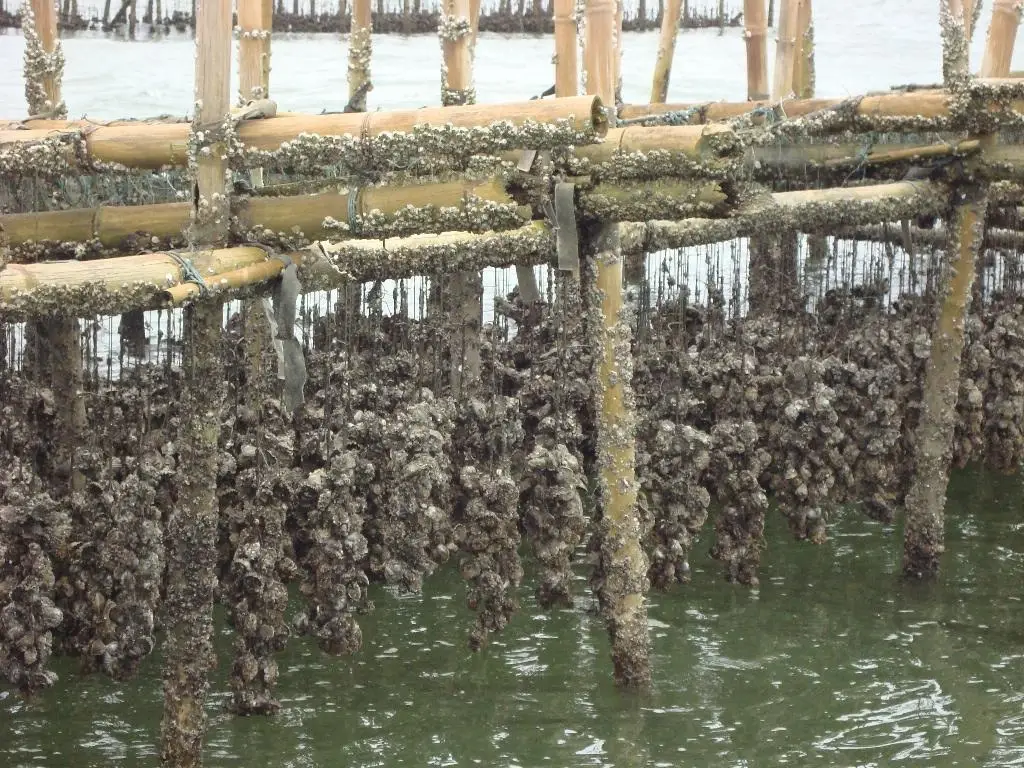
Seen from a boat, an oyster farm can look deceptively simple. Rows of concrete posts, cement structures or other suitable surfaces are positioned where water movement and tidal levels favor oyster growth. As the tide falls, more of these cultivation structures become visible above the water and clusters of oysters can be seen attached to them. This is why morning and particularly low-tide conditions have long been recommended for travelers whose main objective is to see the oysters and understand how the farms are arranged.
The expression “naturally cultivated oysters” should not be confused with uncontrolled harvesting of wild oysters. The traditional system combines natural coastal conditions and naturally occurring oyster spat with farming knowledge and purpose-built attachment materials. The official GI production specification describes cultivation associated with natural spat and the waters of Bandon Bay, followed by harvesting, cleaning and preparation before the oysters enter the market. Farmers therefore work with tides, salinity, water circulation and natural food rather than controlling the entire process in a closed system.
The oyster strongly associated with this local identity is the White-scar Oyster or Belcher’s Oyster, traditionally recorded as Crassostrea belcheri and known in Thai as the white-jaw cupped oyster. It is a bivalve found in Thai marine waters. The defining characteristics used to describe Surat Thani Oyster under the GI system include generous flesh, an off-white appearance and qualities prized for fresh consumption.
Surat Thani Oyster is protected within Thailand’s geographical-indication system under registration No. สช 49100010. The GI links the product to a defined production area, production practices and characteristics associated with its origin. The system remains active: in July 2026, the Department of Intellectual Property listed 38 authorized users of the Surat Thani Oyster GI mark. For visitors, the GI provides a useful way to understand that the identity of the oyster is linked not only to the species but also to place and production standards.
The formal GI production area is broader than the places most tourists know in Kanchanadit, because the Bandon Bay oyster economy extends along several coastal districts. Kanchanadit nevertheless remains one of the most recognizable centers. Pak Nam Kadae and the mouth of Tha Thong Canal bring farms, fishing communities, seafood markets and restaurants close enough together for travelers to see several stages of the local food system within one day.
Oyster cultivation around Tha Thong has a history extending back to approximately 1958. The GI registration material describes early cultivation using naturally occurring oyster spat around the Tha Thong estuary, followed by further experiments and expansion within Bandon Bay. Over time, local farmers refined their knowledge of where oyster spat settled, which materials provided effective attachment surfaces and how water conditions affected growth.
Concrete posts and cement-based collectors eventually became a recognizable element of the farming landscape. The structures visible at low tide are not decorative objects. They are production tools positioned in relation to tidal movement, current and seabed conditions. Seeing them exposed at low tide makes the logic of the farm easier to understand, while a high-tide trip emphasizes the open-bay scenery, boats and farm boundaries rather than the oysters themselves.
Oyster farming also illustrates the close relationship between food production and ecosystem quality. Oysters obtain food by filtering particles from the surrounding water rather than being fed manufactured pellets in the same way as some farmed animals. Water quality, circulation, salinity and the condition of the wider coastal ecosystem are therefore fundamental resources for oyster farmers. Mangrove areas, estuaries and healthy coastal waters are not simply scenery surrounding the industry; they form part of the environmental system on which the industry depends.
The continuing importance of Kanchanadit’s oyster farms was demonstrated again in 2026. On March 31, inspection teams visited oyster farms in Ao Tha Na, covering Moo 6 and Moo 7 of Kadae, as well as Ao Bang Un in Plai Was. On April 1, another inspection took place in Ao Thong Khao, Moo 1 of Tha Thong. These inspections focused on production methods, farm locations and compliance with GI requirements, confirming that the coast remains a working production area rather than merely a historical tourism story.
In July 2026, the Department of Intellectual Property also visited Surat Thani oyster producers to review GI production processes. This ongoing oversight helps explain why the origin name matters. A traveler may encounter many oysters sold in Surat Thani, but the GI term “Surat Thani Oyster” is associated with a controlled geographical identity and authorized producers rather than functioning as a generic label for every oyster sold in the province.
The boat journey is the part of the experience that most clearly separates an oyster-farm visit from simply eating oysters at a market. The traditional route from Tha Thong village pier uses a long-tail boat, historically described as accommodating around 10 passengers, and takes approximately 20 minutes to reach the cultivation area. Actual boat size, departure time and destination vary by local operator and farm, so travelers should use the arrangement made with their boat operator as the final reference.
Tide matters more than a fixed clock time. Travelers who specifically want to see oysters attached to concrete cultivation structures should choose a trip when the tide is low enough to expose them. At higher water, much of the structure remains submerged and the experience becomes more about the bay, fishing boats and the spatial layout of the farms. Asking the boat operator about the tide on the actual travel date is therefore more useful than relying on one standard departure hour throughout the year.
A boat ride also changes the way travelers perceive the community. From the water, the coastline becomes a working landscape. Small boats connect homes, landing areas and aquaculture plots; mangroves line parts of the shore; and the sea in front of the villages functions as a workplace rather than a resort beach. The experience is particularly rewarding for travelers interested in food origins, coastal ecology, local livelihoods and traditional fishing communities.
Responsible behavior is important because many parts of the farming area are private or livelihood-related working spaces. Visitors should not climb on, pull, move or handle cultivation equipment without permission. Instructions from the boat operator and farm owner should be followed, and litter should never be left in the water or mangrove environment. Respecting the farming infrastructure protects both local livelihoods and visitors while preserving the character of the experience.
Back on shore, Pak Nam Kadae provides a natural continuation of the farm visit. Ban Pak Nam Kadae Market specializes in fresh seafood, with oysters among its signature products. Travelers can see oysters being selected and opened close to the production area, alongside other seafood and locally processed products. Visiting the market after the boat trip creates a complete sequence: first the estuary and farm, then harvesting culture, and finally the product reaching local kitchens and consumers.
Surat Thani oysters are often remembered for their substantial flesh and creamy off-white appearance. Fresh oysters are commonly served with strongly flavored Thai accompaniments, while local seafood restaurants also prepare them in cooked dishes. Travelers who prefer cooked seafood therefore do not need to eat raw oysters to experience the local specialty. Choosing established vendors that handle seafood carefully remains the most practical approach when exploring the market and restaurant scene.
Pak Kadae is also a cultural community rather than simply a seafood destination. Fishing has long shaped local life, and the area contains heritage associated with Thai-Chinese coastal families. Pak Nam Kadae Shrine and the local Tubtim goddess shrine represent part of this cultural landscape. Boats, markets, religious places and oyster farms all belong to the same community history, making the area particularly suitable for travelers who prefer destinations where food and culture remain connected.
Near the market entrance, the Pak Nam Kadae ecological nature trail provides another perspective on the coast. The elevated walkway extends for roughly 1 kilometer through mangrove surroundings and opens toward the bay. It helps visitors understand the transition between land and sea and why coastal habitats matter to fisheries and aquaculture. The area is also attractive later in the day when the light changes over the bay, offering a contrasting experience to a morning oyster-farm boat trip.
A well-balanced day can begin with the oyster farm during the morning or an appropriate low-tide period, continue with seafood lunch and the Pak Nam Kadae market, and then move to the mangrove trail and community heritage sites. Travelers with more time can continue to Tha Thong Historical Museum at Wat Khao Phra Nim, adding the historical context of the old Tha Thong settlement to the maritime landscape encountered earlier in the day.
Tha Thong Historical Museum is especially relevant because the name Tha Thong repeatedly appears in the history of Surat Thani oyster cultivation. The old Tha Thong settlement has its own archaeological and cultural significance, and the museum preserves stories about the historical community and surrounding area. Pairing the museum with the oyster farms changes the trip from a simple seafood excursion into a broader exploration of how settlements developed around waterways and productive coastal environments.
Another recognized Kanchanadit attraction is the Kadae Jae monkey training center, associated with traditional coconut-farming knowledge. Although this activity belongs to an entirely different economic landscape, combining it with the oyster-farming coast illustrates two important sides of local livelihoods: agriculture on land and fisheries or aquaculture along the sea. This makes Kanchanadit particularly suitable for travelers interested in living cultural knowledge rather than conventional sightseeing alone.
Photographers will find strong visual patterns in the oyster farms. Repeating lines of cultivation posts, reflections on shallow water, long-tail boats and working fishermen create images that differ substantially between low and high tide. Low water reveals more farming detail; higher water emphasizes the open bay. When photographing people at work or entering closely managed farm areas, visitors should ask permission rather than treating the working environment as an unrestricted photo set.
Families can use the farm trip as an outdoor lesson about where food comes from. Children can observe how brackish water, oyster spat, attachment structures, growth, harvesting and markets form one connected system. Because the experience takes place on working boats and tidal waterways, families should select an appropriate boat service, follow all safety instructions provided by the operator and supervise children closely throughout boarding, travel and disembarkation.
Travelers with limited mobility should consider the practical conditions of boarding a long-tail boat. The height between the pier and boat can change with the tide. Those who prefer to remain on land can still experience the oyster culture through Pak Nam Kadae Market, seafood restaurants, the public waterfront and the mangrove trail. A boat journey is therefore valuable but not essential for every visitor.
Comfortable clothing, non-slip footwear and protection from sun and spray are useful for the boat trip. Phones, cameras and valuables are best kept in water-resistant bags while traveling. Visitors planning to walk the mangrove trail afterward should also allow enough time rather than packing the day too tightly, as the combination of boat travel, lunch, market exploration and cultural stops can easily fill several hours.
The production season and the ideal boat conditions should not be confused. Official GI information indicates that Surat Thani oysters can be produced throughout the year, but an individual boat visit is still affected by weather, tides and local operations. Travelers whose priority is seeing exposed oyster-covered posts should therefore focus on the tide for the actual travel date rather than assuming that every visit will look the same simply because oysters are produced year-round.
Kanchanadit is approximately 18 kilometers from Surat Thani city along the main road network, making the area suitable for a mainland day trip. A private car or rental vehicle is the most flexible option for combining Pak Nam Kadae, a boat departure point, restaurants and other attractions. Travelers arriving at Surat Thani International Airport or Surat Thani Railway Station in Phunphin can continue by hired vehicle or rental car toward Kanchanadit.
Getting There from Surat Thani city, follow Highway 401 east toward Kanchanadit District and then turn toward Kadae for Pak Nam Kadae Market and the coastal community, or continue toward the specific Tha Thong boat meeting point arranged with the operator. The traditional boat route from Tha Thong village takes approximately 20 minutes to reach the oyster-farming waters. Because cultivation plots are spread across several bays and subdistricts, there is no single pier serving every farm.
For general orientation, Pak Nam Kadae is around coordinates 9.2074, 99.4772, while the Pak Nam Tha Thong area is around 9.2320, 99.5054. These coordinates are useful for understanding the relationship between the two traditional oyster-farming zones. The exact farm location at sea should always be determined by the boat operator because different producers work in different plots.
Seafood restaurants around Kadae make it easy to continue the experience after returning from the farm. Local choices include Nai Ao Seafood, Kieng Lay Seafood, Aree Seafood, Farm Hoi Seafood and Sinmana Farmstay. Eating locally provides access to more than oysters alone and helps visitors experience the broader seafood economy connected with Kanchanadit’s fishing communities.
Accommodation in Kanchanadit tends to be small or medium-sized rather than large resort complexes. Sinmana Farmstay in Plai Was offers the most direct connection with the aquaculture theme, while Baan Phrueksa Resort, Woodenhousvilla, Donya Home and several properties in Tha Thong Mai provide land-based alternatives. Staying within the district is convenient for an early boat trip, while travelers who prefer a larger choice of urban services can stay in Surat Thani city and visit Kanchanadit as a day trip.
The deeper value of the Surat Thani oyster farms lies in the fact that they remain a living food-production landscape. Visitors encounter real working communities and see how coastal water, tides, mangroves, farming knowledge, boats, markets and restaurants contribute to a single local product. The experience therefore explains much more than the simple statement that Surat Thani oysters are unusually large.
The health of Bandon Bay is directly relevant to the future of oyster farming because oysters live by filtering natural food from the surrounding water. Coastal water quality, sediment conditions and functioning mangrove environments consequently matter to farmers as well as wildlife. Low-impact tourism, careful waste management and respect for working farm areas help tourism coexist with the industry rather than becoming an additional burden on it.
Visiting the farms also makes the idea of a geographical indication easier to understand. Geography affects food. Bandon Bay’s brackish environment, coastal form, cultivation materials, local knowledge and post-harvest practices combine to create a product identified with Surat Thani. Origin is therefore not simply an address printed on packaging; it is part of the product’s identity and production system.
Travelers deciding between visiting only the market and taking the boat should consider what they want to learn. Pak Nam Kadae Market, restaurants and the mangrove trail provide a strong introduction for a short visit. The boat, however, is the defining experience for anyone who wants to understand oyster cultivation itself, because the concrete posts, farm plots and working boats connect the seafood on shore with the environment where it is produced.
For a full-day itinerary, morning is generally the most practical period for the boat, particularly when it coincides with favorable tidal conditions. Lunch and the seafood market can follow, with the mangrove trail, shrines or historical attractions reserved for the afternoon. Leaving some flexibility in the schedule is useful because boat timing may need to respond to the tide.
Surat Thani Oyster Farms ultimately offer far more than a seafood stop. They provide a direct introduction to Bandon Bay, brackish-water ecology, White-scar Oyster cultivation, Thai GI standards, Kanchanadit fishing communities, coastal food culture and local history. By combining a properly timed boat trip with Pak Nam Kadae Market and nearby cultural sites, travelers can understand why Surat Thani became famous as Thailand’s “city of big oysters” and why this working coastal landscape remains economically and culturally important today.
| Name | Surat Thani Oyster Farms |
| Location | Coastal areas of Kanchanadit District, particularly Pak Nam Kadae, Tha Thong Canal, Ao Tha Na, Ao Thong Khao and Ao Bang Un |
| Main Visitor Area | Ban Pak Kadae, Moo 7, Kadae Subdistrict, Kanchanadit District, Surat Thani 84160, Thailand |
| Coordinates | Pak Nam Kadae: approximately 9.2074, 99.4772 Pak Nam Tha Thong: approximately 9.2320, 99.5054 |
| Highlights | Long-tail boat trips through working oyster farms, concrete cultivation posts, Bandon Bay fishing culture, brackish-water ecology and fresh local seafood |
| Important Oyster Species | White-scar Oyster / Belcher’s Oyster, traditionally recorded as Crassostrea belcheri |
| Geographical Indication | “Surat Thani Oyster,” Thai GI Registration No. สช 49100010 |
| History | Oyster cultivation around Tha Thong dates to approximately 1958 and later expanded through suitable areas of Bandon Bay |
| Environment | Shallow estuarine and bay waters influenced by both freshwater and seawater, creating productive brackish-water conditions |
| Cultivation | Natural coastal conditions and oyster spat are combined with attachment materials such as concrete posts and cement structures |
| Main Areas / Zones | 1. Pak Nam Kadae and Ao Tha Na, Kadae Subdistrict 2. Tha Thong Canal and Ao Thong Khao, Tha Thong Subdistrict 3. Ao Bang Un, Plai Was Subdistrict |
| Open Days | Boat visits operate according to local arrangements and advance booking |
| Best Visiting Time | Morning or low tide, when oysters and cultivation posts are easier to see |
| Travel Information | Drive east from Surat Thani city on Highway 401 toward Kanchanadit, then continue to Pak Nam Kadae or the arranged boat meeting point. The traditional long-tail boat journey from Tha Thong village takes about 20 minutes. |
| Current Status | Active oyster-production areas with GI farm inspections continuing in Kanchanadit during 2026 |
| Community Facilities | Seafood market, restaurants, waterfront public area and mangrove ecological trail |
| Local Information Contact | Kanchanadit Subdistrict Municipality, Tel. 077-379366 |
| Nearby Tourist Attractions | 1. Ban Pak Nam Kadae Market, approx. 1 km 2. Pak Nam Kadae Ecological Nature Trail, approx. 1 km 3. Pak Nam Kadae Public Park, approx. 1 km 4. Pak Nam Kadae Shrine and Tubtim Goddess Shrine, approx. 1 km 5. Tha Thong Historical Museum at Wat Khao Phra Nim, approx. 8 km 6. Kadae Jae Agricultural Monkey Training Center, approx. 14 km |
| Nearby Restaurants | 1. Nai Ao Seafood, approx. 1 km, Tel. 092-242-3366 2. Kieng Lay Seafood, approx. 1 km, Tel. 077-255243 3. Aree Seafood Pak Kadae, approx. 1 km, Tel. 077-379392 4. Farm Hoi Seafood, approx. 6 km, Tel. 083-1751439 5. Sinmana Farmstay, approx. 7 km, Tel. 081-5977575 |
| Nearby Accommodations | 1. Sinmana Farmstay, approx. 7 km, Tel. 081-5977575 2. Baan Phrueksa Resort, approx. 7 km, Tel. 098-2616449 3. Woodenhousvilla, approx. 7 km, Tel. 063-4565959 4. Donya Home, approx. 9 km, Tel. 098-0289185 5. Tongmai Hostel & Resort, approx. 14 km, Tel. 093-5619628 6. Dark Sugar Resort, approx. 14 km, Tel. 063-4672849 |
Frequently Asked Questions (FAQ)
Q: Where are the Surat Thani oyster farms located?
A: The best-known cultivation areas are along the Kanchanadit coast, particularly around Pak Nam Kadae, the mouth of Tha Thong Canal and productive waters in Kadae, Tha Thong and Plai Was subdistricts.
Q: Are the oyster farms still operating in 2026?
A: Yes. Oyster cultivation remains active, and GI production plots in several parts of Kanchanadit were inspected by Thai authorities during 2026. Boat visits should be arranged with a local operator.
Q: When is the best time to visit the oyster farms?
A: Morning or low tide is best if you want to see oysters attached to concrete cultivation structures because more of the farm infrastructure is exposed as the water level falls.
Q: How long does the boat ride from Tha Thong village take?
A: The traditional long-tail boat route from Tha Thong village takes approximately 20 minutes to reach the oyster-farming waters, although the exact destination and schedule depend on the operator.
Q: What species is associated with Surat Thani Oyster?
A: The important species is the White-scar Oyster or Belcher’s Oyster, traditionally recorded as Crassostrea belcheri, and associated with the Thai GI product registered as Surat Thani Oyster.
Q: Can I visit Pak Nam Kadae without taking a boat?
A: Yes. You can explore Ban Pak Nam Kadae Market, seafood restaurants, the mangrove ecological trail, the public waterfront and community cultural sites without going out to the farms by boat.
Q: Is the oyster-farm area suitable for a day trip from Surat Thani city?
A: Yes. Kanchanadit is approximately 18 km from Surat Thani city, making it practical to combine a morning farm visit with seafood lunch, Pak Nam Kadae Market, the mangrove trail and nearby cultural attractions in one day.
 Category: ●Entertainment and Agricultural
 Group: ●Animal camps and shows
Last Update : 2 MonthAgo
 Last Update : 2 MonthAgo
 Click to Access the Navigation Map GPS
Surat Thani Oyster Farms Map
Recommend

 Art, Culture and Heritage
 Landmarks and Memorials(1)
 Art, Craft Centres, Tradition(8)
 Museums(5)
 Educational Places
 Educational Gardens, Farm(1)
 Places of Worship
 Temple(32)
 Other Sacred Sites(8)
 Research and Development
 Royal Project(1)
 Suburban Living
 Village, Community(6)
 Local Market(1)
 Nature and Wildlife
 National Parks and Marine Reserves(8)
 Mountain (Doi)(2)
 Dam, Reservoir, Lake(8)
 Waterfalls(34)
 Hot Springs(7)
 Caves(18)
 River, Canal(11)
 Bays and Beaches(30)
 Islands(16)
 Other natural attractions(10)
Animal camps and shows(6)
 Farms, Parks and Ecotourism(7)
 Outdoor and Adventure Activities(2)
 Shopping
 Shopping and Night Market(1)
 Travel Articles, Recipes
 Travel Review, Food Review(1)
 Southern Food Menu, Southern Food Recipes(1)


