
lovethailand home >South Travel Attractions >Surat Thani Travel Attractions >Koh Samui >Ma Ret > Phra Phutthabat Khao Le
TL;DR: Phra Phutthabat Khao Le is located at Moo 3, Na Mueang Subdistrict, Koh Samui District, Surat Thani Province, open Daily, hours 08.00 – 17.00.

Phra Phutthabat Khao Le
Open Days: Daily
Opening Hours: 08.00 – 17.00
Phra Phutthabat Khao Le, or Wat Phra Phutthabat Khao Le, is a quiet Buddhist site on Khao Le in Na Mueang Subdistrict, Koh Samui District, Surat Thani Province. Its key sacred object is a set of 4 overlapping Buddha footprints placed on the hillside. Visitors climb around 150 steep steps to reach the pavilion where the footprints are enshrined. The site is historically important because it is mentioned in records from King Rama V’s visit to Koh Samui in 1888.
Phra Phutthabat Khao Le is one of Koh Samui’s quieter and older Buddhist sites. It is located on Khao Le in Moo 3, Na Mueang Subdistrict, Koh Samui District, Surat Thani Province. Unlike the island’s busier beaches, resorts, and entertainment areas, this site offers a more reflective experience. Visitors come here to pay respect to the Buddha footprints, walk up the hillside, and see another side of Koh Samui: a side connected to local faith, old communities, and religious heritage.
Older travel descriptions sometimes place Phra Phutthabat Khao Le in the Maret area and state that it is about 15 km from the Koh Samui District Office. Current official cultural and Buddhist records identify the site as being in Moo 3, Na Mueang Subdistrict. For clarity, this article uses Na Mueang as the main location reference while preserving the original core information: the site is on Khao Le, in Koh Samui, and is known for its 4 sacred Buddha footprints.
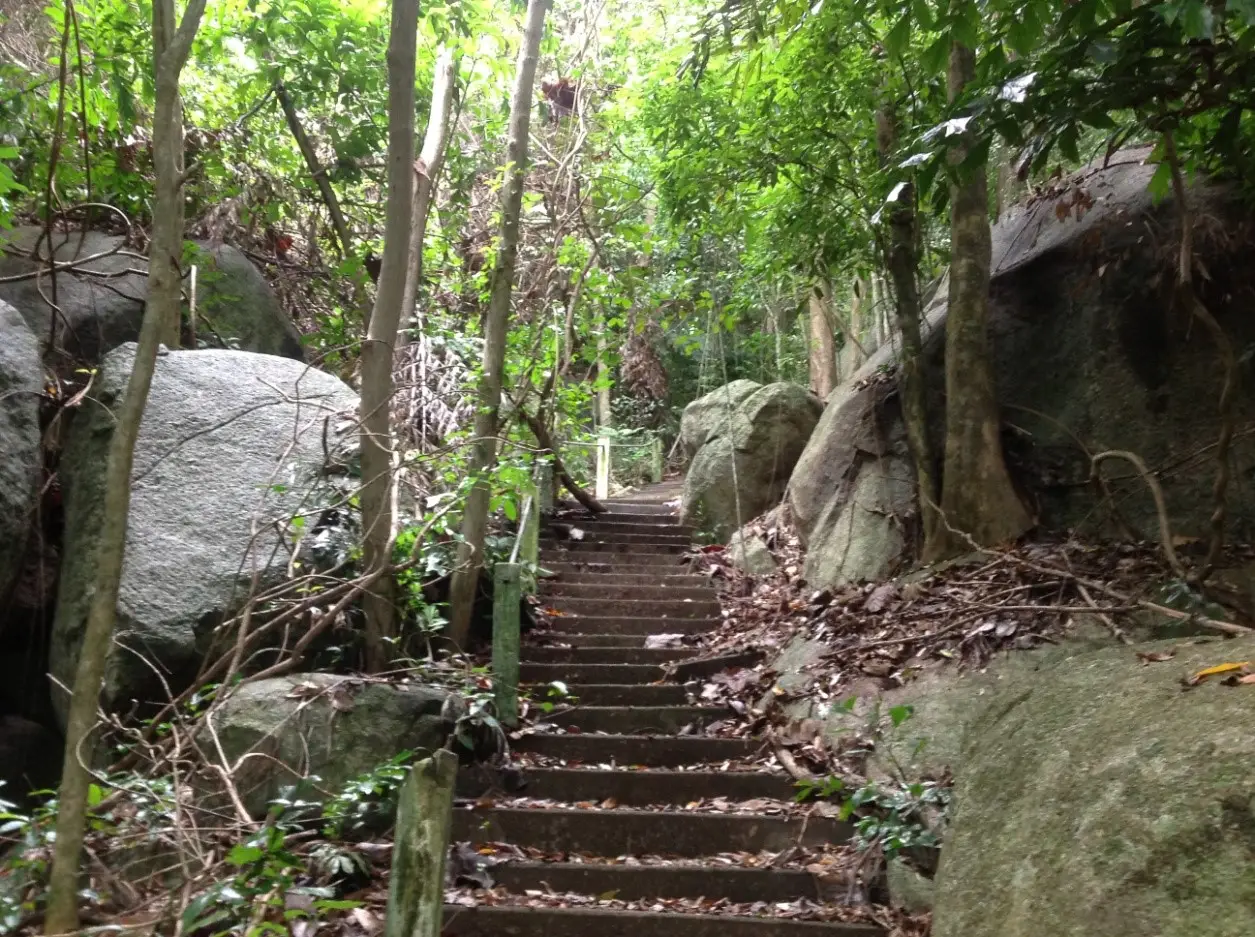
The most important feature of the site is the 4 overlapping Buddha footprints. In Thai Buddhist culture, Buddha footprints are sacred symbols used to recall the Buddha’s presence, virtues, and teachings. At Khao Le, the footprints are not placed in an easily reached roadside pavilion. They are set on the hillside, so visitors must walk up a steep stairway of about 150 steps before reaching the pavilion. This short climb gives the visit a sense of pilgrimage rather than ordinary sightseeing.
The 4 footprints at Phra Phutthabat Khao Le are layered one over another. The outer section is formed with lotus-petal stucco decoration. The first to third footprints overlap, so only some auspicious motifs remain visible. The fourth and smallest footprint is placed in the center and shows the full set of 108 auspicious symbols. This style follows the Thai Buddhist tradition of making Buddha footprint replicas, especially in the Rattanakosin period, where the 108 auspicious symbols represent the Buddha’s extraordinary qualities and the Buddhist worldview.
The historical importance of Phra Phutthabat Khao Le is supported by documentary evidence from the travel records of King Chulalongkorn, King Rama V, during his journey to the Malay Peninsula in the years R.S. 107 and 108. The record mentions the royal visit to Koh Samui on Saturday, 1 September 1888, and describes Khao Le as having a newly built monastery and 4 Buddha footprint replicas on the hillside, placed on large rocks high above the ground. This makes the site important not only for worship but also for the study of Koh Samui’s religious history.
The exact year of construction is not firmly recorded in the original local description, but cultural records suggest that the monastery and Buddha footprints were probably created around the middle of King Rama V’s reign, around 1888 or not long before that. This makes Phra Phutthabat Khao Le one of the older sacred sites on Koh Samui and a useful place for understanding how Buddhist communities developed on the island before the modern tourism era.
The atmosphere of Phra Phutthabat Khao Le is simple and peaceful. It is not a large, crowded tourist attraction. Its value lies in the quiet hillside setting, the old religious object, and the physical act of walking up to worship. The staircase is not extremely long, but it is steep enough to require care. As visitors climb, the noise of the lower area gradually fades, and the approach to the footprint pavilion becomes a calm transition from the everyday world into a sacred space.
The site suits travelers who enjoy cultural, spiritual, and nature-based places away from the main tourist crowds. The walk up to the Buddha footprints can feel almost meditative because it has a steady rhythm. Visitors should wear shoes suitable for climbing steps and sloping ground. It is best to avoid visiting during heavy rain or immediately after rainfall, as the steps and path may become slippery. Morning and late afternoon are more comfortable than the hottest part of the day.
From an art-historical perspective, Phra Phutthabat Khao Le is worth careful attention. Many short travel descriptions mention only that it has 4 Buddha footprints, but the details matter. The overlapping layout, lotus-petal outer decoration, and 108 auspicious symbols on the innermost footprint show a Buddhist visual language that connects local devotion to wider Thai religious art. These details make the site valuable for visitors interested in Buddhist symbolism, not only for those looking for a viewpoint or a quiet temple.
The hill setting is also important. In Thai religious imagination, mountains and elevated places often suggest quietness, purity, and closeness to the sky. Placing the Buddha footprints on the hillside gives the site a spiritual geography. Visitors move from the lower ground upward, step by step, before reaching the sacred object. This physical movement gives the act of worship a deeper meaning than visiting a flat, easily accessible shrine.
Today, Wat Phra Phutthabat Khao Le remains an active local temple. Recent Buddhist records list it as a private-sector temple, or wat rat, with resident monks. The 2025 Kathin project data lists 5 resident monks and names Phra Athikan Ekarin Ekarinto as the abbot. In 2023, the Surat Thani Provincial Office of Buddhism also visited the temple for preparation under the Wat Pracha Rat Sang Suk project. These recent records confirm that the site is still maintained and used by the local Buddhist community.
For visitors planning a Koh Samui itinerary, Phra Phutthabat Khao Le can be combined with several southern Samui attractions. Nearby places include Na Muang Waterfall, Wat Khunaram, Wat Samret, Secret Buddha Garden, and Laem Sor Pagoda. This makes the site a good cultural stop for travelers driving around the quieter southern part of the island. It adds historical and spiritual depth to a trip that might otherwise focus only on beaches and viewpoints.
Getting there is easiest by private car, rental car, rental motorcycle, or local taxi. The site is not on one of the island’s busiest public transport routes, and it sits on a hillside. Roads in the area connect with the Na Mueang zone and Routes 4170 and 4173. Travelers coming from Lamai, Hua Thanon, or southern Koh Samui can use navigation apps and search for Wat Phra Phutthabat Khao Le or Buddha Footprint Koh Samui.
Before visiting, prepare for a short uphill walk. Wear respectful clothing because the site is an active Buddhist temple. Avoid swimwear, revealing clothing, loud behavior, climbing onto restricted structures, or touching the Buddha footprints unnecessarily. Bring a little drinking water and walk carefully, especially on hot days or when the ground is wet. Photography should be done respectfully, particularly near the footprint pavilion and any area where people are praying.
The best time to visit is in the morning or late afternoon. During these hours, the temperature is more comfortable, the light is softer, and the climb feels less demanding. In the rainy season, check the weather before going because the steps may become slippery. This is not a place to rush. Allow enough time to climb, pay respect, take in the view, and appreciate the quiet hillside setting.
The importance of Phra Phutthabat Khao Le lies in its ability to show a deeper identity of Koh Samui. Today, the island is internationally known for beaches, resorts, and nightlife, but it also has older layers of Buddhist faith and community history. The Buddha footprints at Khao Le remind visitors that Samui was a living cultural landscape long before modern tourism. For travelers who want a more meaningful understanding of the island, this site is a valuable stop.
Overall, Phra Phutthabat Khao Le is a worthwhile destination for cultural travelers, Buddhist visitors, and anyone interested in the quieter side of Koh Samui. Its main appeal is not luxury or convenience. Its value comes from the 4 sacred Buddha footprints, the historical record from King Rama V’s time, the hillside climb, and the peaceful atmosphere. It is one of the places that helps visitors see Koh Samui as an island of faith, history, and living local culture.
| Name | Phra Phutthabat Khao Le or Wat Phra Phutthabat Khao Le |
| Location | Moo 3, Na Mueang Subdistrict, Koh Samui District, Surat Thani Province |
| Address | Moo 3, Na Mueang Subdistrict, Koh Samui District, Surat Thani 84140, Thailand |
| Coordinates | 9.43203, 100.00555 |
| Highlights | 4 overlapping Buddha footprints on the hillside, around 150 steep steps, and a peaceful natural viewpoint in southern Koh Samui |
| History | Probably created around the middle of King Rama V’s reign, around 1888 or shortly before, and mentioned in records of King Rama V’s visit to Koh Samui |
| Name Origin | Named after the Buddha footprints enshrined on Khao Le, a hill in the southern part of Koh Samui |
| Distinctive Features | 4 Buddha footprints with lotus-petal outer decoration; the innermost and smallest footprint shows the full set of 108 auspicious symbols |
| Key Sacred Elements | 4 Buddha footprints, footprint pavilion, steep hillside staircase, and natural viewpoint |
| Travel Information | Best reached by private car, rental car, rental motorcycle, or local taxi via the Na Mueang area and Routes 4170 / 4173, followed by a climb of about 150 steep steps |
| Current Status | Open for worship and sightseeing as an active local Buddhist temple and cultural heritage site in Koh Samui |
| Open Days | Daily |
| Opening Hours | 08.00 – 17.00 |
| Fees | No admission fee |
| Facilities | Temple ground, parking area, staircase, footprint pavilion, and natural viewpoint area |
| Main Areas / Zones | Lower temple area, stairway, Buddha footprint pavilion, 4 Buddha footprints, and hillside viewpoint |
| Abbot / Caretaker | Phra Athikan Ekarin Ekarinto |
| Nearby Tourist Attractions | 1. Na Muang Waterfall 1, about 3 km 2. Na Muang Waterfall 2, about 4 km 3. Wat Khunaram, about 4 km 4. Wat Samret, about 4 km 5. Secret Buddha Garden, about 6 km 6. Laem Sor Pagoda, about 8 km |
| Nearby Restaurants | 1. Kao Lay Lae View, about 1 km, Tel. 081 810 3427 2. Sweet Sisters Cafe, about 3 km, Tel. 065 953 8832 3. Boy’s Organic Coffee, about 5 km, Tel. 087 893 9669 4. The Island View Restaurant, about 8 km, Tel. 077 426 422 5. Sunset View Restaurant Taling Ngam, about 8 km, Tel. 094 919 0316 6. Five Islands Beach House, about 9 km, Tel. 083 688 9688 |
| Nearby Accommodations | 1. Samui Fishing Club & Resort, about 2 km, Tel. 065 651 6031 2. Centara Villas Samui, about 4 km, Tel. 077 424 020 3. Tolani Resort Koh Samui, about 5 km, Tel. 077 448 999 4. Rocky’s Boutique Resort, about 6 km, Tel. 077 332 888 5. Five Islands Beach House, about 9 km, Tel. 083 688 9688 6. Mali Samui Resort, about 8 km, Tel. 085 473 3486 |
Frequently Asked Questions (FAQ)
Q: Where is Phra Phutthabat Khao Le located?
A: Phra Phutthabat Khao Le is located in Moo 3, Na Mueang Subdistrict, Koh Samui District, Surat Thani Province, on Khao Le in the southern part of Koh Samui.
Q: Why is Phra Phutthabat Khao Le important?
A: It is an old Buddhist site with 4 overlapping Buddha footprints and is mentioned in historical records from King Rama V’s visit to Koh Samui in 1888.
Q: How many steps must visitors climb?
A: Visitors climb about 150 steep steps to reach the pavilion where the Buddha footprints are enshrined.
Q: What are the opening hours?
A: The site is open daily from 08.00 to 17.00.
Q: Is there an admission fee?
A: No. There is no admission fee to visit and pay respect at Phra Phutthabat Khao Le.
Q: What should visitors prepare before going?
A: Wear stable walking shoes, dress respectfully, bring a little drinking water, and avoid climbing during rain or when the steps are wet.
Q: What nearby places can be visited on the same trip?
A: Nearby places include Na Muang Waterfall, Wat Khunaram, Wat Samret, Secret Buddha Garden, and Laem Sor Pagoda.
 Category: ●Places of Worship
 Group: ●Other Sacred Sites
Last Update : 2 MonthAgo
 Last Update : 2 MonthAgo
 Click to Access the Navigation Map GPS
Phra Phutthabat Khao Le Map
Recommend

 Art, Culture and Heritage
 Landmarks and Memorials(1)
 Art, Craft Centres, Tradition(8)
 Museums(5)
 Educational Places
 Educational Gardens, Farm(1)
 Temple(32)
Other Sacred Sites(8)
Temple(32)
Other Sacred Sites(8)
 Research and Development
 Royal Project(1)
 Suburban Living
 Village, Community(6)
 Local Market(1)
 Nature and Wildlife
 National Parks and Marine Reserves(8)
 Mountain (Doi)(2)
 Dam, Reservoir, Lake(8)
 Waterfalls(34)
 Hot Springs(7)
 Caves(18)
 River, Canal(11)
 Bays and Beaches(30)
 Islands(16)
 Other natural attractions(10)
 Entertainment and Agricultural
 Animal camps and shows(6)
 Farms, Parks and Ecotourism(7)
 Outdoor and Adventure Activities(2)
 Shopping
 Shopping and Night Market(1)
 Travel Articles, Recipes
 Travel Review, Food Review(1)
 Southern Food Menu, Southern Food Recipes(1)


