
lovethailand home >South Travel Attractions >Phuket Travel Attractions >Muang Phuket >Ratsada > Phuket Rajabhat University
TL;DR: Phuket Rajabhat University, Phuket attractions : University, Rajabhat University.

Phuket Rajabhat University
Open Days: Monday – Friday for administrative offices, excluding public holidays
Opening Hours: 8:30 AM – 4:30 PM for general administrative enquiries, not the opening hours of the entire campus
Phuket Rajabhat University (มหาวิทยาลัยราชภัฏภูเก็ต), commonly abbreviated as PKRU, is a public university in southern Thailand dedicated to higher education, teacher development, research, and academic services for communities along the Andaman coast. It is located at 21 Moo 6, Thep Krasattri Road, Ratsada Subdistrict, Mueang Phuket District, Phuket Province 83000. The institution traces its origins to Phuket Teachers College, established on June 9, 1971, with its official establishment announced by the Ministry of Education on June 14 of the same year. It subsequently became Phuket Rajabhat Institute in 1995 and gained university status under the Rajabhat University Act of 2004. Today, Phuket Rajabhat University has five faculties: Education, Science and Technology, Humanities and Social Sciences, Management Sciences, and Agricultural Technology. Its academic fields include teacher education, languages, law, public administration, business, hospitality and tourism, communication arts, public health, digital technology, and modern agriculture. The university continues to serve Phuket and neighboring Andaman provinces through education, research, cultural preservation, and local development.
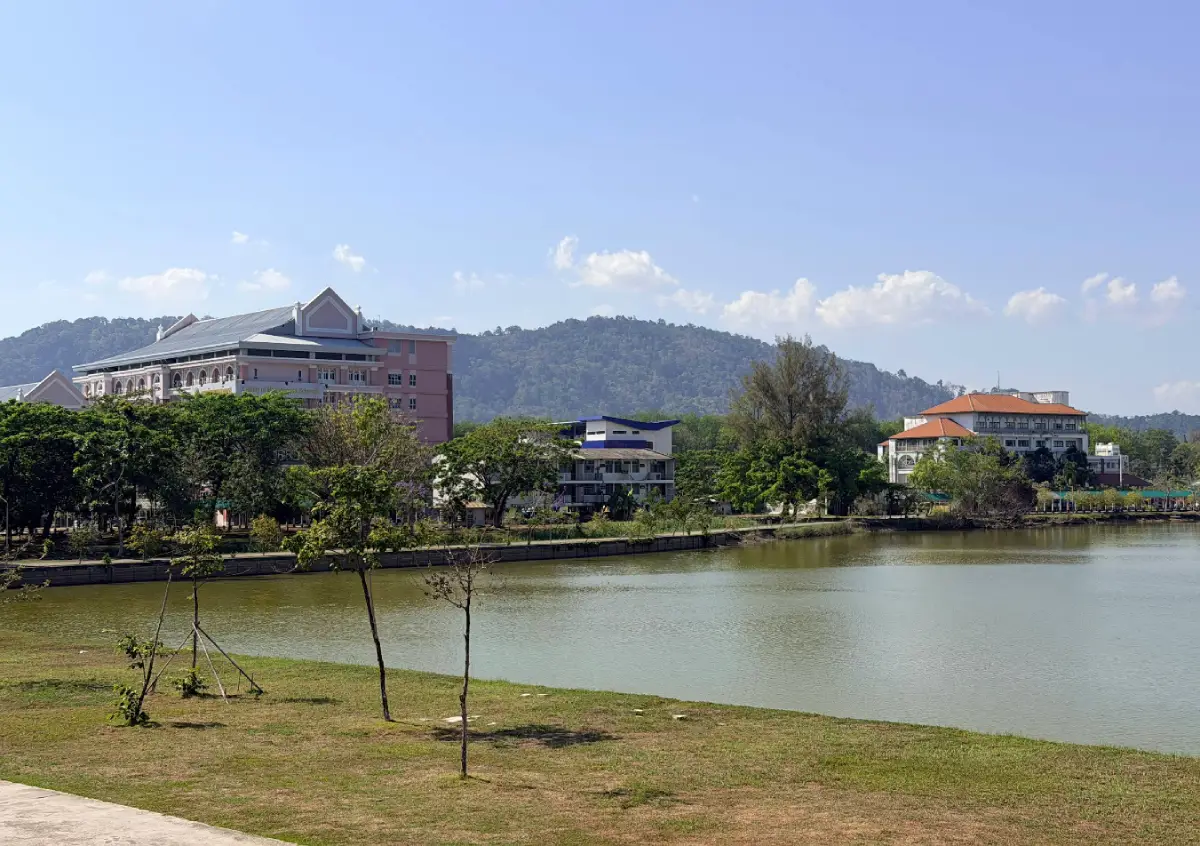
Phuket Rajabhat University is situated in Ratsada Subdistrict, north of central Phuket Town, along Thep Krasattri Road, one of the island's important transport corridors. The surrounding area includes residential neighborhoods, local businesses, restaurants, shops, and roads connecting Phuket Town with other parts of the island. The campus itself contains academic buildings, administration offices, science and computer laboratories, conference facilities, a university library, student activity spaces, and landscaped grounds. These facilities support an academic community that combines professional education with research and engagement with local society.
Phuket has an economic and cultural character that distinguishes it from many other provinces in southern Thailand. International tourism, a diverse population, historic tin-mining communities, maritime trade, and a combination of Thai, Chinese, and other cultural traditions have shaped the province's identity. As Phuket developed, it needed more trained teachers, hospitality professionals, language specialists, business managers, public health personnel, and technology workers. Phuket Rajabhat University has responded to these needs by expanding its education and research beyond its original teacher-training mission.
The university's establishment is closely connected to Thailand's policies for expanding access to education outside Bangkok. During the early 1970s, many provincial schools faced shortages of qualified teachers, particularly in rural communities. Establishing teacher-training colleges in different regions was intended to prepare local students for teaching careers and encourage them to work in communities where professional educators were needed. This approach also reduced the cost of traveling to distant educational institutions and expanded opportunities for young people from provincial families.
Phuket was selected as an important location for teacher education serving Thailand's western southern coast. The institution's original area of responsibility included Phuket, Phang Nga, Ranong, Krabi, and Trang. Developing a teacher-training college in Phuket helped connect higher education with the needs of these provinces and created a foundation for regional academic development. The university's later expansion into other disciplines continued the same principle of providing education relevant to local communities.
On June 9, 1971, Phuket Teachers College was established on a date associated with the Royal Silver Jubilee ceremony of King Bhumibol Adulyadej. The Ministry of Education formally announced the college's establishment on June 14, 1971. Its initial programs included certificates in education and higher certificates in education, along with professional upgrading courses for serving teachers. These programs helped prepare teachers and improve the qualifications of educators already working in schools.
Chalong Phiromrat served as the first head of Phuket Teachers College. His role was associated with the administration of the institution during its formative years, when the college needed to establish its academic programs, personnel system, and educational services. The emphasis on preparing competent teachers during this early period became the foundation of the university's later Faculty of Education and its continuing responsibility to local schools.
The Teachers College Act of 1975 supported the development of degree-level teacher education. Phuket Teachers College subsequently offered Bachelor of Education programs in fields connected with science, humanities, social sciences, and applied disciplines. The introduction of bachelor's degrees marked an important step in the professionalization of teacher education and increased the institution's capacity to offer more advanced academic qualifications.
Further changes followed the amendments to the Teachers College legislation in 1984. These reforms enabled teacher-training colleges to provide bachelor's degrees outside education, including fields such as science, arts, and business administration. Phuket Teachers College expanded into these disciplines, beginning its transformation from a specialized teacher-training institution into a broader center of higher education. The changes also aligned its academic role more closely with Phuket's rapidly developing economy.
Tourism growth in Phuket influenced the institution's academic development. Hotels, travel businesses, transportation services, and related enterprises needed employees who understood management, professional communication, and customer service. At the same time, urban development and population growth created demand for professionals in public administration, health, education, and technology. These developments encouraged the college to introduce a wider range of academic programs relevant to local employment and social needs.
On February 14, 1992, King Bhumibol Adulyadej bestowed the name Rajabhat Institute upon Thailand's teachers colleges. Following the implementation of the Rajabhat Institute Act in 1995, Phuket Teachers College became Phuket Rajabhat Institute. This transition expanded its identity as a higher education institution for local development and strengthened its responsibilities in education, research, academic services, and the preservation of arts and culture.
The term “Rajabhat” carries the idea of royal service and service to the nation. Its adoption as an institutional name reinforced the commitment of Rajabhat institutions to producing graduates with public-minded values and contributing to the development of local communities. For Phuket Rajabhat Institute, the new identity reflected an educational mission extending beyond classrooms into community services, research, cultural learning, and professional development throughout the Andaman region.
The Rajabhat University Act B.E. 2547 was published in the Royal Gazette on June 14, 2004, and came into force on June 15, 2004. Under this legislation, Phuket Rajabhat Institute became Phuket Rajabhat University. University status provided a new legal and administrative framework for higher education, research, institutional development, and academic cooperation. The transformation marked an important stage in the evolution of the institution from a teacher-training college into a multidisciplinary public university.
Following the transition, Phuket Rajabhat University continued expanding its academic activities and supporting organizations. Teacher education remained central to its identity, while programs in science, technology, business, tourism, community development, and agriculture developed in response to changing regional needs. Postgraduate education also expanded opportunities for teachers, administrators, researchers, and other professionals to gain advanced qualifications and specialist knowledge.
The university's official colors are orange and black. Orange represents the flourishing of knowledge and the academic disciplines passed on by the institution, while black symbolizes dedication and sacrifice in service of society. Together, the colors express an educational ideal in which academic achievement is accompanied by the willingness to contribute to the community. Orange and black are therefore important symbols of identity for students, staff, graduates, and alumni.
The university's symbolic tree is the African Tulip Tree, known in Thai as Khae Saet, with the scientific name Spathodea campanulata. The tree produces clusters of large orange-red flowers, giving it a striking appearance when in bloom. Its flowers visually connect with the university's official colors, and the tree is associated with the pride and shared identity of the Phuket Rajabhat academic community.
The university emblem follows the design used by Thailand's Rajabhat universities, with a royal insignia and five symbolic colors. These represent the monarchy, nature and the environment, intellectual development, local culture, and purity of thought. The emblem connects the institution with the wider Rajabhat mission of developing the country through education and serving local communities.
During 2026, Assistant Professor Dr. Hiran Prasarnkarn played an important leadership role as President of Phuket Rajabhat University, contributing to academic development, research, local engagement, and cooperation with external organizations. The university's administration operates through the Office of the President and other academic and service units, while the University Council oversees institutional policy and governance in accordance with higher education legislation.
Phuket Rajabhat University has five principal faculties: the Faculty of Education, Faculty of Science and Technology, Faculty of Humanities and Social Sciences, Faculty of Management Sciences, and Faculty of Agricultural Technology. The university also has organizations supporting postgraduate education, academic administration, library and information services, arts and culture, research, and international affairs. Together, these units provide a framework for multidisciplinary education and community engagement.
The Faculty of Education is particularly significant because it directly continues the institution's original mission. Its Bachelor of Education program includes specializations in Early Childhood Education, Primary Education, Mathematics, Thai, English, General Science, Chemistry, Computer Education, Social Studies, Music Education, and Physical Education. Teacher preparation combines subject knowledge with educational psychology, teaching methods, curriculum development, assessment, and supervised practical training in schools.
Developing teachers for the Andaman region requires an understanding of the social and cultural diversity of local communities. Schools range from urban institutions to smaller schools in rural areas, and students may come from families with different linguistic and cultural backgrounds. Teachers therefore need adaptable instructional skills and the ability to support learners with different needs. The Faculty of Education promotes the values of morality, perseverance, and volunteer service, reflecting the professional responsibilities of teachers.
For the 2026 academic year, Phuket Rajabhat University was selected to participate in the sixth cohort of the Kru Rak Thin program, an initiative designed to support teacher education for students who may later contribute to their home communities. Its participation involved Primary Education with an Early Childhood Education minor. The program reflects the university's continuing commitment to developing qualified teachers who understand the circumstances and educational needs of local areas.
The Faculty of Science and Technology offers applied science and technology programs, including Digital Technology, Home Economics, Industrial Technology, Architectural Technology, and Public Health. These programs prepare graduates for employment involving information systems, product development, industrial operations, technical services, and community health. Laboratories and specialist facilities support practical training in accordance with the requirements of individual disciplines.
Digital Technology is particularly relevant to Phuket's economy, where hotels, tourism enterprises, retailers, and public agencies increasingly depend on information systems. Its academic pathways include Computer Science and Information Technology. Architectural Technology and Industrial Technology support knowledge related to technical design, construction, and production systems, while Public Health focuses on health promotion, prevention, and community-level healthcare concerns.
The Faculty of Humanities and Social Sciences offers education in languages, law, public administration, fine arts, and community development. Its academic fields include Thai, Chinese for Communication, English for Service Business, Public Administration, Law, Community Development, and Fine and Applied Arts. These subjects develop communication skills, social understanding, creative thinking, and knowledge relevant to public organizations and cultural industries.
Language and cultural education is particularly important in Phuket, where many businesses interact with visitors and commercial partners from overseas. Chinese for Communication and English for Service Business can support careers in hospitality, tourism, translation, and international business. Thai language studies and fine arts contribute to communication, creative industries, and the appreciation of local cultural heritage.
Law and Public Administration provide students with knowledge of legal systems, rights and responsibilities, governance, public policy, and organizational management. Community Development emphasizes understanding local needs, encouraging public participation, and supporting social and economic development. These disciplines are particularly relevant to a growing urban region with diverse residents, businesses, and administrative requirements.
The Faculty of Management Sciences focuses on business administration, accounting, communication arts, and tourism-related management. Its programs include Hotel Business Management, Tourism and Service Business Management, Business Administration, Business Computer, Human Resource Management, Communication Arts, and Accountancy. These fields are closely connected with the needs of Phuket's hospitality, aviation, event, retail, and service sectors.
The Business Administration program includes majors in Entrepreneurship, General Management, Marketing, Aviation Business and Logistics Management, and Service Innovation and Event Management. Tourism and Service Business Management includes majors related to Marine Tourism, Wellness Tourism, and Tourism Business Management. These pathways give students opportunities to develop expertise in different professional areas while remaining within the university's formally defined degree programs.
Communication Arts develops skills in media production, digital storytelling, public relations, visual communication, and creative content. These competencies are useful for tourism promotion, digital marketing, and communicating the cultural identity of local communities. Accounting and Human Resource Management provide additional professional knowledge important for financial operations, organizational administration, and the development of employees in business enterprises.
The Faculty of Agricultural Technology offers Modern Agriculture with specializations in Agricultural Resource Management for Tourism, Landscape and Horticultural Technology, and Food Technology and Processing. These fields connect agricultural knowledge with Phuket's economic conditions. Landscape and horticultural skills are useful for hotels, resorts, and public spaces, while food processing helps local producers develop products with greater commercial value.
The relationship between agriculture and tourism is particularly important because hotels, restaurants, and visitor attractions depend on landscaping, high-quality food, and effective resource management. Farmers and small businesses also benefit from technologies that improve production and product quality. Agricultural Technology therefore contributes to both university education and the wider development of local enterprises in the Andaman region.
Postgraduate education at Phuket Rajabhat University supports professional and academic development in fields such as Business Administration, Educational Administration, Mathematics Education, Science Education, and Digital Technology for Business. Master's programs allow working professionals to develop specialist expertise, while advanced study and research support the university's role as a regional knowledge institution.
Research and innovation are supported by the university's Research and Development Institute. Its work is connected with the practical needs of local communities and the regional economy. Research involving tourism, natural resources, local products, digital technologies, community development, and quality of life can provide useful knowledge for government agencies, businesses, and community organizations.
In 2026, the university participated in knowledge-sharing activities relating to halal tourism and food innovation. These efforts supported the development of products and services suitable for consumers from diverse cultural and religious backgrounds. Cooperation in biotechnology and commercially oriented organic products also illustrated the university's interest in applying research to local business development and value creation.
The university's Andaman Halal Science Center provides an institutional connection between scientific knowledge and halal-related product development. Such facilities support cooperation among researchers, businesses, and communities interested in product standards and innovation. This work is relevant to the Andaman region's diverse tourism market and its opportunities in food-related enterprises.
Another significant area of work concerns natural hazard preparedness. In September 2026, Phuket Rajabhat University cooperated with networks associated with UNESCO to explore improvements in tsunami evacuation systems and preparedness in the Andaman region under the Tsunami Ready approach. This subject has considerable relevance to Phuket and neighboring coastal provinces, where community awareness, evacuation planning, and appropriate warning systems can help reduce disaster risks.
The university's Office of Arts and Culture supports the study and preservation of Phuket's diverse cultural heritage. Important local traditions include Baba and Peranakan culture, Sino-European architecture, Phuket cuisine, traditional patterned textiles, and the Phuket Vegetarian Festival. Educational and cultural activities help preserve local knowledge and encourage younger generations to understand the historical experiences that shaped the island.
In 2025, Phuket Rajabhat University organized a university fair themed around the charm of Peranakan culture. The event presented opportunities to experience local traditions through performances, exhibitions, and community activities. Cultural fairs of this kind connect academic learning with public participation and provide opportunities for students and local entrepreneurs to present creative work and regional products.
In October 2026, personnel from the university's Office of Arts and Culture participated in activities associated with the Phuket Vegetarian Festival, an important annual tradition of Phuket's Thai-Chinese communities. The festival is closely connected with Chinese shrines, religious observances, and local identity. University participation in these activities demonstrates its continuing engagement with the cultural life of the province.
Several dates are important in the institution's history. June 9 commemorates the establishment of Phuket Teachers College in 1971. June 14 marks the official announcement establishing the original college and is also associated with the publication of the Rajabhat University Act in 2004. February 14 is Rajabhat Day, commemorating the royal bestowal of the Rajabhat name. These dates provide opportunities for university ceremonies, historical remembrance, and activities that strengthen community identity.
On February 14, 2026, Phuket Rajabhat University held a Rajabhat Day activity at the Thiansirinthorn Meeting Room in the Chaloem Phra Kiat Building. University personnel and students participated in the event, which honored the significance of the Rajabhat name and reflected the university's commitment to public service and local development.
For the 2026 academic year, the university held a university-level orientation for new students on June 21 at the Khun Loet Phokarak Auditorium, within the Andaman Pannarai Convention Center. Faculty and program-level orientations followed, along with activities supporting communication skills, student adjustment, and the welcoming of new members of the university community. These events help first-year students understand academic procedures, campus services, and student life.
The annual National Science Week is another important event. On August 18, 2026, the Faculty of Science and Technology organized activities under the theme “Intelligence Science for a Sustainable Future” at the Andaman Pannarai Convention Center. The event included educational exhibitions and competitions encouraging school students, university students, and members of the public to engage with scientific knowledge, technology, and innovation.
The Chaloem Phra Kiat Building is one of the campus's important administrative and ceremonial facilities. Its Thiansirinthorn Meeting Room hosts university meetings, official events, and academic activities. The building provides an important venue for cooperation among internal university departments and organizations participating in formal activities on campus.
The Andaman Pannarai Convention Center is a major venue for conferences, exhibitions, student orientations, and large public events. The Khun Loet Phokarak Auditorium within the complex has hosted important academic and cultural programs, including National Science Week and new student activities. Its facilities help make the university a meeting place for educational institutions, businesses, government agencies, and members of the public.
The Office of Academic Resources and Information Technology provides access to learning materials, academic information, library services, and digital resources. It developed from the integration of the library, information technology, and educational materials units of the former institution. Its services help students and lecturers find research information, develop digital skills, and support independent learning.
The Faculty of Science and Technology has teaching buildings and laboratories used for science, computing, and public health education. The Faculty of Agricultural Technology has facilities supporting agricultural and product-related learning, while the Faculty of Education uses buildings such as the Khru Chaloem Rat Building for teaching and academic activities. These facilities provide practical environments in which students can develop the competencies needed in their respective professions.
Phuket Rajabhat University Demonstration School is another important institution within the university community. It provides school-level education and connects with educational knowledge and professional development. The demonstration school helps create opportunities for innovative teaching practices, educational research, and cooperation between school teachers and university educators.
The university's Business Incubation Center and Product Standards Testing Center support entrepreneurship, innovation, and the development of products and services. These facilities help connect academic knowledge with practical business needs. Their work is relevant to the Andaman region, where many small enterprises and community businesses seek to improve quality, develop products, and strengthen their market competitiveness.
For visitors interested in educational tourism, Phuket Rajabhat University offers an opportunity to learn about the history of teacher education and the development of higher education in the Andaman region. Visits can involve major campus facilities and publicly accessible academic activities. Organized study visits, laboratory access, and visits to specialist research or service centers should be arranged with the responsible departments in advance.
The university's official telephone numbers are +66 76 523 094 through +66 76 523 097. Information about academic services and university activities is available through its website, www.pkru.ac.th. The student admissions office publishes +66 83 391 1166 as a contact number. General administrative contact hours are Monday through Friday during regular government office hours, while the library, conference facilities, and specialist services follow their own schedules.
Getting There: Phuket Rajabhat University is located at 21 Moo 6, Thep Krasattri Road, Ratsada Subdistrict, Mueang Phuket District, Phuket Province 83000. Visitors traveling by private vehicle can use Thep Krasattri Road, the main route linking central Phuket with northern parts of the island. Entering “Phuket Rajabhat University” into a navigation application will help identify the appropriate campus entrance. Visitors coming from Phuket Town can travel north toward Ratsada, while those arriving at Phuket International Airport can follow the main road network toward Mueang Phuket District.
Travelers arriving by intercity bus may use Phuket Bus Terminal 2 and continue to the university by hired car or a suitable local transport service. Taxis or other hired vehicles can be convenient for visitors traveling with luggage or attending scheduled appointments. Those wishing to use local public transport should confirm routes and stopping points in advance to avoid unnecessary transfers.
Several historical and cultural attractions can be visited in Phuket Town and nearby districts. Phuket Old Town is known for its Sino-European buildings, Baba and Peranakan heritage, and historic streets. The Phuket Thai Hua Museum explores the history of the local Chinese community. Khao Rang Viewpoint offers views across the city, while Wat Khao Rang Samakkhitham is a significant local Buddhist temple. Saphan Hin Park provides a waterfront setting for recreation and community activities. Together, these places offer a broader understanding of Phuket beyond its internationally famous beaches.
From its establishment as Phuket Teachers College in 1971 to its development as Phuket Rajabhat Institute and its transition to university status in 2004, Phuket Rajabhat University has consistently expanded educational opportunities for southern Thailand. Its present academic programs support teacher preparation, business and tourism, language education, technology, public health, and modern agriculture. Through research, cultural preservation, and cooperation with communities, the university continues to serve as an important center of learning and local development in the Andaman region.
Summary Table
| Institution Name | Phuket Rajabhat University |
| Thai Name | มหาวิทยาลัยราชภัฏภูเก็ต |
| Abbreviation | PKRU |
| Institution Type | Public University Dedicated to Local Development |
| Location | Ratsada Subdistrict, Mueang Phuket District, Phuket Province, Thailand |
| Full Address | 21 Moo 6, Thep Krasattri Road, Ratsada, Mueang Phuket District, Phuket 83000, Thailand |
| Former Names | 1. Phuket Teachers College 2. Phuket Rajabhat Institute |
| Original Establishment Date | June 9, 1971 |
| Official Teachers College Announcement | June 14, 1971 |
| Transition to Rajabhat Institute | 1995 under the Rajabhat Institute Act |
| Transition to Rajabhat University | Rajabhat University Act published on June 14, 2004; effective on June 15, 2004 |
| Institutional Age in 2026 | 55 years since establishment and 22 years since achieving Rajabhat University status |
| First Head of Phuket Teachers College | Chalong Phiromrat |
| University Leadership in 2026 | Assistant Professor Dr. Hiran Prasarnkarn, identified as President in university announcements published during 2026 |
| University Colors | Orange and Black |
| University Tree | African Tulip Tree (Spathodea campanulata) |
| Faculties | 1. Faculty of Education 2. Faculty of Science and Technology 3. Faculty of Humanities and Social Sciences 4. Faculty of Management Sciences 5. Faculty of Agricultural Technology |
| Important Institutional Units | 1. Office of the President 2. Office of Academic Promotion and Registration 3. Office of Academic Resources and Information Technology 4. Office of Arts and Culture 5. Research and Development Institute 6. Language Institute and International Affairs 7. Graduate Studies Office 8. Andaman Halal Science Center 9. Business Incubation Center 10. Product Standards Testing Center |
| Academic Strengths | Teacher Education, Science and Technology, Public Health, Languages, Law, Community Development, Business Management, Hospitality and Tourism, Communication Arts, and Modern Agriculture |
| Important Campus Facilities | 1. Chaloem Phra Kiat Building 2. Thiansirinthorn Meeting Room 3. Andaman Pannarai Convention Center 4. Khun Loet Phokarak Auditorium 5. Khru Chaloem Rat Building 6. Faculty of Science and Technology Building 7. Faculty of Agricultural Technology Building 8. University Library and Information Technology Facilities 9. Phuket Rajabhat University Demonstration School 10. Business Incubation Center |
| Important Traditions and Activities | 1. Rajabhat Day, February 14 2. Original Foundation Anniversary, June 9 3. Teachers College Announcement and Rajabhat University Act Anniversary, June 14 4. Freshman Orientation and Welcoming Activities 5. Wai Khru Teacher-Honoring Ceremonies 6. National Science Week 7. Baba and Peranakan Cultural Activities 8. Phuket Vegetarian Festival-Related Community Activities |
| Administrative Contact Days | Monday – Friday, excluding public holidays |
| Administrative Contact Hours | 8:30 AM – 4:30 PM |
| Organized Study Visits | Advance coordination is recommended for group visits, laboratories, and specialist academic service facilities. |
| Campus Facilities | Library, Classrooms, Computer and Science Laboratories, Convention Center, Student Activity Areas, and Campus Dining Services |
| Getting There | Travel via Thep Krasattri Road to Ratsada Subdistrict, Mueang Phuket District. The university is accessible from Phuket Town, Phuket Bus Terminal 2, and Phuket International Airport. |
| Attractions in Phuket Town and Surrounding Areas | 1. Phuket Old Town, Mueang Phuket 2. Phuket Thai Hua Museum, Krabi Road 3. Khao Rang Viewpoint, Phuket Town 4. Wat Khao Rang Samakkhitham, Phuket Town 5. Saphan Hin Park, Phuket Town |
| Restaurants and Cafés in Ratsada and Phuket Town | 1. BaraTea, Ratsada, Tel. +66 65 537 4181 2. Ros Siam Tom Yum Noodles, near the university, Tel. +66 84 997 5494 3. Posh and Pow Club Café, Ratsada, Tel. +66 84 064 6922 4. Raya Restaurant, Dibuk Road, Tel. +66 76 218 155 5. Khao Rang Breeze Restaurant, Rang Hill, Tel. +66 76 355 775 |
| Accommodation in Ratsada and Phuket Town | 1. Angpao Hotel, Ratsada, Tel. +66 76 510 698 2. HOP INN Phuket, Thep Krasattri Road, Tel. +66 2 080 2222 3. Phuketa Hotel Phuket, Ratsada, Tel. +66 76 241 427 4. Roongrawee Forest Hotel Phuket, Yaowarat Road, Tel. +66 76 213 275 5. Royal Phuket City Hotel, Phangnga Road, Tel. +66 76 233 333 |
| Main University Telephone | +66 76 523 094 – +66 76 523 097 |
| Admissions Telephone | +66 83 391 1166 |
| Official University Website | https://www.pkru.ac.th/ |
| Admissions Website | https://enrollstudent.pkru.ac.th/ |
| Current Status | Active public university providing academic programs, research, community services, and cultural activities in the 2026 academic year |
Academic Programs and Fields of Study at Phuket Rajabhat University, Academic Year 2026 (B.E. 2569)
| Faculty and Degree Level | Programs and Fields in the 2026 Curriculum and Tuition Information |
| Faculty of Education | Bachelor's Degree 1. Bachelor of Education in Education (Majors: Early Childhood Education, Primary Education, Mathematics, Thai, English, General Science, Chemistry, Computer Education, Social Studies, Music Education, and Physical Education) Master's Degrees 2. Master of Education in Educational Administration 3. Master of Education in Science Education 4. Master of Education in Mathematics Education |
| Faculty of Science and Technology | Bachelor's Degrees 1. Bachelor of Science in Digital Technology (Computer Science and Information Technology majors) 2. Bachelor of Science in Home Economics 3. Bachelor of Technology in Industrial Technology 4. Bachelor of Technology in Architectural Technology 5. Bachelor of Public Health in Public Health Master's Degree 6. Master of Science in Digital Technology for Business |
| Faculty of Humanities and Social Sciences | Bachelor's Degrees 1. Bachelor of Public Administration in Public Administration 2. Bachelor of Arts in Thai 3. Bachelor of Arts in Chinese for Communication 4. Bachelor of Arts in Community Development 5. Bachelor of Arts in English for Service Business 6. Bachelor of Fine and Applied Arts in Fine and Applied Arts (Art and Design, Performing Arts Management, and Innovative Design and Digital Art majors) 7. Bachelor of Laws in Law |
| Faculty of Management Sciences | Bachelor's Degrees 1. Bachelor of Business Administration in Business Administration (Entrepreneurship, General Management, Aviation Business and Logistics Management, Service Innovation and Event Management, and Marketing majors) 2. Bachelor of Business Administration in Tourism and Service Business Management (Marine Tourism Management, Wellness Tourism Management, and Tourism Business Management majors) 3. Bachelor of Business Administration in Business Computer 4. Bachelor of Business Administration in Human Resource Management 5. Bachelor of Business Administration in Hotel Business Management 6. Bachelor of Communication Arts in Communication Arts 7. Bachelor of Accountancy Master's Degrees 8. Master of Business Administration in Business Administration 9. Master of Business Administration in Human Resource Development |
| Faculty of Agricultural Technology | Bachelor's Degree 1. Bachelor of Technology in Modern Agriculture (Agricultural Resource Management for Tourism, Landscape and Horticultural Technology, and Food Technology and Processing majors) |
Frequently Asked Questions (FAQ)
Q: Where is Phuket Rajabhat University located?
A: Phuket Rajabhat University is located at 21 Moo 6, Thep Krasattri Road, Ratsada Subdistrict, Mueang Phuket District, Phuket Province 83000, Thailand.
Q: When was Phuket Rajabhat University established?
A: It was originally established as Phuket Teachers College on June 9, 1971, with the official college establishment announcement issued on June 14, 1971. It became Phuket Rajabhat Institute in 1995 and Phuket Rajabhat University in 2004.
Q: Is Phuket Rajabhat University a public or private university?
A: It is a public Rajabhat university with a mission to develop education, prepare teachers, conduct research, and provide academic services for local communities.
Q: What faculties does Phuket Rajabhat University have?
A: It has five faculties: Education, Science and Technology, Humanities and Social Sciences, Management Sciences, and Agricultural Technology.
Q: What is Phuket Rajabhat University known for?
A: The university has a longstanding reputation in teacher education and provides programs in hospitality and tourism, business, languages, science and technology, public health, and modern agriculture, with an emphasis on local development in the Andaman region.
Q: What are the university colors and symbolic tree?
A: The university colors are orange and black. Its symbolic tree is the African Tulip Tree (Spathodea campanulata), known locally as Khae Saet.
Q: Can visitors arrange an educational tour of Phuket Rajabhat University?
A: Visitors can contact the university to arrange group educational visits or participate in public academic activities. Advance authorization is required for laboratories and specialist facilities.
Q: How can I apply to Phuket Rajabhat University?
A: Prospective students can review the latest admissions announcements at https://enrollstudent.pkru.ac.th/ or contact the admissions office at +66 83 391 1166.
 Category: ●University
 Group: ●Rajabhat University
Last Update : 4 DayAgo
 Last Update : 4 DayAgo

 Click to Access the Navigation Map GPS
Phuket Rajabhat University Map
Recommend

 Art, Culture and Heritage
 Landmarks and Memorials(7)
 Art, Craft Centres, Tradition(5)
 Museums(4)
 Historic Homes and Cities(1)
 Art Gallery(1)
 Educational Places
 Educational Gardens, Farm(2)
 Public university(1)
Rajabhat University(1)
 Places of Worship
 Temple(14)
 Mosque(47)
 Other Sacred Sites(15)
 Suburban Living
 Village, Community(2)
 Floating Market(1)
 Nature and Wildlife
 National Parks and Marine Reserves(2)
 Mountain (Doi)(2)
 Dam, Reservoir, Lake(1)
 Waterfalls(4)
 Bays and Beaches(30)
 Islands(12)
 Other natural attractions(10)
 Entertainment and Agricultural
 Zoos and Aquariums(2)
 Stadium(2)
 Farms, Parks and Ecotourism(4)
 Amusement Park(2)
 Waterpark(6)
 Theater(1)
 Outdoor and Adventure Activities(1)
 Shopping
 Shopping and Night Market(1)
 Travel Articles, Recipes
 Travel Review, Food Review(1)
 Southern Food Menu, Southern Food Recipes(5)


