
lovethailand home >South Travel Attractions >Phuket Travel Attractions >Muang Phuket >Talat Nuea > Baan Chinpracha
TL;DR: Baan Chinpracha is located at Krabi Road, Phuket Old Town, Talat Nuea Subdistrict, Mueang Phuket District, Phuket Province, open Daily, hours 09.00 – 16.30.
Baan Chinpracha
Open Days: Daily
Opening Hours: 09.00 – 16.30
Baan Chinpracha in Phuket is one of the most significant Sino-Portuguese heritage mansions in Phuket Old Town. Located on Krabi Road in Talat Nuea, Mueang Phuket District, the house belongs to the Tandavanitj family and preserves the atmosphere of an old Phuket Chinese-Hokkien family residence from the tin-mining era. More than a century old, the house is not only an architectural landmark but also a living museum where visitors can see original furniture, family photographs, antique kitchenware, Chinese mother-of-pearl furniture, Italian floor tiles, and the everyday domestic world of Phuket’s early merchant and mining families.
Baan Chinpracha is important because it helps visitors understand Phuket Old Town from the inside. Many travelers walk through the old town and admire its Sino-Portuguese shophouses from the street, but this house allows them to step into a full family mansion. Through its rooms, central courtyard, furniture, ancestral objects, and old photographs, the house explains how Phuket’s wealth, taste, family life, and multicultural identity were shaped by tin mining, maritime trade, Hokkien Chinese migration, and connections with Penang and the Malay Peninsula.
The house was built in 1903, during the late reign of King Rama V, by Phra Pitak Chinpracha, also known as Tan Ma Siang. He was born in Phuket in 1883 and was the son of Luang Bamrung Chinprathet, or Tan Niaw Yee, a Hokkien Chinese who came to Siam in the mid-19th century and became involved in tin mining and trade with Penang. The family background reflects the world of early Phuket merchants and mine owners, whose economic life connected the island with the wider maritime trading network of Southeast Asia.
When Phra Pitak Chinpracha built the mansion, he was still a young man of about 20. The house became one of Phuket’s earliest full-scale Sino-Portuguese mansions, locally associated with the term Ang Mo Lao, meaning a European-style house. Its materials and furnishings came from different parts of the world. Floor tiles were imported from Italy, the fence came from Holland, and much of the furniture was inherited from China or purchased through trade links with Penang. These details show how prosperous Phuket families used international trade routes to shape their homes and identity.
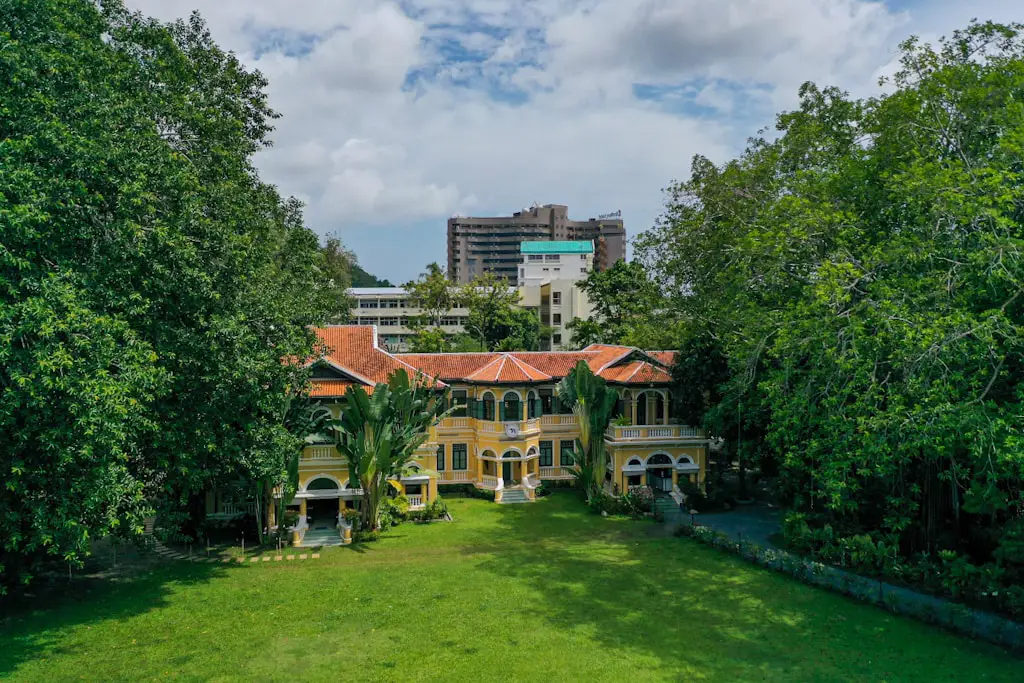
From the outside, the two-storey mansion shows European-influenced arches, columns, wooden shutters, and a dignified old-town facade. Inside, Chinese cultural details dominate the atmosphere: lacquered and gilded doors, Chinese characters, carved wooden furniture, mother-of-pearl inlay, display cabinets, porcelain, and ancestral elements. The result is not purely European or purely Chinese. It is a distinct Phuket blend created by Hokkien Chinese families who adapted different cultural influences into a tropical island home.
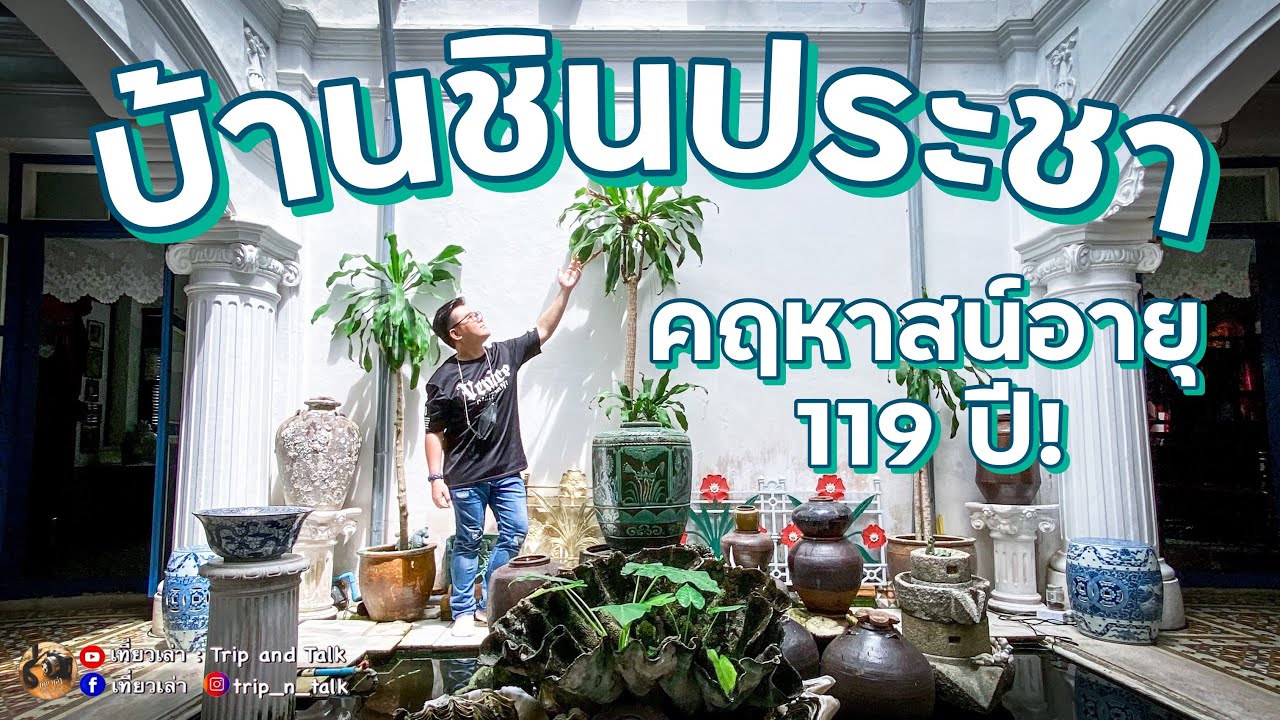
One of the most memorable features of the house is the cool and airy feeling inside. At the centre of the house is an open courtyard with a small water feature, often called chim jae. This opening allows natural light to enter the house while helping hot air escape. The water and open space reduce heat and improve airflow, making the house comfortable even in Phuket’s humid tropical climate. The feature also reflects Chinese feng shui ideas in which water, light, air, and spatial flow are important to family prosperity and well-being.
The central hall is one of the most beautiful areas of Baan Chinpracha. The Italian floor tiles, columns, old furniture, natural light, and indoor pond create a refined atmosphere that is both domestic and museum-like. Unlike many museums where objects are separated from life, this house still feels connected to the family that preserved it. Visitors can sense how guests were received, how family life was arranged, and how architecture helped shape comfort, ceremony, and daily living.
The antique furniture is another highlight. Many items were passed down through generations, including mother-of-pearl wooden furniture, Chinese-style cabinets, old beds, tables, chairs, porcelain, silverware, kitchen objects, and domestic utensils. These objects show the taste and social status of the family, but they also show ordinary life. The kitchen, dining room, and household items are just as meaningful as the grand reception area because they reveal how people cooked, gathered, entertained guests, and maintained family traditions.
The family photographs and old images displayed inside the house are valuable records of Phuket memory. They show people, clothing, ceremonies, interiors, family members, and scenes from the past. Through these images, visitors can see that Phuket history is not only made of major events, official records, or public monuments. It also lives in family albums, wedding scenes, household portraits, and domestic objects that have survived across generations.
Baan Chinpracha is closely connected with Baba-Yaya culture, a major part of Phuket identity. This culture developed from the blending of Chinese immigrants with local cultures of the Malay Peninsula and Southern Thailand. It can be seen in clothing, food, wedding customs, household manners, family rituals, and the decorative world of old homes. At Baan Chinpracha, visitors can better understand that Baba-Yaya culture was not only a festival costume or tourist image, but part of the lived domestic world of Phuket families.
The house continues to be cared for by descendants of the Tandavanitj family. Mr. Chanachon Tandavanitj is one of the current caretakers who helps explain the history and social meaning of the house to visitors. This family continuity is important because it makes Baan Chinpracha different from a fully detached museum. It remains a family heritage house where memory, ownership, care, and interpretation are still connected.
Baan Chinpracha has also been used as a filming location for Thai and international productions. Its preserved interiors, historic atmosphere, and cinematic quality made it suitable for period films and dramas, including the film Heaven & Earth by Oliver Stone. This international visibility shows that the house is not only meaningful to Phuket residents, but also visually and culturally valuable beyond Thailand.
For cultural travelers, Baan Chinpracha is one of the best places to understand the real interior life of Phuket Old Town. From the street, visitors may see many Sino-Portuguese shophouses, but here they can enter a complete mansion and experience its interior logic: reception areas at the front, a grand central hall, an open courtyard, family rooms, kitchen space, and household displays. This gives a much deeper understanding of old-town architecture than exterior sightseeing alone.
The museum is easy to combine with other heritage sites in Phuket Old Town. Phuket Thai Hua Museum, Soi Rommani, the Shrine of the Serene Light, Jui Tui Tao Bo Keng Shrine, Museum Phuket, Thalang Road, Dibuk Road, and local restaurants are all nearby. A good cultural route can begin at Baan Chinpracha, continue to Phuket Thai Hua Museum for the Hokkien Chinese education story, then move through the old town streets to see the broader urban landscape.
Getting There is straightforward because the house is located in Phuket Old Town. Visitors already in the old town can walk along Krabi Road. From Phuket International Airport, take Thepkasattri Road toward Phuket Town; the drive usually takes about 45 to 60 minutes depending on traffic. From Patong Beach, travel through Kathu or Wichit Songkhram Road toward Phuket Town; the drive usually takes about 35 to 50 minutes. Drivers should allow extra time for parking because streets in the old town can be narrow and busy.
The best time to visit is in the morning or before closing in the afternoon. The exterior photographs are usually better when the light is not too harsh, while the interior should be explored slowly to appreciate the wooden details, tiles, furniture, central courtyard, photographs, and kitchen objects. Visitors should dress politely, avoid touching furniture or displayed objects without permission, keep noise low, and follow the instructions of the staff because the house remains a private family heritage property as well as a museum.
In summary, Baan Chinpracha is one of the most meaningful heritage houses in Phuket. It tells the story of tin-mining wealth, Hokkien Chinese settlement, Penang trade, Baba-Yaya culture, Sino-Portuguese architecture, and the domestic life of an old Phuket family over more than 100 years. A visit here is not just about seeing a beautiful old mansion; it is about understanding the roots of Phuket through a real house that still preserves the memory of the city.
| Name | Baan Chinpracha / Phra Pitak Chinpracha House |
| Location | Krabi Road, Phuket Old Town, Talat Nuea Subdistrict, Mueang Phuket District, Phuket Province |
| Address | 98 Krabi Road, Talat Nuea Subdistrict, Mueang Phuket District, Phuket 83000, Thailand |
| Coordinates | 7.8858, 98.3839 |
| Type | Historic House, Living Museum, Sino-Portuguese Heritage Mansion, And Hokkien Chinese Family Heritage Site |
| Highlights | Early Phuket Sino-Portuguese mansion, central chim jae courtyard, Italian floor tiles, lacquered and gilded doors, mother-of-pearl furniture, antique kitchenware, family photographs, and old Phuket domestic atmosphere |
| History | Built in 1903 by Phra Pitak Chinpracha, also known as Tan Ma Siang, son of Luang Bamrung Chinprathet or Tan Niaw Yee, during the late reign of King Rama V |
| Building Features | A two-storey Sino-Portuguese mansion with arches, wooden shutters, a central open courtyard, indoor water feature, wooden staircase, and Chinese-European decorative details |
| Cultural Importance | A heritage house that reflects Phuket’s tin-mining economy, Hokkien Chinese families, Penang trade connections, Baba-Yaya culture, and old Phuket domestic life |
| Main Areas / Zones | Reception Hall Central Hall And Chim Jae Courtyard Dining Room And Old Kitchen Displayed Bedroom Family Photographs And Household Objects Area Baba-Yaya Costume Area Front Garden And Facade |
| Travel Information | Visitors in Phuket Old Town can walk along Krabi Road. From Phuket International Airport, the drive usually takes about 45 – 60 minutes. From Patong, the journey usually takes about 35 – 50 minutes depending on traffic. |
| Current Status | Open as a historic house and living museum in Phuket Old Town |
| Open Days | Daily |
| Opening Hours | 09.00 – 16.30 |
| Admission Fee | Thai Visitors 100 Baht Foreign Visitors 150 Baht |
| Suggested Visit Duration | About 45 Minutes – 1.5 Hours, Or Longer For Photography And Detailed Heritage Appreciation |
| Facilities | House exhibition areas, photo spots, indoor rest area, local snack and coffee corner, Baba-Yaya costume rental, and nearby restaurants in Phuket Old Town |
| Caretaker / Related Organization | Tandavanitj Family / Chinpracha House & Museum |
| Main Contact Number | 076-211-281 |
| Nearby Tourist Attractions | 1. Phuket Thai Hua Museum, about 0.2 km 2. Phuket Old Town, about 0.3 km 3. Soi Rommani, about 0.5 km 4. Shrine Of The Serene Light, about 0.7 km 5. Jui Tui Tao Bo Keng Shrine, about 0.8 km 6. Museum Phuket, about 0.9 km 7. Khao Rang, about 2.5 km 8. Saphan Hin, about 3.5 km |
| Nearby Restaurants | 1. Blue Elephant Phuket, about 0.1 km, Tel. 076-354-355 2. The Charm Dining Gallery, about 0.4 km, Tel. 076-530-199 3. Kopitiam By Wilai, about 0.6 km 4. One Chun, about 0.8 km, Tel. 076-355-909 5. Raya, about 0.9 km, Tel. 076-218-155, 092-252-4883 6. Tu Kab Khao, about 1 km, Tel. 076-608-888 |
| Nearby Accommodations | 1. Hotel Midtown Ratsada, about 0.7 km, Tel. 091-915-4945-7 2. The Memory At On On Hotel, about 0.8 km, Tel. 076-363-700 3. Casa Blanca Boutique Hotel, about 0.9 km, Tel. 076-219-019 4. Courtyard By Marriott Phuket Town, about 1.5 km, Tel. 076-643-555 5. Royal Phuket City Hotel, about 1.7 km, Tel. 076-233-355 6. Blu Monkey Hub & Hotel Phuket, about 1.8 km, Tel. 076-354-266 |
Frequently Asked Questions (FAQ)
Q: Where is Baan Chinpracha located?
A: Baan Chinpracha is located at 98 Krabi Road, Talat Nuea Subdistrict, Mueang Phuket District, Phuket, in the heart of Phuket Old Town.
Q: Why is Baan Chinpracha important?
A: It is an early Sino-Portuguese mansion that reflects Phuket’s tin-mining wealth, Hokkien Chinese families, Baba-Yaya culture, Penang trade connections, and old Phuket domestic life.
Q: When was Baan Chinpracha built and who built it?
A: It was built in 1903 by Phra Pitak Chinpracha, also known as Tan Ma Siang, son of Luang Bamrung Chinprathet or Tan Niaw Yee.
Q: What are the opening days and hours?
A: Baan Chinpracha opens daily from 09.00 to 16.30.
Q: How much is the admission fee?
A: Admission is 100 baht for Thai visitors and 150 baht for foreign visitors.
Q: What can visitors see inside Baan Chinpracha?
A: Visitors can see the reception hall, central chim jae courtyard, dining room, old kitchen, displayed bedroom, mother-of-pearl furniture, antique household objects, family photographs, and Sino-Portuguese architectural details.
Q: Why does the house feel cool inside?
A: The house has a central open courtyard with a small water feature that brings in natural light, improves airflow, and reduces heat, making the interior comfortable in Phuket’s tropical climate.
Q: What nearby places can be visited with Baan Chinpracha?
A: Nearby places include Phuket Thai Hua Museum, Phuket Old Town, Soi Rommani, the Shrine of the Serene Light, Jui Tui Shrine, Museum Phuket, Khao Rang, and local restaurants around the old town.
Tel : 076211167, 076211281
 Tel : 076211167, 076211281
 Category: ●Art, Culture and Heritage
 Group: ●Historic Homes and Cities
Last Update : 2 MonthAgo
 Last Update : 2 MonthAgo
 Click to Access the Navigation Map GPS
Baan Chinpracha Map
Recommend

 Landmarks and Memorials(7)
 Art, Craft Centres, Tradition(5)
 Museums(4)
Historic Homes and Cities(1)
 Art Gallery(1)
 Educational Places
 Educational Gardens, Farm(2)
 Places of Worship
 Temple(14)
 Mosque(47)
 Other Sacred Sites(15)
 Suburban Living
 Village, Community(2)
 Floating Market(1)
 Nature and Wildlife
 National Parks and Marine Reserves(2)
 Mountain (Doi)(2)
 Dam, Reservoir, Lake(1)
 Waterfalls(4)
 Bays and Beaches(30)
 Islands(12)
 Other natural attractions(10)
 Entertainment and Agricultural
 Zoos and Aquariums(2)
 Stadium(2)
 Farms, Parks and Ecotourism(4)
 Amusement Park(2)
 Waterpark(6)
 Theater(1)
 Outdoor and Adventure Activities(1)
 Shopping
 Shopping and Night Market(1)
 Travel Articles, Recipes
 Travel Review, Food Review(1)
 Southern Food Menu, Southern Food Recipes(5)


