
lovethailand home >Northeastern Travel Attractions >Udon Thani Travel Attractions >Ban Phu >Muang Phan > Bun Prasat Phueng Tai Phuan
TL;DR: Bun Prasat Phueng Tai Phuan, Udon Thani attractions : Art, Culture and Heritage, Art, Craft Centres, Tradition.
Bun Prasat Phueng Tai Phuan
Open Days: Held Annually On The Full Moon Day Of The 11th Lunar Month, The End Of Buddhist Lent
Opening Hours: Activities Begin In The Morning And Continue Into The Evening
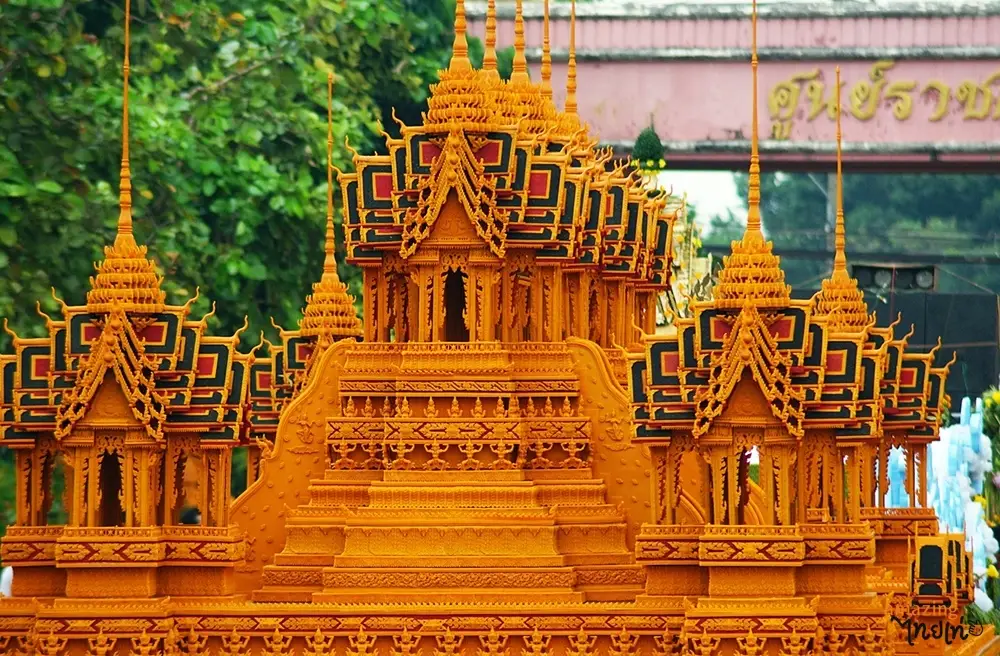
Bun Prasat Phueng Thai Phuan Of Ban Nong Kalum in Mueang Phan Subdistrict, Ban Phue District, Udon Thani Province, is an important annual Buddhist and community tradition of the Thai Phuan people in upper northeastern Thailand. The ceremony is held on the full moon day of the 11th lunar month, known in Thailand as the end of Buddhist Lent. In the Isan cultural calendar, this merit-making occasion belongs to Bun Duean Sip Et, the merit-making tradition of the 11th month according to the local way of life known as Hit Sip Song Khong Sip Si.
This tradition is deeply meaningful because it combines Buddhist devotion, local craftsmanship, community cooperation, and Thai Phuan identity in one ceremony. The main feature is the making of a wax castle, or Prasat Phueng, which is created as an offering to the Buddha. The villagers also prepare oil lamps, wax flowers, religious offerings, coconut oil for lamps, and a procession that carries the decorated wax castle to the temple. Every step reflects faith and collective effort rather than commercial performance.
Ban Nong Kalum is part of Mueang Phan Subdistrict in Ban Phue District, an area known for its Thai Phuan communities, local heritage, Buddhist sites, and cultural routes connected with Phu Phrabat Historical Park and other important attractions. Visiting this tradition gives travelers a deeper understanding of Udon Thani beyond well-known tourist landmarks. It reveals how a small community preserves identity through ritual, handwork, oral knowledge, temple-centered life, and annual participation by many generations.
The timing of the event is based on the lunar calendar. It takes place on the full moon day of the 11th lunar month, the day marking the end of Buddhist Lent. In 2026, this date falls on Monday, October 26. Travelers who want to witness the full ceremony should plan carefully because the complete ritual sequence happens on a specific annual date. It is not a permanent attraction where all ritual elements can be seen every day.
The morning begins with villagers preparing food and making merit at the temple. They offer alms and meals to monks, marking the start of the end-of-Lent merit-making day. After the morning temple activities, the community divides responsibilities among different groups. Some people prepare coconut oil for lamps. Some build the lamp platform. Skilled men work on the wax castle frame. Women prepare oil-lamp trays, lamp wicks, wax flowers, food, and religious offerings. This division of work shows how the ceremony depends on cooperation across households and age groups.
The coconut oil prepared by the villagers is used for lighting the oil lamps in the evening. Part of the oil is also offered to the temple for use after Buddhist Lent. This detail is important because the offering is not merely symbolic. It also supports temple life in a practical way. Merit-making in this tradition therefore includes beauty, faith, and usefulness at the same time.
The lamp platform is built in front of the temple hall or the community preaching hall. It is usually made of wood, raised about a meter from the ground, and covered with woven bamboo flooring. The structure is decorated with coconut leaves, banana stems, and natural materials. In the evening, many oil-lamp trays are placed on the platform and lit together, creating a sacred and beautiful scene of light in front of the temple.
The wax castle frame is made from bamboo and banana sheath. Local craftsmen shape it into a castle-like structure, then decorate it with carved banana-stem patterns. One of the known decorative forms is the Khiwo Ma pattern, a traditional design used in banana-stem carving. This type of craft requires skill, experience, patience, and a clear understanding of natural materials. The finished structure becomes the base for wax flowers and other decorations.
The size of each wax castle depends on the faith, resources, labor, and readiness of each neighborhood group. Some castles are modest and simple, while others are larger and more detailed. The value of the offering is not measured by size alone. Its real meaning lies in the shared intention to make merit, preserve tradition, and create something beautiful for Buddhist worship.
Women play an essential role in preparing the lamp trays, wicks, and wax flowers. The lamp trays are made from local forest fruits such as Matoom Ka or Som Ka. The fruits are cut in half, emptied, smoothed, and turned into natural containers for coconut oil and lamp wicks. This practice reflects local ecological knowledge and the ability to transform ordinary natural materials into sacred ritual objects.
The lamp wicks are made from cotton thread twisted into the shape of a crow’s foot. This form recalls a Buddhist-related belief about a mother crow that nurtured a past spiritual figure. When the wick is placed in the lamp tray and filled with coconut oil, the object becomes more than a simple light source. It carries memory, devotion, and symbolic meaning. When the lamp is lit, the light represents an offering to the Buddha and the intention of the community.
Wax flowers are the most visually distinctive part of the Prasat Phueng tradition. To make them, beeswax is placed in a bowl or metal cup floating in warm water until it melts. A peeled papaya base is dipped into the melted wax and then placed into cool water. Thin wax petals separate from the papaya and form flower-like shapes. Different wax colors such as deep yellow, pale yellow, bright yellow, and white can be used. Local flowers are then placed in the center as stamens before the wax flowers are attached to the castle.
Making wax flowers is a delicate process. Elders often teach younger people how to control the temperature of the wax, how to dip and lift the papaya mold, how to release the wax flowers smoothly, and how to decorate the finished castle. This makes the tradition an informal cultural classroom. Young people learn by doing, watching, asking, and helping. The knowledge is carried through hands, not only through words.
After the wax castle is completed, the villagers prepare religious offerings. These may include notebooks, pencils, robes, monks’ requisites, daily-use items, and donated funds according to the faith and ability of the participants. These offerings show that the ceremony is not only about presenting a beautiful object. It is also about supporting the monks and the temple in practical ways.
In the evening, each neighborhood group carries its wax castle in procession to the temple. When the procession arrives, the wax castle is carried clockwise around the temple hall or preaching hall 3 times. This clockwise circumambulation expresses respect for the Triple Gem. After 3 rounds, the wax castle is placed before the main Buddha image inside the temple hall or on the preaching hall. This is one of the most important visual moments of the event.
After paying respect to the main Buddha image, the villagers do not immediately offer the wax castle. They return to the lamp platform and light the oil lamps together. As many lamps glow in front of the temple, the scene becomes both peaceful and powerful. Fireworks and local ceremonial lights may also be used, and the community releases wind lanterns according to its tradition. The evening atmosphere expresses the joy and brightness of faith at the end of Buddhist Lent.
After the oil lamps are lit in worship of the Buddha, the villagers return to the temple hall or preaching hall to listen to monks chant paritta blessings. They then listen to a sermon on the merit and benefits of making a wax castle offering. This part of the ceremony gives doctrinal meaning to the beautiful objects made by the community. The wax castle becomes a symbol of devotion, discipline, craftsmanship, generosity, and shared Buddhist faith.
After the chanting and sermon, the wax castle and religious offerings are formally offered to the monks. This completes the main ceremony. The wax flowers may be used to make candles for the temple after Buddhist Lent, while the natural castle frame is later placed under trees within the temple grounds. The return of natural materials to the temple environment reflects the local use of biodegradable materials and the simple rhythm of traditional community life.
The strongest value of Bun Prasat Phueng Thai Phuan of Ban Nong Kalum is cooperation. No stage can be completed by one person alone. The lamp platform requires labor. The castle frame requires craftsmanship. The wax flowers require precision. The food requires household support. The procession requires community participation. The offering requires the temple as a center of faith. Through this annual ceremony, the village renews its social bonds.
In terms of ethnic identity, the tradition reflects the strength of Thai Phuan culture in Ban Phue District. The Thai Phuan people have their own language, customs, foodways, textile traditions, beliefs, and ritual practices. Preserving Bun Prasat Phueng is one way the community continues to express who they are. The ceremony is therefore not only a Buddhist ritual. It is also an annual declaration of cultural memory and belonging.
The area around Ban Nong Kalum is rich in historical and cultural attractions. Nearby places include Wat Non Sila At, Phra Phutthabat Bua Bok, Phu Phrabat Historical Park, and the Thai Phuan Ban Phue Museum. Travelers can combine the wax castle tradition with these sites to create a meaningful cultural route through Ban Phue District. This makes the visit valuable for those interested in archaeology, Buddhism, local history, and ethnic heritage.
Wat Non Sila At near Ban Nong Kalum is especially important because it is known for sandstone Sīma stones with Dvaravati and Lopburi artistic influences. Some stones are carved with Buddhist stories and Jataka scenes. The presence of such heritage shows that the wider Mueang Phan and Ban Phue area has long been connected with Buddhist culture. The living wax castle tradition and the ancient Sīma stones together reveal a deep continuity of faith in the area.
Phu Phrabat Historical Park is another nearby site that expands the visitor’s understanding of the region. The park contains sandstone shelters, rock paintings, sacred footprints, Sīma stones, and evidence of religious use over many periods. Visiting Phu Phrabat before or after the wax castle ceremony helps travelers see how nature, belief, and history are closely connected in Ban Phue District.
The Thai Phuan Ban Phue Museum is highly recommended for visitors who want to understand the Thai Phuan community more clearly. The museum presents Thai Phuan ways of life, language, food, clothing, tools, weaving, beliefs, and local knowledge. Seeing the museum and then attending Bun Prasat Phueng creates a fuller travel experience because visitors can connect displayed heritage with living tradition.
Getting There from Udon Thani city is most convenient by private car, rental car, or hired vehicle. Travelers should head toward Ban Phue District and continue to Mueang Phan Subdistrict and Ban Nong Kalum. A day trip is possible, but visitors who want to experience the full morning-to-evening sequence should consider staying in Ban Phue District or Udon Thani city and arranging transportation in advance.
Travelers without a private car should arrange a vehicle from Udon Thani city or Ban Phue District. Because the event continues into the evening and takes place in a village setting, return transportation should be planned clearly. This is especially important for foreign visitors who are not familiar with rural transport in northeastern Thailand.
Visitors should dress respectfully because most activities take place in temple space and are connected with Buddhist offerings. Do not block the procession, disturb ritual participants, touch ritual objects without permission, or photograph people in a disruptive manner. This is a living community ceremony, not a staged performance, and visitors should approach it with respect.
There is no admission fee for the ceremony. Visitors may make merit according to their faith and may support the community by purchasing local food, drinks, or products when available. Supporting local vendors helps the community maintain the vitality of the tradition.
The charm of Bun Prasat Phueng Thai Phuan is not in large-scale spectacle but in careful handwork, natural materials, community rhythm, and sincere faith. The bamboo frame, banana sheath, carved banana stem, wax flowers, fruit lamp trays, crow-foot wicks, coconut oil, and evening lamps all form a ritual language that belongs to the community. Each object has a function and meaning.
For deep cultural travelers, this ceremony is an excellent way to understand Isan through practice rather than surface sightseeing. Visitors can see how labor is shared, how women and men contribute different skills, how younger generations learn from elders, and how the temple remains the heart of community life. The glowing oil lamps at the end of Buddhist Lent become a strong image of collective faith.
Bun Prasat Phueng Thai Phuan of Ban Nong Kalum is a tradition worth preserving and visiting with respect. It shows that culture is not something frozen in books or museums. It is something people continue to make, carry, light, offer, and remember together every year. The wax flowers, the temple procession, the chanting, the sermon, and the oil lamps all reveal the living cultural identity of the Thai Phuan community in Udon Thani.
Overall, this tradition is one of the meaningful cultural events of Ban Phue District. It combines Buddhism, Thai Phuan identity, local craftsmanship, ecological knowledge, community cooperation, and end-of-Lent devotion in a single annual ceremony. Travelers who want to understand Udon Thani in depth should consider visiting Ban Nong Kalum on the end of Buddhist Lent to experience this living heritage with patience and respect.
| Name | Bun Prasat Phueng Thai Phuan Of Ban Nong Kalum |
| Location | Ban Nong Kalum, Mueang Phan Subdistrict, Ban Phue District, Udon Thani Province |
| Address | Ban Nong Kalum, Moo 9, Mueang Phan Subdistrict, Ban Phue District, Udon Thani 41160, Thailand |
| Highlights | Wax Castle Making, Wax Flower Making, Oil-Lamp Trays, Temple Procession, 3 Clockwise Rounds Around The Temple Hall Or Preaching Hall, Evening Lamp Lighting, And Wax Castle Offering At The End Of Buddhist Lent |
| History | An Isan Buddhist merit-making tradition following Hit Sip Song Khong Sip Si, combined with Thai Phuan identity and end-of-Lent devotion. |
| Significance | A ceremony to worship the Buddha at the end of Buddhist Lent and to strengthen the relationship between village, temple, monks, elders, youth, and the Thai Phuan community. |
| Name Origin | Prasat Phueng refers to a castle-like offering decorated with wax flowers made from beeswax and presented as a Buddhist offering. |
| Distinctive Features | The ceremony uses local materials such as bamboo, banana sheath, banana stem, beeswax, forest fruits, cotton thread, and coconut oil to create meaningful ritual objects. |
| Main Areas / Zones | 1. Ban Nong Kalum Community Area For Preparing Wax Castles And Oil-Lamp Trays 2. Neighborhood Groups That Build Wax Castles 3. Community Temple For Almsgiving, Sermon Listening, And Wax Castle Offering 4. Temple Hall Or Preaching Hall Front Area For The Lamp Platform 5. Procession Route From The Village To The Temple 6. Evening Lamp-Lighting And Wind-Lantern Area |
| Caretaker | Thai Phuan Community Of Ban Nong Kalum, Community Temple, Village Leaders, And Local Agencies In Mueang Phan Subdistrict, Ban Phue District |
| Travel Information | From Udon Thani city, travel toward Ban Phue District, then continue to Mueang Phan Subdistrict and Ban Nong Kalum. Private car, rental car, or hired transport is recommended. |
| Current Status | An annual community tradition held according to the end-of-Lent lunar calendar. |
| Open Days | Held Annually On The Full Moon Day Of The 11th Lunar Month, The End Of Buddhist Lent |
| 2026 Event Date | Monday, October 26, 2026 |
| Opening Hours | Activities Begin In The Morning And Continue Into The Evening |
| Admission Fee | Free Admission |
| Facilities | Community Temple Area, Local Restaurants In Ban Phue District, Nearby Accommodations In Ban Phue, And Cultural Attractions In The Surrounding Area |
| Main Contact Number | Tourism Authority Of Thailand, Udon Thani Office: 042-325-406 |
| Nearby Tourist Attractions | 1. Wat Non Sila At, Ban Nong Kalum, About 1 km 2. Phra Phutthabat Bua Bok, About 12 km 3. Phu Phrabat Historical Park, About 14 km 4. Thai Phuan Ban Phue Museum, About 15 km, Tel. 089-618-6551 5. Wat Pa Ban Kho, About 28 km 6. Wat Pa Phu Kon, About 70 km |
| Nearby Restaurants | 1. Kai Yang Thai Phuan Ban Phue, About 14 km 2. BaanYa Cafe’ - Moto-O Ban Phue, About 14 km, Tel. 095-651-5252 3. So Kung Phao Ban Phue, About 15 km, Tel. 081-050-2007 4. Kai Yang Yai Ruang Ban Phue, About 15 km, Tel. 042-280-149 5. Shelly Cafe Ban Phue, About 15 km, Tel. 083-341-6363 6. Khlong Sa Bua Boat Noodles Ban Phue, About 15 km |
| Nearby Accommodations | 1. Thararin Resort Ban Phue, About 12 km, Tel. 088-552-0872 2. Patchawan Resort Ban Phue, About 13 km 3. Romruen Resort Ban Phue, About 14 km 4. Oonrak Resort Ban Phue, About 15 km, Tel. 061-196-9897 5. Niyom STN 2 Hotel Ban Phue, About 15 km 6. Nong Mai Resort Ban Phue, About 16 km |
Frequently Asked Questions (FAQ)
Q: When is Bun Prasat Phueng Thai Phuan of Ban Nong Kalum held?
A: It is held annually on the full moon day of the 11th lunar month, the end of Buddhist Lent. In 2026, it falls on Monday, October 26.
Q: Where is Bun Prasat Phueng Thai Phuan of Ban Nong Kalum located?
A: It takes place at Ban Nong Kalum, Mueang Phan Subdistrict, Ban Phue District, Udon Thani Province.
Q: Why is this tradition important?
A: It is an end-of-Lent Buddhist merit-making ceremony of the Thai Phuan community, using wax castles, oil-lamp trays, wax flowers, and religious offerings to worship the Buddha and preserve Isan and Thai Phuan heritage.
Q: Can tourists join the ceremony?
A: Yes. Visitors may observe the ceremony respectfully, dress politely, avoid disturbing the procession and ritual participants, and make merit according to their faith.
Q: Is there an admission fee?
A: No. There is no admission fee because it is a community merit-making event and Buddhist ceremony.
Q: What is the best time to visit?
A: Visitors should arrive in the morning to see almsgiving and preparation activities, then stay until evening to see the procession, oil-lamp lighting, and wax castle offering.
Q: What makes the Thai Phuan wax castle distinctive?
A: It is made with bamboo, banana sheath, carved banana stem, and wax flowers made from beeswax, then offered to the Buddha as a sacred handcrafted object.
Q: What nearby places can visitors explore after the ceremony?
A: Nearby places include Wat Non Sila At, Phra Phutthabat Bua Bok, Phu Phrabat Historical Park, Thai Phuan Ban Phue Museum, Wat Pa Ban Kho, and Wat Pa Phu Kon.
 Category: ●Art, Culture and Heritage
 Group: ●Art, Craft Centres, Tradition
Last Update : 3 MonthAgo
 Last Update : 3 MonthAgo
Recommend

 Historical Sites and Monuments(1)
 Landmarks and Memorials(1)
Art, Craft Centres, Tradition(2)
Landmarks and Memorials(1)
Art, Craft Centres, Tradition(2)
 Museums(2)
 Places of Worship
 Temple(21)
 Other Sacred Sites(8)
 Suburban Living
 Village, Community(3)
 Nature and Wildlife
 National Parks and Marine Reserves(3)
 Mountain (Doi)(1)
 Dam, Reservoir, Lake(8)
 Waterfalls(6)
 Caves(1)
 River, Canal(4)
 Islands(1)
 Other natural attractions(1)
 Entertainment and Agricultural
 Farms, Parks and Ecotourism(3)
 Waterpark(2)
 Shopping
 Shopping and Night Market(1)
 Travel Articles, Recipes
 Travel Review, Food Review(1)


