
lovethailand home >Northeastern Travel Attractions >Udon Thani Travel Attractions >Chai Wan >Chai Wan > Wat Pa Santikawat
TL;DR: Wat Pa Santikawat is located at Village No. 7, Ban Nong Tum, Chai Wan Subdistrict, Chai Wan District, Udon Thani Province, Thailand, open Daily, hours 07.00 – 18.00.
Wat Pa Santikawat
Open Days: Daily
Opening Hours: 07.00 – 18.00
Wat Pa Santikawat in Udon Thani is located in Village No. 7, Ban Nong Tum, Chai Wan Subdistrict, Chai Wan District, Udon Thani Province. It is one of the most important forest meditation temples in Chai Wan District and is especially known for its sacred stupa, a revered spiritual landmark for the local community. The temple is calm, shaded, and deeply rooted in the Thai forest monk tradition. Although it is only about 500 meters from the Chai Wan District Office, the atmosphere inside the temple feels peaceful and detached from the movement of the town outside.
Wat Pa Santikawat is suitable for visitors who want to pay respect to a sacred stupa, make merit, learn about the Thai forest meditation tradition, and spend time in a quiet natural setting. The temple grounds include the main stupa, a museum dedicated to Luang Pu Bun Chan Kamalo, walking paths among trees, pavilions, monastic residences, and meditation areas. A visit here is not only about viewing a religious monument. It is also an opportunity to experience a living forest monastery created through the faith of monks and the Ban Nong Tum community.
The location of the temple is important to the local history of Chai Wan. Ban Nong Tum is directly connected with the founding of Wat Pa Santikawat. In the early period, Ban Nong Tum was still a small village with only a limited number of households. Local devotees regularly went to listen to Dhamma teachings from Luang Pu Bun Chan Kamalo, who was staying near the old cemetery area of Ban Chai Wan. When the former site had water-related difficulties, villagers invited him to move to the forest area known as Pa Nong Thom Dong Saen Waen, a quiet and open place suitable for establishing a forest monastery.
A key event in the temple’s founding was the testing of the water source. Luang Pu Bun Chan asked the villagers to dig a well first to confirm that the place had usable water. When they dug about 4 to 5 meters deep, they found fresh water. The villagers brought the water to Luang Pu Bun Chan, and after he found it suitable, he agreed to move from the old cemetery area to the forest near Ban Nong Tum. This moment marked the beginning of what later became Wat Pa Santikawat.
The name “Santikawat” conveys the idea of a peaceful dwelling. It matches the character of the temple very well. This is not a temple built for grandeur or display. It was founded as a quiet place for meditation, Dhamma practice, and spiritual training. The term “Wat Pa,” or forest temple, also reflects the Thai forest monk tradition, where monks live close to nature, reduce distractions, and use the stillness of the forest to train the mind. Visitors should therefore understand Wat Pa Santikawat as a place of living Buddhist practice, not only as a sightseeing destination.
Luang Pu Bun Chan Kamalo, also known by his ecclesiastical title Phra Khru Sasanupakorn, was the central figure in the foundation of Wat Pa Santikawat. He was a respected forest monk associated with the meditation tradition of northeastern Thailand. His decision to establish a forest monastery near Ban Nong Tum was not simply the creation of a new religious site. It gave the local community a spiritual center for merit-making, listening to Dhamma, observing precepts, and learning meditation in the forest tradition.
As the temple became established, Wat Pa Santikawat grew into an important center of faith for Chai Wan and nearby communities. Villagers came to make merit, listen to teachings, take part in Buddhist activities, and pay respect to revered teachers. The temple gradually became both a forest meditation monastery and a spiritual center for the community. Although it is close to the district town, the temple has preserved the quiet, shaded, and contemplative atmosphere of a forest temple.
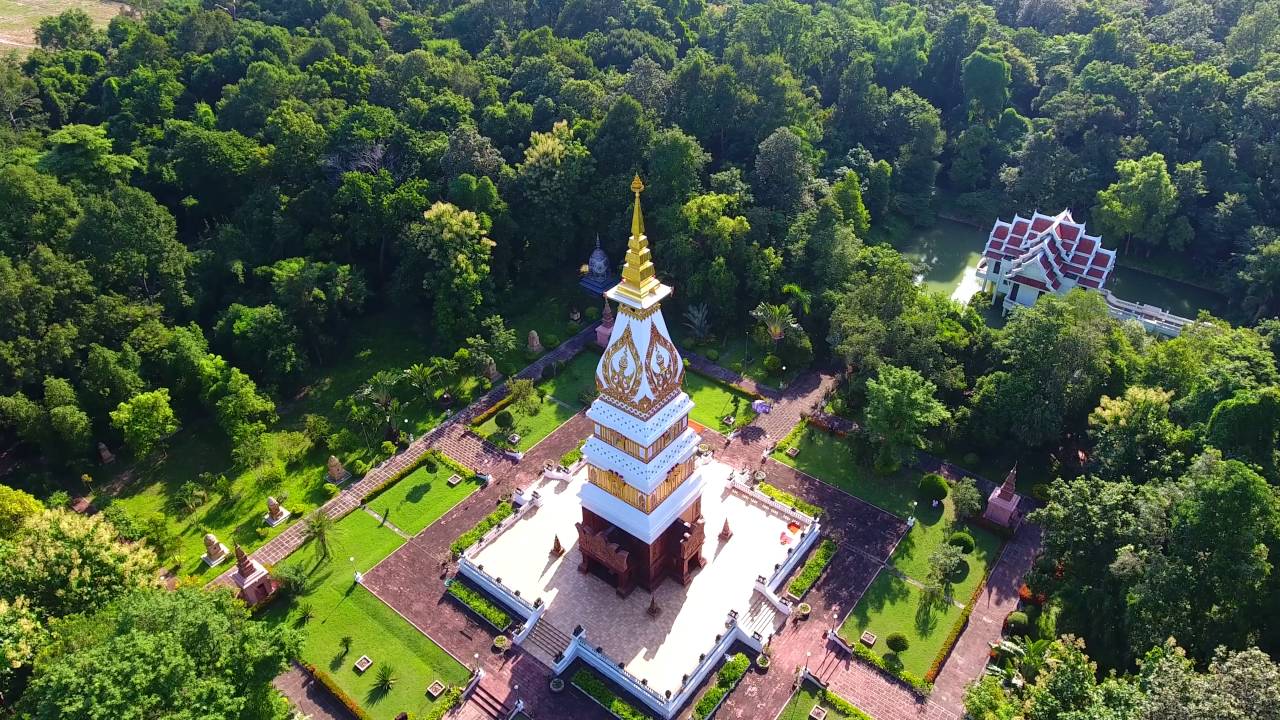
Kamalo Chedi is the most important sacred structure at Wat Pa Santikawat. It was built as a memorial to Luang Pu Bun Chan Kamalo after his passing. The stupa is elegant and visually striking, with a reddish brick base, white upper tiers, and golden decorative patterns. Standing among the trees, it has become the most recognizable landmark of the temple and the first place where most visitors pay respect.
The design of Kamalo Chedi evokes the sacred stupa tradition of northeastern Thailand and has visual associations with Phra That Phanom, one of the most revered stupas in the Isan and Mekong region. This gives the stupa a familiar spiritual quality for local worshippers. It is not merely a memorial building. It is a center of devotion, remembrance, and continuity between teacher, disciple, temple, and community.
Inside Kamalo Chedi, visitors can find a sacred space and a small museum related to the life and teachings of Luang Pu Bun Chan Kamalo. The display includes his image, personal monastic objects, and items that help visitors understand the simplicity and discipline of the forest monk way of life. Seeing these objects in the temple setting gives a stronger impression than reading a biography alone. They reflect a life of restraint, mindfulness, and dedication to Dhamma practice.
The base of the stupa includes decorative details, while the upper parts emphasize white and gold, symbolizing purity, brightness, and spiritual elevation. From the front courtyard, the stupa appears dignified but not excessive. Its power comes from calmness, not display. Many visitors spend time walking around it, viewing the structure from different angles, and then entering respectfully to pay homage.
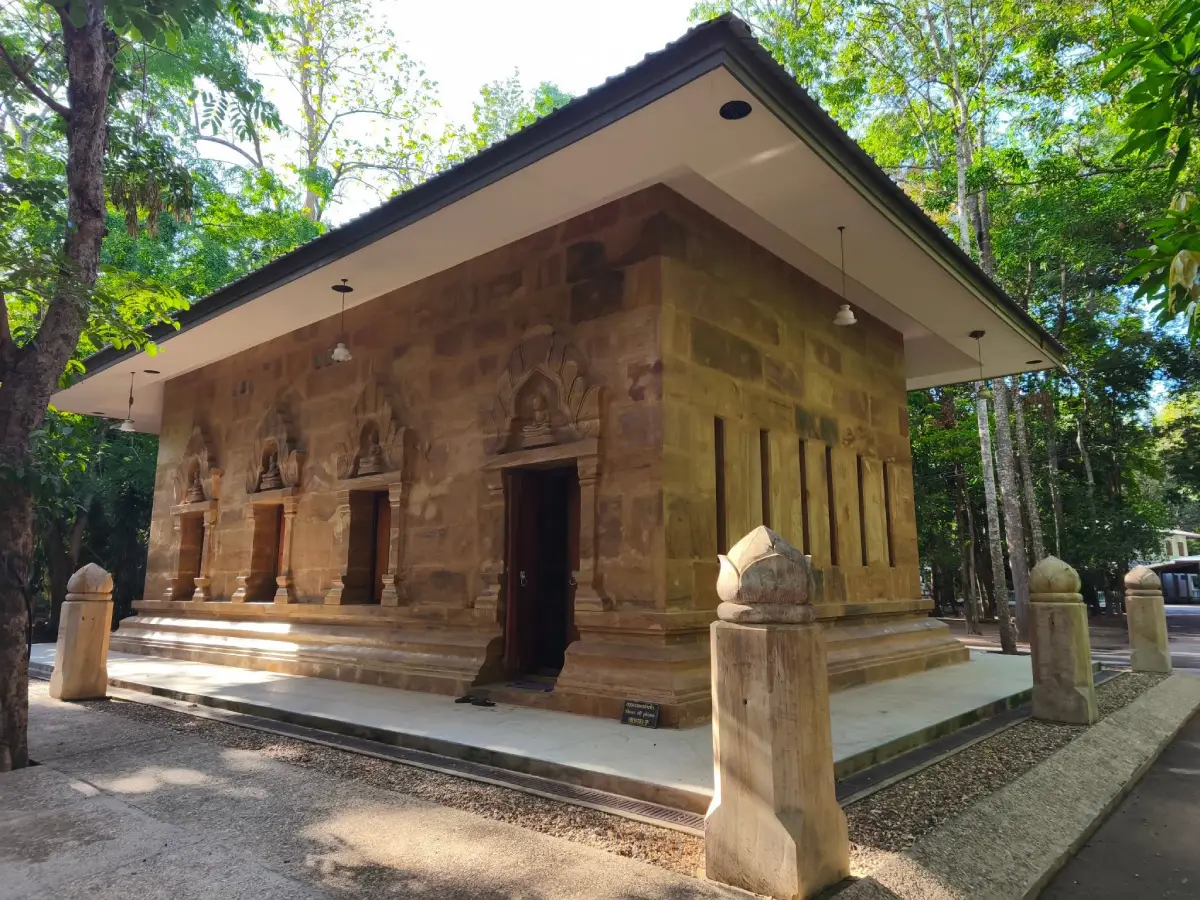
Another stupa within the temple has a different visual style, decorated with colorful ceramic elements. Together with the main Kamalo Chedi, it adds architectural diversity to the temple grounds. The buildings and monuments are not densely arranged like those in urban temples. They are placed within greenery and open space, allowing the temple’s forest character to remain dominant.
The forested area of the temple is one of its greatest qualities. The buildings are scattered among trees, paths, and quiet spaces rather than concentrated in one crowded area. Some paths serve both as walking routes and meditation paths. Shade from the trees makes the temple suitable for slow walking and quiet reflection. In a forest temple, nature is not merely decoration. It is part of the spiritual environment that supports mindfulness.
The pavilions and meditation spaces are arranged in a way that respects the stillness of the site. Those who come for practice can use the quietness of the temple to observe body and mind. General visitors can also walk respectfully and absorb the calm atmosphere. Wat Pa Santikawat therefore serves worshippers, cultural travelers, and people interested in the Thai forest meditation tradition.
Luang Ta Sommai Attamano, also known as Phra Khru Metta Kittikhun, is an important senior monk associated with Wat Pa Santikawat. His lay name was Sommai Chantharak, and he was born in Chai Wan, Udon Thani Province. From a young age, he had a close connection with Luang Pu Bun Chan Kamalo. After ordination, he served Luang Pu Bun Chan closely and continued the temple’s direction in Dhamma teaching, monastic discipline, and community guidance.
The role of Luang Ta Sommai helped maintain the continuity of Wat Pa Santikawat after the time of Luang Pu Bun Chan. He followed the forest monk approach, emphasizing discipline, compassion, Dhamma practice, and teachings that can be applied in daily life. For this reason, the temple is important not only for its architecture and stupa, but also as a place where forest meditation teaching has continued across generations.
For visitors interested in forest monks, Wat Pa Santikawat deserves careful attention. The temple is connected with Luang Pu Bun Chan Kamalo, Luang Ta Sommai Attamano, and the practical Dhamma tradition of northeastern Thailand. The stupa, museum, monastic residences, forest paths, and silence of the grounds all point toward the same message: training the mind through simplicity, mindfulness, and direct practice.
Wat Pa Santikawat is also recognized in local Chai Wan information as one of the important sites in the area, together with Wat Ku Kaeo Witthayaram and Nong Chai Wan Public Park. This shows that the temple is not only a religious site inside its own boundary. It is part of Chai Wan’s local identity, representing faith, local history, and cultural tourism.
Wat Ku Kaeo Witthayaram is another nearby place that complements a visit to Wat Pa Santikawat. It is known for important Buddha images and ancient objects registered as antiquities by the Fine Arts Department. Nong Chai Wan Public Park is a local recreation area. Together, these places present three dimensions of Chai Wan: forest monk devotion, local antiquities, and community public space.
A good way to explore Wat Pa Santikawat is to begin at Kamalo Chedi, the heart of the temple. After paying respect, visitors can continue to the museum area, the image of Luang Pu Bun Chan, his monastic objects, the secondary stupa, the forest paths, pavilions, and meditation areas. This route helps visitors understand the temple from its spiritual center outward into the natural landscape that surrounds it.
Visitors should allow at least one hour for the temple. Those interested in the history of Luang Pu Bun Chan and Luang Ta Sommai should spend more time viewing the details inside Kamalo Chedi and walking through the temple grounds slowly. Wat Pa Santikawat is not a place to rush through. Its value lies in stillness, continuity, and the quiet presence of the teachers remembered there.
The best times to visit are in the morning and late afternoon. Morning visits offer cooler air and a peaceful start to the day. Late afternoon gives softer light for viewing the stupa among the trees. During the hot season, visitors should bring drinking water and dress comfortably but respectfully. During the rainy season, shaded paths may become slippery, so walking carefully is important.
Temple etiquette is especially important at Wat Pa Santikawat because it is both a visitor destination and a place of Buddhist practice. Visitors should dress modestly, speak quietly, avoid disturbing monks or meditators, and avoid touching displays without permission. They should not climb on stupas or sacred structures. Shoes should be removed before entering designated sacred areas. Respectful conduct helps preserve the atmosphere for everyone.
Getting There from Udon Thani city is straightforward by private car, rental car, or chartered local vehicle. Travelers should head toward Chai Wan District, about 62 to 65 kilometers from the city. Once in Chai Wan town, the temple is only about 500 meters from the district office. The location is easy to reach, yet the temple grounds remain calm and secluded in feeling.
Travelers without a private vehicle can use public transport from Udon Thani toward Chai Wan and continue by local transport to the temple. Local information notes transport connections between Chai Wan, Udon Thani, Si That, and Nong Han. Public transport is possible, but visitors who want to combine several sites in one day should use a private vehicle or chartered car for better timing.
A suitable cultural route begins at Wat Pa Santikawat in the morning for paying respect at Kamalo Chedi and walking through the forest monastery. Visitors can then continue to Wat Ku Kaeo Witthayaram and Nong Chai Wan Public Park in Chai Wan. In the afternoon, they can continue toward Ban Chiang National Museum, Wat Pho Si Nai, or Wat Santiwanaram. This route connects forest Buddhism, local antiquities, World Heritage culture, and community life in one day.
For travelers especially interested in the Thai forest meditation tradition, Wat Pa Santikawat can also be included in a wider Udon Thani forest-temple route. It can be combined with other important meditation temples in the province, though timing should be planned carefully because Chai Wan lies to the east of Udon Thani city. Starting early is the best way to experience the route without rushing.
There is no general admission fee at Wat Pa Santikawat. Visitors can enter during opening hours, pay respect to the stupa, make merit, and walk around the temple grounds. Donations may be made voluntarily at designated places inside the temple. This open access reflects the temple’s role as a public religious space for worshippers, local residents, and respectful visitors.
For international visitors, Wat Pa Santikawat is a clear example of the Thai forest Buddhist tradition. It does not emphasize urban splendor. Instead, it emphasizes forest stillness, respect for teachers, meditation, and the use of nature as part of spiritual training. Kamalo Chedi serves as a bridge between architecture, memory, devotion, and the life of a forest monk.
Visitors who have seen famous temples in Bangkok or Chiang Mai will find a different side of Thai Buddhism here. Wat Pa Santikawat is simpler in appearance, but spiritually deep. The temple is not designed mainly for entertainment or photography. It helps visitors understand how forest monks use silence, discipline, and natural surroundings to train the mind.
The appeal of Wat Pa Santikawat comes from several elements working together: its founding through the faith of Ban Nong Tum villagers, the role of Luang Pu Bun Chan Kamalo, the continuing importance of Luang Ta Sommai Attamano, Kamalo Chedi as both stupa and museum, the forest paths, and the temple’s convenient location near Chai Wan town. It is easy to reach but still preserves the calm character of a forest monastery.
Considering its history, sacred stupa, forest-monk heritage, and relationship with the Chai Wan community, Wat Pa Santikawat deserves a place in any cultural itinerary through Udon Thani. Visitors can pay respect at a revered stupa, learn about the meditation tradition, walk through a quiet forest temple, and understand Chai Wan beyond its role as a district town. The temple offers faith, knowledge, and calmness in one complete experience.
| Name | Wat Pa Santikawat, Udon Thani |
| Location | Village No. 7, Ban Nong Tum, Chai Wan Subdistrict, Chai Wan District, Udon Thani Province, Thailand |
| Address | Chai Wan Subdistrict, Chai Wan District, Udon Thani 41290, Thailand |
| Coordinates | 17.28917, 103.22222 |
| Highlights | Kamalo Chedi, a sacred stupa of Chai Wan; Luang Pu Bun Chan Kamalo museum; teacher images and monastic objects; forest walking paths; and the peaceful atmosphere of a Thai forest meditation temple |
| History | Founded as a forest monastery around 1950 by Luang Pu Bun Chan Kamalo together with Ban Nong Tum devotees after fresh water was found in the Pa Nong Thom Dong Saen Waen area |
| Name Origin | The name Santikawat means a peaceful dwelling, matching the temple’s forest character, meditation focus, and quiet natural setting |
| Distinctive Features | A Thai forest meditation temple with a memorial stupa, teacher museum, shaded forest paths, pavilions, meditation areas, and a strong relationship with Ban Nong Tum and Chai Wan community life |
| Travel Information | From Udon Thani city, travel toward Chai Wan District, about 62 – 65 km. In Chai Wan town, the temple is about 500 meters from the district office. A private car, rental car, or chartered local vehicle is recommended |
| Current Status | Open for worshippers and visitors to pay respect to the stupa, make merit, walk through the temple grounds, and experience a forest monastery atmosphere |
| Open Days | Daily |
| Opening Hours | 07.00 – 18.00 |
| Fees | No general admission fee |
| Facilities | Parking area, stupa worship area, pavilions, temple walkways, meditation areas, Luang Pu Bun Chan museum, and shaded forest-temple grounds |
| Main Areas / Zones | Kamalo Chedi Luang Pu Bun Chan Kamalo Museum Teacher Images And Monastic Objects Secondary Stupa Pavilions And Merit-Making Areas Monks’ Residences And Monastic Area Forest Walkways And Meditation Paths Natural Shaded Areas Inside The Temple |
| Abbot / Caretaker | Phra Khru Metta Kittikhun, also known as Luang Ta Sommai Attamano |
| Important Monk Of The Temple | Luang Pu Bun Chan Kamalo, the founder of Wat Pa Santikawat and a revered forest-monk teacher of the Chai Wan community |
| Main Contact Number | 093-301-7685 |
| Nearby Local Office | Chai Wan Subdistrict Municipality, Tel. 042-265-343 |
| Nearby Tourist Attractions | 1. Chai Wan District Office, about 0.5 km 2. Nong Chai Wan Public Park, about 2 km 3. Wat Ku Kaeo Witthayaram, Ban Phia Pu, about 3 km 4. Ku Kaeo District Town, about 20 km 5. Ban Chiang National Museum, about 30 km, Tel. 042-235-040 6. Wat Pho Si Nai And Ban Chiang Excavation Pit, about 30 km 7. Wat Santiwanaram Or Wat Pa Dong Rai, about 34 km 8. Kham Chanot Wang Nakhin, about 45 km |
| Nearby Restaurants | 1. Jungle Cafe Chai Wan Branch, about 1 km, Tel. 086-224-3869 2. Na Chai Wan Restaurant, about 1 km, Tel. 086-579-6916 3. Jaew Hon Dab De Na Chai Wan, about 1 km, Tel. 095-286-9794 4. Nor Nom Chai Wan By Hua Yong, about 1 km, Tel. 062-484-8095 5. Sabai Jai Restaurant, Nong Han, about 27 km, Tel. 081-873-3837 6. Local Nong Han Thai Food Restaurant, about 28 km, Tel. 042-239-145 |
| Nearby Accommodations | 1. Rom Koon Resort Chai Wan, about 3 km, Tel. 080-743-6639 2. Phonrudee Resort Chai Wan, about 4 km 3. Kasalong View Resort Nonghan, about 27 km, Tel. 042-261-233, 061-078-6833 4. Nonghan Grand Hotel And Resort, about 30 km, Tel. 042-111-408 5. Moai Homeplace, Nong Han, about 32 km, Tel. 099-587-9990 6. Able House Resort Nong Han, about 30 km, Tel. 090-293-9352 |
Frequently Asked Questions (FAQ)
Q: Where is Wat Pa Santikawat in Udon Thani located?
A: Wat Pa Santikawat is located in Village No. 7, Ban Nong Tum, Chai Wan Subdistrict, Chai Wan District, Udon Thani Province. It is about 500 meters from the Chai Wan District Office.
Q: What are the opening days and hours of Wat Pa Santikawat?
A: The temple is open daily from 07.00 to 18.00. Morning and late afternoon are the best times to pay respect to the stupa and walk through the forest-temple grounds.
Q: Is there an admission fee for Wat Pa Santikawat?
A: No general admission fee is charged. Visitors can enter the temple, pay respect to the stupa, make merit, and visit during opening hours.
Q: What is the main highlight of Wat Pa Santikawat?
A: The main highlight is Kamalo Chedi, a sacred stupa of Chai Wan and a memorial to Luang Pu Bun Chan Kamalo. The temple also has a teacher museum and a peaceful forest meditation atmosphere.
Q: How is Wat Pa Santikawat related to Luang Pu Bun Chan Kamalo?
A: Luang Pu Bun Chan Kamalo founded Wat Pa Santikawat in the Ban Nong Tum forest area. Kamalo Chedi was later built as a memorial and sacred place connected with his life and teachings.
Q: Who is the abbot of Wat Pa Santikawat?
A: The abbot of Wat Pa Santikawat is Phra Khru Metta Kittikhun, also known as Luang Ta Sommai Attamano, a forest-monk teacher who continued the temple’s tradition after Luang Pu Bun Chan Kamalo.
Q: How can travelers get to Wat Pa Santikawat?
A: From Udon Thani city, travel toward Chai Wan District, about 62 to 65 km. Once in Chai Wan town, the temple is about 500 meters from the district office. A private car, rental car, or chartered vehicle is recommended.
Q: What nearby places can visitors combine with Wat Pa Santikawat?
A: Nearby places include Nong Chai Wan Public Park, Wat Ku Kaeo Witthayaram, Ban Chiang National Museum, Wat Pho Si Nai, Wat Santiwanaram, and Kham Chanot Wang Nakhin.
 Category: ●Places of Worship
 Group: ●Temple
Last Update : 3 MonthAgo
 Last Update : 3 MonthAgo
 Click to Access the Navigation Map GPS
Wat Pa Santikawat Map
Recommend

 Art, Culture and Heritage
 Historical Sites and Monuments(1)
 Landmarks and Memorials(1)
 Art, Craft Centres, Tradition(2)
 Museums(2)
Temple(21)
 Other Sacred Sites(8)
 Suburban Living
 Village, Community(3)
 Nature and Wildlife
 National Parks and Marine Reserves(3)
 Mountain (Doi)(1)
 Dam, Reservoir, Lake(8)
 Waterfalls(6)
 Caves(1)
 River, Canal(4)
 Islands(1)
 Other natural attractions(1)
 Entertainment and Agricultural
 Farms, Parks and Ecotourism(3)
 Waterpark(2)
 Shopping
 Shopping and Night Market(1)
 Travel Articles, Recipes
 Travel Review, Food Review(1)


