
lovethailand home >Northeastern Travel Attractions >Udon Thani Travel Attractions >Nong Han >Ban Ya > Wat Sri Mahathat
TL;DR: Wat Sri Mahathat is located at Ban That, Village No. 3, Ban Ya Subdistrict, Nong Han District, Udon Thani Province, Thailand, open Daily, hours 08.00 – 17.00.
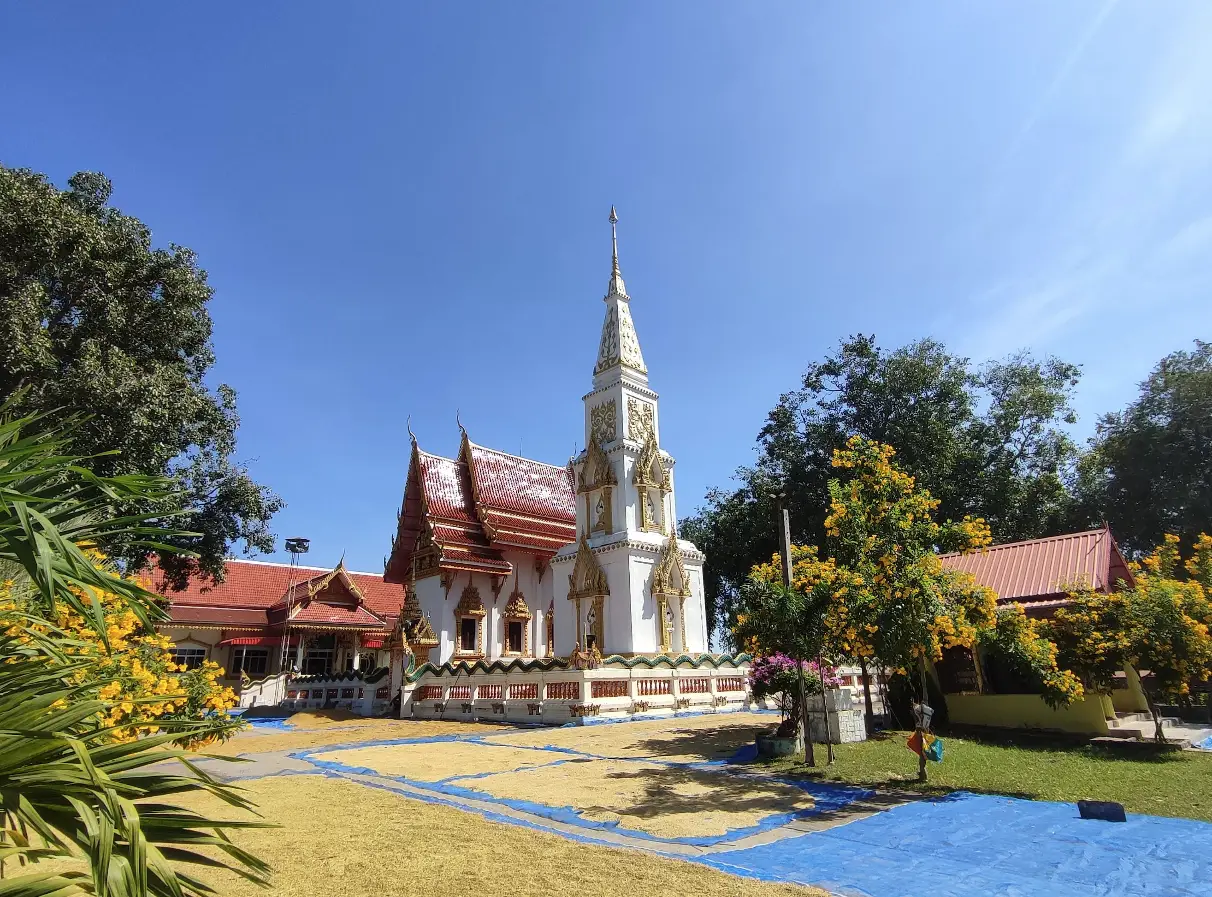
Wat Sri Mahathat
Open Days: Daily
Opening Hours: 08.00 – 17.00
Wat Sri Mahathat in Udon Thani is located at Ban That, Village No. 3, Ban Ya Subdistrict, Nong Han District, Udon Thani Province. It is an old community temple with deep cultural and spiritual importance for Ban That and the wider Ban Ya area. The temple is best known for its ancient stupa, which local tradition associates with the same sacred narrative as Phra That Phanom. For this reason, Wat Sri Mahathat is not only a place for Buddhist worship. It is also a local heritage site where faith, memory, village identity, and the story of settlement in this part of Nong Han are preserved through a sacred monument and the oral history of the community.
A visit to Wat Sri Mahathat offers a different experience from visiting large urban temples or famous tourist temples. This is a quiet rural temple where the main value lies in the ancient stupa, the story of Ban That, and the way local people continue to relate to the sacred place. Visitors can pay respect to the stupa, walk around the temple grounds, observe the village setting, and understand how a Buddhist temple can serve as the historical and spiritual center of a local Isan community. The temple can also be combined with nearby cultural routes, including Wat Pa Si Wilai, Wat Pa Ban Nong Phue, Ban Chiang National Museum, Wat Pho Si Nai, and Wat Santiwanaram.
The name Ban That itself reflects the importance of the sacred stupa. In Isan Buddhist culture, the word “that” is commonly associated with a reliquary stupa, sacred remains, or a deeply revered religious monument. The fact that the village is called Ban That and the temple is called Wat Sri Mahathat shows that the stupa is central to the identity of the place. Travelers who come here are therefore not only visiting a temple. They are entering a community landscape shaped by a sacred monument that has given meaning to the village for generations.
The local history of Wat Sri Mahathat connects the temple with the sacred tradition of Phra That Phanom. According to the temple’s community narrative, after the Buddha’s passing, Phra Maha Kassapa and a group of arahant disciples brought the Buddha’s relics to Mueang Marukhanakhon. Several rulers from important cities joined in building a chamber to enshrine the Buddha’s chest relic at Phu Kamphra, a narrative associated with Phra That Phanom. Within this story, Phraya Kham Daeng, ruler of Nong Han Noi, plays an important role in requesting relics to be brought back and enshrined in his own territory.
The value of this local tradition is not limited to the question of when the stupa was first built. It shows how the people of Ban That understand their temple as part of a wider sacred geography in the Mekong and upper Isan region. Phra That Phanom is one of the greatest centers of Buddhist devotion in northeastern Thailand and Laos, while Wat Sri Mahathat is a community-level sacred stupa that gives Ban That its local spiritual identity. The connection between the two strengthens the cultural significance of the temple and explains why the old stupa is treated as more than an architectural relic.
The local narrative describes the selection of a low hill near water as the site for the stupa. This setting is meaningful both geographically and spiritually. A slightly elevated mound allows a stupa to stand above the surrounding landscape, while nearby water reflects the fertility of an agricultural community. In traditional Buddhist landscapes, a sacred structure on a raised site often becomes a visible spiritual marker for the village. At Wat Sri Mahathat, the ancient stupa continues to function in this way as a point of worship and memory.
Another important part of the story concerns three Bodhi trees planted near the stupa. In Buddhism, the Bodhi tree symbolizes awakening, continuity, and the presence of the Buddha’s teaching. The story of three Bodhi trees around the stupa gives the temple an added layer of sacred meaning. The stupa, the relic tradition, and the Bodhi trees together create a symbolic landscape that connects the temple with Buddhist memory and the hopes of the community.
The local account also tells of a major flood that caused people in the Nong Han Noi area to migrate elsewhere, leaving the stupa abandoned for a long period. This part of the story reflects a common pattern in regional history, where communities moved in response to environmental change, flooding, conflict, disease, or changing settlement conditions. Although people moved away, the sacred structure remained. Over time, it became covered by forest, but it continued to exist as a hidden marker of the past.
A major turning point came around 1880, when families from Ubon Ratchathani migrated into the area and established a new settlement. They found wide fields, abundant trees, and clean water sources suitable for farming. During exploration of a wooded mound, villagers discovered the remains of an old stupa covered by trees and vines. They also found three large Bodhi trees around the monument. This discovery became the basis for the name Ban That and for the renewed importance of the site as a sacred place.
The discovery of the old stupa transformed an overgrown area into the spiritual center of the community once again. The villagers did not see the ruined stupa as an ordinary abandoned structure. They recognized it as a sacred sign that deserved respect, restoration, and continued worship. Wat Sri Mahathat therefore represents a community that built its identity upon an older sacred foundation. The temple name preserves this relationship between the village, the stupa, and the rediscovery of a holy place.
Later, a respected monk known as Ya Than Phra Khru Chan came with the settlers and considered the stupa mound more suitable for religious practice than the previous temple area located closer to the village. The hill was quieter and better suited to meditation and monastic life. With the support of lay followers, Phra Ajarn Sumana was invited to perform rituals of respect for the site before the area was cleared and restored. This marked the return of the mound to active religious use.
During the clearing of the area, villagers found the old stupa ruins, many fragments of pottery, and scattered human bones. These details make Wat Sri Mahathat interesting not only as a religious site but also as a place connected with traces of earlier human activity. Although the temple is not presented as a major archaeological site like Ban Chiang, the historical account suggests that Ban That was part of a landscape that had been used and inhabited before the present village was established.
The name “Wat Sri Mahathat” summarizes the identity of the temple clearly. The word “Mahathat” emphasizes the importance of the sacred stupa, while “Sri” conveys auspiciousness, beauty, and prosperity. Together, the name describes a temple centered on a revered stupa that carries both spiritual and community significance. For local people, the temple is a place of worship and continuity. For visitors, it is a place where the story of faith, settlement, and local memory can be read through the landscape.
Wat Sri Mahathat is especially suitable for religious and cultural travelers. Visitors should begin by paying respect to the ancient stupa, the heart of the temple. After that, they can walk quietly around the temple grounds, observe the surrounding village setting, and consider how the temple relates to the broader history of Ban That. The most important feature of the temple is not its size or grandeur. Its importance lies in the continuity of local belief and the community’s decision to restore a sacred place found on the old stupa mound.
The stupa at Wat Sri Mahathat is a sacred monument for Ban That. Local residents treat it as a spiritual center and a place for merit-making, worship, Buddhist observance days, and community activities. Paying respect to the stupa is therefore both a religious act and an encounter with local history. For the community, the stupa confirms that the village has roots, stories, and a shared sacred center. For travelers, it shows that Udon Thani is not only about the famous Ban Chiang World Heritage area, but also about smaller temples where local history and devotion remain alive.
Wat Sri Mahathat also shows the role of rural Isan temples as centers of community life. A village temple is not only a place for formal Buddhist ceremonies. It can also be a gathering place, a venue for merit-making events, a local memory archive, and a spiritual home for generations of residents. The meaning of Wat Sri Mahathat therefore lies both in the stupa itself and in the way local people continue to use the temple as part of community life.
The belief that the stupa was created in connection with the same sacred tradition as Phra That Phanom is one of the strongest elements of the temple’s identity. This belief links Ban That, Nong Han, and the wider Mekong Buddhist world. Phra That Phanom is a major regional pilgrimage site, while Wat Sri Mahathat is a local sacred stupa that carries similar meaning at the village level. The connection gives the temple cultural depth and explains why the stupa remains so important to Ban That.
Worship at Wat Sri Mahathat can be understood in three layers. The first is religious: the stupa is a sacred Buddhist monument. The second is communal: the stupa is closely linked to the name and identity of Ban That. The third is historical: the site is connected with migration, settlement, discovery of old ruins, and the restoration of a sacred place. These layers make the temple meaningful for both local residents and travelers interested in cultural history.
Visitors interested in local history should pay attention not only to the stupa but also to the surrounding details: the name Ban That, the raised stupa area, the story of the three Bodhi trees, the discovery of pottery fragments, and the decision to move religious activity to the old sacred mound. Reading the place through these details reveals that the temple did not appear by chance. It developed through community memory, faith, and the recognition of an older sacred landscape.
The best times to visit are in the morning or late afternoon, when the weather is more comfortable and the temple atmosphere is calm. On Buddhist holy days or local merit-making occasions, visitors may see villagers coming together for religious activities. Travelers should dress modestly, speak quietly, avoid climbing on or touching sacred structures inappropriately, and respect the temple as a living religious space.
Getting There is easiest by private car, rental car, or chartered local vehicle. From central Udon Thani, travel toward Nong Han District, then continue to Ban Ya Subdistrict and Ban That. The distance from Udon Thani city to the Ban Ya area is about 55 kilometers, while the distance from Nong Han town to Ban Ya is about 20 kilometers. Since the temple is located in a local village area, private transport is the most convenient option.
Travelers without a private vehicle should plan ahead. One practical route is to travel from Udon Thani city to Nong Han town, then arrange local transport to Ban Ya and Ban That. A chartered vehicle is recommended for travelers who want to combine Wat Sri Mahathat with Wat Pa Si Wilai, Wat Pa Ban Nong Phue, Ban Chiang National Museum, Wat Pho Si Nai, and Wat Santiwanaram in the same day.
A meaningful cultural route can begin at Wat Sri Mahathat, where visitors pay respect to the stupa and learn about the story of Ban That. The route can then continue to Wat Pa Si Wilai and Wat Pa Ban Nong Phue within Ban Ya Subdistrict, before moving on to Ban Chiang National Museum and Wat Pho Si Nai. Travelers with more time can add Wat Santiwanaram, known for its lotus-shaped ordination hall in the pond. This route combines local faith, village temples, archaeology, and the wider cultural landscape of Nong Han.
Visitors should allow at least 45 minutes to 1 hour for Wat Sri Mahathat. Those interested in local history may want to spend more time observing the setting and connecting the temple story with the history of Ban That, Phra That Phanom tradition, and migration from Ubon Ratchathani. The temple becomes more meaningful when visited slowly, with attention to the relationship between sacred structure, village memory, and landscape.
For international travelers, Wat Sri Mahathat is a useful place for understanding the role of stupas in Isan Buddhist culture. A stupa is not merely a monument or architectural form. It is a center of devotion, a marker of memory, and a link between people and place. Visiting Wat Sri Mahathat together with Ban Chiang gives travelers two complementary views of Udon Thani: prehistoric heritage through Ban Chiang and local Buddhist memory through the sacred stupa of Ban That.
Wat Sri Mahathat deserves a place in cultural travel routes through Nong Han District. It offers an ancient stupa, a local tradition connected with Phra That Phanom, the story of Ban That’s settlement, and the continuing role of a village temple as a spiritual center. Visitors can make merit, pay respect to the stupa, learn a local legend, and understand how rural Udon Thani preserves memory through temples and community belief. For travelers seeking more than standard sightseeing, this temple provides a quiet but meaningful experience of faith, culture, history, and Isan village life.
| Name | Wat Sri Mahathat, Ban That |
| Location | Ban That, Village No. 3, Ban Ya Subdistrict, Nong Han District, Udon Thani Province, Thailand |
| Address | Ban That, Village No. 3, Ban Ya Subdistrict, Nong Han District, Udon Thani 41320, Thailand |
| Highlights | Ancient stupa of Ban That, local tradition connected with Phra That Phanom, old sacred mound, and the story of a village temple restored around ancient stupa remains |
| History | An old community temple of Ban That. Local history connects the stupa with a sacred tradition related to Phra That Phanom and the settlement of families from Ubon Ratchathani around 1880 before the sacred mound was restored as Wat Sri Mahathat |
| Name Origin | The name Wat Sri Mahathat comes from the ancient stupa on the mound. The name Ban That is also connected with the discovery of the old stupa and three large Bodhi trees around it in local tradition |
| Distinctive Features | A rural community temple centered on an ancient stupa, with strong local faith, sacred history, and cultural memory linked to Ban That and the upper Isan Buddhist landscape |
| Travel Information | From central Udon Thani, travel toward Nong Han District, then continue to Ban Ya Subdistrict and Ban That. The distance from Udon Thani city is about 55 km, and from Nong Han town about 20 km. A private car, rental car, or chartered local vehicle is recommended |
| Current Status | Open for worshippers and visitors to pay respect to the stupa, make merit, and visit the temple grounds |
| Open Days | Daily |
| Opening Hours | 08.00 – 17.00 |
| Fees | No general admission fee |
| Facilities | Stupa worship area, temple religious area, temple grounds, community activity space, and access route from Ban That village |
| Main Areas / Zones | Ancient Stupa Stupa Mound Area Buddhist Worship Area Monastic Area Merit-Making Area Temple Grounds And Community Activity Area Ban That Local History Area |
| Local Information Contact | Ban Ya Subdistrict Administrative Organization, Tel. 0-4221-9922 |
| Official Website / Official Page | Ban Ya Subdistrict Administrative Organization |
| Nearby Tourist Attractions | 1. Wat Pa Si Wilai, Ban That Yai, about 2 km 2. Wat Pa Ban Nong Phue, Ban Ya Subdistrict, about 8 km 3. Nong Han Town, about 20 km 4. Ban Chiang National Museum, about 30 km, Tel. 042-235-040 5. Wat Pho Si Nai And Ban Chiang Excavation Pit, about 30 km 6. Wat Santiwanaram Or Wat Pa Dong Rai, about 34 km 7. Ban Chiang Cultural Tourism Community, about 30 km, Tel. 096-456-6926 8. Red Lotus Sea, Kumphawapi District, about 50 km |
| Nearby Restaurants | 1. Sabai Jai Restaurant, Nong Han, about 20 km, Tel. 081-873-3837 2. Local Nong Han Thai Food Restaurant, about 23 km, Tel. 042-239-145 3. Oh Wa Shabu Nong Han Branch, about 20 km, Tel. 063-743-3309 4. Nui Photchana Restaurant, Nong Mek, about 25 km, Tel. 087-089-3359 5. Lap Ped Ban Chiang, about 30 km, Tel. 090-583-3437 6. Local Restaurants In Nong Han Town, about 20 km |
| Nearby Accommodations | 1. Kasalong View Resort Nonghan, about 20 km, Tel. 042-261-233, 061-078-6833 2. Moai Homeplace, about 23 km, Tel. 099-587-9990 3. Able House Resort Nong Han, about 21 km, Tel. 090-293-9352 4. Pornprakay House Homestay, Ban Chiang, about 30 km, Tel. 042-208-229 5. R Homestay Ban Chiang, about 30 km, Tel. 061-426-2945 6. Accommodations In Udon Thani City, about 55 km |
Frequently Asked Questions (FAQ)
Q: Where is Wat Sri Mahathat in Udon Thani located?
A: Wat Sri Mahathat is located at Ban That, Village No. 3, Ban Ya Subdistrict, Nong Han District, Udon Thani Province. It is an old community temple and a sacred place for Ban That.
Q: What are the opening days and hours of Wat Sri Mahathat?
A: The temple is open daily from 08.00 to 17.00. Morning and late afternoon are suitable times for paying respect to the stupa and walking quietly around the temple grounds.
Q: Is there an admission fee for Wat Sri Mahathat?
A: No general admission fee is charged. Visitors can enter the temple, pay respect to the stupa, make merit, and visit during opening hours.
Q: What is the main highlight of Wat Sri Mahathat?
A: The main highlight is the ancient stupa of Ban That, which local tradition connects with the sacred narrative of Phra That Phanom and the history of the Ban That community.
Q: How is Wat Sri Mahathat related to Phra That Phanom?
A: Local tradition connects the temple’s stupa with the broader sacred story of Phra That Phanom and the enshrinement of Buddha relics in the Nong Han Noi area, giving the temple strong spiritual meaning for Ban That.
Q: How long should visitors spend at Wat Sri Mahathat?
A: Visitors should allow at least 45 minutes to 1 hour for paying respect to the stupa, walking around the temple grounds, and learning the local history of Ban That. A half-day is better when combining nearby temples.
Q: How can travelers get to Wat Sri Mahathat?
A: From Udon Thani city, travel toward Nong Han District, then continue to Ban Ya Subdistrict and Ban That. The distance is about 55 km from Udon Thani city, and a private car, rental car, or chartered local vehicle is recommended.
Q: What nearby places can travelers visit after Wat Sri Mahathat?
A: Nearby places include Wat Pa Si Wilai, Wat Pa Ban Nong Phue, Ban Chiang National Museum, Wat Pho Si Nai, Wat Santiwanaram, Ban Chiang Cultural Tourism Community, and the Red Lotus Sea.
 Category: ●Places of Worship
 Group: ●Temple
Last Update : 3 MonthAgo
 Last Update : 3 MonthAgo
 Click to Access the Navigation Map GPS
Wat Sri Mahathat Map
Recommend

 Art, Culture and Heritage
 Historical Sites and Monuments(1)
 Landmarks and Memorials(1)
 Art, Craft Centres, Tradition(2)
 Museums(2)
Temple(21)
 Other Sacred Sites(8)
 Suburban Living
 Village, Community(3)
 Nature and Wildlife
 National Parks and Marine Reserves(3)
 Mountain (Doi)(1)
 Dam, Reservoir, Lake(8)
 Waterfalls(6)
 Caves(1)
 River, Canal(4)
 Islands(1)
 Other natural attractions(1)
 Entertainment and Agricultural
 Farms, Parks and Ecotourism(3)
 Waterpark(2)
 Shopping
 Shopping and Night Market(1)
 Travel Articles, Recipes
 Travel Review, Food Review(1)


