
lovethailand home >Northeastern Travel Attractions >Nong Khai Travel Attractions >Muang Nongkhai >Wat That > Wat Si Bua Bang
TL;DR: Wat Si Bua Bang is located at Wat That Subdistrict, Mueang Nong Khai District, Nong Khai Province, open Daily, hours 08.00 – 17.00.
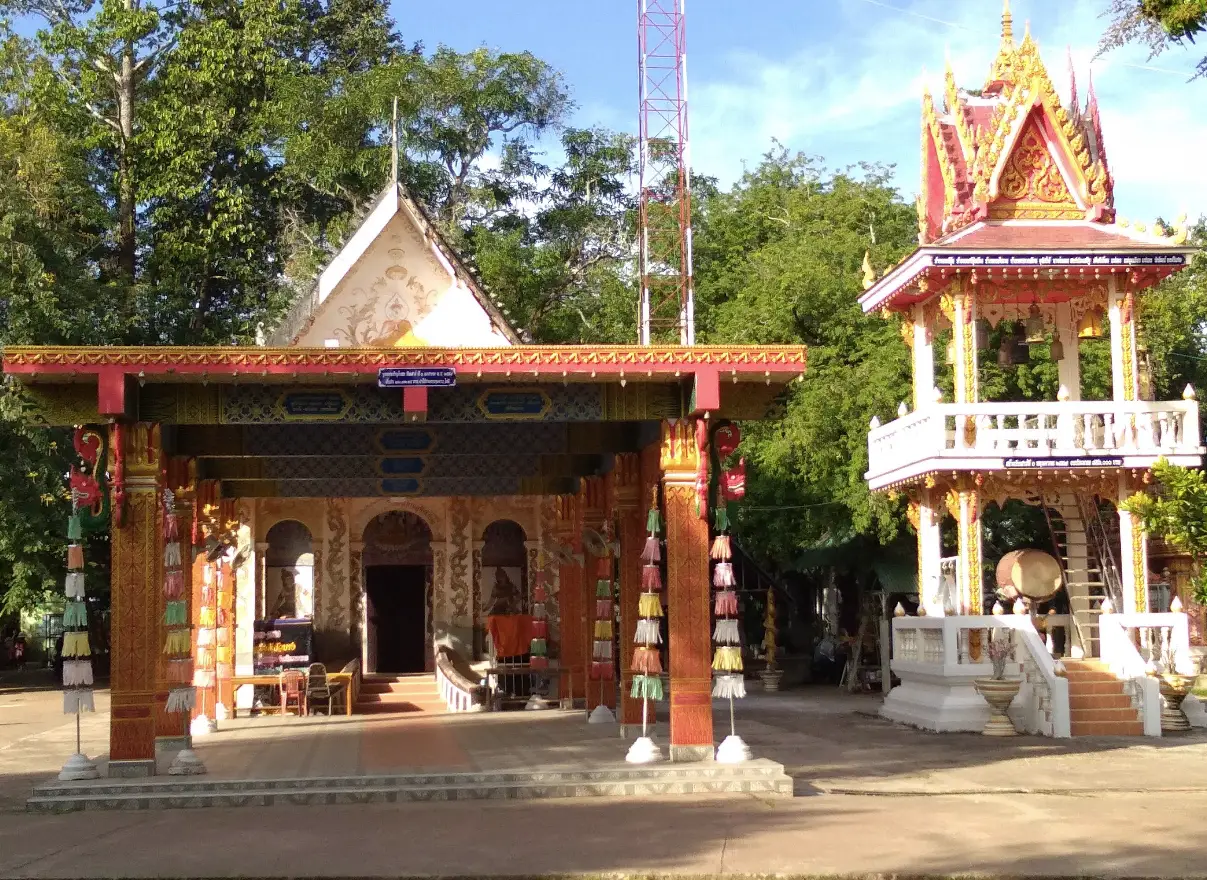
Wat Si Bua Bang
Open Days: Daily
Opening Hours: 08.00 – 17.00
Wat Si Bua Bang in Nong Khai Province is an old community temple in Wat That Subdistrict, Mueang Nong Khai District. It remains an active Buddhist temple and a quiet cultural attraction for travelers who want to experience a more local side of Nong Khai. The temple is known for its peaceful atmosphere, shaded grounds, old ordination hall, and Luang Pho Phon Thong, an ancient Lan Xang-style Buddha image that has long been respected by the local community. For foreign travelers, Wat Si Bua Bang is best visited as part of a slow cultural route that can include Sala Kaew Ku, Bueng Nong Khai, Nong Khai Aquarium, Wat Pho Chai, Tha Sadet Market, and the Mekong riverside area.
Wat Si Bua Bang is located in the Ban Mueang Bang-Phon Ngam area of Wat That Subdistrict, Mueang Nong Khai District, Nong Khai Province. It is not a large or crowded tourist landmark, but that is exactly what makes it meaningful. The temple preserves the atmosphere of a genuine rural-community monastery, where the temple, monks, local residents, and Buddhist traditions remain closely connected. Visitors will find a calm setting, temple buildings that have aged with time, local religious spaces, and a sense of everyday devotion that is different from the busier attractions in central Nong Khai.
The most important sacred image at Wat Si Bua Bang is Luang Pho Phon Thong, an ancient Buddha image associated with the Lan Xang cultural tradition. Local accounts say that villagers found the Buddha image at a termite mound or earth mound in a forest area known as Dong Phon Thong. The image was then brought to Wat Si Bua Bang in Wat That Subdistrict and given the name Luang Pho Phon Thong. This story reflects a common pattern of sacred memory in the Mekong region, where Buddha images, natural landscapes, community faith, and temple identity are deeply intertwined.
The name Phon Thong adds a distinctive cultural meaning to the temple. In the Isan context, the word phon can refer to an elevated earth mound or termite mound, while thong carries a sense of auspiciousness and value. Together, the name Luang Pho Phon Thong connects the Buddha image to the land, the forest, and the local community. For travelers who are interested in cultural interpretation, this story gives Wat Si Bua Bang more depth than a simple temple visit. It allows visitors to understand how local Buddhist devotion in Nong Khai is often shaped by oral history, landscape, and communal memory.
Another important feature of the temple is its old ordination hall. The ubosot at Wat Si Bua Bang was rebuilt and restored in 1953. It formerly housed Luang Pho Phon Thong as the principal Buddha image. Inside, the wall surfaces include Buddhist-life paintings that tell stories from the life of the Buddha. Such murals are not only decorative; in Thai temple culture, they also function as visual teaching tools. They help local people and visitors learn Buddhist stories and values through imagery, turning the temple into both a sacred space and a cultural classroom.
Today, the ordination hall shows signs of age, particularly around the roof structure, yet it still retains strong religious and historical value. The building continues to be associated with monastic activities and Buddhist ceremonies. For this reason, visitors should approach the old hall respectfully. Avoid touching fragile surfaces, climbing on old structures, or entering restricted areas without permission. The building represents a long period of community effort, restoration, worship, and local religious life, making it one of the most meaningful elements of Wat Si Bua Bang.
The temple grounds are shaded and peaceful, making Wat Si Bua Bang suitable for travelers who prefer quiet cultural sites rather than heavily promoted attractions. Visitors can spend time paying respect to the Buddha image, observing the ordination hall, walking gently around the temple compound, and appreciating the atmosphere of a local Isan Buddhist temple. This is not a place designed primarily for entertainment. It is a living religious site where travelers can experience stillness, humility, and the rhythm of local Buddhist practice.
Culturally, Wat Si Bua Bang forms part of the Buddhist and community life of Wat That Subdistrict. The local area continues to observe traditional Isan merit-making cycles, including ceremonies associated with Buddhist Lent, the end of Buddhist Lent, Kathin, Songkran, and other annual religious events. These traditions show how the temple continues to function as a social and spiritual center. For foreign visitors, understanding this role is important: a Thai temple is not only an architectural site, but also a place where people gather, learn, make merit, preserve traditions, and maintain community bonds.
Phra Khru Suchin Phatthanakit is an important monk connected with Wat Si Bua Bang. Cultural records identify him as the abbot of Wat Si Bua Bang, the director of the temple’s Buddhist Sunday School, and an ecclesiastical leader for Wat That Subdistrict Area 2. These roles indicate that the temple has served not only as a place of worship, but also as a center for Buddhist education, moral training, and the preservation of religious customs. This gives the temple a broader cultural role within the local community.
For travelers interested in Buddhist art, Luang Pho Phon Thong is the main point of devotion. Ancient Buddha images connected to the Lan Xang tradition are significant across the Mekong region, where Thai and Lao cultural histories overlap. Nong Khai, as a border province along the Mekong River, has long been shaped by exchange between communities on both sides of the river. Visiting Wat Si Bua Bang therefore helps travelers see Nong Khai beyond its more famous images of Tha Sadet Market, the Thai-Lao Friendship Bridge, and riverside tourism. It reveals a quieter layer of local faith and cross-Mekong cultural memory.
The appeal of Wat Si Bua Bang lies in its simplicity. The temple is not heavily commercialized, and it does not overwhelm visitors with large-scale tourist infrastructure. Instead, it offers a local temple environment where visitors can observe how Buddhism remains part of daily life. The old ubosot, shaded grounds, sacred Buddha image, and community setting create a gentle travel experience. For photographers and culture-focused travelers, this atmosphere is valuable because it offers authentic scenes without the rush often found at more crowded destinations.
Compared with Wat Pho Chai in central Nong Khai, which enshrines the highly revered Luang Pho Phra Sai and attracts many worshippers, Wat Si Bua Bang offers a different experience. Wat Pho Chai represents a major city-level center of devotion, while Wat Si Bua Bang reflects the spiritual memory of a local subdistrict community. Visiting both temples on the same trip helps travelers understand different layers of Buddhist life in Nong Khai: one at the provincial and urban level, and the other at the community level.
Wat Si Bua Bang is also meaningful when considered together with the wider landscape of Wat That Subdistrict. Local development documents identify Wat Si Bua Bang as a religious tourism site with Luang Pho Phon Thong, an ancient Buddha image, and an attractive ordination hall. The same area also includes Bueng Nong Khai, a natural water body developed as a community recreation area. This connection between temple, community, water landscape, and local life makes Wat That Subdistrict an interesting area for travelers who want to go beyond standard Nong Khai sightseeing routes.
The most convenient way to reach Wat Si Bua Bang is by private car, rental car, or local hired transport. From central Nong Khai, travelers can drive toward Wat That Subdistrict and use digital navigation by entering Wat Si Bua Bang as the destination. The temple is located along Road 3108. The route is suitable for travelers who are comfortable exploring outside the city center. Those without private transport should arrange a local vehicle in advance, especially if they plan to continue to several attractions in the same day.
Getting There works best when Wat Si Bua Bang is included in a half-day or full-day cultural route. A practical itinerary is to visit Wat Si Bua Bang in the morning, continue to Sala Kaew Ku to see its monumental sculpture park, stop at Bueng Nong Khai or Nong Khai Aquarium depending on travel interests, then return toward central Nong Khai for Wat Pho Chai, Tha Sadet Market, and a riverside meal. This route combines religious heritage, local community atmosphere, sculpture, nature, and food, giving travelers a rounded view of Nong Khai.
The best time to visit is in the morning or late afternoon, when the weather is more comfortable and the temple atmosphere is quieter. During important Buddhist periods, such as Buddhist Lent, the end of Buddhist Lent, Kathin season, and Songkran, visitors may see more local religious activity. When visiting during ceremonies, travelers should be especially respectful. Keep a quiet voice, dress modestly, avoid interrupting rituals, and ask for permission before photographing people, monks, or ceremonial activities.
Visitors should dress respectfully when entering Wat Si Bua Bang. Shoulders and knees should be covered as much as possible, and clothing should not be overly revealing. Shoes should be removed before entering sacred indoor areas when required. Travelers should avoid touching Buddha images, murals, or fragile architectural details. Since the old ordination hall shows signs of age, it is also important to avoid leaning on, climbing onto, or disturbing any part of the structure. Respectful behavior helps preserve the site and maintains the dignity of the temple as an active place of worship.
Several nearby attractions can be combined with Wat Si Bua Bang. Sala Kaew Ku, also known as Wat Khaek, is a distinctive sculpture park filled with large Buddhist, Hindu, and folk-religious figures. Bueng Nong Khai offers a quieter natural setting connected to local recreation. Nong Khai Aquarium is suitable for families and visitors interested in aquatic life. Wat Pho Chai is one of the province’s most important temples, and Tha Sadet Market provides a riverside shopping and food experience. Together, these places allow travelers to design a varied and culturally rich day in Nong Khai.
Food is another strong reason to explore Nong Khai more slowly. The city is especially known for Vietnamese-influenced dishes, Isan food, Thai dishes, riverside restaurants, and casual cafés. Daeng Namnuang is one of the best-known names associated with Nong Khai-style Vietnamese food, while restaurants along the Mekong promenade offer convenient meals after temple visits. For travelers visiting Wat Si Bua Bang, it is practical to plan lunch or dinner in central Nong Khai after completing the temple and nearby attraction route.
Accommodation is easiest to find in central Nong Khai or near the Mekong riverside. Staying in town gives travelers better access to restaurants, Tha Sadet Market, Wat Pho Chai, the railway station, and onward travel toward the Thai-Lao Friendship Bridge. Those who plan to visit Wat Si Bua Bang, Sala Kaew Ku, and other attractions in one day will usually find central Nong Khai the most convenient base. Riverside hotels and small resorts are also suitable for travelers who prefer a quieter evening atmosphere.
Wat Si Bua Bang is therefore a worthwhile stop for travelers who want to understand Nong Khai beyond its most famous landmarks. It offers an ancient Lan Xang-style Buddha image, an old ordination hall rebuilt in 1953, Buddhist murals, shaded grounds, and a living connection to local faith. The temple is especially suitable for travelers interested in community temples, Buddhist art, Isan culture, and quiet spiritual spaces. A visit here adds depth to a Nong Khai itinerary and helps reveal the province’s cultural identity along the Mekong River.
| Name | Wat Si Bua Bang |
| Location | Wat That Subdistrict, Mueang Nong Khai District, Nong Khai Province |
| Address | Road 3108, Wat That Subdistrict, Mueang Nong Khai District, Nong Khai 43000, Thailand |
| Coordinates | 17.84382, 102.83298 |
| Highlights | Old community temple, peaceful shaded grounds, old ordination hall, and Luang Pho Phon Thong, an ancient Lan Xang-style Buddha image |
| History | The ordination hall was rebuilt and restored in 1953 and formerly housed Luang Pho Phon Thong as the principal Buddha image |
| Important Sacred Objects | Luang Pho Phon Thong, an ancient Lan Xang-style Buddha image, and an old ordination hall with Buddhist-life wall paintings |
| Name Origin | Local accounts say the Buddha image was found at an earth mound or termite mound in a forest area called Dong Phon Thong before being brought to Wat Si Bua Bang |
| Distinctive Features | A quiet community temple with an old ubosot, local Buddhist memory, and cultural links to the Mekong and Lan Xang traditions |
| Travel Information | Best reached by private car, rental car, or local hired transport from central Nong Khai. Use digital navigation to Wat Si Bua Bang in Wat That Subdistrict |
| Current Status | Active local Buddhist temple and community religious site |
| Open Days | Daily |
| Opening Hours | 08.00 – 17.00 |
| Facilities | Temple grounds, parking area within the temple compound, and worship spaces typical of a local community temple |
| Main Areas / Zones | Old ordination hall, Luang Pho Phon Thong worship area, temple courtyard, and monastic activity spaces |
| Abbot / Caretaker | Phra Khru Suchin Phatthanakit |
| Local Administrative Contact | Wat That Subdistrict Municipality, Tel. 042-414758 |
| Nearby Tourist Attractions | 1. Sala Kaew Ku, about 7 km 2. Bueng Nong Khai, about 4 km 3. Nong Khai Aquarium, about 8 km 4. Wat Pho Chai Royal Temple, about 11 km 5. Tha Sadet Market, about 12 km 6. First Thai-Lao Friendship Bridge, about 16 km |
| Nearby Restaurants | 1. Daeng Namnuang Nong Khai, about 12 km, Tel. 0-4241-1961, 0-4242-1202, 0-4246-0647 2. Macky’s Riverside Kitchen, about 12 km, Tel. 097-109-1022 3. The Nua Moo Kratha Buffet Nong Khai, about 12 km, Tel. 095-652-8209 4. Chim Chum Nong Khai By Krua Lung Bang, about 10 km, Tel. 099-510-9599 5. River Chill Nong Khai Restaurant, about 10 km, Tel. 088-661-1187 |
| Nearby Accommodations | 1. REST TIME HOTEL Nongkhai, about 11 km, Tel. 083-151-0021 2. Asawann Hotel Nongkhai, about 11 km, Tel. 042-464514 3. Busyarin Hotel, about 12 km, Tel. 042-412599 4. LePont Riverfront Resort Nong Khai, about 15 km, Tel. 042-412888 5. Nong Khai Resort, about 13 km, Tel. 042-464958-9, 086-458-7293 |
Frequently Asked Questions (FAQ)
Q: Where is Wat Si Bua Bang located?
A: Wat Si Bua Bang is located in Wat That Subdistrict, Mueang Nong Khai District, Nong Khai Province, along Road 3108.
Q: What are the opening days and hours of Wat Si Bua Bang?
A: The temple is open daily from 08.00 to 17.00. Morning and late afternoon are the most comfortable times to visit.
Q: What is the main highlight of Wat Si Bua Bang?
A: The main highlight is Luang Pho Phon Thong, an ancient Lan Xang-style Buddha image, together with the old ordination hall rebuilt in 1953.
Q: Why is Luang Pho Phon Thong important?
A: Luang Pho Phon Thong is a revered ancient Buddha image linked to local oral history. Villagers are said to have found it at an earth mound in a forest area called Dong Phon Thong.
Q: What is interesting about the old ordination hall?
A: The ubosot was rebuilt and restored in 1953, formerly housed Luang Pho Phon Thong, and contains Buddhist-life wall paintings that reflect the temple’s religious and cultural value.
Q: How can travelers get to Wat Si Bua Bang?
A: The easiest way is by private car, rental car, or local hired transport from central Nong Khai. Use digital navigation and enter Wat Si Bua Bang as the destination.
Q: What nearby attractions can be visited with Wat Si Bua Bang?
A: Nearby attractions include Sala Kaew Ku, Bueng Nong Khai, Nong Khai Aquarium, Wat Pho Chai, Tha Sadet Market, and the First Thai-Lao Friendship Bridge.
Q: What should visitors wear when visiting Wat Si Bua Bang?
A: Visitors should dress modestly, keep their voices low, avoid touching sacred objects or old wall surfaces, and respect all areas used for monastic and community ceremonies.
 Category: ●Places of Worship
 Group: ●Temple
Last Update : 3 MonthAgo
 Last Update : 3 MonthAgo
 Click to Access the Navigation Map GPS
 Art, Culture and Heritage
 Historical Sites and Monuments(1)
 Landmarks and Memorials(2)
 Art, Craft Centres, Tradition(1)
 Educational Places
 Educational Gardens, Farm(1)
Temple(16)
Educational Gardens, Farm(1)
Temple(16)
 Mosque(1)
 Other Sacred Sites(8)
 Suburban Living
 Village, Community(3)
 Local Market(4)
 Nature and Wildlife
 National Parks and Marine Reserves(2)
 Dam, Reservoir, Lake(2)
 Waterfalls(4)
 River, Canal(8)
 Bays and Beaches(1)
 Entertainment and Agricultural
 Farms, Parks and Ecotourism(2)
 Shopping
 Shopping and Night Market(1)
 Travel Articles, Recipes
 Travel Review, Food Review(1)


