
lovethailand home >Northeastern Travel Attractions >Loei Travel Attractions >Na Haeo >Saeng Pha > Khring Waterfall
TL;DR: Khring Waterfall is located at Saeng Pha Subdistrict, Na Haeo District, Loei Province, near the Mueang Phrae – Rom Klao road, open Daily, hours 07.00 – 18.00.

Khring Waterfall
Open Days: Daily
Opening Hours: 07.00 – 18.00
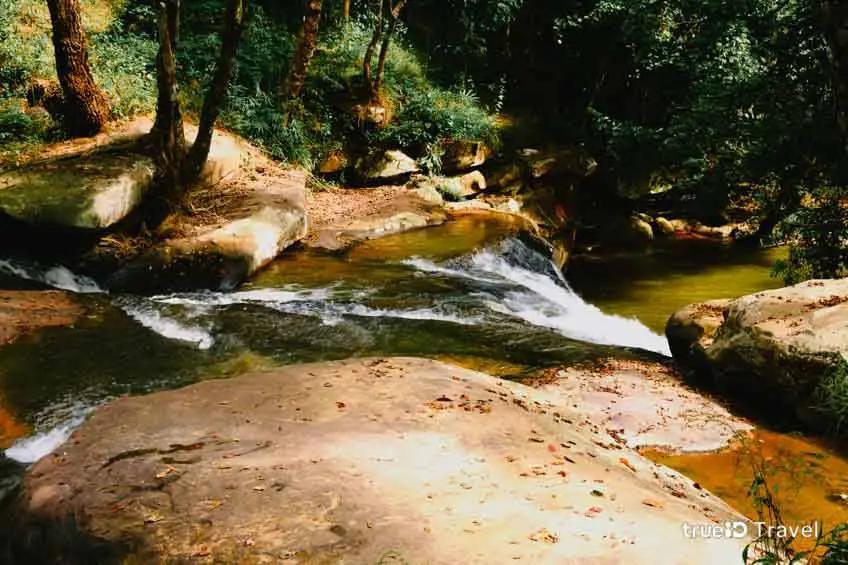
Khring Waterfall in Loei Province is a small natural waterfall in Na Haeo District, located near the Mueang Phrae – Rom Klao road in the Phu Suan Sai National Park area. The waterfall is known for its lush riverside vegetation, layered natural rocks, a large lower pool, and a simple rest pavilion for visitors. It is a quiet place for travelers who want to experience the forested mountain atmosphere of Na Haeo without visiting an overly crowded destination.
Khring Waterfall is best appreciated as a peaceful stream waterfall rather than a dramatic high cliff waterfall. Water flows gently over rocks arranged in natural layers, creating small cascades before reaching the larger pool below. The banks are covered with many kinds of plants, giving the area a fresh, green, and fertile appearance. This combination of water, stone, shade, and forest plants makes the waterfall ideal for resting, photography, and slow nature travel.
The waterfall is located in Saeng Pha Subdistrict, Na Haeo District, one of the most scenic border areas of Loei Province. Na Haeo is known for mountains, streams, forest, farming villages, and communities near the Hueang River along the Thai-Lao border. Because of this setting, a trip to Khring Waterfall is not only about the waterfall itself. It is also about the route, the cool mountain air, the quiet rural landscape, and the atmosphere of a remote district that remains closely connected to nature.
The waterfall is sometimes written in Thai as Nam Tok Khring and sometimes as Nam Tok Khing. Both spellings refer to the same waterfall in the Saeng Pha area. The consistent features mentioned across local travel information are its location near the Mueang Phrae – Rom Klao road, the thick riverside vegetation, the layered rocks, the large lower pool, and the rest pavilion. These details show that the waterfall remains a natural stream attraction rather than a heavily altered commercial site.
Vegetation is one of the defining characteristics of Khring Waterfall. Many kinds of plants grow along the water’s edge, from small shrubs and streamside plants to larger trees that provide shade. These plants are not only beautiful; they also help protect the stream environment. They hold the soil along the banks, retain moisture, and create habitats for insects, birds, and small wildlife. Visitors should therefore avoid trampling the plants, picking leaves, or leaving rubbish near the stream.
The layered rocks create the visual identity of the waterfall. Water passes over these rocks in stages, forming gentle natural steps. Some sections of water spread thinly across the rock surface, while others flow through gaps and drop into the pool below. The movement is calm but continuous, and the sound of water flowing over stone gives the site a relaxing atmosphere. This is the kind of place where the details matter: the texture of the rocks, the green leaves, the reflections in the pool, and the sound of the stream.
The large lower pool is another important feature of Khring Waterfall. It collects water flowing down from the rock layers and creates a quiet focal point for the site. Visitors often stop here to rest, take photographs, or enjoy the sound of the stream. However, caution is always necessary near the water. Rocks can be slippery from moisture and algae, especially after rain. Children should be supervised closely, and visitors should not jump into the water or enter areas where the depth or current cannot be seen clearly.
The rest pavilion near the waterfall adds convenience for visitors. It provides a shaded place to sit, put down belongings temporarily, and enjoy the scenery. The pavilion should be used respectfully. Visitors should not leave food waste, write on surfaces, light fires, or make loud noise that disturbs others. Khring Waterfall is a natural public space shared by travelers, park staff, and local communities, so responsible behavior is essential.
Khring Waterfall is around 10 kilometers from Na Haeo town according to local travel descriptions, and it is connected to the Mueang Phrae – Rom Klao route. This makes it suitable as part of a wider Na Haeo itinerary. Travelers can combine the waterfall with nearby natural and cultural attractions such as Chang Tok Waterfall, Wang Tat Waterfall, Phra That Din Thaen, Phu Suan Sai National Park, Phu Hua Hom viewpoint, and Ban Mueang Phrae on the Thai-Lao border.
Getting There is most convenient by private car or motorcycle. From Na Haeo town, travel toward the Mueang Phrae – Rom Klao road and continue toward Saeng Pha Subdistrict and the Phu Suan Sai National Park area. The road passes through mountain and rural scenery, with communities, farmland, and forested sections along the way. During the rainy season, travelers should check the weather and road conditions before departure because mountain roads and stream areas may become wet or slippery.
Daytime is the best time to visit Khring Waterfall. Morning offers cooler air and soft natural light, while the afternoon is suitable for a short nature stop before continuing to other places in Na Haeo. Visitors should avoid staying until dark, especially if unfamiliar with the area. Mountain roads can be more difficult to drive at night, and mobile signal may not be reliable in some places.
The waterfall becomes especially fresh during the rainy season and early post-rainy period. Water flow is stronger, the pool looks livelier, and the plants along the banks become deep green. However, this is also the season when safety matters most. If the water becomes muddy, if the current is strong, or if rain continues for a long time, visitors should stay away from the water and observe the waterfall only from safe areas. Mountain streams can change quickly when rain falls upstream.
The cool season is also a pleasant time to visit. Na Haeo is known for cool weather, calm mornings, and a peaceful mountain atmosphere. Although the water volume may not be as strong as during the rainy season, the route is often easier, the ground is less muddy, and the temperature is comfortable for walking and sitting by the stream. A cool-season itinerary can combine sunrise or mist views at Phu Hua Hom with a later visit to Khring Waterfall.
For photography, Khring Waterfall offers several natural compositions: layered rocks with flowing water, the lower pool, streamside plants, the rest pavilion surrounded by greenery, and the shaded forest atmosphere. Morning and late afternoon light tend to be softer and more flattering than harsh midday light. Photographers should bring waterproof protection for cameras or phones because the waterfall area can be humid and damp.
Khring Waterfall is suitable for families who want children to learn about nature in a direct but manageable setting. Children can observe how a stream flows over rocks, how riverside plants protect the banks, and why rubbish should not be left in natural areas. Parents should use the visit to teach basic safety near water, including not running on rocks, not entering unknown pools, and staying within sight of adults at all times.
From a landscape perspective, Khring Waterfall represents the ecological richness of Phu Suan Sai National Park. The park covers parts of Na Haeo District, including Na Haeo, Saeng Pha, and Lao Ko Hok subdistricts. It is known for forested mountains, viewpoints, camping areas, streams, and quiet natural scenery. A visit to Khring Waterfall helps travelers see another side of the park beyond the popular camping and viewpoint areas.
Phu Suan Sai National Park is also known for its peaceful atmosphere, cool air, Thai-Lao border scenery, dark-sky setting, and misty viewpoints. Many travelers visit the park for camping, stargazing, sunrise views, and mountain landscapes. Including Khring Waterfall in a Na Haeo travel plan adds water, forest, and stream scenery to the experience, making the journey more complete and varied.
Recommended activities at the waterfall include walking carefully along safe streamside areas, sitting in the pavilion, listening to the water, photographing the rock layers, observing riverside plants, and cooling the feet in safe shallow spots. If visitors bring food, they should choose items with minimal packaging and carry all waste back out. Lighting fires or cooking in undesignated areas should be avoided because the waterfall is part of a protected natural environment.
Preparation is important for a comfortable visit. Travelers should wear shoes with good grip, bring drinking water, quick-dry clothing, insect repellent, a waterproof pouch for phones, and a personal trash bag. During the rainy season, a light raincoat is useful. Drivers should check tires, brakes, and fuel before traveling because Na Haeo’s mountain roads and the distance between communities can make spontaneous stops less convenient.
The most important safety concern is slippery rock. Visitors should not run, climb high rocks, jump into the pool, or enter water where the bottom cannot be seen. If heavy rain begins or the water level rises, move away from the stream immediately. In mountainous areas, water can rise quickly even when the rain is falling upstream rather than directly at the waterfall.
Khring Waterfall can be combined with several nearby attractions. Chang Tok Waterfall is about 500 meters upstream from Khring Waterfall, and Wang Tat Waterfall is also in the Lam Nam Phrae watercourse. Phra That Din Thaen is a respected local spiritual site in Ban Saeng Pha, while Phu Hua Hom offers sunrise and mist views within the Phu Suan Sai National Park area. Ban Mueang Phrae is a quiet border village near the Hueang River, reflecting the simple lifestyle of the Thai-Lao border region.
The area also suits travelers interested in local culture. Phra That Din Thaen is a distinctive sacred site connected to community faith, while Ban Mueang Phrae provides a glimpse of life along the Thai-Lao border. Combining these places with Khring Waterfall allows travelers to experience water, forest, faith, and community life within one Na Haeo itinerary.
Food and coffee stops in Na Haeo include Mac Loei Macadamia, Reforest Coffee Na-Haeo, Coffee View, Rim Hueang near Ban Mueang Phrae, and local eateries in Na Haeo town. Places with published phone numbers should be contacted before visiting, especially on weekdays or outside the main travel season, because small local businesses may adjust opening hours according to customers and local conditions.
Accommodation options near the waterfall and Na Haeo area include Phu Suan Sai National Park bungalows and camping areas, Na Haeo Resort, Nathon Camp View, Baan Suan Sutthinan Homestay, Baan Phu Tawan Homestay, and small local homestays. Travelers who want to see Phu Hua Hom, stargaze, and visit Khring Waterfall should consider staying in Na Haeo or inside the national park area to reduce travel time and allow an early start.
Responsible travel is essential at Khring Waterfall because its beauty depends on the health of the plants, rocks, stream, and pool. A small amount of rubbish can quickly damage the atmosphere of a natural site. Visitors should take all waste out with them, avoid using soap or chemicals in the water, and leave the plants and stones untouched. The best approach is simple: take only photographs, leave no rubbish, and disturb nature as little as possible.
First-time visitors to Na Haeo should plan the route in advance, download maps, check the weather, and allow more time than the map distance suggests. Mountain roads may be slower than city roads, and travel conditions can change with weather. During holidays, accommodation should be reserved in advance, and travelers should contact the park for current information about fees, accommodation, camping, and road conditions.
A full-day Na Haeo itinerary can begin with sunrise or mist viewing at Phu Hua Hom, followed by coffee or breakfast in Na Haeo, then a visit to Khring Waterfall to see the layered rocks and lower pool. If time allows, travelers can continue to Chang Tok Waterfall or Wang Tat Waterfall, then end the day at Phra That Din Thaen or Ban Mueang Phrae. This route combines mountains, waterfalls, forest, local culture, and border-community scenery.
Khring Waterfall is therefore more than a quick nature stop. It is part of the broader Phu Suan Sai and Na Haeo landscape, where water, rocks, plants, cool mountain air, and local routes come together. Travelers who enjoy quiet natural places will appreciate the sound of flowing water, the green stream banks, and the simple rest pavilion that allows time to slow down.
In summary, Khring Waterfall in Loei Province is a peaceful waterfall in Na Haeo District, near the Mueang Phrae – Rom Klao road and the Phu Suan Sai National Park area. Its highlights include lush riverside vegetation, naturally layered rocks, a large lower pool, and a rest pavilion for visitors. It is suitable for relaxing, nature photography, slow travel, and combining with other attractions in Na Haeo. Visitors should travel during the day, wear suitable footwear, respect national park rules, keep the area clean, and avoid entering the water during heavy rain or strong currents.
| Name | Khring Waterfall |
| Alternative Name | Khing Waterfall |
| Location | Saeng Pha Subdistrict, Na Haeo District, Loei Province, near the Mueang Phrae – Rom Klao road |
| Address | Saeng Pha Subdistrict, Na Haeo District, Loei 42170, Thailand |
| Highlights | Natural waterfall near the Mueang Phrae – Rom Klao road, lush riverside plants, layered rocks, a large lower pool, and a rest pavilion |
| Distinctive Features | Stream-style waterfall with water flowing over natural rock layers in a shaded and fertile forest setting |
| Water Source / Natural Area | Lam Nam Phrae and forest area within Phu Suan Sai National Park |
| Name Origin | Local waterfall name used in Saeng Pha Subdistrict; the name appears in travel information as both Khring and Khing Waterfall |
| Travel Information | From Na Haeo town, follow the Mueang Phrae – Rom Klao route toward Saeng Pha Subdistrict and Phu Suan Sai National Park. The waterfall is about 10 km from the district area and is most convenient by private car or motorcycle. |
| Current Status | Natural attraction within the Phu Suan Sai National Park area, Na Haeo District, Loei Province |
| Open Days | Daily |
| Opening Hours | 07.00 – 18.00 |
| Fees | Phu Suan Sai National Park entrance fee: Thai adult 20 Baht, Thai child 10 Baht; foreign adult 100 Baht, foreign child 50 Baht; car fee 30 Baht |
| Facilities | Rest pavilion, natural pool, stream viewing area, layered rock photography spots, and nearby national park facilities such as visitor center, camping area, bungalows, parking, toilets, restaurant, welfare shop, and first-aid point |
| Main Areas / Zones | Entrance and Mueang Phrae – Rom Klao road zone Riverside vegetation zone Natural rock-layer zone Large lower pool zone Rest pavilion zone Waterfall and green forest photography zone |
| Caretaker | Phu Suan Sai National Park, Department of National Parks, Wildlife and Plant Conservation |
| Main Contact Number | Phu Suan Sai National Park Tel. 094-239-2498, 086-066-4147 |
| Official Website / Official Page | Phu Suan Sai National Park / National Park Accommodation Booking System, Department of National Parks, Wildlife and Plant Conservation |
| Nearby Tourist Attractions | 1. Chang Tok Waterfall, about 0.5 km 2. Wang Tat Waterfall, about 2 km 3. Phra That Din Thaen, Ban Saeng Pha, about 7 km 4. Phu Suan Sai National Park Headquarters, about 10 km 5. Phu Hua Hom Mist Viewpoint, about 15 km 6. Ban Mueang Phrae Thai-Lao Border Village, about 12 km 7. Tat Hueang Waterfall, about 25 km |
| Nearby Restaurants | 1. Reforest Coffee Na-Haeo, about 8 km, Tel. 095-849-7427 2. Mac Loei Macadamia, about 10 km, Tel. 091-935-4926, 091-935-4962 3. Coffee View, about 12 km, Tel. 081-563-0996 4. Rim Hueang Thai-Lao Border Restaurant, Ban Mueang Phrae, about 12 km 5. Lek Mee Sen Noodle Shop, about 12 km 6. Kafae Na Pho Ko, about 13 km 7. Rom Yen @ Na Haeo, about 13 km |
| Nearby Accommodations | 1. Phu Suan Sai National Park Bungalows And Camping Area, about 10 km, Tel. 094-239-2498, 086-066-4147 2. Na Haeo Resort, about 12 km, Tel. 081-826-7369, 042-897-809 3. Baan Suan Sutthinan Homestay, about 14 km 4. Nathon Camp View, about 28 km, Tel. 089-812-3998 5. Baan Phu Tawan Homestay, about 15 km 6. 1112 Homestay, about 15 km 7. Nanathanee Farmstay, about 15 km |
Frequently Asked Questions (FAQ)
Q: Where is Khring Waterfall located?
A: Khring Waterfall is located in Saeng Pha Subdistrict, Na Haeo District, Loei Province, near the Mueang Phrae – Rom Klao road and within the Phu Suan Sai National Park area.
Q: What makes Khring Waterfall special?
A: Its highlights are lush riverside vegetation, water flowing over naturally layered rocks, a large lower pool, and a rest pavilion for visitors.
Q: When is the best time to visit Khring Waterfall?
A: The rainy to early post-rainy season is best for stronger water flow and lush greenery, while the cool season is ideal for comfortable travel and quiet nature visits.
Q: Is Khring Waterfall easy to reach?
A: It is most convenient by private car or motorcycle from Na Haeo town via the Mueang Phrae – Rom Klao route toward Saeng Pha and Phu Suan Sai National Park.
Q: Is there an entrance fee for Khring Waterfall?
A: Khring Waterfall is in the Phu Suan Sai National Park area, so the national park entrance fee applies: Thai adult 20 Baht, Thai child 10 Baht, foreign adult 100 Baht, and foreign child 50 Baht.
Q: Is Khring Waterfall suitable for swimming?
A: It is suitable for resting by the stream and enjoying the natural pool, but visitors should avoid entering the water during heavy rain, muddy water, or strong currents.
Q: What nearby attractions can be visited with Khring Waterfall?
A: Nearby places include Chang Tok Waterfall, Wang Tat Waterfall, Phra That Din Thaen, Phu Suan Sai National Park, Phu Hua Hom, and Ban Mueang Phrae.
Q: What should visitors bring to Khring Waterfall?
A: Visitors should bring drinking water, shoes with good grip, a waterproof pouch for phones or cameras, insect repellent, a personal trash bag, and travel during daylight hours.
 Category: ●Nature and Wildlife
 Group: ●Waterfalls
Last Update : 3 MonthAgo
 Last Update : 3 MonthAgo
 Click to Access the Navigation Map GPS
Khring Waterfall Map
Recommend

 Art, Culture and Heritage
 Historical Sites and Monuments(2)
 Landmarks and Memorials(3)
 Art, Craft Centres, Tradition(2)
 Museums(4)
 Art Gallery(1)
 Educational Places
 Educational Gardens, Farm(2)
 Places of Worship
 Temple(16)
 Other Sacred Sites(8)
 Research and Development
 Royal Project(3)
 Suburban Living
 Village, Community(3)
 Local Market(1)
 National Parks and Marine Reserves(5)
 Mountain (Doi)(10)
 Dam, Reservoir, Lake(7)
Waterfalls(21)
 Caves(3)
 River, Canal(5)
 Bays and Beaches(1)
 Other natural attractions(1)
 Entertainment and Agricultural
 Farms, Parks and Ecotourism(8)
 Waterpark(1)
 Outdoor and Adventure Activities(2)
 Travel Articles, Recipes
 Travel Review, Food Review(1)


