lovethailand home >North Travel Attractions >Uthai Thani Travel Attractions >Muang Uthai Thani >Uthai Mai > Wat Mani Sathit Kapittharam
TL;DR: Wat Mani Sathit Kapittharam is located at Sunthon Sathit Road / Mani Sathit Road, Uthai Mai Subdistrict, Mueang Uthai Thani District, Uthai Thani Province, open Daily, hours 08.00 – 17.00.
Wat Mani Sathit Kapittharam
Open Days: Daily
Opening Hours: 08.00 – 17.00
Wat Mani Sathit Kapittharam, also known locally as Wat Thung Kaeo, is one of the most important Buddhist temples in Uthai Thani Province. Located around Sunthon Sathit Road and Mani Sathit Road in Uthai Mai Subdistrict, Mueang Uthai Thani District, the temple stands close to the public health park, the clock tower roundabout, local markets, and the old-town area. For international travelers, this temple offers a meaningful introduction to the religious, historical, and cultural identity of Uthai Thani. It is not only a place for worship, but also a living reminder of how temples, communities, royal ceremonies, and urban development have shaped the province over time.
The temple is widely known by local residents as Wat Thung Kaeo. The name recalls the former landscape of the area, which was once associated with open fields, bamboo groves, and a quieter town environment before the modern urban center expanded around it. Today, the temple is located near roads, markets, and civic landmarks, yet its compound still preserves a calm and shaded atmosphere. Visitors can come here to pay respect, walk around the temple grounds, observe Thai religious architecture, and learn about a temple that has long been connected with the people of Uthai Thani.
The history of Wat Mani Sathit Kapittharam is layered and closely tied to the development of Uthai Thani town. The temple was originally named Wat Mani Thudong Song Moolikawat and was established around 1888 during the Rattanakosin period. It received its official consecrated boundary in 1891. Later, in 1913, Somdet Phra Maha Samanachao Krom Phraya Vajirananavarorasa, the Supreme Patriarch, visited Uthai Thani during an inspection of the northern monastic administration. After seeing the temple, he renamed it Wat Thung Kaeo, following the name already used by local people.
The name Thung Kaeo is important because it preserves the memory of the original landscape. The temple area was once near bamboo groves, while the eastern side opened onto a large field called Thung Kaeo by the local community. This local name became strongly associated with the temple. Later, after the great fire at Sakae Krang Market on 18 March 1935, the authorities reorganized the town plan. Roads were cut through the land of Wat Khwit on three sides: Sri Uthai Road, Maharat Road, and Sakae Krang Road. As a result, Wat Khwit was merged with Wat Thung Kaeo. In 1938, Somdet Phra Wanarat Heng Khemachari renamed the temple Wat Mani Sathit Kapittharam. The word Mani means “jewel” or “glass,” referring to Thung Kaeo, while Kapit means “wood apple,” referring to Wat Khwit.
This history makes the temple more than a religious site. It is also a record of urban memory. The temple name preserves traces of open fields, bamboo groves, wandering monks, local devotion, a major town fire, road construction, and the merging of older temple spaces. Wat Mani Sathit Kapittharam therefore helps visitors understand how a Thai temple can carry the history of a town within its name, layout, and sacred structures.
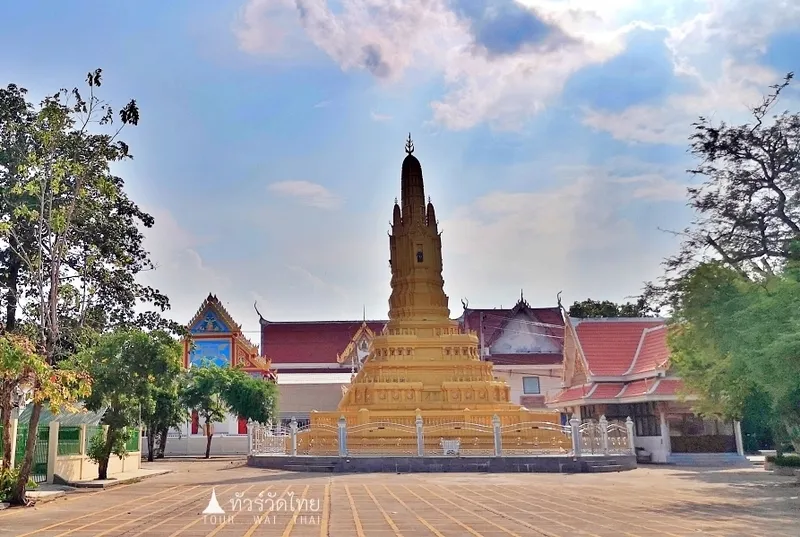
The most prominent landmark inside the temple is the large five-spired prang. Built in 1909, the prang has a base width of 8 meters and rises 16 meters high. Its form is elegant and balanced, with the central spire rising above the surrounding smaller spires. Architecturally, the prang reflects Thai Buddhist ideas of sacred verticality, centrality, and spiritual elevation. It is not merely an ornamental monument; it is a sacred structure containing relics of the Buddha, making it one of the most spiritually significant points within the temple compound.
The five-spired prang is also associated with Luang Pho Yaem, the monk who played an important role in the founding and early development of the temple. A statue of Luang Pho Yaem is enshrined in the temple area, allowing visitors to pay respect to the spiritual figure whose presence helped shape the faith of the local community. According to the temple’s history, Luang Pho Yaem was a wandering monk whose stay in the Thung Kaeo area inspired devotion among local residents. Over time, their support helped transform the site into an established temple.
Another highly important feature is the large circular holy-water pond built of brick. At the center of the pond lies a stone slab inscribed with sacred yantra characters associated with Luang Pho Yaem. This pond is not simply a landscape element. In Thai Buddhist and royal ritual traditions, consecrated water carries deep symbolic meaning related to purification, blessing, auspiciousness, and sacred authority. The water from this pond was formerly used in royal coronation-related ceremonies during the reigns of King Rama 6 and King Rama 7, giving the temple a rare connection with national ceremonial history.
The holy-water pond shows how local sacred sites can be linked with the wider history of the Thai kingdom. Water used in important ceremonies is not chosen randomly. It is selected from places considered pure, sacred, and ritually meaningful. For this reason, the pond at Wat Mani Sathit Kapittharam is an important cultural and historical feature. It demonstrates the relationship between the temple, the local community, Buddhist belief, and the royal court.
The ordination hall, or ubosot, is another key area of the temple. It houses a principal Buddha image in the meditation posture, creating a peaceful atmosphere for worship and reflection. The meditation posture symbolizes calmness, concentration, and spiritual steadiness. For visitors, the ubosot offers a quiet place to pay respect and experience the inner stillness that defines Buddhist sacred space. Although the temple is located within the town, the atmosphere inside the religious buildings remains calm and respectful.
The viharn and sermon hall also contribute to the completeness of the temple compound. In Thai Buddhist temples, these structures serve different but complementary functions. The ubosot is used for formal monastic ceremonies, the viharn is often used for worship and community devotion, while the sermon hall supports teaching, gatherings, and merit-making activities. Together with the prang, the holy-water pond, and the open temple courtyard, these buildings show how Thai temples function as places of worship, education, community activity, and cultural memory.
Wat Mani Sathit Kapittharam holds the status of a third-class royal temple of the ordinary type. This status reflects its importance within the monastic and cultural landscape of Uthai Thani. Royal temples are not merely beautiful or old; they are recognized as religious institutions with historical value and continuing social significance. Visitors should therefore treat the temple with respect, dress modestly, speak quietly, and avoid disturbing monks, worshippers, or religious activities taking place within the compound.
The atmosphere of the temple is best appreciated slowly. The five-spired prang connects visitors with Buddhist relic worship and the memory of Luang Pho Yaem. The circular holy-water pond connects the temple with ritual purity and royal ceremonial history. The ubosot connects the space with formal Buddhist practice. The viharn and sermon hall connect the temple with daily devotion and community life. When seen together, these features form a spiritual and historical map of Uthai Thani’s old town.
For travelers interested in local history, the temple is especially valuable because it shows how religious places can be affected by urban change. The great fire at Sakae Krang Market in 1935 and the subsequent reorganization of the town plan led to the merging of Wat Khwit with Wat Thung Kaeo. This event is still remembered through the temple’s present name. In this sense, the temple allows visitors to read the history of the town through religious geography, road development, and the preservation of old names.
A recommended visit begins with paying respect inside the ubosot, then walking to the five-spired prang, the holy-water pond, the viharn, and the sermon hall. Visitors should also spend time observing the temple grounds as a whole. Unlike temples designed mainly for dramatic tourism, Wat Mani Sathit Kapittharam rewards careful observation. Its value is found in meaning, continuity, sacred memory, and the relationship between architecture and community.
Getting There is very convenient because the temple is located in Uthai Thani town. Travelers can set their destination to Wat Mani Sathit Kapittharam or Wat Thung Kaeo in Uthai Mai Subdistrict. The temple is close to the public health park, the clock tower roundabout, the market, and the old-town area. Visitors staying in town can reach it by private car, local transport, motorcycle taxi, or by continuing from nearby markets and cultural streets. It is easy to combine the temple with other places in town within the same day.
Wat Mani Sathit Kapittharam fits well into a cultural walking or driving route in Uthai Thani. Nearby attractions include Trok Rong Ya Walking Street, Baan Jongrak, the Sakae Krang riverside morning market, Wat Thammakhosok, Wat Uposatharam, and Wat Sangkat Rattana Khiri on Khao Sakae Krang. With half a day, travelers can combine the temple with the old town and riverside area. With a full day, they can continue to Wat Tha Sung or other major attractions in the province.
For photography, the temple offers several meaningful viewpoints. The five-spired prang is the main architectural highlight, while the circular holy-water pond provides a rare ritual element not commonly found in every temple. The open courtyard, shaded areas, and religious buildings also show the peaceful character of a town temple. Morning and late afternoon light are suitable for photographing the prang and the temple atmosphere. Visitors should take photographs respectfully and avoid entering restricted areas.
For foreign travelers, this temple provides an excellent example of how Thai temples are more than places of worship. They can function as community centers, records of local geography, memorials of urban change, and ritual sites connected with national history. Wat Mani Sathit Kapittharam is especially interesting because its name itself tells a story: Mani referring to Thung Kaeo, and Kapit referring to Wat Khwit, the temple that was later merged into it.
In summary, Wat Mani Sathit Kapittharam, or Wat Thung Kaeo, is a temple that should not be overlooked when visiting Uthai Thani. It combines Rattanakosin-period history, local devotion, the memory of wandering monks, a five-spired prang containing Buddha relics, a sacred holy-water pond connected with royal ceremonies, and the status of a royal temple in the heart of the city. A visit here is not only an act of making merit, but also a way to understand the deeper cultural roots of Uthai Thani.
| Name | Wat Mani Sathit Kapittharam, Also Known As Wat Thung Kaeo |
| Location | Sunthon Sathit Road / Mani Sathit Road, Uthai Mai Subdistrict, Mueang Uthai Thani District, Uthai Thani Province |
| Address | Uthai Mai Subdistrict, Mueang Uthai Thani District, Uthai Thani 61000, Thailand, Near The Public Health Park And Clock Tower Roundabout |
| Coordinates | Approximately 15.3834, 100.0235 |
| Highlights | Five-Spired Prang Containing Buddha Relics, Sacred Holy-Water Pond, Ubosot, Viharn, Sermon Hall, Statue Of Luang Pho Yaem, And A Peaceful Royal Temple Atmosphere In Uthai Thani Town |
| History | Established Around 1888 During The Rattanakosin Period, Received Its Consecrated Boundary In 1891, Renamed Wat Thung Kaeo In 1913, And Renamed Wat Mani Sathit Kapittharam In 1938 After Wat Khwit Was Merged With Wat Thung Kaeo |
| Name Origin | Mani Means Jewel Or Glass, Referring To Thung Kaeo, While Kapit Means Wood Apple, Referring To Wat Khwit, Which Was Later Merged Into The Temple |
| Distinctive Features | A Third-Class Royal Temple With A Five-Spired Prang Measuring 8 Meters Wide At The Base And 16 Meters High, Built In 1909, And A Sacred Pond Connected With Royal Coronation Ceremonies In The Past |
| Travel Information | Conveniently Reached By Private Car, Local Transport, Or Motorcycle Taxi From Uthai Thani Town. The Temple Is Near The Market, Public Health Park, Clock Tower Roundabout, And Old-Town Area |
| Current Status | Open To Visitors And Worshippers |
| Open Days | Daily |
| Opening Hours | 08.00 – 17.00 |
| Fees | No Admission Fee |
| Facilities | Worship Areas, Ubosot, Viharn, Sermon Hall, Temple Courtyard, Holy-Water Pond, Waiting Areas, And Parking Areas Nearby |
| Main Areas / Zones | 1. Five-Spired Prang 2. Circular Holy-Water Pond 3. Ubosot And Principal Buddha Image In Meditation Posture 4. Viharn 5. Sermon Hall 6. Statue Of Luang Pho Yaem 7. Temple Courtyard And Religious Activity Area 8. Royal Temple Area In The Heart Of Uthai Thani Town |
| Abbot / Caretaker | Phra Khru Upakit Pariyatti Sophon, Abbot Of Wat Mani Sathit Kapittharam Royal Temple |
| Main Contact Number | 096-820-5163 |
| Official Website / Official Page | Facebook: Wat Mani Sathit Kapittharam Royal Temple |
| Nearby Tourist Attractions | 1. Trok Rong Ya Walking Street, About 1 km 2. Baan Jongrak, About 1 km 3. Sakae Krang Riverside Morning Market, About 1 km 4. Wat Thammakhosok Or Wat Rong Kho, About 1 km 5. Wat Uposatharam, About 2 km 6. Wat Sangkat Rattana Khiri And Khao Sakae Krang, About 3 km |
| Nearby Restaurants | 1. Hua Mum Uthai Thani, About 1 km, Tel. 082-164-6603 2. Lek Som Tam Na Praisanee Uthai Thani, About 1 km, Tel. 081-046-9950 3. Baan Bua Luang Restaurant, About 1 km, Tel. 056-525-047, 062-252-9445 4. Krua Rim Suan Uthai Thani, About 2 km, Tel. 089-008-3062 5. Pa Samran Restaurant, About 6 km, Tel. 056-980-085, 083-874-0376 |
| Nearby Accommodations | 1. Sabua The Terrace Homestay, About 1 km 2. Baan Rao Uthai Thani Homestay, About 1 km, Tel. 082-595-3344 3. Baan Na Non, About 1 km, Tel. 085-874-2846, 083-018-8866 4. Comeneetee Uthai, About 1 km, Tel. 089-907-2098, 086-652-7749 5. Klang Mueang Villa, About 2 km, Tel. 056-049-713, 098-781-4564, 096-675-5466 |
Frequently Asked Questions (FAQ)
Q: Where Is Wat Mani Sathit Kapittharam Located?
A: Wat Mani Sathit Kapittharam is located in Uthai Mai Subdistrict, Mueang Uthai Thani District, Uthai Thani Province, near the public health park, clock tower roundabout, market, and old-town area.
Q: Why Is Wat Mani Sathit Kapittharam Also Called Wat Thung Kaeo?
A: The temple area was formerly associated with a large open field called Thung Kaeo by local residents, so the name became widely used by the community.
Q: What Is The Main Highlight Of Wat Mani Sathit Kapittharam?
A: The main highlight is the five-spired prang containing Buddha relics, together with the sacred holy-water pond, the statue of Luang Pho Yaem, the ubosot, the viharn, and the royal temple atmosphere.
Q: When Was The Large Prang At Wat Mani Sathit Kapittharam Built?
A: The large prang was built in 1909. It has a base width of 8 meters, a height of 16 meters, and a five-spired form.
Q: Why Is The Holy-Water Pond Important?
A: The circular brick holy-water pond contains a stone slab inscribed with sacred yantra characters associated with Luang Pho Yaem, and its water was formerly used in royal coronation-related ceremonies during the reigns of King Rama 6 and King Rama 7.
Q: Is There An Admission Fee?
A: No. There is no admission fee for visiting the temple.
Q: Who Is The Abbot Of Wat Mani Sathit Kapittharam?
A: The abbot is Phra Khru Upakit Pariyatti Sophon.
Q: What Nearby Places Can Visitors Combine With Wat Mani Sathit Kapittharam?
A: Nearby places include Trok Rong Ya Walking Street, Baan Jongrak, the Sakae Krang riverside morning market, Wat Thammakhosok, Wat Uposatharam, and Wat Sangkat Rattana Khiri.
 Category: ●Places of Worship
 Group: ●Temple
Last Update : 5 MonthAgo
 Last Update : 5 MonthAgo
 Click to Access the Navigation Map GPS
Wat Mani Sathit Kapittharam Map
Recommend

 Art, Culture and Heritage
 Historical Sites and Monuments(3)
 Landmarks and Memorials(1)
 Art, Craft Centres, Tradition(5)
 Museums(1)
Temple(31)
 Other Sacred Sites(3)
 Suburban Living
 Village, Community(4)
 Local Market(1)
 Nature and Wildlife
 National Parks and Marine Reserves(2)
 Mountain (Doi)(7)
 Dam, Reservoir, Lake(5)
 Waterfalls(5)
 Hot Springs(1)
 Caves(9)
 Flower Field(2)
 River, Canal(2)
 Islands(1)
 Other natural attractions(1)
 Entertainment and Agricultural
 Farms, Parks and Ecotourism(2)
 Shopping
 Shopping and Night Market(1)
 Travel Articles, Recipes
 Travel Review, Food Review(1)


