
lovethailand home >North Travel Attractions >Sukhothai Travel Attractions >Si Samrong >Ban San > Luang Pho Khao
TL;DR: Luang Pho Khao is located at Wat Ban San, Moo 2, Ban San Subdistrict, Si Samrong District, Sukhothai Province, open Daily, hours Daytime.
Luang Pho Khao
Open Days: Daily
Opening Hours: Daytime
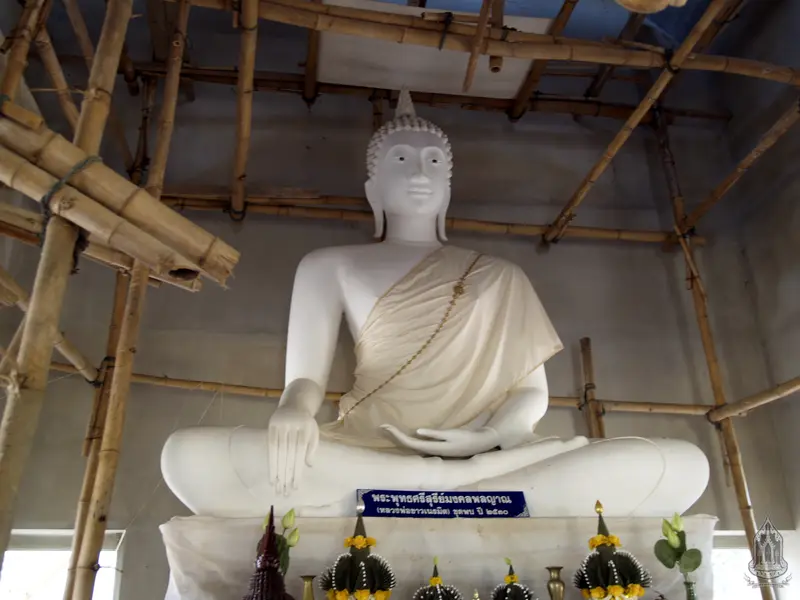
Luang Pho Khao at Wat Ban San in Sukhothai Province is an old stucco Buddha image enshrined at Wat Ban San, Ban San Subdistrict, Si Samrong District. The image is about 140 cm high, with a lap width of about 110 cm, and is seated in the Subduing Mara posture. Its artistic appearance resembles the Chiang Saen style, and local tradition regards it as being around 500 years old. For visitors who want to explore Sukhothai beyond the famous historical park, Luang Pho Khao offers a meaningful experience of local Buddhist faith, rural temple culture, and community memory.
In simple terms, Luang Pho Khao is a sacred old Buddha image of Wat Ban San. The image has several distinctive features: a topknot resembling a lotus bud, a long robe fold falling across the shoulder down toward the navel, and fingers of equal length. These details make the image especially interesting for travelers who appreciate Buddhist art. At the same time, the image is deeply respected by local people because of the stories of protection and wonder associated with it.
Wat Ban San is a local Buddhist temple in Moo 2, Ban San Subdistrict, Si Samrong District, Sukhothai Province. It is a community temple under the Mahanikaya order. The temple is not a large tourist complex, but it has strong spiritual meaning for the people of Ban San. Like many rural temples in Thailand, it functions as a place of worship, merit-making, annual ceremonies, and community gathering. Luang Pho Khao is one of the important sacred images that give the temple its identity.
The Buddha image is seated in the Subduing Mara posture, one of the most significant postures in Buddhist art. This posture represents the moment when the Buddha overcame temptation and spiritual obstacles through wisdom and inner strength. For worshippers, the posture symbolizes stability, courage, patience, and victory over difficulty. When local people and visitors bow before Luang Pho Khao, they are not only praying for blessings but also reflecting on Buddhist values of calmness and moral determination.
The artistic details of Luang Pho Khao are worth observing carefully. The lotus-bud-like topknot gives the image a graceful and ancient character. The robe fold across the shoulder descends toward the navel, creating a calm vertical line on the body of the image. The equal-length fingers are another notable feature. Although the image is found in a local temple rather than a major archaeological site, its form provides a valuable glimpse into the spread and adaptation of Buddhist artistic styles in Sukhothai and the lower northern region of Thailand.
The name Luang Pho Khao, meaning “Venerable White Buddha,” carries a feeling of purity and serenity. In Thai Buddhist culture, the color white is often associated with cleanliness, peace, compassion, and spiritual brightness. The name helps local worshippers remember the image with affection and reverence. It also gives foreign travelers an immediate sense of the calm and gentle atmosphere surrounding the Buddha image.
One of the most important local stories about Luang Pho Khao comes from the time when Wat Ban San was still undeveloped. The viharn that housed the Buddha image was simple, with a thatched roof made of cogon grass. Around the viharn was a dark, overgrown area of wild grass. During the dry season, grass fires could easily occur. Yet local people tell that when fire burned through the surrounding grass, the viharn of Luang Pho Khao did not catch fire. This event became an important story of sacred protection in the memory of the community.
Another remembered event involves an old and very tall sugar palm tree that leaned over the viharn. If such a tree had fallen directly onto the building, it could have damaged the roof and the Buddha image. However, when the tree finally broke and fell, it did not strike Luang Pho Khao. Local people regarded this as another remarkable sign of the image’s sacred power. Together, the fire story and the falling palm story form the core of the community’s faith in Luang Pho Khao.
For foreign visitors, these stories should be understood as part of local religious culture. They are not merely tales of miracles; they are ways in which the community preserves memory. They tell us that the Buddha image remained with the people during a time when the temple was simple, vulnerable, and surrounded by nature. The stories also show how deeply local people felt responsible for protecting the image and how their faith grew stronger through shared experience.
Wat Ban San also has an important annual tradition: the procession of Luang Pho Sam Phi Nong and the Buddha bathing ceremony. This event is held in March each year, from the 14th waning moon of the 4th lunar month to the 1st waxing moon of the 5th lunar month. The ceremony reflects the role of Wat Ban San as a spiritual and social center. During the event, local people gather for merit-making, ritual bathing of Buddha images, processions, and community activities. It is one of the best times to experience the living faith of the village.
Although the annual tradition is directly associated with Luang Pho Sam Phi Nong, it belongs to the same sacred environment of Wat Ban San. Visitors who come during the festival can see how the temple connects multiple sacred images, local rituals, and community identity. The temple becomes more than a quiet place of worship; it becomes a space where people return, meet, make merit, and pass on cultural memory to younger generations.
Luang Pho Khao is also important because it helps visitors understand Sukhothai beyond the image of ancient ruins. Many travelers know Sukhothai through Sukhothai Historical Park, Wat Mahathat, Wat Si Chum, and World Heritage monuments. However, Sukhothai also contains many active community temples where old Buddha images, local legends, and annual ceremonies remain part of everyday life. Wat Ban San is one of these living temples.
The charm of visiting Luang Pho Khao lies in simplicity. This is not a crowded attraction filled with grand architecture. Instead, it offers the quiet atmosphere of a rural temple, the sincerity of local worship, and the depth of a sacred image that has been respected for generations. Travelers who enjoy slow cultural travel will find this kind of place especially meaningful because it reveals the human side of Buddhist heritage.
Visitors may worship Luang Pho Khao in a simple and respectful way. Common practices include bowing, offering flowers, lighting incense and candles where permitted, making merit, and praying quietly. Modest dress is recommended. Visitors should keep their voices low inside the temple area, avoid touching the old Buddha image unnecessarily, and respect local worshippers. These practices help preserve both the physical image and the sacred atmosphere of the temple.
For those interested in Buddhist art, it is worth spending a few minutes looking closely at the face, posture, robe line, topknot, and hands of Luang Pho Khao. The image shows how local sacred art can carry both artistic value and devotional power. Even without a large museum label or grand historical narrative, a community Buddha image can tell a rich story through form, faith, and the way people continue to care for it.
Getting There is most convenient by private car, rental car, or hired local transport. From Sukhothai town, travelers can head toward Si Samrong District and continue to Ban San Subdistrict. Wat Ban San is located in Moo 2. Those using public transport can first reach Si Samrong District and then take local transport or hire a vehicle to Ban San. A private vehicle is recommended for travelers who want to combine the temple with other nearby attractions in the same day.
Nearby places can be arranged into a cultural route. Visitors may continue to Wat Pak Khlong Daen, Wat Sopharam, Sukhothai town, Phra Mae Ya Shrine, King Rama IX Commemoration Park, and Sukhothai Historical Park. This route allows travelers to experience both local temple culture and the broader historical identity of Sukhothai Province.
The best time to visit is in the morning or late afternoon, when the weather is more comfortable and the temple atmosphere is calm. Travelers who want to see community life should visit during the annual procession and Buddha bathing ceremony in March. At that time, the temple becomes lively with merit-making, ritual activities, and local participation.
Luang Pho Khao is a meaningful destination because it combines Buddhist art, local legend, and living community faith. The image is old and artistically interesting, but its deeper value comes from the stories preserved by the people of Ban San. The fire that did not burn the viharn and the palm tree that did not fall onto the Buddha image are remembered as signs of protection and sacred presence.
In summary, Luang Pho Khao at Wat Ban San is an old stucco Buddha image of Sukhothai Province, approximately 500 years old, seated in the Subduing Mara posture and resembling the Chiang Saen style. Its distinctive features and local miracle stories make it one of the meaningful sacred images of Si Samrong District. For travelers who want to understand Sukhothai through community temples and local faith, Wat Ban San is a worthwhile place to visit.
| Name | Luang Pho Khao, Wat Ban San |
| Location | Wat Ban San, Moo 2, Ban San Subdistrict, Si Samrong District, Sukhothai Province |
| Highlights | An old stucco Buddha image in the Subduing Mara posture, about 140 cm high and 110 cm wide at the lap, resembling the Chiang Saen style and believed to be about 500 years old |
| History | A long-revered Buddha image of Wat Ban San and Ban San community, respected as a sacred image of Si Samrong District |
| Distinctive Features | Lotus-bud-like topknot, long robe fold descending toward the navel, equal-length fingers, and a seated base about 7 cm high |
| Local Faith Story | Local stories tell that grass fires did not burn the old viharn of Luang Pho Khao, and a tall old palm tree that fell near the viharn did not strike the Buddha image |
| Important Tradition / Ritual | The procession of Luang Pho Sam Phi Nong and the Buddha bathing ceremony at Wat Ban San, held in March each year from the 14th waning moon of the 4th lunar month to the 1st waxing moon of the 5th lunar month |
| Travel Information | Travel from Sukhothai town toward Si Samrong District, then continue to Ban San Subdistrict. Private car, rental car, or hired local transport is recommended |
| Current Status | Open for worship at Wat Ban San, a local Buddhist temple under the Mahanikaya order |
| Open Days | Daily |
| Opening Hours | Daytime |
| Facilities | Worship area, temple grounds, parking area, and community religious space |
| Abbot / Caretaker | Phra Khru Mongkhon Sathukit (Charoen) |
| Nearby Tourist Attractions | 1. Wat Pak Khlong Daen, about 3 km 2. Wat Sopharam, Si Samrong District, about 12 km 3. King Rama IX Commemoration Park, Sukhothai, about 16 km 4. Phra Mae Ya Shrine, about 18 km 5. Sukhothai Historical Park, about 28 km 6. Wat Mahathat, Sukhothai Historical Park, about 29 km |
| Nearby Restaurants | 1. Local Restaurants in Si Samrong District, about 10 km 2. Restaurants around Si Samrong Market Area, about 11 km 3. Restaurants in Sukhothai Town, about 18 km 4. Cafes and Local Food Stops on the Si Samrong-Sukhothai Route, about 12 km 5. Restaurants near Sukhothai Historical Park, about 28 km |
| Nearby Accommodations | 1. Sanrak Resort Sukhothai, about 10 km, Tel. 081-971-9709 2. Vee Wan Resort Sukhothai, about 12 km, Tel. 097-918-9966 3. Sukruthai Resort, about 12 km, Tel. 081-020-3111 4. Sun Smile Resort, Sam Ruean Subdistrict, Si Samrong District, about 15 km, Tel. 063-882-9323 5. Accommodations in Sukhothai Town, about 18 km |
Frequently Asked Questions (FAQ)
Q: Where is Luang Pho Khao located?
A: Luang Pho Khao is enshrined at Wat Ban San, Moo 2, Ban San Subdistrict, Si Samrong District, Sukhothai Province.
Q: How old is Luang Pho Khao?
A: Luang Pho Khao is regarded as being about 500 years old and is an old stucco Buddha image respected by the Ban San community.
Q: What are the distinctive features of Luang Pho Khao?
A: The image is about 140 cm high, with a lap width of about 110 cm. It has a lotus-bud-like topknot, a long robe fold descending toward the navel, and equal-length fingers.
Q: What local miracle stories are associated with Luang Pho Khao?
A: Local stories tell that fire did not burn the old viharn of Luang Pho Khao, and a tall old palm tree that fell near the viharn did not strike the Buddha image.
Q: Does Wat Ban San have an annual tradition?
A: Yes. The procession of Luang Pho Sam Phi Nong and the Buddha bathing ceremony is held in March each year, from the 14th waning moon of the 4th lunar month to the 1st waxing moon of the 5th lunar month.
Q: How should visitors behave when worshipping Luang Pho Khao?
A: Visitors should dress modestly, behave respectfully, keep their voices low, and avoid touching the old Buddha image unnecessarily.
Q: What nearby attractions can travelers visit after Wat Ban San?
A: Nearby places include Wat Pak Khlong Daen, Wat Sopharam, Phra Mae Ya Shrine, Sukhothai Historical Park, and Wat Mahathat.
 Category: ●Places of Worship
 Group: ●Other Sacred Sites
Last Update : 5 MonthAgo
 Last Update : 5 MonthAgo
 Click to Access the Navigation Map GPS
 Art, Culture and Heritage
 Historical Sites and Monuments(4)
 Landmarks and Memorials(5)
 Art, Craft Centres, Tradition(11)
 Museums(5)
 Temple(40)
Other Sacred Sites(10)
Temple(40)
Other Sacred Sites(10)
 Suburban Living
 Village, Community(3)
 Nature and Wildlife
 National Parks and Marine Reserves(3)
 Mountain (Doi)(2)
 Dam, Reservoir, Lake(4)
 Waterfalls(8)
 Caves(4)
 River, Canal(2)
 Entertainment and Agricultural
 Farms, Parks and Ecotourism(3)
 Travel Articles, Recipes
 Travel Review, Food Review(1)


