lovethailand home >North Travel Attractions >Sukhothai Travel Attractions >Si Samrong >Wang Luek > Wat Ko Mai Daeng
TL;DR: Wat Ko Mai Daeng is located at Ban Ko Mai Daeng, Wang Luek Subdistrict, Si Samrong District, Sukhothai Province, open Daily, hours 08.00 – 17.00.
Wat Ko Mai Daeng
Open Days: Daily
Opening Hours: 08.00 – 17.00
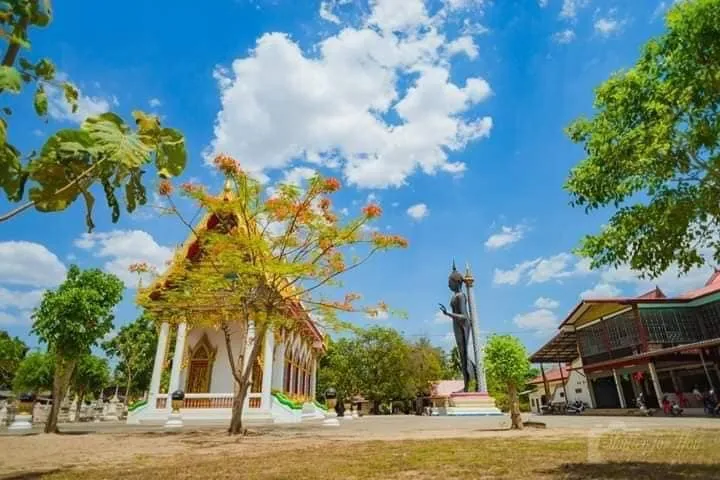
Wat Ko Mai Daeng in Sukhothai Province is a local Buddhist temple in the Mahanikaya tradition, located in Ban Ko Mai Daeng, Moo 6, Wang Luek Subdistrict, Si Samrong District. The temple is important to the community as a place of worship, merit-making, Buddhist ceremonies, and local cultural activities. Its main highlight is Phra Phuttha Leela Thisathon Naruemit, a large walking Buddha image measuring 15 wa in height. Built in 1984 through the faith and cooperation of the local community, the image has become a spiritual center for villagers and visitors who come to pay respect, make merit, and experience the peaceful atmosphere of a rural Sukhothai temple.
Wat Ko Mai Daeng is well suited for travelers interested in religious and community-based tourism in Sukhothai. Unlike the major historical parks and world-famous ancient ruins, this temple offers a quieter and more intimate experience. It reflects the living Buddhist faith of a local community rather than the monumental remains of an ancient city. Visitors come here to see the large walking Buddha, enjoy the calm temple grounds, take photographs respectfully, and learn how Buddhism continues to shape everyday life in rural Sukhothai.
Phra Phuttha Leela Thisathon Naruemit is the spiritual heart of the temple. The image is in the walking Buddha posture, one of the most graceful and meaningful postures in Thai Buddhist art. The walking Buddha represents the Buddha moving forward with mindfulness, compassion, and serenity. In Sukhothai art, the walking Buddha is especially admired for its elegant lines, balanced movement, and sense of gentle spiritual motion. At Wat Ko Mai Daeng, this tradition is carried into a modern community context through a large and highly visible Buddha image that continues to inspire devotion.
The image stands 15 wa tall and is enshrined on an elegant lotus base. The lotus is a powerful Buddhist symbol, representing purity, spiritual growth, and the ability to rise above the difficulties of the world. When visitors stand before the image, they see not only its height and scale, but also its symbolic message. The Buddha appears calm, graceful, and compassionate, creating an atmosphere of peace for those who come to pray or quietly reflect.
The construction of Phra Phuttha Leela Thisathon Naruemit in 1984 reflects the strong faith of the villagers and devotees who wanted to create a sacred landmark for the temple. The image is not merely a decorative structure. It represents shared merit, collective belief, and the hope that the temple would remain a spiritual center for future generations. In many Thai rural communities, building a large Buddha image is a major act of religious devotion, bringing people together through donations, labor, and shared intention.
Inside the Buddha image, sacred objects and amulets were enshrined. This practice reflects a common Thai Buddhist tradition in which sacred images are filled with meaningful items as symbols of blessing, protection, and accumulated merit. For local devotees, the image is therefore more than a visual object. It is a vessel of faith, prayer, and communal spiritual energy created by generations of people who wished to support Buddhism and bring peace to their community.
The history of Wat Ko Mai Daeng is closely connected with Ban Ko Mai Daeng. The temple area was once a dense and overgrown place with many large trees. Local people formerly referred to the area as “To Mai Daeng,” which later developed into the name “Ko Mai Daeng.” The temple was established around 1936 and gradually became the religious center of the local community. Its development from a forested area into a village temple reflects the growth of settlement and the central role of Buddhism in shaping community life.
Wat Ko Mai Daeng is located on Wang Luek–Nong Sakae Road in Wang Luek Subdistrict, Si Samrong District. The temple grounds are spacious enough for religious ceremonies, community gatherings, merit-making, and visitor access. The atmosphere is simple, peaceful, and local. It is a good place for travelers who prefer a calm temple setting rather than a crowded tourist attraction. The temple is suitable for worship, meditation, quiet walking, and respectful photography.
The beauty of Phra Phuttha Leela Thisathon Naruemit lies in the graceful movement of the walking Buddha posture. The raised foot, the position of the hands, and the curve of the body suggest motion without losing balance. The image does not feel static. Instead, it gives the impression of the Buddha walking gently and peacefully. This creates a feeling of kindness, calmness, and spiritual reassurance for visitors.
Because Sukhothai is famous for the walking Buddha image, Wat Ko Mai Daeng has a meaningful connection with the province’s artistic identity. Sukhothai-style walking Buddha images are admired for their ability to combine stillness and movement. Phra Phuttha Leela Thisathon Naruemit continues that artistic spirit in a contemporary local temple. It allows visitors to see how Sukhothai Buddhist aesthetics continue to inspire modern religious art.
In religious life, Wat Ko Mai Daeng serves as a place for merit-making, Buddhist sermons, candlelight processions, almsgiving, and observances on major Buddhist holy days such as Makha Bucha, Visakha Bucha, Asalha Bucha, Buddhist Lent, and the end of Buddhist Lent. The temple also plays an important role in Kathin ceremonies, village merit-making activities, and local festivals. These activities show how the temple remains a living center of faith and social connection.
The Kathin ceremony is particularly important because it brings villagers and devotees together after the Buddhist Lent season. People offer robes and donations to support the monks and maintain the temple. For cultural travelers, visiting during a temple festival or merit-making event offers a chance to observe the warmth, generosity, and unity of the local community. The experience is different from visiting a historical monument because it reveals Buddhism as a living practice.
Wat Ko Mai Daeng also hosts local community activities during seasonal festivals such as Songkran, village merit-making events, and other Buddhist observances. These activities help connect generations within the village. Children, adults, elders, monks, and laypeople share the temple as a place of memory and participation. The temple is therefore both a sacred site and a social center.
For visitors from outside the area, Wat Ko Mai Daeng offers a different perspective on Sukhothai. The province is often associated with ancient ruins and UNESCO heritage sites, but living temples like Wat Ko Mai Daeng show how Buddhist faith continues in present-day communities. The temple helps expand the travel experience from ancient history to modern rural spirituality.
The temple is located in Si Samrong District, an area connected with Sukhothai city, Sawankhalok, and Si Satchanalai. This makes Wat Ko Mai Daeng a practical stop for travelers exploring central Sukhothai Province. Visitors can combine it with other local temples in Si Samrong or continue toward Sukhothai Historical Park and Si Satchanalai Historical Park for a broader cultural route.
Getting There is easiest by private car. From Sukhothai city, travel toward Si Samrong District, then continue to Wang Luek Subdistrict and Ban Ko Mai Daeng. The journey generally takes around 30–45 minutes depending on traffic and the starting point. From Si Samrong town, the temple is closer and can be reached by local roads. Visitors should use a navigation app together with local signs for Ban Ko Mai Daeng and Wat Ko Mai Daeng.
Travelers using public transport can get to Sukhothai city or Si Samrong town first, then continue by local hired vehicle. Since rural transport services may not run frequently, it is best to plan the return journey in advance. Renting a car or hiring local transport is suitable for visitors who want to include several nearby attractions in the same day.
The best times to visit are in the morning or late afternoon, when the weather is more comfortable. Morning visits are suitable for making merit and enjoying the quiet atmosphere, while late afternoon provides softer light for photographing the large walking Buddha image. Visitors who prefer a peaceful experience should come on ordinary weekdays, while those interested in community life may choose Buddhist holy days or temple festival periods.
Visitors should dress respectfully when entering the temple. Shoulders and knees should be covered, and behavior should remain calm and polite. Do not climb the Buddha base, touch sacred objects unnecessarily, or disturb people who are praying. Photography is acceptable when done respectfully and without interrupting religious activities.
Wat Ko Mai Daeng is also a place to learn about the relationship between Buddhism and rural community life in Sukhothai. Temples in Thai villages often function as more than religious spaces. They are meeting places, learning spaces, centers of mutual support, and stages for seasonal traditions. A visit to Wat Ko Mai Daeng helps travelers understand this important cultural role.
For photography, the large walking Buddha image is the main subject. The best composition includes the full height of the image and the lotus base, helping convey its scale and elegance. Morning and late afternoon light are recommended. Visitors should avoid blocking worshippers and should not use the temple space in a way that disrespects its sacred character.
Wat Ko Mai Daeng can be included in a wider Sukhothai itinerary. Travelers may visit the temple together with Wat Sopharam, Thung Thale Luang, Sukhothai Historical Park, Wat Si Chum, Wat Mahathat, or Si Satchanalai Historical Park. This route combines living religious culture, local community atmosphere, and the world-famous historical heritage of Sukhothai.
In summary, Wat Ko Mai Daeng in Sukhothai Province is a meaningful community temple known for Phra Phuttha Leela Thisathon Naruemit, a 15-wa-tall walking Buddha image built in 1984. The temple is suitable for merit-making, worship, quiet reflection, photography, and learning about local Buddhist life. It offers travelers a peaceful and authentic view of Sukhothai beyond the ancient ruins, showing how faith, art, and community remain closely connected.
| Name | Wat Ko Mai Daeng |
| Location | Ban Ko Mai Daeng, Wang Luek Subdistrict, Si Samrong District, Sukhothai Province |
| Address | No. 14, Moo 6, Ban Ko Mai Daeng, Wang Luek–Nong Sakae Road, Wang Luek Subdistrict, Si Samrong District, Sukhothai 64120, Thailand |
| Highlights | Phra Phuttha Leela Thisathon Naruemit, a 15-wa-tall walking Buddha image enshrined on a lotus base and revered as the spiritual center of Ban Ko Mai Daeng |
| History | The temple was established around 1936. Phra Phuttha Leela Thisathon Naruemit was built in 1984 through the faith of the local community |
| Name Origin | The area was once known locally as To Mai Daeng because of large redwood-like tree stumps, later becoming Ko Mai Daeng, the name used for the village and temple |
| Distinctive Features | A rural Sukhothai community temple with a large walking Buddha image, peaceful grounds, and active Buddhist community life |
| Travel Information | From Sukhothai city, travel toward Si Samrong District, then continue to Wang Luek Subdistrict and Ban Ko Mai Daeng; the trip usually takes about 30–45 minutes by car |
| Current Status | Active local Buddhist temple with resident monks and community Buddhist activities |
| Open Days | Daily |
| Opening Hours | 08.00 – 17.00 |
| Facilities | Temple courtyard, parking area, pavilion, merit-making area, worship area for Phra Phuttha Leela Thisathon Naruemit, and peaceful temple grounds |
| Main Areas / Zones | Phra Phuttha Leela Thisathon Naruemit, lotus base, worship courtyard, sermon hall, and community religious activity areas |
| Abbot / Caretaker | Phra Athikan Somchai Somachitto |
| Main Contact Number | 089-906-1644 |
| Official Website / Official Page | Ban Ko Mai Daeng / Wat Ko Mai Daeng, Wang Luek Subdistrict, Si Samrong District, Sukhothai Province |
| Nearby Tourist Attractions | 1. Wat Sopharam, Si Samrong District, about 12 km 2. Thung Thale Luang, Sukhothai, about 25 km 3. Sukhothai Historical Park, about 35 km 4. Wat Si Chum, about 36 km 5. Wat Mahathat, Sukhothai Historical Park, about 37 km 6. Si Satchanalai Historical Park, about 55 km |
| Nearby Restaurants | 1. Kor Kai Si Samrong Riverside Branch, about 12 km, Tel. 096-687-5874 2. Ta Phut Noodle, Si Samrong, about 13 km 3. Amornbergfah Cafe', about 13 km 4. ORDINA.HOUSE, about 14 km 5. Hom Muen Li, about 14 km 6. Pa Ban Thap Phueng Restaurant, about 18 km |
| Nearby Accommodations | 1. Sukruethai Resort, Wang Luek Subdistrict, about 5 km, Tel. 081-020-3111 2. Sanrak Resort Si Samrong, about 14 km, Tel. 081-971-9709 3. OYO 75596 The Sirisuk House Si Samrong, about 15 km 4. Destiny Home Stay Si Samrong, about 17 km 5. Sukhothai Heritage Resort, about 35 km |
Frequently Asked Questions (FAQ)
Q: Where is Wat Ko Mai Daeng located?
A: Wat Ko Mai Daeng is located at No. 14, Moo 6, Ban Ko Mai Daeng, Wang Luek–Nong Sakae Road, Wang Luek Subdistrict, Si Samrong District, Sukhothai Province.
Q: What is the main highlight of Wat Ko Mai Daeng?
A: The main highlight is Phra Phuttha Leela Thisathon Naruemit, a 15-wa-tall walking Buddha image enshrined on a lotus base.
Q: When was Phra Phuttha Leela Thisathon Naruemit built?
A: The image was built in 1984 through the faith and cooperation of the local community and devotees.
Q: Does Wat Ko Mai Daeng have an abbot?
A: Yes. Wat Ko Mai Daeng is an active local temple with resident monks. The abbot is Phra Athikan Somchai Somachitto.
Q: What type of travel is Wat Ko Mai Daeng suitable for?
A: It is suitable for religious tourism, merit-making, quiet reflection, respectful photography, and learning about rural Buddhist community life in Sukhothai.
Q: How can visitors travel from Sukhothai city to Wat Ko Mai Daeng?
A: Travel by private car from Sukhothai city toward Si Samrong District, then continue to Wang Luek Subdistrict and Ban Ko Mai Daeng. The journey usually takes about 30–45 minutes.
Q: What nearby attractions can be visited with Wat Ko Mai Daeng?
A: Nearby and connected attractions include Wat Sopharam, Thung Thale Luang, Sukhothai Historical Park, Wat Si Chum, Wat Mahathat, and Si Satchanalai Historical Park.
Q: Is there a contact number for Wat Ko Mai Daeng?
A: The main contact number for Wat Ko Mai Daeng is 089-906-1644.
 Category: ●Places of Worship
 Group: ●Temple
Last Update : 5 MonthAgo
 Last Update : 5 MonthAgo
 Click to Access the Navigation Map GPS

 Art, Culture and Heritage
 Historical Sites and Monuments(4)
 Landmarks and Memorials(5)
 Art, Craft Centres, Tradition(11)
 Museums(5)
Temple(40)
 Other Sacred Sites(10)
 Suburban Living
 Village, Community(3)
 Nature and Wildlife
 National Parks and Marine Reserves(3)
 Mountain (Doi)(2)
 Dam, Reservoir, Lake(4)
 Waterfalls(8)
 Caves(4)
 River, Canal(2)
 Entertainment and Agricultural
 Farms, Parks and Ecotourism(3)
 Travel Articles, Recipes
 Travel Review, Food Review(1)


