
lovethailand home >North Travel Attractions >Sukhothai Travel Attractions >Si Sat Chana Lai >Mae Sam > Narai Cave (Khao Wong Cave)
TL;DR: Narai Cave (Khao Wong Cave) is located at Along the route up Khao Luang, Ramkhamhaeng National Park, Khiri Mat District, Sukhothai Province, open Daily, hours Daytime.
Narai Cave (Khao Wong Cave)
Open Days: Daily
Opening Hours: Daytime
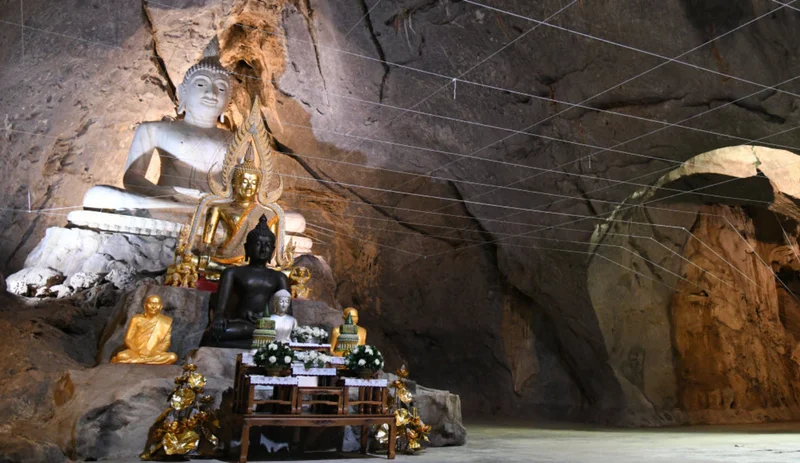
Narai Cave in Sukhothai Province is a small but historically meaningful cave located inside Ramkhamhaeng National Park, along the route up Khao Luang. The cave is about 3 km from the national park office and is known for its connection with an ancient sandstone image of Avalokitesvara Bodhisattva. Because the image had features that local villagers associated with Phra Narai, the Thai name for Vishnu, the cave became locally known as “Tham Narai” or Narai Cave. The original image has now been moved to Ramkhamhaeng National Museum for proper preservation.
Narai Cave is suitable for travelers who want to discover a deeper side of Sukhothai beyond the famous historical park. While most visitors know Sukhothai for ancient temples, lotus ponds, Buddha images, and World Heritage monuments, Narai Cave introduces another layer of the province: forested mountains, sacred caves, sandstone sculpture, local interpretation, and the spiritual landscape of Khao Luang.
The cave is located in Ramkhamhaeng National Park in Khiri Mat District, Sukhothai Province. The national park is best known for Khao Luang, one of the province’s most prominent mountains and a popular trekking destination. Narai Cave lies along the route connected with the ascent area, making it an interesting stop for travelers who enjoy both nature and history.
The importance of Narai Cave comes from the ancient sandstone image once enshrined inside the cave. The image is identified as Avalokitesvara Bodhisattva, an important figure in Mahayana Buddhist belief associated with compassion and mercy. However, local villagers saw visual features that reminded them of Phra Narai, or Vishnu, and this local understanding gave the cave its present name. This makes Narai Cave an excellent example of how archaeological objects can be remembered and reinterpreted through local belief.
Avalokitesvara Bodhisattva represents compassion in Mahayana Buddhism, and the presence of such an image in this mountain cave suggests that the area once held religious significance. For foreign travelers, this helps explain why a small cave can be culturally important: it is not the size of the cave that matters most, but the evidence of belief, art, and sacred use embedded in the landscape.
The local name “Narai Cave” also reflects the way Thai communities often understand sacred images through familiar religious vocabulary. In Thailand, Buddhist, Brahmanical, and local spiritual traditions have interacted for centuries. A sacred image may be remembered through its visual form, its perceived power, or the name that villagers use in everyday speech. Narai Cave preserves this relationship between official art history and local memory.
The original sandstone image is no longer kept inside the cave. It has been moved to Ramkhamhaeng National Museum, where it can be preserved under more suitable conditions and studied by visitors and researchers. The cave, however, remains important as the original discovery site. Visiting the cave and then continuing to the museum allows travelers to connect the natural setting with the preserved artifact.
The atmosphere around Narai Cave is quiet and natural. Because it lies within a national park, the surrounding area includes forest, slopes, walking paths, and the mountain environment of Khao Luang. The experience is very different from visiting the old city of Sukhothai. Instead of brick monuments and open historical plains, visitors encounter shade, rock, forest sounds, and the feeling of a place that once served as a sacred natural refuge.
For travelers who appreciate meaningful destinations, Narai Cave is more rewarding when visited with context. Understanding the sandstone Avalokitesvara image, the local association with Phra Narai, and the role of Ramkhamhaeng National Museum gives the cave a stronger sense of place. It becomes more than a natural cave; it becomes a point where archaeology, religious belief, and landscape meet.
Visitors planning a trip to Khao Luang can include Narai Cave as part of a broader national park experience. Many travelers come to Ramkhamhaeng National Park for trekking, waterfalls, viewpoints, and forest scenery. Narai Cave adds a historical and spiritual dimension to that journey, showing that the mountain was not only a natural landmark but also a cultural landscape.
Travelers should begin at the Ramkhamhaeng National Park office, where they can check current conditions, receive guidance, and plan their route. Since the cave is about 3 km from the office, visitors should allow enough time, especially if combining the visit with other activities in the park. Those planning to trek up Khao Luang should follow the park’s instructions carefully.
Practical preparation is important. Visitors should wear proper walking shoes, bring drinking water, carry a small flashlight, and choose clothing suitable for a natural trail. The route passes through a forested national park environment, so travelers should avoid walking off the marked route and should not enter unsafe areas.
As with all natural caves, visitors should travel responsibly. Do not write on cave walls, remove stones, damage plants, disturb wildlife, or leave rubbish in the area. Narai Cave has both natural and cultural value, so respectful behavior is essential for protecting the site.
To fully understand the story of Narai Cave, foreign travelers should also visit Ramkhamhaeng National Museum in the old Sukhothai area. The museum preserves important artifacts from the region, including objects that help explain the religious and artistic history of Sukhothai. Seeing the cave and the museum together creates a more complete travel experience.
Narai Cave can be combined with several nearby destinations, including Khao Luang, Sai Rung Waterfall, Ramkhamhaeng National Museum, Sukhothai Historical Park, and Wat Si Chum. This route allows travelers to experience forest, mountain, archaeology, museum collections, and major historic monuments in one well-rounded Sukhothai itinerary.
The best time to visit is in the morning or during daylight hours when visibility is good. The post-rainy season and cool season are especially pleasant for walking in the national park area. Visitors should check park conditions before traveling, especially during periods of heavy rain or seasonal trail changes.
Narai Cave may be small, but it offers a rich story. It shows that Sukhothai’s heritage is not limited to temples and ancient city walls. Some of its history is hidden in caves, forests, mountains, and local names passed down through generations. For travelers who want to understand Sukhothai in a more thoughtful way, Narai Cave is a quiet but worthwhile destination.
| Name | Narai Cave |
| Location | Along the route up Khao Luang, Ramkhamhaeng National Park, Khiri Mat District, Sukhothai Province |
| Address | Ramkhamhaeng National Park, Na Choeng Khiri Subdistrict, Khiri Mat District, Sukhothai 64160, Thailand |
| Highlights | A natural cave near the Khao Luang trail, formerly housing an ancient sandstone Avalokitesvara Bodhisattva image locally associated with Phra Narai |
| History | The cave once enshrined an ancient sandstone Avalokitesvara Bodhisattva image, which has now been moved to Ramkhamhaeng National Museum for preservation |
| Name Origin | Local villagers called it Narai Cave because the ancient image formerly inside the cave had features that reminded them of Phra Narai |
| Distinctive Features | A small natural cave within the forested mountain area of Ramkhamhaeng National Park, about 3 km from the park office |
| Travel Information | Travel by private car to Ramkhamhaeng National Park in Khiri Mat District, then follow park guidance toward the Khao Luang route and Narai Cave area |
| Current Status | A natural and archaeological point inside Ramkhamhaeng National Park; the original image is preserved at Ramkhamhaeng National Museum |
| Open Days | Daily |
| Opening Hours | Daytime |
| Fees | Ramkhamhaeng National Park entrance fee applies |
| Facilities | Visitor center, camping area, toilets, park office, and natural walking routes within Ramkhamhaeng National Park |
| Main Areas / Zones | 1. Ramkhamhaeng National Park Office 2. Visitor Center 3. Khao Luang Trail 4. Narai Cave 5. Forest and Nature Study Area |
| Caretaker | Ramkhamhaeng National Park, Department of National Parks, Wildlife and Plant Conservation |
| Main Contact Number | 098-883-9297 |
| Official Website / Official Page | Ramkhamhaeng National Park - Ramkhamhaeng National Park Official Page |
| Nearby Tourist Attractions | 1. Khao Luang Sukhothai, about 3 km 2. Sai Rung Waterfall, about 14 km 3. Ramkhamhaeng National Museum, about 28 km 4. Sukhothai Historical Park, about 30 km 5. Wat Si Chum, about 32 km |
| Nearby Restaurants | 1. Suan Ahan Ban Rao, about 18 km, Tel. 085-047-4488 2. Tor Khao Tom Khiri Mat, about 18 km 3. Pad Thai Boran Je Phanom, about 18 km 4. Kuai Tiao Thai Boran Yai Chalo, about 18 km 5. Krua Ban Mae, about 18 km |
| Nearby Accommodations | 1. Ban Piamsuk Resort Khiri Mat, about 18 km, Tel. 081-533-0389 2. Boonma Resort, about 20 km, Tel. 095-467-2373 3. Sukhothai Treasure Resort & Spa, about 27 km 4. Le Charme Sukhothai Resort, about 29 km 5. Thai Thai Sukhothai Resort, about 30 km |
Frequently Asked Questions (FAQ)
Q: Where is Narai Cave located?
A: Narai Cave is located along the route up Khao Luang inside Ramkhamhaeng National Park, Khiri Mat District, Sukhothai Province, about 3 km from the park office.
Q: Why is Narai Cave important?
A: The cave once housed an ancient sandstone Avalokitesvara Bodhisattva image that local villagers associated with Phra Narai, making it important for both archaeology and local belief.
Q: Where is the ancient image from Narai Cave now?
A: The ancient sandstone image formerly kept inside Narai Cave has been moved to Ramkhamhaeng National Museum for preservation.
Q: What kind of travelers will enjoy Narai Cave?
A: Narai Cave is suitable for travelers interested in nature, archaeology, ancient art, forest trails, and meaningful cultural travel inside a national park.
Q: How should visitors prepare before visiting Narai Cave?
A: Visitors should wear proper walking shoes, bring drinking water, carry a flashlight, and check route conditions with park staff before entering the area.
Q: Is there an entrance fee for Narai Cave?
A: Narai Cave is inside Ramkhamhaeng National Park, so the national park entrance fee applies.
Q: What nearby places can be combined with Narai Cave?
A: Travelers can combine Narai Cave with Khao Luang, Sai Rung Waterfall, Ramkhamhaeng National Museum, Sukhothai Historical Park, and Wat Si Chum.
Q: When is the best time to visit Narai Cave?
A: Morning and daylight hours are best, especially during the post-rainy season and cool season when the weather is more comfortable for walking.
 Category: ●Nature and Wildlife
 Group: ●Caves
Last Update : 5 MonthAgo
 Last Update : 5 MonthAgo
 Click to Access the Navigation Map GPS
Narai Cave (Khao Wong Cave) Map
Recommend

 Art, Culture and Heritage
 Historical Sites and Monuments(4)
 Landmarks and Memorials(5)
 Art, Craft Centres, Tradition(11)
 Museums(5)
 Places of Worship
 Temple(40)
 Other Sacred Sites(10)
 Suburban Living
 Village, Community(3)
 National Parks and Marine Reserves(3)
 Mountain (Doi)(2)
 Dam, Reservoir, Lake(4)
 Waterfalls(8)
Caves(4)
Waterfalls(8)
Caves(4)
 River, Canal(2)
 Entertainment and Agricultural
 Farms, Parks and Ecotourism(3)
 Travel Articles, Recipes
 Travel Review, Food Review(1)


