
lovethailand home >North Travel Attractions >Sukhothai Travel Attractions >Khiri Mat >Sam Phuang > Traditional Boat Racing Festival
TL;DR: Traditional Boat Racing Festival, Sukhothai attractions : Art, Culture and Heritage, Art, Craft Centres, Tradition.
Traditional Boat Racing Festival
Open Days: Held annually around the New Year period or according to the announcement of Sam Phuang Subdistrict Administrative Organization
Opening Hours: Activities are generally held during the daytime; visitors should check the annual schedule before traveling
The Traditional Boat Racing Festival of Sam Phuang Subdistrict in Sukhothai Province is a local cultural tradition that reflects the deep relationship between northern Thai communities, waterways, agriculture, teamwork, and village life. In Sam Phuang, Khiri Mat District, waterways are not only natural resources but also part of local memory. They have supported farming, fishing, transportation, social gatherings, and annual community events. The boat racing tradition therefore represents much more than sport. It is a living expression of community pride, cooperation, local identity, and cultural continuity.
TL;DR: The Sam Phuang Boat Racing Festival is a community-based annual tradition in Khiri Mat District, Sukhothai Province. It is usually associated with the New Year period or the date announced by the local authority. Local canals are used as the race course, and the event often includes boat racing, sea boxing, folk games, food stalls, local products, and community gatherings. The festival is rooted in the canal-based way of life of Sam Phuang, where water once supported farming, fishing, travel, and social life. It is a valuable experience for travelers who want to understand Sukhothai beyond the historical park and explore a living rural tradition.
The name “Sam Phuang” itself is closely connected with water and community life. Local memory explains that the area had canals where villagers caught fish together. After catching fish, they would string the fish with rattan into bundles and share them among the villagers, giving each person three bundles. This practice became associated with the name of the village and later the subdistrict. The story reveals how water, food, sharing, and community relationships shaped local identity. For this reason, a boat racing festival in Sam Phuang is not an isolated activity but a natural continuation of the area’s water-based heritage.
To understand the importance of the festival, it is necessary to understand the landscape of Sam Phuang. The canals running through the community were used for agriculture, fishing, movement, and everyday social connection. During the annual festival, these same waterways are transformed into a racing arena. The canal becomes a place where families gather, children cheer, elders remember earlier generations, and athletes test their strength and skill. In this way, the festival brings the waterway back to the center of community life.
Northern Thai boat racing traditions have their own character. While boat racing exists in many regions of Thailand, the Sam Phuang event is strongly local and community-based. It is not only about formal competition or large-scale tourism. Many participants are local residents or people connected with the subdistrict. Spectators include relatives, neighbors, returning family members, and visitors from nearby areas. The result is a warm, informal, and lively atmosphere where competition and community celebration happen together.
The festival is often connected with the New Year period, a time when many people return home, meet relatives, and participate in local events. This timing gives the boat race social meaning. It becomes a welcome-home occasion for people who work elsewhere, a festive gathering for families, and a cultural classroom for younger generations. Children and youth can see how their community uses water, boats, teamwork, and traditional games to celebrate identity. Older residents can share memories of earlier festivals and explain the skills behind paddling, boat preparation, and canal life.
The boat races in Sam Phuang use local canals as the race course. This makes the event feel close and exciting. Spectators can stand along the banks and clearly see the movement of the boats, the rhythm of paddles, and the effort of each team. Racing in a canal requires more than speed. Paddlers must understand the water, maintain balance, follow the race line, and coordinate their strokes. Even a small mistake in rhythm can reduce speed or affect the boat’s stability. The race is therefore a true test of teamwork.
The heart of boat racing lies in synchronized paddling. A fast boat is not powered by one strong person alone. It depends on the rhythm of the entire team. Every paddler must move together, listen to signals, control breathing, use strength steadily, and respond to the lead paddler. This is why boat racing is such a strong symbol of community cooperation. If one person loses rhythm, the whole boat is affected. The race becomes a practical lesson in unity, discipline, patience, and mutual trust.
Preparing the boats is also an important part of the tradition. Boats must be checked for strength, balance, and suitability for the canal. Paddles must be ready. The race area must be safe for athletes and spectators. Local organizers, community leaders, volunteers, food vendors, athletes, and villagers all play a role in making the event possible. Even people who do not race still contribute by preparing food, arranging the space, helping children, welcoming visitors, or cleaning the area after the event. The festival is therefore a shared community project.
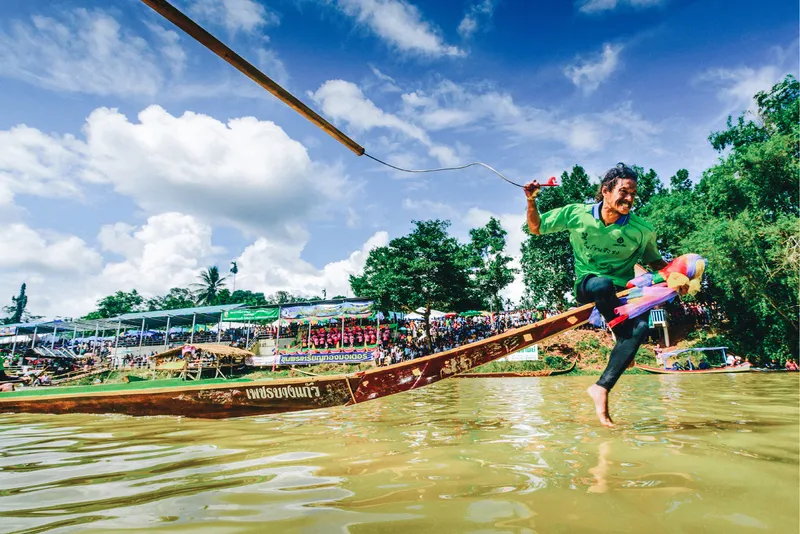
In addition to boat racing, one of the most entertaining activities is sea boxing, known in Thai as “muay talay.” This folk game is usually performed over water. Competitors sit or balance on a beam above the water and try to strike, dodge, and stay balanced. The winner is often the one who can keep balance while the opponent falls into the water. Sea boxing brings laughter, excitement, courage, agility, and humor to the festival. It is accessible to spectators of all ages and adds a playful character to the event.
Sea boxing is more than a comic activity. It also reflects how familiar the community is with water. Competitors must have balance, confidence, and quick movement. Falling into the water is part of the fun, not a serious failure. The purpose is participation, shared laughter, and community enjoyment. This makes sea boxing a perfect companion to boat racing, because both activities use water as the stage and both rely on courage, rhythm, and friendly competition.
The Sam Phuang Boat Racing Festival also shows the value of unity. From preparing the race course to organizing teams, setting up safety areas, selling food, and welcoming visitors, the work requires cooperation. The festival is not created by a single person. It is made by the whole community. This cooperative nature is one of the reasons the tradition remains meaningful. It gives residents a reason to work together and gives visitors a chance to see real local life rather than a staged performance.
The event also functions as a bridge between generations. Elders can explain how the canals were used in the past, why the village is called Sam Phuang, how boats were prepared, and how paddling techniques were passed down. Young people can learn by helping, watching, or taking part in the activities. Some may become paddlers. Others may document the festival through photos and videos, helping present local culture through modern media. In this way, the tradition is not frozen in the past but continues to adapt.
The festival also has economic value for the community. When people gather for the event, local food, snacks, drinks, agricultural products, and community goods can be sold. Sam Phuang is connected with agricultural life and local products such as processed fruit, dried bananas, and dried fish. The festival creates an opportunity for residents to earn income and introduce local products to visitors. This economic role is important because cultural festivals can help support small communities when they are organized with local participation.
For travelers, the Sam Phuang Boat Racing Festival offers a different view of Sukhothai. Many visitors know Sukhothai mainly through Sukhothai Historical Park and Si Satchanalai Historical Park. These are important and beautiful destinations, but they represent only one side of the province. In Khiri Mat and Sam Phuang, travelers can encounter rural life, canals, agriculture, folk activities, and community traditions. Visiting the boat racing festival helps reveal Sukhothai as a living province, not only an ancient capital.
The festival may include several forms of boat racing. Traditional long-boat racing emphasizes teamwork, strength, rhythm, and the beauty of large wooden boats. Smaller local boat races focus on agility and may allow broader community participation, including youth and families. Cultural boat racing combines the races with folk games such as sea boxing, local performances, and village activities. Prize-based races add excitement and motivation, while conservation-oriented races emphasize traditional boats, local dress, old paddling methods, and the transmission of community knowledge.
Among these forms, conservation-oriented racing is especially meaningful. It is not focused only on winning. It values the preservation of local skills, the storytelling of the community, the memory of canal life, and the pride of local identity. Demonstrating older paddling methods, using traditional-style boats, or explaining the meaning of the event helps younger people understand that boat racing is cultural heritage, not merely entertainment.
For spectators, watching boats race along the canal is an intimate and energetic experience. The sound of paddles striking water, the splash of the canal, the cheers from both banks, and the laughter from sea boxing create a lively atmosphere. Unlike a formal performance on a distant stage, this type of festival happens close to the audience. Visitors can feel the energy of the race, see the faces of the paddlers, hear local voices, and sense the pride of the community.
Travelers planning to attend should check the annual schedule with Sam Phuang Subdistrict Administrative Organization before making the trip, because dates may change according to the local event calendar, weather, water conditions, and administrative planning. The most convenient way to reach Sam Phuang is by private car or rental car from Sukhothai town or nearby districts. The visit can be combined with Ramkhamhaeng National Park, Wat Tham Phra Mae Ya, Ban Thung Luang pottery village, Sukhothai Historical Park, and other cultural or natural attractions in the province.
Getting There from Sukhothai town is easiest by driving toward Khiri Mat District and continuing to Sam Phuang Subdistrict. The area is suitable for a day trip, but travelers without a private vehicle should arrange hired transport or rent a car in Sukhothai, because public transport may not be available at all times around the event area. Those staying near Sukhothai Historical Park can also travel to Khiri Mat by road and combine the trip with other attractions in the district.
Visitors should prepare for a waterside community event. Comfortable shoes are recommended because the ground near canals may be uneven or wet. A hat or umbrella is useful for daytime activities. Families with children should be careful near the water and stand only in safe viewing areas. Visitors should not block the race route, enter the water without permission, or throw rubbish into the canal. Respecting the waterway is important because the canal is the heart of the tradition.
For foreign travelers, the Sam Phuang Boat Racing Festival is a valuable opportunity to understand Thai culture at the community level. It is not a large commercial show created only for tourism. It comes from the real relationship between people, water, agriculture, and local identity. Watching villagers race boats, cheer teams, prepare food, sell local products, and enjoy folk games allows visitors to see how Thai traditions remain alive in small communities.
The tradition deserves continued support because it carries many layers of value. As a sport, it develops strength, endurance, discipline, and teamwork. As culture, it preserves canal life, folk games, local stories, and community memory. As an economy, it supports local food vendors and producers. As education, it allows younger generations to learn from elders. As tourism, it introduces visitors to a side of Sukhothai that is warm, local, and deeply human.
In conclusion, the boat racing tradition of Sam Phuang in Sukhothai Province reflects the identity of northern Thai community life through water, sport, cooperation, and cultural continuity. The annual event, especially when connected with the New Year period, strengthens community unity, creates joy, supports local income, and keeps traditional knowledge alive. It is not only a local competition but also a cultural heritage of Sukhothai and Thailand, offering visitors a meaningful way to experience the living spirit of a waterside community.
| Name | Sam Phuang Traditional Boat Racing Festival, Sukhothai Province |
| Location | Sam Phuang Subdistrict, Khiri Mat District, Sukhothai Province |
| Local Authority Address | Sam Phuang Subdistrict Administrative Organization, Sam Phuang Subdistrict, Khiri Mat District, Sukhothai 64160, Thailand |
| Festival Period | Around the New Year period or according to the annual announcement of Sam Phuang Subdistrict Administrative Organization |
| Highlights | Boat racing on local canals, sea boxing, community gathering, folk games, and local waterside culture |
| History | Connected with the canal-based way of life of Sam Phuang, where waterways supported agriculture, fishing, travel, and later community traditions |
| Name Origin | The name Sam Phuang is linked to a local story in which villagers caught fish from the canal, strung them into bundles, and shared three bundles with each person |
| Distinctive Features | A community-based boat racing festival using a real local canal as the race course, with a close and lively village atmosphere |
| Main Activities | Traditional long-boat racing, small local boat racing, cultural boat racing, prize-based racing, conservation-oriented racing, and sea boxing |
| Boat Racing Formats | 1. Traditional Long-Boat Racing: large wooden boats with many paddlers and synchronized strokes 2. Small Local Boat Racing: smaller boats focusing on agility and family participation 3. Cultural Boat Racing: races combined with sea boxing, folk games, and local performances 4. Prize-Based Racing: competitive races with prizes to increase excitement 5. Conservation-Oriented Racing: traditional boats, local dress, old paddling methods, and community knowledge transmission |
| Travel Information | Best reached by private car or rental car from Sukhothai town toward Khiri Mat District and then to Sam Phuang Subdistrict; hired transport is recommended for visitors without private vehicles |
| Current Status | A local community tradition organized according to the annual event schedule of Sam Phuang Subdistrict |
| Caretaker / Related Authority | Sam Phuang Subdistrict Administrative Organization and local communities in Sam Phuang, Khiri Mat District, Sukhothai Province |
| Main Contact Number | Sam Phuang Subdistrict Administrative Organization, Tel. 055-945582 |
| Nearby Tourist Attractions | 1. Wat Tham Phra Mae Ya, about 12 km 2. Ramkhamhaeng National Park, about 18 km 3. Ban Thung Luang Pottery Village, about 18 km 4. Sukhothai Historical Park, about 28 km 5. Ramkhamhaeng National Museum, about 28 km 6. Wat Si Chum, about 30 km |
| Nearby Restaurants | 1. Local Food Shops in Sam Phuang, about 1 km 2. Restaurants in Khiri Mat Town, about 10 km 3. Chanda's Historical Garden Restaurant, about 28 km, Tel. 092-993-3408 4. Sureerat Restaurant, about 28 km, Tel. 055-633-323 5. Cafe Thammada, about 29 km, Tel. 084-931-9299 |
| Nearby Accommodations | 1. Whan Whan Resort Khiri Mat, about 10 km, Tel. 081-533-9255 2. Boonma Resort, about 18 km, Tel. 095-467-2373 3. Thai Thai Sukhothai Resort, about 29 km, Tel. 084-932-1006 4. Sukhothai Garden, about 29 km 5. Sriwilai Sukhothai Resort & Spa, about 30 km |
Frequently Asked Questions (FAQ)
Q: Where is the Sam Phuang Boat Racing Festival held?
A: It is held in Sam Phuang Subdistrict, Khiri Mat District, Sukhothai Province, using local canals as the race course according to the annual community schedule.
Q: When does the festival take place?
A: It is generally associated with the New Year period or the annual event schedule of the subdistrict. Visitors should check the latest announcement from Sam Phuang Subdistrict Administrative Organization before traveling.
Q: Why is this tradition important?
A: It reflects the canal-based way of life of Sam Phuang, community unity, teamwork, and the transmission of local culture from older generations to younger people.
Q: What activities are included in the festival?
A: Activities include boat racing on the canal, sea boxing, folk games, cheering by local residents, food stalls, and the sale of local products.
Q: What is sea boxing?
A: Sea boxing is a folk game in which competitors balance on a beam or platform above water and try to make the opponent fall into the water, creating excitement and laughter for spectators.
Q: How should visitors prepare for the event?
A: Visitors should check the date in advance, wear comfortable shoes, be careful near the canal, watch children closely, and avoid throwing rubbish into the water.
Q: What nearby attractions can be combined with the trip?
A: Visitors can combine the festival with Wat Tham Phra Mae Ya, Ramkhamhaeng National Park, Ban Thung Luang Pottery Village, Sukhothai Historical Park, Ramkhamhaeng National Museum, and Wat Si Chum.
 Category: ●Art, Culture and Heritage
 Group: ●Art, Craft Centres, Tradition
Last Update : 3 MonthAgo
 Last Update : 3 MonthAgo
Recommend

 Historical Sites and Monuments(4)
 Landmarks and Memorials(5)
Art, Craft Centres, Tradition(11)
Landmarks and Memorials(5)
Art, Craft Centres, Tradition(11)
 Museums(5)
 Places of Worship
 Temple(40)
 Other Sacred Sites(10)
 Suburban Living
 Village, Community(3)
 Nature and Wildlife
 National Parks and Marine Reserves(3)
 Mountain (Doi)(2)
 Dam, Reservoir, Lake(4)
 Waterfalls(8)
 Caves(4)
 River, Canal(2)
 Entertainment and Agricultural
 Farms, Parks and Ecotourism(3)


