
lovethailand home >North Travel Attractions >Sukhothai Travel Attractions >Muang Sukhothai >Muang Kao > Saritphong Dam
TL;DR: Saritphong Dam is located at Mueang Kao Subdistrict, Mueang Sukhothai District, Sukhothai Province, Thailand, open Daily, hours Open All Day.
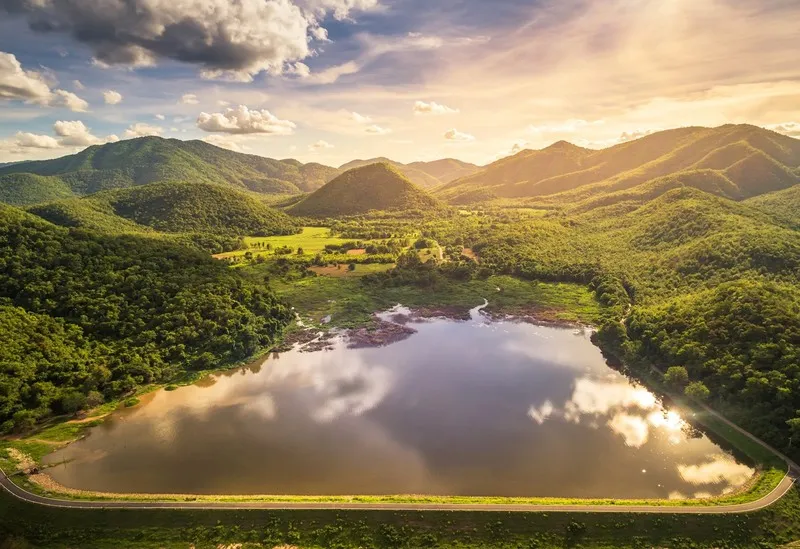
Saritphong Dam
Open Days: Daily
Opening Hours: Open All Day
Saritphong Dam, also known as Phra Ruang Dam, in Sukhothai Province is one of the most important ancient water-management landmarks of historic Sukhothai. Located southwest of the old city walls, between Kio Ai Ma Hill and Phra Bat Yai Hill, this ancient earthen dam reflects the intelligence, engineering skill, and environmental understanding of the people of Sukhothai. It is not only a scenic reservoir surrounded by hills, but also a valuable historical site that helps explain how water supported the prosperity of the ancient capital.
Saritphong Dam is best understood as part of the wider water system of Sukhothai Historical Park. While most travelers know Sukhothai for its temples, Buddha images, stupas, and ancient ruins, the city’s success also depended on water. The people of Sukhothai had to collect rainwater, manage seasonal runoff, store water for dry months, and move water into the city for daily use and agriculture. Saritphong Dam was one of the key structures that made this possible.
The site is located in a natural valley where water from the surrounding hills flows down through several channels. The Fine Arts Department describes Saritphong as a large earthen dam built between Kio Ai Ma Hill and Phra Bat Yai Hill, receiving water from 17 mountain gullies. This location was chosen with deep knowledge of the landscape. Instead of forcing nature to change completely, the ancient builders used the natural hills, slope, and water flow to create a practical and sustainable water-retention system.
The name Saritphong is closely associated with the ancient irrigation system of Sukhothai, while the name Phra Ruang Dam connects the place with local memory and the legendary image of Phra Ruang. For local people and Thai visitors, the name carries both historical and cultural meaning. It refers not only to a dam but also to the wisdom of an ancient society that understood the importance of water as the foundation of community life, food production, and urban stability.
The dam functioned by holding water from the hills and directing it toward the old city. Water from Saritphong was traditionally channeled through the Sao Ho Canal into the southwest corner of Sukhothai. From there, the water was connected with the city’s internal water system, including ponds and reservoirs such as Traphang Ngoen and Traphang Thong. This network shows that ancient Sukhothai was not a randomly developed settlement. It was a carefully planned city where water, religion, agriculture, and urban life were closely connected.
From an engineering perspective, Saritphong Dam is impressive because it demonstrates practical knowledge without relying on modern machinery. The builders understood how to place an earthen structure at the right point between hills, how to use the natural catchment area, and how to allow water to move by gravity. The dam is therefore a clear example of ancient civil engineering based on observation, local experience, and environmental adaptation.
The current structure has been improved by the Royal Irrigation Department together with the Fine Arts Department. The dam is now stronger than the ancient form and is used for water storage while still retaining its historical meaning. According to official information, the dam is about 10 meters high and about 400 meters long, with a storage capacity of around 400,000 cubic meters. This combination of conservation and practical use makes the site a living heritage landscape rather than a frozen ruin.
The surrounding scenery is one of the reasons travelers enjoy visiting Saritphong Dam. The reservoir lies among hills and greenery, creating a quiet atmosphere away from the busier central area of Sukhothai Historical Park. The water surface, mountain backdrop, and natural vegetation make it a pleasant place for photography, reflection, and slow travel. During periods when the water level is suitable, the reservoir reflects the sky and hills beautifully, especially in the early morning and late afternoon.
Unlike the main temples inside the historical park, Saritphong Dam offers a different kind of experience. There are no towering stupas or grand Buddha images here. Instead, visitors encounter a landscape that reveals the hidden infrastructure behind the ancient city. Standing beside the reservoir and looking toward the hills, it becomes easier to understand why this location was selected and how water from the mountains could be collected and directed into the city.
For students, researchers, and cultural travelers, Saritphong Dam is a useful outdoor classroom. It connects geography, history, hydrology, engineering, archaeology, and environmental studies in one place. A visit here can be paired with a trip to Sukhothai Historical Park, Wat Mahathat, Wat Sa Si, Wat Si Chum, Ramkhamhaeng National Museum, and other important sites in the old city. Together, these places show that Sukhothai’s heritage is not only artistic and religious, but also technological and ecological.
The dam also deepens the meaning of the famous image of Sukhothai as a fertile city. The prosperity of the ancient capital was not accidental. It came from planning, landscape knowledge, and water management. Saritphong Dam helps modern visitors see the practical systems that supported rice cultivation, settlement, and daily life. In this way, the site adds an important layer to the story of Sukhothai.
Saritphong Dam is suitable for travelers who prefer quiet places, natural scenery, and meaningful historical interpretation. It is a good stop for those who have already visited the main ruins and want to understand how the ancient city worked as a complete living system. The visit does not require a long time, but it can leave a strong impression because the place connects a simple landscape with a deep historical function.
Getting There is convenient by private car, rental car, motorcycle, or local transport from the old city area. From Sukhothai Historical Park, travel southwest toward the foothills outside the ancient city walls. Visitors should search for the official names “Saritphong Dam” or “Phra Ruang Dam,” because the Thai spelling and local names may vary. The site is especially suitable to include in a route with the western and central zones of the historical park.
Visitors should take basic precautions when walking near the reservoir and earthen dam. The area is a historical water-management site and a natural landscape, so travelers should avoid climbing on fragile or restricted areas, should not leave waste behind, and should help preserve the calm environment. Responsible travel is important because the value of Saritphong Dam lies not only in its scenery but also in its role as a heritage site.
The best time to visit is early morning or late afternoon. Morning offers cool air and soft light, while late afternoon provides warmer colors for landscape photography. Travelers interested in photography should allow enough time to walk slowly and observe the reflection of water, hills, and sky. The place is also suitable for visitors who want a peaceful pause after exploring the temple ruins of Sukhothai.
In a broader sense, Saritphong Dam shows that ancient Sukhothai was a city built with an understanding of natural systems. Its people used hills, water flow, canals, ponds, and earthen embankments to create a balanced system for survival and prosperity. This wisdom remains relevant today, especially in an age when sustainable water management is a major concern around the world. For foreign travelers, Saritphong Dam offers a clear example of how Thai heritage includes not only architecture and religion, but also environmental intelligence.
A visit to Saritphong Dam completes the Sukhothai experience. After seeing the temples, Buddha images, and ancient city layout, this reservoir helps visitors understand the source of life behind the old capital. It is a quiet but powerful place where nature, history, engineering, and local wisdom meet. For anyone interested in cultural travel, ancient technology, or the relationship between people and water, Saritphong Dam is one of the most meaningful stops in Sukhothai Province.
| Name | Saritphong Dam / Phra Ruang Dam |
| Location | Mueang Kao Subdistrict, Mueang Sukhothai District, Sukhothai Province, Thailand |
| Coordinates | Approximately 17.0025, 99.6725 |
| Highlights | Ancient earthen dam, historic water-management system, mountain reservoir scenery, and evidence of Sukhothai’s ancient irrigation knowledge |
| History | Part of the ancient Sukhothai water system and associated with Saritphong mentioned in the context of the King Ramkhamhaeng Inscription; later improved by the Royal Irrigation Department and the Fine Arts Department |
| Name Origin | “Saritphong” refers to the ancient dam of Sukhothai, while “Phra Ruang Dam” reflects local memory connected with Phra Ruang traditions |
| Distinctive Features | Earthen dam between Kio Ai Ma Hill and Phra Bat Yai Hill, receiving water from 17 mountain gullies; about 10 meters high, 400 meters long, and able to store about 400,000 cubic meters of water |
| Travel Information | Accessible from Sukhothai Historical Park by private car, rental car, motorcycle, or local transport; search for “Saritphong Dam” or “Phra Ruang Dam” for accurate navigation |
| Current Status | Open as a historical water-management site, scenic reservoir, and cultural learning destination near Sukhothai Historical Park |
| Open Days | Daily |
| Opening Hours | Open All Day |
| Fees | No Admission Fee |
| Facilities | Viewpoint area, roadside parking in suitable areas, and natural walking areas around the reservoir |
| Main Areas / Zones | 1. Ancient earthen dam 2. Mountain reservoir 3. Water catchment area from the hill gullies 4. Reservoir and hill viewpoint 5. Area connected with the ancient Sukhothai water system |
| Caretaker / Related Authority | Sukhothai Historical Park, Fine Arts Department, and the Royal Irrigation Department for related water-system improvements |
| Nearby Tourist Attractions | 1. Wat Si Chum, about 4 km 2. Sukhothai Historical Park, about 5 km 3. Wat Mahathat Sukhothai, about 5 km 4. Ramkhamhaeng National Museum, about 5 km 5. Wat Sa Si, about 5 km |
| Nearby Restaurants | 1. Thai Ta Pui Noodles, about 6 km, Tel. 084-6868928 2. Mai Klang Krung Sukhothai Noodles, about 13 km, Tel. 081-9714406 3. Jae Hae Sukhothai Noodles, about 12 km, Tel. 055-611901 4. Maeboonmee Cafe & Bistro, about 6 km 5. Chanda’s Historical Garden Restaurant, about 6 km |
| Nearby Accommodations | 1. Sukhothai Garden, about 5 km 2. Thai Thai Sukhothai Resort, about 6 km 3. Tharaburi Resort, about 6 km 4. Le Charme Sukhothai Resort, about 6 km 5. Sukhothai Treasure Resort & Spa, about 11 km, Tel. 055-611555 |
Frequently Asked Questions (FAQ)
Q: Where is Saritphong Dam located?
A: Saritphong Dam is located in Mueang Kao Subdistrict, Mueang Sukhothai District, Sukhothai Province, southwest of the ancient city walls.
Q: Why is Saritphong Dam important to ancient Sukhothai?
A: It was a major earthen dam and water-retention structure that collected water from the hills and directed it into the ancient city for daily use and agriculture.
Q: Are Saritphong Dam and Phra Ruang Dam the same place?
A: Yes. Saritphong Dam is also commonly known as Phra Ruang Dam, an ancient dam connected with the irrigation system of historic Sukhothai.
Q: Is there an admission fee for Saritphong Dam?
A: No. Visitors can enter the area without an admission fee.
Q: What is the best time to visit Saritphong Dam?
A: Early morning and late afternoon are the best times because the weather is cooler and the light is better for photographing the reservoir and hills.
Q: Who should visit Saritphong Dam?
A: It is suitable for travelers interested in Sukhothai history, ancient irrigation, natural scenery, photography, and quiet cultural travel.
Q: How can travelers get to Saritphong Dam?
A: Travelers can go from Sukhothai Historical Park toward the southwest by private car, rental car, motorcycle, or local transport. Use the names “Saritphong Dam” or “Phra Ruang Dam” for navigation.
Q: How long should visitors spend at Saritphong Dam?
A: Most visitors spend about 30 minutes to 1 hour viewing the reservoir, taking photos, and learning about the ancient water system. More time is recommended for a quiet visit or sunset photography.
 Category: ●Nature and Wildlife
 Group: ●Dam, Reservoir, Lake
Last Update : 5 MonthAgo
 Last Update : 5 MonthAgo
 Click to Access the Navigation Map GPS
 Art, Culture and Heritage
 Historical Sites and Monuments(4)
 Landmarks and Memorials(5)
 Art, Craft Centres, Tradition(11)
 Museums(5)
 Places of Worship
 Temple(40)
 Other Sacred Sites(10)
 Suburban Living
 Village, Community(3)
 National Parks and Marine Reserves(3)
 Mountain (Doi)(2)
Dam, Reservoir, Lake(4)
Mountain (Doi)(2)
Dam, Reservoir, Lake(4)
 Waterfalls(8)
 Caves(4)
 River, Canal(2)
 Entertainment and Agricultural
 Farms, Parks and Ecotourism(3)
 Travel Articles, Recipes
 Travel Review, Food Review(1)


