
lovethailand home >Central Travel Attractions >Nonthaburi Travel Attractions >Muang Nonthaburi >Bang Khen > Dhurakij Pundit University (DPU)
TL;DR: Dhurakij Pundit University (DPU) is located at 110/1-4 Prachachuen Road, Thung Song Hong, Lak Si, Bangkok 10210, Thailand, open Monday – Friday (Administrative Office Services), hours 08:30 – 16:30.
Dhurakij Pundit University (DPU)
Open Days: Monday – Friday (Administrative Office Services)
Opening Hours: 08:30 – 16:30
Dhurakij Pundit University (DPU), known in Thai as มหาวิทยาลัยธุรกิจบัณฑิตย์, is a private university in Bangkok, Thailand, with a history dating back to May 30, 1968. Founded by Dr. Sawai Suthipitak and Ajarn Sanan Ketudat, the institution was established with the conviction that education should contribute to society and national development. It began as a business-oriented educational institution on Rama VI Road, became a college in 1970, and was granted university status in 1984. Today, DPU is located at 110/1-4 Prachachuen Road, Thung Song Hong, Lak Si, Bangkok 10210, close to the provincial boundary with Nonthaburi. Its academic programs cover business administration, accounting, communication arts, engineering, digital technology, law, tourism, aviation, languages, design, and health sciences. The university is particularly associated with career-oriented education, practical learning, and the development of skills relevant to contemporary business and society.
Although Dhurakij Pundit University is officially situated in Bangkok, its location near Ngamwongwan Road and the Pong Phet intersection places it close to several established communities in Nonthaburi Province. Students and visitors frequently travel between the university and nearby areas of Mueang Nonthaburi for accommodation, restaurants, shopping, and daily services. The surrounding urban area includes Thung Song Hong in Bangkok and neighboring communities in Bang Khen and Tha Sai, Nonthaburi. This geographic relationship explains why DPU is sometimes associated with Nonthaburi, even though its registered address and main campus are in Bangkok.
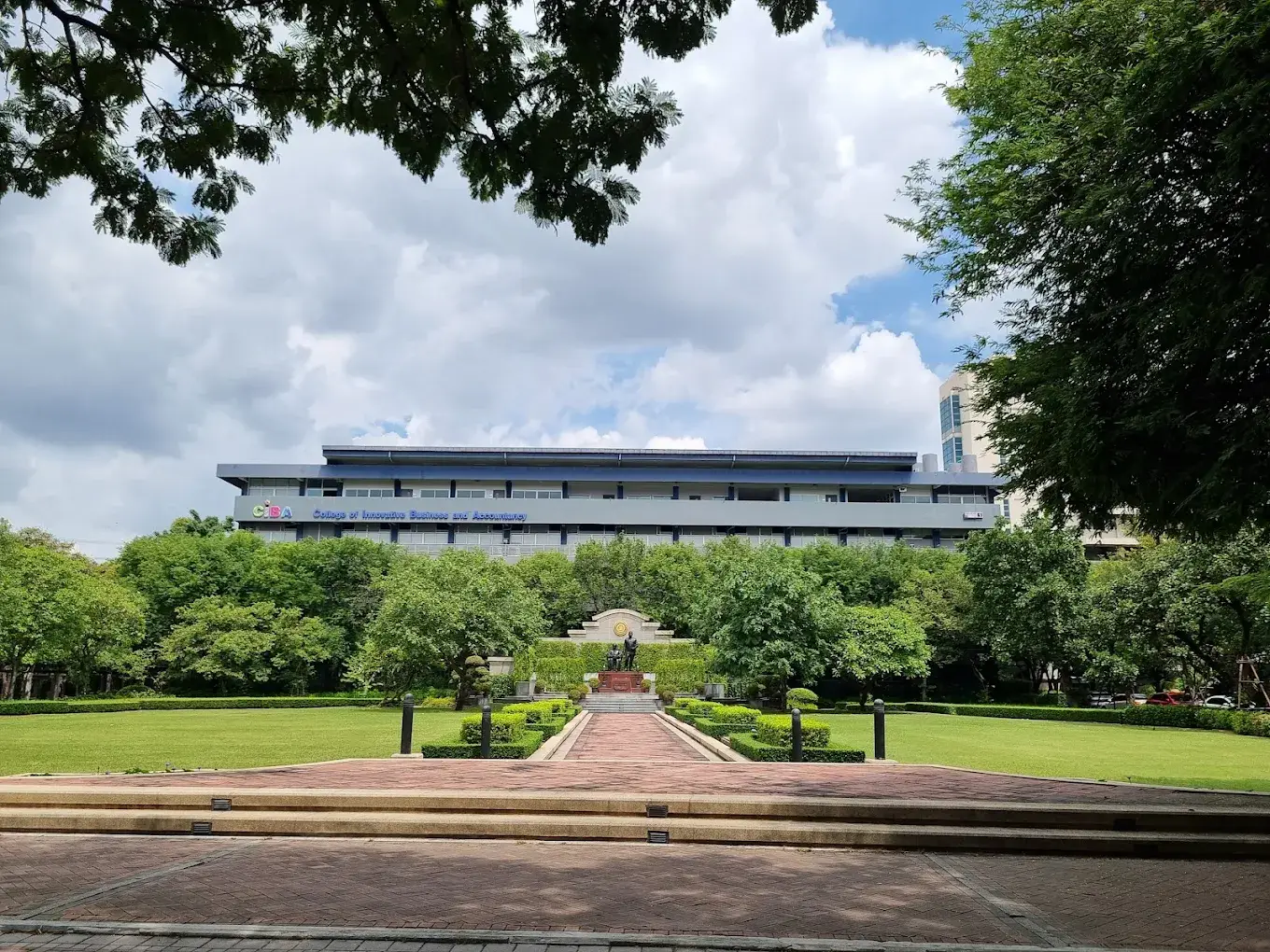
The university campus is a substantial educational environment within a densely developed part of the Bangkok Metropolitan Region. Its grounds include academic buildings, administrative offices, laboratories, study areas, green spaces, sports facilities, and locations for student activities. Landscaped areas and mature trees provide a sense of openness that contrasts with the busy streets outside. The campus layout reflects the idea that higher education should provide not only classrooms but also spaces where students can collaborate, conduct research, develop practical projects, and participate in university life.
The origins of Dhurakij Pundit University are closely connected with Thailand's economic and educational development during the second half of the twentieth century. As the country expanded its commercial, industrial, financial, and service activities, employers increasingly required personnel trained in accounting, finance, management, marketing, and office administration. At the same time, access to higher education remained limited for many prospective students. Private educational institutions began to play an increasingly important role in widening educational opportunities and preparing graduates for a modernizing economy.
DPU was founded by Dr. Sawai Suthipitak and Ajarn Sanan Ketudat, who shared a commitment to using education for the benefit of society and Thailand. Their educational vision emphasized more than the transmission of technical knowledge. They sought to cultivate people capable of contributing to the economy through professional competence, honesty, responsibility, and ethical conduct. This philosophy reflected the belief that successful business activity should be accompanied by integrity and consideration for the wider community.
On May 30, 1968, the institution that would become Dhurakij Pundit University began its educational activities on Rama VI Road in Bangkok. Business administration was the original academic foundation, with subjects connected to commerce, accounting, finance, banking, marketing, and office practices. These fields responded directly to the workforce requirements of Thailand's developing commercial economy. The university's early specialization also explains the meaning and enduring importance of its name.
The Thai name Dhurakij Pundit conveys the idea of knowledge and expertise in business. Beyond professional commercial skills, it suggests the qualities of an educated individual who can apply knowledge wisely and responsibly. This understanding became a defining element of the institution's identity, connecting professional success with intellectual development and ethical behavior.
In 1970, the institution was developed into Dhurakij Pundit College under the regulatory framework governing private higher education in Thailand. The change in status allowed for the expansion of academic programs and the development of degree-level education. Important fields during this period included business administration, accountancy, economics, and law. The combination of these subjects gave students an understanding of commercial organizations, financial systems, economic decision-making, and legal responsibilities.
Accounting education supported the development of businesses requiring reliable financial information and reporting. Economics provided tools for understanding markets, resources, and public policy, while law helped students understand the rules governing business and society. Together, these academic areas gave the college a stronger foundation for the training of professional personnel and its subsequent expansion into a multidisciplinary university.
A major milestone occurred on October 24, 1984, when Dhurakij Pundit College was granted university status and became Dhurakij Pundit University. This transformation reflected the development of the institution's academic capabilities and administrative structures. During the years that followed, DPU broadened its educational activities, expanded its faculties, and strengthened graduate-level education and academic services.
As the university grew, its original premises on Rama VI Road became increasingly limited for expanding teaching and student activities. DPU therefore developed a larger educational site along Prachachuen Road near the water-supply canal. The university's historical account identifies 1989 as an important year in the expansion of its present campus, which provided space for academic buildings, laboratories, a library, administrative offices, and student facilities. This change gave DPU the opportunity to create a more comprehensive university environment.
The development of the Prachachuen campus was significant for more than its physical size. It enabled academic facilities to be organized around different forms of learning, including lectures, laboratory practice, research, group projects, and student development activities. Over time, the campus grew into a learning community where students could spend much of their academic and social lives within a single environment.
In 2004, DPU established an International College to support internationally oriented education and the development of graduates prepared for cross-border professional environments. The establishment of a Chinese International College in 2010 further reflected the importance of cooperation between Thailand and China in education and business. These developments expanded the university's international outlook and reinforced the importance of language, cultural understanding, and international business knowledge.
In 2008, Dhurakij Pundit University received recognition for excellence in internal higher education quality assurance from Thailand's Office of the Higher Education Commission. The university's historical records identify the award as an important milestone in the development of its academic management and quality assurance systems. Such recognition contributed to the institution's ongoing efforts to maintain educational standards and public confidence.
Dr. Darika Lathapipat became rector in 2016 and has emphasized educational development focused on students' future capabilities. Her leadership has been associated with initiatives encouraging practical learning, entrepreneurship, digital literacy, and professional readiness. In 2026, DPU continued to promote educational approaches that connect students' potential with the needs of emerging industries and a rapidly changing employment landscape.
Although DPU is historically known for business and professional education, its modern academic portfolio extends far beyond its original fields. The university now offers programs connected to engineering, computer science, digital media, filmmaking, game development, aviation, hospitality, traditional Thai medicine, nursing, medical technology, physical therapy, sports science, and other professional disciplines. This diversification illustrates its adaptation to new economic sectors and changing expectations of higher education.
The university's official emblem is associated with Phra Sitthathirat, a representation of the Hindu deity Ganesha, traditionally connected with wisdom, learning, and the removal of obstacles. The emblem includes a seated figure, a surrounding arrangement of 32 lotus petals, and nine precious gems. The lotus imagery symbolizes virtue and growth, while the nine gems represent qualities expected of educated graduates, including knowledge, perseverance, integrity, responsibility, and the effective application of learning.
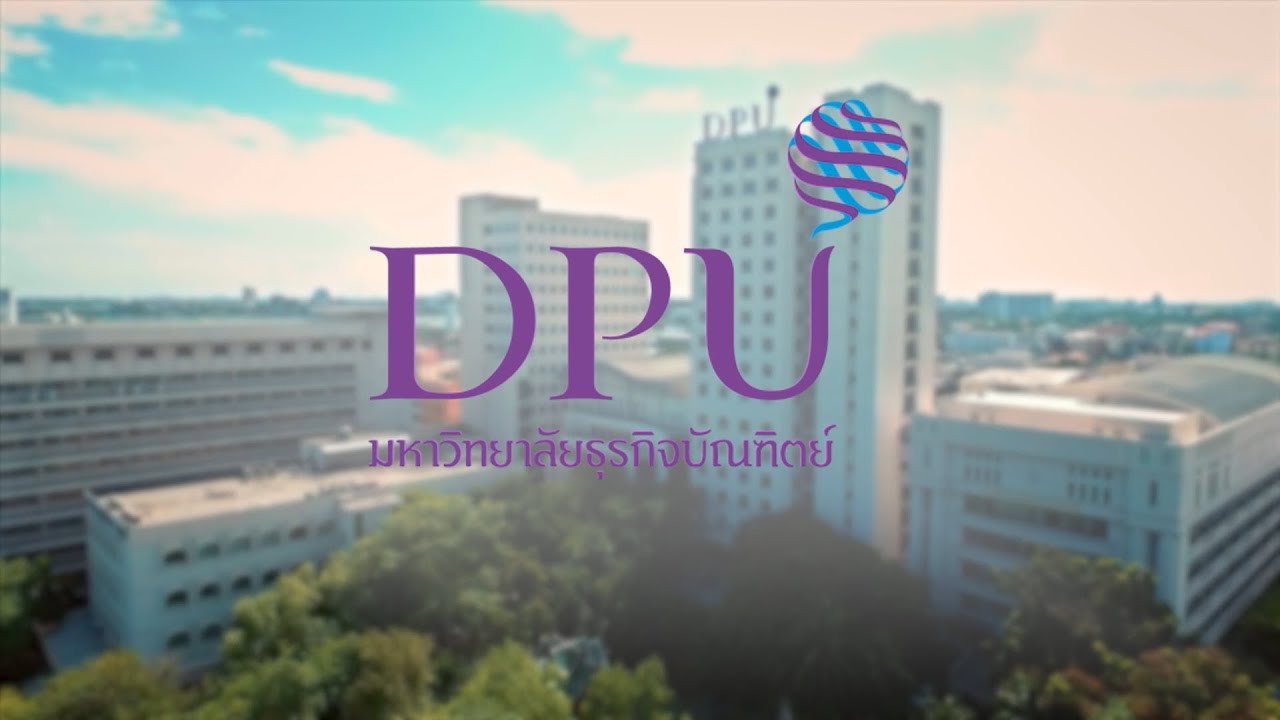
The traditional university colors are purple and light blue. Purple represents industry and the production of goods, while light blue represents commerce and trade. Together, the colors express the university's historical connection with business activities involving both production and exchange. These colors appear in institutional symbols and help preserve a visual link with DPU's origins as a business education institution.
Bamboo is the university's symbolic plant. Its flexibility, endurance, and tendency to grow in closely connected clusters make it an appropriate representation of perseverance and unity. The symbolism emphasizes the importance of individual effort together with cooperation, loyalty, and mutual support. In an educational context, bamboo reflects the belief that professional capability must be supported by personal discipline and the ability to work effectively with others.
One of the most important historical attractions within DPU is the Dr. Sawai Suthipitak Historical Hall and Museum. Established in 2003, the museum was created to honor one of the university's founders and preserve the institution's history. Its exhibitions are arranged across 14 rooms and cover two major themes: the life and experiences of Dr. Sawai Suthipitak, and the establishment and development of the educational institution he founded with Ajarn Sanan Ketudat.
The museum provides an opportunity to understand the relationship between an individual's educational vision and broader developments in Thai society. The displays introduce visitors to the founder's personal history, his commitment to public service, and his efforts to establish a private institution of higher learning. The story of DPU's development also reveals the challenges involved in building academic facilities, organizing programs, and developing an institution trusted by students and the wider public.
The DPU Learning Center and Library is another important academic facility. Its origins date to a small library established with the original institution in 1968. As the university expanded, its library services developed into a wider system of academic resources, including printed collections, electronic information, independent study facilities, and services supporting academic research. This history mirrors the wider transformation of higher education from reliance on physical books to the integration of digital information resources.
Modern learning facilities include DPU Makerspace and the ANT DPU Computer Lab. These spaces support students studying computer technology, creative design, game development, and related subjects. They allow learners to explore software and equipment, work collaboratively, test ideas, and develop tangible projects. Such environments are important for education that emphasizes experimentation, applied technology, and the ability to transform concepts into practical outcomes.
Health science laboratories support the work of academic units involved in nursing, medical technology, physical therapy, and other health-related fields. Professional education in these disciplines requires both theoretical understanding and carefully supervised practical training. Laboratory environments provide opportunities to develop familiarity with scientific instruments, analytical procedures, professional standards, and appropriate safety practices.
Communication arts is one of DPU's important contemporary fields of study. Its programs address digital content creation, filmmaking, digital performance, entertainment events, and brand communication. Students learn about storytelling, media production, audience analysis, and the development of content for digital platforms. These subjects reflect major changes in the advertising, communication, and entertainment industries, where creative and technological capabilities increasingly overlap.
The Faculty of Fine and Applied Arts and the College of Creative Design and Entertainment Technology contribute to the university's creative education portfolio. Their fields involve fashion, graphic design, illustration, interior environments, digital art, interactive design, and game development. Learning in these areas combines artistic foundations with digital production methods, user experience, and professional presentation. The result is a range of pathways connected to Thailand's growing creative and digital industries.
Engineering and technology programs further extend DPU's role beyond its business origins. These include computer engineering, logistics engineering, modern automotive engineering, and information technology and artificial intelligence. The subjects are directly relevant to digital transformation, intelligent systems, supply-chain operations, modern transportation, and technology-based services. Students in these fields develop technical knowledge that can complement business skills and support the creation or improvement of contemporary products and processes.
Aviation business education is another specialized area offered by the university. Programs relating to aviation business, aviation technology management, and aviation operations introduce students to the requirements of a highly regulated international industry. The educational pathways may involve management, operational processes, customer services, and professional aviation knowledge. Programs connected with pilot training have additional requirements involving qualifications, practical training, and professional licensing.
The Faculty of Tourism and Hospitality addresses the needs of Thailand's tourism and service sectors. Programs include hospitality and food business, tourism and event business, and culinary arts. These disciplines require a combination of managerial understanding, communication skills, customer service, and practical experience. Students may learn about hotel operations, visitor experience, food preparation, event planning, and the organization of hospitality services.
DPU Place, an accommodation and hospitality facility located within the university campus, has been associated with practical training in hospitality management. The facility provides an environment where students can understand aspects of hotel operations, accommodation services, and the organization of meetings and other activities. Practical training of this kind helps connect academic study with the day-to-day responsibilities found in the hospitality industry.
The expansion of DPU's health-related education reflects wider changes in the needs of Thai society. The university has developed academic offerings involving nursing, medical technology, physical therapy, traditional Thai medicine, sports science, cosmetic science, and related fields. Each discipline has its own educational content and professional requirements. Their presence demonstrates how the university's educational mission has grown from its early commercial focus to include healthcare services and quality of life.
The Faculty of Liberal Arts provides programs in languages used in professional and international business environments. English, Chinese, Japanese, and Korean are relevant to international trade, tourism, communication, and service industries. Language education involves not only grammar and vocabulary but also intercultural competence, business communication, and the ability to work with people from different backgrounds. Meanwhile, the Pridi Banomyong Faculty of Law and the Faculty of Public Administration support education in legal reasoning, governance, public policy, and organizational administration.
DPU International College offers English-medium study opportunities in areas such as international business, tourism management, information systems, aviation business, and digital media. International education allows students to strengthen language skills, develop a broader understanding of business practices, and experience multicultural learning environments. Interaction among students from different countries also contributes to communication skills and the ability to work across cultural boundaries.
In the 2026 academic environment, the university's educational priorities are closely connected with digital technology, media creation, data analysis, and artificial intelligence. These fields increasingly influence the way organizations operate, communicate, and compete. DPU's approach to developing student capabilities therefore involves opportunities for practical projects, technological learning, and collaboration with professional sectors. Such experiences help students understand how classroom knowledge can be applied to actual workplace challenges.
Academic events contribute to the university's learning environment through seminars, workshops, exhibitions, professional competitions, and collaborative activities. They provide opportunities for students, lecturers, researchers, and external specialists to exchange knowledge and explore contemporary issues. This interaction is important for a university whose teaching philosophy emphasizes professional relevance and the practical application of academic knowledge.
Traditional Thai culture also has an important place in university life. One example is the wai khru, or teacher-honoring ceremony, which expresses gratitude and respect toward educators. On September 19, 2026, DPU's College of Integrative Medicine and Faculty of Sports and Exercise Science organized a wai khru ceremony in the Pridi Banomyong Meeting Room, together with student activities encouraging creativity and personal development. The event demonstrated how an established Thai educational tradition can remain meaningful within a modern university.
The significance of wai khru extends beyond formal ceremonial practices. It encourages students to reflect on the responsibilities associated with acquiring and applying knowledge. For students in healthcare and other professions serving the public, these values are particularly relevant. The ceremony also strengthens relationships among students, lecturers, and different academic generations, contributing to a sense of shared educational purpose.
Other aspects of university culture include graduation ceremonies, new-student orientation, volunteer activities, professional skill competitions, and alumni engagement. These experiences help students develop teamwork, leadership, communication, and time-management abilities. They also strengthen relationships between the university and its graduates, creating networks that can continue beyond the completion of formal study.
DPU's relationship with surrounding communities is important in both economic and social terms. The presence of students, university personnel, and visitors supports restaurants, shops, accommodation providers, and local services in the Prachachuen and Ngamwongwan areas. At the same time, university expertise can contribute to the development of professional skills, community projects, and collaboration with businesses. The relationship illustrates how a university forms part of the urban economy rather than operating separately from it.
For visitors interested in educational heritage, Dhurakij Pundit University offers a useful perspective on the history of private higher education in Thailand. The Dr. Sawai Suthipitak Historical Hall and Museum is particularly valuable for understanding the institution's origins and the development of its educational mission. University open-house activities, student exhibitions, and public academic events may also provide opportunities to observe contemporary teaching and creative work across different disciplines.
However, DPU is an operating university rather than an unrestricted tourist attraction. Access to classrooms, engineering laboratories, health science facilities, and specialized teaching spaces is subject to university regulations. Visitors wishing to undertake educational tours should contact the relevant department in advance. Those interested in the historical museum should confirm the visiting arrangements and service hours with the Learning Center and Library.
Getting There is possible by private car, public bus, urban rail services, and taxis. Dhurakij Pundit University is located on Prachachuen Road, Thung Song Hong, Lak Si, Bangkok. Drivers from central Bangkok may approach the area through Ngamwongwan Road or Vibhavadi Rangsit Road before connecting to Prachachuen Road. Travelers from Nonthaburi can use Ngamwongwan Road and the Pong Phet intersection to reach the same area.
The university identifies several relevant public bus services, including routes 24, 66, 70, and 2-32. Passengers using the BTS Green Line can travel to Sena Nikhom Station and continue by bus 24. Those using the MRT Pink Line can alight at Chaeng Watthana 14 Station and connect with bus 66. The SRT Red Line provides another option, with Thung Song Hong Station serving as a connection point for local transport to the university.
Travelers arriving from Nonthaburi may also use the MRT Purple Line to Nonthaburi Civic Center Station, continue by bus toward The Mall Ngamwongwan, and transfer to the local transport services recommended by DPU. While this journey may involve more than one connection, it offers an alternative to driving. The university also publishes information about designated shuttle pickup points and schedules, which should be checked before travel because operating arrangements may change.
The campus has parking facilities for students and visitors, subject to university regulations. Those attending admissions appointments, academic examinations, or large events should allow sufficient travel time, particularly during busy periods on Prachachuen and Ngamwongwan Roads. These roads connect important Bangkok and Nonthaburi communities and can experience heavy traffic at peak hours.
The university's location also provides access to a variety of cultural and leisure destinations. Places of interest in the wider surrounding area include the Museum of Contemporary Art Bangkok, Wat Samian Nari, Baan Bang Khen, and shopping centers along Ngamwongwan Road. Visitors interested in DPU's educational history may find it worthwhile to begin with the university's own historical museum before exploring the wider neighborhood.
Dhurakij Pundit University is therefore more than a university specializing in business education. Its history illustrates the development of Thailand's private higher education system over nearly six decades, beginning with a small business-oriented institution on Rama VI Road and progressing through college status, university recognition, campus expansion, and contemporary multidisciplinary education. By retaining its founders' emphasis on social contribution while developing new programs and learning environments, DPU continues to reflect the changing relationship between higher education, professional skills, and Thailand's economic future.
| University Name | Dhurakij Pundit University (DPU) |
| Thai Name | มหาวิทยาลัยธุรกิจบัณฑิตย์ |
| Institution Type | Private University |
| Address | 110/1-4 Prachachuen Road, Thung Song Hong, Lak Si, Bangkok 10210, Thailand |
| Nearby Area | Lak Si District, Bangkok, Close to Mueang Nonthaburi District, Nonthaburi Province |
| Foundation Date | May 30, 1968 |
| College Status | 1970 |
| University Status Granted | October 24, 1984 |
| Institutional Age | 58 Years as of 2026 |
| Founders | Dr. Sawai Suthipitak and Ajarn Sanan Ketudat |
| Rector in 2026 | Dr. Darika Lathapipat |
| Meaning of the Name | Knowledge and Expertise in Business |
| University Colors | Purple and Light Blue |
| Symbolic Plant | Bamboo |
| University Emblem | Phra Sitthathirat, 32 Lotus Petals, and Nine Precious Gems |
| Academic Strengths | Business Administration, Accounting, Communication Arts, Engineering, Digital Technology, Aviation, Tourism, Law, Languages, Creative Design, and Health Sciences |
| Important Campus Facilities | Dr. Sawai Suthipitak Historical Hall and Museum, Learning Center and Library, DPU Makerspace, ANT DPU Computer Lab, Health Sciences Laboratories, Academic Buildings, DPU Place, DPU Cafe, and Student Activity Areas |
| Important Activities and Traditions | Wai Khru Ceremonies, Student Development Activities, Graduation, Academic Events, and Community Service Projects |
| Administrative Office Hours | Monday – Friday, 08:30 – 16:30 |
| Historical Museum Hours | Monday – Friday, 08:30 – 12:00 and 13:00 – 16:00, According to Library Service Information |
| Visitor Access | Public Events and Study Visits Are Subject to University Regulations. Access to Laboratories and Specialized Teaching Facilities Requires Prior Coordination. |
| Getting There | Via Prachachuen Road from Ngamwongwan or Vibhavadi Rangsit Roads; Bus Routes 24, 66, 70, and 2-32; or the SRT Red Line to Thung Song Hong Station Followed by Local Transport |
| Nearby Attractions | 1. Museum of Contemporary Art (MOCA Bangkok) 2. Wat Samian Nari 3. Baan Bang Khen 4. The Mall Lifestore Ngamwongwan, Nonthaburi 5. The Pantip at Ngamwongwan, Nonthaburi |
| Restaurants in the Surrounding Area | 1. Nittaya Kai Yang, Prachachuen Road, Tel. +66 2 591 1264 – 65 2. Ood Khao Man Gai, DPU Branch, Tel. +66 83 554 7373 3. Tiger BBQ@DPU, Tel. +66 96 730 8865 4. Chamchuri House, Prachachuen 31, Tel. +66 63 247 1099 5. Shoukei, Prachachuen, Tel. +66 64 853 1071 |
| Accommodation in the Surrounding Area | 1. DPU Place, On Campus, Tel. +66 2 954 9500 2. Frame Hotel Bangkok, Ngamwongwan 47, Tel. +66 2 589 1588 3. The Journey Hotel, Lak Si, Tel. +66 2 954 9226 4. ROOM@Prachachuen, Nonthaburi 5. The European Place, Lak Si |
| University Telephone | +66 2 954 7300 |
| Undergraduate Admissions | +66 2 954 7300 Ext. 111, +66 82 442 7290 |
| Graduate Admissions | +66 2 954 7300 Ext. 425, +66 82 442 8194 |
| contact@dpu.ac.th | |
| Official Website | https://www.dpu.ac.th |
| Current Status | Operating in the 2026 Academic Year |
Academic Programs and Fields of Study at Dhurakij Pundit University, Academic Year 2026 (B.E. 2569)
| College of Creative Design and Entertainment Technology | Bachelor's Degrees 1. Interactive Design and Game Development 2. Interactive Digital Art |
| College of Engineering and Technology | Bachelor's Degrees 1. Logistics Engineering 2. Computer Engineering 3. Information Technology and Artificial Intelligence 4. Modern Automotive Engineering Master's Degrees 1. Engineering Management 2. Computer Engineering 3. Big Data Engineering 4. Information Technology Doctoral Degrees 1. Engineering and Technology Management 2. Information Technology 3. Computer Engineering |
| College of Aviation Development and Training | Bachelor's Degree Programs 1. Aviation Business 2. Aviation Technology Management and Flight Operations 3. Bachelor's Degree Pathway Combined with Commercial Pilot Licence Training |
| College of Integrative Medicine | Bachelor's Degree 1. Integrative Health and Beauty Master's Degrees 1. Anti-Aging and Regenerative Medicine 2. Aesthetic Medicine Doctoral Degrees 1. Aesthetic Medicine 2. Anti-Aging and Regenerative Medicine 3. Integrative Nutrition in Causal Medicine 4. Health and Beauty Business Management |
| College of Nursing | Bachelor's Degree 1. Nursing Science |
| International College | International Bachelor's Degree Programs and Pathways 1. International Business 2. Information Systems for Digital Business 3. Tourism Management 4. Aviation Business 5. Digital Content and Media Creation 6. UK Top-Up (Business Management) 7. International Business / Tourism Management (DPU) and Business and Management (UoS) Dual Degree Master's Degree Programs 1. Master of Business Administration (English Program) 2. Master of Business Administration (Chinese-English Program) |
| Faculty of Business Administration | Bachelor's Degrees 1. Finance, Investment and Financial Technology 2. Management 3. International Business 4. Logistics and Supply Chain Management 5. Information Systems for Digital Business 6. Marketing and Branding in the Digital Age |
| Faculty of Accountancy | Bachelor's Degrees and Study Formats 1. Accountancy 2. Digital Accountancy (e-Learning) |
| College of Innovative Business and Accountancy | Master's Degrees 1. Business Administration 2. Accountancy Doctoral Degrees 1. Business Administration 2. Accountancy |
| Faculty of Communication Arts | Bachelor's Degrees 1. Film and Digital Media 2. Digital Performance Communication 3. Digital Content and Media Creation (Including Influencer and Content Creator Study Focuses) 4. Event Creation and Entertainment Industry Management 5. Brand Communication Master's Degree 1. Communication Arts |
| Faculty of Fine and Applied Arts | Bachelor's Degree 1. Creative Design (With Study Focuses in Fashion Design and Business, Digital Graphic Design and Illustration, and Interior Environment Design) |
| Faculty of Liberal Arts | Bachelor's Degrees 1. Business English 2. Business Chinese 3. Eastern Languages for Business (Japanese and Korean Study Focuses) |
| Pridi Banomyong Faculty of Law | Bachelor's Degree 1. Law Master's Degree 1. Law Doctoral Degree 1. Law |
| Faculty of Public Administration | Bachelor's Degree 1. Public Administration Master's Degree 1. Public Administration Doctoral Degree 1. Public Administration |
| Faculty of Tourism and Hospitality | Bachelor's Degrees 1. Hospitality and Food Business 2. Tourism and Event Business 3. Culinary Arts Master's Degree 1. Tourism Management |
| Faculty of Science | Bachelor's Degree 1. Cosmetic Science and Dietary Supplements |
| Faculty of Sports and Exercise Science | Bachelor's Degree 1. Sports and Exercise Science Doctoral Degree 1. Sports and Exercise Science |
| Faculty of Integrative Oriental Medicine | Bachelor's Degree 1. Traditional Thai Medicine |
| Faculty of Medical Technology | Bachelor's Degree 1. Medical Technology |
| Faculty of Physical Therapy | Bachelor's Degree 1. Physical Therapy |
| College of Education | Graduate Diploma Programs 1. Teaching Profession 2. Educational Administration Master's Degree 1. Curriculum and Instruction |
Frequently Asked Questions (FAQ)
Q: Is Dhurakij Pundit University in Bangkok or Nonthaburi?
A: Dhurakij Pundit University is officially located in Thung Song Hong, Lak Si District, Bangkok 10210. Its campus is close to the border with Nonthaburi Province and the Ngamwongwan area.
Q: What are the opening days and hours of Dhurakij Pundit University?
A: Administrative office services are generally available Monday through Friday from 08:30 to 16:30. Teaching activities, library services, and individual departments may follow different schedules.
Q: When was Dhurakij Pundit University founded?
A: The institution began on May 30, 1968. It became Dhurakij Pundit College in 1970 and was granted university status on October 24, 1984.
Q: Who founded Dhurakij Pundit University?
A: The university was founded by Dr. Sawai Suthipitak and Ajarn Sanan Ketudat, who believed that education should serve society and national development.
Q: Is Dhurakij Pundit University a public or private university?
A: DPU is a private university offering higher education and professional study programs in a wide range of disciplines.
Q: What subjects can students study at DPU?
A: Academic fields include business administration, accountancy, communication arts, engineering, digital technology, law, public administration, tourism, aviation, languages, creative design, nursing, medical technology, physical therapy, and health sciences.
Q: Is there a museum inside Dhurakij Pundit University?
A: Yes. The Dr. Sawai Suthipitak Historical Hall and Museum presents the founder's life and the university's history. Visitors should check current arrangements with the Learning Center and Library before visiting.
Q: How can I reach Dhurakij Pundit University by train?
A: One option is to take the SRT Red Line to Thung Song Hong Station and continue by local transport. Travelers using the MRT Pink Line can alight at Chaeng Watthana 14 Station and connect with bus 66, following the university's published transport guidance.
 Category: ●University
 Group: ●Private University
Last Update : 2 DayAgo
 Last Update : 2 DayAgo
 Click to Access the Navigation Map GPS
Dhurakij Pundit University (DPU) Map
Recommend

 Art, Culture and Heritage
 Royal Palace(1)
 Art, Craft Centres, Tradition(2)
 Museums(3)
 Historic Homes and Cities(1)
 Art Gallery(1)
 Educational Places
 Museum for Study(2)
 Public university(1)
 Rajamangala University of Technology(1)
Private University(2)
 Places of Worship
 Temple(52)
 Mosque(11)
 Other Sacred Sites(2)
 Suburban Living
 Village, Community(2)
 Floating Market(3)
 Nature and Wildlife
 National Parks and Marine Reserves(1)
 Flower Field(1)
 River, Canal(2)
 Islands(1)
 Entertainment and Agricultural
 Animal camps and shows(1)
 Farms, Parks and Ecotourism(8)
 Waterpark(1)
 Shopping
 Shopping and Night Market(1)
 Travel Articles, Recipes
 Travel Review, Food Review(1)


