
lovethailand home >North Travel Attractions >Uttaradit Travel Attractions >Lap Lae >Thung Yang > Uttaradit Replica City Pillar Shrine
TL;DR: Uttaradit Replica City Pillar Shrine is located at Wat Phra Thaen Sila At Royal Monastery, Ban Phra Thaen, Village 6, Thung Yang, Laplae District, Uttaradit 53210, Thailand, open Daily, hours 08:00 – 17:00.
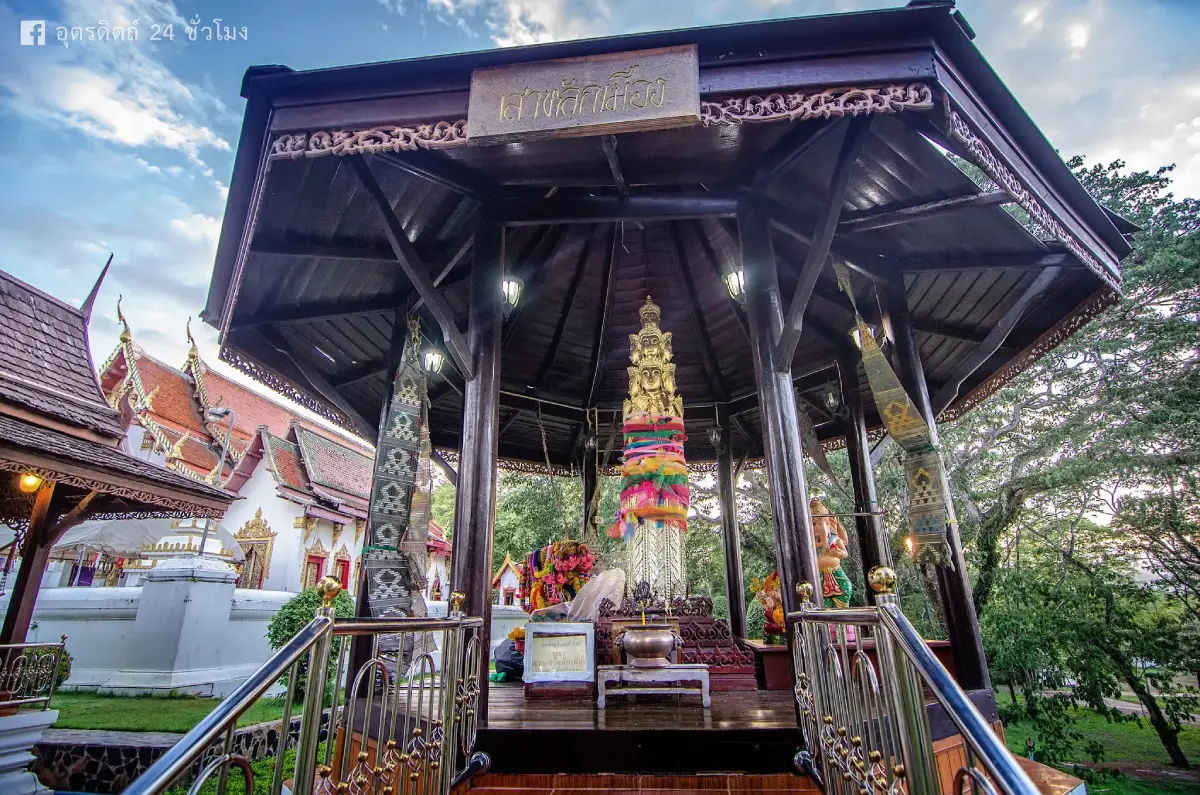
Uttaradit Replica City Pillar Shrine
Open Days: Daily
Opening Hours: 08:00 – 17:00
Uttaradit Replica City Pillar Shrine at Wat Phra Thaen Sila At is a sacred landmark associated with traditional beliefs concerning city pillars and the spiritual protection of communities. It is situated within Wat Phra Thaen Sila At, a royal Buddhist temple at Ban Phra Thaen, Thung Yang Subdistrict, Laplae District, Uttaradit Province 53210, northern Thailand. The city pillar forms part of a larger religious and cultural complex containing Phra Thaen Sila At, the main viharn, the revered Buddha image Luang Pho Thammachak, sacred Buddha footprints, and a local museum. The significance of the site therefore extends beyond city-pillar worship to include Buddhist history, local religious traditions, and the cultural heritage of Uttaradit Province.
Wat Phra Thaen Sila At is among the best-known Buddhist landmarks in Uttaradit. It is a third-class royal monastery affiliated with the Dhammayuttika Nikaya and stands on Khao Tao, also known as Khao Thong, in the Ban Phra Thaen area. The temple is particularly renowned for Phra Thaen Sila At, an ancient laterite platform held in deep reverence by Buddhist devotees. Its importance is reflected in the official emblem of Uttaradit Province, which incorporates an image of the sacred platform. The presence of a city pillar within the same compound adds another dimension to the temple's cultural significance, connecting civic spiritual beliefs with Buddhist worship.
In Thai culture, a city pillar symbolizes the establishment and stability of a community. It represents a sacred center associated with protection, harmony, and collective identity. At Wat Phra Thaen Sila At, this symbolism exists within a religious landscape containing several important Buddhist monuments. Visitors can consequently observe the relationship between traditional beliefs concerning a town's spiritual guardianship and the worship of sacred Buddhist objects in the same location.
Uttaradit Province lies in a region connecting lower northern Thailand with the upper central plains. Its history has been shaped by the Nan River, transportation routes, trade, and the development of settlements over many centuries. Laplae District and Thung Yang Subdistrict are associated with old communities, religious landmarks, and local historical traditions that predate the emergence of modern Uttaradit as an administrative center. This context helps explain the importance of Wat Phra Thaen Sila At as part of a much wider cultural landscape.
Thung Yang is an old community closely connected with Buddhist worship and historic religious sites, particularly Wat Phra Thaen Sila At, Wat Phra Yuen Phutthabat Yukhon, and Wat Phra Borommathat Thung Yang. The proximity of these temples creates a distinctive pilgrimage landscape in which visitors can explore several sacred places in succession. Their continued importance demonstrates how the community has preserved religious traditions, architectural heritage, and historical memory across generations.
Wat Phra Thaen Sila At was formerly known as Wat Mahathat. It stands in Ban Phra Thaen, Village 6, Thung Yang Subdistrict, on Khao Tao or Khao Thong hill. Wat Phra Yuen Phutthabat Yukhon is located to the east on another summit of the same hill. The close geographical relationship between the two temples reflects the longstanding practice of selecting prominent landscapes as locations for sacred buildings and Buddhist monuments.
Wat Phra Thaen Sila At is an ancient temple, although its founder and precise date of establishment are not recorded with certainty. Local historical accounts and architectural interpretations have associated the temple with the Sukhothai and early Ayutthaya periods. Understanding its history requires consideration of written chronicles, surviving religious objects, architectural styles, and traditions passed down through the surrounding community. These different types of evidence contribute to the temple's historical significance.
An important historical account appears in the royal chronicles of the reign of King Borommakot of Ayutthaya. The king is recorded as having visited and paid respect to Phra Thaen Sila At in 1740. This event demonstrates that the sacred platform had already achieved considerable religious recognition during the late Ayutthaya period. The temple's significance therefore developed long before Uttaradit became a modern travel destination.
Phra Thaen Sila At is a rectangular laterite platform measuring approximately eight feet wide, ten feet long, and three feet high. Its base is decorated with lotus-petal motifs. Today, the sacred platform is housed inside the main viharn, protected by an ornamental pavilion or canopy. Laterite was widely used in ancient religious architecture in Thailand, and the platform has value both as a material expression of historical craftsmanship and as an object of Buddhist devotion.
According to the traditional religious legend of Phra Thaen Sila At, the platform is associated with the five Buddhas of the present auspicious aeon, known in Buddhist cosmology as the Bhadrakalpa. The belief holds that the Buddhas have visited or will visit the site to meditate. This narrative forms part of the sacred tradition surrounding the platform and has contributed to the development of annual worship ceremonies. Although the story belongs to the realm of religious belief, it remains culturally significant as an expression of devotion and community memory.
A major event in the temple's history occurred on March 25, 1908, when a forest fire spread into the compound and destroyed several important buildings. The damaged structures included the main viharn and the pavilion associated with the sacred laterite platform. The platform itself survived, together with parts of the religious complex that escaped the flames. The fire became an important turning point in the temple's history and prompted extensive restoration.
Following the disaster, Phraya Warodomphakdi Si Uttaradit Nakhon, also known as An Hongsanan, who held an important administrative role in Uttaradit, helped raise funds and arrange repairs to the damaged religious buildings. The restoration of the viharn was essential to preserving the temple's function as a center of Buddhist devotion. The event illustrates the contribution of local administrators, supporters, and residents to the preservation of an important religious landmark.
The temple's architectural history also includes an account of elaborately carved wooden doors associated with the viharn of Phra Phuttha Chinnarat in Phitsanulok Province. These doors were celebrated for intricate layered carvings and ornamental motifs. The old doors at Wat Phra Thaen Sila At were destroyed in the 1908 fire, however, and should not be confused with architectural elements still preserved in the present viharn.
The current religious buildings and the protective structure surrounding Phra Thaen Sila At reflect the continued devotion of the community. The main viharn serves not only as the setting for the sacred platform but also as a space for prayers, merit-making, and ceremonial gatherings. Repeated use for religious activities has helped maintain both the physical landmark and the traditions associated with it.
In 2006, Wat Phra Thaen Sila At was elevated to the status of a third-class royal monastery within the Dhammayuttika Nikaya. This recognition reflected the temple's importance within Thailand's Buddhist religious landscape. Despite its royal status, it continues to maintain close connections with the Thung Yang community and with devotees traveling from other provinces to worship the sacred platform.
The temple grounds also contain a city pillar, listed among the important attractions within the compound. It is revered as a sacred civic landmark in accordance with traditional beliefs concerning the protection and well-being of communities. Its role differs from that of Phra Thaen Sila At, which is a Buddhist devotional object. The presence of both within the temple allows visitors to appreciate different expressions of faith and their relationship to local cultural identity.
The city pillar within Wat Phra Thaen Sila At is separate from the newer Uttaradit Provincial City Pillar Shrine project near the former provincial government building in Mueang Uttaradit District. The two locations have different histories and geographical settings. The pillar in the temple should therefore be understood within the religious and cultural context of Thung Yang and Laplae, rather than through the construction history of the newer provincial project.
Paying respect to a city pillar is associated with traditional wishes for good fortune, security, and the peaceful life of a community. Worshippers may offer a wai and pray according to their personal beliefs, while maintaining appropriate behavior within the sacred compound. Combining respect for the city pillar with worship at Phra Thaen Sila At brings together traditional civic-spiritual beliefs and Buddhist devotion in a single visit.
From a cultural perspective, a city pillar represents the shared identity of a community. Its symbolism encompasses the safety of residents, attachment to their homeland, and the hope for collective well-being. City pillar traditions occur across Thailand, although the histories, architectural forms, and ceremonies associated with individual sites differ according to their local settings.
In Uttaradit, local sacred traditions are connected with temples, stupas, Buddha images, and other revered landmarks throughout Mueang Uttaradit and Laplae districts. The presence of a city pillar at Wat Phra Thaen Sila At is part of a religious landscape in which respect for local sacred guardians and Buddhist religious practice can coexist without necessarily sharing identical origins or ceremonial meanings.
The main viharn is one of the most important buildings at Wat Phra Thaen Sila At because it houses the revered laterite platform beneath a decorative pavilion. It is central to worship, religious ceremonies, and visits by devotees. The architectural setting emphasizes the platform's sacred status and its importance as a symbol closely associated with Uttaradit Province.
Another important sacred object is Luang Pho Thammachak, a revered Buddha image associated with the temple's local traditions. Historical accounts of the great fire of 1908 describe the building housing this image as having survived the destruction. This story has contributed to the image's reputation for sacred protection and remains an important part of the community's memory of the temple.
The temple also contains sacred Buddha footprints, which are respected as Buddhist devotional objects. Worship of Buddha footprints is a tradition found at many religious sites across Thailand. The practice expresses remembrance of the Buddha and an aspiration to follow the teachings of Buddhism. The presence of these footprints adds another dimension to the variety of sacred objects at Wat Phra Thaen Sila At.
Among the temple's historical objects is an inscription on a bronze replica Buddha footprint, dated to 1905. The inscription is written in Thai using a script associated with the Thonburi and Rattanakosin periods. It has been documented by the Sirindhorn Anthropology Centre's inscription database. Its preservation demonstrates the temple's importance not only as an active place of worship but also as a repository of historical and religious evidence.
The local museum at Wat Phra Thaen Sila At provides an important opportunity to learn about regional culture. The initiative was developed through the efforts of Phra Chaloemsin Chayapaolo. A former Buddhist assembly hall was adapted for exhibitions, demonstrating how traditional religious buildings can be given an educational role while preserving their connection with the temple and the surrounding community.
The museum's collections include photographs, paintings, historic clothing and textiles, household utensils, traditional fishing equipment, pottery, baskets, and tools associated with everyday occupations. These objects offer a tangible introduction to the lifestyles of earlier generations in the Thung Yang and Laplae areas.
The museum also displays Buddhist images and woodcarvings associated with regional religious traditions. Presenting sacred objects alongside items from daily life reveals the close relationship between Buddhist institutions and the social history of rural communities. The collection demonstrates that a temple can preserve memories of craftsmanship, household activities, agriculture, and local beliefs as well as religious ceremonies.
Thung Yang and Laplae have distinctive cultural identities shaped by agriculture, fruit cultivation, traditional cuisine, and Buddhist festivals. The surrounding landscape includes foothills and fertile agricultural areas, which have influenced settlement patterns and local livelihoods. Community traditions preserve elements of earlier ways of life while adapting to social and economic change.
Laplae District is particularly well known for its local folklore and traditional communities. It is also an important fruit-growing area, especially for the celebrated Long Laplae and Lin Laplae durian varieties. These fruits have become closely associated with local agriculture and the economy. A visit to Wat Phra Thaen Sila At can therefore be combined with exploration of Laplae's food heritage, historical communities, and agricultural traditions.
The temple's most important annual event is the Phra Thaen Sila At Worship Festival, traditionally held around the full moon of the third lunar month, which corresponds to Makha Bucha Day. It is a major religious event for Uttaradit Province and nearby communities. Activities include worship of the sacred platform, Buddhist merit-making, and community cultural programs that vary from year to year.
The annual festival brings together devotees from different districts and provides an opportunity for collective worship and religious participation. It also creates connections between the temple, government agencies, local businesses, and community organizations. Its significance therefore extends beyond individual religious devotion to include the preservation of cultural traditions and social cooperation.
In 2025, Uttaradit Province organized the annual Phra Thaen Sila At Worship Festival, with opening ceremonies and religious activities held at the main viharn on January 30. The ceremonies included acts of respect toward protective deities and sacred guardians associated with the temple, as well as merit dedication to individuals who had contributed to the Buddhist community. These practices demonstrate the coexistence of Buddhist rituals and traditional beliefs concerning sacred places.
Wat Phra Thaen Sila At has also hosted ceremonies associated with Peng Pud, a northern Thai tradition observed when a full-moon day falls on a Wednesday. The occasion includes midnight alms-giving connected with beliefs about Phra Upakhut. In February 2025, the temple organized a late-night alms-giving ceremony attended by monks, community members, and government representatives, demonstrating its continuing role in maintaining regional traditions.
The Peng Pud tradition combines Buddhist merit-making with distinctive beliefs preserved in northern Thailand. Its unusual ceremonial timing sets it apart from everyday alms-giving activities. The event provides an opportunity for younger generations to learn about inherited customs through participation with monks, elders, and local communities.
Phra Winai Sathon, also known as Thawin Thawaro, was identified in official provincial reports in 2025 as the abbot of Wat Phra Thaen Sila At and the Ecclesiastical Provincial Governor of Uttaradit within the Dhammayuttika Nikaya. His responsibilities include monastic administration, the religious management of the temple, and cooperation with local communities in maintaining Buddhist practices and important sacred spaces.
Wat Phra Thaen Sila At remains significant as a place connecting different generations. Residents and travelers can make merit, worship Phra Thaen Sila At, pay respect to Luang Pho Thammachak, visit the local museum, and learn about the history of Uttaradit in one compound. These diverse activities reflect the traditional role of Thai temples as centers of worship, education, cultural preservation, and community identity.
Visitors interested in the city pillar should understand its distinct meaning from that of the sacred laterite platform. The city pillar is associated with traditional ideas of civic protection and prosperity, while Phra Thaen Sila At is linked to Buddhist religious beliefs and legends concerning the Buddhas. Distinguishing between these two sacred objects gives visitors a clearer understanding of the temple's cultural landscape.
A visit to the temple can be both spiritually meaningful and educational. Those traveling for worship can spend time in its quiet religious setting, while visitors interested in history can study the royal chronicles, the rebuilding following the 1908 fire, and important architectural features. Travelers interested in local ways of life can explore the museum and continue to cultural attractions elsewhere in Laplae District.
The compound includes the main viharn and the sacred laterite platform, the area associated with Luang Pho Thammachak, Buddha footprint landmarks, a local museum, and the city pillar. Exploring these different areas reveals the variety of religious objects, architectural structures, historical collections, and community beliefs preserved at Wat Phra Thaen Sila At.
The temple is suitable for a range of visitors, including older worshippers, students of Buddhist history, cultural heritage enthusiasts, and families interested in exploring local traditions together. It can provide both a devotional experience and a practical introduction to the historical identity of Uttaradit Province.
Architectural enthusiasts will find the temple particularly interesting for its main viharn, protective pavilion, religious ornaments, and arrangement of buildings on the hillside. Understanding the restoration history helps visitors recognize that the present structures belong to different periods of repair and reconstruction rather than all dating from the temple's original foundation.
The temple's architecture and artistic traditions also reflect historical cultural connections between northern Thailand and the religious centers of Sukhothai and Ayutthaya. Such influences can be explored through the history of local craftsmanship, the architectural form of Buddhist halls, and the tradition of constructing protective structures around sacred objects.
The surroundings of Wat Phra Thaen Sila At retain the atmosphere of Thung Yang, a community closely associated with several important historic temples. Local roads connect the area with Laplae town and central Uttaradit, making the temple convenient to visit as part of a route exploring both religious heritage and local community life.
Wat Phra Yuen Phutthabat Yukhon is one of the closest religious attractions. Situated on another summit of the same hill, it is connected with Buddhist devotional traditions involving sacred images and footprints. Visiting both temples provides an opportunity to appreciate the cluster of religious sites that developed around the Ban Phra Thaen hills.
Wat Phra Borommathat Thung Yang is another historic religious landmark of Laplae District. It contains a revered stupa and remains an important site of Buddhist worship. Visiting the temple alongside Wat Phra Thaen Sila At demonstrates the historical and spiritual importance of the Thung Yang area as a center of religious devotion.
Laplae City Gate is a prominent landmark marking an entrance into the historic Laplae area. It is associated with local history and the identity of the old town. Nearby cultural attractions provide an opportunity to explore stories about Laplae and understand the relationship between Buddhist temples, community history, and local traditions.
Laplae Museum and the Si Phanom Mat community area provide further insight into local life, including settlement history, commerce, food culture, and the development of traditional neighborhoods. Combining these places with Wat Phra Thaen Sila At offers a broader perspective on the relationship between religion, urban identity, and daily life in Uttaradit.
Laplae cuisine is distinctive, especially dishes such as khao phan phak, mee phan, and khao khaep. These foods feature thin rice sheets and traditional methods of preparing rice-based ingredients. They reflect local culinary knowledge and everyday eating traditions. Sampling these specialties after visiting the temple provides an opportunity to experience the area's cultural heritage through food.
Laplae District has a variety of local restaurants serving traditional dishes, noodles, and Thai meals. Dining establishments can be found around Si Phanom Mat and Thung Yang, including places specializing in rice-sheet dishes. These restaurants complement a cultural route through temples, markets, and historic communities.
Accommodation for visitors is available in both Laplae District and central Uttaradit. Staying in Laplae offers proximity to community attractions, traditional dining, and cultural sites. Hotels in central Uttaradit provide convenient connections with railway services, major roads, and other destinations across the province.
A wider itinerary from Wat Phra Thaen Sila At can include natural attractions such as Mae Phun Waterfall in Laplae District. The waterfall is associated with the area's foothill landscape and provides a contrast with the historic temples and cultural neighborhoods of Thung Yang and Laplae. This combination allows travelers to experience religion, history, regional food, and nature in one area.
Visitors arriving during the annual Phra Thaen Sila At Worship Festival will encounter an atmosphere quite different from ordinary days. Religious ceremonies and community participation attract larger gatherings, demonstrating the temple's continuing importance as a regional spiritual center. On regular days, the temple offers a quieter setting for worship and exploration of its historical buildings.
Visitors should dress modestly, maintain a respectful manner, and avoid unnecessary noise in ceremonial areas. Sacred objects and historical artifacts should not be touched without permission. Flowers, incense, candles, and other offerings should be placed only in designated areas. Respectful behavior helps preserve the religious atmosphere for everyone.
Photography should be conducted without obstructing worshippers or disturbing Buddhist ceremonies. Visitors entering the museum and exhibition spaces should follow any posted instructions. Maintaining cleanliness and avoiding contact with delicate objects are important parts of preserving the temple's cultural heritage.
Getting There Wat Phra Thaen Sila At is located at Ban Phra Thaen, Thung Yang Subdistrict, Laplae District, Uttaradit Province 53210. Travelers can reach the temple by private vehicle or local transport from central Uttaradit. Follow the roads toward Thung Yang and the signs for Wat Phra Thaen Sila At. Once inside the temple compound, the city pillar and other sacred landmarks can be explored along the available pathways.
Visitors traveling from neighboring provinces can reach Uttaradit through the main highway network before continuing toward Laplae and Thung Yang. Rail travelers can arrive at a railway station in the Uttaradit urban area and use local transport to reach the temple. The destination is therefore accessible both to visitors driving independently and those using a combination of public transportation and local taxi services.
A cultural route can connect Wat Phra Thaen Sila At with Wat Phra Yuen Phutthabat Yukhon, Wat Phra Borommathat Thung Yang, Laplae City Gate, Laplae Museum, and restaurants serving local specialties around Si Phanom Mat. Each destination contributes a different part of the regional story, from sacred hilltop landmarks and historic stupas to community symbols and traditional ways of life.
The city pillar within Wat Phra Thaen Sila At represents traditional beliefs concerning the good fortune and protection of the community. Its setting within one of Uttaradit's most important religious complexes makes it particularly meaningful. Visitors can pay respects at the pillar, worship Phra Thaen Sila At, visit Luang Pho Thammachak, explore Buddha footprint traditions, and learn about regional history through the local museum, all within the same temple compound.
The enduring value of this destination lies in its continuity of faith and community heritage. Wat Phra Thaen Sila At has witnessed important historical events, including recognition as a major pilgrimage site during the Ayutthaya period, reconstruction following the fire of 1908, elevation to royal-monastery status in 2006, and the ongoing celebration of significant Buddhist festivals. Visiting the temple and its city pillar offers an integrated understanding of local civic beliefs, Buddhist traditions, artistic heritage, and the cultural contributions of the Thung Yang and Laplae communities to Uttaradit Province.
| Place Name | Uttaradit Replica City Pillar Shrine at Wat Phra Thaen Sila At |
| Address | Wat Phra Thaen Sila At Royal Monastery, Ban Phra Thaen, Village 6, Thung Yang, Laplae District, Uttaradit 53210, Thailand |
| Map Reference | Plus Code H2XV+8C5, Thung Yang, Laplae District, Uttaradit |
| Type | Sacred City Pillar Landmark within a Royal Buddhist Monastery and a Historical and Cultural Attraction |
| Significance | The City Pillar Represents Traditional Civic Beliefs, while Wat Phra Thaen Sila At is a Major Center of Buddhist Devotion in Uttaradit Province |
| Temple History | Formerly Known as Wat Mahathat. Its Exact Founding Date Is Unrecorded. A Royal Visit to the Sacred Platform Was Recorded in 1740; a Major Fire Occurred in 1908; and the Temple Became a Third-Class Royal Monastery in 2006. |
| Buddhist Monastic Order | Dhammayuttika Nikaya |
| Abbot | Phra Winai Sathon (Thawin Thawaro), Ecclesiastical Provincial Governor of Uttaradit (Dhammayuttika), According to 2025 Provincial Reports |
| Important Sacred Features | City Pillar, Phra Thaen Sila At, Main Viharn, Luang Pho Thammachak, Buddha Footprints, Local Museum and Ho Kham Kaew |
| Phra Thaen Sila At | Rectangular Laterite Platform Measuring Approximately 8 ft Wide, 10 ft Long and 3 ft High, Decorated with Lotus-Petal Motifs and Enshrined within a Protective Pavilion inside the Main Viharn |
| Main Areas | 1. City Pillar Area 2. Main Viharn and Phra Thaen Sila At 3. Luang Pho Thammachak Worship Area 4. Buddha Footprint Area 5. Local Museum 6. Ho Kham Kaew and Surrounding Temple Grounds |
| Major Festivals | Annual Phra Thaen Sila At Worship Festival around the Full Moon of the Third Lunar Month and Phra Upakhut Alms-Giving during the Peng Pud Tradition |
| Open Days | Daily |
| Opening Hours | 08:00 – 17:00 |
| Temple Phone | +66 55 453 527 |
| Getting There | Travel from Central Uttaradit toward Laplae District, Thung Yang Subdistrict and Wat Phra Thaen Sila At |
| Nearby Tourist Attractions | 1. Wat Phra Yuen Phutthabat Yukhon, on the Same Hill 2. Wat Phra Borommathat Thung Yang, Thung Yang Subdistrict 3. Thung Yang Market, Approximately 2 km 4. Laplae City Gate, Approximately 6 km 5. Laplae Museum, Approximately 7 km 6. Mae Phun Waterfall, Laplae District |
| Nearby Restaurants | 1. Nong A Coffee, Within the Temple Grounds 2. Pa Thaen Noodle Shop, Approximately 0.3 km 3. Lan Pho Cafe, Thung Yang, Tel. +66 55 816 888 4. The Terminal Cafe, Thung Yang, Approximately 3 km, Tel. +66 81 703 6843 5. Khao Phan Phak Indy, Laplae District, Tel. +66 80 447 0345 6. Pa Wang Mee Phan Laplae, Laplae District, Tel. +66 84 045 2407 7. Krua Mon Kaew, Laplae District, Tel. +66 87 816 7668 |
| Nearby Accommodations | 1. Thung Yang House, Approximately 2 km, Tel. +66 65 455 6393 2. Bansuan Sangtawan Resort, Laplae District, Tel. +66 83 161 5735 3. Laplae Guesthouse, Laplae District, Tel. +66 84 502 3761 4. Ruean Laplae Resort, Laplae District, Tel. +66 86 679 9673 5. Seeharaj Hotel, Central Uttaradit, Approximately 8 km, Tel. +66 55 832 790-6 6. Friday Hotel, Central Uttaradit, Approximately 8 km, Tel. +66 55 832 775-9 7. K2 Living Hotel, Central Uttaradit, Approximately 9 km, Tel. +66 55 411 548 |
Frequently Asked Questions (FAQ)
Q: Where is the Uttaradit Replica City Pillar Shrine located?
A: The city pillar is located within Wat Phra Thaen Sila At Royal Monastery at Ban Phra Thaen, Thung Yang Subdistrict, Laplae District, Uttaradit Province 53210, Thailand.
Q: What are the opening days and hours of Wat Phra Thaen Sila At?
A: The temple is open daily from 08:00 to 17:00.
Q: Is the city pillar at Wat Phra Thaen Sila At the same as the new Uttaradit Provincial City Pillar Shrine?
A: No. The city pillar within Wat Phra Thaen Sila At is located in Laplae District. The newer provincial shrine project is situated near the former provincial government building in Mueang Uttaradit District.
Q: What is the history of Wat Phra Thaen Sila At?
A: Formerly known as Wat Mahathat, it is an ancient temple without a definitively recorded founding year. A royal visit to the sacred platform was recorded in 1740, a major fire damaged the temple in 1908, and the temple was elevated to third-class royal-monastery status in 2006.
Q: What is Phra Thaen Sila At?
A: Phra Thaen Sila At is a sacred rectangular laterite platform inside the main viharn. It measures approximately eight feet wide, ten feet long, and three feet high and is one of Uttaradit Province's most revered Buddhist landmarks.
Q: Who is the abbot of Wat Phra Thaen Sila At?
A: Phra Winai Sathon (Thawin Thawaro) was identified in 2025 official provincial records as the abbot of Wat Phra Thaen Sila At and the Ecclesiastical Provincial Governor of Uttaradit within the Dhammayuttika Nikaya.
Q: What traditional festivals are associated with Wat Phra Thaen Sila At?
A: The main annual event is the Phra Thaen Sila At Worship Festival, traditionally held around the full moon of the third lunar month, or Makha Bucha Day. The temple has also hosted Phra Upakhut alms-giving ceremonies associated with the northern Thai Peng Pud tradition.
Q: What attractions can visitors explore near Wat Phra Thaen Sila At?
A: Nearby attractions include Wat Phra Yuen Phutthabat Yukhon, Wat Phra Borommathat Thung Yang, Thung Yang Market, Laplae City Gate, Laplae Museum, and Mae Phun Waterfall, along with local restaurants and accommodation in Laplae and central Uttaradit.
 Category: ●Places of Worship
 Group: ●Other Sacred Sites
Last Update : 5 DayAgo
 Last Update : 5 DayAgo
 Click to Access the Navigation Map GPS
Uttaradit Replica City Pillar Shrine Map
Recommend

 Art, Culture and Heritage
 Historical Sites and Monuments(2)
 Landmarks and Memorials(8)
 Art, Craft Centres, Tradition(3)
 Museums(1)
 Historic Homes and Cities(1)
 Temple(42)
Other Sacred Sites(6)
 Suburban Living
 Village, Community(4)
 Nature and Wildlife
 National Parks and Marine Reserves(5)
 Mountain (Doi)(3)
 Dam, Reservoir, Lake(3)
 Waterfalls(11)
 Caves(3)
 River, Canal(3)
 Other natural attractions(3)
 Entertainment and Agricultural
 Farms, Parks and Ecotourism(1)
 Travel Articles, Recipes
 Travel Review, Food Review(1)


