
lovethailand home >Northeastern Travel Attractions >Bueng Kan Travel Attractions >Mueang Bueng Kan >Bueng Kan > Chao Mae Song Nang Shrine (Bueng Kan City Pillar S..
TL;DR: Chao Mae Song Nang Shrine (Bueng Kan City Pillar Shrine) is located at Ban Bueng Kan Klang, Moo 1, Chao Mae Song Nang Road, Bueng Kan Subdistrict, Mueang Bueng Kan District, Bueng Kan Province 38000, Thailand, open Daily, hours 07:30 – 19:00.
Chao Mae Song Nang Shrine (Bueng Kan City Pillar Shrine)
Open Days: Daily
Opening Hours: 07:30 – 19:00
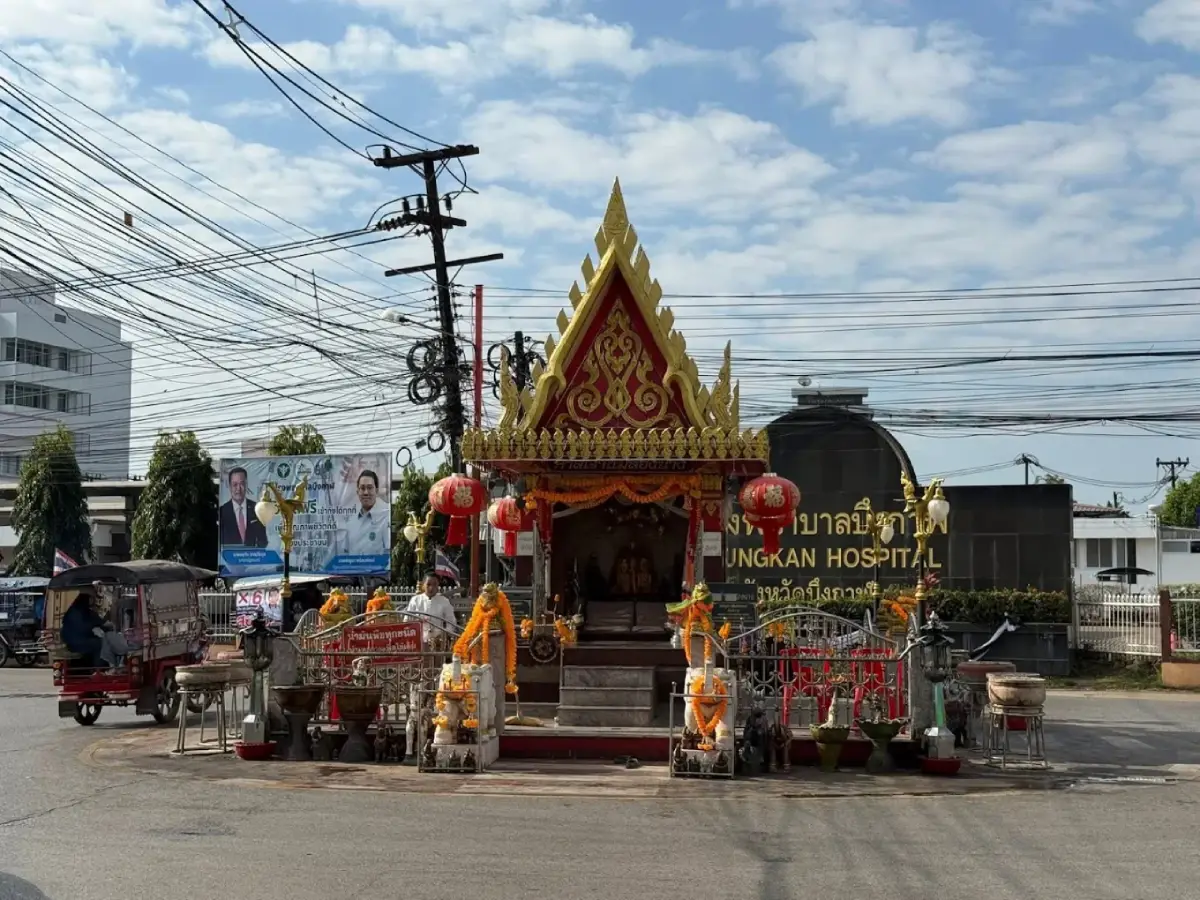
Chao Mae Song Nang Shrine (Bueng Kan City Pillar Shrine) is one of the most revered sacred landmarks in Bueng Kan Province, northeastern Thailand. The shrine stands at a traffic roundabout on Chao Mae Song Nang Road in Ban Bueng Kan Klang, Moo 1, Bueng Kan Subdistrict, Mueang Bueng Kan District, Bueng Kan Province 38000, near Bueng Kan Hospital. Deeply rooted in the history of communities along the Mekong River, the shrine is associated with the local legend of two sisters, Phao and Lao, daughters of an elderly man named Phrom who later became revered as Ya Pho Pha Khao, the White-Robed Elder. Beliefs surrounding the two guardian ladies are closely connected with the protection of communities, waterways, agriculture, safe travel, and the well-being of people living along the Mekong. The shrine also hosts annual worship ceremonies and provincial cultural events, preserving a living connection between ancestral traditions and the identity of present-day Bueng Kan.
The shrine is particularly significant because its history predates the establishment of Bueng Kan as Thailand's 77th province in 2011. Its traditions emerged from older communities whose lives were shaped by migration, family relationships, agriculture, fishing, and the use of natural water resources. When Bueng Kan became a separate province, the community's longstanding devotion to Chao Mae Song Nang continued. The shrine subsequently became an important setting for provincial ceremonies and cultural celebrations, carrying the memory of earlier generations into a new administrative era.
The shrine is located within the urban center of Bueng Kan, where roads, businesses, government services, and residential communities meet. Its position in the middle of a traffic roundabout opposite Bueng Kan Hospital makes it a highly visible local landmark. Although relatively small, the structure is distinguished by elaborate ornamentation. A steeply pitched roof with red-and-gold decorative patterns rises above the shrine, creating an unmistakable landmark within the everyday streetscape.
The worship of Chao Mae Song Nang is inseparable from the Mekong River and the waterways surrounding Bueng Kan. Earlier communities depended heavily on farming and fishing, and natural conditions directly influenced their livelihoods. Water levels, seasonal rainfall, and the availability of fish were central concerns for families living near rivers and wetlands. In response, villagers developed traditions of paying respect to protective spirits believed to watch over water, agricultural production, and the safety of the settlement. Devotion to Chao Mae Song Nang was therefore not limited to personal wishes. It formed part of a broader cultural system that connected the community with its environment.
An important account of the shrine's origins is associated with Ya Pho Pha Khao Kut Thing, a respected figure in the local tradition. The story was preserved in the recollections of Khrueang Phi Fueang, an elderly resident of northern Bueng Kan, who recounted the community's history in 1989 at the age of more than 94. This oral account provides the foundation for understanding the legend of the two sisters, the development of early settlements, and the relationship between ancestral beliefs and the surrounding wetlands.
According to the local narrative, the story begins during the period of the Haw conflicts, when groups of people migrated to escape warfare. Some traveled southward along the Mekong River and eventually reached the Bueng Kan area. The region offered fertile land, natural water sources, and conditions favorable for agriculture and fishing. These advantages encouraged the migrants to establish homes near the water and gradually develop communities based on family connections and shared resources.
The tradition identifies three important ancestral leaders: Khun Han, Ya Pho Phrom, and Ya Pho Pho. Each arrived with relatives and followers, forming the foundations of the developing settlement. Residential areas were organized into groups known as khum, or village neighborhoods, according to their geographical positions. These became Khum Nuea, the northern neighborhood; Khum Klang, the central neighborhood; and Khum Tai, the southern neighborhood. This pattern reflects a familiar form of social organization in northeastern Thai villages, where geography and kinship often shaped the structure of settlement.
Additional migrants later arrived from neighboring communities, including areas connected with Nong Khai. Their arrival expanded the population and strengthened the network of relationships among households. The developing community depended on shared access to farmland, fisheries, and natural resources. At the same time, beliefs concerning ancestors and protective spirits became important elements of the settlement's cultural and social life.
Among these later arrivals was an elderly man named Phrom, remembered in the legend as someone possessing traditional ritual knowledge and the ability to treat illness through spiritual practices. He had two daughters named Phao and Lao. During their migration along the Mekong River, Phrom's elderly wife became ill and died. Following this loss, he adopted the life of a white-robed religious practitioner and eventually settled in the central neighborhood of Bueng Kan.
The white-robed way of life described in the legend represents a form of spiritual discipline connected with moral conduct, religious observance, and local ritual traditions. In rural communities where modern medical services were once limited, people possessing knowledge of healing practices and protective ceremonies often gained considerable respect. Phrom's reputation as a spiritual practitioner therefore made him an important figure in the beliefs of the early Bueng Kan community.
At that time, the Kut Thing wetland area was surrounded by dense vegetation and forest. Residents entered the area to gather natural products, fish, and obtain resources for everyday use. However, the thick vegetation and presence of wild animals also exposed people to danger. When injuries or deaths occurred, villagers interpreted some of these events through beliefs concerning spirits inhabiting the forest and wetland environment.
Community members invited Phrom to stay at Don Ho near Kut Thing, where they believed he could perform rituals to remove harmful spiritual influences and protect residents. Through his association with the area, he became remembered as a guardian figure of the community. After his death from old age, villagers constructed a shrine dedicated to his spirit. In local tradition, he became known as Ya Pho Pha Khao, the White-Robed Elder.
The story of Ya Pho Pha Khao Kut Thing illustrates the relationship between local spiritual leadership and the natural landscape. A wetland once associated with danger acquired another meaning as a place under the protection of a respected spiritual figure. This belief contributed to community customs concerning the appropriate use of land and water. Natural resources were understood not simply as materials to be exploited but also as places deserving care and respect.
Phrom's daughters, Phao and Lao, continued living within the community. According to the narrative, both reached old age and eventually passed away. Villagers who respected their family built a shrine to honor the spirits of the two sisters. The sacred place became known as San Song Nang, meaning the Shrine of the Two Ladies. Over time, the name developed into Chao Mae Song Nang Shrine, the title by which the landmark is widely recognized today.
The shrine's name is therefore directly connected with the two sisters in the local account. It does not refer to a particular architectural feature or the number of city pillars. The title Chao Mae expresses respect for female guardian spirits believed to protect the community and its waterways. This origin distinguishes the shrine from formal city pillar shrines established according to traditional state ceremonies.
As devotion to the two guardian ladies expanded, people from other communities began visiting the shrine to make offerings and seek blessings. Local narratives tell of the guardian spirits helping people in distress, warning residents of danger through dreams, and protecting those who honored them. These beliefs have been transmitted within families and remain part of Bueng Kan's living cultural heritage.
The significance of the legend extends beyond its supernatural elements. It preserves the memory of migration, the formation of village neighborhoods, the importance of family networks, and the reliance of early communities on natural resources. It also illustrates how individuals respected for their spiritual or social roles became central figures in local traditions. Such stories offer valuable insights into the worldview of agricultural communities along the Mekong.
Beliefs involving two female guardian figures are also found in other communities along the Mekong River and throughout northeastern Thailand. In some places, the legends concern daughters or descendants of rulers associated with the Vientiane region who traveled along the river and died during migration. Although these narratives share certain themes, their details vary between communities. They should therefore be understood as related cultural traditions rather than identical accounts of a single historical event.
For Bueng Kan residents, the tradition concerning Phrom, Phao, and Lao is especially meaningful because it is linked to named individuals, older village neighborhoods, and the Kut Thing wetlands. These local connections help explain why the shrine's ceremonies historically focused on agriculture, rainfall, waterways, and community protection. The Bueng Kan narrative therefore possesses characteristics that distinguish it from the legends of similarly named shrines elsewhere in the Mekong region.
The establishment of the shrine reflects the importance of ancestor veneration in northeastern Thai culture. Within many local belief systems, respected individuals who have died may become protective ancestral figures in the memory of their descendants. Building a shrine provides a designated place where later generations can express gratitude and maintain a symbolic relationship with those who lived before them.
The shrine also serves a wider social purpose by bringing families and different community groups together. Traditional ceremonies require collective preparation, including arranging offerings, organizing the grounds, preparing food, and coordinating the participation of residents. These activities strengthen relationships and provide opportunities for shared cultural expression. The shrine therefore functions as both a place of worship and a community institution.
The present-day shrine is a compact but richly ornamented structure. Its steep gabled roof features gold-and-red Thai decorative patterns, with elaborate details along the roof edges and upper sections. A prominent nameplate identifies the shrine, while lanterns and auspicious animal figures contribute to the visual character of the entrance. The overall appearance combines elements of Thai sacred architecture with decorative traditions associated with Chinese-style shrines.
Red and gold are the dominant colors of the exterior. The gilded patterns emphasize the sacred character of the building, while the red background creates a strong visual contrast against the surrounding roads and city buildings. Despite its small size, the shrine stands out through the care devoted to its roof ornamentation, entrance, and sacred decorative details.
Steps lead from the front of the shrine to the worship area. Inside are an altar, sacred images, ceremonial decorations, flowers, and other offerings presented by devotees. The arrangement focuses attention on the principal objects of veneration and creates an intimate religious environment. Visitors can observe the connection between the shrine's physical appearance and the offerings through which residents express their beliefs.
Figures and sacred representations within the shrine are decorated with colorful fabrics, ornaments, and ceremonial accessories. These objects are associated with the guardian ladies and other elements of local spiritual tradition. Their appearance reflects popular artistic expression rather than the strictly monastic design of a Buddhist temple. Colorful offerings and carefully arranged decorations contribute to the distinctive atmosphere inside the small building.
Chao Mae Song Nang Shrine is different from a conventional Buddhist monastery. Its principal purpose is the veneration of ancestral guardian spirits, rather than serving as a residence for monks or a complex centered on an ordination hall, Buddhist assembly hall, and stupa. The shrine therefore has no abbot. Its activities are connected with the Chao Mae Song Nang Shrine Association, local caretakers, and community organizations.
The shrine's position in a traffic roundabout is another distinctive feature. Unlike temples set within extensive grounds, it stands directly within a functioning urban road network. This makes the shrine highly visible to residents going about their daily lives. The sacred building exists alongside transport, commerce, and community services, illustrating how traditional beliefs remain present within a modern provincial town.
Devotees visit the shrine to seek blessings for safe travel, good fortune, health, prosperity, and family well-being. These practices represent personal expressions of faith and respect for the guardian spirits. Many local families continue customs learned from older relatives, making worship at the shrine part of their continuing connection with Bueng Kan and its traditions.
Offerings traditionally include flowers, garlands, incense, candles, fruit, and other ceremonial items presented according to local customs. These gifts symbolize devotion and gratitude. The limited space of the shrine makes orderly use of the offering areas particularly important, especially because traffic continues to circulate around the site.
Traditional ceremonies associated with Chao Mae Song Nang involved a ritual specialist known locally as a cham. This person played a role in communicating with the guardian spirits according to community belief and guided the performance of ceremonies. Responsibilities included determining appropriate ritual days, explaining customary practices, and directing the preparation of offerings. Such roles are part of the broader tradition of local spirit worship that has long coexisted with Buddhism in northeastern Thailand.
Two particularly important forms of traditional ceremony are known as Wan Liang Long and Wan Liang Khuen. Both are closely associated with the agricultural cycle. One takes place before the beginning of rice cultivation, while the other expresses gratitude after the harvest. Together, they represent a traditional relationship between farming communities, their natural environment, and the protective spirits they honor.
Wan Liang Long is performed before rice planting begins during the rainy season, traditionally around the sixth lunar month. Villagers bring offerings to inform the guardian spirits that agricultural work is about to commence. Their prayers concern adequate rainfall, healthy crops, protection from damaging natural conditions, and a successful growing season.
This pre-planting ceremony reflects the uncertainty that agricultural families historically faced. Rice cultivation depended heavily on seasonal rainfall and the availability of water. By performing a communal ceremony before entering the fields, residents expressed their hopes for favorable conditions while strengthening their sense of shared responsibility and mutual support.
Wan Liang Khuen takes place after the rice harvest. The community offers thanks to Chao Mae Song Nang for the protection and abundance believed to have accompanied the farming season. The ceremony expresses gratitude, marks the completion of agricultural work, and provides another opportunity for families to gather and maintain their cultural ties.
Local ceremonial traditions also distinguish between rituals honoring Ya Pho Pha Khao and those dedicated to Chao Mae Song Nang. Wednesday is traditionally associated with offerings to the White-Robed Elder, while Thursday is associated with the worship of the two guardian ladies. This customary distinction preserves the relationships between the figures in the founding narrative and the specific ceremonial roles attributed to them.
As Bueng Kan developed beyond its older agricultural economy, the shrine's ceremonies adapted to the changing character of the community. In addition to seasonal rituals related to farming, residents introduced an annual worship event in November. This timing follows the end of Buddhist Lent and the traditional Kathin season, when many major religious activities have concluded.
The modern form of the annual worship celebration began on November 18, 2005. The intention was to create an occasion that could be attended by residents from different occupations, not only those directly involved in agriculture. Holding the event toward the end of November allowed more people to participate in the preparations and ceremonies, reinforcing the shrine's role as a shared cultural landmark.
The annual celebration generally takes place in late November and combines Buddhist merit-making with ceremonies dedicated to the local guardian spirits. This combination illustrates a characteristic feature of northeastern Thai culture, where Buddhist observances and community spirit traditions often exist together within a single festival.
On November 29, 2025, Bueng Kan Province held its annual worship ceremony at Chao Mae Song Nang Shrine. Provincial officials, government representatives, and residents participated in the event. Activities included offering alms to monks, presenting the morning meal to the monastic community, and performing traditional ceremonies to honor the guardian ladies. The celebration demonstrated the shrine's continuing importance as a center of community devotion.
During the 2025 ceremony, Phra Khru Ophas Thammarot, an adviser to the Bueng Kan provincial ecclesiastical authorities and abbot of Wat Chotirot Thammakon, presided over the Buddhist proceedings with eight other monks. The shrine-related activities involved the Chao Mae Song Nang Shrine Association. At that time, Chamrat Titma was identified as the association's president. The cooperation between Buddhist representatives and the shrine community reflects the interconnected religious traditions of the province.
The annual festival is important not only as an act of worship but also as an opportunity for residents to maintain local customs, strengthen community relationships, and introduce younger generations to the shrine's history. The event gives people from different backgrounds a shared occasion for expressing their connection with the place where they live.
Chao Mae Song Nang Shrine also participates in significant provincial ceremonies. On March 23, 2026, a special worship ceremony was held in connection with the 15th anniversary of Bueng Kan's establishment as a province and the annual provincial Red Cross Fair. Provincial administrators, government agencies, private-sector representatives, and residents attended the commemorative activities.
The anniversary celebrations included a ceremonial procession carrying offerings associated with the Naga, an important sacred figure in Mekong cultural traditions. Participants moved from Chao Mae Song Nang Shrine toward Khao Mao Rim Khong Road, where further provincial activities took place. Large numbers of residents representing all eight districts of Bueng Kan wore the province's purple-and-white traditional attire and performed cultural dances, including Fon Chai Buri and Fon Phleng Bueng Kan Ban Ai.
The use of Chao Mae Song Nang Shrine as a starting point for the provincial anniversary procession illustrates the shrine's significance beyond its original neighborhood. It has become a place where the traditions of an older community are incorporated into celebrations representing the province as a whole. Traditional costumes, dancing, music, and sacred offerings provide a visible connection between historical beliefs and contemporary provincial identity.
Although the shrine is frequently listed or described alongside the name Bueng Kan City Pillar Shrine, its traditional origins are associated with ancestor veneration and the two sisters of the local legend. The separate project to construct a new provincial city pillar shrine involves formal planning, architectural design, and the establishment of a city pillar according to ceremonial traditions. These developments belong to different historical and administrative contexts.
This distinction reveals the different ways sacred places develop in Thailand. Community shrines often originate from respected ancestors, local events, or shared memories, while formal city pillar shrines are associated with the ceremonial establishment and protection of a settlement. In Bueng Kan, Chao Mae Song Nang Shrine has long served as a sacred symbol of the city in the belief and everyday practice of local residents.
Devotion to the guardian ladies also has an environmental dimension. Traditionally, communities maintained customary restrictions concerning waterways, wetland areas, and places believed to be protected by sacred spirits. These beliefs encouraged respect for communal resources and discouraged behavior regarded as harmful to the natural environment.
The relationship between spiritual beliefs and environmental care is especially evident in the story of Kut Thing. This wetland area has long supported local fisheries and natural ecosystems. The traditions concerning Ya Pho Pha Khao and Chao Mae Song Nang placed the surrounding landscape within a framework of community responsibility and respect. Water was understood as an essential resource for life and as part of the spiritual geography of the settlement.
Bueng Kan Province possesses a diverse natural environment that includes the Mekong River, wetlands, forests, and mountain landscapes. These features have shaped the lives and cultural traditions of residents over many generations. The Chao Mae Song Nang legend offers an example of how earlier communities expressed their relationship with nature through stories of ancestral guardians and protective spirits.
Exploring the shrine's history is therefore an opportunity to understand the social development of Bueng Kan rather than simply to admire a sacred building. The legend preserves themes of migration, settlement, agriculture, fishing, spiritual leadership, and seasonal rituals. These elements reveal important aspects of the community's historical identity and its transition from a riverside settlement to a modern provincial town.
The shrine is a meaningful destination for cultural travelers because of its central location and close connection with the Mekong River heritage of Bueng Kan. A visit provides an introduction to local ancestral beliefs and religious architecture before travelers explore the riverfront, markets, wetlands, and natural attractions of Mueang Bueng Kan District.
The building itself is particularly noteworthy for its steep red-and-gold roof, ornate gable, sacred images, and colorful offerings. The grounds are relatively compact, so the visit focuses on the historical and cultural significance of the shrine rather than extensive architectural complexes. Its position within the urban roundabout also gives visitors a direct impression of how traditional sacred landmarks are integrated into everyday town life.
Another interesting aspect is the contrast between an ancestral shrine and a Buddhist temple. At Chao Mae Song Nang Shrine, the altar and sacred representations associated with local guardian spirits are central to worship. Buddhist monasteries, by contrast, are organized around religious buildings, Buddha images, and the activities of ordained monks. Both types of sacred place form part of the rich religious landscape of northeastern Thailand.
The shrine welcomes people from a wide variety of occupations and backgrounds. Farmers, merchants, public officials, families, and other residents participate in its cultural activities. Annual ceremonies provide a shared occasion for people whose everyday lives may otherwise be quite different, allowing the shrine to remain relevant within a changing urban society.
Participation in ceremonies also helps transmit cultural knowledge to younger generations. Preparing offerings, arranging the shrine, following ritual sequences, and learning appropriate ways to pay respect all provide opportunities for intergenerational learning. These practices help maintain the traditions not simply as stories about the past but as activities that continue to be performed.
As a sacred landmark of Bueng Kan, the shrine reflects the province's combination of local spirit traditions, northeastern Thai culture, and Buddhism. Its continued importance demonstrates that cultural beliefs can remain meaningful despite changes in administration, economy, and the physical environment of a town.
The shrine's association with the provincial anniversary is especially significant. Bueng Kan officially became Thailand's 77th province on March 23, 2011. The incorporation of Chao Mae Song Nang worship into anniversary events recognizes that the cultural history of the local community extends far beyond the province's modern administrative establishment.
In this sense, the establishment of a new province did not create its cultural heritage from the beginning. Rather, the new administrative identity developed upon existing communities, historical memories, and traditions. Chao Mae Song Nang Shrine remains a tangible reminder of that continuity, linking the history of earlier riverside settlements with the identity of modern Bueng Kan.
Visitors can combine a stop at the shrine with several attractions in Mueang Bueng Kan District. The Mekong waterfront is one of the town's defining features, particularly around Khao Mao Rim Khong Road and the riverside walking street. This area offers views of the river and opportunities to experience the atmosphere of a Thai border town. The riverfront setting also provides a geographical context for understanding the migration narratives associated with Chao Mae Song Nang.
Bueng Kan Walking Street is a popular local market area where visitors can find food, snacks, beverages, and community products. Its evening atmosphere reflects the everyday social life of the town. Visiting the market after exploring the shrine provides a contrast between the sacred traditions preserved at the shrine and the commercial and recreational activities of the modern riverside community.
Other riverfront landmarks include the Mekong riverside pavilion, scenic public areas, and the northern Isan border landmark sign. These places provide views across the Mekong toward Laos and emphasize Bueng Kan's geographical position along the international river boundary. The waterfront landscape remains one of the strongest features of the province's identity.
Kut Thing is another important destination for those interested in the shrine's cultural background. The wetland has ecological value and a longstanding relationship with fishing communities. Its connection with the legend of Ya Pho Pha Khao makes it particularly relevant to understanding the origins of Chao Mae Song Nang worship and the role of natural resources in local spiritual traditions.
Kaeng A Hong and Wat Ahong Silawat are important attractions farther along the Mekong River in Mueang Bueng Kan District. The area is known for its riverside setting and local traditions concerning the river's depths and Naga beliefs. Wat Ahong Silawat is also a respected Buddhist destination, allowing travelers to experience both natural scenery and the religious culture of the Mekong region.
Food is another important part of experiencing Bueng Kan. The town offers Thai, Isan, and local breakfast dishes, as well as meals associated with the fishing traditions of the Mekong River. Local restaurants provide opportunities to explore flavors shaped by agriculture, freshwater ingredients, and the broader food culture of northeastern Thailand.
Typical dishes include larb, koi, fish soups, grilled foods, vegetables, and everyday rice dishes. Sticky rice is an important part of regional dining traditions, and meals are often shared among family members or friends. Visiting local restaurants and markets adds a culinary dimension to a cultural journey through Bueng Kan.
Restaurants in the town include Lert Rot Noodle Shop opposite Bueng Kan Hospital, Carabao Larb Khom, Mawin Ocha, Sabiang Restaurant, and Krua Phu Wa 2000. They serve a variety of dishes, ranging from noodles and traditional breakfasts to regional meat dishes and familiar Thai meals. Their presence illustrates the range of dining options available in the provincial town.
Accommodation options in Mueang Bueng Kan District include The One Hotel Bueng Kan, B2 Bueng Kan, The Wisdom Residence, Bann Ta-Thin Guesthouse, and U Sabai Bueng Kan. These establishments represent different types of lodging, including modern hotels, budget accommodation, and smaller properties. Their locations within or near the town provide convenient access to local services and attractions.
Staying in Bueng Kan town makes it possible to combine the shrine with the Mekong waterfront, Bueng Kan Walking Street, Kut Thing, and Kaeng A Hong. The town also serves as a starting point for journeys to other major attractions in the province, including Hin Sam Wan, also called Three Whale Rock, Phu Sing Forest Park, and Wat Phu Tok in Si Wilai District.
Chao Mae Song Nang Shrine does not require the same amount of visiting time as a large national park or archaeological complex. Its value lies instead in the historical narratives and living ceremonies associated with a relatively small sacred building. Understanding the meaning of the shrine offers a deeper appreciation of Bueng Kan's local culture than its physical size alone might suggest.
The shrine's setting within an active traffic roundabout makes the relationship between faith and modern urban life particularly visible. Roads continue to serve everyday traffic around the sacred building. Visitors should use appropriate access points and take care when approaching the shrine, allowing worship to take place without interfering with road safety.
The shrine is also an important resource for understanding local oral history. Details concerning Ya Pho Pha Khao, Phao and Lao, the village neighborhoods, and the Kut Thing wetlands have been preserved through community recollections. These accounts provide perspectives on the experiences of ordinary residents whose lives are not always prominent in official political histories.
The story of Chao Mae Song Nang also reveals the role of women within local cultural memory. Although Phrom is remembered as a respected ritual practitioner, his two daughters became the guardian figures after whom the shrine is named. Their place in community tradition demonstrates how ancestral reverence can preserve the memory of women as protective figures across generations.
The ceremonial traditions surrounding the shrine preserve knowledge about agricultural seasons, water resources, and communal cooperation. Wan Liang Long and Wan Liang Khuen correspond to significant stages of farming, while the November annual celebration represents an adaptation of older customs to the circumstances of modern community life.
Chao Mae Song Nang Shrine consequently carries several layers of meaning. It is a place for ancestor veneration, a symbol of beliefs concerning the protection of waterways, a center of agricultural ceremonial traditions, and a venue for important provincial events. These overlapping roles demonstrate how even a small shrine can hold considerable historical, social, and spiritual significance.
Getting There: Chao Mae Song Nang Shrine is situated at a roundabout on Chao Mae Song Nang Road in Ban Bueng Kan Klang, Moo 1, Bueng Kan Subdistrict, Mueang Bueng Kan District, Bueng Kan Province 38000, Thailand. Visitors traveling by car can enter central Bueng Kan and follow Chao Mae Song Nang Road toward Bueng Kan Hospital, the principal landmark opposite the shrine. Travelers arriving by intercity bus can continue by locally available transport to the hospital area.
From the shrine, visitors can continue through Bueng Kan town toward the Mekong riverfront and the walking street area. Roads through the provincial center connect with major routes serving surrounding districts and neighboring provinces. This makes the shrine a convenient starting point for a cultural itinerary before traveling farther to the region's natural landscapes and Buddhist landmarks.
Chao Mae Song Nang Shrine illustrates the continuity of local beliefs through the changing history of Bueng Kan. From the migration of families along the Mekong River and the establishment of early settlements near Kut Thing to the growth of the modern provincial town, the story of Phrom, Phao, and Lao has remained an important element of community heritage.
The annual worship ceremony, provincial anniversary celebrations, and continuing participation of residents show that the shrine is more than a monument preserving an old legend. It remains a living cultural institution where people express their relationship with ancestors, the natural environment, and the wider community. Devotion to the two guardian ladies is therefore an enduring part of Bueng Kan's identity.
With its origins in Mekong migration traditions, its association with the two sisters and Ya Pho Pha Khao Kut Thing, its agricultural ceremonies, and its annual worship celebrations, Chao Mae Song Nang Shrine represents a distinctive element of Bueng Kan's cultural heritage. The shrine provides insight into how history, ancestral memory, local faith, and the natural landscape have shaped the identity of this northeastern Thai border province.
| Place Name | Chao Mae Song Nang Shrine (Also Listed as Bueng Kan City Pillar Shrine) |
| Address | Ban Bueng Kan Klang, Moo 1, Chao Mae Song Nang Road, Bueng Kan Subdistrict, Mueang Bueng Kan District, Bueng Kan Province 38000, Thailand |
| Location Landmark | Traffic Roundabout Opposite Bueng Kan Hospital |
| Type of Attraction | Ancestral Guardian Shrine, Community Sacred Landmark, and Cultural Attraction |
| Figures in the Local Legend | Phao and Lao, the Two Sisters, and Phrom, also known as Ya Pho Pha Khao Kut Thing |
| History and Name Origin | The shrine is named after two sisters, Phao and Lao. Local residents established a place of worship to honor their spirits according to the community's ancestral tradition. |
| Architecture | Compact Ornamental Shrine with a Steep Gabled Roof, Red-and-Gold Decorations, Lanterns, and an Interior Altar |
| Main Features | 1. Main Shrine Building and Decorative Gable 2. Altar with Sacred Figures 3. Traditional Offering Area 4. Entrance Steps 5. Front Ceremonial Space |
| Cultural Significance | A Revered Community Shrine Associated with Ancestral Beliefs, the Protection of Waterways, Agriculture, and Local Well-Being |
| Important Traditions | Wan Liang Long Before Rice Planting, Wan Liang Khuen After the Harvest, and the Annual Worship Ceremony in November |
| Recent Provincial Ceremony | March 23, 2026: Worship Ceremony for the 15th Anniversary of Bueng Kan Province |
| Management | Chao Mae Song Nang Shrine Association and Local Community Representatives. Chamrat Titma Served as Association President During the 2025 Annual Celebration. |
| Open Days | Daily |
| Opening Hours | 07:30 – 19:00 |
| Admission Fee | Free Admission |
| Facilities | Parking and Restroom Facilities in the Surrounding Area; Accessible Parking Listed in Visitor Information |
| Getting There | Travel to Central Bueng Kan and Follow Chao Mae Song Nang Road Toward Bueng Kan Hospital. |
| Municipal Contact | Bueng Kan Municipality: +66 42 491 897 |
| Attractions in Mueang Bueng Kan and Surrounding Areas | 1. Bueng Kan Walking Street, Khao Mao Rim Khong Road 2. Mekong Riverside Pavilion 3. Northern Isan Border Landmark Sign 4. Mum Sabai Mekong Riverside Park 5. Kut Thing Wetland 6. Kaeng A Hong 7. Wat Ahong Silawat |
| Restaurants in Mueang Bueng Kan | 1. Lert Rot Noodle Shop, Opposite Bueng Kan Hospital, Tel. +66 89 575 0041 2. Carabao Larb Khom, Branch 3, Chao Mae Song Nang Road, Tel. +66 87 504 6445 3. Mawin Ocha, Bueng Kan Road, Tel. +66 91 861 6727 4. Sabiang Restaurant, Thai Samak Road, Tel. +66 86 031 6920 5. Krua Phu Wa 2000, Prasat Chai Road, Tel. +66 42 491 248 6. Chakangrao Restaurant, Wisit Subdistrict, Tel. +66 98 827 5099 |
| Accommodations in Mueang Bueng Kan | 1. The One Hotel Bueng Kan, Bueng Kan–Nakhon Phanom Road, Tel. +66 42 492 234 2. B2 Bueng Kan, Wisit Subdistrict, Tel. +66 42 084 180 3. The Wisdom Residence, Central Bueng Kan, Tel. +66 42 086 977 4. Bann Ta-Thin Guesthouse, Mekong Riverside, Wisit Subdistrict, Tel. +66 95 665 8635 5. U Sabai Bueng Kan, Phon Thuk Phai Road, Tel. +66 91 371 4449 |
Frequently Asked Questions (FAQ)
Q: Where is Chao Mae Song Nang Shrine located?
A: The shrine stands in a traffic roundabout on Chao Mae Song Nang Road in Ban Bueng Kan Klang, Moo 1, Bueng Kan Subdistrict, Mueang Bueng Kan District, Bueng Kan Province 38000, opposite Bueng Kan Hospital.
Q: What are the opening hours and admission fee?
A: Chao Mae Song Nang Shrine is open daily from 07:30 to 19:00. There is no admission fee.
Q: Who are the two guardian ladies of Chao Mae Song Nang Shrine?
A: According to the local Bueng Kan legend, the guardian ladies were two sisters named Phao and Lao, daughters of Phrom, also known as Ya Pho Pha Khao Kut Thing. Villagers established the shrine to honor their spirits.
Q: Is Chao Mae Song Nang Shrine the same as Bueng Kan City Pillar Shrine?
A: The shrine is also listed under the name Bueng Kan City Pillar Shrine in travel information and is revered as a sacred landmark of the town. However, its ancestral origins are distinct from the separate project to construct a new provincial city pillar shrine.
Q: What are Wan Liang Long and Wan Liang Khuen?
A: Wan Liang Long is a traditional ceremony performed before rice planting to seek protection and favorable growing conditions. Wan Liang Khuen is a ceremony held after the harvest to express gratitude to the guardian spirits.
Q: When is the annual Chao Mae Song Nang worship festival held?
A: The annual community worship festival is traditionally organized in late November. Older agricultural rituals are also connected with the beginning of rice cultivation and the period following the harvest.
Q: Does Chao Mae Song Nang Shrine have an abbot?
A: No. It is an ancestral guardian shrine, not a Buddhist monastery. Its activities are associated with the Chao Mae Song Nang Shrine Association and local community representatives.
Q: What attractions can be visited around Chao Mae Song Nang Shrine?
A: Attractions in the same district include Bueng Kan Walking Street, the Mekong riverside area, the Northern Isan Border Landmark Sign, Kut Thing Wetland, Kaeng A Hong, and Wat Ahong Silawat.
 Category: ●Places of Worship
 Group: ●Other Sacred Sites
Last Update : 5 DayAgo
 Last Update : 5 DayAgo
 Click to Access the Navigation Map GPS
Chao Mae Song Nang Shrine (Bueng Kan City Pillar Shrine) Map
Recommend

 Art, Culture and Heritage
 Landmarks and Memorials(1)
 Museums(1)
 Temple(12)
Other Sacred Sites(4)
 Suburban Living
 Local Market(1)
 Nature and Wildlife
 National Parks and Marine Reserves(1)
 Mountain (Doi)(3)
 Waterfalls(5)
 Caves(1)
 River, Canal(4)
 Bays and Beaches(1)
 Islands(1)
 Entertainment and Agricultural
 Waterpark(1)
 Shopping
 Shopping and Night Market(1)
 Travel Articles, Recipes
 Travel Review, Food Review(1)


