
lovethailand home >South Travel Attractions >Phatthalung Travel Attractions >Muang Phatthalung >Tha Miram > Phatthalung City Pillar Shrine
TL;DR: Phatthalung City Pillar Shrine is located at Wat Khuan Prong Grounds, Moo 2, Tha Miram Subdistrict, Mueang Phatthalung District, Phatthalung Province 93000, Thailand, open Daily.
Phatthalung City Pillar Shrine
Open Days: Daily
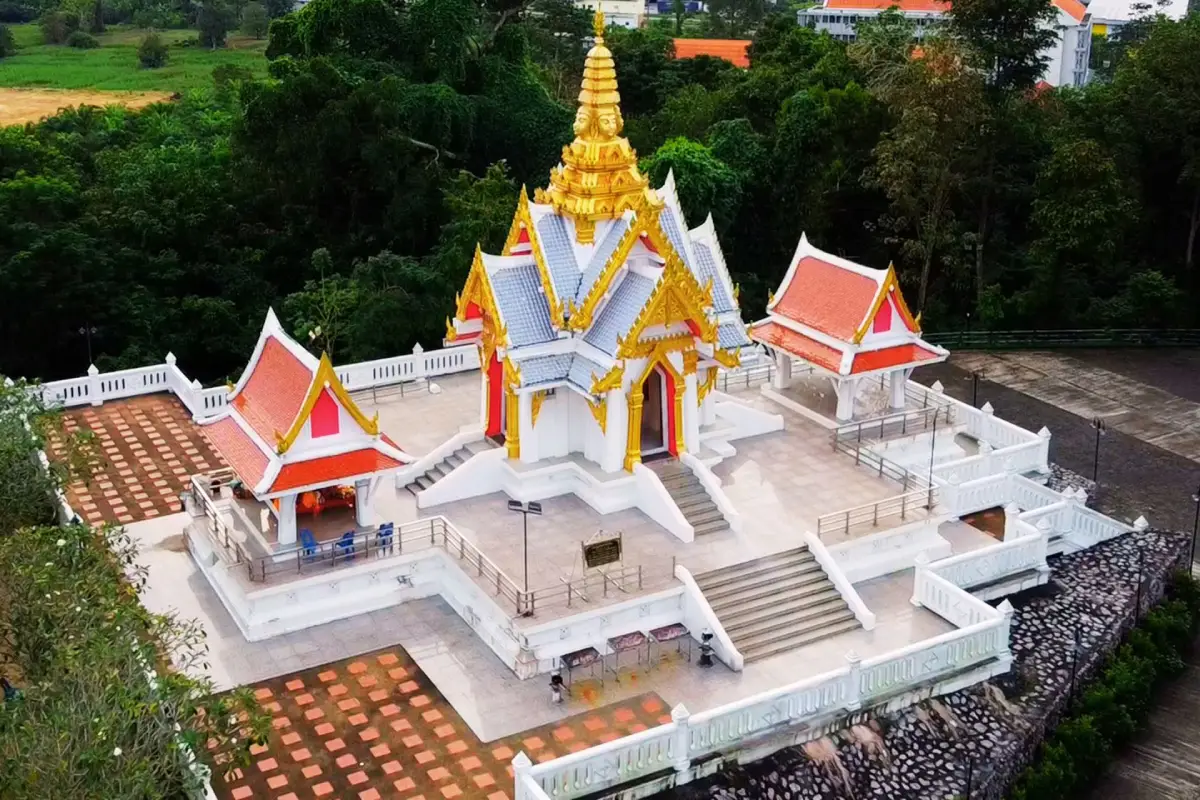
Phatthalung City Pillar Shrine is one of the province's most important sacred landmarks and a spiritual center for residents of southern Thailand. It is located within the grounds of Wat Khuan Prong, Moo 2, Tha Miram Subdistrict, Mueang Phatthalung District, Phatthalung Province 93000. The shrine stands on elevated ground overlooking parts of Phatthalung Town and the distinctive limestone mountain of Khao Ok Thalu. It was designed by Associate Professor Dr. Pinyo Suwankiri, a National Artist in architecture, in the form of a traditional four-sided Thai pavilion with layered roofs, white-and-gold decorative details, and an ornate prang-style spire featuring four faces of Brahma. Inside is a sacred city pillar made from Ratchaphruek, or golden shower tree wood, donated by Wat Khao Chiak and carved by craftsmen at Phatthalung Central Prison. Construction began on June 18, 2010, and was completed in 2011. Additional restoration and landscaping work was completed in 2019, followed by the royal opening on November 28, 2020. The shrine remains an active place of worship and a destination for visitors interested in provincial history and traditional Thai architecture.
One of the shrine's distinguishing characteristics is the way it combines the history of Phatthalung's former administrative centers with beliefs surrounding the sacred foundation of a town. Phatthalung has a long history and has moved its administrative center several times. The establishment of the present city pillar shrine was therefore especially meaningful because it brought memories of the earlier towns together within a new spiritual landmark for residents of the province.
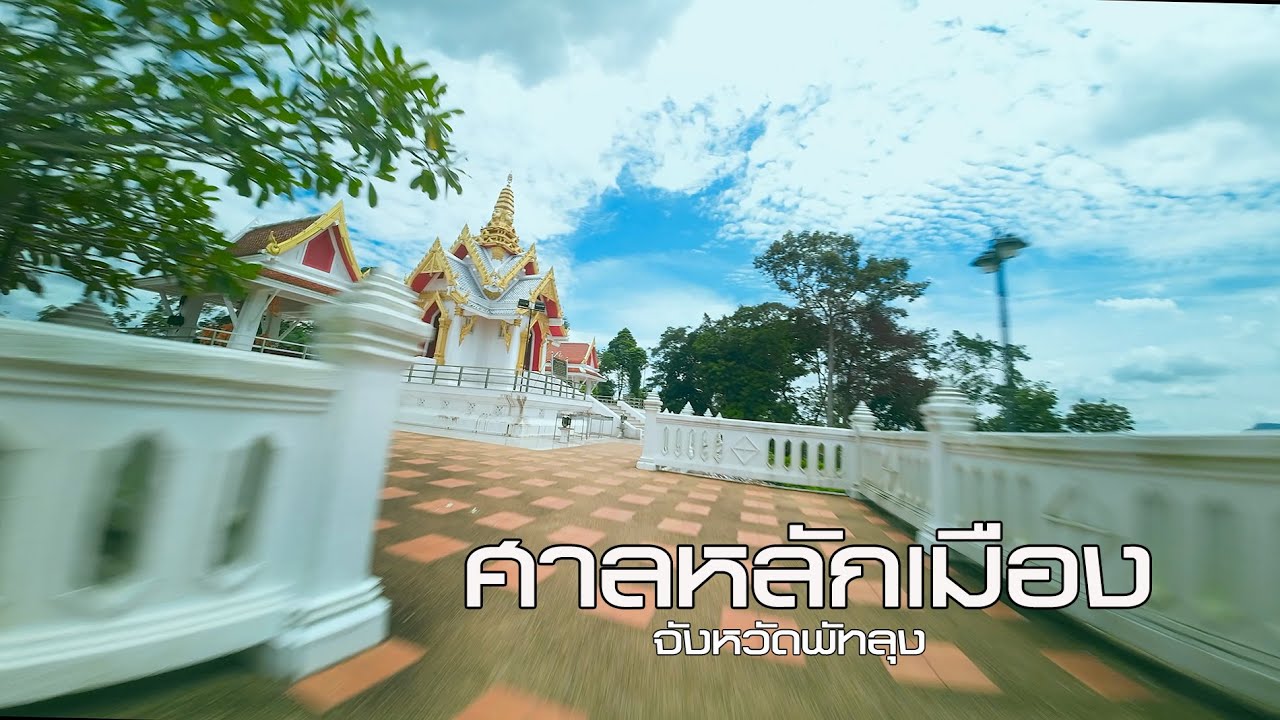
The shrine stands on the southern side of Wat Khuan Prong, an old Buddhist temple in Tha Miram Subdistrict. Its elevated position offers extensive views across parts of the town, while its road connections provide convenient access from the surrounding districts. At the upper courtyard, the white pavilion and its gilded ornaments stand prominently against the landscape. The setting is particularly notable because visitors can appreciate both the ceremonial building and the geographical character of Phatthalung.
Khao Ok Thalu, the limestone mountain that symbolizes Phatthalung, is an important part of the surrounding view. The mountain's distinctive opening makes it one of the province's most recognizable natural landmarks. Seeing it from the area around the city pillar shrine adds another dimension to a visit, connecting the sacred architecture with a landscape that has long been associated with local identity.
Phatthalung Province occupies an important position in the history of the southern Thai peninsula. Its geography is shaped by the Songkhla Lake basin, agricultural plains, woodlands, and mountains along its western side. Historical communities developed in locations suited to farming, trade, transportation, and access to natural resources. Political changes and settlement patterns resulted in the town having several different administrative centers over time.
Important historical locations associated with the former town include Khok Bang Kaeo, the old town of Chai Buri, and Ban Lam Pam. Each represents a different period and geographical setting in the development of Phatthalung. These locations demonstrate that the province's administrative history extends far beyond the present urban center.
Khok Bang Kaeo was associated with an early phase of the town's historical development in a landscape connected with waterways and Songkhla Lake. Communities in this part of southern Thailand maintained relationships with neighboring settlements and regional centers. Changes in administration and security conditions contributed to the movement of the town during later periods.
The old town of Chai Buri is another important historical location. Its landscape offered different advantages from lakeside settlements, including opportunities for settlement and defense. Considering Chai Buri alongside Khok Bang Kaeo and Ban Lam Pam reveals how the selection of administrative centers reflected the needs of different historical periods.
Ban Lam Pam was closely associated with the lake and the water routes used for transportation and commerce. These connections made the community significant during another stage of Phatthalung's history. Today, Lam Pam continues to preserve landscapes and local attractions that reflect the province's longstanding relationship with Songkhla Lake.
In 1923, Phatthalung's administrative center was relocated to the area now associated with Khuha Sawan Subdistrict. This developed into the present provincial town. However, a new city pillar shrine was not established immediately after the relocation. Because the town had moved several times, evidence concerning earlier city pillars was incomplete, creating the historical context for constructing the present provincial shrine.
In Thai tradition, the establishment of a city pillar symbolizes the ceremonial foundation and spiritual stability of a settlement. The pillar represents auspiciousness, prosperity, and the shared identity of the community. Traditional beliefs also refer to guardian deities, including Phra Song Mueang and Phra Suea Mueang, who are associated with protecting the town and its inhabitants.
The city pillar tradition encompasses more than the physical column. It also involves selecting an auspicious location, preparing the ceremonial area, and performing prescribed rites. Different towns may adopt different architectural forms and ceremonial practices, but the central idea remains the establishment of a sacred symbol of civic stability.
The modern proposal to create a city pillar shrine in Phatthalung developed during 1995–1996, around the commemoration of the 50th anniversary of King Bhumibol Adulyadej's accession to the throne. Royal permission was granted for the project, which was intended both as a commemorative landmark and as a spiritual center for the people of Phatthalung.
During this period, Governor Prasit Phannaphisut and other provincial officials supported the concept. However, the project required further preparation involving the selection of land, funding, and coordination among different organizations. Construction was consequently not completed during the initial period of planning.
In 2010, Governor Winai Kruwanphat and representatives of government agencies and the community renewed efforts to establish the shrine. A working group considered suitable locations, focusing on topography, access, the surrounding scenery, and the historical importance of each proposed site.
The group selected land at Wat Khuan Prong, Moo 2, Tha Miram Subdistrict. The location stood on elevated ground with attractive views and convenient road access. It was also associated with an established Buddhist temple and a long history of local religious life. These qualities made it an appropriate setting for a new provincial sacred landmark.
The decision to build the shrine within the grounds of Wat Khuan Prong distinguishes it from city pillar shrines located beside provincial halls or commercial streets. Visitors can experience the modern city pillar shrine and explore an older Buddhist temple within the same compound, providing a connection between different historical periods and religious traditions.
Wat Khuan Prong belongs to the Mahanikaya order of Thai Buddhism and stands on elevated ground in the Ban Khuan Prong community. Archaeological remains and historic objects associated with the temple are linked to the Ayutthaya period. Local historical accounts place its establishment as early as 1599, during the reign of King Naresuan.
Records describe the temple land as covering approximately 26 rai, 3 ngan, and 23 square wah, with an additional separate parcel of monastic land. Its elevated setting is reflected in the local place name, as the southern Thai word khuan commonly refers to a hill or raised ground. The place name has been retained through the history of the surrounding community.
The temple contains several types of Buddhist buildings, including an ordination hall, a sermon hall, a Tripitaka library, monks' residences, a chedi, and supporting structures for religious activities. These buildings represent the temple's role as a center of Buddhist worship and community life. The presence of the provincial city pillar shrine within the grounds adds another layer of cultural importance.
The Tripitaka library at Wat Khuan Prong is a particularly interesting example of traditional architecture. It is described as a square wooden building with a terracotta-tiled roof and elements influenced by Chinese art. The structure illustrates the interaction between local southern Thai craftsmanship and architectural forms associated with wider cultural exchanges.
The temple's ordination hall serves Buddhist monastic ceremonies, while the sermon hall accommodates religious activities involving monks and laypeople. These functions differ from those of the city pillar shrine, whose purpose is the enshrinement and worship of the sacred civic pillar. The two sites coexist while retaining their distinct religious and ceremonial roles.
Wat Khuan Prong is also associated with the cultural history of the phon, a large traditional drum closely connected with Phatthalung's local identity. Historical accounts mention Phon Rueang Decha, formerly known as Phon Khrong Phuk, a drum connected with the temple's community. Such drums were traditionally used to communicate time, announce important events, and support local ceremonies.
Phon drumming is an important southern Thai cultural tradition, particularly in Phatthalung, where drum competitions and performances form part of local heritage. The history of drums associated with Wat Khuan Prong consequently connects the shrine's setting with another aspect of traditional community life beyond Buddhist worship and historic architecture.
Although the city pillar shrine is situated within Wat Khuan Prong, it is not an ordination hall or a monks' residence and does not have its own abbot. Its ceremonial activities involve the provincial administration, the Phatthalung City Pillar Shrine Foundation committee, and participating local organizations. The temple's monastic administration is distinct from the organizations involved in major city pillar ceremonies.
Construction of the city pillar shrine began on June 18, 2010, with financial support from residents and other donors. Contributions toward the project exceeded 12 million baht. This public support reflected a shared desire to establish a provincial sacred landmark that would preserve the tradition of city pillars while expressing the artistic character of southern Thailand.
Associate Professor Dr. Pinyo Suwankiri, a National Artist in architecture, was commissioned to design the shrine. His design incorporated traditional Thai architectural forms with details suited to the southern region. The building was intended to be both an impressive work of ceremonial architecture and a functional space for the worship of the city pillar.
The construction area measured approximately 25 by 30 meters, with the principal pavilion occupying an area of 8 by 8 meters and rising approximately 15.79 meters above ground level. The building stands on a raised platform, emphasizing its sacred function and allowing it to be seen clearly from the surrounding courtyard and elevated landscape.
The main pavilion follows the four-sided chatumuk tradition, with a two-tiered roof and a central prang-style spire depicting the four faces of Brahma. Its uppermost point is decorated with a traditional nopphasun finial. The arrangement gives the shrine a dignified silhouette and highlights the central sacred space housing the city pillar.
The four-faced image of Brahma is associated with Brahmanical traditions and symbolic concepts that have influenced Thai sacred architecture for centuries. Its placement on the spire provides a distinctive identity and relates the architecture to beliefs concerning divine guardianship and the importance of directions.
The nopphasun finial is a traditional ornamental element associated with auspiciousness and the sacred character of important Thai buildings. Its placement at the top of the spire strengthens the pavilion's vertical emphasis and adds to the elaborate appearance of the roof.
The roof is decorated with traditional ornamental features, including elaborate gables, ruy raka, and stylized mythical bird motifs. Gold-colored decoration contrasts with the white surfaces and red accents of the building. These details reflect the refinement of traditional Thai craftsmanship and contribute to the shrine's ceremonial dignity.
The base of the pavilion incorporates lotus-shaped moldings, stucco patterns, decorative door frames, capitals, and supporting brackets. The architectural details were arranged to create harmony between the foundation, walls, and upper spire. As a result, the shrine is a complete work of ceremonial architecture rather than a simple shelter over the sacred pillar.
Staircases provide access from all four directions, corresponding with the chatumuk design and its emphasis on symmetry. The front staircase forms the principal visual approach from the lower courtyard, while the other entrances allow access from additional parts of the surrounding grounds.
Smaller pavilions beside the principal building have been used for the sale of flowers, incense, candles, and other offerings. Their traditional Thai architectural appearance complements the main shrine and provides practical facilities for worshippers.
The principal construction was completed in 2011, but further work continued to improve the shrine grounds. Additional stairs, electrical lighting, building repairs, and landscaping were undertaken to prepare the site for ceremonies and visitors. The major improvements were completed in September 2019.
The sacred pillar inside the shrine was made from Ratchaphruek wood donated by Wat Khao Chiak in Phatthalung Province. Ratchaphruek, also known as the golden shower tree, is associated with auspiciousness, stability, and prosperity in Thai culture. Choosing this wood connected the sacred object with both traditional symbolism and the province's own communities.
Ratchaphruek is familiar throughout Thailand for its clusters of bright yellow blossoms. The tree's auspicious associations have made it significant in several ceremonial settings. Using wood donated from within Phatthalung also gives the pillar a distinctly local connection.
Phatthalung Central Prison was entrusted with carving the Ratchaphruek wood into the sacred pillar. The design included a traditional mondop-shaped upper finial and proportions inspired by the Bangkok City Pillar. The carving required precision in shaping the wood and creating ornamental details appropriate to an important ceremonial object.
The city pillar project also involved bringing soil from ten historical town sites associated with earlier periods of Phatthalung's history. The soil was incorporated into the ceremonial establishment of the new city pillar. This ritual symbolically connected the modern sacred landmark with the province's former administrative centers.
The use of soil from different old town locations is especially meaningful because Phatthalung had moved its administrative center several times. Through this ceremony, the memories of former settlements were brought together within a new spiritual symbol. The ritual expressed respect for the different communities and places that had contributed to the province's development.
On November 6, 2020, the province began important ceremonies associated with bringing the city pillar to its place of enshrinement. On November 7, ceremonies were held to consecrate the pillar, sacred inscriptions, and soil associated with the cardinal directions. On November 8, the city pillar was ceremonially installed in accordance with traditional practices.
The ceremonial installation was a crucial event because it formally placed the sacred column within the building prepared for it. Buddhist chanting and traditional offerings expressed hopes for peace, prosperity, and the continued well-being of the province.
November 28, 2020, became one of the most important dates in the shrine's history. King Maha Vajiralongkorn and Queen Suthida traveled to Wat Khuan Prong in Tha Miram Subdistrict and formally opened Phatthalung City Pillar Shrine.
During the royal ceremony, the King sprinkled and anointed sacred inscriptions before they were placed within the upper section of the city pillar. He installed the ornamental finial and paid his respects to the sacred pillar. Buddhist monks chanted auspicious verses, accompanied by traditional ceremonial instruments. The occasion became an important part of the province's contemporary history.
The King also planted a Payom tree, the provincial tree of Phatthalung, within the shrine grounds. Payom is known for its pale yellow, fragrant blossoms. The commemorative planting created another historical feature associated with the royal opening and connected the shrine with the natural symbols of the province.
The Payom tree has significance as part of Phatthalung's provincial identity. Its presence within the sacred compound adds a living element of historical remembrance to the landscaped setting, complementing the architectural and ceremonial features of the shrine.
Further ceremonial developments continued after the royal opening. On February 10, 2022, the province held a ceremony to install carved representations of the Four Great Guardian Kings within the shrine. The figures were placed in the upper corners of the building to symbolize protection from the four directions.
The Four Great Guardian Kings are represented by Thao Wessuwan, Thao Thatarot, Thao Wirupak, and Thao Wirunhok. Their relief carvings form part of the interior wooden decoration. In Buddhist cosmology, these figures are associated with guardianship over the different directions and the protection of living beings.
Thao Wessuwan is associated with the north, Thao Thatarot with the east, Thao Wirunhok with the south, and Thao Wirupak with the west. Their arrangement in the shrine reflects the importance of direction in traditional cosmological beliefs and gives ceremonial meaning to different parts of the interior.
The guardian carvings connect the building's four-sided architectural form with beliefs about protection from all directions. Considered together with the four-faced Brahma on the spire and the city pillar at the center, they reveal a deliberate integration of architecture and religious symbolism.
Phatthalung City Pillar Shrine consequently contains many features of artistic interest, including the chatumuk roof, the Brahma-faced spire, the nopphasun finial, traditional gables, carved brackets, lotus-shaped moldings, the Ratchaphruek city pillar, and the Four Great Guardian Kings. These details reflect both the craftsmanship involved in its construction and the ceremonial meanings of the architectural design.
The shrine's importance to residents is reflected in the continued practice of worship. Common offerings include flowers, incense, candles, garlands, colored cloth, and other traditional objects. Some visitors come to pray for stability in life, career success, personal safety, or family well-being, while others pay their respects when returning to their hometown or traveling through the province.
On particularly auspicious dates, large numbers of worshippers visit the shrine. On July 5, 2025, a day associated with the traditional belief known as Saturday Five, residents and visitors gathered to make offerings. Flowers, incense, bananas, red soft drinks, and lamp oil were among the ceremonial items, while some devotees tied colored cloth around the sacred pillar.
Saturday Five refers to an auspicious combination of Saturday and the fifth lunar day in certain Thai traditional belief systems. Some worshippers regard this as an important occasion for religious observances and seeking blessings. The large gathering at the shrine demonstrates the continuing relevance of these beliefs in contemporary community life.
For many visitors, paying respect to the city pillar is also an expression of connection with home. Residents who work in other provinces sometimes return during holidays and visit the shrine as part of a family trip. The practice reflects personal faith as well as emotional ties to the province and its cultural identity.
Annual city pillar celebrations provide another opportunity for people to gather at the sacred landmark. These events typically involve offerings, merit-making, and cultural activities arranged by provincial agencies, local authorities, and community organizations. They help preserve the meaning of the city pillar and provide occasions for younger generations to learn about its history.
From November 26 to November 30, 2024, Phatthalung Province organized a major city pillar celebration in cooperation with the Provincial Cultural Office, Tha Miram Municipality, and other organizations. The program included merit-making, almsgiving for 73 Buddhist monks, traditional worship ceremonies, and cultural activities.
The 2024 celebration also strengthened connections between the shrine and the Tha Miram community. Residents, government agencies, and local organizations gathered at the site, and visitors from other areas learned about its construction and the historical importance of Wat Khuan Prong.
Such festivals contribute to community cultural life and the local economy. Increased visitor activity creates opportunities for nearby businesses and community groups, while ceremonies and performances expose younger residents to local customs and traditional arts.
Beyond annual festivals, the shrine is an important destination for cultural tourism in central Phatthalung. Its architecture, elevated views, and proximity to an old Buddhist temple create a distinctive combination. The site appeals to people interested in provincial history, personal worship, traditional craftsmanship, and the geography of the town.
The front courtyard offers a clear view of the principal pavilion on its raised platform. The projecting roof sections and gilded spire can be appreciated from below, while the sides reveal the dimensional complexity of the four-sided design and the relationship between the main building and smaller pavilions.
Access to the upper shrine area is provided by the main staircase, a staircase near the temple, and a road suitable for vehicles. These routes connect the shrine with Wat Khuan Prong and the surrounding road network. The upper grounds also provide views of the town and distant mountains.
Looking across the town from the elevated courtyard reveals aspects of Phatthalung's geography, including limestone formations, urban settlements, and surrounding lowlands. The appearance of Khao Ok Thalu in the wider landscape connects the modern sacred building with a natural landmark that has long represented the province.
Khao Ok Thalu is a limestone mountain distinguished by an opening through its central section. Its name refers to this unusual natural feature. Located near Phatthalung Town, the mountain is closely associated with the visual identity of the province and makes a useful companion destination to the city pillar shrine.
Wat Khuha Sawan is another important Buddhist temple in the town area. It is associated with limestone caves, historic settlement, and local Buddhist traditions. Visiting it alongside the city pillar shrine introduces the contrast between an old cave temple and a more recently constructed civic sacred landmark.
Wat Khuha Sawan also has significance in relation to the development of Khuha Sawan Subdistrict, which became the administrative center after the town's relocation in 1923. Its location and name help illustrate the historical geography of central Phatthalung.
Phra Phuttha Nirokhantrai Chaiwat Chaturathit, also known locally as Phra Si Mum Mueang, is an important Buddha image enshrined in Phatthalung Town. The image belongs to a broader group of Buddha images associated with protection of the country's different regions. It is respected by Buddhist devotees and represents a different sacred tradition from the city pillar.
It is important to distinguish Phra Si Mum Mueang from Phatthalung City Pillar Shrine. The former is a Buddhist image, while the latter houses a civic sacred pillar associated with beliefs concerning the foundation and stability of a town. Both are revered landmarks, but their histories and ceremonial functions differ.
The Shadow Puppet Gallery in Tha Miram is another cultural attraction that can be combined with the city pillar shrine. It is dedicated to Nang Talung, the traditional southern Thai shadow-puppet theater. Visitors can learn about the carved leather puppets, the techniques used to make them, and their cultural role within Phatthalung.
Nang Talung performances involve intricately carved leather figures moved behind a screen, with spoken dialogue, storytelling, and regional music. The stories may draw from folklore, literature, or everyday life in southern Thailand. The gallery highlights a form of cultural heritage that complements the shrine's ceremonial and architectural significance.
The Suchart Sapsin Shadow Puppet House is another recognized cultural learning destination in Phatthalung. It is associated with the preservation of puppet carving and traditional shadow-puppet performance. Its activities demonstrate the continuing value of local craftsmanship and artistic knowledge.
Wat Wang is an important historic Buddhist temple in Mueang Phatthalung District. It is known for traditional religious architecture and artwork, including mural paintings. Visiting Wat Wang alongside the city pillar shrine offers a comparison between the province's older temple art and the carefully designed contemporary shrine.
Lam Pam Lake is a well-known recreational area beside Songkhla Lake. Its broad waters and lakeside landscape have long been connected with local communities and travel. Lam Pam also has historical significance as one of the earlier locations associated with the town of Phatthalung.
Saen Suk Beach at Lam Pam provides an open lakeside setting where residents and visitors can relax and enjoy views of the water. The area reflects Phatthalung's relationship with the Songkhla Lake system and surrounding wetlands rather than an open-sea coastline.
Traveling from the elevated city pillar shrine to Lam Pam highlights the province's contrasting landscapes. The shrine overlooks parts of the town from higher ground, while Lam Pam is closely associated with lakeside settlements and waterways. The historical relationship between these different landscapes makes them meaningful destinations within the same district.
Thale Noi, in Khuan Khanun District, is one of Phatthalung's best-known wetland attractions. The area contains open water, aquatic plants, and seasonal birdlife, forming an important natural ecosystem. It demonstrates the close relationship between local communities and the region's wetland environments.
The 80th Birthday Anniversary Bridge is another popular landmark in the wider Thale Noi area. The road crosses a landscape of wetlands and grasslands, offering views of the region's distinctive natural scenery. Visiting the bridge provides a further contrast with the historic and sacred attractions of Phatthalung Town.
Phatthalung's food culture reflects the combination of agriculture, freshwater resources, and southern Thai culinary traditions. Local dishes commonly incorporate vegetables, freshwater fish, aromatic herbs, and strongly flavored curry pastes. Popular meals include sour curries, spicy stir-fries, fish dishes, and khanom chin served with vegetables.
The province's food scene also reflects the influence of trading communities and cultural exchanges across southern Thailand. Restaurants in the town range from simple noodle and rice-soup shops to family restaurants and larger establishments offering Thai and Chinese-influenced food.
Thewtat Highway Restaurant in Tha Miram is a large roadside establishment serving Thai food and seafood along Phetkasem Road. Baeb Thai, on the Phatthalung–Hat Yai route, combines dining, drinks, and other services. These venues differ from smaller community restaurants and serve both local residents and travelers using the main road corridor.
Som Tam Mae Mim in Tha Miram specializes in spicy papaya salad and casual Thai dishes. Baan Hoonop, also in Tha Miram, provides food in a setting associated with a natural waterway. Together, they illustrate the variety of dining experiences near the wider city pillar shrine area.
Within central Phatthalung, Khu Hu Restaurant on Pracha Bamrung Road is an established Thai-Chinese dining venue. Lap Pak Mueang Lung serves a variety of casual dishes in Khuha Sawan, while Khao Tom U-Turn on Rames Road offers rice soup and other meals during the evening and nighttime.
Khanom Chin Mae Tuk near Tha Miram Bridge is another example of traditional southern Thai dining. Khanom chin, fermented rice noodles commonly served with curry sauces and fresh vegetables, remains a familiar part of the regional diet and local food culture.
Kiang Talay Terrace in Lam Pam offers Thai cuisine with views of Songkhla Lake. Dining in the lakeside area can be combined with a journey from the city pillar shrine to Lam Pam's historic and natural attractions.
Accommodation in Phatthalung is available in both the town center and the surrounding Tha Miram area. Dusit Princess Phatthalung on Manora Road provides modern facilities for travelers and is connected by road to the city pillar shrine and other district attractions.
Siva Royal Hotel on Phatthana Road is a town hotel suited to business and leisure travelers. The Centris Hotel on Pho Sa-at Road is centrally located near commercial areas and Phatthalung Railway Station, providing access to shops, restaurants, and urban transport connections.
City Park Hotel on Phadung Don Yo Road and Mest Hotel in the Disra–Sakhonrin area provide additional accommodation in central Phatthalung. Phatthalung Meridian on Manora Road in Khuan Maphrao offers an alternative outside the densest town-center area. These hotels differ in their locations, facilities, and atmosphere.
Staying in Mueang Phatthalung District provides convenient access to several cultural and natural attractions, including the city pillar shrine, Wat Khuan Prong, Khao Ok Thalu, Wat Khuha Sawan, Phra Si Mum Mueang, the Shadow Puppet Gallery, and Lam Pam. Main roads also connect the town with Thale Noi and attractions in neighboring districts.
Getting There: Phatthalung City Pillar Shrine is situated within Wat Khuan Prong, Moo 2, Tha Miram Subdistrict, Mueang Phatthalung District, Phatthalung Province 93000, Thailand. Drivers using Phetkasem Road can enter Tha Miram and follow the local roads toward Wat Khuan Prong and the shrine. A vehicle access road reaches the upper grounds, while staircases also connect the shrine with the lower area.
Travelers arriving at Phatthalung Railway Station can continue by local transport or private vehicle toward Tha Miram. Visitors traveling from neighboring provinces can use Phetkasem Road, one of the main north–south routes through southern Thailand. Wat Khuan Prong and Phatthalung City Pillar Shrine are both identifiable destinations on digital maps.
A cultural route can begin at the city pillar shrine and Wat Khuan Prong before continuing to the Shadow Puppet Gallery, Khao Ok Thalu, Wat Khuha Sawan, and Phra Si Mum Mueang. Such a journey combines an old Buddhist temple, a modern city pillar shrine, traditional performing arts, and the natural limestone landscape for which Phatthalung is known.
Travelers interested in the province's administrative history can extend the journey to Lam Pam and other former town sites. Exploring these places together reveals how settlements developed in different landscapes, including elevated ground, lowlands, and lakeside communities.
Phatthalung City Pillar Shrine is particularly valuable for preserving historical memories of the former town centers. Its creation involved bringing soil from ten historic locations into the ceremonial establishment of the new pillar. This practice symbolically united the different stages of the province's history within one sacred landmark.
Building the shrine within Wat Khuan Prong also created a connection between Ayutthaya-period religious heritage and contemporary Thai architecture. The temple continues to function as a place of Buddhist worship and local cultural activities, while the city pillar shrine represents provincial guardian traditions. Together, they give the compound multiple layers of historical and ceremonial significance.
Wat Khuan Prong remains important to the Tha Miram community through religious observances, traditional buildings, and local cultural knowledge. The presence of the city pillar shrine has also attracted visitors from other parts of the province, strengthening the temple's role as a destination for both religious and historical learning.
Architecturally, the shrine demonstrates the adaptation of traditional Thai ceremonial forms through the work of a National Artist. The Brahma-faced spire, ornamented roof, lotus-shaped moldings, and carved guardian figures show how craftsmanship and symbolic beliefs were incorporated into the building's design.
In terms of popular devotion, the shrine remains an active place where people present offerings and participate in auspicious ceremonies. Visits on Saturday Five and during annual celebrations demonstrate that the building is not simply a monument, but a functioning sacred landmark with continuing importance in local life.
Socially, the shrine represents cooperation among provincial agencies, the shrine foundation, local authorities, and residents. Public fundraising, ceremonial preparations, and annual celebrations reflect a shared commitment to maintaining an important symbol of Phatthalung for future generations.
Phatthalung City Pillar Shrine therefore connects the province's historical town sites with its modern cultural identity. From the choice of Wat Khuan Prong and the construction begun in 2010 to the landscaping completed in 2019, the royal opening in 2020, and subsequent ceremonies, its development reflects the continuing significance of city pillar traditions in southern Thailand.
With its four-sided Thai pavilion, Brahma-faced spire, gilded Ratchaphruek pillar, Four Great Guardian Kings, and elevated setting overlooking the landscape of Khao Ok Thalu, Phatthalung City Pillar Shrine brings together history, architecture, nature, and popular devotion. Its location within the historic grounds of Wat Khuan Prong makes it a meaningful landmark linking the province's past with the cultural life of its present-day communities.
| Place Name | Phatthalung City Pillar Shrine |
| Address | Wat Khuan Prong Grounds, Moo 2, Tha Miram Subdistrict, Mueang Phatthalung District, Phatthalung Province 93000, Thailand |
| Wat Khuan Prong Reference Coordinates | 7.59912579, 100.062910125 |
| Type of Attraction | City Pillar Shrine, Provincial Sacred Landmark, Cultural and Architectural Attraction |
| History | Construction Began on June 18, 2010; Completed in 2011; Major Landscaping and Repairs Completed in September 2019; Royal Opening on November 28, 2020 |
| Architect | Associate Professor Dr. Pinyo Suwankiri, National Artist in Architecture |
| Construction Area | Approximately 25 × 30 m; Main Pavilion 8 × 8 m, Approximately 15.79 m High |
| Architecture | Four-Sided Thai Chatumuk Pavilion with Two-Tiered Roof, Four-Faced Brahma Spire, Nopphasun Finial, and White-and-Gold Ornamentation |
| Sacred City Pillar | Made from Ratchaphruek (Golden Shower Tree) Wood Donated by Wat Khao Chiak and Carved at Phatthalung Central Prison |
| Historical Significance | Established as a Shared Sacred Landmark Following Multiple Historical Relocations of Phatthalung's Administrative Center; Soil from Ten Former Town Sites Was Incorporated into the Ceremonial Establishment |
| Main Areas and Features | 1. Four-Sided Main Pavilion 2. Sacred City Pillar Chamber 3. Four Great Guardian Kings Relief Carvings 4. Offering Pavilion 5. Staircases and Vehicle Access Road 6. Ceremonial Courtyard and Viewpoint 7. Wat Khuan Prong Temple Grounds and Historic Buildings |
| Management and Ceremonial Organizations | Phatthalung Provincial Administration, Phatthalung City Pillar Shrine Foundation Committee, and Participating Local Authorities |
| Host Temple | Wat Khuan Prong, a Mahanikaya Buddhist Temple with Ayutthaya-Period Historical Associations, an Ordination Hall, Tripitaka Library, Sermon Hall, and Monastic Residences |
| Important Traditions | City Pillar Worship, Auspicious-Day Offerings, Annual Celebrations, and the Installation of the Four Great Guardian Kings; Major Celebration Held November 26–30, 2024 |
| Open Days | Daily |
| Site Access | Place Listings Indicate 24-Hour Access to the Grounds |
| Admission Fee | No General Admission Ticket Required |
| Facilities | Parking, Restrooms, and Courtyard Access Listed in Visitor Information |
| Getting There | From Phetkasem Road, Enter Tha Miram Subdistrict and Continue Toward Wat Khuan Prong and the City Pillar Shrine |
| Tourism Listing Contact | +66 61 214 9082 |
| Attractions in the Surrounding Area | 1. Wat Khuan Prong – Same Grounds as the Shrine 2. Shadow Puppet Gallery – Phetkasem Road, Tha Miram, Tel. +66 89 462 9314 3. Khao Ok Thalu – Mueang Phatthalung District 4. Wat Khuha Sawan – Khuha Sawan Subdistrict 5. Phra Phuttha Nirokhantrai Chaiwat Chaturathit – Central Phatthalung 6. Wat Wang – Mueang Phatthalung District 7. Saen Suk Beach, Lam Pam – Lam Pam Subdistrict 8. Suchart Sapsin Shadow Puppet House – Mueang Phatthalung District |
| Restaurants in Phatthalung Town and Connected Areas | 1. Thewtat Highway – Phetkasem Road, Tha Miram, Tel. +66 74 673 808 2. Baeb Thai – Phatthalung–Hat Yai Road, Tha Miram, Tel. +66 89 876 2235 3. Som Tam Mae Mim – Phetkasem Road, Tha Miram, Tel. +66 83 399 1328 4. Baan Hoonop – Tha Miram, Tel. +66 87 269 4817 5. Khu Hu Restaurant – Pracha Bamrung Road, Khuha Sawan, Tel. +66 74 611 938 6. Lap Pak Mueang Lung – Khuha Sawan, Tel. +66 81 698 2181 7. Khanom Chin Mae Tuk – Tha Miram Bridge Area, Tel. +66 63 161 4519 8. Khao Tom U-Turn – Rames Road, Tel. +66 96 810 0383 |
| Accommodations in Phatthalung Town and Connected Areas | 1. Dusit Princess Phatthalung – Manora Road, Tha Miram, Tel. +66 74 880 777 2. Siva Royal Hotel – Phatthana Road, Khuha Sawan, Tel. +66 74 673 999 3. The Centris Hotel Phatthalung – Pho Sa-at Road, Khuha Sawan, Tel. +66 74 616 555 4. City Park Hotel – Phadung Don Yo Road, Tel. +66 74 613 516 5. Mest Hotel – Disra–Sakhonrin Road, Tel. +66 74 611 636 6. Phatthalung Meridian – Manora Road, Khuan Maphrao, Tel. +66 81 978 8477 |
| Current Status | Open as an Active Provincial Sacred Landmark and Cultural Attraction |
Frequently Asked Questions (FAQ)
Q: Where is Phatthalung City Pillar Shrine located?
A: The shrine is within Wat Khuan Prong, Moo 2, Tha Miram Subdistrict, Mueang Phatthalung District, Phatthalung Province 93000, Thailand.
Q: Is Phatthalung City Pillar Shrine still open to visitors?
A: Yes. It remains an active place of worship, with place listings indicating daily access to the grounds.
Q: Is there an admission fee?
A: No general admission ticket is required to visit the city pillar shrine.
Q: When was Phatthalung City Pillar Shrine built?
A: Construction began on June 18, 2010, and was completed in 2011. Landscaping and restoration work was completed in September 2019, followed by the royal opening on November 28, 2020.
Q: Who designed the shrine?
A: Associate Professor Dr. Pinyo Suwankiri, a National Artist in architecture, designed the building.
Q: What kind of wood was used for the city pillar?
A: The pillar was made from Ratchaphruek, or golden shower tree wood, donated by Wat Khao Chiak and carved at Phatthalung Central Prison.
Q: What are the shrine's most distinctive architectural features?
A: They include the four-sided Thai pavilion, layered roofs, the four-faced Brahma spire, the nopphasun finial, white-and-gold decoration, and the Four Great Guardian Kings relief carvings inside.
Q: Is Phatthalung City Pillar Shrine part of Wat Khuan Prong?
A: The shrine is located within the Wat Khuan Prong grounds. However, the city pillar shrine and the Buddhist monastery have different ceremonial functions and organizational responsibilities.
 Category: ●Places of Worship
 Group: ●Other Sacred Sites
Last Update : 5 DayAgo
 Last Update : 5 DayAgo
 Click to Access the Navigation Map GPS
Phatthalung City Pillar Shrine Map
Recommend

 Art, Culture and Heritage
 Historical Sites and Monuments(1)
 Landmarks and Memorials(1)
 Art, Craft Centres, Tradition(6)
 Historic Homes and Cities(1)
 Educational Places
 Educational Gardens, Farm(1)
 Temple(25)
Other Sacred Sites(4)
 Research and Development
 Royal Project(2)
 Suburban Living
 Village, Community(3)
 Nature and Wildlife
 National Parks and Marine Reserves(3)
 Mountain (Doi)(4)
 Dam, Reservoir, Lake(7)
 Waterfalls(16)
 Hot Springs(2)
 Caves(12)
 River, Canal(5)
 Bays and Beaches(6)
 Islands(2)
 Other natural attractions(4)
 Entertainment and Agricultural
 Farms, Parks and Ecotourism(4)
 Travel Articles, Recipes
 Travel Review, Food Review(1)


