
lovethailand home >Eastern Travel Attractions >Rayong Travel Attractions >Muang Rayong >Tha Pradu > Rayong City Pillar Shrine
TL;DR: Rayong City Pillar Shrine is located at 10/1 Lak Mueang Road (Sukhumvit Nakhon Rayong 62), Tha Pradu Subdistrict, Mueang Rayong District, Rayong 21000, Thailand, open Daily, hours 06:00 – 18:00.
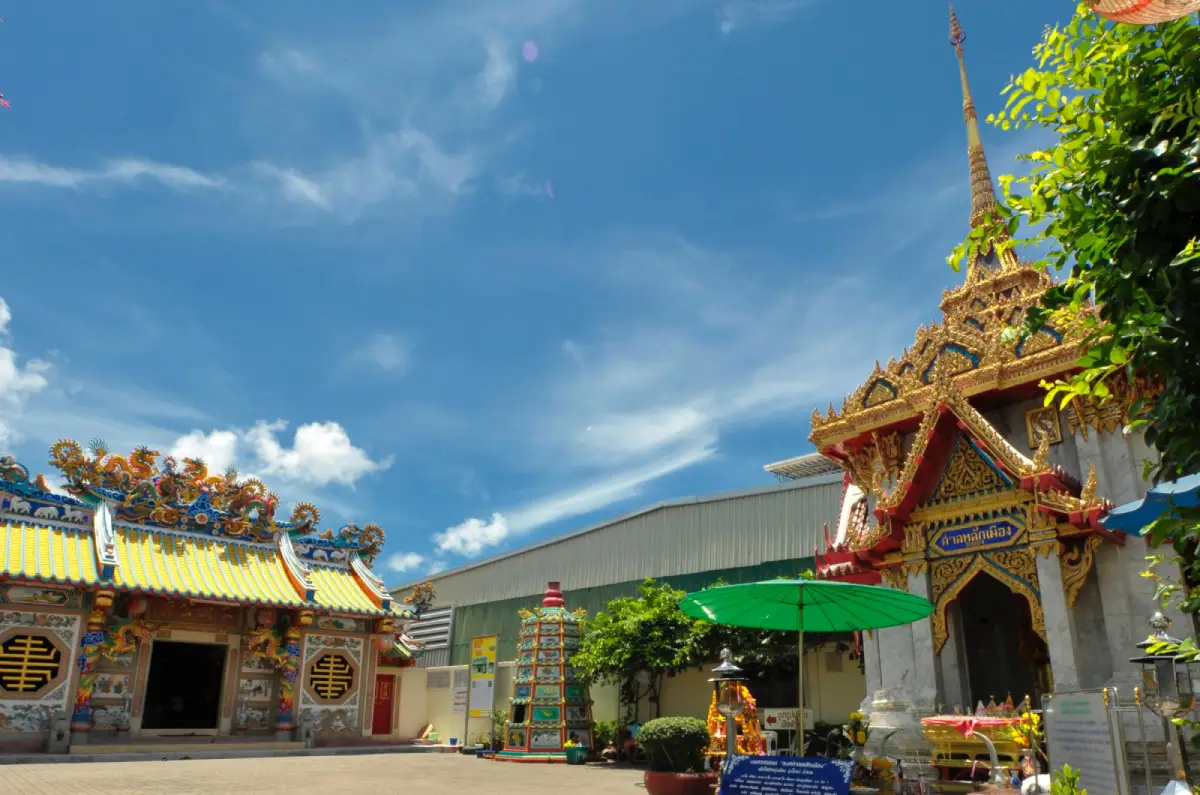
Rayong City Pillar Shrine
Open Days: Daily
Opening Hours: 06:00 – 18:00
Rayong City Pillar Shrine is one of the most important sacred civic landmarks in Rayong Province, eastern Thailand. Located at 10/1 Lak Mueang Road, also known as Sukhumvit Nakhon Rayong 62, Tha Pradu Subdistrict, Mueang Rayong District, Rayong 21000, the shrine stands in the heart of the historic town. It houses the sacred city pillar of Rayong, whose history dates to 1895 during the reign of King Chulalongkorn, Rama V. After the original wooden shrine deteriorated, the community undertook a major reconstruction project during the late twentieth century. Today, the complex contains a beautifully decorated Thai-style four-sided pavilion housing the city pillar and a separate Chinese-style shrine dedicated to the city's guardian deity. Together, these buildings represent the coexistence of Thai and Chinese cultural traditions within an established coastal trading community.
The shrine stands in Tha Pradu, one of the historic neighborhoods of central Rayong. The surrounding area contains commercial buildings, houses, markets, Buddhist temples, and old streets that retain connections with the town's earlier development. Although modern Rayong has become a major center of industry, trade, and economic activity along Thailand's eastern seaboard, the City Pillar Shrine continues to serve as a place of devotion for residents and travelers.
The principal architectural attraction is the four-sided Thai pavilion, or chaturamuk mondop, containing the sacred city pillar. Constructed from masonry and faced with granite panels, the building has entrances and staircases on all four sides. Its upper structure takes the form of an elaborately decorated, recessed-corner chedi-like spire finished in gold and blue glass. Inside stands a gilded wooden city pillar with a lotus-bud finial. Stone panels on the interior walls record historical information about the shrine.
Another important building in the complex is the Chinese-style guardian shrine situated to the east of the main pavilion. Its architecture reflects Chinese religious traditions, and the interior houses the revered Chao Pho Lak Mueang, the city's guardian deity. An inscription above the entrance records its construction date as November 4, 1994. This building has a separate architectural and construction history from the Thai pavilion, although both form part of the same sacred complex.
The shrine grounds occupy a relatively compact urban plot measuring approximately 15 meters wide and 40 meters deep. The paved courtyard accommodates worshippers and connects the two principal buildings. Although the site is much smaller than a large Buddhist temple or historical park, its arrangement allows visitors to observe both sacred buildings closely and appreciate their different architectural traditions.
Rayong has a long history as a coastal settlement associated with the Gulf of Thailand and regional trade. The province contains beaches, rivers, canals, agricultural plains, and areas of forested hills. These varied landscapes have supported fishing, fruit growing, agriculture, trade, and other livelihoods. The development of Tha Pradu and nearby communities reflects the importance of locations where inland routes connected with waterways and coastal transport.
The Rayong River played an important role in the town's earlier development. It provided water for communities and served as a route for transporting people and agricultural products. Houses, markets, and commercial neighborhoods grew along routes connecting agricultural areas with coastal settlements. Before modern roads became dominant, boats were essential to everyday transport and trade.
In traditional Thai culture, establishing a city pillar represents the creation of a symbolic center for a town. The pillar is associated with ideas of stability, protection, and auspiciousness. A city pillar shrine consequently has a significance beyond its architecture: it is a place where residents express respect for the guardian powers associated with their community.
Thai city pillar traditions incorporate several layers of belief, including local guardian-spirit traditions, Brahmanical ceremonies, and customs developed by individual communities. The pillar serves as a shared civic symbol, while worship at the shrine expresses hopes for peaceful living, prosperity, and the continuity of the town.
Historical records place the original establishment of Rayong's city pillar in 1895, during the reign of King Chulalongkorn. It was located on Lak Mueang Road in Tha Pradu Subdistrict. The original shrine was made of wood and housed the city pillar according to local tradition. It subsequently became an important sacred landmark within the town.
The late nineteenth century was a period of major administrative change in Thailand. During the reign of King Chulalongkorn, the kingdom underwent reforms affecting provincial government, transportation, and public administration. Rayong developed within this broader historical context as a coastal town connected with trade and the administration of the eastern region.
The original wooden building was exposed to the hot, humid conditions of Thailand's eastern coast. Timber structures required regular maintenance because of rainfall, moisture, and changes in temperature. Over the years, the shrine and city pillar deteriorated, eventually becoming damaged to the extent that the original building could no longer be maintained in its former condition.
After the damage occurred, local residents worked together to restore the city pillar to its original position. At that stage, a substantial protective building had not yet been erected, leaving the pillar exposed to the weather. This episode demonstrates the importance attached to maintaining the sacred location even when the physical structure had deteriorated.
The period during which the pillar stood without a substantial building illustrates how the significance of a sacred civic site can survive changes to its architecture. For residents, the pillar's importance was rooted in shared beliefs and historical memory rather than the scale or appearance of its protective structure.
In 1989, residents of Rayong began planning a comprehensive restoration of the city pillar and shrine. The intention was to create a stronger, more dignified building that could serve as a lasting center of devotion. A committee was established to examine possible approaches, and several meetings were held before agreement was reached on the construction of a masonry chaturamuk pavilion.
The choice of a four-sided pavilion was significant in both architectural and ceremonial terms. Its symmetrical plan emphasizes the sacred center of the building and allows access from different directions. The more durable construction also provides better protection for the city pillar while giving the shrine an appearance appropriate to its importance in the community.
The reconstruction project received extensive support from residents and other devotees. Donations totaling more than 3 million baht helped finance the building and preparation of the shrine grounds. This financial contribution demonstrates the shared commitment of the Rayong community to preserving its sacred civic landmark.
November 2, 1991, marked a major milestone in the reconstruction. On that date, the Supreme Patriarch of Thailand presided over the foundation-stone ceremony for the new city pillar pavilion. The event formally initiated an important stage in the development of the modern shrine.
Foundation-stone ceremonies are associated with auspicious beginnings in Thai cultural traditions. The selection of the ceremonial date and the performance of religious rites express hopes for the successful completion and enduring stability of important buildings. At Rayong, the ceremony also symbolized the community's collective effort to preserve its city pillar.
Another significant event involved the upper section of the city pillar. King Bhumibol Adulyadej, Rama IX, performed the ceremonial sprinkling and anointing of an inscribed sacred plate associated with the pillar's finial. The upper section was subsequently installed on September 1, 1993, during an important ceremony at the shrine.
Local accounts record that a solar halo appeared during the installation ceremony on September 1, 1993. Those attending regarded the phenomenon as an auspicious event. The story has become part of the community's historical memory of the modern shrine's completion and ceremonial establishment.
Following the construction of the Thai pavilion, the grounds were further developed to accommodate local devotional practices. The Chinese-style guardian shrine was built in the eastern part of the complex. Its entrance inscription records November 4, 1994, as the construction date, establishing a separate chronology from that of the main pavilion.
The two buildings represent related but distinct sacred functions. The Thai pavilion contains the city pillar and follows traditional Thai ceremonial architecture. The Chinese-style building houses Chao Pho Lak Mueang and incorporates Chinese religious design. Their coexistence illustrates the cultural diversity of Rayong's historic coastal communities.
The main pavilion is a masonry building faced with granite, giving it a solid and dignified appearance. Its stone surfaces distinguish it from the original timber structure. The strong visual relationship between the granite-clad base and the elaborate gilded upper structure emphasizes both durability and ceremonial importance.
The term chaturamuk refers to a building with four projecting sides or entrances. At Rayong City Pillar Shrine, staircases and doors are arranged on all four sides of the pavilion. This symmetrical design directs attention toward the central interior space containing the sacred pillar and creates a balanced architectural composition.
The upper section takes the form of a recessed-corner, chedi-inspired spire decorated in gold and blue glass. The contrast between gilded surfaces and reflective glass produces a distinctive appearance in daylight. Its vertical form makes the shrine recognizable from the surrounding courtyard and nearby street.
Traditional decorative forms contribute to the pavilion's ornate appearance. Their carefully arranged curves and patterns reflect the artistic vocabulary of Thai ceremonial architecture. The attention given to the spire and roofline emphasizes the sacred significance of the object housed inside.
The city pillar itself is wooden and gilded along its length. Its upper section is carved into the form of a lotus bud. Lotus forms appear frequently in Thai religious art, where they are associated with purity, reverence, and auspiciousness. The finial provides a distinctive artistic feature while reinforcing the pillar's ceremonial importance.
Stone panels on the interior walls record historical accounts and imagery associated with the city pillar. These inscriptions are an important educational feature, allowing visitors to connect the sacred object with the documented events of the shrine's construction and restoration.
The principal offering area is situated in the courtyard to the north of the pavilion. Worshippers can present flowers, garlands, and ceremonial items in the designated space. Separating the offering area from the pillar helps organize the flow of visitors and protects the sacred interior.
The Chinese-style shrine features a different decorative language from the Thai pavilion. Its architectural composition, colored ornamentation, and devotional objects reflect Chinese-influenced traditions. Inside, residents pay respect to Chao Pho Lak Mueang, the local guardian deity.
The presence of Chinese-style sacred architecture is consistent with Rayong's wider history as a coastal trading town. Maritime trade and the movement of people helped create communities where different artistic and religious traditions were maintained. The shrine complex offers a visible example of this cultural interaction.
Residents and travelers visit the shrine to express their respect and make wishes according to personal beliefs. Traditional aspirations may concern family well-being, safety, work, business, and auspicious beginnings. The act of worship also represents a connection with the shared history and identity of Rayong.
Common offerings include flowers, garlands, incense, and candles. Worshippers should use the designated areas and avoid obstructing the pavilion entrances. Respectful conduct is especially important because the site remains an active place of devotion rather than functioning only as a historical attraction.
Rayong City Pillar Shrine is not a Buddhist monastery. It does not have a resident abbot or the same religious functions as a temple with an ordination hall and monastic community. Its principal sacred features are the city pillar pavilion and the Chinese-style guardian shrine. Buddhist temples nearby provide opportunities to study different religious traditions.
The shrine has cultural significance beyond individual worship. Its history connects the nineteenth-century establishment of the city pillar with the collective restoration efforts of residents nearly a century later. This continuity demonstrates how local traditions can remain meaningful even as their architectural settings change.
The public donations supporting the reconstruction between 1989 and 1993 illustrate the role of community participation in heritage preservation. Residents helped transform the deteriorated site into a more durable complex, ensuring that its sacred functions could continue for future generations.
The shrine is also connected with seasonal devotional practices and the cultural life of the town. During Songkran, Thai communities traditionally participate in merit-making and worship at important local sacred places. The city pillar remains one of the landmarks associated with the spiritual identity of Rayong.
Rayong has a variety of other cultural celebrations, Buddhist ceremonies, and community traditions. These activities preserve aspects of local heritage alongside the modern economic life of the province. The City Pillar Shrine contributes the civic and guardian-belief dimension, while surrounding temples and neighborhoods maintain their own religious and social practices.
Wat Lum Mahachai Chumphon is one of the most important nearby Buddhist temples. Located on Taksin Maharat Road in Tha Pradu, it is associated with the history of King Taksin the Great. The temple grounds contain a shrine dedicated to the king, and visitors can explore local accounts of his movements and military campaign in eastern Thailand during the final years of the Ayutthaya Kingdom.
The King Taksin Shrine at Wat Lum Mahachai Chumphon houses a seated royal statue. A large old Satu tree nearby is connected with local traditions concerning the king's passage through Rayong. Visiting this site adds an important national-historical dimension to an exploration of the provincial capital.
The relationship between Wat Lum and the City Pillar Shrine illustrates the different purposes of sacred places in Rayong. The city pillar is associated with the ceremonial center and protection of the town, while Wat Lum is a Buddhist monastery with an important connection to King Taksin's historical legacy. Together, they provide a broader understanding of the province's cultural heritage.
Wat Pa Pradu is another important royal Buddhist temple in central Rayong, located along Sukhumvit Road in Tha Pradu. It is especially famous for a large reclining Buddha image resting on its left side. This is an unusual representation compared with the more common right-side reclining posture found in Thai Buddhist art.
Wat Pa Pradu continues to function as a major Buddhist place of worship. Its sacred images and religious buildings reflect the traditions of the local community. Combining a visit to the temple with the City Pillar Shrine allows travelers to compare Buddhist devotional practices with the civic guardian traditions associated with the pillar.
Yomjinda Road is Rayong's best-known historic street. Situated in Tha Pradu near the Rayong River, it preserves elements of the town's earlier commercial landscape. Wooden buildings, traditional shops, and cultural activities give the street a character distinct from modern shopping districts and coastal resorts.
Walking along Yomjinda Road reveals traces of the old trading community that depended on waterways for moving merchandise. Historic commercial buildings and adapted shopfronts demonstrate the transition from an earlier riverside economy toward the modern city. Its proximity to the City Pillar Shrine makes it a natural part of a cultural itinerary.
Some old buildings along the street have been adapted into restaurants, cafes, and cultural spaces while retaining elements of their traditional architecture. This adaptive reuse illustrates how historic neighborhoods can remain active parts of urban life rather than becoming static monuments.
Suan Si Mueang is a major public park in central Rayong. Residents use the grounds for walking, exercise, recreation, and community activities. Visiting the park after exploring the City Pillar Shrine and historic streets introduces another aspect of everyday life in the provincial capital.
Rayong Clock Tower is another recognizable point within the commercial center. The surrounding roads connect local shops, the old town, Wat Pa Pradu, and the City Pillar Shrine. The landmark helps visitors understand the arrangement of streets and commercial districts within the urban area.
Wat Lum Market is an important local trading area near Wat Lum Mahachai Chumphon. Breakfast stalls, porridge shops, rice dishes, and other everyday foods reflect the routines of residents. The market provides a practical example of how religious places and commercial activity continue to coexist within Tha Pradu.
A cultural journey linking the City Pillar Shrine, Wat Lum Mahachai Chumphon, the King Taksin Shrine, Wat Pa Pradu, and Yomjinda Road introduces several historical periods. Visitors encounter memories of the late Ayutthaya era, the establishment of the city pillar under King Rama V, twentieth-century restoration projects, and the contemporary preservation of Rayong's historic townscape.
Rayong also has well-known coastal attractions within Mueang Rayong District, including Saeng Chan Beach and the Pak Nam Rayong area. These destinations reveal the province's relationship with the sea and its continuing importance to local livelihoods. Combining an urban cultural visit with the coast offers a wider appreciation of the province.
Saeng Chan Beach is recognizable for its curved shoreline sections shaped by coastal protection structures. The beach is used for recreation and sea views. Its open coastal landscape provides a contrast with the compact streets and historic buildings around the City Pillar Shrine.
Rayong's local cuisine reflects the province's combination of fishing communities and fruit-growing areas. Fresh seafood, eastern Thai dishes, seasonal fruit, noodles, porridge, and rice dishes are all part of the regional food culture. Central Rayong also has longstanding independent restaurants serving residents in everyday neighborhood settings.
Som Tam Rattana is a local restaurant in the Tha Pradu area, near the Yomjinda old-town district. It is known for northeastern Thai dishes and local preparations such as grilled-fish papaya salad. Its location makes it an option for a meal during an exploration of the historic neighborhood.
Jok Nai Jua near Wat Lum Market specializes in breakfast dishes, including rice porridge. The restaurant is associated with the everyday food culture of Tha Pradu, serving people beginning their workday or shopping in the nearby market.
Soodjai Borigarn 2509 is another locally established dining business in Tha Pradu. Its menu includes noodle and rice dishes, reflecting the longstanding popularity of simple local restaurants within the town. Such establishments contribute to the distinct character of Rayong's older commercial neighborhoods.
Tum Lum Taek Rayong on Phakdi Borirak Road offers papaya salad and other strongly flavored Thai dishes. Kung King Noodles, located on Sukhumvit Road opposite Wat Pa Pradu, provides noodle dishes in a convenient location near one of the city's principal temples.
Other options include Machun Kansai Sukiyaki on Pojanakorn Road and Baan Khun Chai in Choeng Noen, which offers contemporary Thai cuisine. This diversity illustrates how Rayong's restaurant scene accommodates both traditional local tastes and the preferences of residents, workers, and travelers from different backgrounds.
Accommodation in central Rayong ranges from smaller hotels in Tha Pradu to larger business and leisure properties. Travelers wishing to explore the City Pillar Shrine, Wat Pa Pradu, and Yomjinda Road may find the central urban area convenient, while accommodation farther outside the historic district offers a different atmosphere.
Klaang Muang Hotel is located on Pojanakorn Road in Tha Pradu, close to the town's main commercial streets. Star Convention Hotel Rayong is a larger property offering guest rooms and meeting facilities within the central urban area. Both provide access to the wider city road network and nearby attractions.
PLAAI Play Hotel Rayong stands on Lang Wat Pa Road in Tha Pradu. Classic Kameo Hotel Rayong is located near Rat Bamrung Road, while Golden City Rayong Hotel occupies a site along Sukhumvit Road. These properties offer different forms of accommodation for visitors traveling through the provincial capital.
Smaller resort-style accommodation is also available in neighboring urban areas, including Miyangna Resort in Choeng Noen. Staying overnight in Rayong provides time to explore the sacred landmarks, old-town streets, markets, restaurants, and coastal destinations without concentrating every activity into a brief stop.
A cultural itinerary can begin at the City Pillar Shrine, where visitors pay respect to the pillar and examine the Thai pavilion. The route can continue to Wat Lum Mahachai Chumphon and the King Taksin Shrine before exploring Yomjinda Road and enjoying a meal in the old market district.
Another route can connect the City Pillar Shrine with Wat Pa Pradu, followed by Suan Si Mueang and the central commercial district. This journey combines sacred architecture, a famous Buddhist image, and the public spaces used by local residents.
Travelers interested in the sea can explore the city center first before continuing to Saeng Chan Beach or other coastal locations within Mueang Rayong District. This combination demonstrates that Rayong's cultural identity includes historical settlements and local religious traditions as well as its better-known beaches.
The shrine is suitable for educational visits because it brings together the meaning of city pillars, traditional Thai architecture, historic restoration, and the interaction of Thai and Chinese cultural traditions. The community-funded pavilion also provides an example of collective participation in the conservation of sacred heritage.
The stone inscriptions within the pavilion contribute to its educational importance. They preserve information about the development of the shrine and allow visitors to associate the gilded pillar with historical events rather than viewing it solely as an object of devotion.
The shrine holds a place in the shared memory of different generations of Rayong residents. Older residents may remember the restoration period, while younger generations encounter the site through family worship, community activities, or cultural visits. These experiences reinforce the shrine's role within local identity.
Maintaining the grounds requires attention to cleanliness, visitor movement, and respectful treatment of sacred objects. The building stands within a densely settled urban area, so worshippers should avoid obstructing entrances or nearby roads and use the designated spaces for offerings.
Photography can capture the gilded spire, blue glass decorations, granite-clad pavilion, and contrasting Chinese-style building from the front courtyard. Visitors should avoid disturbing ceremonies or people engaged in worship and take care around the offering areas.
The shrine is located on Sukhumvit Nakhon Rayong 62, approximately 40 meters from the main Sukhumvit Road. Drivers can approach from the city center and turn into Lak Mueang Road. Public transport users can reach central Rayong and continue by local transport to Tha Pradu.
Visitors traveling from Bangkok can use Motorway 7 and connecting highways, including Highway 36, toward Rayong. From the urban area, continue along Sukhumvit Road and turn into Sukhumvit Nakhon Rayong 62. Private transportation is convenient for combining the shrine with temples, markets, and coastal attractions.
Current place listings describe the shrine as open daily from 06:00 to 18:00, with no general admission fee. Flowers, garlands, and other devotional offerings may be presented voluntarily. The site's compact urban location means that parking space may be more limited than at larger attractions outside the town center.
Rayong City Pillar Shrine is particularly important because several aspects of local heritage are concentrated within one site: the city pillar established during the reign of King Rama V, the community restoration effort, the ornate Thai pavilion, the Chinese guardian shrine, and the historic setting of Tha Pradu. Together, they illustrate the relationship between cultural traditions and the development of the provincial capital.
Rayong is a province in which older urban heritage and modern economic development coexist. The City Pillar Shrine and Yomjinda Road preserve memories of the earlier town, while highways, commercial districts, and industrial development reflect the province's contemporary importance. Maintaining cultural landmarks helps preserve a visible connection with the past amid these changes.
The shrine represents living heritage rather than merely a preserved old building. Residents continue to pay respect to its sacred features, and the reconstructed pavilion supports the traditions associated with the pillar. The restoration of the site between 1989 and 1993 therefore continued a devotional history that began with the establishment of the original pillar in 1895.
Getting There Rayong City Pillar Shrine is located at 10/1 Lak Mueang Road, or Sukhumvit Nakhon Rayong 62, Tha Pradu Subdistrict, Mueang Rayong District, Rayong 21000, Thailand. From Sukhumvit Road in central Rayong, turn into Sukhumvit Nakhon Rayong 62 and continue approximately 40 meters to the shrine. Travelers arriving by public transport can reach central Rayong before taking local transport to Tha Pradu. The geographical coordinates are latitude 12.680857 and longitude 101.280723.
Rayong City Pillar Shrine is an important landmark linking the history of the province with the religious beliefs and cultural identity of its residents. The founding of the original pillar in 1895, the community restoration initiative of 1989, and the major ceremonies of 1991 and 1993 demonstrate a sustained commitment to preserving a shared sacred symbol. The four-sided Thai pavilion, Chinese guardian shrine, and surrounding old-town setting make the site a distinctive part of Rayong's cultural heritage.
Visiting the shrine offers more than an opportunity to seek blessings. It introduces the history of a coastal town where different cultural traditions have developed together. A journey connecting the shrine with Wat Lum Mahachai Chumphon, the King Taksin Shrine, Wat Pa Pradu, Yomjinda Road, Wat Lum Market, and Suan Si Mueang reveals Rayong through its architecture, history, devotion, and everyday community life, providing a broader appreciation of the province beyond its beaches and modern commercial districts.
| Place Name | Rayong City Pillar Shrine |
| Address | 10/1 Lak Mueang Road (Sukhumvit Nakhon Rayong 62), Tha Pradu Subdistrict, Mueang Rayong District, Rayong 21000, Thailand |
| Coordinates | Latitude 12.680857, Longitude 101.280723 |
| Type | Provincial City Pillar Shrine, Sacred Civic Landmark and Cultural Attraction |
| Significance | A Center of Local Devotion and a Symbol of the Historical Identity and Stability of Rayong |
| Original Establishment | 1895, During the Reign of King Chulalongkorn (Rama V) |
| Present Shrine Construction | Reconstruction Planned in 1989; Foundation Ceremony on November 2, 1991; City Pillar Finial Installed on September 1, 1993 |
| Architectural Style | Granite-Clad Thai Chaturamuk Pavilion with Four Entrances and a Gilded Recessed-Corner Spire Decorated with Blue Glass |
| City Pillar | Gilded Wooden Pillar with a Lotus-Bud Finial |
| Chinese-Style Guardian Shrine | Located East of the Main Pavilion; Houses Chao Pho Lak Mueang; Construction Date Inscribed as November 4, 1994 |
| Main Areas and Features | 1. Main Chaturamuk Pavilion 2. Gilded City Pillar 3. Historical Stone Inscriptions 4. Front Worship Courtyard 5. Chinese-Style Guardian Shrine 6. Entrance from Lak Mueang Road |
| Site Dimensions | Approximately 15 Meters Wide and 40 Meters Deep |
| Community Contributions | A Reconstruction Committee and Public Donations Totaling More Than 3 Million Baht |
| Open Days | Daily |
| Opening Hours | 06:00 – 18:00 |
| Admission Fee | Free Admission |
| Getting There | From Sukhumvit Road in Central Rayong, Turn into Sukhumvit Nakhon Rayong 62 (Lak Mueang Road). The Shrine Is Approximately 40 Meters from the Main Road |
| Nearby Cultural Attractions | 1. Wat Lum Mahachai Chumphon, Tha Pradu, Tel. +66 38 876 320 2. King Taksin the Great Shrine, Inside Wat Lum Mahachai Chumphon 3. Wat Pa Pradu Royal Temple, Sukhumvit Road, Tha Pradu 4. Yomjinda Road, Historic Rayong Town 5. Suan Si Mueang Park, Tha Pradu 6. Wat Lum Market, Taksin Maharat Road 7. Rayong Clock Tower, Central Rayong |
| Restaurants in Central Rayong | 1. Jok Nai Jua, Wat Lum Market, Tel. +66 89 601 9899 2. Soodjai Borigarn 2509, Tha Pradu, Tel. +66 83 095 4840 3. Som Tam Rattana, Yomjinda Area, Tel. +66 62 646 1446 4. Tum Lum Taek Rayong, Phakdi Borirak Road, Tel. +66 92 892 2661 5. Kung King Noodles, Opposite Wat Pa Pradu, Tel. +66 91 871 4286 6. Machun Kansai Sukiyaki, Pojanakorn Road, Tel. +66 89 888 9399 7. Baan Khun Chai, Choeng Noen, Tel. +66 61 516 9329 |
| Accommodations in Mueang Rayong | 1. Klaang Muang Hotel, Pojanakorn Road, Tel. +66 91 946 4199 2. PLAAI Play Hotel Rayong, Lang Wat Pa Road, Tel. +66 38 029 081 3. Star Convention Hotel Rayong, Tha Pradu, Tel. +66 98 561 4901 4. Classic Kameo Hotel Rayong, Rat Bamrung Road, Tel. +66 38 614 341 5. Golden City Rayong Hotel, Sukhumvit Road, Tel. +66 38 618 701 6. Miyangna Resort, Choeng Noen, Tel. +66 81 889 9475 |
Frequently Asked Questions (FAQ)
Q: Where is Rayong City Pillar Shrine located?
A: The shrine is at 10/1 Lak Mueang Road, also known as Sukhumvit Nakhon Rayong 62, Tha Pradu Subdistrict, Mueang Rayong District, Rayong 21000, Thailand. Its coordinates are 12.680857, 101.280723.
Q: What are the opening days and hours of Rayong City Pillar Shrine?
A: Current place listings show the shrine as open daily from 06:00 to 18:00.
Q: Is there an admission fee?
A: No. General admission is free, while flowers, garlands, and other offerings may be presented voluntarily.
Q: When was Rayong City Pillar Shrine first established?
A: The original city pillar dates to 1895 during the reign of King Chulalongkorn. Reconstruction planning began in 1989, and the foundation stone for the present pavilion was laid on November 2, 1991.
Q: When was the city pillar's upper section installed?
A: The ceremonial installation took place on September 1, 1993, following the royal anointing of an inscribed sacred plate associated with the finial by King Bhumibol Adulyadej.
Q: What are the two principal sacred buildings at the complex?
A: They are the Thai-style four-sided pavilion containing the city pillar and the Chinese-style shrine to the east housing Chao Pho Lak Mueang.
Q: What is distinctive about the shrine's architecture?
A: The main pavilion is faced with granite, has staircases on four sides, and features a gilded recessed-corner spire decorated with blue glass. Inside stands a gilded wooden city pillar with a lotus-bud finial.
Q: What attractions can visitors explore nearby?
A: Nearby attractions include Wat Lum Mahachai Chumphon, the King Taksin Shrine, Wat Pa Pradu, Yomjinda Road, Suan Si Mueang Park, and Wat Lum Market.
 Category: ●Places of Worship
 Group: ●Other Sacred Sites
Last Update : 5 DayAgo
 Last Update : 5 DayAgo

 Click to Access the Navigation Map GPS
Rayong City Pillar Shrine Map
Recommend

 Art, Culture and Heritage
 Landmarks and Memorials(3)
 Art, Craft Centres, Tradition(2)
 Museums(3)
 Educational Places
 Educational Gardens, Farm(2)
 Temple(34)
Other Sacred Sites(8)
 Research and Development
 Royal Project(1)
 Suburban Living
 Village, Community(2)
 Local Market(3)
 Nature and Wildlife
 National Parks and Marine Reserves(2)
 Mountain (Doi)(2)
 Dam, Reservoir, Lake(5)
 Waterfalls(4)
 River, Canal(1)
 Bays and Beaches(27)
 Islands(8)
 Other natural attractions(4)
 Entertainment and Agricultural
 Zoos and Aquariums(1)
 Farms, Parks and Ecotourism(16)
 Outdoor and Adventure Activities(2)
 Shopping
 Shopping and Night Market(1)
 Travel Articles, Recipes
 Travel Review, Food Review(1)


