
lovethailand home >Eastern Travel Attractions >Prachin Buri Travel Attractions >Muang Prachin Buri >Na Muang > Prachin Buri City Pillar Shrine
TL;DR: Prachin Buri City Pillar Shrine is located at Prachin Anuson Road, Beside the Prachin Buri River, Opposite Municipal Soi 1, Na Mueang Subdistrict, Mueang Prachin Buri District, Prachin, open Daily, hours 08:00 – 17:00.
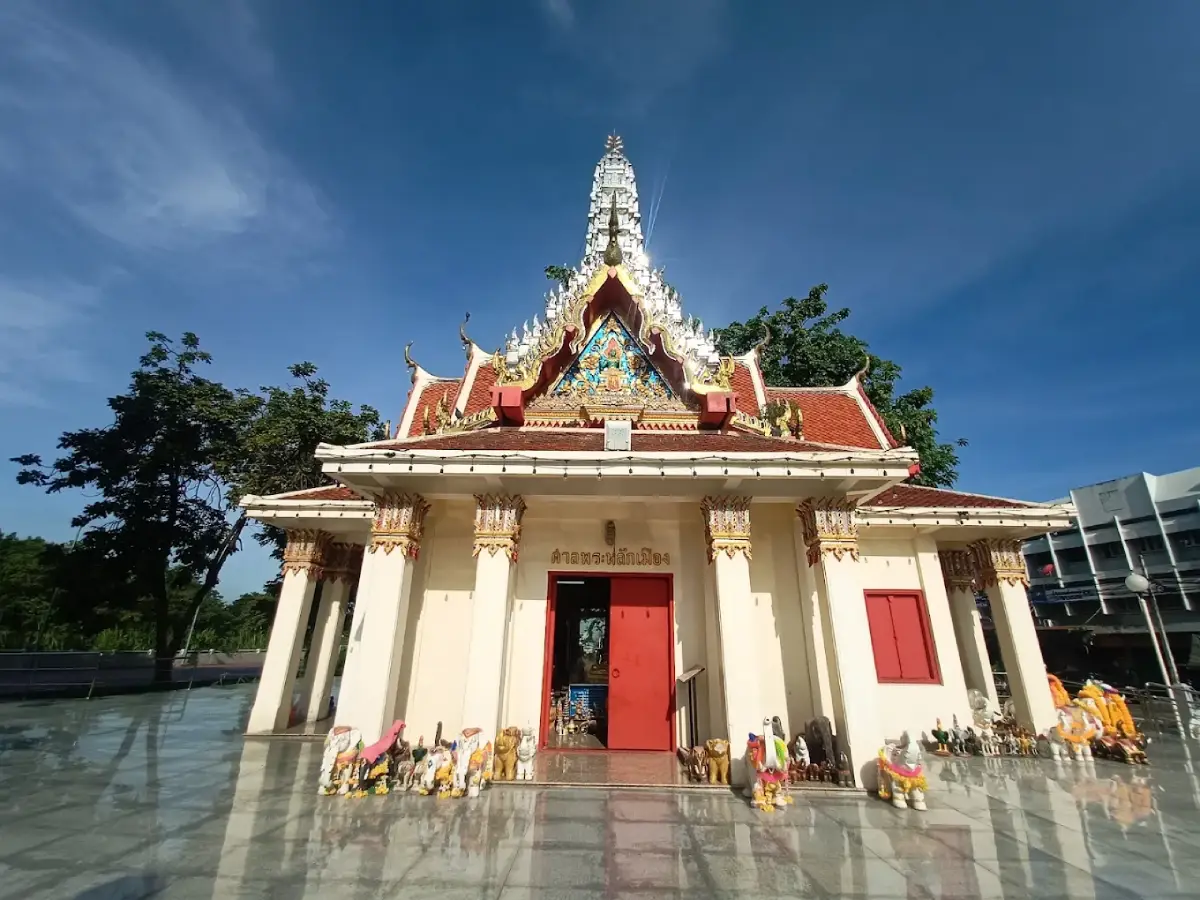
Prachin Buri City Pillar Shrine
Open Days: Daily
Opening Hours: 08:00 – 17:00
Prachin Buri City Pillar Shrine, also known as the Prachin Buri Phra Lak Mueang Shrine, is a sacred civic landmark on the banks of the Prachin Buri River in central Thailand. Located on Prachin Anuson Road, opposite Municipal Soi 1, Na Mueang Subdistrict, Mueang Prachin Buri District, Prachin Buri 25000, the shrine is an important center of local devotion and a reminder of the province's administrative and cultural history during the Rattanakosin period. The original city pillar shrine was established in 1872 during the reign of King Chulalongkorn, following the construction of the town's fortifications. As the original building deteriorated over time, a replacement shrine was commissioned in 1971. The present pavilion houses a sacred pillar carved from auspicious Chaiyaphruek wood by the Handicrafts Division of Thailand's Fine Arts Department. Its four-sided Thai architectural design, red-tiled roof, ornate central spire, and elaborate gilded details make it one of the distinctive cultural landmarks of Prachin Buri town.
One of the shrine's most distinctive features is its riverside setting within the historic urban area. The building has four projecting sides, a two-tiered roof, and a prang-style spire rising above its center. The gables feature gilded wooden carvings decorated with glass, including images of celestial figures and floral motifs. Traditional Thai roof ornaments, including chofa, bai raka, and naga-inspired details, give the pavilion its ceremonial appearance. These features make the shrine valuable not only as a place of worship but also as an example of traditional Thai architectural design.
Prachin Buri has a long and varied history. Geographically, the province occupies an important transition zone between the central plains and the mountains of eastern Thailand. Its landscape includes river basins, agricultural land, forests, and mountainous areas connected with the Khao Yai region. These environmental differences have shaped local occupations, settlement patterns, and the development of communities through successive historical periods.
The Prachin Buri River has been particularly important in the development of the provincial capital. It provided water for settlements and served as a transportation route connecting communities across the region. The river forms part of the wider Bang Pakong River system, one of the important waterways of eastern Thailand. The location of the City Pillar Shrine beside the river reflects the close connection between the historic town and its natural geography.
The province's cultural history extends much further into the past than the present shrine. Ancient sites around Si Mahosot preserve archaeological evidence of earlier settlements, religious architecture, and artistic traditions associated with the Dvaravati period and subsequent cultural influences. Although the City Pillar Shrine belongs to the Rattanakosin period, this wider history demonstrates the long continuity of human settlement in the region.
During the Rattanakosin period, Prachin Buri played a role in the administration and security of Thailand's eastern territories. In the nineteenth century, royal initiatives involved the construction of fortifications and town walls. These structures represented both practical measures for defense and expressions of the town's position within the administrative system of the kingdom.
The documented history of the City Pillar Shrine begins with events in 1867. King Mongkut, Rama IV, commissioned Prince Krom Muen Bowon Wiset Chaichan to oversee the construction of fortifications and walls at Prachin Buri. The work continued until its completion in 1872, during the reign of King Chulalongkorn, Rama V. This development became an important milestone in the town's urban history.
In 1872, after the completion of the fortifications, King Chulalongkorn ordered Phraya Phuthon Phai, an official responsible for the Ministry of the Interior, to establish a shrine and install the sacred city pillar. The site was chosen on the northern bank of the Prachin Buri River, near the former provincial police headquarters. This ceremony established an enduring sacred landmark connected with the administration and identity of the town.
The establishment of a city pillar has significance beyond the placement of a wooden post. In traditional Thai culture, it represents the symbolic center of a settlement and expresses hopes for stability, protection, and the well-being of the community. The selection of the location, the ceremonies performed, and the construction of the shrine are therefore all part of its cultural meaning.
Thai city pillar traditions reflect the interaction of local guardian beliefs, Brahmanical ceremonies, and broader ideas of auspiciousness. Honoring the pillar may represent wishes for safety, peace, and prosperity. It can also be understood as an expression of respect for the historical community and its continuity across generations.
The original shrine's position near the river and government buildings linked it with the two important foundations of the town: public administration and waterborne transportation. Before roads became dominant, waterways were major routes for moving agricultural produce, people, and merchandise. Sacred and administrative landmarks frequently occupied sites closely connected with these river-based settlements.
Over time, provincial government facilities were relocated and the urban landscape changed. The original City Pillar Shrine gradually deteriorated, prompting plans for its replacement. Preserving the significance of the sacred site and providing an appropriate building for worship became important objectives of the later construction project.
The new shrine project began in 1971 during the reign of King Bhumibol Adulyadej, Rama IX. Police Major General Srisak Thammarak, then Governor of Prachin Buri, initiated the project. Provincial officials, merchants, and residents supported the undertaking, demonstrating the community's commitment to maintaining the shrine as an important provincial landmark.
Specialists also contributed to the project. Chanthit Krasaesin and Major General Saman Wirawitthaya helped examine the proposed site according to traditional principles described in the Nakhon Than texts and determine an auspicious date for the foundation ceremony. Their involvement illustrates the importance placed on ritual timing and appropriate location in the construction of a sacred civic building.
Thailand's Fine Arts Department played an important role in designing the building and carving the city pillar. Although the structure uses reinforced concrete, its architectural form follows traditional Thai ceremonial styles. This combination allows the building to incorporate modern construction methods while preserving the appearance and symbolism of historic Thai architecture.
The pavilion follows the chaturamuk plan, meaning that it has four projecting sides. Its roof is arranged in two receding levels, with gables facing all four directions. Red fish-scale-shaped tiles cover the roof surfaces. The balanced design emphasizes the central sacred space in which the city pillar is enshrined.
The central prang-style spire is among the building's most recognizable architectural features. It incorporates three tiers of decorative fak pheka, also known as lamphukhan, associated with the vajra, the thunderbolt weapon of Indra in traditional Hindu and Thai religious symbolism. This decorative feature contributes both height and ceremonial meaning to the shrine.
Each of the four gables is decorated with gilded wooden carvings and colored glass. Celestial figures and floral designs emphasize the sacred character of the building. Such detailed ornamentation requires considerable craftsmanship and demonstrates how traditional Thai artistic forms can be applied to a civic shrine as well as to Buddhist religious architecture.
Additional roof decorations include chofa, bai raka, naga-inspired elements, and traditional finials. Their flowing forms and carefully arranged silhouettes give the pavilion its characteristic elegance. Other details, such as lotus capitals, decorative ceiling patterns, and krajang motifs, enrich the architectural composition.
The lotus and krajang designs demonstrate the use of traditional Thai ornamental vocabulary. Columns are not merely structural supports; they also contribute to the artistic character of the building. Roof and ceiling decorations create a harmonious rhythm of shapes that highlights the importance of the central shrine.
The carvings depicting celestial figures on the gables draw upon traditional Thai religious and artistic ideas. Combined with gold surfaces and glass inlay, they create an impressive appearance when illuminated by daylight. These details reward careful observation from the exterior of the pavilion.
The shrine has entrances on all four sides, corresponding to its four-sided architectural plan. This arrangement provides access from different directions while maintaining visual balance. The sacred city pillar occupies the principal position within the interior, making it the focus of the building's design and devotional use.
The present city pillar is made from auspicious Chaiyaphruek wood. The Handicrafts Division of the Fine Arts Department designed and carved the cylindrical pillar, incorporating a lotus-petal base and an ornate four-headed, four-faced upper section. The result reflects both traditional symbolic meaning and skilled woodcarving.
Chaiyaphruek has favorable associations in Thai culture because its name is connected with victory and success. The choice of timber for a city pillar therefore involves symbolic significance as well as the physical characteristics of the wood. Its use expresses hopes for the prosperity and stability of the community.
The carved lotus base follows a long-established artistic tradition in Thailand. Lotus imagery frequently appears beneath revered images and ceremonial objects, conveying purity and respect. Its use at the foot of the city pillar provides an elegant transition between the supporting base and the shaft.
The four-faced ornamentation near the top is related to Brahma-inspired symbolism found in Thai ceremonial art. Four-faced imagery has associations with the cardinal directions and sacred guardianship. The decorative treatment makes the pillar significant both as a sacred object and as a work of traditional craftsmanship.
Inside the shrine, flowers, garlands, and other offerings contribute to the atmosphere of devotion. Worshippers approach the city pillar to pay their respects and offer prayers according to personal beliefs. The building protects the sacred object while providing an appropriate setting for its continuing ceremonial use.
The City Pillar Shrine is not a Buddhist monastery with resident monks, an ordination hall, or a monastic abbot. Its principal function is to house the sacred city pillar. Buddhist temples in the surrounding town have different religious purposes and may contain ordination halls, viharns, stupas, and other facilities associated with the monastic community.
Worship at the shrine is traditionally associated with wishes for security, success, peaceful family life, and safe travel. Residents may visit at important moments in their lives, while travelers may stop to pay respect upon arriving in the province. Beyond individual aspirations, the practice maintains a connection with the history and identity of Prachin Buri.
Visitors should dress appropriately, maintain a quiet manner, and use designated areas for offerings. Flowers and garlands may be presented according to local custom. Respect for other worshippers and careful treatment of the building help preserve its sacred atmosphere and architectural features.
The shrine remains part of a living urban community rather than functioning solely as a historical monument. Its proximity to shops, markets, and residential neighborhoods allows residents to incorporate worship into everyday life. This relationship gives the site an important role in the cultural identity of the old town.
The Municipal Fresh Market, locally known as Talat Lang or Lower Market, is one of the notable commercial areas near the shrine. It occupies a traditional riverside neighborhood where residents buy food, agricultural products, and daily necessities. Exploring the market introduces visitors to the ordinary trading practices that remain part of Prachin Buri's local culture.
Talat Lang is more than a tourist destination. It is a working market serving the community, with rice dishes, noodles, traditional desserts, and fresh ingredients. Visitors can experience the atmosphere of an older provincial trading area while appreciating its historical connection with the nearby river.
Home Story – Herbal City Prachin Buri is a cultural attraction housed in a traditional wooden building. Exhibits tell stories about the history of the town, local lifestyles, and herbal knowledge. The venue also offers food and drinks associated with herbal ingredients, connecting local cuisine with the province's distinctive cultural heritage.
Visiting Home Story after the City Pillar Shrine provides a complementary perspective on local history. The shrine illustrates civic spirituality and ceremonial architecture, while Home Story presents the everyday lives of residents, the preservation of wooden houses, and knowledge handed down through the community.
Wat Kaeo Phichit is an important royal Buddhist temple in the town, situated near the river. Established in 1879 by Nang Pramun Phokha, also known as Kaeo Prasangsit, the temple is renowned for its distinctive architecture incorporating Thai, Chinese, and Western artistic influences. Its varied decorative forms make it one of Prachin Buri's best-known cultural landmarks.
The ordination hall at Wat Kaeo Phichit is especially notable for its creative combination of architectural styles. Visiting the temple after the City Pillar Shrine allows travelers to compare traditional Thai civic architecture with a Buddhist religious building shaped by a wider range of artistic influences.
Wat Chaeng is another Buddhist temple within the urban area of Prachin Buri. It serves the local community and is part of the town's wider religious landscape. Visiting several temples and the City Pillar Shrine provides insight into the distribution of sacred places across the historic town.
Prachin Buri National Museum is a major center for learning about archaeology and the cultural history of eastern Thailand. Its collections include archaeological artifacts and materials associated with ancient settlements and religious sites in Prachin Buri and neighboring provinces. The museum extends the historical perspective beyond the nineteenth-century City Pillar Shrine.
Objects displayed at the museum contribute to understanding the region's artistic and religious connections, including those associated with ancient Si Mahosot and Dvaravati cultural traditions. Studying these collections alongside the city shrine reveals the historical depth of the province, from early settlements to developments during the Rattanakosin period.
The Chao Phraya Abhaibhubejhr Building is another celebrated historic landmark. Located within the grounds of Chao Phraya Abhaibhubejhr Hospital, the building reflects Western architectural influences that became prominent in Thailand during the Rattanakosin period. It is associated today with the preservation and presentation of knowledge concerning traditional Thai medicine and herbs.
The building also provides an interesting architectural comparison. The City Pillar Shrine expresses traditional Thai ceremonial design, Wat Kaeo Phichit combines different artistic traditions, and the Abhaibhubejhr building reflects Western-influenced architecture. Exploring the three sites introduces visitors to the variety of architectural heritage found within Prachin Buri.
Prachin Buri's identity as a center of herbal knowledge is reflected in attractions such as the traditional medicine museum and Home Story. Together, they illustrate the relationship between local plants, community knowledge, historical buildings, and the continuing development of traditional medical practices.
The King Chulalongkorn Monument near the former Provincial Hall is another landmark connected with the modern administrative history of Prachin Buri. It commemorates the monarch whose reign saw major government reforms and the establishment of the original city pillar shrine. Visiting the monument adds another dimension to the town's nineteenth-century history.
Prachin Wanarom Park offers a green public space within the wider urban environment. It provides opportunities for recreation alongside the area's temples, museums, markets, and cultural attractions. Its presence reflects the variety of experiences available in the provincial capital beyond historical sightseeing.
Other important cultural destinations in the province include the ancient town of Si Mahosot, the archaeological remains at Sa Morakot, and Wat Ton Pho Si Maha Pho. These places preserve evidence of ancient communities and Buddhist traditions that predate the city pillar shrine by many centuries.
Si Mahosot is an important archaeological area containing remains of ancient settlement and religious activity. The site provides context for objects exhibited at Prachin Buri National Museum and demonstrates the connections between the eastern region and wider networks of ancient Southeast Asian culture.
Wat Ton Pho Si Maha Pho is renowned for its revered bodhi tree and associated Buddhist traditions. The site illustrates a different form of sacred heritage from that of a city pillar. Visiting both places reveals how communities express respect through different religious symbols and historic landscapes.
Prachin Buri's culinary traditions reflect the diversity of its communities and its riverside environment. Local restaurants serve Thai food, Chinese-influenced cuisine, noodles, freshwater fish dishes, and traditional desserts. Many businesses around the old market district are closely connected with everyday life rather than being exclusively oriented toward tourists.
Yen Ta Fo Nakhon Sawan near the City Pillar Shrine is a convenient local noodle restaurant on Na Mueang Road. Boonta Chicken Rice is another well-known name associated with the market area. Both are examples of the simple, familiar dining places that give the historic town its everyday atmosphere.
Mang Korn Thong Restaurant offers Thai-Chinese dishes in central Prachin Buri. Krua Chalawan serves a range of Thai meals, while Home Story – Herbal City provides food and drinks inspired by the province's herbal heritage. These restaurants offer different opportunities to explore regional food culture.
More contemporary options include Dr. Salmon and Shabu, which offers Japanese-inspired dishes and hotpot. The presence of both traditional and modern establishments reflects the changing tastes and continuing commercial development of the provincial capital.
Accommodation within Mueang Prachin Buri ranges from small hotels and serviced residences to riverside homestays. Staying in Na Mueang Subdistrict provides access to the City Pillar Shrine, the historic market, Wat Kaeo Phichit, and the National Museum. Other districts offer quieter settings and different types of lodging.
iRabbit Hotel is a modern property in the central urban area. Bung Bung Buri provides another accommodation option on Chaeng Phatthana Road. River Home Prachinburi is associated with a riverside setting on Prachin Anuson Road, offering a connection with the river landscape that shaped the historical town.
Other accommodation options in the wider district include Pattha Hotel, Narasiri Service Apartment, and Silom Hotel Prachinburi. Their locations and facilities vary, allowing visitors to select a base suited to urban sightseeing, business travel, or onward journeys toward other parts of the province.
A cultural visit can begin with worship at the City Pillar Shrine, followed by a closer look at its architectural details. Visitors interested in Thai art can study the central spire, gilded gables, ornamental roof features, and carved city pillar. The journey can then continue to Talat Lang, Home Story, or Prachin Buri National Museum.
The shrine's riverside position offers an opportunity to appreciate the relationship between the sacred landmark and its natural surroundings. The river is not merely a scenic element; it was historically central to transportation, trade, and the establishment of communities. Observing the setting helps place the shrine within the broader story of urban Prachin Buri.
Photography should be conducted respectfully, particularly when people are worshipping inside the building. The roof, red tiles, white spire, and carved gables are among the architectural features that can be appreciated from outside. The four-sided form is especially visible when viewed from different positions around the shrine.
The shrine provides an educational experience for students and younger visitors. Its history connects the reigns of King Mongkut and King Chulalongkorn, the construction of fortifications, the installation of the city pillar, changes in government facilities, and the creation of a new shrine during the reign of King Bhumibol Adulyadej.
The 1971 construction project also illustrates cooperation among government officials, merchants, residents, and specialists. Preserving the shrine required collective support and the application of traditional artistic knowledge. This social history is an important part of the cultural value of the building.
The shrine represents living heritage because it continues to be used for devotion rather than existing solely as a preserved historical structure. Residents visit to pay respect, while travelers can learn about the history and architectural traditions of Prachin Buri. Continued use helps sustain the cultural significance of the site.
Its location within the historic town also illustrates changes in the urban landscape. Once strongly oriented toward waterways and early government facilities, the town later developed modern roads and administrative centers. The City Pillar Shrine remains a physical connection between these different periods.
Although Prachin Buri is well known for mountains, forests, and nature-based tourism, its urban heritage is equally important. The City Pillar Shrine introduces the history of administration and traditional civic beliefs, while temples and museums reveal other aspects of archaeology, art, and local culture.
Visitors driving from Bangkok can travel along Rangsit–Nakhon Nayok Road, Highway 305, and continue toward Prachin Buri town. After entering Na Mueang Subdistrict, follow Prachin Anuson Road toward the river and the area opposite Municipal Soi 1. The shrine's coordinates are latitude 14.052582 and longitude 101.370975.
Rail passengers can arrive at Prachin Buri Railway Station and continue by local hired transport. Travelers arriving by bus can also reach the town center and continue to the shrine by local transport. A private car offers convenient connections to cultural destinations and attractions outside the main urban area.
The shrine stands within an established neighborhood containing roads, shops, and other community facilities. Visitors should use parking spaces considerately and keep access routes clear, especially during busy periods or local events. The building remains a sacred place, and respectful conduct is appropriate throughout the visit.
Prachin Buri City Pillar Shrine is open daily from 08:00 to 17:00, and there is no general admission fee. Visitors can pay their respects without purchasing an entrance ticket. Floral offerings or other ceremonial items may be presented according to individual beliefs and local practices.
Travelers interested in comparing sacred architecture can visit Wat Kaeo Phichit and Wat Chaeng. These Buddhist temples have different religious functions from the City Pillar Shrine, including buildings and spaces used for monastic ceremonies. The comparison helps reveal the variety of sacred architecture and community beliefs found within Prachin Buri.
The role of the Fine Arts Department is another important aspect of the shrine's history. Its work on the building and pillar demonstrates how traditional Thai ornamentation can be combined with modern construction. The resulting structure preserves an established artistic vocabulary while accommodating the needs of a contemporary public sacred place.
Getting There Prachin Buri City Pillar Shrine is located on Prachin Anuson Road beside the Prachin Buri River, opposite Municipal Soi 1, Na Mueang Subdistrict, Mueang Prachin Buri District, Prachin Buri 25000, Thailand. Visitors arriving from Bangkok can travel via Rangsit–Nakhon Nayok Road and continue into Prachin Buri town. Rail and bus passengers can reach the town center before taking local transport to the shrine. The map coordinates are 14.052582, 101.370975.
Prachin Buri City Pillar Shrine brings together devotion, civic history, traditional architecture, and the heritage of a riverside community. The establishment of the original shrine in 1872 and the construction of its replacement in 1971 connect different stages in the history of the town. The chaturamuk pavilion, richly decorated spire, and intricately carved Chaiyaphruek pillar demonstrate the refinement of Thai craftsmanship.
A visit to the shrine offers more than an opportunity to seek blessings. It provides an introduction to the province's development during the Rattanakosin period and its longstanding relationship with the river. Combined with nearby markets, Home Story – Herbal City, Wat Kaeo Phichit, Prachin Buri National Museum, and the Chao Phraya Abhaibhubejhr Building, the shrine forms part of a rewarding journey through the diverse cultural history of Prachin Buri.
| Place Name | Prachin Buri City Pillar Shrine (Phra Lak Mueang Prachin Buri) |
| Address | Prachin Anuson Road, Beside the Prachin Buri River, Opposite Municipal Soi 1, Na Mueang Subdistrict, Mueang Prachin Buri District, Prachin Buri 25000, Thailand |
| Coordinates | Latitude 14.052582, Longitude 101.370975 |
| Type | Provincial City Pillar Shrine, Sacred Civic Landmark and Protected Cultural-Artistic Site |
| Significance | A Center of Local Devotion and a Symbol of the Historic Town of Prachin Buri |
| Original Shrine | Established in 1872 During the Reign of King Chulalongkorn, Following the Construction of the Town's Fortifications |
| Present Shrine | Construction Initiated in 1971 by Police Major General Srisak Thammarak, Then Governor of Prachin Buri |
| Architectural Design | Fine Arts Department of Thailand; City Pillar Designed and Carved by Its Handicrafts Division |
| City Pillar Material | Auspicious Chaiyaphruek Wood, with a Lotus-Petal Base and Four-Headed, Four-Faced Upper Ornamentation |
| Architecture | Four-Sided Thai Chaturamuk Pavilion, Two-Tiered Red-Tiled Roof, Central Prang-Style Spire, Gilded Gables and Four Entrances |
| Main Areas and Features | 1. Main Chaturamuk Shrine Pavilion 2. Chaiyaphruek City Pillar 3. Four Decorated Gables 4. Central Spire and Roof Ornamentation 5. Interior Worship Area 6. Entrance Courtyard 7. Nearby Prachin Buri Riverside Area |
| Public Information Authorities | Prachin Buri Town Municipality and Prachin Buri Provincial Office of Tourism and Sports |
| Open Days | Daily |
| Opening Hours | 08:00 – 17:00 |
| Admission Fee | Free Admission |
| Facilities | Nearby Parking and Restrooms |
| Getting There | Travel via Rangsit–Nakhon Nayok Road into Prachin Buri Town and Continue to Prachin Anuson Road beside the River, Opposite Municipal Soi 1 |
| Nearby Attractions and Cultural Sites | 1. Home Story – Herbal City Prachin Buri, Na Mueang, Tel. +66 97 021 1037 2. Prachin Buri Municipal Fresh Market, Na Mueang 3. Wat Kaeo Phichit, Na Mueang, Tel. +66 92 283 5429 4. Wat Chaeng, Mueang Prachin Buri 5. Prachin Buri National Museum, Tel. +66 37 211 586 6. Chao Phraya Abhaibhubejhr Building and Thai Traditional Medicine Museum, Tha Ngam, Tel. +66 37 211 289 7. King Chulalongkorn Monument, Former Provincial Hall Area 8. Prachin Wanarom Park, Prachin Buri Town |
| Restaurants in Central Prachin Buri | 1. Yen Ta Fo Nakhon Sawan City Pillar Branch, Na Mueang Road, Tel. +66 92 776 1419 2. Home Story – Herbal City Prachin Buri, Na Mueang Road, Tel. +66 97 021 1037 3. Mang Korn Thong Restaurant, Prachin Takham Road, Tel. +66 37 211 246 4. Krua Chalawan, Prachin Takham 3 Road, Tel. +66 98 878 7142 5. Dr. Salmon and Shabu, Na Mueang, Tel. +66 96 057 1975 |
| Accommodations in Mueang Prachin Buri | 1. iRabbit Hotel, Chaeng Phatthana Road, Na Mueang, Tel. +66 98 824 2424 2. Bung Bung Buri, Chaeng Phatthana Road, Na Mueang, Tel. +66 88 787 8963 3. River Home Prachinburi, Prachin Anuson Road, Na Mueang, Tel. +66 84 520 3662 4. Living Room, Mueang Prachin Buri, Tel. +66 92 571 6555 5. Silom Hotel Prachinburi, Bang Boribun, Tel. +66 37 211 967 6. Pattha Hotel, Central Prachin Buri 7. Narasiri Service Apartment, Na Mueang |
Frequently Asked Questions (FAQ)
Q: Where is Prachin Buri City Pillar Shrine located?
A: The shrine is situated on Prachin Anuson Road beside the Prachin Buri River, opposite Municipal Soi 1, Na Mueang Subdistrict, Mueang Prachin Buri District, Prachin Buri 25000, Thailand. Its coordinates are 14.052582, 101.370975.
Q: What are the opening days and hours?
A: The shrine is open daily from 08:00 to 17:00.
Q: Is there an admission fee?
A: No. General admission is free.
Q: When was Prachin Buri City Pillar Shrine established?
A: The original shrine and city pillar were established in 1872 during the reign of King Chulalongkorn. Construction of the replacement shrine began in 1971.
Q: Who initiated the construction of the present shrine?
A: Police Major General Srisak Thammarak, then Governor of Prachin Buri, initiated the project in 1971 with support from government officials, merchants, and local residents.
Q: What material was used for the city pillar?
A: The present pillar was carved from auspicious Chaiyaphruek wood. It has a lotus-petal base and a four-headed, four-faced upper ornament designed by the Fine Arts Department's Handicrafts Division.
Q: What is distinctive about the shrine's architecture?
A: It is a traditional Thai chaturamuk pavilion with a two-tiered red-tiled roof, a central prang-style spire, four entrances, and intricately gilded wooden gables decorated with glass.
Q: What attractions can visitors explore nearby?
A: Nearby destinations include Prachin Buri Municipal Fresh Market, Home Story – Herbal City, Wat Kaeo Phichit, Wat Chaeng, Prachin Buri National Museum, and the Chao Phraya Abhaibhubejhr Building.
 Category: ●Places of Worship
 Group: ●Other Sacred Sites
Last Update : 5 DayAgo
 Last Update : 5 DayAgo
 Click to Access the Navigation Map GPS
Prachin Buri City Pillar Shrine Map

 Art, Culture and Heritage
 Historical Sites and Monuments(5)
 Landmarks and Memorials(4)
 Royal Palace(1)
 Art, Craft Centres, Tradition(4)
 Museums(4)
 Art Gallery(1)
 Educational Places
 Educational Gardens, Farm(2)
 Temple(23)
Other Sacred Sites(7)
 Research and Development
 Royal Project(1)
 Suburban Living
 Village, Community(3)
 Local Market(2)
 Nature and Wildlife
 National Parks and Marine Reserves(4)
 Mountain (Doi)(3)
 Dam, Reservoir, Lake(1)
 Waterfalls(14)
 Caves(1)
 River, Canal(2)
 Bays and Beaches(1)
 Entertainment and Agricultural
 Farms, Parks and Ecotourism(2)
 Outdoor and Adventure Activities(1)
 Travel Articles, Recipes
 Travel Review, Food Review(1)


