
lovethailand home >Northeastern Travel Attractions >Yasothon Travel Attractions >Muang Yasothon >Nai Muang > Yasothon City Pillar Shrine
TL;DR: Yasothon City Pillar Shrine is located at 38 Uthai Ramrit Road, Nai Mueang Subdistrict, Mueang Yasothon District, Yasothon Province 35000, Thailand, open Daily, hours 08:00 – 17:00.
Yasothon City Pillar Shrine
Open Days: Daily
Opening Hours: 08:00 – 17:00
Yasothon City Pillar Shrine, also known as Chao Pho Lak Mueang Yasothon Shrine, is one of the province's most important sacred landmarks and a spiritual center for the local community. Located on Uthai Ramrit Road in the historic Ban Sing Tha district, Nai Mueang Subdistrict, Mueang Yasothon District, Yasothon Province 35000, northeastern Thailand, the shrine is distinguished by an unusual combination of Thai, Chinese, and Lao architectural traditions. Inside the building stand three sacred pillars: the central pillar represents the city pillar, while the two flanking pillars are associated with the guardian spirits Phra La Ngum and Phra La Ngam. The shrine is also the setting for the annual City Pillar Celebration, popularly known as the Yasothon Chinese Opera Festival, and for ceremonies connected with the province's famous Bun Bang Fai Rocket Festival. Its significance encompasses local history, sacred architecture, ancestral beliefs, and the multicultural heritage of one of Yasothon's oldest commercial neighborhoods.
Yasothon City Pillar Shrine is much more than a building containing sacred objects. It preserves community memories associated with the establishment of Ban Sing Tha, a historic settlement that played an important role in the development of Yasothon town. The story of its three pillars reveals how traditional beliefs in protective spirits became connected with the symbolism of a city pillar. The building itself reflects the relationships among Thai, Lao, and Thai-Chinese communities that contributed to the cultural identity of the old town.
The shrine stands in Ban Sing Tha, one of Yasothon's most significant historic districts. This neighborhood developed into an important trading area during the town's earlier history, with commercial activity connected to waterways and overland routes. Historic streets, traditional shophouses, Buddhist temples, and sacred buildings remain within the same urban district. The area offers a distinctive setting in which local history can be experienced through surviving buildings and continuing community practices.
Uthai Ramrit Road, where the shrine is located, connects several important features of Ban Sing Tha's historical landscape. Houses, shops, and cultural landmarks stand alongside everyday businesses, demonstrating that the old town continues to function as a residential and commercial community. The shrine is therefore a living sacred site within an active neighborhood rather than an isolated historic monument.
The early history of Ban Sing Tha is associated with groups of settlers who established homes near the Chi River and neighboring areas of relatively elevated land. Waterways were essential to transportation, agriculture, fishing, and commerce before the construction of modern road networks. Communities chose settlement locations according to access to water, natural resources, and the conditions needed for long-term habitation.
According to the Ban Sing Tha local chronicle, in 1775 a community leader named Chao Kham Su led his followers to clear a forested area known as Dong Khwang Tha Chi in preparation for building their homes. During the clearing work, an event involving the breaking of a large tree was interpreted by local people as a supernatural occurrence. The incident became part of the founding narrative of the settlement and its sacred guardians.
The story gave rise to the tradition concerning Phra La Ngum and Phra La Ngam, two protective spirits believed to inhabit and guard the area. After witnessing the unusual event, community members consulted traditional ritual specialists to interpret its meaning. According to the resulting tradition, the two guardian spirits had demonstrated their presence and protective power to the settlers.
Villagers subsequently used timber associated with the event to establish three sacred settlement pillars. The middle pillar represented the community's principal foundation, while the pillars on either side became associated with Phra La Ngum and Phra La Ngam. This arrangement created a spiritual center for Ban Sing Tha and became the basis of the three-pillar shrine revered by residents in later generations.
The story is essential to understanding the shrine's unusual arrangement. The three pillars do not signify three separate cities or three different periods of city founding. Instead, each has a specific role within the local belief system: the central pillar represents the city, and the two side pillars represent protective spirits responsible for safeguarding it.
The three sacred pillars are among the shrine's most distinctive features. Provincial tourism information identifies this arrangement as an exceptional characteristic of Yasothon City Pillar Shrine. Their continued veneration makes the site an important example of the interaction between city pillar symbolism and northeastern Thai beliefs concerning spiritual guardians.
Belief in protective spirits has deep roots in the agricultural and settlement traditions of northeastern Thailand. When people established new communities, they often paid respect to spirits believed to inhabit the surrounding land and natural environment. Such practices expressed respect for the place where the settlement was being formed and helped provide spiritual reassurance to its residents.
Village and city pillars consequently acquired both ceremonial and social meanings. A central pillar symbolized the permanence and stability of settlement, while annual offerings created occasions for community members to gather. At Yasothon City Pillar Shrine, these functions continue to connect present-day residents with their understanding of the earliest history of Ban Sing Tha.
The names of the two guardian spirits appear in local documents with slightly different spellings, including variants of Phra La Ngam and Phra La Nga. The essential meaning, however, remains consistent: the two spirits are revered as protectors of the settlement and of its central sacred pillar. This tradition gives the shrine an identity shaped by local ancestral and guardian beliefs rather than formal city-founding ceremonies alone.
As Ban Sing Tha developed into a commercial neighborhood, the importance of the shrine expanded. Thai-Chinese merchants who established businesses in the district became important participants in its worship traditions. Their involvement contributed to the shrine's architectural and ceremonial development, introducing Chinese decorative and cultural elements alongside longstanding local beliefs.
Historically, Ban Sing Tha was home to a mixture of trading households, local families, and residents with connections to different cultural communities. Traditional commercial buildings and streets recall the period when goods and people moved through the area. Buddhist temples, Chinese-influenced shrines, and local houses came to form a shared urban environment, reflecting the cultural interactions that shaped Yasothon.
An important stage in the shrine's architectural history occurred on December 5, 1987, when the building was renovated. This renovation is a key date in accounts of the present shrine, whose appearance incorporates prominent Thai and Chinese artistic elements together with a Lao-inspired feature at the uppermost part of the structure.
The 1987 renovation changed the architectural setting without eliminating the symbolic importance of the three sacred pillars. The central pillar and the guardian pillars continued to occupy their traditional roles. Their preservation illustrates how a community can adapt the physical form of a sacred site while maintaining the beliefs and historical memories associated with it.
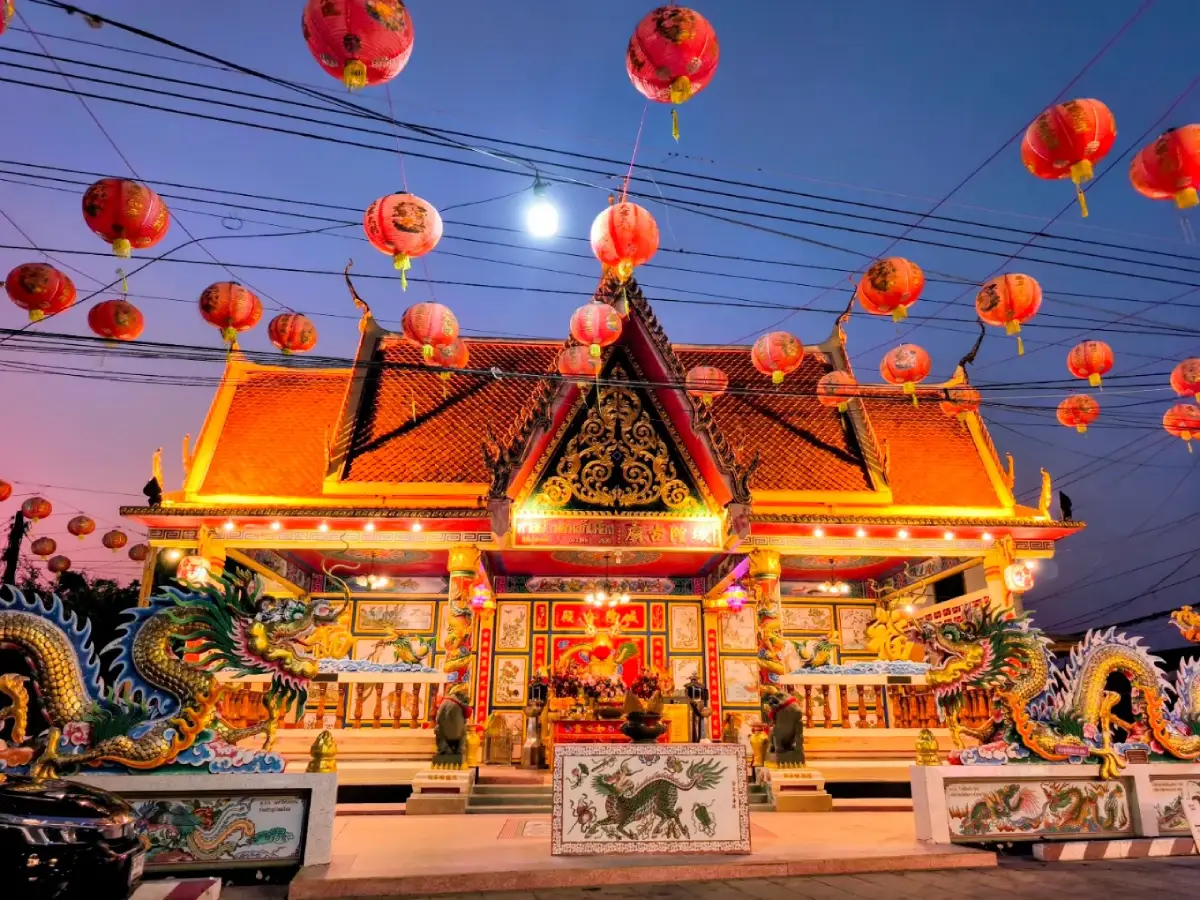
Architecturally, Yasothon City Pillar Shrine is particularly notable for combining a Chinese-style shrine structure with decorative features associated with Thai and Lao sacred architecture. Its appearance differs from many other provincial city pillar shrines that emphasize traditional Thai pavilions or four-sided halls. The building represents a multicultural approach to sacred design that is closely connected to the history of Ban Sing Tha.
Two large dragon sculptures stand near the shrine entrance. In Chinese cultural tradition, dragons are auspicious symbols associated with power, prosperity, and protection. Their placement at the shrine establishes a strong Chinese artistic character and reflects the contributions of the local Thai-Chinese community to the site's cultural identity.
The paired dragons are among the features that make the shrine immediately recognizable. Beyond their decorative role, they help define the entrance as a transition from the ordinary streets of the old town into a sacred place. Their scale and symbolism contribute to the shrine's ceremonial atmosphere.
An altar dedicated to Heaven and Earth stands in front of the building according to Chinese religious tradition. Respect for Heaven and Earth expresses gratitude toward the natural order and the forces believed to sustain life. The inclusion of this altar alongside the Thai city pillar and local guardian spirits demonstrates how multiple traditions have been accommodated within one sacred complex.
Interior decorative elements also show Chinese influences, including polished wall artworks with traditional Chinese motifs. These details contribute to the building's artistic significance and reflect the tastes and ceremonial practices of the Thai-Chinese merchant community that historically played an important role in Ban Sing Tha.
The roof incorporates a gabled form with chofa and bairaka ornaments associated with traditional Thai architecture. These refined roof decorations are commonly found on important Thai religious buildings. Their presence above a Chinese-style shrine structure introduces recognizable Thai design elements into the building's overall appearance.
At the top of the shrine is a feature shaped like a Lao-style sacred stupa. This element reflects cultural connections between the Isan region and communities with Lao artistic traditions. Its inclusion distinguishes the building from a conventional Chinese temple and emphasizes the regional influences that form part of Yasothon's cultural heritage.
Viewed as a whole, the shrine presents a visible combination of three architectural traditions. The main structure, dragons, and decorative artworks express Chinese influence. Roof ornaments represent Thai craftsmanship, while the stupa-like upper feature refers to Lao sacred architecture. Together, these elements symbolize the multicultural relationships that developed within Ban Sing Tha and the wider town.
Inside the shrine, the three sacred pillars remain its most important objects. The central pillar is the city pillar, while the two flanking pillars are associated with Phra La Ngum and Phra La Ngam. Their arrangement gives physical form to the traditional belief that the community's foundation is protected by guardian spirits.
For local residents, worship at the shrine is associated with auspiciousness, stability, and respect for the spiritual guardians of the town. Devotees may present flowers, incense, candles, and offerings in accordance with local customs. These practices express individual beliefs while maintaining the traditions passed down through generations of community life.
The shrine's importance extends beyond the households of Ban Sing Tha. People from other neighborhoods of Yasothon and surrounding districts also visit, particularly during festivals, important personal occasions, and the beginning of a new year. The act of paying respect to the city pillar symbolizes a continuing relationship with the town's spiritual and historical identity.
Yasothon City Pillar Shrine is not a Buddhist monastery and therefore has no abbot. Its ceremonies and major activities are associated with the Yasothon City Pillar Shrine Committee, local residents, the Ruam Samakkhi Yasothon Foundation, and participating municipal and provincial organizations. This community-based arrangement reflects the collaborative character of the shrine's cultural traditions.
The shrine committee plays an important role in coordinating annual ceremonies, cultural programs, and preparations for public gatherings. Major celebrations require cooperation among business owners, community representatives, volunteers, performers, and public institutions. These shared activities allow the shrine to continue functioning as a community landmark while preserving its historic customs.
The most prominent annual celebration is the Yasothon City Pillar Shrine Festival, widely known as the Yasothon Chinese Opera Festival. The event has strong connections with Thai-Chinese culture and traditions of offering performances in honor of sacred guardians. Programs include worship ceremonies, Chinese opera, lion dancing, and other cultural activities that bring the historic district to life.
The festival provides an opportunity for residents from different backgrounds to demonstrate respect for the city pillar and participate in community life. Merchants, local organizations, government agencies, and families contribute in various ways, giving the celebration religious, social, and cultural significance.
Chinese opera is especially important because it forms part of the tradition of presenting dramatic performances at sacred shrines. The art form combines music, stylized movement, singing, elaborate costumes, and dramatic storytelling. Its presence in Yasothon's annual celebration preserves an important aspect of Thai-Chinese cultural heritage and reflects the history of the old trading community.
Lion and dragon dances are additional highlights of the festivities. These performances carry auspicious meanings in Chinese tradition and are widely associated with major celebrations. In the setting of Ban Sing Tha, they demonstrate how the customs of Thai-Chinese residents have become part of Yasothon's wider cultural identity.
In 2025, the annual shrine celebration took place from November 7 to November 12, extending over six days and nights. The program was organized through cooperation among the Yasothon City Pillar Shrine Committee, the Ruam Samakkhi Yasothon Foundation, provincial agencies, private organizations, and local residents. Activities included ceremonies honoring the sacred guardians, opening events, cultural performances, and celebrations reflecting Thai-Chinese traditions.
The opening ceremony on November 7, 2025, was attended by the provincial governor and representatives of several organizations. Thawatchai Nitphanit served as chairman of the Yasothon City Pillar Shrine Committee for the 2025 celebration. The participation of large numbers of residents confirmed that the shrine continued to play an active role in the cultural life of the province.
Combining worship ceremonies with cultural performances gives the annual festival a wider community function. During the celebration, the shrine becomes a gathering place for families, businesses, performers, and local organizations. Preparing the program also creates opportunities for cultural knowledge and practical skills to be passed from older residents to younger generations.
Another tradition associated with the shrine is the annual bathing ceremony for the city pillar guardian, generally held during the fifth lunar month on a date determined by the municipality and local organizers. Ritual bathing symbolizes purification, respect, and auspicious renewal. It belongs to a broader range of northeastern Thai ceremonies performed during seasonal transitions.
The shrine is also connected with Yasothon's famous Bun Bang Fai Rocket Festival. Local traditions include worship of the city pillar guardian and ceremonies involving Chao Tha, Chao Thung, and Chao Tong, spiritual figures associated with waterways, fields, and the surrounding natural landscape. These customs reflect the importance of rainfall and agricultural fertility in the cultural life of Isan communities.
The ceremonies for Chao Thung and Chao Tong preserve beliefs concerning the spiritual protection of farmland and natural resources. Their continued performance alongside the Rocket Festival illustrates the survival of local guardian traditions within a modern provincial celebration that attracts visitors from many areas.
On May 9, 2024, Yasothon Municipality and participating organizations held a worship ceremony at the city pillar shrine, followed by rituals associated with Chao Thung behind Wat Thung Sawang Chaiyaphum and Chao Tong near the Chi River at Bung Noi and Bung Yai. These events demonstrated the relationship between the city pillar shrine and the natural landscape associated with the Rocket Festival.
The Rocket Festival is linked to the approach of the rainy season and traditional hopes for agricultural abundance. Ceremonies involving the city pillar and guardians of fields and waterways show that the symbolic protection of the town is connected with broader beliefs concerning rainfall, farming, and the well-being of rural communities.
The shrine also serves as a setting for New Year worship. On the evening of December 31, 2024, provincial and municipal authorities joined residents for activities welcoming 2025 at the shrine. People gathered to pay their respects and seek blessings for the coming year, illustrating how the sacred place continues to accommodate contemporary civic traditions.
Another important activity in the surrounding old town is the traditional-style morning almsgiving ceremony held on the street in front of the shrine. Connected with the Ban Sing Tha walking street and cultural programs, the event encourages participants to wear Thai traditional clothing and take part in Buddhist merit-making. Its use of Uthai Ramrit Road links the shrine with the wider religious and social traditions of the neighborhood.
Although the city pillar shrine is not a Buddhist temple, nearby Buddhist activities demonstrate how different forms of sacred space coexist within local culture. Residents use the old-town streets for almsgiving as well as guardian-spirit ceremonies, reflecting a community in which Buddhist and local traditional practices continue alongside one another.
Ban Sing Tha is also distinguished by historic commercial buildings and houses that preserve traces of Yasothon's trading past. Some of the architectural features reflect the influence of Chinese merchant communities and their interactions with local building traditions. Exploring the neighborhood provides a wider historical context for understanding the shrine's prominence among merchants and residents.
The old town illustrates Yasothon's transition from a community connected to river transport into a commercial district served by modern streets. Historic buildings and sacred landmarks provide physical evidence of these changes, while continuing community activities preserve the social character of the neighborhood.
Wat Sing Tha is a Buddhist temple associated with the history of the Ban Sing Tha neighborhood. It forms part of a cultural landscape containing traditional houses, old commercial streets, and Yasothon City Pillar Shrine. Its proximity to the shrine illustrates the coexistence of Buddhist religious practices and beliefs in local guardian spirits.
Wat Mahathat, a royal Buddhist temple, is another important landmark in central Yasothon. The temple contains Phra That Anon, a revered sacred stupa that holds particular significance for local Buddhist communities. Its history and architecture make it an important destination for understanding the province's religious heritage.
Phra That Anon reflects the importance of stupa architecture within the Buddhist traditions of northeastern Thailand. Visiting Wat Mahathat alongside the city pillar shrine provides an opportunity to appreciate the differences between Buddhist religious architecture and the multicultural decorative traditions found at the shrine.
Wat Si Thammaram is another established Buddhist temple in Yasothon town. Its role in local religious life makes it part of the area's wider cultural landscape. Together with other temples and the city pillar shrine, it illustrates the diversity of religious institutions and traditions maintained by local residents.
Phaya Thaen Public Park is one of the town's major recreational and cultural areas. Its identity is associated with Phaya Thaen, a figure in local beliefs concerning rain and the famous Rocket Festival. The public space contains recreational areas and attractions inspired by regional folklore, connecting traditional narratives with modern tourism.
Phaya Khan Khak Museum is housed in an enormous toad-shaped building inspired by the legend of the Toad King. The unusual structure has become one of Yasothon's most recognizable attractions. Its displays relate to local mythology and the origins and cultural significance of the Rocket Festival, in which requests for rain play a central role.
Phaya Thaen Park and the Toad Museum share a cultural connection with Yasothon City Pillar Shrine even though they occupy different parts of the town. All reflect beliefs concerning sacred powers, community protection, and the relationship between people and the natural world. Exploring these attractions together reveals the different ways Yasothon's traditions are represented through ceremonies, architecture, and public spaces.
That Kong Khao Noi is another important historical and cultural destination in Yasothon Province. This small stupa is associated with a well-known local tale concerning gratitude, anger, and the consequences of human actions. The story has been preserved as a moral narrative within Isan culture, while the monument remains a distinctive example of regional sacred architecture.
Together, these attractions demonstrate the breadth of Yasothon's cultural heritage. The city pillar shrine reflects settlement history and guardian traditions. Buddhist temples and stupas represent religious devotion, while folklore-inspired museums and monuments preserve narratives that remain meaningful to regional identity.
Food and drink are also important parts of the Ban Sing Tha experience. Yasothon town offers Isan restaurants, noodle shops, coffee houses, and contemporary dining establishments. Some operate in or near older commercial buildings, allowing visitors to experience the historical atmosphere of the neighborhood while enjoying local food.
Dining options near the shrine include Sing Nom Sod on Uthai Ramrit Road and other cafés and restaurants within the old town. Elsewhere in central Yasothon, local eateries serve traditional northeastern dishes alongside food influenced by other parts of Thailand. The range of establishments provides options for short visits as well as longer stays.
Isan cuisine is central to Yasothon's food culture. Sticky rice, fresh vegetables, spicy soups, grilled meats, larb, and som tam are characteristic foods. Their preparation reflects local ingredients and the social custom of sharing several dishes among family members and friends. Modern town restaurants also offer menus from other culinary traditions.
Accommodation in Mueang Yasothon District ranges from affordable hotels to larger properties and apartment-style lodging. Staying in the town provides road access to the city pillar shrine, Wat Mahathat, Ban Sing Tha, and Phaya Thaen Public Park, making it convenient to explore the main cultural attractions of the provincial center.
Accommodation choices include B.M. Grand Hotel, Big Elephant Hotel, The Green Park Grand Yasothon, The Colour Hotel Yasothon, and additional properties around the town center. Their locations allow travelers to combine cultural visits with restaurants, markets, and other services within the municipal area.
Getting There: Yasothon City Pillar Shrine is located at 38 Uthai Ramrit Road, Nai Mueang Subdistrict, Mueang Yasothon District, Yasothon Province 35000, Thailand. Drivers can travel into central Yasothon and follow Uthai Ramrit Road toward the historic Ban Sing Tha neighborhood. Wat Sing Tha, Wat Mahathat, and the old commercial buildings provide recognizable landmarks in the surrounding area.
Visitors arriving by intercity bus can continue by locally available transport to the city pillar shrine or Ban Sing Tha old town. The surrounding road network connects Uthai Ramrit Road with Waree Ratchadet Road, Chaeng Sanit Road, and other major streets in central Yasothon, providing access to hotels, dining establishments, and additional attractions.
A walking route through the historic district can begin at the city pillar shrine and continue past the old buildings of Ban Sing Tha. Visitors can then explore Wat Sing Tha and Wat Mahathat, where Phra That Anon is an important highlight. This route brings together settlement history, the influence of Thai-Chinese commerce, local guardian beliefs, and Buddhist religious traditions.
Those interested in Yasothon's folklore and Rocket Festival heritage can continue to Phaya Thaen Park and Phaya Khan Khak Museum before traveling farther to That Kong Khao Noi. This journey introduces different expressions of northeastern Thai cultural identity, ranging from living ceremonies at the city pillar shrine to legends represented in public architecture and sacred monuments.
On ordinary days, the shrine provides a relatively peaceful place for local worshippers to offer flowers and express their respect. During the Chinese Opera Festival and other major ceremonies, the atmosphere becomes considerably more active, with performances, offerings, preparations, and large gatherings. This changing character demonstrates that the shrine continues to serve the community throughout the year.
The shrine's principal appeal is not the scale of its building but its historical significance and unusual architectural combination. The integration of Thai, Chinese, and Lao traditions reflects cultural exchange, while the three sacred pillars preserve beliefs dating back to the earliest settlement narratives of Ban Sing Tha.
Viewed within the old-town setting, Yasothon City Pillar Shrine serves as a focus of historical memory. The stories of Chao Kham Su, Phra La Ngum, and Phra La Ngam remain part of local tradition, and the continued existence of the shrine gives residents and visitors a physical place through which to understand those narratives.
The shrine's relationship with the Thai-Chinese merchant community is equally important. Chinese opera, lion dances, and dragon performances show how Chinese cultural heritage continues to be expressed in Yasothon. At the same time, ceremonies for field and water guardians preserve older Isan beliefs concerning nature and agricultural life. The shrine therefore represents a place where different cultural traditions have developed together.
Yasothon City Pillar Shrine also strengthens the sense of local belonging among residents. For people whose families have lived in Ban Sing Tha for generations, as well as those from other parts of the province, paying respect to the shrine expresses a connection with the town's history and its spiritual guardians.
The continued organization of annual celebrations and ritual ceremonies makes the shrine an example of living cultural heritage. Preparing offerings, presenting Chinese opera, coordinating ceremonies, and organizing community events all involve skills and knowledge transmitted between generations. The sacred building is therefore important not only as a work of architecture but also as the setting for ongoing cultural practices.
Yasothon City Pillar Shrine brings together the history of early settlement, beliefs in protective spirits, three distinctive architectural traditions, and community ceremonies. Its three sacred pillars, paired entrance dragons, Heaven and Earth altar, and Lao-style upper ornament give it a recognizable identity. The annual shrine festival and ceremonies connected with Bun Bang Fai illustrate the continuing relevance of these beliefs in local life.
Located within the historic Ban Sing Tha district and close to important temples, old commercial streets, markets, and other town attractions, Yasothon City Pillar Shrine remains a meaningful cultural destination. Its value extends beyond personal religious devotion to the preservation of historical memory, community unity, and the coexistence of different traditions that have shaped Yasothon over many generations.
| Place Name | Yasothon City Pillar Shrine (Chao Pho Lak Mueang Yasothon Shrine) |
| Address | 38 Uthai Ramrit Road, Nai Mueang Subdistrict, Mueang Yasothon District, Yasothon Province 35000, Thailand |
| Neighborhood | Historic Ban Sing Tha District, Yasothon Municipality |
| Type of Attraction | City Pillar Shrine, Guardian-Spirit Shrine, Historical and Cultural Landmark |
| Important History | Local Founding Tradition Associated with Chao Kham Su in 1775; Shrine Building Renovated on December 5, 1987 |
| Figures in the Local Legend | Chao Kham Su, Phra La Ngum, and Phra La Ngam |
| Sacred Pillars | Three Sacred Pillars: the Central City Pillar and Two Flanking Pillars Associated with the Guardian Spirits Phra La Ngum and Phra La Ngam |
| Architecture | A Combination of Chinese, Thai, and Lao Styles, Featuring Two Entrance Dragons, a Heaven and Earth Altar, Thai Gabled Roof Decorations, and a Lao-Style Stupa Feature |
| Main Areas and Features | 1. Main Shrine Building 2. Three Sacred Pillars 3. Paired Dragon Sculptures 4. Heaven and Earth Altar 5. Interior Decorative Artworks 6. Offering Area 7. Forecourt Used for Community Activities |
| Management and Festival Organizations | Yasothon City Pillar Shrine Committee, Ruam Samakkhi Yasothon Foundation, and Participating Local Authorities. Thawatchai Nitphanit Served as the 2025 Shrine Committee Chairman. |
| Annual Traditions | City Pillar Shrine Celebration (Chinese Opera Festival), Fifth Lunar Month Bathing Ceremony, and Rituals Associated with Bun Bang Fai |
| 2025 Annual Festival | November 7 – 12, 2025 |
| Open Days | Daily |
| Opening Hours | 08:00 – 17:00 |
| Admission Fee | Free Admission |
| Getting There | Travel to Central Yasothon and Follow Uthai Ramrit Road into the Historic Ban Sing Tha District. |
| Municipal Contact | Yasothon Municipality: +66 45 712 252 |
| Nearby Attractions | 1. Ban Sing Tha Historic Old Town – Same Neighborhood 2. Wat Sing Tha – Approx. 0.3 km 3. Sing Tha Museum – Within the Old Town 4. Wat Mahathat and Phra That Anon – Approx. 0.7 km from Wat Sing Tha 5. Wat Si Thammaram – Approx. 1.2 km from Wat Sing Tha 6. Phaya Thaen Park and Phaya Khan Khak Museum – Approx. 2.8 km from Wat Sing Tha 7. That Kong Khao Noi – Approx. 12 km from the Old Town Area |
| Restaurants in the Old Town and Central Yasothon | 1. Sing Nom Sod, Uthai Ramrit Road, Tel. +66 98 879 3991 2. Vachi Old Town, Ban Sing Tha, Tel. +66 62 994 2559 3. Khao Tom Yok Yasothon, Tel. +66 93 329 3779 4. Wat Sing Tha Coconut Smoothie Shop, Tel. +66 95 815 4051 5. Tutting Larb Ped, Tel. +66 45 711 600 6. Ban Khun Ya Rim Thuan, Tel. +66 95 231 2221 7. Pho Phong Khao Pun Sao, Waree Ratchadet Road, Tel. +66 61 926 4298 |
| Accommodations in Central Yasothon | 1. B.M. Grand Hotel – Approx. 0.7 km from the Old Town Area, Tel. +66 45 712 333 2. Big Elephant Hotel – Approx. 1.1 km from the Old Town Area, Tel. +66 45 711 123 3. The Colour Hotel Yasothon – Approx. 1.3 km from the Old Town Area, Tel. +66 45 971 794 4. The Green Park Grand Yasothon – Approx. 1.7 km from the Old Town Area, Tel. +66 45 714 700 5. JP Emerald Hotel, Central Yasothon, Tel. +66 45 714 456 6. U-Sabai Villa Yasothon, Chaeng Sanit 1 Alley, Tel. +66 84 983 3160 |
| Current Status | An Active Sacred and Cultural Landmark with the 2025 Annual Shrine Festival and Community Activities in the 2026 Fiscal Year |
Frequently Asked Questions (FAQ)
Q: Where is Yasothon City Pillar Shrine located?
A: It is located at 38 Uthai Ramrit Road in the historic Ban Sing Tha district, Nai Mueang Subdistrict, Mueang Yasothon District, Yasothon Province 35000, Thailand.
Q: What are the opening hours and admission fee?
A: Published visitor information lists daily opening hours from 08:00 to 17:00. There is no admission fee.
Q: Why are there three sacred pillars inside the shrine?
A: According to local beliefs, the middle pillar represents the city pillar, while the pillars on either side are associated with Phra La Ngum and Phra La Ngam, two guardian spirits believed to protect the original Ban Sing Tha community.
Q: What is the history of Yasothon City Pillar Shrine?
A: Local tradition connects the establishment of the sacred pillars with events in 1775 during the period of Chao Kham Su. The shrine building was renovated on December 5, 1987.
Q: What makes the shrine's architecture distinctive?
A: Its architecture combines Chinese, Thai, and Lao elements, including two dragon sculptures, a Heaven and Earth altar, Thai-style roof ornaments, and a Lao-style stupa feature at the top of the building.
Q: What is the Yasothon Chinese Opera Festival, and when does it take place?
A: It is the annual celebration honoring the city pillar guardian, featuring worship ceremonies, Chinese opera, lion dancing, and Thai-Chinese cultural activities. In 2025, the festival was held from November 7 to November 12.
Q: Is the shrine connected with the Bun Bang Fai Rocket Festival?
A: Yes. Local ceremonies include worship of the city pillar guardian and rituals associated with field and water guardians, reflecting traditional beliefs concerning rainfall, agricultural fertility, and community protection.
Q: What attractions are near Yasothon City Pillar Shrine?
A: Nearby attractions include Ban Sing Tha Old Town, Wat Sing Tha, Wat Mahathat and Phra That Anon, Wat Si Thammaram, Phaya Thaen Park, Phaya Khan Khak Museum, and That Kong Khao Noi.
 Category: ●Places of Worship
 Group: ●Other Sacred Sites
Last Update : 5 DayAgo
 Last Update : 5 DayAgo

 Click to Access the Navigation Map GPS
Yasothon City Pillar Shrine Map

 Art, Culture and Heritage
 Historical Sites and Monuments(6)
 Landmarks and Memorials(1)
 Art, Craft Centres, Tradition(4)
 Museums(1)
 Historic Homes and Cities(1)
 Temple(22)
 Church(1)
Other Sacred Sites(10)
 Research and Development
 Royal Project(2)
 Suburban Living
 Village, Community(3)
 Local Market(1)
 Nature and Wildlife
 National Parks and Marine Reserves(2)
 Mountain (Doi)(2)
 Dam, Reservoir, Lake(7)
 River, Canal(2)
 Bays and Beaches(1)
 Other natural attractions(2)
 Entertainment and Agricultural
 Farms, Parks and Ecotourism(1)
 Travel Articles, Recipes
 Travel Review, Food Review(2)


