
lovethailand home >Northeastern Travel Attractions >Ubon Ratchathani Travel Attractions >Khong Chiam >Huai Phai > Pha Taem Prehistoric Rock Paintings
TL;DR: Pha Taem Prehistoric Rock Paintings is located at Pha Taem National Park, Huai Phai Subdistrict, Khong Chiam District, Ubon Ratchathani Province, Thailand, open Daily, hours 05.00 – 18.00.

Pha Taem Prehistoric Rock Paintings
Open Days: Daily
Opening Hours: 05.00 – 18.00
Pha Taem Prehistoric Rock Paintings in Ubon Ratchathani are among the most important archaeological and natural attractions in Northeastern Thailand. Located inside Pha Taem National Park in Huai Phai Subdistrict, Khong Chiam District, Ubon Ratchathani Province, the site sits on a sandstone cliff overlooking the Mekong River and the landscape of Lao PDR across the water. The highlight is a long series of prehistoric red rock paintings preserved on the lower cliff wall. These ancient images record the relationship between early human communities, the river, wild animals, fishing tools, symbolic beliefs, and the dramatic cliff landscape of the Mekong region.
Pha Taem is open daily from 05.00 to 18.00. The national park entrance fee is 40 baht for Thai adults and 20 baht for Thai children. For foreign visitors, the entrance fee is 400 baht for adults and 200 baht for children. The rock paintings and the cliff-viewing area are managed by Pha Taem National Park under the Department of National Parks, Wildlife and Plant Conservation. The visitor center is located close to the car park and the main Pha Taem viewpoint, making it the best place to begin before walking down to the prehistoric paintings below the cliff.
Pha Taem National Park is Thailand’s 74th national park and covers areas in Khong Chiam, Si Mueang Mai, and Pho Sai districts of Ubon Ratchathani Province. The park covers approximately 212,500 rai, or about 340 square kilometers. Its landscape consists of high plateaus, sandstone cliffs, rocky plains, dry dipterocarp forest, waterfalls, and Mekong River viewpoints. The open rocky terrain and the high cliff line make Pha Taem one of the most famous sunrise viewpoints in Thailand, especially for travelers who want to see the first light over the Mekong.
The name “Pha Taem” is directly connected to the ancient paintings. In the local language, “taem” means to paint, mark, draw, or apply color. The name therefore refers to a painted cliff, a sandstone wall marked by ancient human expression. This makes the name more than a geographical label. It tells visitors exactly what makes the place important: a cliff where prehistoric people left painted symbols on stone.
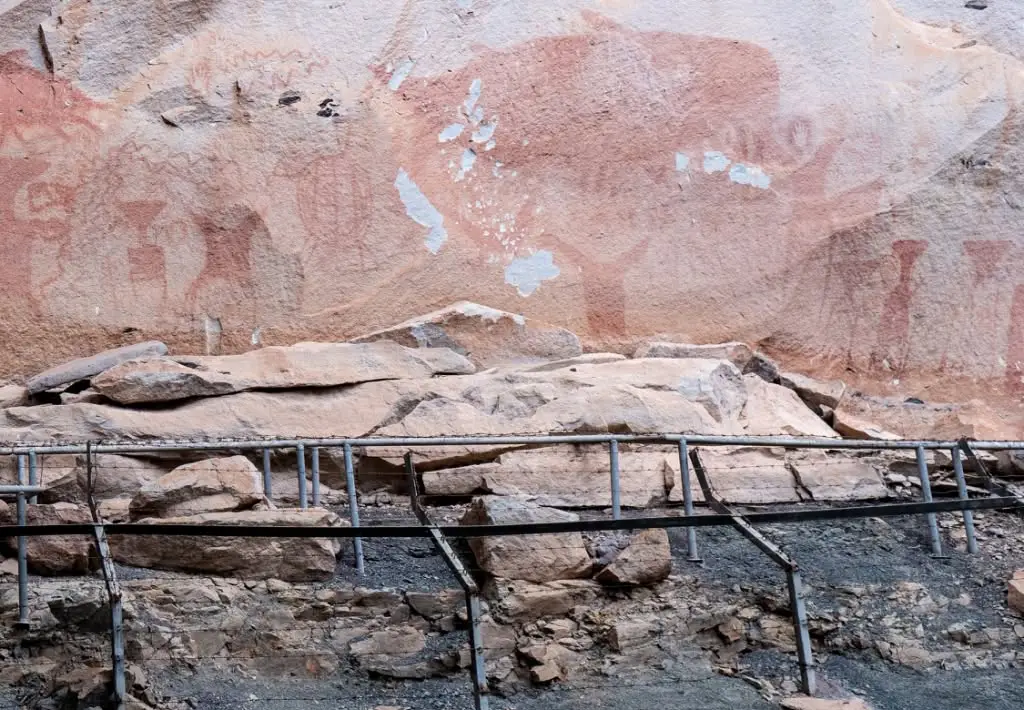
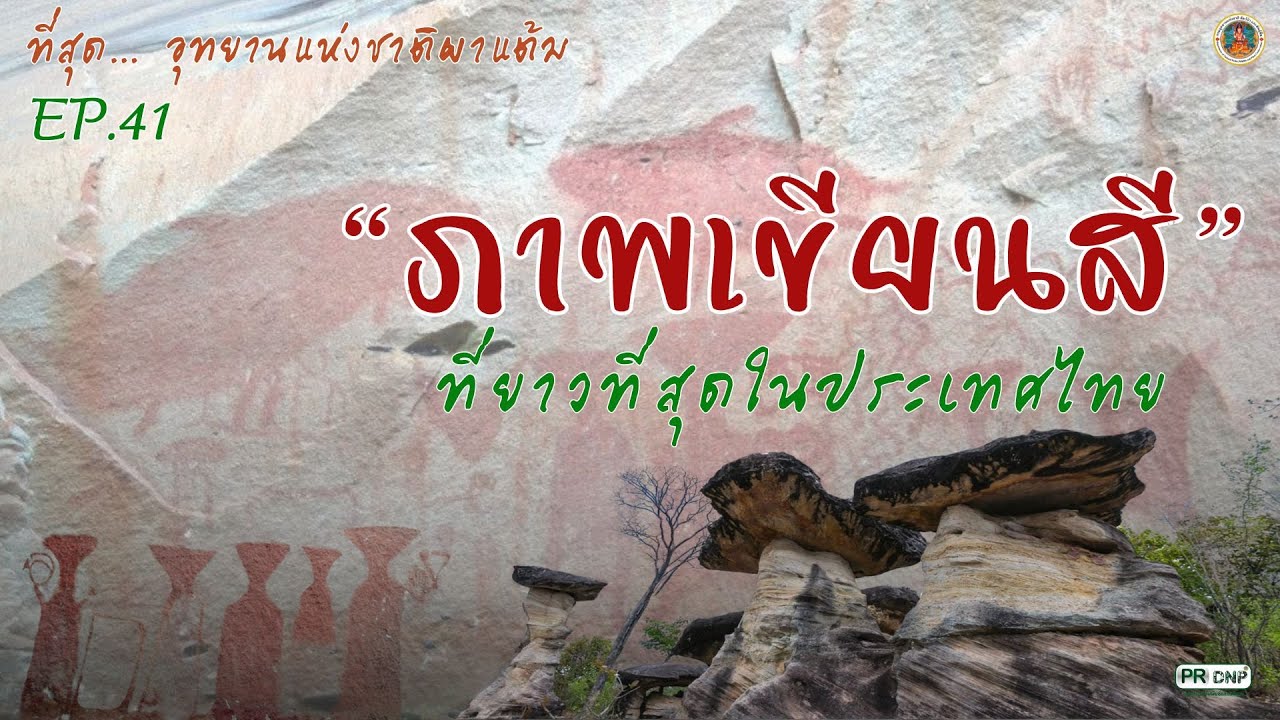
The prehistoric paintings at Pha Taem are more than 3,000 years old. They stretch along the sandstone cliff for about 180 meters and include more than 300 images. The paintings are generally grouped into human figures, handprints, animals, objects, and geometric forms. Many were painted in red pigment from natural minerals. Their forms give modern visitors insight into the life and worldview of prehistoric people who lived in the Mekong River basin long before written records appeared in the region.
Among the most memorable images are large fish, animals, human figures, handprints, and a form interpreted as a traditional fish trap known locally as a “tum.” This woven bamboo fishing tool reflects the importance of river life along the Mekong. The presence of fish and fishing-related imagery shows that the river was already central to food, movement, resources, and belief in ancient times. Wave-like lines and other symbols further strengthen the connection between the cliff, the forest, and the river below.
The trail to the rock paintings begins near the visitor center and the cliff-top viewpoint. Visitors descend from the upper cliff to the lower walking path, then follow a route along the base of the sandstone wall. The path passes several groups of paintings before returning to the top area. This is what makes Pha Taem different from a conventional museum. Visitors see the paintings in their original landscape, still attached to the cliff where they were created thousands of years ago.
The Pha Taem visitor center is a simple one-storey concrete building located near the car park and the main cliff area. Inside, it displays information about the park’s geography, wildlife, nearby waterfalls, flower fields, and important natural attractions. Souvenirs are also available, and the area behind the visitor center offers a beautiful viewpoint over the Mekong River. For first-time visitors, this center is the most practical place to collect information, ask for a walking map, and understand the route before going down to the paintings.
Asking for a walking map is useful because the painting groups are not all located in one compact point. The distance between some sections, the cliffside walking path, and the return climb require basic preparation. A map helps visitors understand how far they can walk, how much time they need, and which sections of the rock art trail they should focus on. This is especially helpful for families, elderly travelers, and visitors who arrive during hot or rainy weather.
The upper viewpoint is another major reason to visit Pha Taem. From the cliff edge, visitors can see the Mekong River flowing below and the landscape of Lao PDR beyond the water. At sunrise, the first light spreads across the cliff, the rocky plateau, and the forested valley. This dramatic morning view has made Pha Taem one of the most popular sunrise destinations in Ubon Ratchathani, especially during the cool season and New Year holidays.
Pha Taem’s terrain is dominated by sandstone, rocky fields, and open dry dipterocarp forest. The trees are not as tall or dense as rainforest, so the sky opens widely above the landscape. This open terrain also makes the national park suitable for stargazing and astronomical photography in several areas, including the main Pha Taem viewpoint, Sao Chaliang, and other rocky viewpoints. For travelers interested in both cultural heritage and night-sky scenery, Pha Taem offers a rare combination.
Beyond the prehistoric paintings, Pha Taem National Park contains several notable natural attractions. Sao Chaliang is a group of mushroom-shaped sandstone pillars formed by natural erosion over a very long period of time. Soi Sawan Waterfall, Saeng Chan Waterfall, Thung Na Mueang Waterfall, the Dong Na Tham forest area, flower fields, rocky viewpoints, and Mekong River scenery all add depth to the park. These attractions allow visitors to combine archaeology, geology, waterfalls, flowers, and forest landscapes in one trip.
Sao Chaliang is located close to the Pha Taem cliff area and is one of the easiest nearby stops. The rock pillars rise from the ground in unusual shapes, with broad stones balanced above narrower bases. Their form shows the long natural process of erosion by wind, water, and weathering. For travelers interested in geology, Sao Chaliang is a clear example of sandstone landscape formation. For photographers, it provides a completely different visual mood from the cliff paintings and the Mekong viewpoint.
Soi Sawan Waterfall is another key attraction within Pha Taem National Park. It is formed by 2 streams flowing down from different sides of a cliff and meeting below, creating a shape similar to a necklace. Around the waterfall, rocky fields and seasonal wildflowers add to the beauty of the area, especially during the rainy season and early cool season. Visitors who want to extend their Pha Taem trip beyond the rock paintings often include this waterfall in the same day route.
Saeng Chan Waterfall, also known as Long Ru Waterfall, has one of the most distinctive forms in Ubon Ratchathani. Water drops through a natural hole in the rock before falling to the pool below. When the light and water conditions are right, the scene resembles moonlight shining through the cliff, giving the waterfall its poetic name. Thung Na Mueang Waterfall is another peaceful waterfall nearby, often visited together with Saeng Chan Waterfall when road and seasonal conditions are suitable.
Dong Na Tham is a more adventurous natural area inside Pha Taem National Park. It features dry dipterocarp forest, rocky plains, sandstone formations, cliffs, and wide viewpoints. This area is suitable for travelers who want to spend more time in nature and are comfortable with longer travel routes. Compared with the main Pha Taem cliff and visitor center, Dong Na Tham requires more planning, time, and transport preparation.
The greatest value of the Pha Taem rock paintings lies in seeing ancient human expression in its original environment. The paintings are not isolated from the landscape. They remain with the cliff, the wind, the sunlight, the rocky path, the forest, and the Mekong River below. Walking beneath the cliff allows visitors to understand that these images were part of a lived landscape, not simply decorative marks on stone.
The red color of the paintings is striking against the pale sandstone wall. Some figures remain clear, while others have faded with time. Protective barriers and designated walking platforms help prevent direct contact with the paintings. These measures are essential because the paintings are fragile archaeological evidence that cannot be replaced. Visitors should not touch the rock art, climb onto the cliff wall, write on stone, or leave any marks in the area.
Historically, the paintings help modern viewers imagine life before written history in the Mekong region. Animal figures suggest the surrounding environment and available wildlife. Fish and fishing tools point to the importance of river resources. Human figures and handprints suggest identity, presence, and group expression. Geometric forms and wave-like lines show that prehistoric art also carried symbolic meanings beyond direct representation.
Visitors should begin at the visitor center, study the map, and prepare properly before walking down to the painting trail. Comfortable shoes, drinking water, sun protection, and enough time are important. Some parts of the path include steps, rock surfaces, and sloping sections. During or after rain, the rocky trail can become slippery. The safest way to visit is to follow the marked route and respect the instructions of park officers.
The best times to visit are early morning and late afternoon. Early morning is ideal for sunrise over the Mekong and cooler weather. Late afternoon gives softer light and a more comfortable walking experience. Visitors who want to walk the full painting route should avoid rushing. Each painting group has its own details, and the climb back to the upper area takes more energy than the descent.
For families and general travelers, the visitor center makes the experience easier to understand. Children and young visitors can learn about geography, wildlife, waterfalls, flower fields, and the archaeological background before seeing the actual site. This transforms a simple sightseeing trip into a meaningful educational experience about ancient people, natural landscapes, and the Mekong River environment.
Pha Taem is also highly suitable for foreign travelers because its main stories are visible through images and landscape. Even without deep knowledge of Thai language, visitors can recognize fish, animals, hands, human figures, and abstract symbols painted on stone. When combined with the Mekong River view, the cliff trail, and the park’s natural scenery, Pha Taem becomes an internationally accessible heritage site.
Getting There is most convenient by private car, rental car, or arranged transport. From Ubon Ratchathani city, travelers drive toward Khong Chiam District and continue to Pha Taem National Park. The distance from Ubon Ratchathani city is about 95 km. The route is paved and accessible, but public transport does not run directly to the visitor center throughout the day. Travelers without a car should arrange a vehicle with a driver from Ubon Ratchathani city or from accommodation in Khong Chiam.
Staying in Khong Chiam makes a Pha Taem visit easier, especially for travelers who want to see sunrise. Khong Chiam is much closer to the park than Ubon Ratchathani city and offers riverside accommodation, local restaurants, and access to other Mekong attractions. From Khong Chiam, travelers can visit Pha Taem in the morning, return for lunch along the Mekong, and continue to the Two-Colored River viewpoint, Wat Tham Khuha Sawan, Kaeng Tana, or nearby waterfalls.
A full-day route can begin with sunrise at the Pha Taem viewpoint, followed by the visitor center and the prehistoric rock painting trail. After returning to the top of the cliff, visitors can continue to Sao Chaliang, then choose Soi Sawan Waterfall, Saeng Chan Waterfall, or Thung Na Mueang Waterfall depending on the season and travel plan. In the evening, returning to Khong Chiam for a Mekong riverside meal completes the route with local food and river scenery.
The late rainy season and early cool season offer the richest natural atmosphere. Waterfalls are active, wildflowers appear on rocky fields, the forest becomes greener, and morning temperatures are more comfortable. The hot season offers clearer skies and easier road conditions, but travelers should begin early and avoid walking long distances under strong midday sun.
Conservation is central to the Pha Taem experience. The rock paintings cannot be recreated, and even small acts of damage can permanently affect the site. Responsible visitors stay on marked trails, do not touch the cliff wall, do not use inappropriate lighting close to the paintings, do not scratch or write on stone, and take all rubbish away. Protecting the paintings means preserving one of Thailand’s most valuable prehistoric records for future generations.
Pha Taem also shows how deeply human life has long been connected with the Mekong River. From the cliff, the river is visible below as both a landscape and a historical lifeline. It has supported food, travel, settlement, and cultural exchange for thousands of years. Seeing the paintings while looking out toward the Mekong helps visitors understand the site not as an isolated archaeological wall, but as part of a wider river civilization.
For travelers interested in history, art, and culture, Pha Taem deserves time and attention. The large fish images reflect river resources. Animal figures reflect the surrounding natural world. Handprints express human presence. Fishing tools reflect practical knowledge. Geometric lines show symbolic thinking. When these images are read together with the real cliff and river setting, the site becomes far more powerful than a simple viewpoint.
The Pha Taem Prehistoric Rock Paintings are therefore more than a photo stop. They are a rare open-air archive of prehistoric life, framed by cliffs, forest, and the Mekong River. In one place, visitors experience archaeology, geology, nature, sunrise views, short hiking, national park facilities, and the cultural landscape of eastern Isan. For any traveler visiting Ubon Ratchathani, Pha Taem should be considered one of the province’s essential destinations.
| Name | Pha Taem Prehistoric Rock Paintings |
| Location | Pha Taem National Park, Huai Phai Subdistrict, Khong Chiam District, Ubon Ratchathani Province, Thailand |
| Address | Ban Nong Phue, Huai Phai Subdistrict, Khong Chiam District, Ubon Ratchathani 34220, Thailand |
| Coordinates | Approximately 15.3990, 105.5077 |
| Highlights | Prehistoric rock paintings over 3,000 years old, about 180 m of painted cliff wall, more than 300 images, Mekong River viewpoint, and sunrise scenery |
| History | A prehistoric rock art site on a sandstone cliff overlooking the Mekong River, preserving evidence of ancient human life in the Mekong basin |
| Name Origin | The word “taem” means to paint or mark, referring to the painted cliff wall |
| Distinctive Features | Human figures, handprints, animal figures, objects, geometric forms, large fish images, and fishing-tool symbols connected with Mekong River life |
| Travel Information | About 95 km from Ubon Ratchathani city via Khong Chiam District. Best reached by private car, rental car, or arranged transport. |
| Current Status | Open for visitors to see the prehistoric paintings, cliff viewpoint, visitor center, and national park attractions during park operating hours |
| Open Days | Daily |
| Opening Hours | 05.00 – 18.00 |
| Fees | Thai visitors: adult 40 baht, child 20 baht / Foreign visitors: adult 400 baht, child 200 baht |
| Facilities | Visitor center, car park, toilets, shower rooms, camping ground, guesthouses, restaurant, souvenir shop, meeting room, and youth camp building |
| Main Areas / Zones | Visitor center, car park, Pha Taem cliff viewpoint, prehistoric rock painting trail, Sao Chaliang, Soi Sawan Waterfall, Saeng Chan Waterfall, Thung Na Mueang Waterfall, flower fields, and Dong Na Tham forest area |
| Caretaker | Pha Taem National Park, Department of National Parks, Wildlife and Plant Conservation / Pramuan Rattanawan, Chief of Pha Taem National Park |
| Main Contact Number | 045-252581, 089-8105532 |
| Official Website / Official Page | Pha Taem National Park, Department of National Parks, Wildlife and Plant Conservation |
| Nearby Tourist Attractions | 1. Sao Chaliang, about 1 km 2. Soi Sawan Waterfall, about 20 km 3. Saeng Chan Waterfall, about 28 km 4. Thung Na Mueang Waterfall, about 30 km 5. Two-Colored River Viewpoint, Khong Chiam, about 23 km 6. Kaeng Tana, about 27 km |
| Nearby Restaurants | 1. Lab Pla Khong Chiam Restaurant, about 23 km, Tel. 045-351283 2. Café De Khong and Bar, about 25 km, Tel. 081-860-5905, 045-351174-6 3. Pae Araya Khong Chiam, about 24 km 4. Peerada Cafe & Restaurant Khong Chiam, about 25 km 5. Rim Khong Restaurant Khong Chiam, about 24 km |
| Nearby Accommodations | 1. Kayom House - White Meranti House & Resort, about 7 km, Tel. 088-710-0086 2. Khong Chiam Orchid Riverside Resort, about 23 km, Tel. 098-916-8771 3. Tohsang Heritage Khongjiam, about 25 km, Tel. 081-860-5905, 045-351174-6 4. Sedhapura By Tohsang, about 25 km, Tel. 081-860-5905, 045-351174-6 5. Peerada River View Resort, about 25 km, Tel. 045-351213 6. Khong Chiam 2 Hotel, about 24 km |
Frequently Asked Questions (FAQ)
Q: Where are the Pha Taem Prehistoric Rock Paintings located?
A: They are located inside Pha Taem National Park in Huai Phai Subdistrict, Khong Chiam District, Ubon Ratchathani Province, Thailand.
Q: What time does Pha Taem open?
A: Pha Taem is open daily from 05.00 to 18.00.
Q: How much is the entrance fee to Pha Taem?
A: The entrance fee is 40 baht for Thai adults and 20 baht for Thai children. For foreign visitors, it is 400 baht for adults and 200 baht for children.
Q: How old are the Pha Taem rock paintings?
A: The paintings are more than 3,000 years old and are among the most important prehistoric records in the Mekong region of Thailand.
Q: Is the walking route to the paintings difficult?
A: The route descends from the cliff-top area to a lower cliffside trail. Visitors should wear comfortable shoes, carry water, and collect a walking map from the visitor center before starting.
Q: When is the best time to visit Pha Taem?
A: Early morning is best for sunrise and Mekong River views, while the late rainy season and early cool season are ideal for waterfalls, wildflowers, and more comfortable walking weather.
Q: Is Pha Taem suitable for foreign travelers?
A: Yes. The site is highly suitable for foreign travelers because it combines prehistoric art, Mekong River scenery, nature trails, visitor facilities, and clear cultural meaning in one place.
Q: What attractions can be visited after Pha Taem?
A: Nearby attractions include Sao Chaliang, Soi Sawan Waterfall, Saeng Chan Waterfall, Thung Na Mueang Waterfall, the Two-Colored River Viewpoint, and Kaeng Tana.
 Category: ●Art, Culture and Heritage
 Group: ●Historical Sites and Monuments
Last Update : 3 MonthAgo
 Last Update : 3 MonthAgo
 Click to Access the Navigation Map GPS
Pha Taem Prehistoric Rock Paintings Map
Recommend
 Historical Sites and Monuments(5)
 Landmarks and Memorials(2)
 Royal Palace(1)
 Art, Craft Centres, Tradition(7)
 Museums(3)
 Places of Worship
 Temple(37)
 Other Sacred Sites(4)
 Research and Development
 Royal Project(2)
 Suburban Living
 Village, Community(2)
 Local Market(4)
 Nature and Wildlife
 National Parks and Marine Reserves(5)
 Mountain (Doi)(6)
 Dam, Reservoir, Lake(8)
 Waterfalls(12)
 Hot Springs(1)
 Caves(2)
 River, Canal(11)
 Bays and Beaches(8)
 Islands(2)
 Other natural attractions(6)
 Entertainment and Agricultural
 Zoos and Aquariums(2)
 Animal camps and shows(1)
 Farms, Parks and Ecotourism(1)
 Waterpark(1)
 Travel Articles, Recipes
 Travel Review, Food Review(1)


