
lovethailand home >Northeastern Travel Attractions >Mukdahan Travel Attractions >Muang Mukdahan >Mukdahan > Mukdahan City Pillar Shrine
TL;DR: Mukdahan City Pillar Shrine is located at Provincial Government Complex, Near Mukdahan Provincial Hall, open Daily, hours 06:00 – 18:00.
Mukdahan City Pillar Shrine
Open Days: Daily
Opening Hours: 06:00 – 18:00
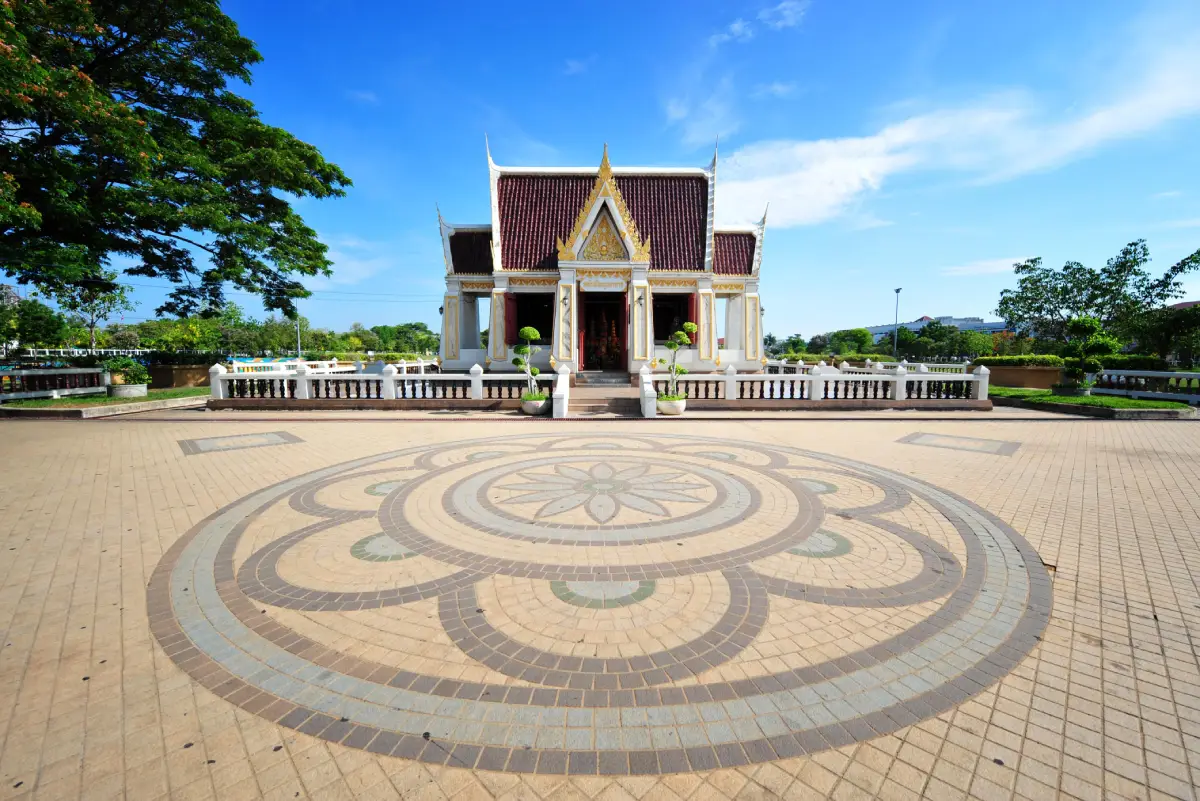
Mukdahan City Pillar Shrine is one of the most important sacred landmarks and cultural symbols of Mukdahan Province in northeastern Thailand. Located within the provincial government complex near Mukdahan Provincial Hall on Wiwit Surakan Road, Mukdahan Subdistrict, Mueang Mukdahan District, Mukdahan Province 49000, the shrine serves as a spiritual center for local residents and a venue for important provincial ceremonies. Its traditional four-sided Thai pavilion features elaborate golden decorations, a red-tiled roof, and a sacred city pillar made from Chaiyaphruek wood, finished with black lacquer and gold leaf. The pillar has an elegant ornamental top shaped like a traditional Pum Khao Bin finial. The shrine is closely connected with the historical identity of Mukdahan, a city founded in 1770 by Chao Chanthakinnari and later established as a separate Thai province in 1982. Annual worship ceremonies take place in January, bringing together provincial officials, community representatives, and residents to honor the city's sacred guardian and seek blessings for the community.
The significance of Mukdahan City Pillar Shrine extends beyond its architectural appearance. It represents a longstanding Thai tradition associating the establishment of a town with spiritual protection, civic stability, and the well-being of its people. City pillars have traditionally served as symbolic centers of settlements, expressing hopes for peace, prosperity, and social harmony. In Mukdahan, these beliefs continue through ceremonies attended by residents and government organizations, particularly during important provincial occasions.
The shrine is distinguished by its traditional Thai chatumuk design, a four-sided pavilion standing on a raised platform. Steps lead to the principal entrance, while a surrounding veranda defines the sacred structure. White walls and columns contrast with gold ornamentation on the gables and architectural details. A dark red tiled roof gives the building a dignified appearance, and an ornamental pattern in the spacious courtyard creates a harmonious foreground for the pavilion.
The surrounding environment includes provincial government buildings, important roads, and established urban neighborhoods. This location makes the shrine accessible to residents and visitors traveling through central Mukdahan. The contrast between the traditional Thai architecture of the shrine and the modern administrative buildings nearby reinforces its symbolic role as a meeting point between civic history, public administration, and local spiritual traditions.
Mukdahan's history is closely associated with the Mekong River and the movement of communities along its banks. The river provided natural transport routes, agricultural resources, and opportunities for trade between settlements. People moving between different parts of the Mekong basin established communities in areas where water, farmland, and access to transportation supported daily life. These geographical advantages gradually helped Mukdahan develop into an important settlement on the Thai side of the river.
One of the central figures in the founding of Mukdahan was Chao Chanthakinnari, also known as Chao Kinnari. He played an important role in leading settlers and establishing Mukdahan in 1770, during the late Thonburi period. The early history of the town survives through local historical accounts, Buddhist temples, guardian shrines, and landmarks in the old urban district. Wat Si Mongkhon Tai, Chao Pho Chao Fa Mung Mueang Shrine, and Chao Mae Song Nang Phi Nong Shrine are particularly associated with the cultural traditions of the town's founding period.
The establishment of Mukdahan involved more than the construction of houses. It required the organization of a community, the selection of suitable land, the creation of religious institutions, and the development of social relationships among different groups of settlers. Sacred places dedicated to the spiritual guardians of the town provided common locations for worship and helped strengthen the sense of belonging among residents.
Throughout the Thonburi and Rattanakosin periods, Mukdahan developed within the broader political and administrative history of the Mekong borderlands. Its position opposite the area that later became the Lao city of Savannakhet made it important for transportation, cultural contact, and commerce. Following changes in provincial administration, Mukdahan was officially established as a separate province on September 27, 1982, becoming Thailand's 73rd province at that time.
The creation of Mukdahan Province in 1982 marked an important administrative development for a town whose settlement history extended back to 1770. The development of provincial government facilities and public spaces contributed to the modern identity of Mukdahan as an administrative center. The city pillar shrine consequently became an important symbol of civic stability and spiritual continuity within the provincial government district.
The Thai tradition of erecting a city pillar is closely associated with Brahmanical ceremonies and ideas concerning the establishment of a sacred center for a settlement. In traditional practice, the city pillar represents the symbolic foundation and spiritual stability of a town. Its construction and installation involve careful attention to ceremonial timing, the selection of timber, the form of the pillar, and ritual offerings intended to promote auspiciousness and prosperity.
The Mukdahan city pillar is a smooth, cylindrical wooden column made from Chaiyaphruek timber and decorated with lacquer and gold leaf. Its upper section is fashioned into a Pum Khao Bin finial, an elegant traditional Thai ornamental form. The slender design emphasizes the pillar's importance and gives it a distinctive appearance within the shrine. The choice of Chaiyaphruek wood also reflects the symbolic meaning of its Thai name, which is associated with victory and good fortune.
Chaiyaphruek timber has cultural significance in Thailand because its name evokes success and victory. The selection of wood for a sacred pillar traditionally carries symbolic meaning in addition to practical considerations such as strength and durability. In Mukdahan, the use of this timber combines traditional craftsmanship with ceremonial beliefs concerning the stability and prosperity of the city.
The application of lacquer and gold leaf is a well-established decorative technique in Thai religious art. Lacquer creates a prepared surface to which thin gold leaf can be applied, giving the object a luminous appearance appropriate for sacred settings. On Mukdahan's city pillar, this treatment visually distinguishes the column from ordinary wooden structures and emphasizes its ceremonial importance.
The Pum Khao Bin finial is associated with traditional Thai decorative art. Its form resembles an elegant, elongated floral or rice-shaped ornament with a tapering upper extension. The design contributes to the refined silhouette of the city pillar and represents the attention given to sacred objects in Thai craftsmanship. Rather than appearing as an ordinary structural post, the pillar becomes a carefully finished ceremonial object.
The shrine building follows the chatumuk architectural tradition, in which the principal sacred space occupies the center of a balanced composition with projecting roof sections. This design establishes a strong central focus and provides an appropriate setting for the city pillar. Its symmetrical form also gives the building the ceremonial dignity expected of an important provincial landmark.
Architectural descriptions give the main building a width of approximately 4 meters and a length of 7 meters. The front projection extends about 2 meters, while the structure reaches approximately 8.50 meters in height. The surrounding veranda stands on a platform raised about 0.85 meters above ground level, with an overall area measuring approximately 16 by 19 meters. These proportions create a compact but prominent sacred pavilion.
The front gable is decorated with traditional Thai patterns highlighted in gold. Its ornate surface contrasts with the white columns and walls, while the dark red roof tiles strengthen the building's visual identity. The architecture combines classical decorative principles with the functional requirements of a modern city pillar shrine.
The veranda surrounding the pavilion connects the exterior courtyard with the interior sacred space. Balustrades and columns define the boundary of the structure, while the entrance steps provide a clear approach to the city pillar. The raised platform gives visitors a sense of moving from an ordinary public area into a place of greater ceremonial importance.
The courtyard in front of the shrine is another distinctive element. Its open area is decorated with a symmetrical circular pavement design, creating an attractive foreground and allowing visitors to appreciate the complete architectural composition. Trees and ornamental plants contribute to the landscaped setting and soften the appearance of the surrounding administrative district.
From the front courtyard, the building forms the central point of the landscape. The approach, steps, and entrance align visually with the sacred pillar inside. This arrangement reinforces the symbolic importance of the city pillar and creates a sense of dignity appropriate to a site used for public ceremonies and personal worship.
Inside the pavilion, the sacred city pillar is the primary focus of devotion. Offerings such as flowers, garlands, incense, candles, and colored ceremonial cloth are placed in designated areas. Residents visit to pay their respects and seek blessings associated with family well-being, personal safety, business success, and prosperity. The atmosphere reflects the enduring relationship between local beliefs and everyday life.
For many residents, worship at the city pillar shrine is a meaningful way to mark important occasions. Some visit before beginning a new undertaking or embarking on a journey, while others bring family members during holidays and traditional festivals. Such practices illustrate how a civic sacred landmark can become part of the personal experiences and family traditions of a community.
Traditional offerings serve as symbolic expressions of respect rather than compulsory requirements. Floral garlands, incense, candles, and colored cloth are commonly associated with worship at Thai city pillar shrines. Using the designated offering areas helps preserve cleanliness and allows the shrine to remain suitable for both individual visitors and larger ceremonies.
Mukdahan City Pillar Shrine is not a Buddhist monastery, and therefore it does not have an abbot. Its main function is to house the sacred city pillar and provide a location for ceremonial worship. Major events are organized with the participation of provincial government agencies and other relevant organizations, particularly during the annual provincial festival and Red Cross Fair.
The present city pillar shrine should be distinguished from Chao Pho Chao Fa Mung Mueang Shrine on Song Nang Sathit Road. Although both are associated with spiritual protection of Mukdahan, they have different histories and physical features. The present city pillar shrine is a traditional Thai chatumuk building containing the gilded Chaiyaphruek pillar. Chao Pho Chao Fa Mung Mueang Shrine is an older guardian-spirit shrine associated with the memory of Mukdahan's founding.
The origins of Chao Pho Chao Fa Mung Mueang Shrine are preserved through local historical traditions rather than a definitive construction record. Community accounts connect the shrine with the foundation of Mukdahan by Chao Chanthakinnari in 1770. The original structure was a wooden shrine, which was later reconstructed in concrete and decorated in a style influenced by Chinese shrine architecture.
Within Chao Pho Chao Fa Mung Mueang Shrine is an older city-related sacred marker associated with the shrine's local traditions. It should not be confused with the gilded wooden city pillar housed in the present Mukdahan City Pillar Shrine. The distinction reflects the existence of different historical layers of guardian-spirit worship and civic ceremonial traditions within the same provincial town.
Chao Pho Chao Fa Mung Mueang is revered by many residents as a protective spirit associated with peace and prosperity. Visitors present offerings and seek blessings according to local customs. The shrine's history is closely connected with the old settlement near the Mekong River, making it an important destination for understanding the cultural memory of Mukdahan's earlier communities.
Another important sacred site is Chao Mae Song Nang Phi Nong Shrine, situated beside the Mekong River on Samran Chai Khong Tai Road, near the municipal pier and immigration checkpoint. The shrine is associated with a local legend concerning two sisters who became revered as female guardian spirits. Its history is connected with the early settlement of Mukdahan and the spiritual beliefs of communities living along the river.
According to one version of the local legend, the two sisters belonged to a noble family on the Lao side of the Mekong and died after a boating accident while traveling across the river. Their spirits became associated with the location where the accident occurred. During the period when Chao Chanthakinnari established Mukdahan, unusual events were believed to have taken place near the area, leading to the establishment of a shrine dedicated to the sisters.
Chao Pho Chao Fa Mung Mueang Shrine and Chao Mae Song Nang Phi Nong Shrine are closely connected through an annual worship tradition. On the full-moon day of the sixth lunar month, residents traditionally conduct ceremonies honoring both sacred places. Activities include the presentation of savory and sweet foods, flowers, incense, candles, and traditional dance performances.
Traditional ceremonies may involve a ritual specialist known locally as a cham, who guides proceedings according to community customs. The role is associated with ritual communication, the arrangement of offerings, and the observance of established ceremonial sequences. Such practices represent an important part of northeastern Thai culture, where Buddhist traditions coexist with beliefs concerning ancestors and protective spirits.
Mukdahan City Pillar Shrine has its own important annual ceremony, traditionally associated with January 9 and the provincial festival and Red Cross Fair. The ceremony honors the sacred city pillar and expresses hopes for good fortune and successful community activities. It is attended by provincial officials and representatives of local organizations, giving the shrine an important role in formal civic observances.
The city pillar ceremony traditionally incorporates Brahmanical ritual elements. Offerings, incense, floral garlands, ceremonial recitations, and the scattering of flowers and puffed rice are among the practices associated with the event. The careful performance of these activities expresses respect for the spiritual guardian of the city and preserves established provincial traditions.
On January 7, 2026, Mukdahan Province held a major ceremony honoring sacred landmarks ahead of the provincial Red Cross Fair and annual festival. The activities began with a royal tribute ceremony at the monument to King Chulalongkorn, King Rama V, in the provincial government complex. A city pillar worship ceremony followed at 07:30, presided over by Mukdahan Governor Worayan Bunnarach.
The 2026 ceremony included traditional offerings and Brahmanical rituals. Participants lit incense, scattered puffed rice and flowers, and presented ceremonial objects. A group of traditional dancers performed in honor of the sacred city pillar. The ceremony demonstrated the continuing importance of established ritual practices within the public life of the province.
Other ceremonial elements included the presentation of red cloth and seven-colored cloth to the city pillar guardian, floral garlands, scented water, and blessed water. These offerings symbolize devotion, purity, and auspiciousness. The use of colorful ceremonial cloth is also found at other city pillar shrines and sacred places throughout Thailand.
The January 2026 event confirmed the shrine's continuing role as an active ceremonial landmark. It is not simply a historical site described in tourism publications. The shrine remains a location where provincial leaders, government agencies, dancers, and members of the community participate in important public ceremonies.
During celebrations commemorating Mukdahan's establishment as a province, the city pillar shrine is included among the important sacred destinations of the town. Other locations involved in the broader cultural landscape include Chao Pho Chao Fa Mung Mueang Shrine, Chao Mae Song Nang Phi Nong Shrine, Wat Si Mongkhon Tai, Wat Si Bun Rueang, Ho Kaeo Mukdahan, and Wat Roi Phra Phutthabat Phu Manorom. Together, these places reflect the variety of religious and spiritual traditions maintained by local residents.
Wat Si Mongkhon Tai has a particularly close relationship with Mukdahan's founding history. Established within the historical context of Chao Chanthakinnari's settlement, the temple houses Phra Chao Ong Luang, an important Buddha image revered by local residents. Traditional accounts also associate the temple with the discovery of an iron Buddha image during the early development of the town. These narratives contribute to the temple's importance in the province's religious history.
Wat Si Bun Rueang is another significant Buddhist temple within the old town area. Its Buddha images, religious artwork, and connections with local communities make it an important place of worship. Visiting Wat Si Mongkhon Tai and Wat Si Bun Rueang alongside the city pillar shrine allows travelers to appreciate the different religious institutions that have contributed to the cultural development of Mukdahan.
Chao Pho Chao Fa Mung Mueang Shrine also forms part of Mukdahan's Chinese New Year celebrations, which reflect the province's ethnically diverse community. Thai, Chinese, Vietnamese, and Lao cultural influences have interacted along the Mekong for generations. During cultural festivities, lantern decorations, lion dances, and community performances contribute to the vibrant atmosphere around the old town and its sacred landmarks.
This cultural diversity is one of Mukdahan's defining characteristics. The Mekong has long been a transport route and a place of exchange between communities. People brought languages, culinary traditions, artistic practices, and religious beliefs from different regions. The presence of Buddhist temples, guardian shrines, a city pillar shrine, and historic markets within the same town reflects this complex cultural heritage.
For visitors interested in history, Mukdahan City Pillar Shrine provides a convenient starting point for exploring the town. Its position near the provincial government district allows travelers to continue to Song Nang Sathit Road, older neighborhoods, local markets, and the Mekong waterfront. A cultural route can begin with the city pillar before moving on to guardian shrines and Buddhist landmarks associated with earlier settlement traditions.
Chao Pho Chao Fa Mung Mueang Shrine is particularly useful for understanding the distinction between older community guardian worship and the present city pillar shrine. Its architectural details reflect Chinese influences and its surroundings preserve elements of the older town. By contrast, the present city pillar shrine follows the traditional Thai chatumuk form and occupies a more formal civic setting.
Chao Mae Song Nang Phi Nong Shrine provides a different cultural perspective through its riverside setting and the legend of the two sisters. The shrine is associated with traditions concerning spiritual protection along the Mekong and is historically linked with Chao Pho Chao Fa Mung Mueang Shrine. Its location near Wat Si Mongkhon Tai makes it a natural continuation of an old-town cultural journey.
Indochina Market is one of the best-known commercial attractions of Mukdahan. Located close to the Mekong waterfront on Samran Chai Khong Road, the market contains shops selling clothing, household goods, accessories, snacks, souvenirs, and various items associated with regional trade. The market illustrates Mukdahan's continuing role as a trading town connecting communities on both sides of the Mekong River.
The Mekong waterfront offers views of the river and the Lao city of Kaysone Phomvihane in Savannakhet Province across the water. Riverside promenades and public viewing areas provide opportunities to experience the geography of this international border region. The landscape makes clear why the Mekong has played such an important role in the history, economy, and cultural identity of Mukdahan.
Ho Kaeo Mukdahan, the province's observation tower, is another important destination. The tower contains exhibits associated with Mukdahan's history and cultural heritage, together with elevated observation areas offering panoramic views of the town, the Mekong River, and the Lao side of the border. Visiting the tower provides a broader geographical perspective on the settlement patterns and river connections that shaped the province.
Wat Roi Phra Phutthabat Phu Manorom is a prominent Buddhist destination situated on elevated ground in Mueang Mukdahan District. It is known for its monumental white Buddha image, large Naga sculpture, and scenic viewpoints overlooking Mukdahan and the Mekong River. The temple reflects the importance of Buddhism and Naga-related traditions in the culture of communities living along the great river.
Naga beliefs are found throughout many communities of the Mekong basin. These traditions associate the mythical serpent with water, abundance, protection, and Buddhism. The presence of important Naga monuments and guardian shrines within Mukdahan Province illustrates the diversity of symbols through which local residents express their spiritual relationship with the surrounding environment.
Food culture is another notable aspect of Mukdahan. The town offers northeastern Thai cuisine alongside dishes influenced by Chinese, Vietnamese, and Lao communities. Local restaurants serve everything from rice dishes and noodles to traditional Isan meals and contemporary international cuisine. This culinary diversity reflects generations of movement, settlement, and interaction along the Mekong.
Popular regional dishes include larb, som tam, spicy soups, grilled meats, and communal hot-pot meals. Vietnamese-inspired cuisine also forms an important part of the area's food traditions. Exploring local restaurants therefore provides another way to experience the province's cultural connections and everyday social life.
Dining options in central Mukdahan include Good Mook Café and Restaurant on Song Nang Sathit Road, Buono, Rattiya Jaew Hon Branch 2, Wirin Jaew Hon, and shabu restaurants along Chayangkun Road. The Ratri Market area opposite the city pillar shrine also contains smaller food businesses serving local residents and visitors. These establishments provide a variety of choices within the broader town-center district.
Ratri Market is a local evening food and shopping area near the city pillar shrine. Its stalls and casual dining options become part of the town's activity later in the day. The contrast between the quiet ceremonial character of the shrine and the liveliness of the nearby market illustrates the different functions of urban spaces within the same community.
Mukdahan town offers a wide range of accommodation, from affordable city hotels to larger properties and Mekong riverside establishments. Options include Submukda Grand Hotel, Ploy Palace Hotel, B2 Mukdahan, Riverfront Hotel, Hotel de Ladda, and Hotel Muq. Their locations provide access to the city pillar shrine, the administrative district, shopping areas, and the riverfront.
Hotels near the Mekong are particularly attractive for their riverside surroundings, while those in the commercial town center offer convenient access to shops, restaurants, and transport services. The variety of accommodation allows travelers to plan different kinds of visits, from short cultural excursions and business trips to longer journeys through northeastern Thailand and neighboring Laos.
Travel within Mukdahan is possible by private vehicle and locally available transport services. The shrine occupies a convenient position near the provincial government center, with road connections to surrounding neighborhoods and important landmarks. Major regional routes connect Mukdahan with Nakhon Phanom, Amnat Charoen, Roi Et, and Kalasin. The Second Thai-Lao Friendship Bridge also links the province with Savannakhet across the border.
Getting There: Mukdahan City Pillar Shrine is situated near Mukdahan Provincial Hall on Wiwit Surakan Road in Mukdahan Subdistrict, Mueang Mukdahan District, Mukdahan Province 49000, Thailand. Visitors driving into central Mukdahan can follow the main town roads toward the provincial government complex. Travelers arriving at Mukdahan Bus Terminal can continue by locally available transport to the provincial hall area. Travel distance and journey time depend on the point of departure within the town.
A cultural route through old Mukdahan can begin at the city pillar shrine and continue to Chao Pho Chao Fa Mung Mueang Shrine on Song Nang Sathit Road. From there, visitors can explore Wat Si Mongkhon Tai, Chao Mae Song Nang Phi Nong Shrine, and Indochina Market beside the Mekong. This itinerary brings together civic beliefs, local guardian traditions, Buddhist heritage, and the commercial history of the border town.
Visitors particularly interested in temples can extend their journey to Wat Si Bun Rueang and Wat Roi Phra Phutthabat Phu Manorom. This combination highlights the differences between a city pillar shrine, a traditional guardian shrine, and a Buddhist monastery. It also provides opportunities to view the Mekong from both the riverfront and elevated hilltop locations.
Culturally, Mukdahan City Pillar Shrine represents the interaction of Brahmanical ceremonial traditions, local spiritual beliefs, and contemporary community life. The participation of provincial authorities in annual worship ceremonies demonstrates that the shrine remains important not merely as a historical attraction but as a location for public observances that encourage unity and shared identity.
The continued performance of city pillar ceremonies helps preserve knowledge about ritual offerings, ceremonial sequences, traditional dance, and the symbolism of the sacred pillar. Younger participants have opportunities to learn how these practices express respect for the history of the community and a collective desire for peace and prosperity.
The shrine's location beside provincial government buildings adds another layer of meaning. It stands within the administrative heart of Mukdahan while retaining a distinctly traditional architectural identity. In this setting, the city pillar forms a symbolic connection between the administration of the province and beliefs about the enduring protection of the community.
Mukdahan City Pillar Shrine also illustrates the adaptation of traditional Thai architecture to modern provincial sacred spaces. Its chatumuk structure, white-and-gold decorative treatment, lacquered wooden city pillar, and orderly ceremonial courtyard create a building that is meaningful both artistically and symbolically.
Considering Mukdahan's history from its establishment in 1770 to its designation as a province in 1982 and its annual ceremonies in the present day, the shrine represents an enduring tradition of associating civic identity with sacred protection. Administrative structures and the surrounding urban environment have changed, but the idea of maintaining a spiritual center for the community remains significant.
One of the qualities that distinguishes the shrine is its location in a culturally diverse border town. Guardian shrines, Buddhist temples, traditional markets, and neighborhoods associated with the Mekong are all found within the surrounding urban area. A visit to the city pillar shrine can therefore serve as an introduction to different dimensions of Mukdahan's heritage, including settlement history, religious traditions, trade, and cross-border cultural relationships.
Mukdahan City Pillar Shrine is consequently an important destination for understanding the province through its history, architecture, ceremonies, and community life. The traditional four-sided pavilion and gilded Chaiyaphruek city pillar are its most recognizable physical features, while the annual January worship ceremonies and connections with older guardian shrines reflect the continuing importance of local spiritual traditions.
With its central location, distinctive Thai architecture, and enduring ceremonial role, Mukdahan City Pillar Shrine remains both a spiritual center for residents and a meaningful cultural landmark for visitors. Its significance lies not only in the beauty of the pavilion but also in the shared memory, respect for civic history, and collective hopes for peace and prosperity that the shrine continues to represent.
| Place Name | Mukdahan City Pillar Shrine |
| Location | Provincial Government Complex, Near Mukdahan Provincial Hall |
| Address | Wiwit Surakan Road, Mukdahan Subdistrict, Mueang Mukdahan District, Mukdahan Province 49000, Thailand |
| Type of Attraction | City Pillar Shrine, Sacred Provincial Landmark, Historical and Cultural Attraction |
| Cultural Significance | Spiritual Center of Mukdahan and an Important Venue for Provincial City Pillar Worship Ceremonies |
| Historical Background | Mukdahan was founded by Chao Chanthakinnari in 1770 and became a separate province on September 27, 1982. |
| Architecture | Traditional Four-Sided Thai Pavilion with White Walls, Gold-Decorated Gables, Dark Red Roof Tiles, and a Raised Veranda |
| Building Dimensions | Approximately 4 m Wide, 7 m Long, 2 m Front Projection, 8.50 m High, with a 0.85 m Raised Platform and a Surrounding Veranda Measuring Approximately 16 × 19 m |
| City Pillar | Smooth Cylindrical Chaiyaphruek Wooden Pillar with Lacquer and Gold Leaf, Featuring a Traditional Pum Khao Bin Finial |
| Main Areas and Features | 1. Four-Sided Shrine Pavilion 2. Sacred City Pillar Area 3. Offering Area 4. Surrounding Veranda 5. Main Entrance and Steps 6. Ceremonial Courtyard with Decorative Pavement 7. Landscaped Surroundings |
| Organizations Involved in Ceremonies | Mukdahan Provincial Administration and Participating Government Agencies. The Shrine Is Not a Buddhist Monastery and Has No Abbot. |
| Annual Ceremony | City Pillar Worship Ceremony Traditionally Associated with January 9 and the Mukdahan Annual Festival and Red Cross Fair |
| 2026 Ceremony | January 7, 2026: Provincial Worship Ceremony Ahead of the Mukdahan Red Cross Fair and Annual Festival |
| Open Days | Daily |
| Opening Hours | 06:00 – 18:00 |
| Admission Fee | Free Admission |
| Facilities | Parking, Wheelchair-Accessible Entrance, and Restroom Facilities in the Provincial Government Complex |
| Getting There | Travel to Central Mukdahan and Follow the Main Town Roads Toward Mukdahan Provincial Hall on Wiwit Surakan Road. |
| Provincial Hall Contact | +66 42 611 330 |
| Attractions in Mukdahan Town and Surrounding Areas | 1. Chao Pho Chao Fa Mung Mueang Shrine, Song Nang Sathit Road 2. Chao Mae Song Nang Phi Nong Shrine, Mekong Riverfront 3. Wat Si Mongkhon Tai, Old Town District 4. Wat Si Bun Rueang, Central Mukdahan 5. Indochina Market, Mekong Riverfront 6. Ho Kaeo Mukdahan Observation Tower, Tel. +66 42 633 211 7. Wat Roi Phra Phutthabat Phu Manorom, Na Si Nuan Subdistrict |
| Restaurants in Central Mukdahan | 1. Yam Laek at Ratri Market, Opposite City Pillar Shrine, Tel. +66 97 939 6999 2. Good Mook Café and Restaurant, Song Nang Sathit Road, Tel. +66 42 612 091 3. Buono, Song Nang Sathit Road, Tel. +66 62 858 1932 4. Rattiya Jaew Hon Branch 2, Phithak Phanom Khet Road, Tel. +66 42 614 789 5. Wirin Jaew Hon, Cha Phuban Alley, Tel. +66 42 612 487 6. Berero Shabu Mukdahan, Chayangkun Road |
| Accommodations Near Mukdahan Provincial Hall | 1. Ploy Palace Hotel – Approx. 0.56 km from Provincial Hall, Tel. +66 42 614 988 2. Submukda Grand Hotel – Approx. 0.61 km from Provincial Hall, Tel. +66 42 620 111 3. B2 Mukdahan – Approx. 1.04 km from Provincial Hall, Tel. +66 42 040 123 4. Hotel Muq – Approx. 1.40 km from Provincial Hall, Tel. +66 63 787 5555 5. Hotel de Ladda – Approx. 1.51 km from Provincial Hall, Tel. +66 42 611 499 6. Riverfront Hotel Mukdahan, Samran Chai Khong Tai Road, Tel. +66 42 612 949 7. Kiengpiman Hotel, Damrong Mukda Alley, Tel. +66 95 598 2241 |
| Current Status | Open for Daily Worship and Continuing to Serve as a Major Provincial Ceremonial Landmark, Including the January 7, 2026 Worship Ceremony |
Frequently Asked Questions (FAQ)
Q: Where is Mukdahan City Pillar Shrine located?
A: The shrine is situated within the provincial government district near Mukdahan Provincial Hall on Wiwit Surakan Road, Mukdahan Subdistrict, Mueang Mukdahan District, Mukdahan Province 49000, Thailand.
Q: What are the opening hours, and is admission free?
A: Mukdahan City Pillar Shrine is open daily from 06:00 to 18:00. There is no admission fee.
Q: What kind of wood was used to make the Mukdahan city pillar?
A: The pillar is made from Chaiyaphruek wood. It has a smooth cylindrical shape, is finished with lacquer and gold leaf, and features a traditional Pum Khao Bin finial.
Q: What is distinctive about the shrine's architecture?
A: The building is a traditional Thai chatumuk pavilion with a four-sided design, dark red tiled roofs, white columns, gold-decorated gables, and a raised veranda.
Q: When is the annual city pillar worship ceremony held?
A: The ceremony is traditionally associated with January 9 during the provincial annual festival and Red Cross Fair. In 2026, the provincial worship ceremony took place on January 7.
Q: Is Mukdahan City Pillar Shrine the same as Chao Pho Chao Fa Mung Mueang Shrine?
A: No. Mukdahan City Pillar Shrine is the present Thai-style pavilion near the provincial hall. Chao Pho Chao Fa Mung Mueang Shrine is an older guardian-spirit shrine on Song Nang Sathit Road with its own historical traditions and sacred city-related marker.
Q: Does Mukdahan City Pillar Shrine have an abbot?
A: No. It is a city pillar shrine, not a Buddhist monastery. Its major ceremonies involve provincial government agencies and other participating organizations.
Q: What attractions can visitors explore near Mukdahan City Pillar Shrine?
A: Nearby cultural destinations include Chao Pho Chao Fa Mung Mueang Shrine, Chao Mae Song Nang Phi Nong Shrine, Wat Si Mongkhon Tai, Wat Si Bun Rueang, Indochina Market, and Ho Kaeo Mukdahan. Wat Roi Phra Phutthabat Phu Manorom is another important attraction in Mueang Mukdahan District.
 Category: ●Places of Worship
 Group: ●Other Sacred Sites
Last Update : 5 DayAgo
 Last Update : 5 DayAgo

 Click to Access the Navigation Map GPS
Mukdahan City Pillar Shrine Map
Recommend

 Art, Culture and Heritage
 Historical Sites and Monuments(2)
 Landmarks and Memorials(3)
 Art, Craft Centres, Tradition(2)
 Museums(1)
 Temple(17)
Other Sacred Sites(4)
 Suburban Living
 Village, Community(4)
 Local Market(2)
 Nature and Wildlife
 National Parks and Marine Reserves(4)
 Mountain (Doi)(5)
 Dam, Reservoir, Lake(3)
 Waterfalls(5)
 Caves(2)
 River, Canal(2)
 Bays and Beaches(1)
 Other natural attractions(1)
 Entertainment and Agricultural
 Farms, Parks and Ecotourism(1)
 Travel Articles, Recipes
 Travel Review, Food Review(1)


