
lovethailand home >Northeastern Travel Attractions >Amnat Charoen Travel Attractions >Muang Amnat Charoen >Bung > Amnat Charoen City Pillar Shrine
TL;DR: Amnat Charoen City Pillar Shrine is located at Ming Mueang Chaloem Phra Kiat Park, Chayangkun Road, Bung Subdistrict, Mueang Amnat Charoen District, Amnat Charoen Province 37000, Thailand, open Daily, hours 08:00 – 18:00.

Amnat Charoen City Pillar Shrine
Open Days: Daily
Opening Hours: 08:00 – 18:00
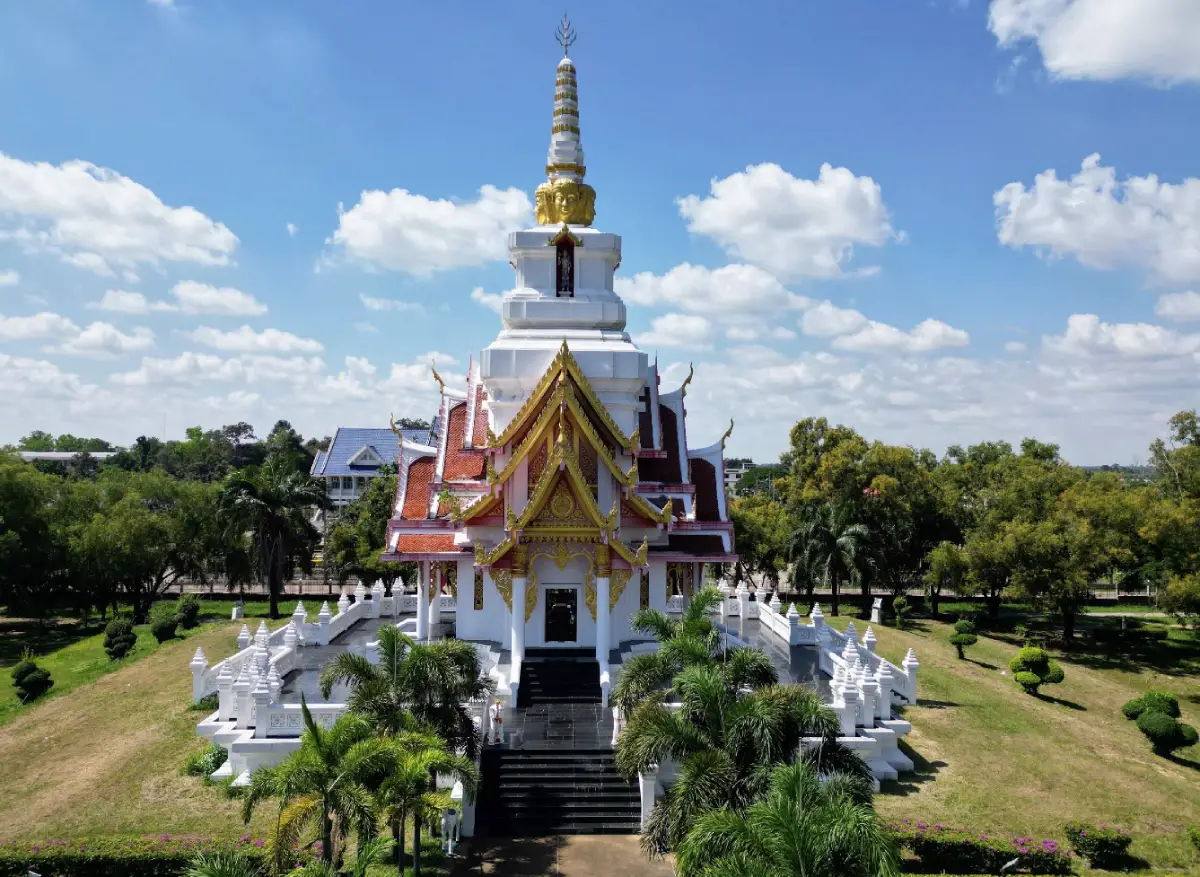
Amnat Charoen City Pillar Shrine is one of the most important sacred landmarks and spiritual centers of Amnat Charoen Province in northeastern Thailand. It stands inside Ming Mueang Chaloem Phra Kiat Park on Chayangkun Road, Bung Subdistrict, Mueang Amnat Charoen District, Amnat Charoen Province 37000. The shrine is distinguished by a traditional Thai four-sided pavilion crowned with a tall prang-style spire. Its white structure, richly ornamented red-and-gold roof, and elevated ceremonial platform create an impressive architectural landmark amid the greenery of the public park. The sacred city pillar inside is made from Ratchaphruek, or golden shower tree wood, which carries auspicious meanings associated with prosperity and success. Construction of the shrine began in late 1995. On January 27, 2001, King Bhumibol Adulyadej performed the royal sprinkling and anointing ceremony for the city pillar, and the shrine was formally opened on May 9, 2001. Today, the landmark combines provincial history, traditional Thai architecture, beliefs concerning the spiritual guardianship of the city, and an important public park used by local residents throughout the year.
The shrine occupies a prominent position within Ming Mueang Chaloem Phra Kiat Park, a public garden developed in commemoration of the 50th anniversary of King Bhumibol Adulyadej's accession to the throne. The park covers more than 34 rai and provides landscaped grounds, walking areas, and space for recreation and exercise. The city pillar shrine is therefore not isolated from community life. Instead, it is part of an urban landscape where sacred traditions and everyday public activities exist side by side.
The importance of the shrine is rooted in the Thai tradition of establishing a sacred pillar as a symbol of a city's foundation, stability, and collective well-being. Historically, city pillars have represented the symbolic and spiritual center of a settlement. A shrine housing such a pillar provides a place where residents can pay their respects and express hopes for harmony, prosperity, and protection. In Amnat Charoen, this tradition has been maintained within the setting of a modern provincial town.
The construction of Amnat Charoen City Pillar Shrine is closely related to the establishment of Amnat Charoen as a separate province on August 27, 1993. The new province developed administrative institutions, public facilities, and important civic landmarks reflecting its distinct identity. Creating a city pillar shrine was one way of expressing unity among residents while preserving a longstanding Thai ceremonial tradition.
Amnat Charoen's history, however, extends much further into the past than its modern provincial status. The area developed through rural communities, agricultural settlements, local trading networks, and administrative relationships with other northeastern towns. Rice cultivation and other forms of farming were central to local life, while the movement of people between settlements contributed to the region's shared language and cultural heritage.
The historical background of Amnat Charoen is connected with the political and cultural development of the Mun and Mekong river regions. Communities in areas associated with Ubon Ratchathani, Khemmarat, and the wider Lan Xang cultural world maintained relationships through migration, trade, and religious traditions. These connections contributed to the distinctive cultural character of the region that later became Amnat Charoen Province.
An important event in regional administrative history occurred in 1814, when Chao Phraya Phrom Worarat Suriwong, the governor of Ubon Ratchathani, petitioned King Rama II for permission to establish Ban Khok Kong Dong Phaniang as the town of Khemmarat Thani. The royal approval of this new town formed part of the broader development of northeastern administrative centers and reflects the historical circumstances in which communities across the region expanded.
Administrative boundaries continued to change during subsequent periods. The territory of present-day Amnat Charoen was incorporated into larger provincial systems before being separated from Ubon Ratchathani and established as a province in 1993. This transformation created a need for new provincial institutions and shared symbols that could express the identity of residents from different districts.
Construction of the city pillar shrine took place within this context of provincial development. It was intended to provide an important ceremonial landmark and a common spiritual focus. The choice of Ming Mueang Chaloem Phra Kiat Park as its location also placed the shrine within an accessible public environment where citizens could gather for recreation, worship, and community activities.
The project began in late 1995 with cooperation from government agencies, private organizations, and residents of Amnat Charoen. The Department of Public Works, then under the Ministry of Interior, was involved in designing the shrine. Its architectural form was based on a traditional four-sided Thai pavilion crowned with a prang, reflecting the importance of the sacred pillar and the desire to create a dignified provincial landmark.
The shrine measures approximately 27.70 meters in width and 27.70 meters in length, reaching a height of about 28.20 meters. Its balanced composition emphasizes the central sacred space, while the elevated roof structure creates a distinctive silhouette. Ornate gables, gold decorations, and the tall central spire make the building visible from different parts of the surrounding park.
The four-sided design follows the Thai chatumuk architectural tradition, in which projecting sections are arranged around a central space. Such buildings emphasize symmetry and the ceremonial importance of the center. In the case of Amnat Charoen City Pillar Shrine, the arrangement gives architectural prominence to the sacred wooden pillar housed inside.
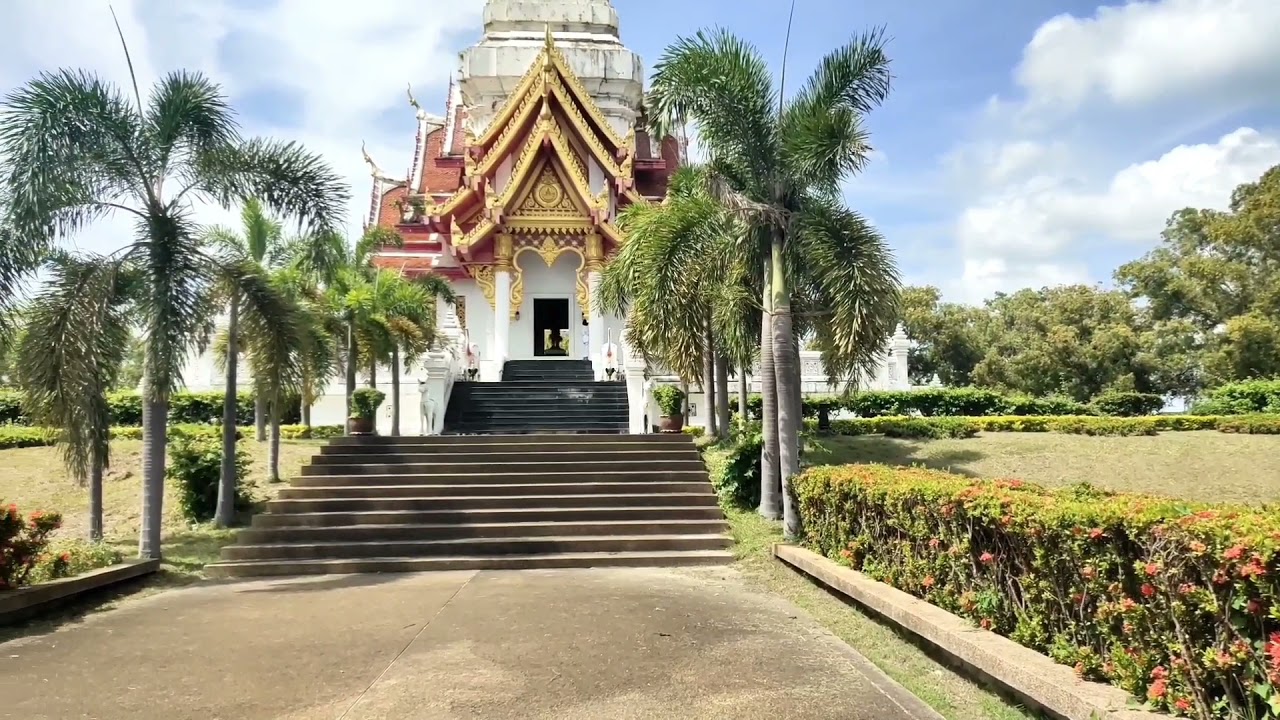
The pavilion stands on a raised platform approached by a broad staircase. Dark-colored stone steps contrast with the white balustrades and walls, while the roof introduces rich tones of red and gold. Seen from the front, the staircase leads the eye toward the entrance and the sacred space beyond, giving the approach a formal and dignified character.
The main walkway is framed by trees and landscaped planting. This arrangement makes the shrine the focal point of a carefully organized view across the park. The green surroundings soften the appearance of the imposing building and create a peaceful setting that distinguishes the site from many city pillar shrines located within crowded commercial neighborhoods.
The prang-style spire rises above the layered Thai roof, expressing the vertical emphasis commonly found in sacred Thai architecture. Decorative elements on the gables and roof edges contribute to the structure's ornate appearance. The use of white, red, and gold creates a clear visual identity and makes the shrine one of the most recognizable architectural landmarks of Amnat Charoen.
The building illustrates how traditional Thai design can be adapted to a contemporary provincial landmark. Although the shrine is not an ancient monument, its architectural language draws upon established religious and ceremonial forms. Its setting in a landscaped public park also reflects modern approaches to creating civic spaces that combine cultural identity with recreation.
The sacred city pillar is made from Ratchaphruek wood, commonly known as the golden shower tree or khun in Thai. The timber was carefully selected from Takaothong Garden in Nakhon Ratchasima Province. Traditional ceremonies were performed in connection with the selection and cutting of the wood before it was shaped into the city pillar.
Ratchaphruek has a special place in Thai cultural symbolism. The tree is widely recognized for its clusters of yellow flowers, and its name is associated with auspiciousness and prosperity. Selecting this wood for the city pillar connected the physical object with beliefs about the city's future stability and success.
The pillar has a smooth cylindrical shape and a finial described as a nine-tiered crystal form. Its design was influenced by the traditional appearance of the Bangkok city pillar while retaining characteristics specific to Amnat Charoen. The use of carefully selected local-region timber, ceremonial preparation, and skilled craftsmanship gave the pillar an identity directly associated with the province's founding as a modern administrative center.
The pillar was designed by Sanit Wilai of the Fine Arts Department's Division of Handicrafts. The work involved translating traditional ceremonial concepts into a balanced wooden form with an appropriate ornamental top. This collaboration between skilled craftsmen and the provincial project connected the shrine with the wider tradition of Thai sacred art.
The wooden pillar was completed in September 1995, before subsequent work on the shrine building and surrounding environment. Establishing the city pillar shrine required several stages, including timber selection, carving, architectural design, construction, and royal and religious ceremonies associated with the final installation.
January 27, 2001, is one of the most important dates in the shrine's history. On that day, King Bhumibol Adulyadej, King Rama IX, performed the royal sprinkling and anointing ceremony for the city pillar at Dusidalai Hall, Chitralada Palace, Bangkok. The ceremony became an important part of the recorded history of the shrine and remains significant in the collective memory of Amnat Charoen residents.
The shrine was formally opened on May 9, 2001, by Crown Prince Maha Vajiralongkorn, who later became King Rama X. His participation in the opening ceremony marked the completion of an important provincial project and established the shrine as a public sacred landmark of Amnat Charoen.
Historical photographs inside the shrine document the royal ceremonies associated with the creation and opening of the landmark. These images include records of the anointing of the city pillar and the opening ceremony. They help visitors understand the shrine's role within the history of the province and preserve visual evidence of the important events surrounding its establishment.
The photographs have historical value because they record a significant phase in Amnat Charoen's development following its establishment as a province. They connect the sacred wooden pillar with the people, institutions, and ceremonies involved in creating the shrine, allowing later generations to appreciate the landmark's relatively recent but meaningful history.
The grounds of Ming Mueang Park also contain a Ratchaphruek tree associated with the opening ceremony of May 9, 2001. The tree was planted by the Crown Prince at that time and serves as a living reminder of the event. Its presence adds another cultural layer to the park, linking the choice of wood for the sacred pillar with a commemorative tree in the landscape.
The pillar and commemorative Ratchaphruek tree together create a symbolic relationship between sacred craftsmanship, nature, and historical memory. As a result, the shrine's history is represented not only by the building and photographs but also by a living element of the surrounding public garden.
Belief in the sacred guardianship of a city is a longstanding feature of Thai culture. The city pillar represents the spiritual stability of the settlement, and worshippers pay their respects according to personal beliefs and traditional customs. Common wishes concern family well-being, safety, career success, and prosperity.
Visitors may present flowers, incense, candles, garlands, and ceremonial colored cloth at the designated offering areas. These objects express reverence and devotion. Maintaining order and cleanliness around the altar helps preserve the shrine as a dignified setting for both individual worshippers and ceremonial gatherings.
For many local residents, worship at the shrine is closely connected with their sense of belonging to Amnat Charoen. Some visit before undertaking important personal or professional activities, while others return during holidays or family occasions. Through these practices, the city pillar remains connected with everyday hopes and concerns rather than serving only as a formal civic monument.
Religious holidays and important provincial events often bring additional activity to the shrine and surrounding park. Some residents visit specifically to worship, while others come to walk, exercise, or participate in public programs. The coexistence of these activities gives the area a broad community role.
Amnat Charoen City Pillar Shrine is not a Buddhist monastery and therefore has no abbot. The maintenance of the shrine and its public setting involves municipal personnel and relevant local organizations. Provincial ceremonies and annual events are arranged through cooperation between Amnat Charoen Municipality, government agencies, and community representatives.
Annual worship and celebration ceremonies provide opportunities for residents to express respect for the sacred pillar and take part in provincial traditions. Programs may include merit-making, offerings, and formal ceremonial observances. These activities help preserve the cultural significance of the city pillar for younger generations.
In 2024, Amnat Charoen Municipality organized a city pillar worship and celebration ceremony. The event included merit-making and traditional offerings, demonstrating the shrine's continued role as an active place of provincial worship rather than merely a tourist attraction or architectural landmark.
The social value of such ceremonies lies in their ability to bring together residents, community representatives, and public organizations. Preparing and participating in these events creates a shared experience through which people can maintain traditional practices and reinforce their connection with the province.
Ming Mueang Chaloem Phra Kiat Park provides an important recreational environment surrounding the shrine. Its walking routes, green spaces, trees, and open areas are used for leisure and exercise. The atmosphere changes throughout the day as residents use the grounds for morning activities, relaxation, and evening recreation.
The park is also important to Amnat Charoen's urban landscape because it stands beside Chayangkun Road, a major transportation route. The road-facing entrance connects the park with daily town activity, while the landscaped interior provides a quieter setting. The shrine is therefore located at the meeting point between a busy provincial town and a peaceful public garden.
The arrangement of the grounds emphasizes the shrine's position as an architectural focal point. A central walkway, rows of trees, landscaped planting, and open space lead visitors toward the elevated pavilion. These design elements make it possible to appreciate the building's proportions and ceremonial character from a distance.
The principal approach offers a particularly clear view of the four-sided roof and tall prang-style spire. The white shrine rises above its dark staircase, surrounded by greenery. This carefully framed perspective has become one of the most recognizable visual features of the site.
The staircase and raised platform reveal the relationship between the surrounding park and the sacred space above. The dark steps and white railings emphasize the transition toward the shrine, while the ornate entrance and decorated roof express the craftsmanship associated with important Thai ceremonial buildings.
Inside the pavilion, the atmosphere is more focused on worship and contemplation. The sacred pillar occupies the central position, surrounded by offerings and historical photographs. These elements allow visitors to experience both the spiritual role of the shrine and the important events that led to its establishment.
Walking through the grounds provides an opportunity to appreciate the relationship between architecture and public landscaping. The shrine serves as the principal landmark, while the park accommodates activities that extend well beyond religious ceremonies. Together, they represent a distinctive approach to combining cultural heritage and community recreation within a provincial town.
As a cultural attraction, Amnat Charoen City Pillar Shrine is especially meaningful for visitors interested in provincial history, Thai architecture, and traditional beliefs. The sacred wooden pillar, historical photographs, commemorative tree, and formal architectural design provide different ways of understanding the site's significance.
Other attractions within and around central Amnat Charoen can be explored as part of the same journey. Wat Samran Niwet, a royal Buddhist temple in Bung Subdistrict, plays an important role in local religious activities. Unlike the city pillar shrine, it is a monastery where Buddhist monks reside and conduct ceremonies. Visiting both landmarks highlights the different functions of sacred places within Thai society.
Wat Samran Niwet has long been associated with the Buddhist community of Amnat Charoen. It hosts religious observances and provincial Buddhist activities, and its status as a royal temple reflects its importance within the local religious landscape. Its proximity to the city center makes it a natural destination for travelers exploring Amnat Charoen's cultural landmarks.
Wat Saen Sawat Thatsanaram is another important temple in Mueang Amnat Charoen District. It was established on November 26, 1976, and received its royal grant of consecrated boundaries on December 25, 1982. The temple contains Chedi Si Saen Mueang, constructed in 1994, and reflects both Thai and Lan Xang artistic influences. Its history is associated with the faith and cooperation of local residents.
Chedi Si Saen Mueang symbolizes auspiciousness and the identity of the surrounding community. Its construction was supported by local devotees, demonstrating the social role of religious building projects. When considered alongside the city pillar shrine, the temple shows how different sacred structures can express related hopes for prosperity and communal well-being through distinct religious traditions.
Phra Mongkhon Ming Mueang is another major sacred landmark of Amnat Charoen. This monumental Buddha image stands within a Buddhist park in Mueang Amnat Charoen District. Its prominent golden surface and large scale have made it one of the most recognizable religious symbols of the province.
The Buddhist park surrounding Phra Mongkhon Ming Mueang is associated with a natural landscape of elevated ground and sandstone formations. Its setting differs from the landscaped urban environment of Ming Mueang Park. Exploring both locations allows visitors to appreciate the contrast between an urban city pillar shrine and a monumental Buddha image set within an open natural environment.
Phuttha Utthayan Reservoir provides another recreational destination near the Buddhist park. The reservoir's broad water surface and surrounding landscape offer a different experience from the sacred architecture of the city center. Its proximity to religious attractions makes it part of the wider recreational landscape of Mueang Amnat Charoen.
Wat Tham Saeng Phet is a respected forest temple in Mueang Amnat Charoen District. Situated amid natural surroundings and elevated terrain, it is associated with Buddhist meditation and forest monastic traditions. Its features include a reclining Buddha image, meditation buildings, and areas where visitors can experience the quieter atmosphere of a forest temple.
Wat Si Yaek Saeng Phet is another temple in the district, located in the hilly landscape of Nong Ma Saeo Subdistrict. The setting provides an experience different from the urban shrine, with temple architecture surrounded by a more natural environment. The site represents another aspect of the province's Buddhist and cultural heritage.
Wat Phra Lao Thep Nimit, in Phana District, is particularly well known for its revered Buddha image associated with Lan Xang artistic traditions. The temple is an important destination for visitors interested in northeastern Thai Buddhist art. Its architecture and religious heritage reflect historical cultural relationships within the Mekong region.
The variety of temples and sacred sites across Amnat Charoen illustrates the coexistence of several religious and artistic traditions. The city pillar shrine expresses beliefs associated with the symbolic establishment and protection of a town, while Buddhist temples preserve religious teachings, sacred images, architectural craftsmanship, and monastic practices.
Food culture provides another dimension to a visit to Amnat Charoen. The town offers northeastern Thai dishes, familiar Thai meals, Vietnamese-influenced cuisine, noodle shops, and contemporary restaurants. Regional foods are closely connected with agricultural life and local ingredients, with dishes such as som tam, larb, spicy soups, grilled meats, and sticky rice forming part of everyday dining traditions.
Restaurants such as Plueak Mai Ngam serve Thai and Isan dishes in Mueang Amnat Charoen District, while Klang Soi offers a casual setting for meals and drinks. These establishments serve both residents and visitors and reflect the development of the town's modern dining scene.
Ing Than Restaurant specializes in Vietnamese-style dishes and demonstrates the culinary influence of communities living across northeastern Thailand. Popular regional Vietnamese-inspired dishes include nem nuong, fresh rolls, and Vietnamese-style noodle soups. This culinary diversity reflects broader cultural connections within the region.
Amnat Charoen also has casual noodle shops and contemporary eateries on its main roads. The Yentafo restaurant near Amnat Charoen Hospital and other dining establishments along Chayangkun Road provide practical options for residents, people conducting business in the town, and visitors exploring local attractions.
Accommodation in central Amnat Charoen includes small hotels, budget-oriented properties, and roadside hotels suited to travelers arriving by car. Examples include Faikid Hotel, Baan Suan Fa Sai Hotel, Route 202 Hotel, The C Hotel, and The One Amnat Charoen. Their locations in Mueang Amnat Charoen District provide road connections to the city pillar shrine and other town attractions.
Faikid Hotel is an established town property, while Baan Suan Fa Sai and Route 202 offer additional choices near major roads and residential areas. Smaller properties such as The One and The C Hotel provide alternative accommodation styles for visitors seeking a convenient base in the provincial town.
Staying in the municipal area provides time to explore Ming Mueang Park, the city pillar shrine, nearby temples, and local neighborhoods. It also gives travelers a convenient starting point for journeys to Phra Mongkhon Ming Mueang, Wat Tham Saeng Phet, and other attractions outside the central town.
Getting There: Amnat Charoen City Pillar Shrine stands inside Ming Mueang Chaloem Phra Kiat Park on Chayangkun Road, Bung Subdistrict, Mueang Amnat Charoen District, Amnat Charoen Province 37000, Thailand. Visitors driving to the town can follow Highway 212, also known as Chayangkun Road, toward the city center. The park is situated near Amnat Charoen Provincial Court and other government offices.
The front of the park faces Chayangkun Road, while the rear connects with Sukhaphiban 1 Road. The provincial court is located near its northern side, and Thep Mongkhon Alley borders the southern area. These landmarks make the park identifiable within the town's road network. Travelers arriving by intercity bus can continue to the city center using locally available transport services.
A cultural itinerary within Amnat Charoen can begin at the city pillar shrine and Ming Mueang Park before continuing to Wat Samran Niwet, Phra Mongkhon Ming Mueang, and Phuttha Utthayan Reservoir. This combination offers a varied experience of city pillar traditions, Buddhist worship, and recreational landscapes within the same district.
Visitors interested in forest temples and natural surroundings can continue toward Wat Tham Saeng Phet and Wat Si Yaek Saeng Phet. Those particularly interested in Lan Xang Buddhist art can extend their journey to Wat Phra Lao Thep Nimit in Phana District.
Amnat Charoen City Pillar Shrine is also important as an example of urban planning and public-space development following the creation of a new province. Instead of placing the shrine in a densely built commercial district, planners incorporated it into a major landscaped park. The design combines a culturally significant building with green areas and public facilities, giving the site both ceremonial and recreational functions.
The relationship between the shrine and its surrounding park is central to its identity. The shrine provides a sacred focus and a symbol of the province's development, while the park creates a comfortable and accessible place for everyday community life. Together, they form a landmark that residents encounter not only during special ceremonies but throughout the year.
The shrine represents provincial identity through its history as a collaborative project established during the early years of Amnat Charoen's administrative independence. Government agencies, private organizations, and residents contributed to its development. Continuing worship and community ceremonies have ensured that the landmark remains culturally meaningful rather than functioning solely as a physical symbol.
The Ratchaphruek city pillar is more than an ornamental wooden object. It stands at the center of traditional ceremonies and preserves the memory of the project's establishment. Its auspicious timber, distinctive nine-tiered finial, and artistic design illustrate the care devoted to creating an appropriate sacred symbol for the province.
The royal ceremonies of 2001 are equally important to the shrine's historical identity. Photographs inside the building and the commemorative Ratchaphruek tree preserve the memory of these events and provide visible connections between the shrine's sacred function and the history of its construction.
For cultural travelers, the shrine combines several points of interest in one setting: traditional Thai architecture, the sacred wooden city pillar, royal historical photographs, and the landscaped grounds of Ming Mueang Park. Other religious and recreational attractions in the area make it a useful introduction to the cultural character of Amnat Charoen.
The wider Thai tradition of city pillars concerns the stability of settlements, the protection of their people, and the expression of communal hopes for prosperity. Amnat Charoen City Pillar Shrine belongs to this heritage, demonstrating how an established cultural idea has been adapted to the circumstances of a contemporary province.
With construction beginning in 1995, important royal ceremonies in 2001, an impressive four-sided pavilion with a prang-style spire, and a sacred pillar made from Ratchaphruek wood, Amnat Charoen City Pillar Shrine has considerable historical, architectural, and cultural value. Its setting within Ming Mueang Chaloem Phra Kiat Park reinforces its role as both a spiritual center and an important public landmark.
Today, the shrine continues to symbolize the development of Amnat Charoen Province and the cooperation of its people. The white pavilion rising above the landscaped park, the sacred Ratchaphruek pillar, and the history of the opening ceremony all contribute to the site's distinctive character. It remains a meaningful place where residents express their respect for the city's guardian traditions and maintain a connection with the history and identity of their province.
| Place Name | Amnat Charoen City Pillar Shrine |
| Address | Ming Mueang Chaloem Phra Kiat Park, Chayangkun Road, Bung Subdistrict, Mueang Amnat Charoen District, Amnat Charoen Province 37000, Thailand |
| Coordinates | 15.869073, 104.623806 |
| Type of Attraction | City Pillar Shrine, Provincial Sacred Landmark, Historical and Cultural Attraction |
| Historical Timeline | August 27, 1993: Amnat Charoen Became a Province Late 1995: Shrine Construction Began January 27, 2001: Royal Sprinkling and Anointing of the City Pillar by King Rama IX May 9, 2001: Official Opening Ceremony |
| Architecture | Traditional Four-Sided Thai Pavilion with a Prang-Style Spire, White Walls, Red-and-Gold Roof Decorations, and an Elevated Platform |
| Building Dimensions | Approximately 27.70 m Wide, 27.70 m Long, and 28.20 m High |
| City Pillar | Ratchaphruek (Golden Shower Tree) Wood from Takaothong Garden, Nakhon Ratchasima. Cylindrical Design with a Nine-Tiered Finial, Designed by Sanit Wilai of the Fine Arts Department. |
| Park Area | More Than 34 Rai |
| Main Features | 1. Four-Sided Shrine Pavilion 2. Sacred City Pillar 3. Traditional Offering Area 4. Royal Historical Photographs 5. Main Staircase and Entrance 6. Commemorative Ratchaphruek Tree 7. Walking and Recreational Areas in Ming Mueang Park |
| Management | Amnat Charoen Municipality and Relevant Local Organizations. The Shrine Is Not a Buddhist Monastery and Has No Abbot. |
| Important Traditions | City Pillar Worship and Celebration Ceremonies, Merit-Making, and Community Observances |
| Open Days | Daily |
| Shrine Visiting Hours | 08:00 – 18:00 |
| Ming Mueang Park Hours | 05:00 – 19:30 |
| Admission Fee | Free General Admission |
| Facilities | Parking, Public Walkways, Landscaped Gardens, Exercise Areas, and Public Restrooms in the Park |
| Getting There | Follow Highway 212 (Chayangkun Road) to Central Amnat Charoen and Continue to Ming Mueang Chaloem Phra Kiat Park Near Amnat Charoen Provincial Court. |
| Tourism Information Contact | +66 45 243 770 |
| Municipal Contact | Amnat Charoen Municipality: +66 45 989 664 |
| Attractions in and Around Mueang Amnat Charoen | 1. Ming Mueang Chaloem Phra Kiat Park – Same Grounds as the Shrine 2. Wat Samran Niwet Royal Temple – Chayangkun Road, Bung Subdistrict, Tel. +66 45 512 247 3. Wat Saen Sawat Thatsanaram and Chedi Si Saen Mueang – Bung Subdistrict 4. Phra Mongkhon Ming Mueang Buddhist Park – Bung Subdistrict 5. Phuttha Utthayan Reservoir – Mueang Amnat Charoen District 6. Wat Tham Saeng Phet – Mueang Amnat Charoen District 7. Wat Si Yaek Saeng Phet – Nong Ma Saeo Subdistrict 8. Wat Phra Lao Thep Nimit – Phana District |
| Restaurants in Central Amnat Charoen | 1. Klang Soi Restaurant, Phuk Phan Alley, Bung Subdistrict, Tel. +66 65 480 2559 2. Plueak Mai Ngam Restaurant, Bung Subdistrict, Tel. +66 89 944 9623 3. Ing Than Vietnamese Restaurant, Mueang Amnat Charoen, Tel. +66 88 711 3750 4. Mala Tang Amnat Charoen, Chayangkun Road, Tel. +66 96 032 6014 5. Yentafo Restaurant Near Amnat Charoen Hospital, Arunprasert Road, Tel. +66 94 307 0789 |
| Accommodations in Central Amnat Charoen | 1. Faikid Hotel, Bung Subdistrict, Tel. +66 45 511 999 2. Baan Suan Fa Sai Hotel, Samran Rat Road, Bung Subdistrict, Tel. +66 45 512 022 3. Route 202 Hotel, Arunprasert Road, Bung Subdistrict, Tel. +66 83 743 3355 4. The C Hotel Amnat Charoen, Thetsaban Amnat Alley, Tel. +66 62 925 4411 5. The One Amnat Charoen, Bung Subdistrict, Tel. +66 89 699 1962 6. Baan Premsiri Hotel, Bung Subdistrict, Tel. +66 80 375 7588 7. Penpit Hotel, Bung Subdistrict, Tel. +66 82 366 1540 8. Plai Fah GP Hotel, Amnat Charoen 2 Alley, Tel. +66 64 245 1696 |
| Current Status | An Active Provincial Sacred Landmark and Public Cultural Attraction in Ming Mueang Chaloem Phra Kiat Park |
Frequently Asked Questions (FAQ)
Q: Where is Amnat Charoen City Pillar Shrine located?
A: The shrine is located inside Ming Mueang Chaloem Phra Kiat Park on Chayangkun Road, Bung Subdistrict, Mueang Amnat Charoen District, Amnat Charoen Province 37000, Thailand.
Q: What are the shrine's opening hours?
A: Published visitor information lists the shrine's opening hours as 08:00 to 18:00 daily. The surrounding Ming Mueang Park has separate published opening hours of 05:00 to 19:30.
Q: Is there an admission fee?
A: There is no general admission fee to visit the shrine.
Q: What kind of wood was used for the city pillar?
A: The pillar was made from Ratchaphruek, or golden shower tree wood, selected from Takaothong Garden in Nakhon Ratchasima Province. It has a cylindrical form and a nine-tiered ornamental finial.
Q: When was Amnat Charoen City Pillar Shrine built?
A: Construction began in late 1995. The royal sprinkling and anointing ceremony took place on January 27, 2001, and the shrine officially opened on May 9, 2001.
Q: What is distinctive about the shrine's architecture?
A: It is a traditional Thai four-sided pavilion crowned with a tall prang-style spire. The white building has red-and-gold roof decorations and stands on an elevated platform within the landscaped park.
Q: Does Amnat Charoen City Pillar Shrine have an abbot?
A: No. The shrine is not a Buddhist monastery. Its maintenance and ceremonial activities involve Amnat Charoen Municipality and relevant local organizations.
Q: What attractions can be visited near the city pillar shrine?
A: Attractions in the surrounding district include Ming Mueang Chaloem Phra Kiat Park, Wat Samran Niwet, Wat Saen Sawat Thatsanaram, Phra Mongkhon Ming Mueang Buddhist Park, Phuttha Utthayan Reservoir, and Wat Tham Saeng Phet.
 Category: ●Places of Worship
 Group: ●Other Sacred Sites
Last Update : 5 DayAgo
 Last Update : 5 DayAgo
 Click to Access the Navigation Map GPS
Amnat Charoen City Pillar Shrine Map

 Art, Culture and Heritage
 Historical Sites and Monuments(1)
 Art, Craft Centres, Tradition(4)
 Museums(1)
 Temple(30)
Other Sacred Sites(8)
 Suburban Living
 Village, Community(4)
 Nature and Wildlife
 National Parks and Marine Reserves(3)
 Mountain (Doi)(6)
 Dam, Reservoir, Lake(5)
 Waterfalls(3)
 Caves(2)
 River, Canal(5)
 Other natural attractions(5)
 Entertainment and Agricultural
 Zoos and Aquariums(1)
 Farms, Parks and Ecotourism(4)
 Shopping
 Shopping and Night Market(1)
 Travel Articles, Recipes
 Travel Review, Food Review(3)


