
lovethailand home >Central Travel Attractions >Samut Songkhram Travel Attractions >Muang Samut Songkhram >Mae Klong > Samut Songkhram City Pillar Shrine
TL;DR: Samut Songkhram City Pillar Shrine is located at In Front of Samut Songkhram Provincial Hall, Ekkachai Road, Mae Klong Subdistrict, Mueang Samut Songkhram District, Samut Songkhram 75000, open Daily, hours 06:00 – 18:00.
Samut Songkhram City Pillar Shrine
Open Days: Daily
Opening Hours: 06:00 – 18:00
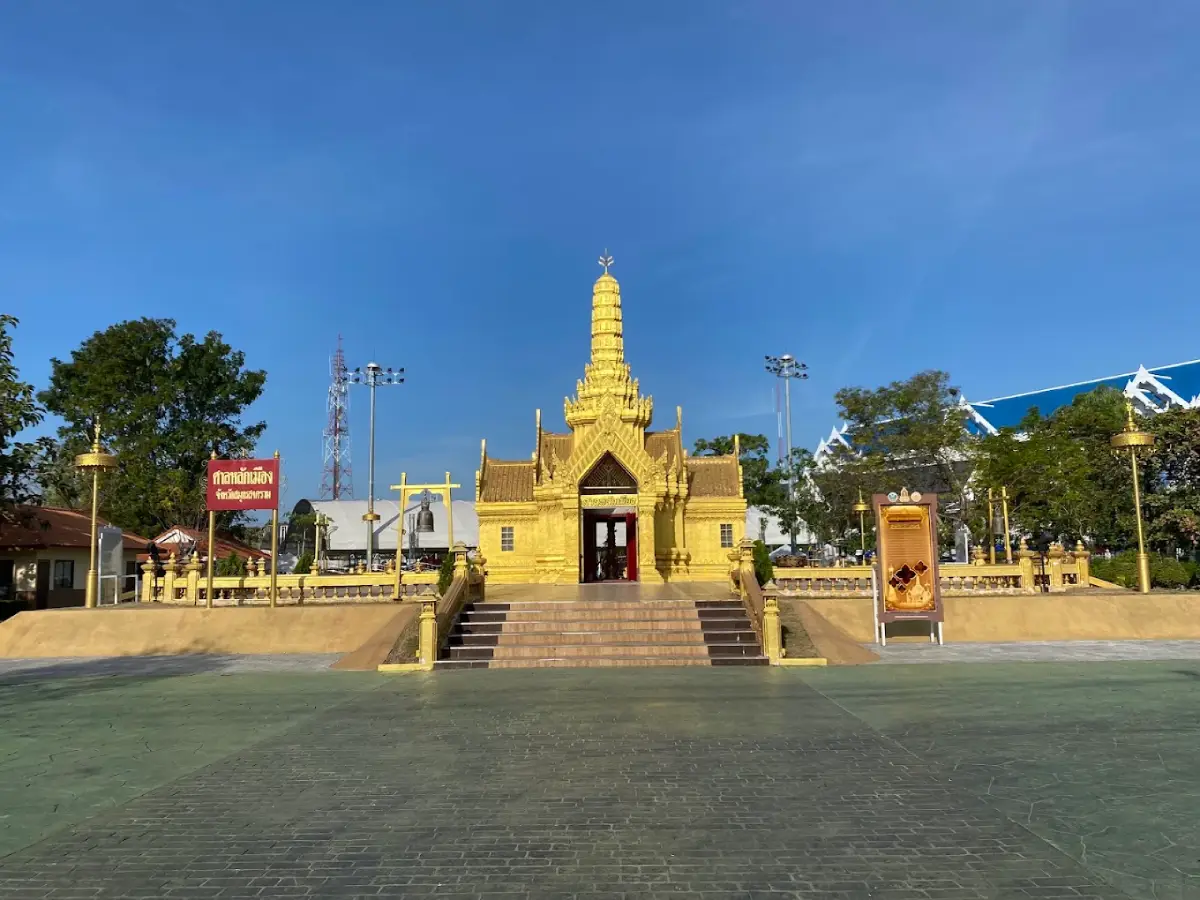
Samut Songkhram City Pillar Shrine is an important sacred civic landmark in Mae Klong, the provincial capital of Samut Songkhram in central Thailand. Located in front of Samut Songkhram Provincial Hall on Ekkachai Road, Mae Klong Subdistrict, Mueang Samut Songkhram District, Samut Songkhram 75000, the shrine is a center of local devotion associated with history, traditional beliefs, Thai architecture, and community ceremonies. Its most recognizable feature is an elaborately decorated golden-yellow Thai pavilion with four projecting entrances, a two-tiered roof, and a tall prang-style spire. Inside stands a sacred city pillar carved from auspicious Chaiyaphruek wood. The present shrine was constructed in 1974 and continues to serve as an important location for provincial worship and traditional ceremonies.
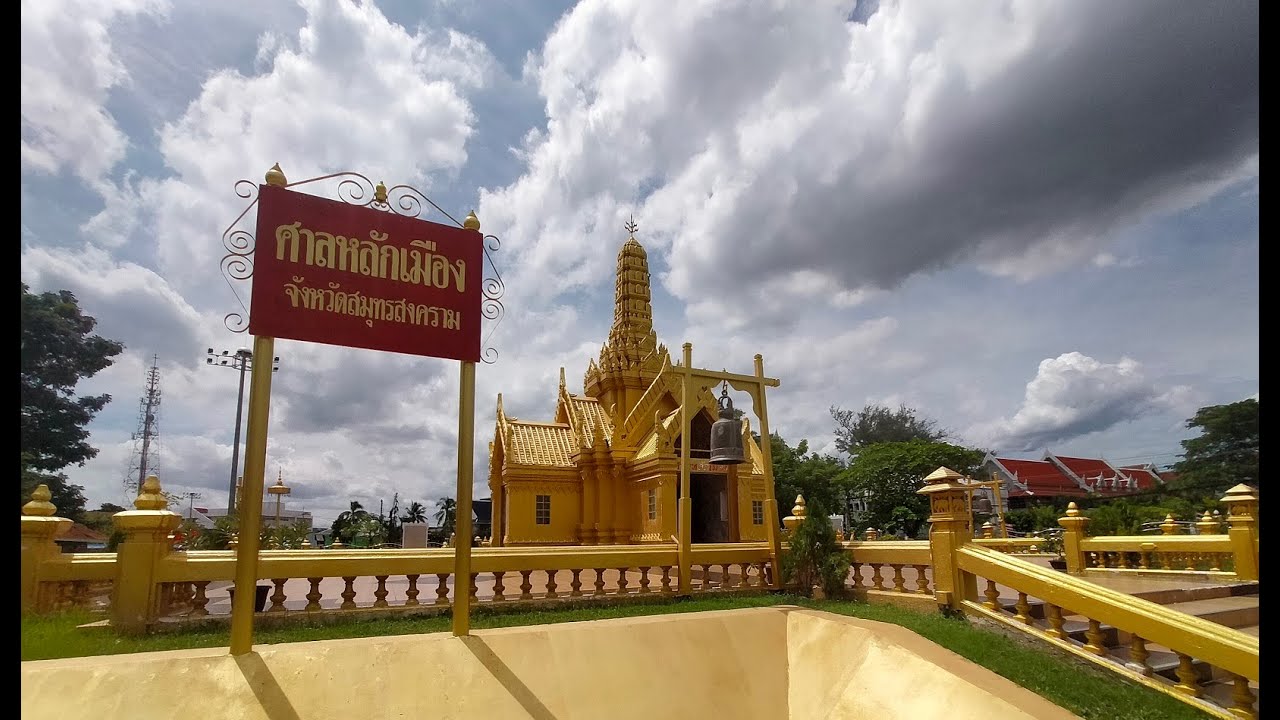
The architectural character of the shrine distinguishes it from many other city pillar buildings in Thailand. The entire structure is painted in shades of gold, emphasizing its sacred and ceremonial importance. From the front, visitors can see a raised platform approached by a wide staircase, gilded railings, and elaborate roof ornaments. A tall central spire rises above the roof, giving the building a distinctive vertical profile. Inside, the city pillar displays detailed woodcarving, particularly at its lotus-petal base and the symbolic four-faced ornamentation near its upper section.
The shrine stands in the provincial administrative area, close to the Provincial Hall and a public square used for important community activities. Its location is convenient for visitors and reflects the connection between the traditional city pillar and contemporary provincial administration. Nearby attractions include Mae Klong's commercial district, old markets, railway station, famous railway market, and important Buddhist temples, allowing the shrine to form part of a wider cultural visit to the town.
The importance of Samut Songkhram City Pillar Shrine extends beyond the traditional belief in seeking blessings. It is closely connected with the history of Mae Klong, an old settlement at the mouth of the Mae Klong River. The province's identity has long been shaped by waterways, fishing, river-based trade, fruit orchards, and coconut cultivation. Its location between agricultural land and the Gulf of Thailand has produced distinctive livelihoods and cultural traditions that continue to influence everyday life.
Samut Songkhram is widely known as Mae Klong after the river that has been central to its history. The river flows through the province before entering the Gulf of Thailand, creating landscapes influenced by freshwater, brackish water, and coastal tides. These varied environments support different occupations, including fruit growing, coconut sugar production, fishing, seafood processing, and related forms of local trade.
The settlement pattern of Mae Klong developed around an extensive network of rivers and canals. In earlier times, boats were essential for transporting fruit, coconuts, agricultural produce, and everyday goods between homes and markets. Communities grew along waterways, with Buddhist temples and other sacred places acting as social centers. Although roads and railways later became increasingly important, the waterways have remained central to the province's economy and cultural identity.
The history of Samut Songkhram is linked with provincial administration during the Ayutthaya period. Historical references to the town and its governing officials demonstrate its place within the network of settlements connected to central Thailand. Its position near the mouth of a major river gave it significance for transport, commerce, and connections between inland communities and the coast.
The province is also closely connected with the Bang Chang royal family line, whose members played important roles in the history of the early Chakri Dynasty. The Amphawa and Bang Chang areas therefore hold significance beyond their agricultural and riverside heritage. Their royal connections survive through temple histories, local historical narratives, and preserved cultural landmarks.
Samut Songkhram is particularly important as the birthplace of King Phutthaloetla Naphalai, King Rama II of the Rattanakosin Kingdom. His association with Bang Chang contributes to the province's significance for royal history, literature, and traditional Thai arts. Amphawa contains a memorial park and Buddhist temples closely associated with this historical background.
The province's connection with royal history was among the principal reasons considered during the establishment of the present City Pillar Shrine. Provincial authorities regarded Samut Songkhram as a historically important town deserving a sacred civic monument. The project was therefore intended to honor the town's heritage while providing a shared spiritual landmark for its residents.
Before construction began, provincial authorities consulted the Fine Arts Department to determine whether an earlier officially established city pillar shrine had existed in Samut Songkhram. When the historical investigation did not identify a clearly documented earlier shrine, the province proceeded with plans to establish a new one. The project involved selecting an appropriate site, designing the building, obtaining suitable timber, and conducting the customary ceremonies associated with a city pillar.
The construction initiative was undertaken during the governorship of Chan Kanchanakhaphan. The proposal received the support of the provincial council and was developed through a committee structure. Thep Sunthonsarathun served in a public-relations and committee-secretarial role. This cooperation illustrates how the shrine emerged as a provincial undertaking involving several administrative and community participants.
The principal reasons for constructing the shrine included the antiquity of Samut Songkhram, its connection with the Bang Chang royal family line and King Rama II, the preservation of Thai city-pillar traditions, and the need for a shared spiritual center. These ideas reflect the meaning of the shrine as a symbol of stability, harmony, public well-being, and collective civic identity.
The present Samut Songkhram City Pillar Shrine was constructed in 1974. A site in front of the Provincial Hall was selected for its open and prominent position, consistent with traditional considerations in choosing a location for an important civic monument. Its placement near the administrative center also made the shrine suitable for ceremonies attended by officials and the public.
The Handicrafts Division of Thailand's Fine Arts Department was responsible for designing the shrine and preparing the artistic design of the city pillar. The building draws on the ceremonial architecture of central Thailand. It is a four-sided Thai pavilion constructed from plastered brickwork, painted golden yellow, and crowned by a two-tiered roof and richly decorated spire. Entrances on all four sides reinforce the pavilion's balanced appearance and ceremonial character.
The Thai architectural term mondop refers to a type of sacred pavilion commonly associated with the enshrinement of important religious objects. The term chaturamuk describes a building with four projecting faces or entrances. Bringing these forms together creates architectural symmetry and provides access from different directions. At Samut Songkhram City Pillar Shrine, the arrangement emphasizes the central importance of the city pillar.
The roof includes several tiers and elaborate ornaments. The central spire incorporates decorative elements known as fak pheka or lamphukhan, whose forms are associated with the vajra, the symbolic thunderbolt weapon of Indra in Hindu and Thai religious art. Such features demonstrate how traditional architectural symbols are used to express sacred authority and ceremonial significance.
The golden-yellow color of the shrine is one of its defining visual characteristics. It covers the walls, columns, roof surfaces, and much of the ornamentation, creating a unified appearance. Gold is associated in Thai sacred art with dignity, honor, and auspiciousness. The consistent use of this color makes the shrine especially recognizable within the surrounding administrative district.
The building stands on a raised platform reached by broad steps and ornamental balustrades. Elevating the pavilion gives it a prominent appearance and establishes a transition between the ordinary public space outside and the sacred interior. This arrangement is characteristic of many important ceremonial buildings in Thailand.
The city pillar itself is a cylindrical wooden post made from auspicious Chaiyaphruek timber. During the construction project, timber was donated by Phra Khru Wisutthibodi, then the abbot of Wat Khongkharam in Ratchaburi Province. The wood was subsequently entrusted to the Fine Arts Department for carving and finishing. The donation and artistic work formed important parts of the shrine's establishment.
The pillar measures approximately 108 inches, or about 2.74 meters, according to historical descriptions of its construction. Its base is carved in the form of lotus petals, while the upper section incorporates a four-faced Brahma-inspired design. Together, these elements demonstrate the artistic craftsmanship of the Fine Arts Department and the symbolic importance of the pillar.
Chaiyaphruek wood carries auspicious associations in Thai culture, particularly through its name, which relates to victory and success. Selecting wood for a sacred pillar involves considerations of symbolism as well as material quality. The use of a traditionally significant timber reflects the belief that the central symbol of a town should represent favorable qualities.
The lotus-petal base reflects the importance of the lotus in Thai religious and ceremonial art. The flower symbolizes purity and is frequently used to support revered objects or figures in architecture and sculpture. The carved petals provide a decorative transition between the platform and the pillar itself.
The upper part of the pillar is also associated with nested gold reliquaries and the enshrinement of royal hair relics, according to the historical account of its construction. The use of carefully prepared inner containers demonstrates the ceremonial significance of features that are not directly visible from the exterior.
The four-faced carving near the pillar's top draws upon Brahmanical symbolism incorporated into Thai ceremonial culture. Its four faces are associated with a sacred presence oriented toward different directions. Combined with the lotus base and carved upper section, the pillar represents both an artistic achievement and a ceremonial object with multiple layers of meaning.
The relationship between the city pillar and the pavilion is central to the site's architectural character. The building protects the sacred object, defines a space for ceremonies, and emphasizes the pillar's position as the symbolic center of civic devotion. Exterior architecture and interior craftsmanship therefore work together to express a common cultural purpose.
Samut Songkhram City Pillar Shrine is not a Buddhist monastery and does not have an abbot or resident monastic community in the same sense as a temple. Provincial authorities and the Samut Songkhram Provincial Administrative Organization have important roles in organizing its public ceremonies, particularly the annual city-pillar celebrations and provincial merit-making activities.
Worship at city pillar shrines is an established tradition in many Thai provinces. Residents and travelers come to express respect for the sacred center of a town and to seek auspiciousness according to their personal beliefs. Traditional wishes may concern safety, successful work, family well-being, or peace within the community. The act of worship also expresses a connection between individuals and the place they regard as their home.
Devotional practices commonly include a respectful wai, quiet prayer, and appropriate offerings of flowers, garlands, incense, or candles. Offerings should be placed in the areas designated by the shrine. Maintaining cleanliness and consideration for other worshippers helps protect the building and preserve a respectful atmosphere for visitors.
Samut Songkhram City Pillar Shrine has an important role in provincial ceremonies. The City Pillar Celebration and Provincial Merit-Making Festival includes Buddhist chanting, Brahmanical offerings, and cultural performances. These traditions demonstrate how religious ceremonies, civic identity, and public participation are brought together around the shrine.
Buddhist monks participate in chanting and merit-making rituals, while Brahmanical ceremonies honor the city pillar according to traditional customs. The combination reflects the coexistence of different ceremonial traditions within Thai society. The shared purpose is to express respect, auspiciousness, and collective hopes for the well-being of the province.
Traditional dance performances are another distinctive part of the celebration. Participants wear ceremonial or traditional clothing and perform dances honoring the city pillar. These performances are meaningful not only as devotional activities but also as expressions of regional culture involving large numbers of residents.
On April 1, 2026, Samut Songkhram Province organized the City Pillar Celebration and Provincial Merit-Making Festival to commemorate its 125th anniversary as a modern province. Governor Chayachai Saeng-in presided over ceremonies attended by officials, the Provincial Administrative Organization, public agencies, private organizations, and members of the community. The program included Buddhist chanting, ceremonial offerings, cultural performances, and a major traditional dance dedicated to the city pillar.
The 125th anniversary marked in 2026 relates to the province's administrative history, particularly the reforms associated with 1901. It does not represent the age of the present City Pillar Shrine, which was constructed in 1974. These dates refer to different historical developments: one concerns the formation of modern provincial administration, while the other concerns the construction of the sacred civic building.
The annual celebration contributes to community identity by bringing together government officials, local businesses, and residents. The ceremonies express remembrance of earlier generations and reinforce shared cultural traditions. The continuing participation of the community demonstrates the shrine's relevance to contemporary social life.
The shrine has also undergone conservation and restoration. In 2021, provincial ceremonies included the worship of the city pillar following restoration work and a celebration associated with the province's anniversary. Such maintenance helps protect the shrine's artistic features and ensures that it can continue serving its ceremonial purpose.
Several important attractions are located within Mae Klong town. One of the most significant is Wat Phet Samut Worawihan, commonly known as Wat Ban Laem, a royal Buddhist temple that houses Luang Pho Ban Laem, a highly revered Buddha image. Visiting the temple alongside the City Pillar Shrine provides insight into different forms of devotion: one centered on civic guardianship and the other on Buddhist worship.
Wat Phet Samut Worawihan has longstanding connections with local fishing communities and the historical development of Mae Klong. Traditional stories concerning Luang Pho Ban Laem are associated with the river and boat travel, reflecting the importance of waterways to the town. The temple remains a major religious landmark within the central urban area.
Mae Klong Railway Market, also known as Talat Rom Hup, is one of Thailand's most distinctive markets. Vendors operate alongside railway tracks and move awnings and some merchandise when trains approach. This unusual arrangement reflects the coexistence of everyday commerce and railway transportation in a dense market setting.
Mae Klong Railway Station is the terminus of the Mae Klong Railway. The line developed as part of the regional transportation network serving communities west of Bangkok. Its location beside the market has made the station an important part of the town's daily life and a valuable landmark for understanding local transport history.
The Mae Klong market district is also an active commercial area selling fresh fish, seafood, vegetables, fruit, prepared food, and household goods. Residents from surrounding communities visit the market for everyday shopping. It therefore functions both as an important local economic center and a well-known cultural attraction.
Mae Klong mackerel, particularly steamed fish traditionally arranged in bamboo baskets, is closely associated with the province's culinary identity. The popularity of this product reflects the importance of fishing and coastal food production. Sampling local dishes or exploring the fresh-food market reveals another aspect of Samut Songkhram's relationship with its natural environment.
Other characteristic products include coconuts and coconut sugar, which are associated with orchards and agricultural communities throughout the province. Local knowledge of harvesting coconut sap and preparing traditional foods demonstrates how residents have adapted to the surrounding landscape and its resources.
Amphawa is another major cultural destination in Samut Songkhram. The area is famous for its canal-side community, floating market, and preserved riverside houses. Traveling from Mae Klong to Amphawa allows visitors to compare a provincial administrative center with an older canal-based trading settlement. Both are closely connected with the Mae Klong River and its network of waterways.
Amphawa Floating Market is known for local food, waterside shops, and traditional wooden houses. During its main trading periods, the canal and surrounding streets become lively with visitors and vendors. The market offers a cultural complement to a visit to the City Pillar Shrine by demonstrating the role of waterways in the province's trading history.
Wat Amphawan Chetiyaram Worawihan is an important royal Buddhist temple in Amphawa associated with the Bang Chang royal family line and the history of King Rama II. Its buildings and religious art contribute to the understanding of the early Rattanakosin period. The temple also provides historical context for the royal connections that influenced the decision to create Samut Songkhram's City Pillar Shrine.
King Rama II Memorial Park is another significant destination in Amphawa. It contains traditional Thai houses and exhibits related to royal history, regional culture, and the arts of the early Rattanakosin period. The park offers a way to explore the literary and cultural heritage associated with the king who was born in the Bang Chang area.
Wat Bang Kung is a famous historical and Buddhist attraction known for its old chapel enclosed by the roots of large trees. The chapel houses a revered Buddha image and is connected with military history and the historical development of the Bang Kung area during the late Ayutthaya and early Rattanakosin periods.
Wat Chulamanee is another important temple in Amphawa District, drawing worshippers interested in its Buddhist architecture and the revered figure of Thao Wessuwan. Visiting the temple and the City Pillar Shrine illustrates different expressions of protective spiritual beliefs and Buddhist traditions within the same province.
Don Hoi Lot is a notable coastal natural attraction near the mouth of the Mae Klong River. Its tidal flats and sandy mudbanks provide habitat for razor clams and other marine organisms. The area is important for coastal ecology, fishing communities, and the relationship between natural resources and local food production.
Khlong Khon mangrove forests offer another perspective on the province's coastal environment. Mangroves provide nursery habitats for aquatic animals, help protect the shoreline, and support local livelihoods. Conservation-oriented activities in the area demonstrate the close relationship between community development and environmental stewardship.
Wat Chong Lom is another Buddhist temple in Mueang Samut Songkhram District. It is an active religious landmark associated with the local community and can be included in a wider cultural journey through Mae Klong. Visiting different temples in the area highlights the relationship between Buddhist institutions, riverside neighborhoods, and everyday community life.
Samut Songkhram's seafood cuisine reflects the range of resources available in the Mae Klong River estuary and coastal waters. Mackerel, shrimp, crab, shellfish, and other fish are widely used in regional dishes. Local restaurants serve traditional central Thai meals and specialties rooted in the province's fishing communities.
Dining options in and around Mae Klong include Daeng Seafood, Poh Pla Too Mae Klong, Ruen Wari, Baan Khun Tawee, Sathanimaeklong 2448, and establishments within the central market district. Their locations and menus offer different experiences, from casual local meals to seafood served near the river.
Riverside restaurants provide an opportunity to enjoy local food while observing the Mae Klong River and the surrounding communities. Restaurants within the market area, by contrast, offer the atmosphere of everyday commercial life. Both settings reflect the importance of food and trade in the cultural identity of Mae Klong.
Accommodation is available in central Mae Klong, along the river, and in quieter districts with gardens and canals. Travelers wishing to explore the railway market and Wat Phet Samut Worawihan may prefer lodging in the town center, while visitors seeking a more relaxed environment can consider riverside or garden-style properties in Ban Prok and Lat Yai.
Accommodation options include Mae Klong Hotel, Alongkorn Hotel by SB, Coco View Hotel, Baan Siriporn Resort, Baan Suan Nuanta, and Sang Siri Apartment. These properties range from practical urban hotels to riverfront and garden accommodations. An overnight stay provides more time to explore Mae Klong, Amphawa, and the province's natural attractions.
Samut Songkhram City Pillar Shrine is suitable for a short cultural visit within Mae Klong town. Families and individual travelers can learn about its history, architecture, and sacred pillar before continuing to Buddhist temples, markets, or restaurants. Visitors should maintain a respectful manner because the shrine remains an active place of worship.
For those interested in traditional art, the shrine provides an opportunity to study the chaturamuk pavilion, central spire, Indra-related ornamentation, lotus-petal carvings, and four-faced design of the pillar. Each feature reflects traditional symbolism and the skill of the artists who designed the complex.
History enthusiasts can connect the shrine's story with the development of Samut Songkhram from an Ayutthaya-period town to a modern province, its relationship with the Bang Chang royal family, the administrative changes of 1901, and the construction of the present shrine in 1974. These periods contribute different elements to the province's historical identity.
For students, the shrine offers an introduction to the organization of provincial government, the symbolism of city pillars, and the establishment of public monuments during the modern period. The collaboration between the provincial authorities and the Fine Arts Department provides an example of how administration, craftsmanship, and cultural heritage can be connected.
The shrine's setting within the administrative district gives it a public and ceremonial character. Its golden pavilion stands prominently above the front courtyard, with the Provincial Hall and public event spaces nearby. This relationship makes the shrine a visible part of the town's civic landscape.
Architectural photography can capture the golden pavilion, decorative roofline, and central spire from the front courtyard. Inside, the carved city pillar and devotional decorations reveal the building's sacred purpose. Photography should not obstruct worshippers, ceremonies, or access to the shrine.
Published visitor information lists the shrine as open daily from 06:00 to 18:00, including public holidays, with no general admission fee. The location can be reached from Ekkachai Road and has parking facilities in the surrounding area. Special provincial ceremonies may involve temporary arrangements for visitors and traffic.
Accessibility is one of the advantages of visiting Samut Songkhram. The province is connected with Bangkok, Samut Sakhon, Ratchaburi, and Phetchaburi through major roads. Its relatively compact geography allows travelers to combine historical sites, markets, riverside communities, and natural attractions during a day trip or overnight excursion.
Travelers coming from Bangkok can use Rama II Road, Highway 35, to reach Samut Songkhram before continuing into central Mae Klong and Ekkachai Road. The Provincial Hall is the principal landmark for locating the City Pillar Shrine. Public transport passengers can travel to Mae Klong town and continue by local transport.
Rail travel offers another experience. Visitors can travel along the Mae Klong Railway through connections via Maha Chai and Ban Laem before reaching Mae Klong Station. The railway journey introduces the history of the region's transportation network and its relationship with the famous railway market.
A cultural itinerary around Mae Klong can begin with the City Pillar Shrine, followed by Wat Phet Samut Worawihan and the railway market. Visitors can then enjoy a local seafood meal before continuing to Amphawa or other nearby cultural attractions. This combination brings together civic beliefs, Buddhism, market life, and regional cuisine.
Visitors interested in royal history can continue to Wat Amphawan Chetiyaram and King Rama II Memorial Park. Those interested in other sacred places may include Wat Bang Kung and Wat Chulamanee, while nature enthusiasts can explore Don Hoi Lot or the mangrove landscape of Khlong Khon.
Getting There Samut Songkhram City Pillar Shrine is located in front of Samut Songkhram Provincial Hall on Ekkachai Road, Mae Klong Subdistrict, Mueang Samut Songkhram District, Samut Songkhram 75000, Thailand. Private vehicles and local transport can reach the area from central Mae Klong. Travelers arriving via Highway 35 should follow the routes into town and toward the Provincial Hall, which serves as the main landmark for locating the shrine.
Samut Songkhram City Pillar Shrine is significant as a symbol of Mae Klong and an example of traditional Thai civic beliefs expressed through modern ceremonial architecture. Its construction in 1974, design by the Fine Arts Department, and intricately carved Chaiyaphruek wooden pillar give it artistic and spiritual importance. The continuation of worship and provincial celebrations demonstrates its role as a living cultural landmark.
A visit to the shrine offers more than an opportunity to seek blessings. It introduces the history of a province shaped by the Mae Klong River, waterborne commerce, coconut orchards, fishing communities, the Bang Chang royal family, and connections with the Chakri Dynasty. The shrine links these historical layers through a shared symbol of civic stability and community harmony, remaining an important place of respect for the people of Samut Songkhram.
| Place Name | Samut Songkhram City Pillar Shrine (Mae Klong City Pillar Shrine) |
| Address | In Front of Samut Songkhram Provincial Hall, Ekkachai Road, Mae Klong Subdistrict, Mueang Samut Songkhram District, Samut Songkhram 75000, Thailand |
| Map Reference | Plus Code C263+Q3C, Mae Klong, Samut Songkhram |
| Type | Provincial City Pillar Shrine, Sacred Civic Landmark and Cultural Attraction |
| Significance | A Center of Local Devotion and a Symbol of Stability, Community Harmony and Auspiciousness |
| Year Established | 1974 |
| Project Initiator | Chan Kanchanakhaphan, Governor of Samut Songkhram During the Construction Period |
| Architectural Designer | Handicrafts Division, Fine Arts Department of Thailand |
| City Pillar Material | Auspicious Chaiyaphruek Wood Donated by Phra Khru Wisutthibodi, Then Abbot of Wat Khongkharam in Ratchaburi Province |
| City Pillar Features | Cylindrical Wooden Pillar Approximately 108 Inches Tall, Carved Lotus-Petal Base, Four-Faced Upper Ornamentation and Nested Gold Reliquary Elements Described in the Construction History |
| Architecture | Golden-Yellow Central Thai Chaturamuk Pavilion with a Two-Tiered Roof, Ornamental Prang-Style Spire and Four Entrances |
| Main Areas | 1. Chaturamuk Shrine Building 2. City Pillar Worship Area 3. Front Staircase and Ceremonial Forecourt 4. Four Entrances to the Pavilion 5. Adjacent Public Square Used for Provincial Ceremonies |
| Provincial Ceremonies | Activities Are Organized by Samut Songkhram Provincial Authorities, the Provincial Administrative Organization and Cooperating Agencies |
| Major Traditions | City Pillar Celebration, Provincial Merit-Making, Buddhist Chanting, Brahmanical Offerings and Traditional Dance; the 2026 Event Was Held on April 1 |
| Open Days | Daily, Including Public Holidays |
| Opening Hours | 06:00 – 18:00 |
| Admission Fee | Free Admission |
| Facilities | Visitor Parking and Wheelchair-Accessible Entrance |
| Getting There | Take Highway 35 (Rama II Road) toward Samut Songkhram, Continue into Central Mae Klong and Follow Ekkachai Road toward Samut Songkhram Provincial Hall |
| Nearby and Regional Tourist Attractions | 1. Wat Phet Samut Worawihan, Central Mae Klong 2. Mae Klong Railway Market, Central Mae Klong 3. Mae Klong Railway Station, Central Mae Klong 4. Wat Chong Lom, Ban Prok 5. Amphawa Floating Market, Amphawa District 6. Wat Amphawan Chetiyaram Worawihan, Amphawa District 7. King Rama II Memorial Park, Amphawa District 8. Wat Bang Kung, Bang Khonthi District 9. Wat Chulamanee, Amphawa District 10. Don Hoi Lot, Mueang Samut Songkhram District |
| Restaurants in Mae Klong and Surrounding Areas | 1. Daeng Seafood, Rat Prasit Road, Tel. +66 81 857 4111 2. Poh Pla Too Mae Klong, Samut Songkhram–Bang Phae Road, Tel. +66 81 158 0463 3. Ruen Wari Restaurant, Mae Klong, Tel. +66 34 770 061 4. Baan Khun Tawee, Pathummalai Road, Tel. +66 81 569 9544 5. Sathanimaeklong 2448, Bang Kaeo, Tel. +66 81 438 4262 6. Hok Huat Halal Restaurant, Mae Klong, Tel. +66 90 971 9064 7. Krua Rim Thang Klang Bo, Laem Yai, Tel. +66 99 190 9362 |
| Accommodations in Mae Klong and Surrounding Areas | 1. Mae Klong Hotel, Phet Samut Road, Tel. +66 87 154 4984 2. Alongkorn Hotel by SB, Kasemsuk Road, Tel. +66 92 591 4615 3. Coco View Hotel, Samut Songkhram–Bang Phae Road, Tel. +66 88 288 1900 4. Baan Siriporn Resort, Ratchayathiraksa Road, Tel. +66 83 155 2929 5. Baan Suan Nuanta, Lat Yai, Tel. +66 89 896 8842 6. Sang Siri Apartment, Bang Kaeo, Tel. +66 86 688 6098 7. Urbana House, Ratchayathiraksa Road, Tel. +66 34 710 744 8. HAKKA Wellness Residence, Mae Klong, Tel. +66 63 583 5888 |
Frequently Asked Questions (FAQ)
Q: Where is Samut Songkhram City Pillar Shrine located?
A: The shrine stands in front of Samut Songkhram Provincial Hall on Ekkachai Road, Mae Klong Subdistrict, Mueang Samut Songkhram District, Samut Songkhram 75000, Thailand.
Q: What are the opening days and hours of Samut Songkhram City Pillar Shrine?
A: Published visitor information lists the shrine as open daily from 06:00 to 18:00, including public holidays.
Q: Is there an admission fee?
A: No. General admission is free, and visitors can pay their respects without purchasing an entrance ticket.
Q: When was Samut Songkhram City Pillar Shrine built?
A: The present shrine was built in 1974 during the governorship of Chan Kanchanakhaphan. The Handicrafts Division of Thailand's Fine Arts Department designed the building and the city pillar.
Q: What kind of wood was used for the city pillar?
A: The pillar was carved from auspicious Chaiyaphruek wood. It is approximately 108 inches tall and features a lotus-petal base and four-faced upper ornamentation.
Q: What is distinctive about the shrine's architecture?
A: The building is a golden-yellow Thai chaturamuk pavilion with a two-tiered roof, a decorated prang-style spire, and entrances on four sides. Its design was created by the Fine Arts Department.
Q: When is the City Pillar Shrine celebration held?
A: Celebrations are organized on significant provincial occasions. On April 1, 2026, the province held a City Pillar Celebration and Merit-Making Festival marking the 125th anniversary of its modern provincial administration, not the age of the shrine itself.
Q: What attractions can visitors explore near the shrine?
A: Attractions include Wat Phet Samut Worawihan, Mae Klong Railway Market, Mae Klong Railway Station, and Wat Chong Lom. Visitors can also travel onward to Amphawa Floating Market, Wat Chulamanee, King Rama II Memorial Park, and Don Hoi Lot.
 Category: ●Places of Worship
 Group: ●Other Sacred Sites
Last Update : 5 DayAgo
 Last Update : 5 DayAgo
 Click to Access the Navigation Map GPS
Samut Songkhram City Pillar Shrine Map
Recommend

 Art, Culture and Heritage
 Historical Sites and Monuments(2)
 Art, Craft Centres, Tradition(1)
 Museums(6)
 Historic Homes and Cities(1)
 Temple(34)
 Church(1)
Other Sacred Sites(1)
 Research and Development
 Royal Project(2)
 Suburban Living
 Village, Community(6)
 Local Market(2)
 Floating Market(5)
 Nature and Wildlife
 River, Canal(1)
 Bays and Beaches(1)
 Other natural attractions(1)
 Entertainment and Agricultural
 Farms, Parks and Ecotourism(1)
 Waterpark(1)
 Travel Articles, Recipes
 Travel Review, Food Review(1)


