
lovethailand home >North Travel Attractions >Phichit Travel Attractions >Muang Phichit >Mueang Kao > Phichit City Pillar Shrine
TL;DR: Phichit City Pillar Shrine is located at Phichit Old City Park, Ban Mueang Kao, Mueang Kao Subdistrict, Mueang Phichit District, Phichit 66000, Thailand, open Daily, hours 08:00 – 17:00.
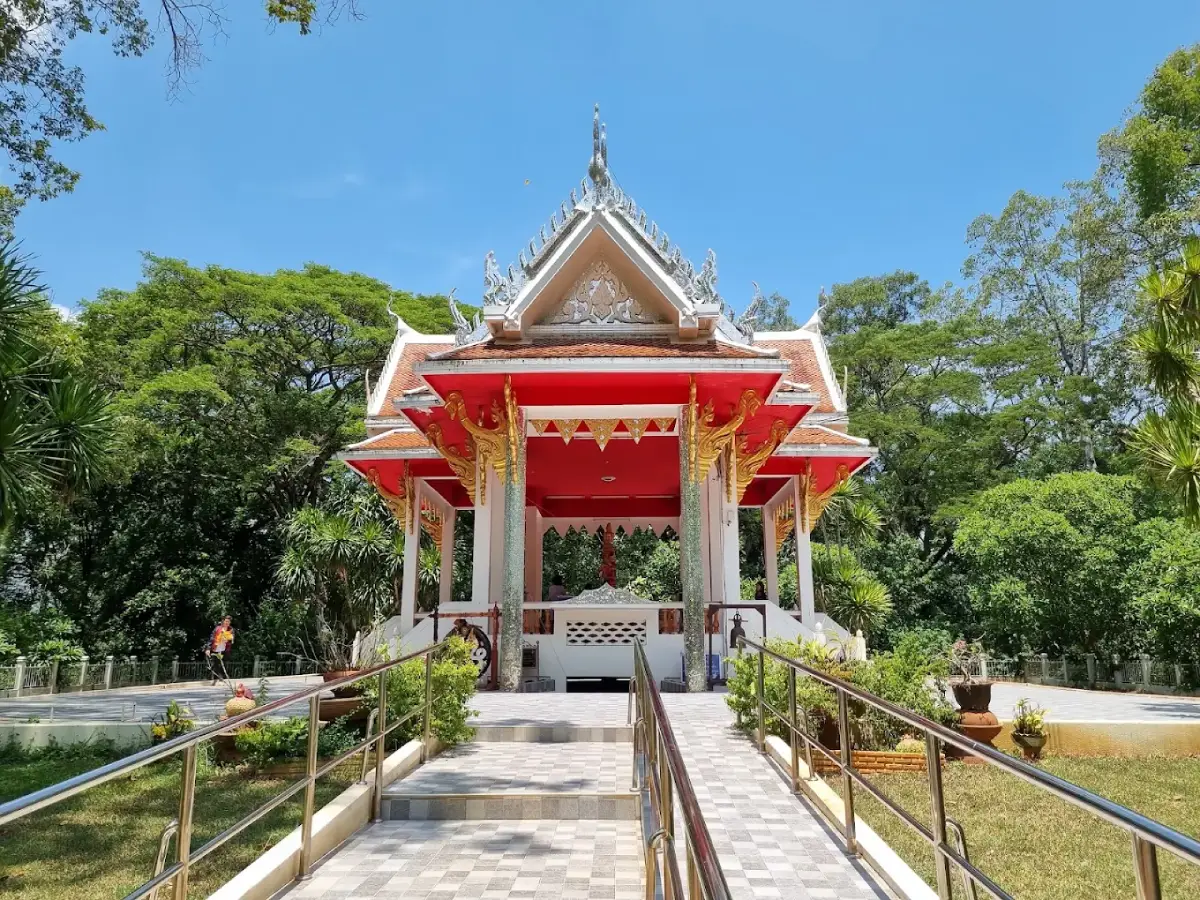
Phichit City Pillar Shrine
Open Days: Daily
Opening Hours: 08:00 – 17:00
Phichit City Pillar Shrine is one of the most important sacred civic landmarks and historical attractions in Phichit Province, Thailand. Situated within Phichit Old City Park in Mueang Kao Subdistrict, Mueang Phichit District, Phichit 66000, approximately seven kilometers from the modern town center, the shrine occupies a peaceful setting surrounded by ancient earthworks, remnants of the old city walls, Buddhist ruins, and mature trees. The building houses the revered city pillar on its upper floor, while its lower level contains a statue of Phraya Khotrabong Thewarat, affectionately called Pho Pu, or Grandfather, by local residents. His name is closely connected with the traditional account of the founding of ancient Phichit. The shrine is therefore significant for its spiritual traditions, local history, Thai architecture, and the preservation of regional cultural heritage.
The shrine is distinguished by its open-sided Thai-style chaturamuk pavilion, arranged over two levels. The upper floor contains the city pillar, which is honored by worshippers seeking traditional blessings and good fortune. The lower floor enshrines Phraya Khotrabong Thewarat, who is remembered in local tradition as the founder of ancient Phichit. This arrangement brings together beliefs concerning the sacred protection of the city and the remembrance of its legendary founder. It also gives the shrine an architectural and ceremonial identity that differs from many other Thai city pillar shrines, where the principal sacred objects are usually located on a single level.
Phichit City Pillar Shrine stands within the historical landscape of Phichit Old City Park, associated with the ancient settlements known as Mueang Sa Luang and Phichit. The former walled city covered approximately 400 rai, or about 640,000 square meters. Its remaining features include traces of city walls, moats, old stupas, temple ruins, and other archaeological remains. Parts of the site were later developed into the Kanchanakuman Arboretum, creating a shaded public landscape where visitors can learn about local history while enjoying the surrounding trees and natural environment.
The historical importance of Phichit is closely connected with the Nan River. For centuries, the river supported settlement, agriculture, trade, and transportation throughout the lower northern region of Thailand. Ancient Phichit stood near an earlier course of the Nan River, which once connected communities and important towns. Later changes in the river's course affected settlement patterns and contributed to the relocation of the urban center. Although the old town gradually lost its administrative role, its surviving remains continued to preserve evidence of an important historical settlement.
Phichit Province has a long history associated with ancient settlements and political developments in the upper Chao Phraya basin. The old town maintained connections with Sukhothai and Ayutthaya through administration, Buddhism, and transportation networks. Although the modern center of Phichit is located away from the original walled settlement, historical place names, local legends, and archaeological remains continue to connect the two periods of the town's development.
The traditional foundation story of Phichit is associated with Phraya Khotrabong Thewarat, also known in some accounts as King Khotrabong. According to local narratives, Prince Kanchanakuman, who ruled Nakhon Chai Bowon, traveled along the old Nan River and discovered a location suitable for establishing a new city. The site offered geographical advantages for settlement and defense. The story became an important foundation of the community's belief in Pho Pu Phraya Khotrabong Thewarat.
Local tradition associates the foundation of ancient Phichit with Buddhist Era 1601, corresponding to AD 1058. The date is connected with a ceremonial establishment of the city pillar and the creation of a new settlement. The traditional account describes Brahmin priests selecting the site and conducting a city pillar ceremony beside the old Nan River. The ceremonial date is given as Wednesday, the thirteenth waxing day of the twelfth lunar month in the Year of the Tiger. This date belongs to the traditional chronology of the ancient city's foundation and must be distinguished from the construction of the present two-level shrine building, which occurred during the modern restoration of the historical site.
The city has been known by several historical names. Mueang Sa Luang is associated with the ancient settlement, while the name Mueang Okkhaburi appears in historical accounts connected with the Ayutthaya period. Okkhaburi has a meaning associated with a city surrounded by or located amid water. The name Phichit conveys the idea of a beautiful city. These different names reflect the area's geography, historical administration, and changing cultural identity. Understanding the city pillar shrine consequently involves exploring the town's names and the memories associated with them.
According to the traditional foundation narrative, the ancient town was established near the former Nan River because the location provided access to water, transportation, and resources. The construction of walls, moats, and gates formed part of the organization and defense of the settlement. Surviving traces of these structures demonstrate that ancient Phichit possessed an organized urban landscape rather than being merely a loose collection of houses beside the river.
The legend of Phraya Khotrabong Thewarat is important because it provides a cultural explanation of the town's origins. Honoring Pho Pu expresses more than respect for an individual represented by a statue. It recalls the figure whom the community believes established the foundations of its hometown. Similar foundation legends occur in many parts of Thailand, bringing together history, beliefs, and local identity. Although every detail of such narratives cannot necessarily be established through archaeological evidence, their cultural importance remains visible through living ceremonies and devotional practices.
The statue of Phraya Khotrabong Thewarat is a central object of devotion at the shrine. Residents respectfully refer to him as Pho Pu, a form of address suggesting a revered elder, ancestor, or protective figure. The statue's position on the lower level is associated with beliefs concerning a guardian connected with the land and the town. The city pillar above symbolizes the settlement's sacred center and stability. This two-level arrangement allows visitors to appreciate the distinct meanings of these revered figures.
Accounts of Phraya Khotrabong also present him as a ruler associated with kindness and justice. The Thai Cultural Encyclopedia describes traditions concerning the Khotrabong dynasty and the ideal of ruling according to the Ten Royal Virtues. The narrative reflects local ideas about responsible leadership and moral government. These values remain part of the community's memory through the shrine, commemorative ceremonies, and the continuing use of the founder's name.
The old town underwent significant changes over time, especially when the Nan River shifted away from its earlier course. Settlement and transport patterns adapted to the changing river environment, and people gradually relocated toward the newer waterway. The former city consequently declined in importance. Its remaining walls, moats, and temple ruins became valuable evidence of the historical settlement, later preserved within Phichit Old City Park.
As the ancient settlement declined, many structures deteriorated or disappeared. Sections of the walls and moats became overgrown, while religious buildings survived mainly as foundations or fragmented ruins. The area developed the character of an archaeological landscape requiring study and conservation to reveal its former urban organization.
Between approximately 1964 and 1967, provincial authorities initiated efforts to restore the old city area as a historical attraction and public recreation space. The initiative aimed to return cultural and social value to a landscape associated with the town's origins. It also encouraged the preservation of important historical features while improving the surroundings for public access. This restoration marked a significant stage in the development of the old city as a place for historical learning.
The restoration of the city pillar shrine took place through several stages. Historical accounts refer to efforts to re-establish the sacred pillar during the restoration of the old city, including a foundation-stone ceremony in 1968 and further work during the following years. Tourism records identify 1977 as the year associated with the present two-story shrine building. The shrine's development should therefore be understood as a sequence involving the revival of a sacred site, improvements to the surrounding historical area, and construction of the modern pavilion.
Luang Pu Ngin Sorayo is mentioned in local historical accounts of the restoration of Phichit's city pillar. He was associated with ceremonies to re-establish the shrine within the old city. Traditional accounts of excavation work describe the discovery of old timber fragments and various ancient objects. These discoveries became connected with local beliefs concerning the possible location of an earlier city pillar. Their historical interpretation requires archaeological study, but the accounts remain important to the community's memory of the restoration.
In 1977, the Kanchanakuman Arboretum was established within the old city area. The planting and maintenance of numerous trees transformed the surroundings into a shaded landscape suitable for public recreation and the study of plant life. The arboretum contributed substantially to the atmosphere now associated with Phichit Old City Park, where archaeological landmarks coexist with mature trees and a peaceful natural environment.
The combination of the city pillar shrine and the arboretum creates a setting that differs from city pillar shrines located in busy provincial centers. The compound is surrounded by trees and vegetation rather than densely built commercial streets. Its environment encourages a slower appreciation of history and cultural traditions, while the greenery demonstrates how the remnants of an ancient settlement have become part of a public landscape.
The present shrine is an open-sided Thai-style pavilion with a chaturamuk layout. Its projecting roof sections and ornamental details are characteristic of Thai ceremonial architecture. White columns contrast with red and gold decorative elements, emphasizing the importance of the sacred interior. The open arrangement allows visitors to see the shrine and its surrounding landscape from several directions while permitting natural ventilation.
The chaturamuk form, featuring architectural projections toward different directions, gives the building a balanced appearance and creates several approaches to the sacred space. Similar forms appear in a variety of important Thai ceremonial and religious buildings. At Phichit City Pillar Shrine, this architectural arrangement emphasizes the dignity of the city pillar and provides a formal setting for worship.
On the upper level, the city pillar is placed on a decorated base with space for ceremonial offerings. The pillar includes an ornamental upper section and is often wrapped with colored cloth as an expression of devotion. Garlands, flowers, and other offerings demonstrate its continuing role in the spiritual lives of worshippers. The interior is therefore not simply an exhibition of a historical object but an active place of faith.
The lower level is dedicated to Phraya Khotrabong Thewarat, whose statue is honored by worshippers as Pho Pu. Paying respect to this area is associated with remembrance of the legendary founder, while the upper level is connected with the sacred center and protection of the town. The physical distinction between the levels helps visitors understand the two principal aspects of devotion represented within the building.
The shrine includes an approach courtyard, pathways, and surrounding space connected with the park. Its roof and decorated columns are visible against the vegetation of the old city. This setting makes it a recognizable landmark within the historical area and a natural point of reference for exploring nearby ruins and cultural attractions.
City pillar traditions in Thailand are associated with beliefs in the stability and protection of settlements. A city pillar represents a symbolic center and expresses the collective identity of a community. Showing respect at the pillar can therefore carry social meaning, reflecting a sense of shared history and attachment to the hometown.
For the people of Phichit, worship of Pho Pu Phraya Khotrabong is closely connected with the memory of the town's founding. Devotees visit the statue to seek auspiciousness and to honor a figure remembered as the town's protector. These practices form part of living cultural heritage because they are performed, maintained, and passed down by the community.
Ceremonies honoring the city pillar and Pho Pu are closely associated with Phichit's Songkran traditions. Residents gather during the Thai New Year to express respect for the sacred guardians of their town. Ritual bathing of the founder's statue and worship at the city pillar are therefore important expressions of both spiritual belief and communal identity.
The annual tradition of honoring the city pillar, bathing Pho Pu, and remembering the history of ancient Phichit brings together worship and historical commemoration. Activities include ceremonial offerings, ritual bathing of the statue, prayers at the city pillar, and cultural programs presenting aspects of the old town's identity. These events demonstrate how a historical site can remain an active setting for community traditions rather than functioning only as a collection of archaeological remains.
In April 2026, Phichit Province organized ceremonies honoring the city pillar and Pho Pu Phraya Khotrabong Thewarat as part of its Songkran celebrations and historical remembrance of the old town. The event reaffirmed the shrine's continuing public role and provided a contemporary example of residents participating in the preservation of local beliefs.
Connecting Songkran with the city pillar expresses the traditional meaning of the Thai New Year as a time for renewal and respect. Bathing ceremonies and devotional practices symbolize continuity between generations and remembrance of those associated with the town's origins. Their cultural significance extends beyond entertainment to include the maintenance of local identity and collective memory.
The annual ceremonies also provide opportunities to communicate local history. The legend of Phraya Khotrabong and the foundation of Phichit becomes part of public cultural activities, allowing residents to learn about the earlier names of the town, the significance of the city pillar, and the development of the settlement. Using the historical location for these activities gives the stories an immediate geographical connection.
Wat Mahathat in the old city is one of the most important archaeological sites within the same park. The former Buddhist temple contains numerous brick-built remains, including a principal stupa, viharn foundations, an ordination hall, subsidiary stupas, and other religious structures. Its position near the center of the ancient settlement demonstrates the importance of Buddhism within the organized urban landscape.
Wat Mahathat is recognized as an important registered historical monument. Its principal stupa is associated with Sri Lankan-inspired Buddhist architectural traditions. In front of the stupa are remains of a large nine-bay viharn, while an ordination hall with a double boundary of sema stones stands behind it. These elements demonstrate the organization of Buddhist sacred space within the ancient town.
Archaeological study of Wat Mahathat has identified building remains from different historical periods, associated with developments between the Sukhothai and Ayutthaya eras. In some places, structures from different phases overlap, indicating continued use and modification of the religious site. Such findings help explain the importance of the temple beyond what is immediately visible in its surviving brick foundations.
The ordination hall is particularly important because of its sema stones, which mark a consecrated area used for Buddhist monastic ceremonies. The double arrangement provides evidence relevant to understanding the temple's status and functions. The viharn and stupa remains also reveal how the settlement organized spaces for worship, religious images, and the enshrinement of sacred relics.
Mature trees now grow near and around parts of the ruins. The juxtaposition of roots and ancient brickwork illustrates how nature gradually reclaimed parts of the former city after its decline. The resulting landscape is significant both for archaeological study and as a visual record of the relationship between human settlement and the natural environment.
Wat Mahathat today functions as an archaeological site rather than an active Buddhist monastery with the same daily routines as a contemporary temple. Its viharn, ordination hall, and stupas are studied as surviving evidence of an earlier religious community. This distinction is important when comparing the ruined temple with Wat Nakhon Chum and other active monasteries in the surrounding district.
Chalawan Cave is another important attraction inside Phichit Old City Park. It is associated with the well-known literary story of Krai Thong and the crocodile Chalawan. The site takes the form of a cavity or cave descending into the ground and has long been connected with local narratives concerning its depth and exploration. Sediment and collapsing earth have gradually reduced the depth of the cave, making its literary and cultural associations particularly important today.
The story of Krai Thong is closely linked with the cultural identity of Phichit. Its prominent characters include Krai Thong, Chalawan, Taphao Kaeo, and Taphao Thong. The tale of the crocodile and the heroic confrontation with Krai Thong is widely known in Thai literature. Sculptures of its characters within the park connect the literary narrative with a physical location in Phichit.
The association between Chalawan Cave and Krai Thong has given Phichit a distinctive literary identity. Places connected with familiar stories allow literature to become part of the local landscape and public memory. The cave's significance therefore depends less on its physical dimensions than on the cultural meaning attached to it by generations of readers and residents.
Ko Si Mala is another notable feature of the old city. It is a raised earthen mound resembling a small island within an old moat outside the former city walls. The surrounding moat has become shallow over time. Some historical interpretations suggest that the site may once have supported a defensive structure or watchtower, although its precise original function has not been conclusively established. Its form nevertheless offers insight into possible elements of the ancient city's defensive system.
The old city walls and moats are essential for understanding the layout of ancient Phichit. Moats could serve drainage, defensive, and boundary functions, while walls established the physical limits of the settlement. Exploring these remains alongside the City Pillar Shrine helps visitors distinguish between the symbolic center of the town and the structures that defined its physical boundaries.
Kanchanakuman Arboretum adds an important natural dimension to Phichit Old City Park. Its trees and other plants provide shade and support the study of local vegetation. The presence of an arboretum within a historical landscape allows visitors to engage with natural and archaeological heritage during the same visit.
Established in 1977, the arboretum was part of the transformation of the old city into a public recreation area. Continued management of the trees has helped maintain a comfortable and attractive environment around the historical sites. The green spaces also connect different attractions within the park, making the experience of exploring the old town more integrated.
Management of Phichit Old City Park involves several types of public responsibilities because the area contains archaeological monuments, an arboretum, and spaces used for religious and cultural ceremonies. Local administration and provincial agencies are involved in public activities and site management. In 2025, discussions were held concerning the delineation of the city pillar shrine area from the Kanchanakuman Arboretum, reflecting ongoing attention to how different parts of the site are administered.
Conserving such a varied historical area requires cooperation among organizations responsible for archaeological heritage, plant conservation, and public cultural activities. The shrine is an active devotional landmark, Wat Mahathat is an archaeological monument, and the arboretum serves educational and environmental functions. Together, these elements make Phichit Old City Park a particularly varied destination.
Phichit City Pillar Shrine is open daily from 08:00 to 17:00, with no general admission fee. Visitors can pay their respects and explore surrounding historical attractions within the same park. The location provides the opportunity to combine cultural worship, archaeological discovery, and appreciation of nature without returning to central Phichit between activities.
The shrine is particularly valuable for understanding the traditional significance of a city's foundation. Both the city pillar and the founder's statue are located within the same building. Their separation between the upper and lower levels illustrates distinct aspects of the local belief system: the city pillar expresses the symbolic stability of the community, while Pho Pu represents the remembered founder and protective ancestor.
Worship at Phichit City Pillar Shrine is meaningful to residents, people returning to their hometown, and visitors from surrounding provinces. The city pillar is associated with wishes for family well-being and personal security, while reverence for Pho Pu expresses a connection with the town's history. The practices demonstrate how individual devotion can also reinforce a wider communal identity.
The atmosphere of Phichit Old City Park differs from that of crowded urban attractions. Trees, walking paths, and historical landmarks are distributed across a relatively spacious landscape. Visitors can experience the quiet surroundings while observing ancient brickwork, moat remains, and other features of the settlement. This setting creates a sense of continuity between the past and the present.
Morning light reveals the vegetation and traditional architecture in a calm atmosphere, while the stronger daylight later in the day highlights structural details of the shrine and ruins. The combination of mature trees and a Thai-style pavilion gives the site a distinctive visual character and demonstrates how historical attractions can coexist with the natural environment.
The shrine and old city park are valuable for educational visits by children, students, and heritage enthusiasts. The settlement's layout can be studied through its surviving walls, moats, temple ruins, and the city pillar. Exploring the site reveals connections between geography, administration, religion, and community traditions that are more difficult to appreciate when these subjects are studied separately.
For visitors interested in architecture, the City Pillar Shrine demonstrates the use of a chaturamuk pavilion in a modern ceremonial building. Wat Mahathat, by contrast, preserves the remains of ancient brick Buddhist structures. Comparing the two highlights differences in materials, architectural form, and function between constructions from different periods.
The old city also offers an opportunity to appreciate Thai literature through the story of Krai Thong and its connection with Chalawan Cave. The legend of the crocodile remains an important part of Phichit's public identity. Physical representations of the characters help communicate this literary heritage within a geographical setting associated with the story.
Wat Nakhon Chum is another significant Buddhist temple in Mueang Kao Subdistrict. It remains an active place of religious worship and is associated with the history of the local community. Visiting Wat Nakhon Chum alongside Wat Mahathat helps illustrate the difference between a functioning monastery and an ancient Buddhist complex preserved primarily as an archaeological monument.
Beyond the old city, the modern town of Phichit contains other important religious attractions, particularly Wat Tha Luang. This royal monastery stands beside the Nan River and houses Luang Pho Phet, a revered Buddha image closely associated with the religious identity of Phichit Province. Visiting Wat Tha Luang provides a connection between the heritage of the old town and the spiritual life of the modern provincial center.
Luang Pho Phet is one of the province's most respected Buddha images. Enshrined at Wat Tha Luang, it serves as an important focus of Buddhist devotion. Visiting the image in conjunction with the old city shrine reveals different dimensions of local faith. The City Pillar Shrine is connected with the town's legendary founder and civic guardianship, while Wat Tha Luang represents Buddhist religious traditions within the contemporary urban community.
Bueng Si Fai is another major attraction in Phichit. It is a large freshwater lake and an important recreational landscape, with viewpoints and features associated with the province's crocodile symbolism. The lake contributes a natural and cultural dimension to a journey that includes the shrine and the heritage sites of the old town.
Combining Phichit City Pillar Shrine, Phichit Old City Park, Wat Tha Luang, and Bueng Si Fai reveals several aspects of the province's identity. These include the legendary foundation of the town, Buddhist heritage, the spiritual traditions of local communities, freshwater landscapes, and the enduring story of the crocodile Chalawan.
Phichit's cuisine is closely connected with its river environment and agricultural communities. Freshwater fish and locally grown ingredients feature in many traditional dishes. Restaurants in and around the modern town serve Thai food, regional fish dishes, northeastern Thai cuisine, noodles, and meals suitable for families. This variety reflects both local culinary traditions and more recent urban dining preferences.
Restaurants are distributed along the routes connecting the old city with modern Phichit, while many larger establishments are concentrated within the town itself. Dining options in Mueang Phichit District include Khwan Khao Garden Restaurant, Krua Manok River Fish Restaurant, Uan River Fish Restaurant, Som Tam Pu Na Khun Thip Farm, and Sushi Mai Phichit. These establishments offer different cuisines and settings for travelers visiting the district.
Visitors staying overnight can choose accommodation in central Phichit, where hotels and essential services are more concentrated. Options include Fahluang Residence, Rabeangnum Resort, Orchid Place Hotel, The Nest Hotel Phichit, and Modern Resort. Their locations and facilities vary, allowing travelers to arrange accommodation according to the broader itinerary around the old town and other provincial attractions.
Phichit Old City Park is particularly suitable for an extended historical visit because several major attractions stand within the same general area. The City Pillar Shrine, Wat Mahathat, Chalawan Cave, Ko Si Mala, and Kanchanakuman Arboretum present different aspects of the former city. Together, they cover spiritual beliefs, archaeological remains, literature, and environmental heritage.
The conservation of the old city is important because it protects physical evidence of a settlement that once served as a community center. Walls, moats, and Buddhist ruins reveal elements of urban planning and the role of religion in the historical town. The present shrine, meanwhile, demonstrates the modern revival of collective memory and devotion. The coexistence of ancient remains and newer ceremonial architecture is one of the defining characteristics of the park.
The relationship between the City Pillar Shrine and Wat Mahathat also illustrates the distinction between sacred civic traditions and Buddhist religious institutions. The city pillar expresses beliefs concerning the town's protection and stability, while Wat Mahathat belonged to the Buddhist religious life of the ancient settlement. The presence of both demonstrates the variety of traditions that contributed to the cultural world of historical Phichit.
Phichit City Pillar Shrine is not itself a Buddhist monastery with an ordination hall or resident monastic community. Its central functions are the worship of the city pillar and the honoring of Pho Pu Phraya Khotrabong Thewarat. Buddhist architectural features such as viharns, ordination halls, and stupas are encountered primarily at nearby Wat Mahathat, whose ruins form part of the same historical landscape.
Worship at the shrine is an expression of respect for a place meaningful to the community. The practices are associated with remembrance of the city's foundation and hopes for auspiciousness. Maintaining a quiet devotional atmosphere and the cleanliness of the compound supports its continuing role as a respected cultural landmark.
The shrine's architecture and the surrounding park provide opportunities to appreciate local heritage through photography and observation. The two-level pavilion, the city pillar, the statue of Pho Pu, mature trees, and archaeological remains illustrate the relationship between conservation and living cultural activities. The fragility of some ancient structures also emphasizes the importance of protecting the historical environment.
The destination is suitable for visitors of different ages. Older worshippers may come to honor the sacred figures, families can explore the historical area together, and students can examine the relationship between traditional narratives and archaeological evidence. The variety of attractions within one park supports learning about religion, literature, architecture, settlement history, and the natural environment.
The old city provides an important example of the influence of geographical change on human settlement. Its former relationship with the Nan River played a major role in the original location of the town. When the river course changed, patterns of settlement and economic activity also shifted. The preserved remains consequently show that urban development depends not only on politics and government but also on changing environmental conditions.
The story of Phraya Khotrabong Thewarat gives the shrine its distinctive local identity. Pho Pu is closely connected with the community's understanding of the ancient city's foundation. His name and legend continue to appear in local ceremonies and historical accounts. Maintaining the shrine and its annual bathing ritual preserves a cultural connection between contemporary residents and traditional explanations of their town's origins.
The present shrine also illustrates how newer ceremonial architecture can be established within a protected historical landscape. Its open chaturamuk design and division into two levels provide a functional setting for continuing devotional practices. At the same time, its location among archaeological ruins and mature trees integrates it into the wider experience of visiting ancient Phichit.
The shrine connects two distinct historical periods. One is the traditional foundation story associated with AD 1058 and Phraya Khotrabong Thewarat. The other is the modern process of reviving the old city and constructing the current pavilion. Distinguishing these periods reveals that the shrine is not simply an unchanged building from the era of the legend, but a cultural site whose meaning has been preserved and renewed by successive generations.
Getting There Phichit City Pillar Shrine is located inside Phichit Old City Park, Mueang Kao Subdistrict, Mueang Phichit District, Phichit Province 66000, Thailand. The park is approximately seven kilometers from the modern town center. Visitors can reach it by private car or local hired transport, following directions toward Phichit Old City Park and the Wat Mahathat archaeological site. The shrine is situated within the park and is connected with other historical attractions in the same area.
Travelers arriving from neighboring provinces can reach central Phichit through the regional road network before continuing to Mueang Kao. Rail travelers can arrive at Phichit Railway Station and use local transport to reach the historical park. Its location outside the main commercial center makes the destination suitable for a day trip or part of an overnight visit to the province.
Within the park, a cultural route can connect the City Pillar Shrine with Wat Mahathat, Chalawan Cave, Ko Si Mala, and Kanchanakuman Arboretum. The journey can then continue to Wat Nakhon Chum, Wat Tha Luang, and Bueng Si Fai. These sites represent different aspects of Phichit's past and present, contributing to a fuller understanding of the province's identity.
Phichit City Pillar Shrine demonstrates the close relationship between historical memory and living spiritual traditions. Its two-level building, housing both the city pillar and the statue of Pho Pu Phraya Khotrabong Thewarat, symbolizes the traditional foundation and protection of the town. The surrounding archaeological remains and arboretum give the shrine an additional role as part of a wider historical and environmental learning landscape.
Visiting Phichit City Pillar Shrine is consequently more than an act of worship. It provides an introduction to the historical names Mueang Sa Luang and Okkhaburi, the changing course of the Nan River, the importance of Wat Mahathat, the literary traditions surrounding Krai Thong and Chalawan Cave, and the continuing remembrance of Phraya Khotrabong Thewarat. The shrine and Phichit Old City Park together preserve a distinctive combination of history, archaeology, literature, faith, and nature that reveals the cultural foundations of Phichit Province.
| Place Name | Phichit City Pillar Shrine |
| Address | Phichit Old City Park, Ban Mueang Kao, Mueang Kao Subdistrict, Mueang Phichit District, Phichit 66000, Thailand |
| Map Reference | Plus Code C76R+RWF, Mueang Phichit District, Phichit |
| Type | Provincial City Pillar Shrine, Sacred Civic Landmark and Historical Cultural Attraction |
| Significance | A Spiritual Center for Phichit Residents, Housing the City Pillar and the Revered Statue of Phraya Khotrabong Thewarat, the Town's Legendary Founder |
| Historical Context | Traditional Foundation of Phichit in Buddhist Era 1601 (AD 1058), the Historical Names Mueang Sa Luang and Okkhaburi, and the Former Nan River Settlement |
| Shrine Development | Revival of the Old City and City Pillar during the 1960s; Tourism Records Associate the Present Two-Level Shrine Building with 1977 |
| Architecture | Open-Sided, Two-Level Thai Chaturamuk Pavilion with Traditional Roof Decoration |
| Main Sacred Features | Upper Level: City Pillar Lower Level: Statue of Phraya Khotrabong Thewarat (Pho Pu) |
| Areas within Phichit Old City Park | 1. Phichit City Pillar Shrine 2. Wat Mahathat Archaeological Site 3. Chalawan Cave 4. Ko Si Mala 5. Ancient City Walls and Moats 6. Kanchanakuman Arboretum |
| Important Archaeological Site | Wat Mahathat, Including the Principal Sri Lankan-Inspired Stupa, Nine-Bay Viharn, Ordination Hall, Double Sema Boundary, Subsidiary Stupas and Ancient Wall Remains |
| Annual Traditions | Ceremonies Honoring the City Pillar and Phraya Khotrabong Thewarat, Ritual Bathing of Pho Pu and Songkran Activities Remembering Ancient Phichit |
| Site Administration | Phichit Provincial Authorities, Local Government Organizations, Archaeological Heritage Agencies and Arboretum Management Authorities, with Coordinated Responsibilities for Different Areas |
| Open Days | Daily |
| Opening Hours | 08:00 – 17:00 |
| Admission Fee | Free Admission |
| Facilities | Parking, Restrooms, Park Walkways and Nature Study Areas |
| Getting There | Approximately 7 km from Central Phichit to Phichit Old City Park, Then Continue to the City Pillar Shrine within the Park |
| Nearby Tourist Attractions | 1. Wat Mahathat Archaeological Site, Within the Same Park 2. Chalawan Cave, Within the Same Park 3. Ko Si Mala, Within the Old City Area 4. Kanchanakuman Arboretum, Within the Same Park 5. Wat Nakhon Chum, Mueang Kao Subdistrict 6. Wat Tha Luang, Central Phichit 7. Bueng Si Fai, Mueang Phichit District |
| Restaurants in Mueang Phichit District | 1. Khwan Khao Garden Restaurant, Sri Mala Road, Tel. +66 86 679 0432 2. Krua Manok River Fish Restaurant, Central Phichit, Tel. +66 61 691 9326 3. Uan River Fish Restaurant, Central Phichit, Tel. +66 86 936 0479 4. Som Tam Pu Na Khun Thip Farm, Pak Thang, Tel. +66 62 987 3701 5. Sushi Mai Phichit, Phichit Thani Market, Tel. +66 96 658 9195 6. Lanna and Bali Restaurant, Si Fai Road, Tel. +66 82 456 6397 |
| Accommodations in Mueang Phichit District | 1. Fahluang Residence, Tha Luang, Tel. +66 85 151 5696 2. Rabeangnum Resort, Mueang Phichit District, Tel. +66 81 859 4907 3. Orchid Place Hotel, Sa Luang Road, Tel. +66 86 441 0886 4. The Nest Hotel Phichit, Central Phichit, Tel. +66 56 033 662 5. Modern Resort, Khlong Khachen, Tel. +66 80 908 9099 |
Frequently Asked Questions (FAQ)
Q: Where is Phichit City Pillar Shrine located?
A: The shrine is located inside Phichit Old City Park, Mueang Kao Subdistrict, Mueang Phichit District, Phichit Province 66000, Thailand, approximately seven kilometers from the modern town center.
Q: What are the opening days and hours of Phichit City Pillar Shrine?
A: The shrine is open daily from 08:00 to 17:00.
Q: Is there an admission fee to visit Phichit City Pillar Shrine?
A: No. General admission is free, including access to the City Pillar Shrine and public historical areas within Phichit Old City Park.
Q: When was Phichit City Pillar Shrine established?
A: The city pillar is connected with the traditional foundation of ancient Phichit in Buddhist Era 1601 (AD 1058). The area underwent restoration during the 1960s, while tourism records identify 1977 as the year of construction of the present two-level shrine building.
Q: Who was Phraya Khotrabong Thewarat?
A: Phraya Khotrabong Thewarat is the legendary founder of ancient Phichit. Local residents affectionately call him Pho Pu, and his statue is enshrined on the lower level of the City Pillar Shrine.
Q: Why does Phichit City Pillar Shrine have two levels?
A: The upper level houses the city pillar, while the lower level contains the statue of Pho Pu Phraya Khotrabong Thewarat. The arrangement allows worshippers to honor both the city pillar and the legendary founder within the same building.
Q: What important festivals are associated with Phichit City Pillar Shrine?
A: Important traditions include ceremonies honoring the city pillar and Phraya Khotrabong Thewarat, the ritual bathing of Pho Pu, and historical remembrance activities held during the Songkran period.
Q: What attractions can visitors explore near Phichit City Pillar Shrine?
A: Attractions include Wat Mahathat, Chalawan Cave, Ko Si Mala, Kanchanakuman Arboretum, and Wat Nakhon Chum. Wat Tha Luang and Bueng Si Fai are additional destinations in the wider Mueang Phichit area.
 Category: ●Places of Worship
 Group: ●Other Sacred Sites
Last Update : 5 DayAgo
 Last Update : 5 DayAgo

 Click to Access the Navigation Map GPS
Phichit City Pillar Shrine Map
Recommend

 Art, Culture and Heritage
 Historical Sites and Monuments(1)
 Art, Craft Centres, Tradition(1)
 Museums(1)
 Temple(32)
Other Sacred Sites(5)
 Research and Development
 Royal Project(1)
 Suburban Living
 Floating Market(1)
 Nature and Wildlife
 National Parks and Marine Reserves(1)
 Dam, Reservoir, Lake(3)
 River, Canal(2)
 Other natural attractions(1)
 Entertainment and Agricultural
 Animal camps and shows(1)
 Farms, Parks and Ecotourism(4)
 Travel Articles, Recipes
 Travel Review, Food Review(1)


