
lovethailand home >Central Travel Attractions >Nakhon Pathom Travel Attractions >Nakhon Chai Si >Bang Kaeo > Nakhon Pathom City Pillar Shrine
TL;DR: Nakhon Pathom City Pillar Shrine is located at Village 1, Bang Kaeo Subdistrict, Nakhon Chai Si District, Nakhon Pathom 73120, Thailand, Beside Khlong Bang Kaeo, open Daily.
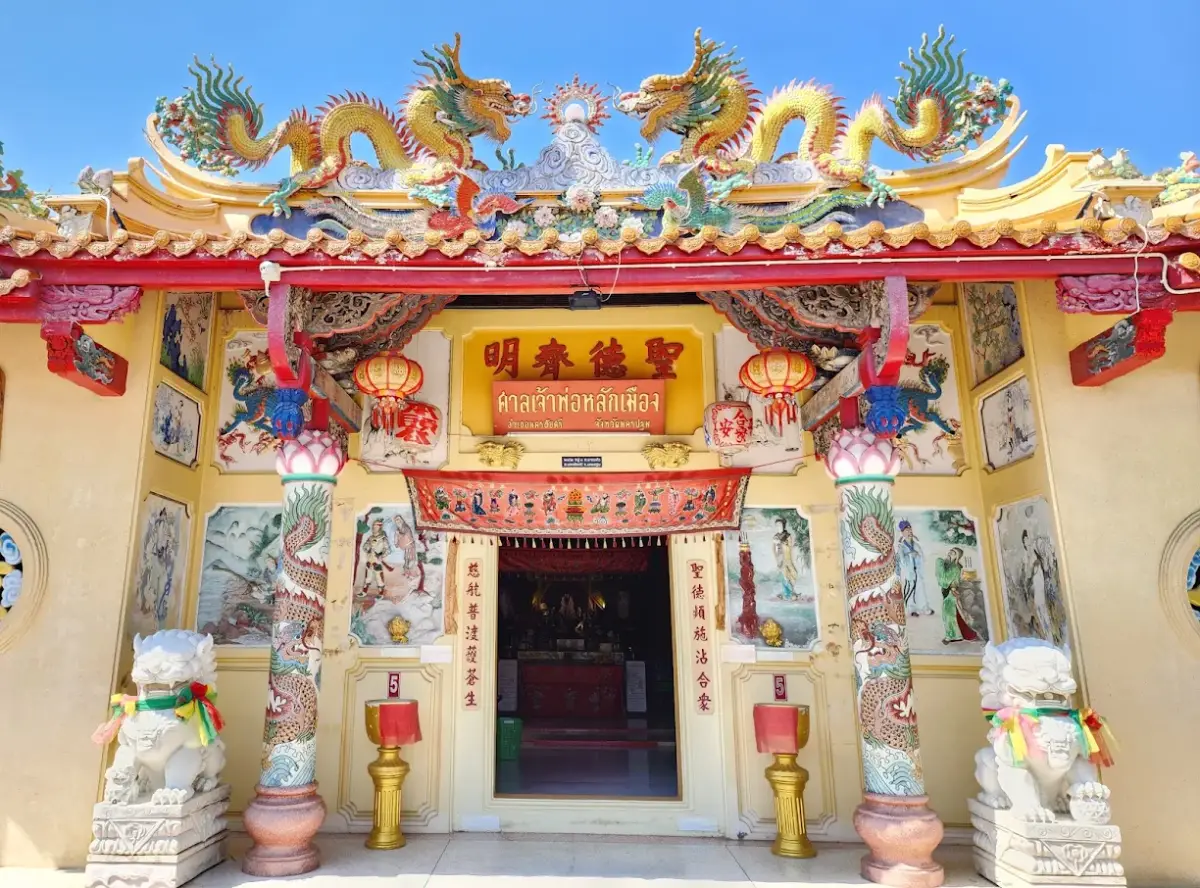
Nakhon Pathom City Pillar Shrine
Open Days: Daily
Visiting Hours: 07:00 – 17:00
Nakhon Pathom City Pillar Shrine, also known as Chao Pho Lak Mueang Shrine, is a sacred community landmark in Nakhon Chai Si District, Nakhon Pathom Province, Thailand. Situated beside Khlong Bang Kaeo in Village 1, Bang Kaeo Subdistrict, Nakhon Chai Si District, Nakhon Pathom 73120, the shrine is recognized for its Chinese-influenced architecture and its long association with local religious traditions. Several revered figures are enshrined within the complex, with Chao Pho Lak Mueang at the center of the community's devotion. The site also reflects the history of riverside settlement, Thai-Chinese cultural heritage, and the traditions preserved by generations of people living along the Nakhon Chai Si River.
The shrine differs from many provincial city pillar shrines elsewhere in Thailand. Rather than standing in a formal Thai-style pavilion near a provincial government building, it is a Chinese-style temple complex within an established riverside community. Its architectural features include roof dragons, Chinese lanterns, dragon-decorated columns, and inscriptions in Chinese characters. These elements illustrate the influence of the Chinese families and community supporters who contributed to its development. The shrine's importance therefore extends beyond the worship of a sacred pillar to include the social and cultural history of its surroundings.
For travelers seeking to understand Nakhon Pathom beyond Phra Pathom Chedi and the archaeological heritage of the Dvaravati period, Chao Pho Lak Mueang Shrine offers a different perspective. Its history is rooted in a small riverside community and shaped by the relationship between Khlong Bang Kaeo, the Nakhon Chai Si River, local commerce, and beliefs in protective sacred figures. A visit provides an opportunity to appreciate Chinese-influenced religious art while learning about the cultural foundations of Nakhon Chai Si District.
The shrine is located in Bang Kaeo Subdistrict, within the basin of the Nakhon Chai Si River, also known as the Tha Chin River. This waterway has shaped settlement patterns for generations. In the past, rivers and canals were essential routes for travel, transport, and communication between villages. Houses, temples, markets, shrines, and trading points consequently developed along the banks, creating communities closely connected with the movement of people and agricultural goods.
Khlong Bang Kaeo connects with the wider Nakhon Chai Si River system and communities around Bang Krabao. The shrine faces the canal, reflecting the spatial organization of traditional riverside settlements. Before roads became the principal form of transport, waterways functioned much like main streets, linking houses, markets, temples, and places of worship. The shrine's orientation toward the canal preserves an important reminder of that earlier landscape.
Nakhon Chai Si is an old district with a history closely associated with trade and settlement along the Tha Chin River. During the Rattanakosin period, riverside communities developed into agricultural and commercial centers. Farmers, boat operators, merchants, and Thai-Chinese families lived and worked within a connected river economy. Their interaction contributed to distinctive cultural traditions visible in local food, language, religious festivals, and the construction of Chinese shrines.
Bang Kaeo is one of the communities where the relationship between river-based livelihoods and spiritual traditions remains particularly apparent. Although roads have become more important for everyday transport, older patterns of settlement survive in local place names, temples, canals, and sacred landmarks. Chao Pho Lak Mueang Shrine is therefore part of the cultural geography of the district and contributes to the community's sense of continuity with its past.
The origins of the shrine are associated with a local story about a wooden pillar found in Khlong Bang Kaeo. According to accounts passed down among families connected with the shrine, a pillar once lay submerged near the present location. Members of the community reportedly experienced dreams concerning the object, prompting residents to search the water and retrieve it. A small shelter was then constructed beside the canal to house the pillar and provide a place for paying respect. This account became an important part of the shrine's oral history.
After the pillar was brought out of the canal, villagers established a modest shelter for worship. As more people began paying their respects, the site gradually became an established local sacred place. Devotion extended beyond individual families, attracting supporters who were able to contribute to the construction and improvement of the shrine.
Prominent Chinese merchants from the Bang Krabao side of the river subsequently played a major role in developing the site. Local accounts mention supporters known as Thao Kae Yaem and Thao Kae Chaisun, among others. With contributions from these merchants and community members, a permanent Chinese-style shrine was constructed to replace the earlier shelter. This development illustrates the importance of social networks and local patronage in creating community religious institutions.
The transformation from a small riverside shelter into a more substantial Chinese-style shrine took place over successive periods. Donations and community cooperation supported improvements to the buildings and the addition of ceremonial spaces. The present complex is therefore the result of development and maintenance by several generations rather than a structure that has remained physically unchanged since the earliest tradition concerning the pillar.
The history of the shrine also highlights the role of women and family networks in preserving local memory. The story of the submerged pillar was passed from older generations to younger family members associated with the shrine's care. Such oral history is particularly important for places whose earliest construction records are incomplete. The recollections of residents help preserve the meaning of the site within the community.
In 2015, the Western Region Information Center at Sanam Chandra Palace Library, Silpakorn University, investigated the shrine through field visits and interviews with local residents. The research documented its location, architectural setting, the account of the pillar found in the canal, and individuals who contributed to its maintenance and restoration. This work provides an important record of the shrine as a community heritage site.
People interviewed during the research included Fuen Thanison, who was caring for the shrine at that time, as well as Fon Thanison and Khajondej Nopkhunchaikit, who had roles in its administration and support. These historical accounts demonstrate the importance of local families and community leaders in preserving the complex. The names belong to the documented history of the shrine in 2015 and do not necessarily identify its current management.
The name Chao Pho Lak Mueang appears on the shrine's signage and has long been used by local residents. It reflects the community's reverence for the pillar and the sacred figures housed within the complex. However, the original source, age, and earlier function of the submerged pillar have not been conclusively established. The traditional name of the shrine should therefore be distinguished from an officially documented ceremony establishing a provincial city pillar.
The cultural importance of the shrine does not depend entirely on whether every detail of its origin can be verified through historical documents. Many important sacred places developed through oral traditions and community participation. Stories preserved by local residents maintain memories of events and objects considered significant to their collective identity. Chao Pho Lak Mueang Shrine is an example of heritage shaped through the relationship between place, people, and belief.
The architecture of the main building is distinctly Chinese-influenced. Its entrance is crowned by elaborate dragon sculptures, while red lanterns hang beneath the roof. Decorative columns display dragon motifs, and Chinese inscriptions appear above and around the entrance. The overall appearance creates a strong contrast with the Thai-style architecture of many other city pillar shrines.
Dragons are important symbols in Chinese culture, associated with power, prosperity, and auspiciousness. Their use in the shrine's roof and columns reflects the beliefs and artistic preferences of the people who built and supported the complex. The colorful dragon sculptures also make the building visually distinctive and immediately recognizable.
Chinese lanterns are another characteristic feature of the shrine. Such lanterns are widely used in Chinese temples, festivals, and ceremonial spaces. They are associated with light, celebration, and good fortune. Together with the Chinese inscriptions and decorative motifs, they demonstrate the continuity of Chinese cultural traditions within the Bang Kaeo community.
The entrance walls and columns feature decorative images associated with auspicious animals and traditional beliefs. Inside, the shrine contains altars and spaces for offerings arranged according to the importance and ceremonial function of each sacred figure. Red, gold, and yellow are prominent throughout the decoration, reflecting a color palette commonly found in Chinese religious architecture.
Beyond the principal sanctuary, the complex contains additional places of worship, including an altar dedicated to Heaven and Earth. The arrangement allows visitors to pay their respects at different locations in a sequence established by the shrine. It reflects the broader traditions of Chinese religious practice rather than the presence of a single isolated sacred pillar.
The Heaven and Earth altar is an important component of ceremonial worship in Chinese religious traditions. It expresses respect for the relationship between humanity, the heavens, and the natural world. Beginning worship at this altar before proceeding into the principal shrine is part of the sequence displayed at Chao Pho Lak Mueang Shrine.
Another worship point is dedicated to Chuea Pui Nia Nia, whose name appears in the local sequence of offerings. This altar forms part of the established ceremonial route within the complex. The presence of several sacred figures illustrates the inclusive character of community Chinese shrines, where different devotional traditions may be represented in a shared sacred space.
The San Sua Kok Ong altar is another significant feature. Some local residents call these three deities Chao Sam Klom. Worship of this group is connected with Chinese cultural traditions, particularly among Teochew, Hakka, and Hokkien communities. Its presence at the shrine offers insight into the wider Chinese heritage of central Thailand and the religious networks associated with migration and settlement.
The principal Chao Pho Lak Mueang altar is the heart of the shrine's devotional activity. Worshippers commonly present garlands, flowers, and other appropriate offerings. The sacred area is decorated with Chinese-style inscriptions and ceremonial objects that emphasize its importance as a place of communal faith.
Additional worship points stand to the sides of the main sanctuary and are incorporated into the ceremonial sequence. After visiting the principal altar, worshippers can follow the signs to other locations, including the Chao Pho Phan Mueang shrine. Each area has a distinct position within the religious setting.
Visitors can follow the worship sequence described by the shrine's signs or attendants. The route begins with Heaven and Earth, continues to Chuea Pui Nia Nia, San Sua Kok Ong, and Chao Pho Lak Mueang, and then proceeds to the remaining designated points. The arrangement supports an orderly ceremonial experience while preserving the customs associated with the site.
The grounds include an open forecourt and parking for visitors, as well as buildings connected with community religious events. Such facilities become particularly important during annual celebrations, when the shrine functions as a gathering place for larger groups rather than only individual worshippers.
A building associated with the annual charitable distribution ceremony forms another important part of the complex. Located beside the main shrine, it is used in activities traditionally known as Thing Krachad or Si Ko. These ceremonies combine religious observance with charitable giving and demonstrate the social responsibilities associated with the shrine.
The annual Thing Krachad or Si Ko festival is among the principal cultural traditions of Chao Pho Lak Mueang Shrine. Historically associated with a period in August, it includes devotional ceremonies, merit dedication, and the distribution of charitable offerings. These activities connect religious belief with practical support for people in the surrounding community.
Charitable distribution has a profound social meaning because it represents generosity and assistance to those in need. The shrine consequently serves not only as a place where individuals seek blessings but also as a setting where community members can express concern for the welfare of others through donations and participation in charitable activities.
The annual festival also brings together families and residents who maintain personal or ancestral connections with the shrine. Participating in ceremonies and helping organize activities creates opportunities for traditions to be passed from elders to younger generations. The event's significance therefore lies in both its rituals and the social cooperation it encourages.
Chao Pho Lak Mueang Shrine is an important example of Thai-Chinese settlement history in Nakhon Chai Si. The involvement of Chinese merchants and local families in constructing the shrine reflects the connection between trade networks and religious patronage. Community supporters contributed not only to economic life but also to the creation of shared cultural and social spaces.
The presence of Chinese shrines near Thai Buddhist temples in Nakhon Chai Si illustrates the cultural diversity of the central Thai river basin. Thai and Thai-Chinese communities have long lived and worked alongside one another through commerce, agriculture, and local traditions. Their sacred places may differ in ceremony and architecture, yet all contribute to community identity and social relationships.
Chao Pho Lak Mueang Shrine is not a Buddhist monastery with an ordination hall, viharn, or resident monastic community as its central features. It is a Chinese-style community shrine organized around altars, sacred figures, and local ceremonial traditions. Its history is best understood through Chinese religious architecture, guardian-deity beliefs, the Thing Krachad festival, and the riverside settlement patterns of Nakhon Chai Si.
Wat Tha Tamnak is a nearby Buddhist temple closely associated with the local place name. According to local tradition, the area was used as a stopping point for military forces traveling along Khlong Bang Kaeo during the early Rattanakosin period. The story is connected with the emergence of the name Tha Tamnak and the subsequent foundation of the temple. It provides another example of the importance of waterways in the district's settlement history.
Wat Tha Tamnak contains several buildings used for Buddhist religious life, including an ordination hall, a preaching and assembly hall, monks' residences, and multipurpose facilities. Each has a different function within the monastery. Studying the temple alongside Chao Pho Lak Mueang Shrine allows visitors to distinguish between Thai Buddhist monastic architecture and the ceremonial arrangement of a Chinese community shrine.
Wat Bang Kaeo is another Buddhist temple in the same general community area, near the route leading to Chao Pho Lak Mueang Shrine. Its name is associated with the canal and the subdistrict, demonstrating how geographical names can preserve the history of settlement and religious life along Khlong Bang Kaeo.
Wat Sing is another temple associated with the local road network between Wat Tha Tamnak and Bang Kaeo. The proximity of several temples, residential neighborhoods, and waterways is characteristic of traditional central Thai settlements. Exploring these places together provides insight into the spatial relationship between homes, temples, markets, and local transport routes.
Wat Klang Bang Kaeo is another important Buddhist landmark in Nakhon Chai Si District. It is particularly associated with Luang Pu Bun and Luang Pu Phoem, revered monks whose lives contributed to local religious history. The temple contains a museum displaying sacred objects, Buddhist images, historical manuscripts, traditional medicine materials, and items connected with the monks. It provides an opportunity to explore Buddhist heritage alongside local cultural and historical collections.
The museum at Wat Klang Bang Kaeo demonstrates the traditional role of temples as centers of knowledge. Its collections include herbal medicine texts, folding manuscripts, palm-leaf scriptures, astrological documents, and personal objects associated with religious teachers. These materials reveal how Buddhist institutions once supported education, healing traditions, and the preservation of local knowledge alongside religious practice.
Thana Market, also known as Nakhon Chai Si Market, is an important historical trading district beside the Tha Chin River. Located in Nakhon Chai Si Subdistrict, the market preserves old wooden shop buildings and a long history of commercial activity. Visitors can explore local food stalls, traditional desserts, riverside restaurants, and agricultural products. Visiting the market after the shrine provides a fuller picture of the relationship between religious life and the river-based economy.
Thana Market developed as a trading and transport center connecting farm products and riverside communities. Before roads became the principal means of movement, the Nakhon Chai Si River carried goods and passengers through the region. Shops and merchant families established themselves around the market, creating a commercial community whose historic buildings still reflect its earlier prosperity.
Nakhon Chai Si's food culture is closely associated with fruit cultivation and riverside commerce. The district is famous for its pomelos, while traditional markets offer dishes such as stewed duck, pad thai, and Thai desserts. Exploring local food allows travelers to experience cultural influences that developed through generations of trade and settlement.
The Thai Human Imagery Museum is another well-known cultural attraction in Nakhon Chai Si District. Its collections use realistic figures to present historical personalities and aspects of Thai culture. The museum is suitable for families and visitors interested in continuing their historical learning after exploring community shrines and riverside neighborhoods.
Wat Bang Phra is another important religious destination, widely associated with Luang Pho Pern and traditions involving sacred tattoos. The temple illustrates a different dimension of Thai religious culture, including respect for revered monks and protective beliefs. Although its ceremonies differ from those of Chao Pho Lak Mueang Shrine, both sites reflect the relationship between faith and everyday community life.
Other sites in the wider area include Wat Si Maha Pho, Wat Huai Phlu, and historic neighborhoods around Nakhon Chai Si. These temples and community landmarks have their own traditions and historical associations. Together, they illustrate the diversity of Thai Buddhist temples, Chinese shrines, and riverside markets found within the district.
Travelers interested in the broader history of Nakhon Pathom Province can continue to Phra Pathom Chedi in Mueang Nakhon Pathom District. This major Buddhist landmark is closely associated with the historical development of Buddhism and the province's identity. Combining a visit to the great chedi with the Chinese-style shrine at Nakhon Chai Si reveals different aspects of heritage within the same province.
Sanam Chandra Palace is another important attraction in Nakhon Pathom, associated with King Vajiravudh and the development of the town during the Rattanakosin period. Its architecture includes Thai and Western influences. Studying the palace and the older riverside communities of Nakhon Chai Si provides a wider perspective on the province's social and cultural development.
One of the most interesting characteristics of Chao Pho Lak Mueang Shrine is its development from a locally revered object into a permanent religious complex supported by the community. This differs from officially established city pillar shrines whose construction and pillar-raising ceremonies were initiated by provincial authorities. The story of a pillar retrieved from the canal and the subsequent support of Chinese merchants is particularly valuable to the study of community history and the formation of sacred places.
The shrine also illustrates how different religious traditions coexist in Thai society. Worshippers may come from different family and cultural backgrounds yet share the same devotional environment. This coexistence is part of Thailand's historical experience of migration, trade, and cultural interaction.
Visitors should respect the shrine's established customs and follow the instructions displayed at each altar. Incense, candles, flowers, garlands, and other offerings should be used only in designated areas. Elaborate offerings are not essential to respectful worship; consideration for other visitors and the sacred surroundings is equally important.
Chao Pho Lak Mueang Shrine is suitable for travelers interested in cultural heritage and riverside community history. Visitors can observe its Chinese architectural ornamentation, explore the meanings of different worship points, and appreciate the building's orientation toward Khlong Bang Kaeo. These details reveal the former importance of water-based transportation and settlement.
Traveling through Bang Kaeo provides an opportunity to experience a local community distinct from the province's larger tourist centers. Houses, village roads, canals, and temples remain important parts of the landscape. Such surroundings help visitors understand the spatial organization and everyday life of traditional communities in the Nakhon Chai Si area.
From a conservation perspective, the shrine illustrates the value of community-created heritage. Its development and restoration have depended on residents, merchants, and donors over successive generations. Preserving the site requires attention to its architecture, religious traditions, and the knowledge passed down within the community.
Renovations have allowed the buildings to continue accommodating worshippers and annual events. At the same time, maintaining their Chinese architectural features is important to the shrine's cultural identity. Dragons, lanterns, inscriptions, and sacred figures communicate the story of cultural interaction through visible artistic forms.
The shrine is also of interest to visitors who enjoy architectural photography. The dragon sculptures above the roof, decorated columns, Chinese inscriptions, and colorful lanterns are particularly distinctive. Photography should be conducted respectfully, without obstructing worshippers or interrupting ceremonies.
During the annual Thing Krachad festival, the shrine becomes a lively gathering place with charitable and religious activities. The event reveals how faith can inspire generosity and collective action. On ordinary days, the atmosphere is better suited to quiet worship and detailed appreciation of the architecture. Both settings contribute to the site's identity.
A variety of restaurants are available around Bang Kaeo and other parts of Nakhon Chai Si District. These include casual Thai restaurants, riverside dining establishments, and modern restaurants. Families can combine a cultural visit with lunch or other meals in nearby communities.
Suan Lung Kit Restaurant in Bang Kaeo offers a relaxed setting with Thai food and everyday dishes. Matane Shabu & Sushi, also in Bang Kaeo, provides Japanese buffet dining. Travelers seeking a riverside atmosphere may consider Baan Natcha Restaurant beside the Tha Chin River or Nang Hoi Kha in the Wat Khae area. These establishments provide different dining experiences within Nakhon Chai Si District.
Accommodation in Nakhon Chai Si includes small hotels, riverside resorts, and garden-style properties. Options are spread across Tha Tamnak, Bang Kaeo Fa, Thaiyawat, and neighboring subdistricts. Visitors can choose between practical lodging near roads and quieter stays in the countryside or beside the river.
Riverside accommodation includes Boat House Boutique Riverside and RK Riverside Resort & Spa. Travelers who prefer a more straightforward base may consider New Home Nakhon Chai Si and other smaller properties in the district. The range of options supports both day trips and overnight cultural excursions.
A cultural journey through Nakhon Chai Si can combine the shrine with Buddhist temples, traditional markets, and museums. One route begins at Chao Pho Lak Mueang Shrine in Bang Kaeo, continues through the Wat Tha Tamnak and Wat Bang Kaeo areas, and reaches Thana Market. Visitors can then travel onward to Wat Klang Bang Kaeo or the Thai Human Imagery Museum. Each destination contributes a different perspective on the district's history.
The shrine also provides a valuable educational experience for students and younger visitors. Local history is not limited to royal palaces, large monuments, or nationally famous historical figures. It also includes communities that create sacred places and preserve their own traditions. The story of the pillar found in the canal and the establishment of the shrine by local people offers an accessible example of this kind of community memory.
The relationship between the shrine and its community has social importance. Religious ceremonies, charitable events, and collective maintenance activities help create a sense of belonging. The continued observance of Thing Krachad reflects both devotion to sacred figures and responsibility for the welfare of other people.
Historically, Chao Pho Lak Mueang Shrine is an example of a place documented through both oral testimony and academic field research. Preserving residents' recollections gives local history a recorded form, while historical investigation helps distinguish between traditional beliefs and the specific evidence required to establish the pillar's original age or function.
The shrine's significance is also linked to the history of Chinese settlement in Nakhon Chai Si. Commercial activity along the river encouraged the formation of merchant communities and social networks. These networks supported the construction of religious buildings and the organization of festivals. Over time, the shrine became a shared cultural space within the wider community.
Getting There Chao Pho Lak Mueang Shrine is located in Village 1, Bang Kaeo Subdistrict, Nakhon Chai Si District, Nakhon Pathom Province 73120, beside Khlong Bang Kaeo. From Bangkok, travelers can follow Borommaratchachonnani Road or Phet Kasem Road toward Nakhon Chai Si District. Continue through the Wat Tha Tamnak and Wat Bang Kaeo areas toward the local riverside community, following signs for Chao Pho Lak Mueang Shrine or a navigation map.
The final approach uses local roads passing through residential communities and temples. A private vehicle is convenient for visiting several attractions in the district, while public transport users can travel to Nakhon Chai Si and continue by local hired vehicle. The shrine's location can be identified using the map reference Q5M8+QG8.
The shrine faces Khlong Bang Kaeo, whose presence is essential to understanding its historical setting. Seeing the canal and surrounding community gives context to the story of the recovered pillar and the development of the shrine. It also illustrates how a settlement once organized around water transport has adapted to modern roads.
Chao Pho Lak Mueang Shrine is a distinctive expression of the faith of the Bang Kaeo community and the multicultural history of Nakhon Chai Si District. The story of the pillar found in the canal, the construction supported by Chinese merchants, the dragon-decorated architecture, and the Thing Krachad charitable tradition all contribute to its particular cultural identity.
Visiting this shrine is therefore more than an opportunity to seek traditional blessings. It is a way to explore the history of a community shaped by waterways, commerce, faith, and cooperation across generations. As one of the cultural landmarks of Nakhon Chai Si, the shrine offers a deeper understanding of Nakhon Pathom Province through the everyday heritage of its riverside settlements.
| Place Name | Chao Pho Lak Mueang Shrine, Nakhon Pathom (Old City Pillar Shrine) |
| Address | Village 1, Bang Kaeo Subdistrict, Nakhon Chai Si District, Nakhon Pathom 73120, Thailand, Beside Khlong Bang Kaeo |
| Map Reference | Plus Code Q5M8+QG8, Bang Kaeo, Nakhon Chai Si District, Nakhon Pathom |
| Type | Chinese-Style Community Shrine, Sacred Civic Landmark and Cultural Attraction |
| Cultural Significance | An Important Place of Worship Associated with Bang Kaeo's Riverside Settlement History and Thai-Chinese Cultural Traditions |
| Historical Background | Local Tradition Describes a Wooden Pillar Retrieved from Khlong Bang Kaeo, Followed by the Construction of a Small Shelter and Later a Permanent Chinese Shrine Supported by Local Merchants and Residents |
| Architecture | Chinese-Influenced Shrine with Roof Dragons, Dragon-Decorated Columns, Chinese Lanterns and Chinese Inscriptions |
| Principal Sacred Figures | Chao Pho Lak Mueang, Heaven and Earth Deities, Chuea Pui Nia Nia, San Sua Kok Ong and Chao Pho Phan Mueang |
| Main Areas and Worship Points | 1. Heaven and Earth Altar 2. Chuea Pui Nia Nia Altar 3. San Sua Kok Ong Altar 4. Main Chao Pho Lak Mueang Shrine 5. Additional Side Worship Points 6. Chao Pho Phan Mueang Shrine 7. Thing Krachad Ceremony Building 8. Shrine Grounds and Forecourt |
| Annual Tradition | Thing Krachad or Si Ko Festival, Associated with Religious Ceremonies and Community Charitable Distribution |
| Historical Management | The 2015 Academic Study Documents Contributions by Fuen Thanison, Fon Thanison and Khajondej Nopkhunchaikit |
| Open Days | Daily |
| Visiting Hours | 07:00 – 17:00 |
| Facilities | Parking, Restrooms and Signs Showing the Worship Sequence |
| Getting There | Travel via Phet Kasem Road or Borommaratchachonnani Road toward Nakhon Chai Si, Then Continue through the Wat Tha Tamnak and Wat Bang Kaeo Areas to the Bang Kaeo Riverside Community |
| Nearby Tourist Attractions | 1. Wat Bang Kaeo, Bang Kaeo Subdistrict 2. Wat Tha Tamnak, Tha Tamnak Subdistrict 3. Wat Sing, Bang Kaeo Community Route 4. Thana Market, Nakhon Chai Si Subdistrict 5. Wat Klang Bang Kaeo, Nakhon Chai Si District 6. Thai Human Imagery Museum, Nakhon Chai Si District 7. Wat Bang Phra, Nakhon Chai Si District 8. Wat Si Maha Pho, Nakhon Chai Si District |
| Restaurants in the Surrounding Area | 1. Suan Lung Kit Restaurant, Bang Kaeo, Tel. +66 82 945 3545 2. Matane Shabu & Sushi, Bang Kaeo, Tel. +66 91 886 6602 3. Baan Natcha Riverside Restaurant, Khun Kaeo, Tel. +66 90 979 0942 4. Nang Hoi Kha Nakhon Chai Si, Wat Khae, Tel. +66 92 119 4913 5. Food Stalls and Local Restaurants at Thana Market, Nakhon Chai Si |
| Nearby Accommodations | 1. New Home Nakhon Chai Si, Tha Tamnak, Tel. +66 86 337 1055 2. Boat House Boutique Riverside, Bang Kaeo Fa, Tel. +66 64 595 5445 3. RK Riverside Resort & Spa, Thaiyawat, Tel. +66 34 109 299 4. Olivia Boutique Thailand Hotel & Cafe, Bang Kaeo Fa, Tel. +66 65 265 6919 5. Panavana Riverside, Lan Tak Fa, Tel. +66 99 959 6564 6. Bananaleaf Wedding Cafe & Resort, Bang Kaeo, Tel. +66 95 879 6622 |
Frequently Asked Questions (FAQ)
Q: Where is Nakhon Pathom Chao Pho Lak Mueang Shrine located?
A: The shrine is situated beside Khlong Bang Kaeo in Village 1, Bang Kaeo Subdistrict, Nakhon Chai Si District, Nakhon Pathom 73120, Thailand. Its map reference is Q5M8+QG8.
Q: What are the visiting hours?
A: The shrine receives visitors daily. The recommended daytime visiting window is 07:00 to 17:00.
Q: What is the history of Nakhon Pathom Chao Pho Lak Mueang Shrine?
A: According to local tradition, villagers recovered a submerged pillar from Khlong Bang Kaeo and placed it in a small shrine. Chinese merchants and local residents later contributed to the construction of a permanent Chinese-style shrine building.
Q: Is this the officially established provincial city pillar shrine of Nakhon Pathom?
A: It is a community shrine traditionally known as Chao Pho Lak Mueang Shrine. The history of its pillar has not been conclusively linked to an officially documented provincial city pillar installation.
Q: Which sacred figures are worshipped at the shrine?
A: Worship points include Chao Pho Lak Mueang, the Heaven and Earth deities, Chuea Pui Nia Nia, San Sua Kok Ong, also called Chao Sam Klom, and Chao Pho Phan Mueang.
Q: Where should visitors begin the worship sequence?
A: The customary sequence begins at the Heaven and Earth altar, followed by Chuea Pui Nia Nia, San Sua Kok Ong, and Chao Pho Lak Mueang. Visitors can then continue to the remaining points according to the signs at the shrine.
Q: What annual festival is associated with the shrine?
A: The shrine is associated with the Thing Krachad or Si Ko festival, a Chinese community tradition involving religious ceremonies and charitable distribution.
Q: What attractions can visitors explore nearby?
A: Attractions around Nakhon Chai Si include Wat Bang Kaeo, Wat Tha Tamnak, Wat Sing, Thana Market, Wat Klang Bang Kaeo, the Thai Human Imagery Museum, and Wat Bang Phra.
 Category: ●Places of Worship
 Group: ●Other Sacred Sites
Last Update : 5 DayAgo
 Last Update : 5 DayAgo
 Click to Access the Navigation Map GPS
Nakhon Pathom City Pillar Shrine Map
Recommend

 Art, Culture and Heritage
 Historical Sites and Monuments(6)
 Landmarks and Memorials(4)
 Royal Palace(3)
 Art, Craft Centres, Tradition(5)
 Museums(13)
 Art Gallery(1)
 Educational Places
 Educational Gardens, Farm(2)
 Temple(77)
Other Sacred Sites(5)
 Research and Development
 Royal Project(1)
 Suburban Living
 Village, Community(3)
 Local Market(3)
 Floating Market(8)
 Nature and Wildlife
 River, Canal(4)
 Other natural attractions(3)
 Entertainment and Agricultural
 Animal camps and shows(1)
 Stadium(1)
 Farms, Parks and Ecotourism(5)
 Theater(1)
 Outdoor and Adventure Activities(2)
 Spas and Wellness
 Spas and Wellness(1)
 Travel Articles, Recipes
 Travel Review, Food Review(1)


