
lovethailand home >South Travel Attractions >Surat Thani Travel Attractions >Chai Ya >Talat Chai Ya > Suad Malai
TL;DR: Suad Malai. is a traditional funeral chanting practice associated with Southern Thai culture, Buddhist moral teaching, manuscript literature, and.
Suad Malai
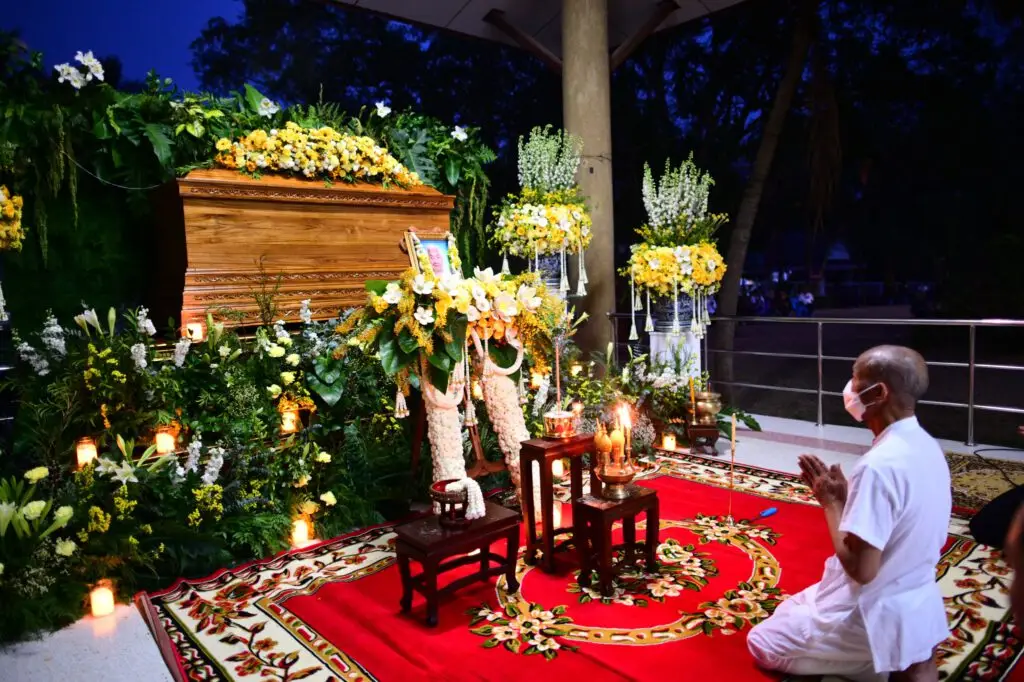
Occasion: Performed at funerals, traditionally at night after the Buddhist monastic rites
Current Status: Still preserved by some performers and cultural lineages, especially in Southern Thailand, but now rarely seen and much less common than in the past
Suad Malai is a traditional funeral chanting practice associated with Southern Thai culture, Buddhist moral teaching, manuscript literature, and community life. It is performed by chanting the story of Phra Malai, a Buddhist narrative used to teach listeners about karma, merit, sin, moral conduct, heaven, hell, and the reality of death. In the past, Suad Malai was an important part of funeral nights, helping the bereaved family and relatives feel less lonely while they kept vigil beside the body. It was not merely a chant, but a living performance that combined religious instruction, oral literature, melody, gesture, call-and-response singing, and emotional support.
In Thai society, a funeral is not only a ceremony for the deceased. It is also a moment when the living face impermanence, remember the virtues of the person who has passed away, and reflect on the meaning of life. Suad Malai developed within this sensitive setting. It served religious, social, and psychological purposes at the same time. Through the story of Phra Malai, listeners were reminded that human actions have consequences and that death should lead people toward mindfulness, merit-making, and moral living.
The main narrative of Suad Malai tells of Phra Malai Thera, a monk with extraordinary spiritual power who travels to hell and heaven. In hell, he sees beings suffering from the consequences of their past actions. These beings ask him to tell their relatives in the human world to make merit and dedicate the merit to them. Phra Malai then carries these messages back to humans. He also travels to the heavenly realm, worships the Chulamani Chedi, meets Indra, and hears teachings connected with Phra Si Ariya Metteyya, the future Buddha in Thai Buddhist belief. The story therefore contains both warning and hope: warning against evil deeds and hope through merit and moral conduct.
In earlier times, Suad Malai was performed by monks. A group of 4 monks, sometimes called one chanting set, would chant after the main religious service. They used ceremonial fans to cover their faces, and the text came from a Malai manuscript, also known as Phra Malai Kham Suat. These manuscripts were often large khoi books or Thai folding books. They were written in Khom Thai script, sometimes mixed with Pali, and many copies contained beautiful illustrations. For this reason, Phra Malai manuscripts are valuable not only as religious texts, but also as literary, artistic, and historical documents.
Later, the practice gradually shifted from monks to lay performers. This change gave Suad Malai a stronger character as a folk performance within funerals. A group of performers was called a Wong Malai. A suitable group often had around 4-6 people. Two main singers, called Mae Khu or Ton Phleng, led the chanting, while the supporting singers, known as Luk Khu or Khu Hu, responded. The performance used not only voice, but also gesture, expression, timing, and dramatic interpretation. The audience did not only receive moral instruction; they also experienced the rhythm and artistry of local oral performance.
Suad Malai was commonly performed at night after the monks had finished chanting Abhidhamma or other funeral rites. At that time, many guests had gone home, leaving close relatives, friends, and neighbors to remain with the bereaved family. A funeral night can feel quiet, heavy, and emotionally difficult. The presence of a Suad Malai group helped reduce loneliness, gave people something meaningful to listen to, and supported the family through a long night of mourning.
The usual sequence begins with offerings and worship of the Triple Gem. The performers then chant Namo to praise the Buddha, the Dhamma, and the Sangha. This is followed by Wai Khun or Wai Khru, an act of respect toward teachers, parents, sacred forces, and sources of knowledge. After that comes the section known as Nai Kan, the beginning of the Phra Malai story. The name comes from the opening words of the chant. This section tells of Phra Malai’s spiritual journey, his visit to hell, his ascent to heaven, his conversation with Indra and Phra Si Ariya, and his teaching about the consequences of good and bad actions.
The Nai Kan section is important because it contains the moral core of Suad Malai. It explains karma through story, image, and emotion rather than through abstract doctrine alone. Listeners hear about suffering in hell, the need to make merit, the danger of wrongdoing, and the possibility of a better future through moral practice. Because this teaching is heard within a funeral setting, its impact becomes stronger. The audience is already surrounded by the reality of death, so the message of impermanence and moral responsibility becomes immediate and vivid.
After the main Phra Malai story, performers often move into a section called Lam Nok or miscellaneous episodes. This part was added to make the performance livelier and to change the emotional atmosphere. Lam Nok may include stories from Thai literature and folk narratives such as Sang Thong, Phra Aphai Mani, Khun Chang Khun Phaen, Inao, Chanthakhorop, Ramakien, Laksanawong, and other local tales. The melodies may resemble lam tat, phleng choi, phleng na, or traditional Thai tunes. This section allows performers to show wit, memory, humor, dramatic skill, and poetic improvisation.
The Lam Nok section helped balance the emotional weight of funeral teaching. If the performance focused only on hell, sin, and death, listeners might become too tense or weary. By adding literary and entertaining episodes, Suad Malai created a rhythm between seriousness and relief. However, the entertaining part should not obscure the main purpose of the tradition. The heart of Suad Malai remains Buddhist moral reflection, remembrance of death, and emotional support for the bereaved.
Musical instruments were not always required. In many traditions, the beauty of Suad Malai came from voice, melody, and the call-and-response structure. Some groups later used instruments such as flute, ramana, or small cymbals. The flute could deepen the sorrowful mood, while rhythm instruments helped maintain timing. These instruments were supporting elements rather than the core of the practice.
Costume was generally simple and respectful. Performers usually dressed appropriately for a funeral, often in dark, white, or subdued colors. Some groups, especially during Lam Nok episodes, used costumes or props related to the story being performed. Items such as masks, moustaches, fangs, cloths, glasses, or facial powder could be used to support dramatic interpretation. These details show that Suad Malai was not only recitation. It was a performance art that required interpretation, presence, and sensitivity to the audience.
In the past, learning Suad Malai was surrounded by belief and restriction. Many people believed that practicing Suad Malai inside the house would bring misfortune because the chant was associated with funerals, corpses, spirits, hell, and death. Students therefore practiced outside the home, such as near cremation grounds, in field huts, barns, temples, or other non-domestic spaces. This belief shows how communities separated everyday household space from ritual knowledge connected with death.
Some communities also believed that Suad Malai should be performed only for people who died in ordinary circumstances. If a death was considered unusual or inauspicious, such as murder, accident, animal attack, or the death of a very young person, performers might avoid accepting the invitation. These beliefs reveal that Suad Malai was deeply embedded in Southern Thai concepts of death, spirits, ritual purity, and auspiciousness.
In Surat Thani Province, Suad Malai was once widely known in districts such as Chaiya, Kanchanadit, Tha Chang, and Tha Chana. Elderly local people remembered that many funerals in the past included Suad Malai, and well-known groups attracted large audiences. Over time, however, funeral practices changed. Recorded music, sound systems, videos, and other modern forms of funeral entertainment or memorial presentation became more common. As a result, Suad Malai gradually lost its regular place in funeral ceremonies.
Another reason for its decline is the difficulty of training. A Suad Malai performer must remember many verses, master melodies, understand older language, coordinate with other singers, improvise, and perform in the emotionally sensitive setting of a funeral. This knowledge cannot be learned from a text alone. It requires a teacher, repeated listening, live practice, and experience in real ceremonies. As older masters pass away and fewer young people learn the art, the tradition survives only within a narrow circle.
Although Suad Malai is now rare, it has not completely disappeared. Contemporary research has discussed the transmission of Phra Malai chanting melodies in Chaiya District, Surat Thani Province, including old performer lineages that still accept invitations for funeral-related ceremonies and, in some cases, perform for public or institutional cultural events. The current status of Suad Malai should therefore be described accurately: it is still preserved by some individuals and groups, but it is no longer as widespread as it once was.
Suad Malai deserves preservation because it contains several layers of cultural value. First, it has religious value because it teaches karma, merit, sin, and mindfulness of death. Second, it has literary value because Phra Malai Kham Suat is a poetic and narrative tradition with distinctive forms and melodies. Third, it has artistic value because many Phra Malai manuscripts include beautiful illustrations. Fourth, it has social value because it helped console families and reduced the loneliness of funeral nights. Fifth, it has linguistic and musical value because it preserves local language, chanting melodies, and oral performance techniques.
As manuscript culture, Phra Malai is especially important. Books known as Phra Malai or Samut Malai were found in old temples from the Ayutthaya and Rattanakosin periods and in regional communities. Many were written on Thai folding books and decorated with paintings. These manuscripts show how religious belief, visual art, literature, and funeral practice were connected. They were not merely reading materials, but objects of faith, memory, and cultural transmission.
As a funeral tradition, Suad Malai turned a space of loss into a space of learning. People attending the funeral did not only express sympathy; they also listened to teachings about the moral consequences of action. The presence of the body made the teaching more powerful. Suad Malai gave grief a direction. It did not erase sorrow, but guided mourners toward reflection, merit-making, and acceptance.
As a performing art, Suad Malai combined chanting, storytelling, theater, oral poetry, and improvisation. The lead singers needed memory, voice control, literary knowledge, emotional intelligence, and the ability to guide the group. The supporting singers needed timing and responsiveness. When Lam Nok episodes were included, performers also needed knowledge of classical and folk literature. A skilled Suad Malai group was therefore not merely a group of chanters; it was a team of performers, storytellers, cultural teachers, and emotional companions.
Preserving Suad Malai requires more than keeping old manuscripts. If the written text survives but no one remembers the melodies, an essential part of the tradition will be lost. If the performance is removed entirely from funeral context and presented only as entertainment, people may misunderstand its purpose. Proper preservation should include audio and video recording, interviews with elder performers, transcription of melodies, community workshops, youth training, and explanation of the religious and social background of the tradition.
Those who wish to study Suad Malai should begin with the story of Phra Malai, because it is the narrative heart of the tradition. They should then study the structure of the performance: Namo, Wai Khun or Wai Khru, Nai Kan, Lam Nok, melody, group roles, performer seating, beliefs about practice, and the function of the chant in funeral ceremonies. This approach helps reveal that Suad Malai is a structured cultural system, not a random form of singing.
Suad Malai also reveals the sensitivity of Thai communities in dealing with death. Rather than leaving funeral nights silent and lonely, communities created a form of religious and artistic companionship. There was chanting, moral teaching, storytelling, occasional humor, and emotional balance. This tradition shows how art and religion once worked together to care for the living during moments of loss.
In modern society, funeral practices continue to change. Suad Malai may never return to every funeral as it once did, but it can still live as a cultural heritage practice if properly documented and transmitted. Temples, schools, universities, cultural centers, and local communities can all play a role. By recording the knowledge of elder performers and creating meaningful opportunities for younger generations to learn, Suad Malai can remain more than a name in cultural history.
In conclusion, Suad Malai is more than funeral chanting. It is a cultural archive that brings together Buddhism, manuscript literature, Thai folding books, visual art, local melody, performance, belief in death and spirits, and emotional care for the bereaved. Although it is now rarely seen, its value remains clear. If it is not recorded and taught, Thailand may lose not only a chant, but also a traditional way of using art, religion, and community presence to help people face grief with mindfulness and dignity.
| Name | Suad Malai |
| Category | Funeral Tradition, Southern Thai Culture, Buddhist Moral Literature, And Oral Heritage |
| Related Region | Southern Thailand, with notable references in Surat Thani Province, especially Chaiya, Kanchanadit, Tha Chang, and Tha Chana districts |
| Occasion | Performed at funerals, traditionally at night after the Buddhist monastic rites |
| Current Status | Still preserved by some performers and cultural lineages, but now much rarer than in the past |
| Cultural Importance | Teaches karma, merit, sin, moral conduct, and mindfulness of death while helping console the bereaved during funeral nights |
| Main Text | Phra Malai Kham Suat, often found in khoi books or Thai folding manuscripts written in Khom Thai script with some Pali passages and illustrations |
| Main Narrative | The story of Phra Malai Thera traveling to hell and heaven, meeting Indra and Phra Si Ariya, and returning to teach humans about karma and merit |
| Group Structure | A group often includes 2 lead singers called Mae Khu or Ton Phleng and supporting singers called Luk Khu or Khu Hu, with around 4-6 performers in many cases |
| Performance Sequence | Namo, Wai Khun or Wai Khru, Nai Kan, and Lam Nok or miscellaneous literary episodes |
| Common Lam Nok Sources | Stories from Thai literature and folk narratives such as Sang Thong, Phra Aphai Mani, Khun Chang Khun Phaen, Inao, Chanthakhorop, Ramakien, and other folk tales |
| Musical Instruments | Originally not required, though some groups later used flute, ramana, or small cymbals to support mood and rhythm |
| Costume | Usually respectful funeral attire; some groups may use story-based costumes or props during Lam Nok sections |
| Training Belief | In the past, performers avoided practicing inside the house because the chant was associated with death and inauspiciousness; training was often done in temples, barns, field huts, or outside domestic spaces |
| Cultural Value | Valuable for Buddhism, funeral culture, manuscript studies, visual art, folk melody, oral performance, and emotional care in mourning rituals |
Frequently Asked Questions (FAQ)
Q: What is Suad Malai?
A: Suad Malai is a traditional funeral chanting practice based on the story of Phra Malai. It teaches Buddhist moral lessons about karma, merit, sin, heaven, hell, and mindfulness of death while helping console the bereaved.
Q: When is Suad Malai performed?
A: It is traditionally performed at night after the Buddhist monastic rites or Abhidhamma chanting, when close relatives and friends remain with the bereaved family to keep vigil beside the body.
Q: What is Phra Malai Kham Suat?
A: Phra Malai Kham Suat is the manuscript or text used for chanting. It tells the story of Phra Malai Thera traveling to hell and heaven, meeting Indra and Phra Si Ariya, and returning to teach humans about karma and merit.
Q: How many people are usually in a Suad Malai group?
A: A group often has around 4-6 performers, including 2 lead singers known as Mae Khu or Ton Phleng and supporting singers who respond to the chant.
Q: What is Nai Kan in Suad Malai?
A: Nai Kan is the opening narrative section of the Phra Malai story. It describes Phra Malai’s spiritual journey, his visit to hell and heaven, and his teachings about karma and moral conduct.
Q: What is Lam Nok?
A: Lam Nok is a later-added miscellaneous section that uses stories from Thai literature or folk narratives to change the mood, add liveliness, and keep the audience engaged during the long funeral night.
Q: Does Suad Malai still exist today?
A: Yes, but it is now rare. Some performers and cultural lineages still preserve it, especially in Southern Thailand, but it is no longer common in funerals as it was in the past.
Q: Why should Suad Malai be preserved?
A: It preserves Buddhist teaching, funeral culture, manuscript literature, folk melody, oral performance, and a traditional way of supporting grieving families through art and religion.
 Category: ●Art, Culture and Heritage
 Group: ●Art, Craft Centres, Tradition
Last Update : 2 MonthAgo
 Last Update : 2 MonthAgo
Recommend

 Landmarks and Memorials(1)
Art, Craft Centres, Tradition(8)
Landmarks and Memorials(1)
Art, Craft Centres, Tradition(8)
 Museums(5)
 Educational Places
 Educational Gardens, Farm(1)
 Places of Worship
 Temple(32)
 Other Sacred Sites(8)
 Research and Development
 Royal Project(1)
 Suburban Living
 Village, Community(6)
 Local Market(1)
 Nature and Wildlife
 National Parks and Marine Reserves(8)
 Mountain (Doi)(2)
 Dam, Reservoir, Lake(8)
 Waterfalls(34)
 Hot Springs(7)
 Caves(18)
 River, Canal(11)
 Bays and Beaches(30)
 Islands(16)
 Other natural attractions(10)
 Entertainment and Agricultural
 Animal camps and shows(6)
 Farms, Parks and Ecotourism(7)
 Outdoor and Adventure Activities(2)
 Shopping
 Shopping and Night Market(1)
 Travel Articles, Recipes
 Travel Review, Food Review(1)
 Southern Food Menu, Southern Food Recipes(1)


