
lovethailand home >South Travel Attractions >Phuket Travel Attractions >Muang Phuket >Talat Nuea > Phuket Thai Hua Museum
TL;DR: Phuket Thai Hua Museum is located at Krabi Road, Phuket Old Town, Talat Nuea Subdistrict, Mueang Phuket District, Phuket Province, open Daily, hours 09.00 – 17.00.
Phuket Thai Hua Museum
Open Days: Daily
Opening Hours: 09.00 – 17.00
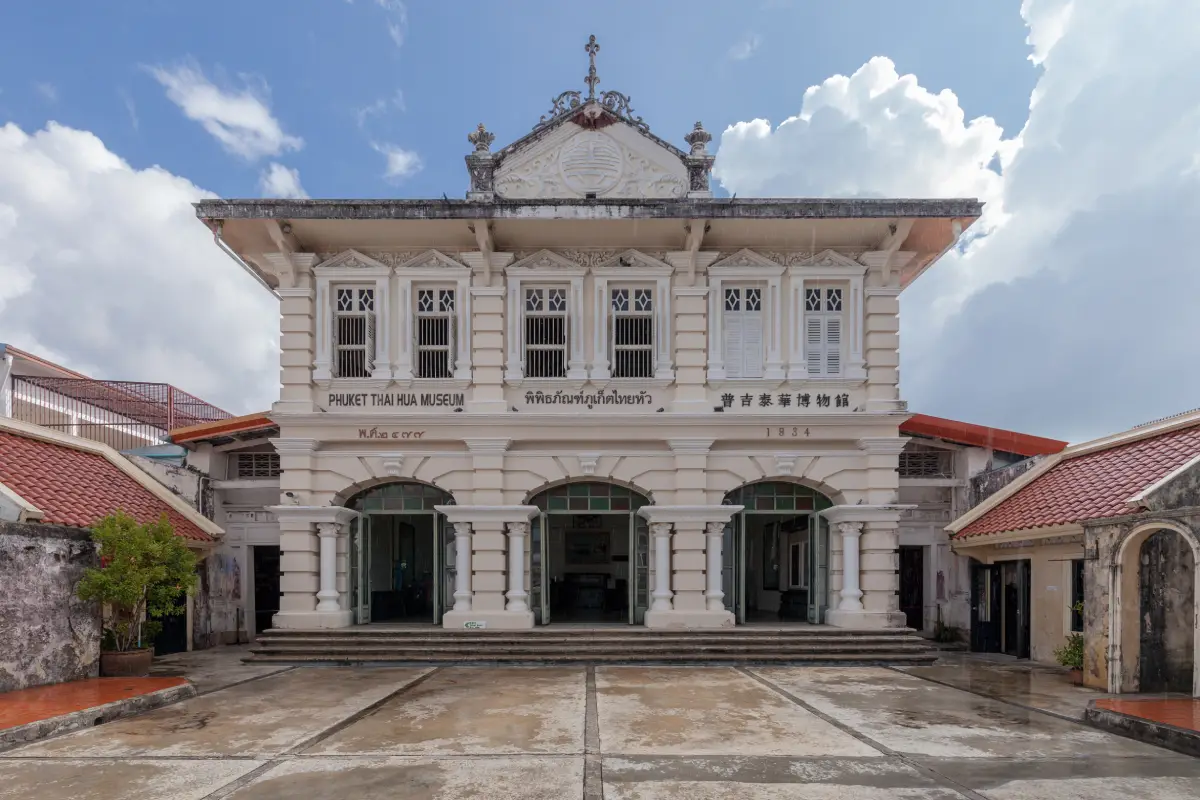
Phuket Thai Hua Museum is one of the most important cultural museums in Phuket Old Town. Located at 28 Krabi Road, Talat Nuea Subdistrict, Mueang Phuket District, the museum occupies a beautifully preserved Sino-Portuguese building that was once the first Chinese-language school in Phuket. The school was founded by early Hokkien Chinese immigrants who settled on the island and wanted their children to learn language, culture, morality, and community values while growing up as part of Thai society.
The museum building is one of the most recognizable heritage landmarks on Krabi Road. The present structure was built in 1934 and opened as a school building on 1 October 1934. Its two-storey form, arched entrances, shuttered windows, columns, decorative plasterwork, and soft-colored facade reflect the Sino-Portuguese architectural style that defines Phuket Old Town. The building was later restored and adapted into a museum so that the story of Phuket’s Chinese community, education, local culture, and urban development could be preserved for future generations.
The value of Phuket Thai Hua Museum is not only in its architecture. It helps visitors understand that Phuket did not grow from tourism alone. The island was shaped by tin mining, sea trade, Chinese migration, Hokkien communities, Baba-Peranakan culture, local education, religious practices, and the gradual blending of different peoples and traditions. A visit here gives deeper meaning to a walk through Phuket Old Town, because the museum explains the people and historical forces behind the buildings, food, shrines, and streets around it.
The name “Thai Hua” reflects the relationship between Thai and Chinese identities in Phuket. In the past, this school gave the children of Chinese families a place to learn language and cultural values while becoming part of the wider Phuket community. Education at Thai Hua was not only about literacy. It also emphasized virtue, discipline, social responsibility, and a philosophy of life. This educational spirit remains one of the museum’s strongest messages.
One of the most meaningful symbols on the building is the red bat decoration on the front gable. In Chinese belief, the bat is associated with good fortune, while red is linked with auspiciousness. On a school building, the bat with outstretched wings also suggests an open book. The symbol therefore expresses the idea that literacy and education are great blessings. This small architectural detail turns the building into a statement about the value that Phuket’s Chinese community placed on learning.
Inside the building, visitors enter a wide central hall with rooms on the left and right wings. A staircase leads to the upper floor, where a balcony surrounds the open interior space and looks down toward the ground floor. The design creates natural ventilation, soft light, and a sense of openness. It also shows how heritage buildings in Phuket were designed to suit the tropical climate while maintaining elegance and civic dignity.
The upper floor remains connected with the building’s educational past, while the lower floor is used for permanent and rotating exhibitions related to Phuket history, arts, and culture. In the front courtyard, old photographs of the school help visitors imagine the building as a living educational institution before it became a museum. These photographs preserve the faces, uniforms, classrooms, ceremonies, and school memories of many generations.
The exhibitions tell the story of Hokkien Chinese immigrants who came to Phuket for work, trade, and settlement. Visitors learn about their journey across the sea, their role in the tin-mining economy, their family life, their occupations, their shrines, their associations, and their contribution to the island’s development. The story is not only one of migration. It is also a story of resilience, adaptation, hard work, and the building of a new home in Phuket.
Tin mining is one of the key historical themes behind the museum. Before Phuket became a global tourism destination, tin shaped the island’s economy and society. Mining brought workers, merchants, capital, technology, and Chinese communities to the island. It also influenced architecture, education, food, charity networks, and urban development. Understanding the Hokkien Chinese story at Thai Hua therefore means understanding Phuket’s mining past as well.
The museum also explains the relationship between Chinese settlers and local Phuket society. Over time, different communities lived together and created a multicultural island identity. This can be seen in food, clothing, festivals, wedding traditions, shrine worship, household customs, and the architecture of Phuket Old Town. Phuket is not culturally one-dimensional; it is a place where Chinese, Thai, Malay, and Western influences combined into a distinct local identity.
Baba-Peranakan culture is another important theme. Visitors can learn about traditional dress, jewelry, family life, food culture, and social customs that developed from the blending of Chinese and local cultures in the region. Baba and Yaya clothing is not only beautiful; it also reflects class, family status, education, taste, and social relationships in old Phuket.
Food culture is also part of the museum’s story. Many Phuket dishes have Hokkien Chinese roots adapted with local ingredients and southern Thai flavors. Dishes and snacks such as Hokkien noodles, moo hong, o-aew, lo ba, local sweets, and vegetarian festival food help explain Phuket through the kitchen. Food is one of the easiest ways to see how migration, family memory, and local ingredients became part of the island’s cultural identity.
Festivals and rituals are another important part of the museum experience. The Phuket Vegetarian Festival, Moon Festival, Baba wedding traditions, and other cultural activities show how Phuket’s Chinese heritage remains active today. The museum is not only a place for old objects; it also works as a cultural space for events, exhibitions, and activities that keep local heritage connected with the present community.
The museum also highlights important Phuket figures, including educators, community leaders, benefactors, mining-era families, and people who supported schools, shrines, hospitals, associations, and public works. These stories show that Phuket’s development was not created by one person. It was built through networks of families, teachers, merchants, donors, and community organizations.
Phuket Thai Hua Museum is also one of the best places to understand Sino-Portuguese architecture before walking through the rest of Phuket Old Town. After seeing the building’s arches, columns, shutters, plasterwork, air vents, and internal layout, visitors will better understand similar buildings on Thalang Road, Dibuk Road, Phang Nga Road, and Soi Rommani. The museum makes the surrounding streets easier to read.
The exhibitions use old photographs, documents, books, objects, and multimedia to make the history accessible. Visitors can move from Chinese migration to tin mining, from education to family life, from Baba culture to food, from festivals to Phuket’s economic transition through mining, rubber, and tourism. This makes the museum suitable for general travelers, students, researchers, writers, and anyone interested in local history.
For visitors interested in educational history, the museum is especially meaningful. Thai Hua represents a community that valued education as a long-term investment. The Chinese ancestors who built the school were not only trying to earn a living in Phuket; they also wanted their children to learn, behave well, and contribute to society. The building is therefore a physical reminder of community sacrifice and foresight.
Visitors should allow about 1 to 2 hours to explore the museum properly. This gives enough time to photograph the building, walk through the central hall, read the exhibition panels, view old photographs, and connect the museum’s stories with the surrounding old town streets. Popular photo points include the front facade, the entrance hall, the staircase, the upper balcony, and selected exhibition rooms. Visitors should follow museum photography rules and avoid touching displayed objects.
The museum’s location makes it easy to combine with other places in Phuket Old Town. Nearby attractions include Soi Rommani, Thalang Road, Chinpracha House, Museum Phuket, the Shrine of the Serene Light, Pud Jor Shrine, Jui Tui Shrine, Khao Rang, and many local restaurants. Starting at Thai Hua Museum before walking through the old town gives the route a clearer historical context.
Getting There is easy from within Phuket Old Town, where visitors can walk or use local transport. From Phuket International Airport, take Thepkasattri Road toward Phuket Town; the drive usually takes about 45 to 60 minutes depending on traffic. From Patong Beach, travel through Kathu or Wichit Songkhram Road toward Phuket Town, usually taking about 35 to 50 minutes. Drivers should allow extra time for parking because Krabi Road and the old town streets can be busy and narrow.
The best time to visit depends on the visitor’s purpose. Morning or late afternoon is good for exterior photography, while weekday mornings are often better for a quieter museum visit. Groups, schools, researchers, or visitors who need guided interpretation should contact the museum before arrival. Planning ahead is useful, especially during weekends, public events, and Phuket Old Town festivals.
Phuket Thai Hua Museum adds depth to cultural travel in Phuket. Once visitors understand the Hokkien Chinese community, tin mining, education, Baba culture, local food, and Sino-Portuguese architecture, the old town becomes more than a photogenic district. It becomes a living historical landscape shaped by families, schools, shrines, trade, and shared memory.
In summary, Phuket Thai Hua Museum is an essential stop for anyone who wants to understand Phuket beyond beaches and shopping. Its 1934 Sino-Portuguese building, red bat symbol, Chinese school history, exhibitions on Hokkien settlers, Baba culture, food traditions, festivals, tin mining, rubber, and tourism make it one of the most meaningful cultural landmarks in Phuket Old Town.
| Name | Phuket Thai Hua Museum |
| Location | Krabi Road, Phuket Old Town, Talat Nuea Subdistrict, Mueang Phuket District, Phuket Province |
| Address | 28 Krabi Road, Talat Nuea Subdistrict, Mueang Phuket District, Phuket 83000, Thailand |
| Coordinates | 7.8882876086, 98.3905995739 |
| Highlights | A 1934 Sino-Portuguese building, former Chinese-language school, Hokkien Chinese heritage exhibitions, Baba-Peranakan culture, tin-mining history, Phuket food culture, local festivals, and old photographs of Phuket |
| History | The building was originally used as a Chinese school and opened as a school building on 1 October 1934. It was later restored and adapted into a community museum and cultural learning center. |
| Symbol Meaning | The red bat decoration on the front gable symbolizes good fortune and the belief that literacy and education are great blessings. |
| Building Features | A two-storey Sino-Portuguese building with a central hall, side wings, staircase, upper balcony, arched entrances, shuttered windows, and decorative plasterwork |
| Main Areas / Zones | Central hall, Hokkien Chinese history exhibitions, Thai Hua school history, tin-mining displays, Baba-Peranakan culture displays, food culture displays, festival exhibitions, old photograph area, and cultural activity spaces |
| Travel Information | Located within walking distance of Phuket Old Town. From Phuket International Airport, the drive usually takes about 45 – 60 minutes. From Patong, the journey usually takes about 35 – 50 minutes depending on traffic. |
| Current Status | Open as a museum and community learning center in Phuket Old Town |
| Open Days | Daily |
| Opening Hours | 09.00 – 17.00 |
| Admission Fee | Thai adults 50 baht / Thai children and students 25 baht Foreign adults 200 baht / Foreign children 120 baht |
| Suggested Visit Duration | About 1 – 2 hours |
| Facilities | Exhibition rooms, activity areas, old photograph displays, souvenir area, and indoor rest spaces |
| Caretaker / Related Organization | Phuket Thai Hua Museum and Phuket Kusonsongkhroh Foundation |
| Main Contact Number | 076-211-224 |
| Nearby Tourist Attractions | 1. Phuket Old Town, about 0.2 km 2. Soi Rommani, about 0.3 km 3. Chinpracha House, about 0.4 km 4. Shrine of the Serene Light, about 0.5 km 5. Museum Phuket, about 0.5 km 6. Jui Tui Tao Bo Keng Shrine, about 0.7 km 7. Khao Rang, about 2.5 km |
| Nearby Restaurants | 1. The Charm Dining Gallery, about 0.2 km, Tel. 076-530-199 2. Kopitiam by Wilai, about 0.3 km, Tel. 083-606-9776, 081-895-4278, 081-892-3723 3. One Chun, about 0.8 km, Tel. 076-355-909 4. Raya, about 0.9 km, Tel. 076-218-155, 092-252-4883 5. Tu Kab Khao, about 1 km, Tel. 076-608-888 6. Torry’s Ice Cream, about 0.3 km, Tel. 076-510-888 |
| Nearby Accommodations | 1. Hotel Midtown Ratsada, about 0.5 km, Tel. 091-915-4945-7 2. The Memory at On On Hotel, about 0.6 km, Tel. 076-363-700 3. Casa Blanca Boutique Hotel, about 0.7 km, Tel. 076-219-019 4. Courtyard by Marriott Phuket Town, about 1.3 km, Tel. 076-643-555 5. Royal Phuket City Hotel, about 1.5 km, Tel. 076-233-355 6. Blu Monkey Hub & Hotel Phuket, about 1.5 km, Tel. 076-354-266 |
Frequently Asked Questions (FAQ)
Q: Where is Phuket Thai Hua Museum located?
A: Phuket Thai Hua Museum is located at 28 Krabi Road, Talat Nuea Subdistrict, Mueang Phuket District, Phuket, in the heart of Phuket Old Town.
Q: Why is Phuket Thai Hua Museum important?
A: The museum was once Phuket’s first Chinese-language school and now tells the story of Hokkien Chinese settlers, Baba-Peranakan culture, tin mining, local food, festivals, and Phuket’s cultural development.
Q: What are the opening days and hours?
A: The museum opens daily from 09.00 to 17.00.
Q: How much is the admission fee?
A: Thai adults pay 50 baht, and Thai children or students pay 25 baht. Foreign adults pay 200 baht, and foreign children pay 120 baht.
Q: What can visitors see inside the museum?
A: Visitors can see exhibitions about Hokkien Chinese migration, Thai Hua school history, tin mining, Baba-Peranakan culture, local food, festivals, Sino-Portuguese architecture, and old photographs of Phuket.
Q: How long should visitors spend at Phuket Thai Hua Museum?
A: Visitors should allow about 1 to 2 hours to explore the building, read the exhibitions, take photos, and connect the museum’s story with Phuket Old Town.
Q: What does the red bat symbol on the building mean?
A: The red bat is an auspicious Chinese symbol. On this former school building, it expresses the idea that literacy and education are great blessings.
Q: What nearby places can be visited with the museum?
A: Nearby places include Phuket Old Town, Soi Rommani, Chinpracha House, Museum Phuket, the Shrine of the Serene Light, Jui Tui Shrine, Khao Rang, and local restaurants around the old town.
 Category: ●Art, Culture and Heritage
 Group: ●Museums
Last Update : 2 MonthAgo
 Last Update : 2 MonthAgo

 Click to Access the Navigation Map GPS
Phuket Thai Hua Museum Map
Recommend

 Landmarks and Memorials(7)
 Art, Craft Centres, Tradition(5)
Museums(4)
 Historic Homes and Cities(1)
 Art Gallery(1)
 Educational Places
 Educational Gardens, Farm(2)
 Places of Worship
 Temple(14)
 Mosque(47)
 Other Sacred Sites(15)
 Suburban Living
 Village, Community(2)
 Floating Market(1)
 Nature and Wildlife
 National Parks and Marine Reserves(2)
 Mountain (Doi)(2)
 Dam, Reservoir, Lake(1)
 Waterfalls(4)
 Bays and Beaches(30)
 Islands(12)
 Other natural attractions(10)
 Entertainment and Agricultural
 Zoos and Aquariums(2)
 Stadium(2)
 Farms, Parks and Ecotourism(4)
 Amusement Park(2)
 Waterpark(6)
 Theater(1)
 Outdoor and Adventure Activities(1)
 Shopping
 Shopping and Night Market(1)
 Travel Articles, Recipes
 Travel Review, Food Review(1)
 Southern Food Menu, Southern Food Recipes(5)


