
lovethailand home >South Travel Attractions >Phuket Travel Attractions >Thalang >Si Sunthon > Tha Ruea City Pillar Shrine (Mae Duang City Pillar..
TL;DR: Tha Ruea City Pillar Shrine (Mae Duang City Pillar Shrine) is located at 229 Soi Lak Mueang 1, Ban Tha Ruea, Si Sunthon Subdistrict, Thalang District, Phuket Province 83110, Thailand, open Open for General Worship.
Tha Ruea City Pillar Shrine (Mae Duang City Pillar Shrine)
Open Days: Open for General Worship
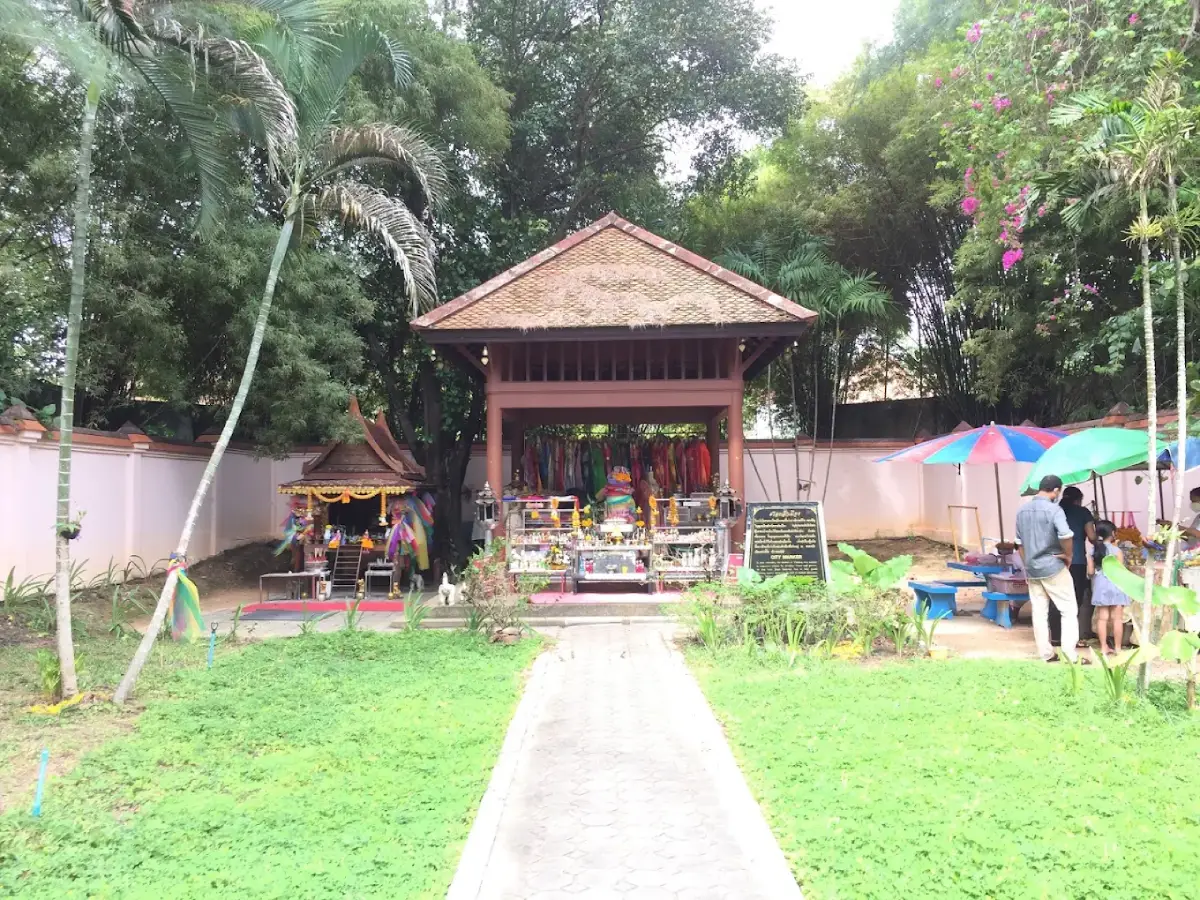
Tha Ruea City Pillar Shrine, also known as Mae Duang City Pillar Shrine, Phuket, is a historic sacred landmark associated with the beliefs and cultural heritage of the Ban Tha Ruea community. It is located at 229 Soi Lak Mueang 1, Si Sunthon Subdistrict, Thalang District, Phuket Province 83110, Thailand. The shrine is one of several historic city pillar sites revered by communities in the former Thalang area. Its distinctive local tradition centers on Mae Duang, a female guardian believed to protect the sacred city pillar and the surrounding community. The shrine is housed in a traditional Thai pavilion with a two-tiered roof, ornamental chofa and bai raka roof decorations, and a gable featuring a kneeling celestial figure with hands joined in respect. Inside are the sacred pillar, offerings, and a small one-person rowing boat with a paddle connected to a local legend. The building faces east and includes marble flooring and decorative surfaces. Its importance extends beyond worship, as it is closely associated with Ban Tha Ruea's former role in waterborne transport and commerce in historic Thalang.
The shrine stands in an area whose name preserves the geographical and economic character of an earlier period. Tha Ruea means a pier or boat landing, recalling the community's former connection with boats, waterways, and commercial transportation before modern roads became the dominant means of movement across Phuket. The place name itself therefore forms part of the area's cultural history and indicates the importance of maritime connections to the development of the settlement.
Mae Duang City Pillar Shrine is distinctive because it belongs to an older local tradition of sacred civic sites rather than the model of a large contemporary city pillar shrine established beside a modern government center. Phuket is associated with several historic city pillar shrines, including Tha Ruea, Mueang Mai, Pa Sak, and Le Phang. Each reflects a different local setting or period of settlement history. Their individual historical accounts should therefore be understood separately.
Ban Tha Ruea lies in Si Sunthon Subdistrict, Thalang District, an area of major importance in the history of Phuket Island. Thalang was once a significant center of administration and maritime commerce, maintaining relationships with other communities around the Malay Peninsula. The later expansion of Phuket Town farther south changed the island's economic and administrative geography, but historic sites in Thalang preserve memories of its earlier importance.
Phuket is a large island in the Andaman Sea, characterized by mountains, valleys, coastal plains, and numerous bays. These geographical features shaped early settlement patterns, with communities developing near water sources and places suitable for fishing, sea travel, and commerce. Maritime transport historically connected island settlements with the mainland and trading ports across the region.
Thalang's history is closely associated with sea routes and trade across the Andaman coast. The exchange of goods and resources among coastal communities contributed to the area's economic development. Later, tin mining became a major influence on Phuket's prosperity. Ban Tha Ruea should consequently be understood as part of a wider network of settlements whose development was connected to changing maritime and commercial activities.
In Thai cultural traditions, a city pillar represents the ceremonial foundation, stability, and symbolic center of a community. Respect for the pillar is associated with beliefs concerning guardian powers, auspiciousness, and the well-being of the town. The specific practices and stories connected with individual shrines vary according to local history and community traditions.
At Tha Ruea, local beliefs are distinguished by the figure of Mae Duang, the female guardian associated with the sacred city pillar. Her name separates the shrine from Mueang Mai City Pillar Shrine, which is associated with Mae Chuang, and Pa Sak City Pillar Shrine, which is linked with Chao Mae Soi Kaeo. These different guardian traditions illustrate the diversity of beliefs preserved among communities in Thalang.
Mae Duang is a name used by local residents to express respect for the guardian of Tha Ruea's city pillar. The tradition belongs to a broader pattern of community guardianship beliefs passed down through oral accounts and household religious practices. For worshippers, the name refers not only to the building but also to the stories, spiritual associations, and inherited memories connected with Ban Tha Ruea.
One of the shrine's best-known legends concerns a small rowing boat kept within the compound. According to local oral tradition, the female guardian appeared in a villager's dream and requested a boat and paddle for traveling. Residents subsequently offered a one-person rowing boat, which became a distinctive feature of the shrine and a symbol of the community's devotion.
The rowing boat provides a particularly meaningful connection between folklore and the historical landscape of Tha Ruea. Because the community was formerly associated with maritime movement and waterways, the appearance of a boat in the legend reflects an object familiar to people whose lives depended on water transport. The offering therefore links a spiritual story with the practical experience of earlier generations.
The story of Mae Duang's boat is a local legend rather than a documented historical event with a verifiable date. Its cultural importance lies in the way it expresses relationships between people, sacred places, and their surrounding environment. Such oral traditions are valuable for understanding how communities interpret their own histories.
Tha Ruea City Pillar Shrine is frequently described in local accounts as one of Phuket's oldest sacred city pillar sites. Some traditions regard it as the island's earliest city pillar shrine. However, the date of the original structure has not been firmly established through published historical documentation. The age of the community and its maritime history should not be confused with the construction date of the shrine building visible today.
Understanding the shrine requires consideration of several connected subjects: the former settlement, waterborne commerce, beliefs surrounding Mae Duang, and the architecture of the pavilion. Its value does not depend on assigning an exceptionally ancient date to the building. Rather, it lies in the continuity of local respect for a place that has remained meaningful within the community.
Historical Thalang experienced changes in settlement and administrative organization as transport routes and political conditions evolved. The presence of several city pillar shrines reflects different stages of this development. Tha Ruea is associated with a community once connected with water transport, while Mueang Mai preserves traditions relating to the restoration of Thalang during the early Rattanakosin period. Pa Sak and Le Phang are associated with their own local communities and guardian beliefs.
Looking at all four shrines reveals that the city pillar tradition in Phuket cannot be reduced to one building or one historical episode. Instead, it forms part of the changing landscape of settlement and authority in Thalang. Preserving the individual shrines helps maintain knowledge of the island's historical geography and distinctive community traditions.
Architecturally, Tha Ruea City Pillar Shrine takes the form of a traditional Thai pavilion with a two-tiered roof. Its upper sections feature chofa and bai raka decorations characteristic of traditional Thai architecture. These ornaments create an elegant roofline, while the pavilion provides an appropriate setting for the sacred pillar and the offerings of worshippers.
The front gable is decorated with a celestial figure in the thepphanom posture, shown with hands joined in respect. Such imagery is familiar in Thai sacred and ceremonial buildings. Its inclusion emphasizes the religious and spiritual character of the shrine and connects the exterior decoration with the acts of reverence performed inside.
The chofa and bai raka ornaments are important parts of the decorative roof system known as the khrueang lamyong. Chofa ornaments appear near the ends of the roof ridge, while bai raka elements accent the sloping roof edges. Together, they give the pavilion the refined silhouette associated with traditional Thai ceremonial architecture.
Marble has been used on the flooring and parts of the pavilion's columns. Its smooth surface contributes to the dignified appearance of the sacred space and reflects natural light. The use of marble also helps distinguish the central worship area and emphasizes the importance of the pillar housed inside.
Another distinctive feature is the building's east-facing orientation. Local historical descriptions record this direction as part of the shrine's architectural character. It also distinguishes Tha Ruea from Mueang Mai City Pillar Shrine, which faces west. The difference illustrates how the individual historic shrines developed distinct arrangements rather than following one identical plan.
Inside the pavilion, the city pillar occupies the central worship area, with space for traditional offerings. Devotees may present flowers, incense, candles, and other customary items in accordance with local practices. The rowing boat and paddle associated with the Mae Duang legend are especially meaningful because they distinguish the shrine from other city pillar sites.
The position of the pillar reflects traditional beliefs concerning the sacred center of a settlement. Paying respect to it is an expression of devotion to the protective powers associated with the community. It also allows residents to maintain a symbolic connection with the history of Ban Tha Ruea.
Local traditions connect Mae Duang with wishes concerning careers, personal relationships, and family well-being. A particularly distinctive belief concerns prayers for a son. Such accounts reflect the personal hopes of worshippers and the role of the shrine in everyday community life.
The belief about praying for a son is part of local spiritual tradition and does not constitute a medical claim about fertility or the sex of a child. Its cultural importance lies in the way it reflects the wishes, stories, and practices of people who have visited the shrine over generations.
Some worshippers also pray for progress at work and success in business. These interests are consistent with the historical character of Tha Ruea as a community connected with commerce and transport. The shrine consequently remains associated with both personal well-being and the activities through which people earn their living.
Mae Duang City Pillar Shrine is a place of worship based on local guardian traditions, not a Buddhist monastery. It therefore has no resident abbot. Wat Tha Ruea, a Buddhist temple in the same community, has a different religious role, although the two places are connected through the history of Ban Tha Ruea.
Wat Tha Ruea is an important Buddhist temple in Si Sunthon. Temple records give its establishment date as April 5, 1787. It developed within a community associated with Thalang's earlier routes of trade and transport. The temple was formerly known as Wat Nok, or the outer temple, in distinction from another local temple known as Wat Nai. Wat Nok was later restored and developed into the present Wat Tha Ruea.
The temple's ordination hall is an important religious building featuring marble decoration and carved doors and windows illustrating the Vessantara Jataka. This Buddhist story focuses on generosity and moral perfection. The principal Buddha image has a lap width of approximately three meters. These artistic features give the temple importance for both religious worship and traditional Buddhist craftsmanship.
The relationship between Wat Tha Ruea and Mae Duang City Pillar Shrine demonstrates how different sacred institutions can exist within the same community. The temple supports Buddhist religious life, while the city pillar shrine represents local traditions concerning the guardian of the settlement. Their histories together provide a richer understanding of Ban Tha Ruea's cultural heritage.
Another significant religious landmark in the area is Tha Ruea Chinese Shrine, also known as Hok Leng Keng. It stands along Thepkasattri Road and is noted for its Chinese architectural style, with red, green, and gold decoration and elaborate dragon ornaments. The shrine plays an important part in Phuket's annual Vegetarian Festival. It is a separate place from Mae Duang City Pillar Shrine.
Hok Leng Keng is associated with devotion to Po Seng Tai Te, a deity revered in Chinese religious traditions for healing and medicine. According to the community's history, worshippers gradually developed a shrine for the deity and later expanded the building. Road improvements along Thepkasattri Road contributed to another phase of reconstruction, resulting in the larger Chinese-style shrine visible today.
The presence of Mae Duang City Pillar Shrine, Wat Tha Ruea, and Hok Leng Keng within Ban Tha Ruea creates a diverse cultural landscape. Each has a distinct function: the city pillar shrine is associated with a local guardian, the Buddhist temple with monastic worship, and Hok Leng Keng with Hokkien Chinese religious traditions and Vegetarian Festival ceremonies.
This cultural diversity reflects the wider history of Phuket, where maritime trade and successive periods of migration brought communities of different backgrounds together. Thai and Thai-Chinese residents contributed to commerce, tin mining, settlement development, and religious life. Preserving their different sacred places helps make the island's complex history visible.
Mae Duang City Pillar Shrine is particularly significant for the study of Thalang's traditional guardian beliefs because its protective figure is understood as female and is remembered by a personal name. Similar traditions can be found at other local shrines. The name Mae Duang gives the site a distinctive identity and remains an important part of how residents recognize and remember it.
The continuation of the boat legend and other stories about Mae Duang demonstrates that sacred places are preserved through more than their buildings. Oral traditions also carry cultural meaning from one generation to the next. Such beliefs and stories form part of the intangible heritage of the community.
The shrine can be connected with several important historical attractions in the wider Thalang area. One is the Two Heroines Monument, dedicated to Thao Thep Krasattri and Thao Si Sunthon. Standing at a major road junction, the monument commemorates the two heroines' role in defending Thalang and remains an important symbol of Phuket's historical identity.
The history of the Two Heroines is central to the collective memory of Phuket, particularly the defense of Thalang during the early Rattanakosin period. Their story continues to be remembered through monuments, museums, commemorative ceremonies, and educational programs throughout the province.
Thalang National Museum is another major historical attraction. It presents the history, archaeology, and cultural heritage of Phuket and the Andaman coast. Its collections and exhibitions provide a broader historical context for understanding the settlements and cultural traditions associated with the old Thalang area.
Mueang Mai City Pillar Shrine is associated with the reestablishment of Thalang during the early Rattanakosin period. It is located at Ban Mueang Mai near Thepkasattri Road and is linked with the guardian figure Mae Chuang. Its west-facing pavilion differs in layout and historical associations from Tha Ruea City Pillar Shrine.
Pa Sak City Pillar Shrine, associated with Chao Mae Soi Kaeo, is situated in Choeng Thale Subdistrict of Thalang District. It is another surviving expression of local guardian beliefs and reflects the importance of the Pa Sak community within the history of the region.
Le Phang City Pillar Shrine is also mentioned among the historic city pillar sites of Thalang. The existence of several such shrines reveals a more complex settlement history than might be suggested by the island's present-day tourist districts. Studying them together provides insight into older centers of community life.
Si Sunthon and Thalang also offer a wide range of local Phuket food. Phuket cuisine combines southern Thai ingredients with influences from Hokkien Chinese communities. Well-known dishes include Hokkien noodles, rice vermicelli with pork-bone broth, southern Thai khanom chin, moo hong braised pork, and seafood prepared with local spices. These food traditions reflect the island's trading history and cultural diversity.
Khanom Chin Lak Mueang Tha Ruea is a small local restaurant near the city pillar shrine, serving rice noodles with strongly flavored southern Thai curry sauces and vegetable accompaniments. Its location in Si Sunthon makes it a convenient place for visitors to experience a familiar local meal within the same neighborhood.
Krua Phraya Phuket is located in Soi Hua Tha in Ban Tha Ruea. The restaurant serves traditional Phuket food in a home-and-garden setting. It reflects the continued importance of regional cooking within a community known for its mixture of historic religious landmarks and residential neighborhoods.
Other dining options in the wider Si Sunthon area include Kin Kub Ee on Si Sunthon Road, known for southern Thai food, and Lamphao Boat Noodles in the Manik neighborhood, serving halal boat noodles. JC Tom Yum Phuket in Pa Klok is another halal noodle option within the wider Thalang district. These establishments demonstrate the range of food traditions available across the area.
Visitors staying in Thalang can choose accommodation near Thepkasattri Road and the Two Heroines Monument, with road connections to Tha Ruea and nearby cultural attractions. Tour De Phuket Hotel is one established property in Si Sunthon, offering guest rooms and facilities for travelers. Smaller rental accommodation is also available within the Ban Tha Ruea community.
Additional accommodation along the wider road corridor includes Supicha Pool Access Hotel in Ko Kaeo and other properties in Thalang. Staying in this part of Phuket provides access to attractions in the island's northern and eastern districts, including the historic city pillar shrines and Thalang National Museum.
Getting There: Tha Ruea City Pillar Shrine, or Mae Duang City Pillar Shrine, is at 229 Soi Lak Mueang 1, Si Sunthon Subdistrict, Thalang District, Phuket Province 83110, Thailand. From Phuket Town, travel north along Thepkasattri Road toward Thalang and the Two Heroines Monument, then enter the Ban Tha Ruea neighborhood and continue to Soi Lak Mueang 1. The destination should be distinguished from Hok Leng Keng Chinese Shrine, which stands beside the main road.
Travelers approaching from northern Phuket can follow Thepkasattri Road south toward Si Sunthon and turn into the Ban Tha Ruea neighborhood. Those traveling from Choeng Thale can use the connecting roads toward the Two Heroines Monument before entering the community streets. Access is therefore based on Thalang's main road network and smaller local roads.
A historical journey through Thalang can connect Mae Duang City Pillar Shrine with Wat Tha Ruea, Hok Leng Keng Chinese Shrine, the Two Heroines Monument, and Thalang National Museum. These destinations represent different aspects of the area's heritage: local guardian beliefs, Buddhism, Hokkien Chinese traditions, the defense of Thalang, and the broader archaeology and history of Phuket.
Viewed within the history of Thalang, Mae Duang City Pillar Shrine is a landmark connecting older geographical conditions with community memory. The rowing boat associated with its legend recalls an age when water transport was fundamental to life, while the Thai pavilion preserves a recognizable form of sacred local architecture.
The shrine remains significant because residents continue to remember Mae Duang and the stories associated with her. Although the original construction date has not been firmly established, the existence of the shrine in Ban Tha Ruea demonstrates the continuity of local beliefs amid major changes in transportation, commerce, and settlement patterns.
Mae Duang City Pillar Shrine also reflects Phuket's cultural diversity. Ban Tha Ruea contains a Buddhist temple, a local city pillar shrine, and a Chinese religious shrine, all associated with different traditions of worship. Together, they preserve local history through buildings, oral accounts, and religious practices, rather than through written documents or museum artifacts alone.
With its two-tiered Thai roof, celestial gable decoration, sacred city pillar, and small rowing boat connected to the Mae Duang legend, Tha Ruea City Pillar Shrine is an important place for understanding the cultural identity of historic Thalang. The traditions of its female guardian, memories of maritime travel, and proximity to other significant heritage sites make it a meaningful part of the cultural landscape of Phuket.
| Place Name | Tha Ruea City Pillar Shrine (Mae Duang City Pillar Shrine) |
| Address | 229 Soi Lak Mueang 1, Ban Tha Ruea, Si Sunthon Subdistrict, Thalang District, Phuket Province 83110, Thailand |
| Coordinates | 7.978927, 98.369041 |
| Attraction Type | Historic City Pillar Shrine and Local Guardian Worship Site |
| Historical Importance | One of the Historic City Pillar Shrines of Thalang, Located in a Former Community Associated with Water Transport and Maritime Commerce |
| Foundation History | An Established Sacred Site of Ban Tha Ruea; the Original Construction Date Has Not Been Definitively Established |
| Main Guardian | Mae Duang, the Female Guardian of the City Pillar in Local Tradition |
| Local Legend | Mae Duang Is Said to Have Appeared in a Villager's Dream and Requested a Rowing Boat, Leading to the Offering of a One-Person Boat and Paddle |
| Architecture | Traditional Thai Pavilion with a Two-Tiered Roof, Chofa and Bai Raka Ornaments, a Thepphanom Gable, and Marble Flooring and Columns |
| Building Orientation | East-Facing |
| Main Features | 1. Traditional Thai Pavilion 2. Sacred City Pillar 3. Traditional Offering Area 4. One-Person Rowing Boat and Paddle 5. Thepphanom Gable and Ornate Roof Decorations 6. Marble Flooring and Columns 7. Entrance and Courtyard |
| Traditional Blessings | Career Progress, Relationships, Family Well-Being, and a Local Belief Associated with Praying for a Son |
| Religious Administration | A Local Guardian Shrine of Ban Tha Ruea, Not a Buddhist Monastery; No Abbot |
| Different Nearby Shrine | Hok Leng Keng Chinese Shrine at 169 Thepkasattri Road Is a Separate Religious Site |
| Visiting Status | Listed as Open to Visitors; No Official Daily Building Hours Published by the Shrine's Caretaker |
| Getting There | Follow Thepkasattri Road toward Ban Tha Ruea in Si Sunthon, then Continue into Soi Lak Mueang 1 |
| Nearby Historical Attractions | 1. Wat Tha Ruea – Ban Tha Ruea, Si Sunthon 2. Hok Leng Keng Chinese Shrine – 169 Thepkasattri Road 3. Two Heroines Monument – Main Road Junction, Thalang 4. Thalang National Museum – Thalang District 5. Mueang Mai City Pillar Shrine – Ban Mueang Mai, Thep Krasattri 6. Pa Sak City Pillar Shrine – Choeng Thale, Thalang |
| Restaurants in Tha Ruea and Surrounding Areas | 1. Khanom Chin Lak Mueang Tha Ruea – Si Sunthon, Near the Shrine 2. Krua Phraya Phuket – Soi Hua Tha, Ban Tha Ruea, Tel. +66 83 138 6789 3. Kin Kub Ee – Si Sunthon Road, Tel. +66 95 428 7195 4. Lamphao Boat Noodles – Manik, Si Sunthon, Tel. +66 63 693 6694 5. JC Tom Yum Phuket – Pa Klok, Tel. +66 96 949 9197 6. Krua Song Yai – Bo Kruat Road, Thalang, Tel. +66 81 017 4007 |
| Accommodations in Thalang and Connected Areas | 1. Tour De Phuket Hotel – Moo 3, Si Sunthon, Tel. +66 76 689 797 2. Tha Ruea Hongpak – Si Sunthon, Tel. +66 89 728 9076 3. Supicha Pool Access Hotel – Ko Kaeo, Tel. +66 76 685 350 4. Puean Chang Resort Phuket – Thalang District 5. Anda Fa Mai Apartment – Thep Krasattri, Tel. +66 83 182 2246 |
| Current Status | Appears in Current Visitor Listings as Open, with No Identified Permanent Closure Notice |
Frequently Asked Questions (FAQ)
Q: Where is Tha Ruea City Pillar Shrine located?
A: It is located at 229 Soi Lak Mueang 1, Ban Tha Ruea, Si Sunthon Subdistrict, Thalang District, Phuket Province 83110, Thailand.
Q: Is Mae Duang City Pillar Shrine the same place as Tha Ruea Chinese Shrine?
A: No. Mae Duang City Pillar Shrine is a historic local city pillar shrine, while Hok Leng Keng is a separate Chinese shrine on Thepkasattri Road.
Q: Who is Mae Duang?
A: Mae Duang is the female guardian associated with Tha Ruea City Pillar Shrine according to local tradition.
Q: Why is there a rowing boat at the shrine?
A: According to local legend, Mae Duang appeared in a villager's dream and requested a boat for traveling. A small boat and paddle were subsequently offered at the shrine.
Q: When was Tha Ruea City Pillar Shrine originally built?
A: It is a historic sacred landmark of the Thalang area, but its original construction date has not been definitively established.
Q: What are the shrine's architectural features?
A: It is an east-facing traditional Thai pavilion with a two-tiered roof, chofa and bai raka decorations, a thepphanom gable, and marble finishes.
Q: What do worshippers traditionally pray for?
A: Local beliefs concern career advancement, relationships, family well-being, and the wish for a son. These are spiritual traditions rather than guaranteed outcomes.
Q: Does Mae Duang City Pillar Shrine have an abbot?
A: No. It is a local guardian shrine, not a Buddhist monastery. Wat Tha Ruea is a separate Buddhist temple in the same community.
 Category: ●Places of Worship
 Group: ●Other Sacred Sites
Last Update : 5 DayAgo
 Last Update : 5 DayAgo
 Click to Access the Navigation Map GPS
Tha Ruea City Pillar Shrine (Mae Duang City Pillar Shrine) Map
Recommend

 Art, Culture and Heritage
 Landmarks and Memorials(7)
 Art, Craft Centres, Tradition(5)
 Museums(4)
 Historic Homes and Cities(1)
 Art Gallery(1)
 Educational Places
 Educational Gardens, Farm(2)
 Temple(14)
 Mosque(47)
Other Sacred Sites(15)
 Suburban Living
 Village, Community(2)
 Floating Market(1)
 Nature and Wildlife
 National Parks and Marine Reserves(2)
 Mountain (Doi)(2)
 Dam, Reservoir, Lake(1)
 Waterfalls(4)
 Bays and Beaches(30)
 Islands(12)
 Other natural attractions(10)
 Entertainment and Agricultural
 Zoos and Aquariums(2)
 Stadium(2)
 Farms, Parks and Ecotourism(4)
 Amusement Park(2)
 Waterpark(6)
 Theater(1)
 Outdoor and Adventure Activities(1)
 Shopping
 Shopping and Night Market(1)
 Travel Articles, Recipes
 Travel Review, Food Review(1)
 Southern Food Menu, Southern Food Recipes(5)


