
lovethailand home >Northeastern Travel Attractions >Maha Sarakham Travel Attractions >Muang Maha Sarakham >Tha Song Khon > Ban Mo Pottery Village
TL;DR: Ban Mo Pottery Village is located at Ban Mo, Village No. 11, Khwao Subdistrict, Mueang Maha Sarakham District, Maha Sarakham Province, open Daily, hours 08.00 – 17.00.

Ban Mo Pottery Village
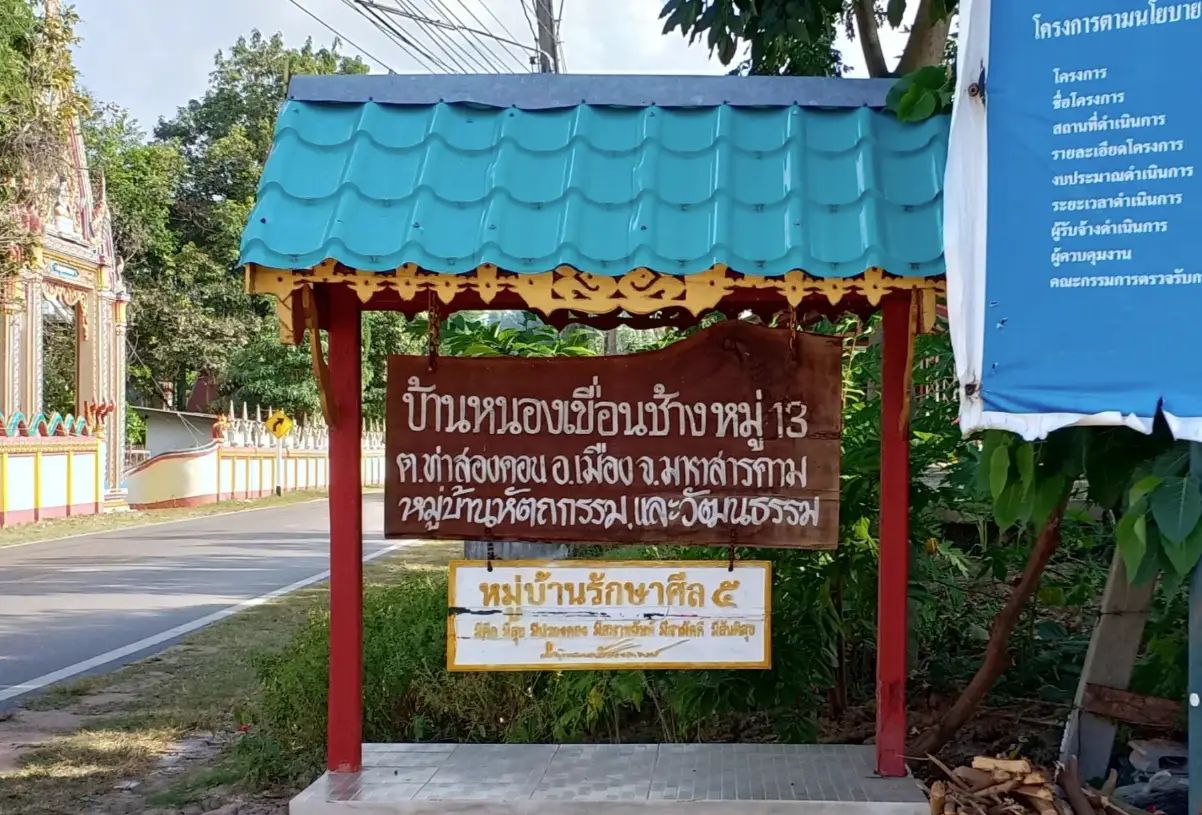
Open Days: Daily
Opening Hours: 08.00 – 17.00
Ban Mo Pottery Village in Maha Sarakham Province is an important traditional craft community in Khwao Subdistrict, Mueang Maha Sarakham District. Officially known as Ban Mo, Village No. 11, the village is widely recognized for its long-standing earthenware pottery tradition. Local people have produced clay pots, water jars, cooking pots, and household vessels for generations. Today, Ban Mo remains a living pottery village where traditional knowledge is still visible in daily work, while new forms of products have also been developed for visitors, collectors, home decoration, and cultural learning.
The charm of Ban Mo Pottery Village is not limited to the finished pottery. Its real value lies in the process, the people, and the knowledge behind each handmade piece. Visitors can see the relationship between clay, water, human hands, drying areas, firing, and accumulated experience. Each clay vessel is not a factory product. It is shaped through careful selection of local clay, kneading, forming, trimming, drying, firing, and checking by skilled artisans. This gives each piece its own character and human touch.
The name Ban Mo literally means “Pot Village”, and it directly reflects the identity of the community. The area contains suitable clay, especially a special dark clay that has long been used by villagers for pottery production. When properly prepared, shaped, and fired, this clay becomes strong household ware suitable for everyday use. The clay itself is therefore one of the community’s most important cultural and economic resources.
The origin story of Ban Mo is connected with the migration of Thai Korat people from Nakhon Ratchasima. The ancestors of the community were skilled in pottery making. When they reached this area and found a landscape with water sources and suitable clay, they settled and began building a village around their craft. From a small number of early families, the community gradually expanded, and pottery became the central occupation that shaped the village’s identity.
In the past, pottery from Ban Mo played an important role in the everyday life of Isan households. Clay water pots helped keep water naturally cool. Clay cooking pots were used for soups and curries. Other earthenware vessels were common in rural kitchens before plastic, aluminum, stainless steel, and industrial ceramics became widespread. These objects were not simply containers; they were part of the food culture, domestic life, and memory of rural northeastern Thailand.
The traditional pottery-making process in Ban Mo still preserves many old techniques. It begins with preparing local clay so that it has the right moisture and texture. The clay must be kneaded until it becomes smooth and workable. Artisans then shape the vessel by hand using simple tools and body rhythm developed through long experience. The shape, wall thickness, balance, and mouth of the pot all matter because they affect both beauty and practical use.
After forming the vessel, artisans trim the surface, refine the rim, correct the shape, and smooth the body. Some pieces must be left until the clay becomes slightly firm before additional work can continue. Knowing when the clay is ready is part of the artisan’s knowledge. Once the vessel is dry enough, it is placed in a drying area and then prepared for firing. The firing stage is crucial because heat, time, and placement in the kiln affect the strength and quality of each piece.
Traditional clay pots have qualities that explain why Isan people used them for so long. They help maintain a natural coolness, provide a warm rural atmosphere, and suit many kinds of local food. Clay cooking ware is also associated with the aroma and texture of traditional cuisine. Although modern materials are now common, many people still value clay vessels for their connection to taste, memory, and the feeling of an old rural kitchen.
Ban Mo has not remained fixed in the past. The community has adapted by producing a wider range of pottery products, including plant pots, decorative items, souvenirs, garden pieces, and smaller products suitable for travelers. This adaptation helps the old craft survive in a changing market. It allows traditional knowledge to continue while responding to contemporary lifestyles and design preferences.
A visit to Ban Mo Pottery Village is suitable for travelers interested in handicrafts, community life, local history, and slow cultural travel. Visitors should not see Ban Mo only as a souvenir stop. It is a living craft village with houses, working areas, artisan families, drying spaces, and production activities that still belong to everyday village life. Walking through the village with attention reveals that local wisdom is not only preserved in museums; it lives in the hands of artisans.
At certain times, visitors or study groups can contact the community enterprise to ask about demonstrations or hands-on pottery activities. Trying to shape clay helps visitors understand the difficulty of the craft. What looks simple when performed by an experienced artisan becomes challenging when done by a beginner. This experience helps visitors appreciate the patience and skill required to make even one well-balanced clay pot.
Ban Mo is also important as a community economy. Pottery allows villagers to create income from local resources. The community uses clay from the area, transforms it through skill, and sells finished products to nearby communities, visitors, and customers from other provinces. The craft supports work close to home, preserves family skills, and strengthens pride in local identity.
Changing times have affected the village. Industrial materials such as plastic, stainless steel, and modern ceramics have reduced everyday demand for traditional clay pots. However, Ban Mo has continued by developing new products, increasing the variety of uses, and welcoming visitors who want to learn about the craft. In this way, pottery is not treated as a dead tradition, but as a living skill that can move with the present.
Culturally, Ban Mo helps complete the picture of Maha Sarakham Province. The province is not only home to temples, ancient sites, and religious landmarks. It also contains living craft communities that reveal the knowledge of ordinary people. Ban Mo pottery reflects household life, farming communities, craft labor, local trade, and the careful use of nearby natural resources. Visiting the village therefore offers a deeper understanding of Maha Sarakham’s cultural landscape.
For travelers interested in local history, Ban Mo can be linked with nearby places in Khwao Subdistrict. Ku Mahathat, also known as Prang Ku Ban Khwao, is an important laterite ancient site in the area. Ban Chiang Hian Museum is another nearby cultural learning place connected with local archaeology and community history. Together, these sites show that Khwao Subdistrict includes craft heritage, ancient remains, temples, museums, and living communities.
Wat Paramaiyikawat, located in Ban Mo, functions as the Buddhist center of the community. Its presence reflects the structure of Isan village life, where houses, temples, occupation, kinship, and local belief remain closely connected. Pottery is therefore not separated from religion or community life; it exists within the same social landscape.
Visitors should allow at least 1 hour for walking around, observing the village, choosing products, and taking photos. Those who want a demonstration or workshop should allow 2 to 3 hours and contact the community in advance. Advance contact is especially useful for school groups, university groups, organized study tours, and foreign travelers who need explanation in a structured format.
Respectful behavior is important because Ban Mo is a living village, not a staged attraction. Visitors should not enter houses or private work areas without permission. Pottery pieces that are still wet or waiting to be fired should not be touched, as they can easily lose shape or break. If visitors want to photograph artisans while they work, they should ask first. Respecting the workspace of the community is essential for responsible cultural tourism.
Buying pottery directly from the village is a practical way to support the community. Each piece carries the cost of labor, time, clay, firing, and skill. Visitors should value handmade pottery differently from factory-made products. When purchasing pottery, it is useful to ask how to care for the item, how to carry it safely, and how to use it properly. This helps the product last longer and preserves the meaning of the craft.
The best time to visit is in the morning or late afternoon, when the weather is more comfortable. Visitors who want to photograph craft activities should come during working hours. Actual activities may vary depending on the season, weather, and household production schedules. Rainy or humid days can affect drying, while sunny days make the drying and firing preparation process more visible.
For international travelers, Ban Mo can be described as a traditional pottery village or Ban Mo Pottery Village in Maha Sarakham. It is not a large ceramic factory. It is a community-based craft village where handmade earthenware remains part of local identity. Visitors can learn about rural craft heritage, traditional clay pottery, handmade vessels, and community-based craftsmanship in a real Isan village context.
Ban Mo is easy to combine with a half-day route in Mueang Maha Sarakham District. The village is located near the Maha Sarakham – Roi Et road, Highway 208. From the city, travel about 4 km and turn left into the community road for another 2 km. Travelers with limited time can visit Ban Mo, Ku Mahathat Ban Khwao, Ban Chiang Hian Museum, and Kaeng Loeng Chan in one route. Those with a full day can continue to Wat Mahachai, Maha Sarakham City Pillar Shrine, Wat Pa Wang Nam Yen, or Mahasarakham University Museum.
Getting There from Maha Sarakham city is straightforward. Take Highway 208 on the Maha Sarakham – Roi Et route for about 4 km, then turn left and continue along the community road for about 2 km to Ban Mo, Khwao Subdistrict. Private car is the most convenient option, but local hired transport can also be used. Online maps can be searched using “Ban Mo Khwao Maha Sarakham” or “Ban Mo Pottery Village Maha Sarakham”.
Visitors should prepare comfortable walking shoes, drinking water, a hat or umbrella, a camera, and cash for purchasing local pottery. If buying several items, it is useful to prepare boxes or protective materials because pottery must be transported carefully. Talking with artisans while purchasing products also provides a chance to learn the story behind the work directly from the people who make it.
Overall, Ban Mo Pottery Village in Khwao Subdistrict is one of Maha Sarakham’s most meaningful cultural destinations. It tells the story of Thai Korat migration, dark local clay, earthenware once used in Isan kitchens, and the adaptation of a craft community in the modern era. Anyone who wants to understand Maha Sarakham beyond temples and landmarks should visit Ban Mo at least once, because one handmade clay pot can hold the history of a village, the skill of an artisan, and the memory of rural Isan life.
| Name | Ban Mo Pottery Village / Ban Mo |
| Location | Ban Mo, Village No. 11, Khwao Subdistrict, Mueang Maha Sarakham District, Maha Sarakham Province |
| Address | Village No. 11, Ban Mo, Khwao Subdistrict, Mueang Maha Sarakham District, Maha Sarakham 44000, Thailand |
| Coordinates | 16.17452335, 103.3430484 |
| Highlights | Traditional pottery community in Khwao Subdistrict, known for handmade clay pots, water jars, cooking pots, and local earthenware products |
| History / Background | A long-established craft community associated with Thai Korat migration and the use of local dark clay for pottery production since the village’s early settlement period |
| Name Origin | The name Ban Mo means Pot Village and comes from the community’s long-standing pottery-making occupation. |
| Distinctive Features | Traditional clay preparation, hand-forming, drying, firing, and adaptation into modern pottery products such as plant pots, decorative pieces, and souvenirs |
| Main Activities | Village walking, pottery observation, purchasing handmade earthenware, learning about clay preparation and firing, and contacting the community enterprise for demonstrations or pottery activities |
| Cultural Value | Preserves traditional Isan pottery wisdom, local resource use, household craft culture, and the identity of a living artisan community in Maha Sarakham |
| Travel Information | From Maha Sarakham city, take Highway 208 on the Maha Sarakham – Roi Et route for about 4 km, then turn left and continue along a community road for about 2 km. |
| Current Status | Open as a traditional craft village and community learning destination for pottery heritage |
| Open Days | Daily |
| Opening Hours | 08.00 – 17.00 |
| Fees | No general admission fee for walking through the community and purchasing pottery. For group demonstrations or hands-on pottery activities, visitors should contact the community enterprise in advance. |
| Facilities | Community area, pottery workspaces, product display and sales points, artisan houses, local temple, community road access, and parking areas arranged within the village |
| Main Areas / Zones | Community pottery enterprise, clay preparation area, pottery forming area, drying area, firing area, product sales points, Wat Paramaiyikawat, and surrounding Ban Mo community |
| Caretaker / Related Authority | Ban Mo pottery community enterprise, Ban Mo community, and Khwao Subdistrict Administrative Organization |
| Contact Number | Community Enterprise, Tel. 098-670-1104 Ban Mo Pottery Development Group, Tel. 082-891-8225 Khwao Subdistrict Administrative Organization, Tel. 043-029-501 |
| Official Website / Official Page | WikiCommunity by Princess Maha Chakri Sirindhorn Anthropology Centre, Khwao Subdistrict Administrative Organization, and Ban Mo Pottery Development Group, Maha Sarakham |
| Nearby Tourist Attractions | 1. Wat Paramaiyikawat Ban Mo, about 1 km 2. Ban Chiang Hian Museum, about 4 km 3. Ku Mahathat or Prang Ku Ban Khwao, about 7 km 4. Kaeng Loeng Chan, about 7 km 5. Maha Sarakham City Pillar Shrine, about 8 km 6. Wat Mahachai and Wat Mahachai Local Museum, about 8 km 7. Wat Pa Wang Nam Yen, about 11 km 8. Mahasarakham University Museum, about 12 km |
| Nearby Restaurants | 1. Chanom Khai Muk Ban Mo, about 1 km, Tel. 063-939-6397, 085-046-6547 2. Krua Kaprao Thong Daeng, about 1 km, Tel. 095-175-4666 3. Tam Sang Na Pump PT, about 2 km, Tel. 098-612-7431 4. Bee Buddy Rim Khlong Maha Sarakham, about 2 km, Tel. 062-365-5547 5. Ran Kafae Mor Lam Sing, about 2 km, Tel. 082-122-2035 6. Me&More Cafe Maha Sarakham, about 8 km, Tel. 091-054-7799 |
| Nearby Accommodations | 1. Praiyanan Place, about 5 km, Tel. 043-777-339, 097-223-9923 2. Your Place Hotel Maha Sarakham, about 7 km, Tel. 043-710-888 3. Top Inn Hotel Maha Sarakham, about 7 km, Tel. 043-711-979 4. Hop Inn Mahasarakham, about 8 km, Tel. 065-950-4683, 02-080-2222 5. Baan Charnchol Resort Maha Sarakham, about 9 km, Tel. 094-929-6201 6. The Orchid Resort & Relax, about 13 km |
Frequently Asked Questions (FAQ)
Q: Where is Ban Mo Pottery Village located?
A: Ban Mo Pottery Village is located at Village No. 11, Ban Mo, Khwao Subdistrict, Mueang Maha Sarakham District, Maha Sarakham Province.
Q: Why is Ban Mo Pottery Village important?
A: It is a traditional pottery community in Maha Sarakham, known for handmade clay pots, water jars, cooking pots, and earthenware products passed down through generations.
Q: What are the opening hours of Ban Mo Pottery Village?
A: The village is open daily from 08.00 to 17.00.
Q: Is there an admission fee?
A: There is no general admission fee for walking through the community and purchasing pottery. Visitors who want demonstrations or hands-on pottery activities should contact the community enterprise in advance.
Q: What products are Ban Mo known for?
A: Ban Mo is known for clay pots, water pots, cooking pots, earthenware vessels, plant pots, decorative items, and handmade pottery souvenirs.
Q: How can travelers get to Ban Mo Pottery Village?
A: From Maha Sarakham city, take Highway 208 toward Roi Et for about 4 km, then turn left and continue along a community road for about 2 km to Ban Mo.
Q: Is Ban Mo suitable for foreign travelers?
A: Yes. It is suitable for foreign travelers interested in traditional crafts, rural Isan culture, handmade pottery, and community-based cultural tourism.
Q: What nearby places can travelers visit after Ban Mo Pottery Village?
A: Travelers can continue to Wat Paramaiyikawat, Ban Chiang Hian Museum, Ku Mahathat Ban Khwao, Kaeng Loeng Chan, Wat Mahachai, and Wat Pa Wang Nam Yen.
 Category: ●Suburban Living
 Group: ●Village, Community
Last Update : 3 MonthAgo
 Last Update : 3 MonthAgo
 Click to Access the Navigation Map GPS
Ban Mo Pottery Village Map

 Art, Culture and Heritage
 Historical Sites and Monuments(4)
 Art, Craft Centres, Tradition(5)
 Museums(3)
 Places of Worship
 Temple(17)
 Other Sacred Sites(7)
 Research and Development
 Royal Project(2)
Village, Community(5)
Royal Project(2)
Village, Community(5)
 Nature and Wildlife
 National Parks and Marine Reserves(3)
 Dam, Reservoir, Lake(10)
 River, Canal(2)
 Bays and Beaches(2)
 Other natural attractions(2)
 Entertainment and Agricultural
 Farms, Parks and Ecotourism(3)
 Travel Articles, Recipes
 Travel Review, Food Review(1)
 Food Menu, Northeastern Recipes(1)


