
lovethailand home >Central Travel Attractions >Bangkok Travel Attractions >Patum Wan >Rong Muang > Wat Chamni Hatthakan
TL;DR: Wat Chamni Hatthakan is located at Rama I Road, Rong Mueang, Pathum Wan, Bangkok, near Kasat Suek Bridge, open Daily, hours 08.00 – 18.00.
Wat Chamni Hatthakan
Open Days: Daily
Opening Hours: 08.00 – 18.00
Wat Chamni Hatthakan, also known locally as Wat Sam Ngam, is a private Buddhist temple under the Mahanikaya order, located at 199 Rama I Road, Rong Mueang Subdistrict, Pathum Wan District, Bangkok 10330. The temple stands near Kasat Suek Bridge and the old Khlong Nang Hong area, placing it within one of Bangkok’s historic inner-city neighborhoods. It is an old community temple with official temple evidence dating to 1824, and it is especially valuable for its Buddhist significance, local history, and early Rattanakosin Thai-Chinese artistic character.
Wat Chamni Hatthakan is suitable for visitors who want to make merit, pay respect to Buddha images, explore an old Bangkok temple, or study Chinese-influenced Buddhist architecture in the Pathum Wan and Rong Mueang area. Although the temple compound is not large, it contains significant religious and artistic features, including an old ordination hall, a reclining Buddha vihara, a principal Buddha image in the posture of subduing Mara, and a shrine hall where devotees pay respect to Phra Sivali, Phra Sri Ariya Metteyya, and Phra Maha Kaccayana.
The temple was formerly associated with several names. It was known as Wat Phikun Thong, Wat Phikun Thong Khlong Nang Hong, and later Wat Sam Ngam, a local name still remembered and used by people in the area. This coexistence of a formal name and a local name reflects the temple’s close relationship with the Rong Mueang community and the older urban landscape around Rama I Road, canals, railways, and historic neighborhoods.
The key historical evidence of the temple is linked to the year 1824. Around that time, Phraya Chamni Hatthakan, a skilled craftsman in the service of the Front Palace under Somdet Phra Bawonratchao Maha Sakdiphonlasep, restored the temple and named it Wat Phraya Chamni. Later, King Rama IV granted the temple the name Wat Chamni Hatthakan in honor of the restorer. This makes the temple name a direct memorial to an important figure associated with craftsmanship, restoration, and early Bangkok religious art.
The word “Hatthakan” is connected with skilled craft and manual artistry. In the context of this temple, the name therefore points not only to a religious place but also to a memory of craft culture in early Rattanakosin Bangkok. Visitors who understand this background will see the temple as more than a quiet neighborhood temple; it is also a small but meaningful record of Bangkok’s artistic and technical heritage.
The temple land lies on flat ground with Khlong Nang Hong passing through the area. Its setting near Kasat Suek Bridge, Rama I Road, and the inner-city Rong Mueang community gives the temple a distinct urban character. Today, the surrounding area includes roads, shophouses, schools, hotels, restaurants, and major transport routes, yet the temple continues to serve as an active Buddhist space for worship, merit-making, ceremonies, and local community life.
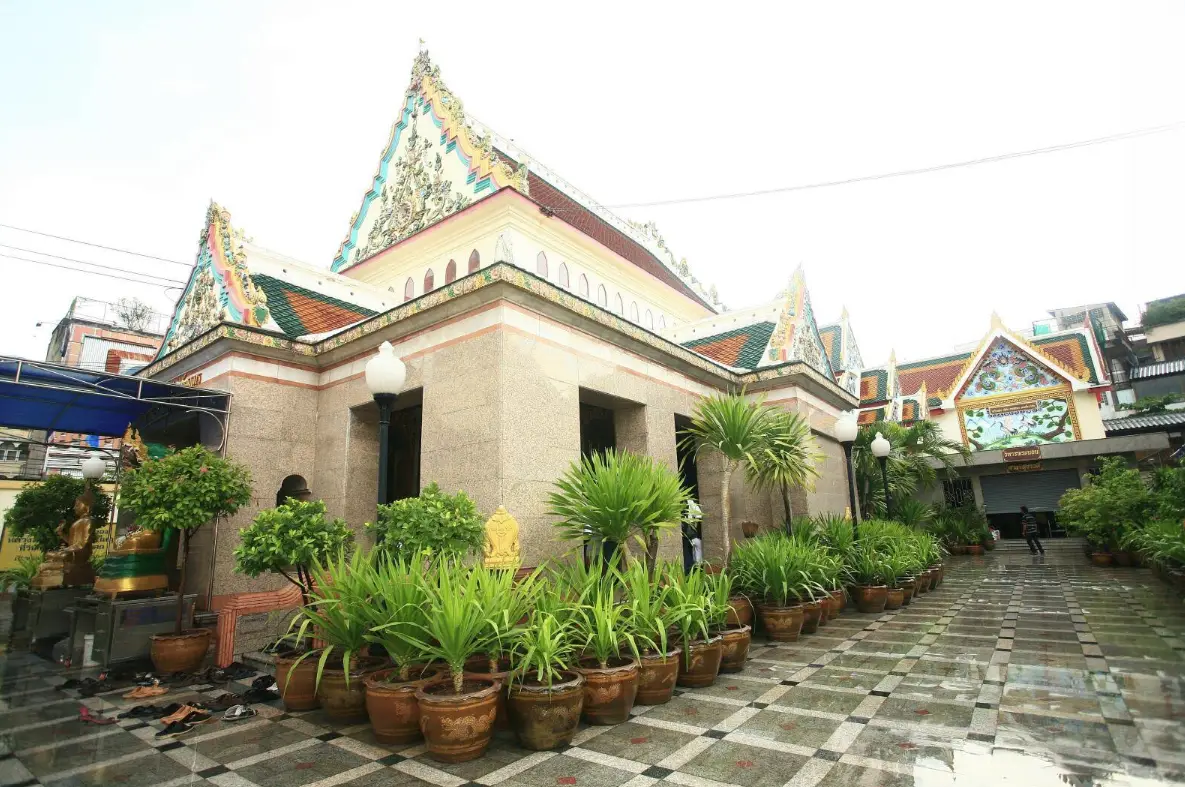
The ordination hall is the most important architectural feature of Wat Chamni Hatthakan. It measures about 8 meters wide and 10 meters long and is associated with late King Rama II-period construction. Its most distinctive feature is the Chinese-influenced decorative style. The pediment is ornamented with ceramic ware and Chinese-style stucco, giving the building a character different from temples that follow the more conventional Thai roof decoration with chofa, bai raka, and hang hong ornaments.
The ordination hall reflects the artistic taste of the early Rattanakosin period, when Chinese motifs, stucco work, floral patterns, and ceramic ornamentation became important elements in many temple buildings. This style became especially prominent during the reign of King Rama III. For visitors interested in Thai art history, Wat Chamni Hatthakan offers a compact but valuable example of how Thai Buddhist architecture absorbed Chinese decorative forms into temple design.
The layout of the main Buddhist sanctuary area is also notable. The ordination hall stands in front on an east-west axis, while the vihara is placed behind it on a north-south axis, creating a T-shaped arrangement. This type of layout is associated with temples built or restored in the early Rattanakosin period, especially around the reign of King Rama III. It adds another layer of architectural interest to the temple.
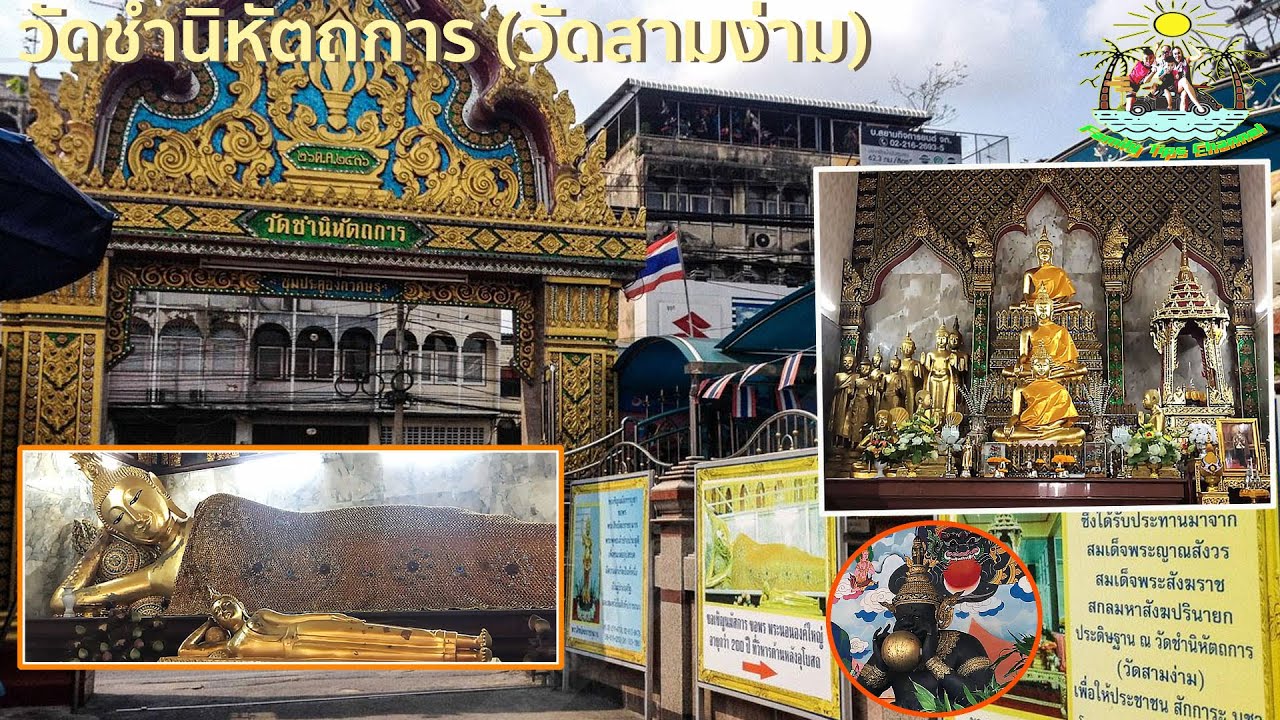
Inside the ordination hall is a principal Buddha image in the posture of subduing Mara, identified in art-historical sources as Phra Si Sanphet Thotsaphonlayan. Two additional Buddha images in the same posture are placed in front in a descending arrangement, while standing Buddha images and relic-related objects are also present in the hall. Together, these sacred objects form the main devotional center of the temple.
The posture of subduing Mara represents the moment when the Buddha overcame temptation and attained the firmness of mind before enlightenment. For worshippers, this image carries meanings of spiritual strength, perseverance, victory over obstacles, and auspicious success. It is a fitting sacred focus for a temple whose formal name also carries associations with skill, achievement, and blessing.
Behind the ordination hall is the reclining Buddha vihara. The reclining Buddha lies in the lion posture, with a flame-like halo, rounded face, arched eyebrows, small lips, and striking black-lined eyes against a gilded body. These features are connected with Buddha image styles of the King Rama III period. The reclining Buddha gives the temple another major point of worship and makes the site important not only for its ordination hall but also for its Buddhist sculpture.
The temple also has a shrine hall housing Phra Sivali, Phra Sri Ariya Metteyya, and Phra Maha Kaccayana, all of whom are popular figures of devotion among Thai Buddhists. Phra Sivali is widely revered in connection with fortune and abundance, Phra Sri Ariya Metteyya is associated with the future Buddha, and Phra Maha Kaccayana is known as a great disciple praised for wisdom and the ability to explain Dhamma clearly. These shrines make the temple meaningful for several devotional purposes.
The temple’s monastic structures include 6 monks’ residences, both wooden and masonry buildings, a large tri-muk sermon hall, a smaller chaturamuk hall, and a vihara for sacred objects. These buildings support the temple’s ongoing religious functions, including resident monks, merit-making, Dhamma activities, ceremonies, and community use. This confirms that Wat Chamni Hatthakan is not merely an old site but a functioning Buddhist temple.
The temple also has a history of Buddhist scripture education. Historical temple records mention that a Buddhist scripture school began operating here in 1958, with Dhamma and Pali studies connected to the temple’s educational role. This reinforces the traditional Thai function of temples as places of worship, learning, monastic training, and moral development.
The current abbot listed in recent Kathin information is Phra Khru Pariyatthamakhun. Recent Kathin records also confirm resident monks and ongoing Buddhist activities. In 2026, the temple appears in Pathum Wan District religious-place information and in Bangkok Metropolitan Administration’s Wat Khu Mueang community-temple activity records, confirming that the temple remains open, active, and connected with the local community.
Main activities at Wat Chamni Hatthakan include Buddhist holy day merit-making, Sangha dana offerings, Dhamma listening, Kathin ceremonies, robe offerings, funeral-related merit-making, and community religious activities. In a dense inner-city district, the temple provides an accessible place where residents, workers, students, and visitors can pause for worship and reflection without leaving central Bangkok.
The atmosphere of Wat Chamni Hatthakan is compact and local. Visitors can walk through the main areas without difficulty, beginning with the ordination hall, continuing to the shrine of Phra Sivali, Phra Sri Ariya Metteyya, and Phra Maha Kaccayana, and then visiting the reclining Buddha vihara behind the ordination hall. The temple’s appeal lies in the density of its historical and artistic details rather than in the size of its grounds.
Visitors interested in art should observe the ordination hall carefully: the pediment, ceramic decoration, stucco work, floral patterns, surrounding columns, boundary markers, and doorway forms all help explain early Bangkok temple craftsmanship. Wat Chamni Hatthakan is therefore suitable for casual worshippers as well as travelers interested in Thai art history and old community temples.
Visitors should dress modestly, remove shoes before entering sacred buildings, keep voices low, and avoid disturbing monks or worshippers. Photography should be done respectfully, especially around areas where ceremonies or merit-making activities are taking place. This is a living temple, so respect for the religious setting is as important as interest in the architecture.
Getting There is convenient because the temple is located on Rama I Road near Kasat Suek Bridge and the National Stadium area. Visitors can take the BTS to National Stadium Station and walk or continue by a short local ride. Drivers can approach via Rama I Road, though traffic and parking should be considered because the temple is in a dense inner-city area. Travelers using the Saen Saep canal boat can get off at Saphan Hua Chang Pier and continue toward Rong Mueang.
The temple can be included in a half-day cultural route around Pathum Wan. A practical route can include Wat Borom Niwat Ratchaworawihan, Wat Chamni Hatthakan, Wat Chai Mongkhon, Wat Sa Bua, Jim Thompson House, Bangkok Art and Culture Centre, MBK Center, and the Banthat Thong food area. This route combines Buddhist history, temple art, urban walking, contemporary culture, shopping, and local dining in one compact district.
Compared with large tourist temples, Wat Chamni Hatthakan is more intimate and detail-focused. Visitors can see a temple name connected with a historic craftsman, a Chinese-influenced ordination hall, a reclining Buddha, a principal Buddha image, and devotional shrines in a small urban compound. This makes the temple especially valuable for travelers who want to understand Bangkok beyond shopping centers and major landmarks.
In summary, Wat Chamni Hatthakan is an old Mahanikaya private temple in Pathum Wan District, with historical evidence from 1824 and older local names including Wat Phikun Thong and Wat Sam Ngam. Its present name honors Phraya Chamni Hatthakan, who restored the temple before King Rama IV later granted its current name. Important features include the Chinese-style ordination hall, the principal Buddha image in the posture of subduing Mara, the reclining Buddha vihara, and the shrine of Phra Sivali, Phra Sri Ariya Metteyya, and Phra Maha Kaccayana. It remains an active community temple and a meaningful stop for merit-making, art appreciation, and cultural walking in central Bangkok.
| Name | Wat Chamni Hatthakan |
| Common Name | Wat Sam Ngam |
| Former Names | Wat Phikun Thong, Wat Phikun Thong Khlong Nang Hong, Wat Phraya Chamni |
| Location | Rama I Road, Rong Mueang, Pathum Wan, Bangkok, near Kasat Suek Bridge |
| Address | 199 Rama I Road, Rong Mueang, Pathum Wan, Bangkok 10330, Thailand |
| Coordinates | 13.74867, 100.51952 |
| Temple Type | Private Buddhist Temple Under The Mahanikaya Order |
| Land Area | 8 Rai, With 2 Additional Monastic Land Plots Totaling 3 Rai |
| Temple Registration Evidence | 1824 |
| Consecrated Boundary | 1904 |
| Highlights | Old Bangkok temple with a Chinese-style ordination hall, ceramic and stucco pediment decoration, principal Buddha image in the posture of subduing Mara, reclining Buddha vihara, and shrine of Phra Sivali, Phra Sri Ariya Metteyya, and Phra Maha Kaccayana |
| History | Restored and officially associated with 1824 by Phraya Chamni Hatthakan; later renamed Wat Chamni Hatthakan by King Rama IV in honor of the restorer |
| Name Origin | Named in honor of Phraya Chamni Hatthakan, a historic craftsman and restorer connected with the Front Palace craft tradition |
| Original Setting | Flat land with Khlong Nang Hong passing through the old Rong Mueang area near Rama I Road and Kasat Suek Bridge |
| Main Areas / Zones | Ordination Hall, Reclining Buddha Vihara, Shrine Of Phra Sivali, Phra Sri Ariya Metteyya And Phra Maha Kaccayana, Sermon Hall, Monks’ Residences, Merit-Making Area, Ceremonial Area |
| Main Buildings | Ordination Hall 8 Meters Wide And 10 Meters Long, 6 Monks’ Residences, Large Tri-Muk Sermon Hall, Smaller Chaturamuk Hall, Reclining Buddha Vihara |
| Main Buddha Images / Sacred Objects | Principal Buddha Image In The Posture Of Subduing Mara, 3 Buddha Images In The Ordination Hall, Reclining Buddha, Phra Sivali, Phra Sri Ariya Metteyya, Phra Maha Kaccayana |
| Artistic Features | Chinese-influenced ordination hall with ceramic ware and Chinese-style stucco decoration; the sanctuary layout relates to early Rattanakosin temple design |
| Abbot / Caretaker | Phra Khru Pariyatthamakhun |
| Resident Monks | 9 Monks According To 2025 Kathin Information |
| Education | Historical Buddhist scripture education began in 1958 |
| Key Activities | Buddhist Holy Day Merit-Making, Sangha Dana, Dhamma Listening, Kathin Ceremony, Robe Offering, Funeral Merit-Making, Wat Khu Mueang And Local Community Activities |
| Travel Information | Get off at National Stadium BTS Station and walk or take a short local ride; drivers can use Rama I Road; Saen Saep canal boat users can get off at Saphan Hua Chang Pier and continue toward Rong Mueang |
| Current Status | Open as an active Buddhist temple with resident monks, Kathin activities, and continuing community involvement |
| Open Days | Daily |
| Opening Hours | 08.00 – 18.00 |
| Facilities | Merit-Making Areas, Pavilions, Ceremonial Area, And Parking |
| Main Contact Number | 02-613-8478 |
| Nearby Tourist Attractions | 1. Wat Borom Niwat Ratchaworawihan, about 1 km 2. Wat Chai Mongkhon, about 1 km, Tel. 02-219-3554 3. Jim Thompson House, about 1 km, Tel. 02-216-7368 4. Bangkok Art And Culture Centre, about 2 km, Tel. 02-214-6630 5. National Stadium / Suphachalasai Stadium, about 2 km, Tel. 02-214-0120 6. MBK Center, about 2 km, Tel. 1285 7. Wat Pathum Wanaram Ratchaworawihan, about 3 km, Tel. 02-251-6469 |
| Nearby Restaurants | 1. Somwang Khao Man Kai & Tom Lueat Mu, Phong Phra Ram Market, about 1 km, Tel. 083-719-8901 2. Wang Mai Cafe National Stadium, about 2 km, Tel. 094-220-5366 3. Krit Thai Residence Restaurant, about 2 km, Tel. 02-219-4100 4. Khanom Chin Bangkok Rama I Road, about 2 km, Tel. 02-612-4578 5. Je Kiang Banthat Thong, about 2 km, Tel. 086-884-4352, 02-050-1086 6. Tham Me Banthat Thong, about 2 km, Tel. 063-212-4459 7. Pa Khao Banthat Thong, about 2 km, Tel. 090-986-9789 |
| Nearby Accommodations | 1. The Twin Towers Hotel Bangkok, about 1 km, Tel. 02-216-9555 2. Krit Thai Residence, about 2 km, Tel. 02-219-4100 3. ibis Bangkok Siam, about 2 km, Tel. 02-659-2888 4. Holiday Inn Express Bangkok Siam, about 2 km, Tel. 02-217-7555 5. Siam@Siam Design Hotel Bangkok, about 2 km, Tel. 02-217-3000 6. Hua Chang Heritage Hotel, about 2 km, Tel. 02-217-0777 7. VIE Hotel Bangkok – MGallery, about 2 km, Tel. 02-309-3939 |
Frequently Asked Questions (FAQ)
Q: Where is Wat Chamni Hatthakan located?
A: Wat Chamni Hatthakan is located at 199 Rama I Road, Rong Mueang Subdistrict, Pathum Wan District, Bangkok 10330, near Kasat Suek Bridge, National Stadium, Jim Thompson House, and the old Rong Mueang area.
Q: What are the opening days and hours of Wat Chamni Hatthakan?
A: The temple is open daily from 08.00 to 18.00. Visitors who want to see the ordination hall, vihara, or join a specific ceremony should visit during daytime and contact the temple beforehand for special activities.
Q: What is the history of Wat Chamni Hatthakan?
A: Wat Chamni Hatthakan is an old temple with official evidence dating to 1824. It was formerly associated with the names Wat Phikun Thong and Wat Sam Ngam. Phraya Chamni Hatthakan restored the temple and named it Wat Phraya Chamni before King Rama IV later granted the present name.
Q: What is special about the ordination hall?
A: The ordination hall has Chinese-influenced architecture, with a pediment decorated using ceramic ware and Chinese-style stucco. It reflects early Rattanakosin craftsmanship and artistic trends associated with the King Rama III period.
Q: What are the main sacred objects inside the temple?
A: Important sacred objects include the principal Buddha image in the posture of subduing Mara, the reclining Buddha, Phra Sivali, Phra Sri Ariya Metteyya, and Phra Maha Kaccayana.
Q: Who is the current abbot of Wat Chamni Hatthakan?
A: The current abbot listed in recent Kathin information is Phra Khru Pariyatthamakhun.
Q: How can visitors get to Wat Chamni Hatthakan?
A: Visitors can take the BTS to National Stadium Station and walk or take a short local ride to the temple. Drivers can approach via Rama I Road, while Saen Saep canal boat users can get off at Saphan Hua Chang Pier and continue toward Rong Mueang.
Q: What nearby places can be visited with Wat Chamni Hatthakan?
A: Nearby places include Wat Borom Niwat Ratchaworawihan, Wat Chai Mongkhon, Wat Sa Bua, Jim Thompson House, Bangkok Art and Culture Centre, National Stadium, MBK Center, and the Banthat Thong food area.
 Category: ●Places of Worship
 Group: ●Temple
Last Update : 1 MonthAgo
 Last Update : 1 MonthAgo
 Click to Access the Navigation Map GPS
Wat Chamni Hatthakan Map
Recommend

 Phra Nakhon(24)Dusit(17)Khlong San(7)Khlong Toei(3)Jatujak(2)Don Muang(5)Taling Chan(26)Thon Buri(23)Bangkok Noi(31)Bangkok Yai(13)Bang Kapi(5)Bang Kun Tien(15)Bang Khen(3)Bang Kholam(10)Bang Sue(9)Bang Plad(23)Bang Rak(6)Chom Thong(16)Bung Kum(5)Pra Wet(6)Patum Wan(6)Pom Prap Sattru Phai(11)Paya Thai(1)Pra Kanong(4)Pa Sri Charoen(23)Min Buri(7)Yan Na Wa(8)Ratchathewi(4)Rat Burana(6)Lat Krabang(13)Nong Chok(16)Lat Phrao(4)Sathorn(4)Sam Phan Tha Wong(12)Nong Khaem(7)Huai Khwang(3)Suan Luang(7)Din Daeng(2)Lak Si(1)Sai Mai(8)Khan Na Yao(2)Wang Thong Lang(1)Klong Sam Wa(10)Watthana(2)Bang Na(4)Thawi Watthana(3)Bang Khae(5)Thung Khru(4)Bang Bon(3)


