
lovethailand home >South Travel Attractions >Satun Travel Attractions >Thung Wa >Thung Wa > Tham Le Stegodon
TL;DR: Tham Le Stegodon is located at Ban Khiri Wong, Moo 7, Thung Wa Subdistrict, Thung Wa District, Satun Province, Thailand, open Advance booking required; visits follow the guide schedule, hours Tour time depends on tidal conditions.
Tham Le Stegodon
Open Days: Advance booking required; visits follow the guide schedule
Opening Hours: Tour time depends on tidal conditions
Tham Le Stegodon, or Le Stegodon Cave, is one of the most important natural and geological attractions in Thung Wa District, Satun Province. It is widely known as Thailand’s longest sea cave, with an underground water route of about 4 km from the cave entrance to the exit. The cave is part of the Satun UNESCO Global Geopark area and is valued for its limestone tunnel, underground stream, stalagmites, stalactites, mangrove-linked exit route, and prehistoric fossil evidence connected to Stegodon, an extinct elephant genus that gave the cave its name. Visitors explore the cave by kayak or canoe with local guides, and advance booking is required because each trip must follow tidal conditions.
The main visitor contact point is connected with Thung Wa Subdistrict Administrative Organization at 206 Moo 8, Thung Wa Subdistrict, Thung Wa District, Satun Province 91120. The cave entrance itself is located in the Ban Khiri Wong area, Moo 7, Thung Wa Subdistrict. Travelers should understand that the visitor experience involves more than one location: the learning and service area in Thung Wa town, the cave entrance at Ban Khiri Wong, the kayak route inside the cave, the mangrove waterway after the cave exit, and the end point around Tha Oi Pier. This is why the trip should be booked and coordinated before arrival.
The word “Le” refers to the sea-related water system of the cave, while “Stegodon” refers to the extinct elephant genus whose fossils were discovered in the area. The cave was formerly known as Tham Wang Kluai before the fossil discovery helped establish its present identity as Tham Le Stegodon. Its name therefore reflects the cave’s natural setting, tidal water system, geological value, and paleontological importance. For Satun, the cave is not just a scenic underground attraction; it is one of the places that helped shape the province’s reputation as a major geological learning destination.
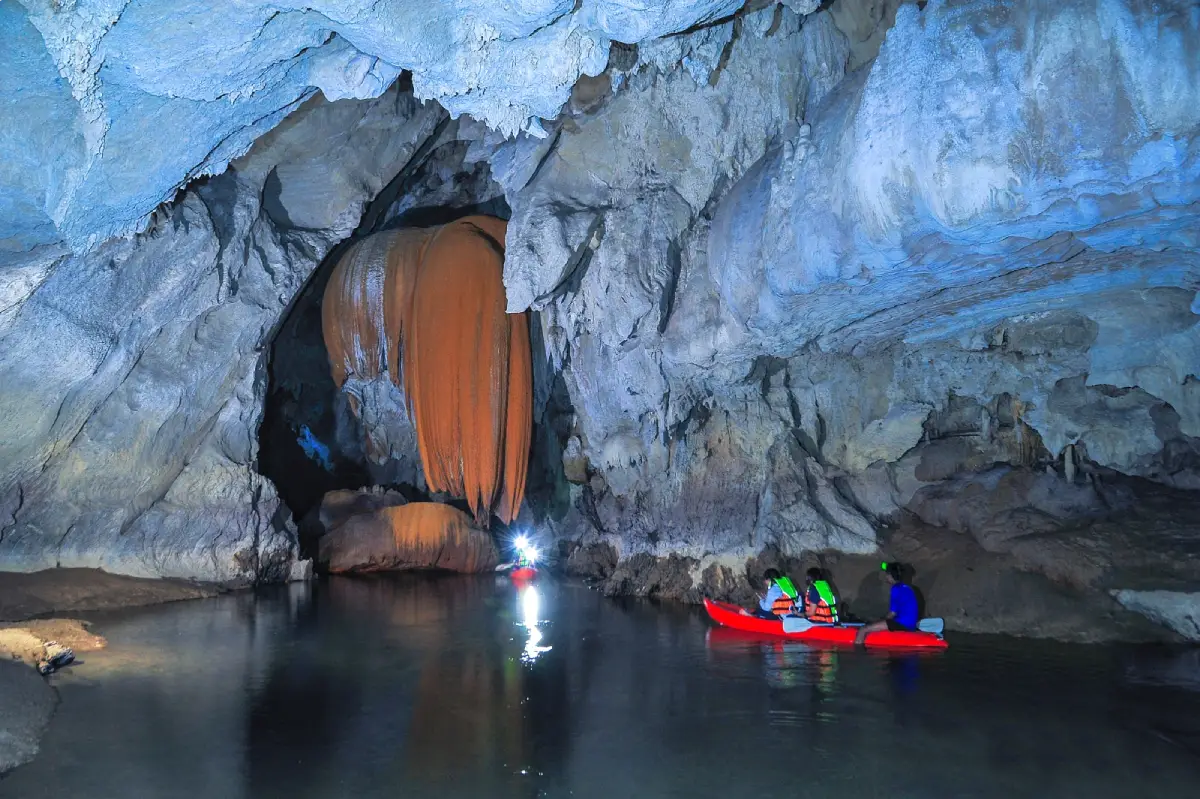
Physically, Tham Le Stegodon is a long limestone tunnel beneath a mountain range. A stream runs through the cave, and seawater influences the water level each day. The interior is winding, with sections that feel broad and open and other parts that become narrower depending on the rock walls and water level. Visitors do not walk through the cave like in many dry cave attractions. Instead, they sit in kayaks or canoes, wear safety equipment, and move slowly through the dark water passage while observing limestone walls, ceilings, stalagmites, stalactites, calcite surfaces, and fossil-related rock features.
The scientific and educational value of Tham Le Stegodon is a major reason to visit. Fossils of vertebrate animals have been found in the cave area, including Stegodon and prehistoric rhinoceros fossils from the Pleistocene period. These remains help explain environmental changes in the past and connect the cave to the broader geological story of Satun. The wider Satun UNESCO Global Geopark area contains many fossil sites and geological records from different periods. A visit to Tham Le Stegodon therefore combines travel, adventure, natural history, and geological interpretation in one route.
One of the most important fossil finds associated with the cave is a Stegodon jawbone with molar teeth. This discovery helped draw attention to the area and encouraged cooperation among local communities, geological agencies, tourism bodies, and conservation groups. As a result, the cave has been developed as a learning-based tourism site rather than a mass-tourism cave. Visitor numbers are controlled, safety procedures are used, and local guides play a key role in explaining the cave and protecting its fragile environment.
Before entering the cave, travelers can visit Satun Geopark Museum and Thung Wa Ancient Elephant Museum in the Thung Wa service area. These museums help explain the geological history of Satun, the formation of limestone landscapes, fossil discoveries, ancient marine life, and the relationship between geology and local communities. Visiting the museum before the cave makes the underground journey more meaningful because travelers can better understand the formations and fossil evidence they see along the route.
The main experience at Tham Le Stegodon is the guided kayak journey through the cave. Visitors wear life jackets, safety helmets, and use lighting equipment while local guides manage the route. The boats move slowly through cool, dark, echoing sections of the limestone tunnel. Along the way, travelers can see stalagmites, stalactites, flowstone, curtain-like formations, and reflective calcite textures. The atmosphere feels very different from ordinary sightseeing because the cave creates a strong sense of traveling through deep geological time.
The cave also has ecological value. Its water system includes freshwater, brackish water, and seawater influence, creating a special environment for cave and coastal life. Visitors should follow guide instructions at all times, avoid disturbing animals, avoid touching rock surfaces, and keep lights under control where guides advise. The cave’s biological and geological features are delicate, and responsible behavior is essential for preserving the site.
After the underground journey, the route connects to a mangrove area and continues toward Tha Oi Pier. Many visitors remember the cave exit because the opening forms a striking natural frame, often described as a heart-shaped view at the end of the tunnel. This transition from the dark limestone cave into daylight, mangrove forest, and open water is one of the most memorable parts of the trip. It also turns the cave visit into a broader nature route that includes both inland karst and coastal ecology.
Travelers must plan this visit carefully because Tham Le Stegodon is not a walk-in attraction with fixed entry at any time of day. The cave route depends on tide level, water condition, equipment readiness, guide availability, and group management. Visitors should contact the service team in advance, provide the travel date and group size, and follow the confirmed time from local staff. Advance booking allows the community team to prepare boats, guides, safety gear, and transport arrangements at the end of the route.
Tham Le Stegodon is suitable for travelers who enjoy nature, geology, and soft adventure. It does not require advanced climbing or caving equipment, but it still takes place in a dark natural cave with water, uneven conditions, and limited space in some sections. Travelers who are uncomfortable with darkness, enclosed spaces, or water-based activities should assess their readiness before joining. Families with children should keep them supervised throughout the trip, and older travelers should join only when they are comfortable with boat-based cave travel.
Good preparation makes the trip safer and more comfortable. Wear quick-drying clothes and footwear with good grip. Bring a waterproof bag for phones, cameras, documents, and personal items. A small towel, drinking water, and a change of clothes are useful after the trip. Photography is possible in suitable areas, but visitors should prioritize safety over taking photos. Standing, leaning out of the boat, or moving suddenly during the kayak route should be avoided.
Visitors should never touch, break, scratch, climb on, or write on stalagmites and stalactites. Cave formations take a very long time to form, and even small damage can be permanent. Travelers should not leave trash, eat inside the cave, collect stones, remove shells, or take fossil-like objects from the area. Tham Le Stegodon is a protected learning landscape, and preserving the cave is part of every visitor’s responsibility.
The strength of Tham Le Stegodon is the way it connects nature, science, and community. A typical route begins with museum-based learning, continues into the limestone cave by kayak, and ends with mangrove scenery and the Tha Oi area. This gives visitors a fuller view of Satun beyond beaches and islands. The province is also rich in limestone mountains, fossils, caves, waterfalls, mangroves, and long-established coastal communities.
Nearby places can be combined with the cave depending on available time. Important stops include Satun Geopark Museum, Thung Wa Ancient Elephant Museum, Tha Oi Viewpoint, Ho Si Lang sandbar area, Thung Wa Dragon Spine sandbar, Lao Trong Island, Than Plio Waterfall, and community-based routes in Thung Wa. A half-day trip can focus on the museum and cave. A full-day route can include the cave, mangroves, Tha Oi Pier, local food, and selected community activities.
Getting There from Satun town covers about 76 km. Travelers can go by private car or take public transport toward Thung Wa District, then contact the cave service point before continuing to the Ban Khiri Wong cave entrance area. A private car is the most convenient option because the cave trip may end near Tha Oi Pier or connect with other community tourism stops. Travelers coming from Hat Yai, Trang, La-ngu, or Pak Bara should allow enough time and follow the confirmed schedule from local staff because the cave entry time depends on the tide.
For geology-focused travelers, Tham Le Stegodon deserves unhurried attention. The cave explains many layers of Satun’s natural identity: ancient limestone, water erosion, underground channels, tidal influence, fossil evidence, mangrove ecology, and community-led conservation. The experience is not only about the thrill of kayaking through a dark cave. It is also about understanding how one landscape can preserve stories of ancient life, changing sea levels, and present-day community stewardship.
Photographers will find several strong visual points: the cave entrance, kayak launch area, limestone chambers, stalagmites, stalactites, calcite walls, and the cave exit opening toward daylight. Photography should be done carefully and without disturbing other visitors or guides. Flash and strong lighting should be used responsibly, and visitors should not lean out of the boat to get a photo. The best images come from patience, stable positioning, and respect for the guide’s safety instructions.
Tham Le Stegodon is also suitable for educational groups because it brings together geology, paleontology, geography, cave ecology, mangrove ecology, community tourism, and conservation. Local guides help make the information practical and easy to understand. Students and study groups can see real examples of limestone formations, fossil-related evidence, tidal cave systems, and community-based tourism management in one destination.
From a community tourism perspective, the cave supports local livelihoods in Thung Wa. Local residents provide guiding, boat services, interpretation, safety support, food, homestay accommodation, and related community activities such as mangrove routes, local crafts, natural dye workshops, and coastal lifestyle learning. Using local services respectfully helps distribute tourism benefits while reinforcing conservation of the cave and surrounding environment.
Tham Le Stegodon should be visited with patience and respect. Every part of the route has meaning: the name linked to Stegodon fossils, the underground waterway, the limestone formations, the fossil traces, the mangrove exit, and the community that protects the site. Travelers who book ahead, prepare properly, and listen to local guides will experience more than a beautiful cave. They will understand why this cave is one of Satun’s most important gateways into geological time.
| Name | Tham Le Stegodon / Le Stegodon Cave |
| Former Name | Tham Wang Kluai |
| Category | Natural attraction and geological learning site in the Satun UNESCO Global Geopark area |
| Location | Ban Khiri Wong, Moo 7, Thung Wa Subdistrict, Thung Wa District, Satun Province, Thailand |
| Contact / Visitor Service Point | 206 Moo 8, Thung Wa Subdistrict, Thung Wa District, Satun 91120, Thailand |
| Highlights | A limestone sea cave with an underground water route of about 4 km, kayak exploration, stalagmites, stalactites, and prehistoric fossil evidence |
| History / Importance | An important fossil discovery site associated with Stegodon and other prehistoric animals, and a key geological learning attraction in Satun Province |
| Name Origin | “Le” refers to the cave’s sea-linked water system, while “Stegodon” refers to the extinct elephant genus whose fossils were discovered in the cave area |
| Distinctive Features | A limestone tunnel cave with an underground stream, tidal influence, kayak route, cave formations, mangrove exit, and connection to Tha Oi Pier |
| Travel Information | About 76 km from Satun town; accessible by private car and public transport toward Thung Wa District, followed by local coordination for the cave entrance and guided tour |
| Current Status | Active geological learning and tourism site in the Satun UNESCO Global Geopark area; TAT STAR certification valid until 25 December 2026 |
| Open Days | Advance booking required; visits follow the guide schedule |
| Opening Hours | Tour time depends on tidal conditions |
| Facilities / Equipment | Kayaks or canoes, life jackets, safety helmets, lighting equipment, local guides, visitor service point, and route connection toward Tha Oi Pier depending on the tour program |
| Main Areas / Zones | Satun Geopark Museum, Thung Wa Ancient Elephant Museum, kayak launch point, cave entrance, underground kayak route, limestone chamber areas, cave exit, mangrove route, and Tha Oi Pier area |
| Caretaker / Local Operator | Thung Wa Subdistrict Administrative Organization and local Tham Le Stegodon tourism group |
| Main Contact Number | 080-110-7060 |
| Official Website / Official Page | Facebook: Tham Le Stegodon |
| Nearby Tourist Attractions | 1. Satun Geopark Museum, about 10 km, Tel. 074-789501 2. Thung Wa Ancient Elephant Museum, about 10 km, Tel. 074-789501 3. Tha Oi Viewpoint, about 18 km, Tel. 074-789110 4. Ho Si Lang, about 18 km 5. Thung Wa Dragon Spine Sandbar, about 18 km 6. Than Plio Waterfall, about 22 km |
| Nearby Restaurants | 1. Flying Fish, about 10 km, Tel. 093-5550946 2. Laew Tae Pu The Orange Cafe, about 12 km, Tel. 083-1965337 3. Town in Home, about 17 km 4. Wang Won Seafood Khon Khlan, about 20 km 5. Nong Nee Restaurant La-ngu Branch, about 32 km, Tel. 084-0693118 6. Nai Fan Bakery La-ngu, about 32 km, Tel. 081-7668688 |
| Nearby Accommodations | 1. Thung Wa Resort, about 10 km, Tel. 087-8376331 2. Thung Wa Homestay Godon, about 10 km, Tel. 091-0240988 3. Ban Rai Homestay Godon, about 11 km, Tel. 080-5448528 4. Engtan Resort, about 18 km, Tel. 086-9697144 5. Nava Nelayan Homestay, about 28 km, Tel. 099-6165062 6. The Chevalley Beach Resort, about 30 km, Tel. 062-2385858 |
Frequently Asked Questions (FAQ)
Q: Where is Tham Le Stegodon located?
A: Tham Le Stegodon is in Thung Wa Subdistrict, Thung Wa District, Satun Province. The visitor service point is at 206 Moo 8, and the cave entrance area is around Ban Khiri Wong, Moo 7.
Q: What makes Tham Le Stegodon special?
A: It is a long limestone sea cave with an underground water route of about 4 km, kayak exploration, beautiful cave formations, and fossil evidence linked to the extinct Stegodon elephant genus.
Q: Do visitors need to book Tham Le Stegodon in advance?
A: Yes. Advance booking is required because each visit needs boats, local guides, safety equipment, and a schedule that matches tidal conditions.
Q: What are the opening hours of Tham Le Stegodon?
A: Tour time depends on tidal conditions and the schedule confirmed by local staff. Visitors should contact the service team before traveling.
Q: How long does a Tham Le Stegodon trip take?
A: The full experience takes several hours, including preparation, safety briefing, kayaking through the cave, mangrove route connection, and travel toward Tha Oi Pier depending on the program.
Q: What should visitors bring to Tham Le Stegodon?
A: Bring quick-drying clothes, footwear with good grip, a waterproof bag, drinking water, a small towel, a change of clothes, and follow guide instructions throughout the route.
Q: Is Tham Le Stegodon suitable for children and older travelers?
A: It can be suitable when participants are healthy, comfortable with water-based cave travel, and able to follow safety instructions. Travelers with concerns about darkness, narrow spaces, or movement limitations should assess their readiness first.
Q: What nearby attractions can be visited with Tham Le Stegodon?
A: Nearby attractions include Satun Geopark Museum, Thung Wa Ancient Elephant Museum, Tha Oi Viewpoint, Ho Si Lang, Thung Wa Dragon Spine Sandbar, and Than Plio Waterfall.
 Category: ●Nature and Wildlife
 Group: ●Caves
Last Update : 2 MonthAgo
 Last Update : 2 MonthAgo
 Click to Access the Navigation Map GPS
Tham Le Stegodon Map
Recommend

 Art, Culture and Heritage
 Historical Sites and Monuments(1)
 Landmarks and Memorials(1)
 Art, Craft Centres, Tradition(5)
 Museums(3)
 Places of Worship
 Temple(3)
 Mosque(27)
 Other Sacred Sites(1)
 Suburban Living
 Village, Community(1)
 Local Market(2)
 National Parks and Marine Reserves(7)
 Mountain (Doi)(1)
 Dam, Reservoir, Lake(2)
 Waterfalls(9)
 Hot Springs(1)
Caves(9)
 Bays and Beaches(10)
 Islands(16)
 Other natural attractions(5)
 Entertainment and Agricultural
 Zoos and Aquariums(1)
 Farms, Parks and Ecotourism(4)
 Outdoor and Adventure Activities(1)
 Travel Articles, Recipes
 Travel Review, Food Review(1)


