
lovethailand home >South Travel Attractions >Satun Travel Attractions >Manang >Pam Phatthana > Phu Pha Phet Cave
TL;DR: Phu Pha Phet Cave is located at Moo 9, Ban Pa Phon / Ban Khuan Din Dam, Palm Phatthana Subdistrict, Manang District, Satun Province, Thailand, open Daily, hours 08.30 – 15.30.

Phu Pha Phet Cave
Open Days: Daily
Opening Hours: 08.30 – 15.30
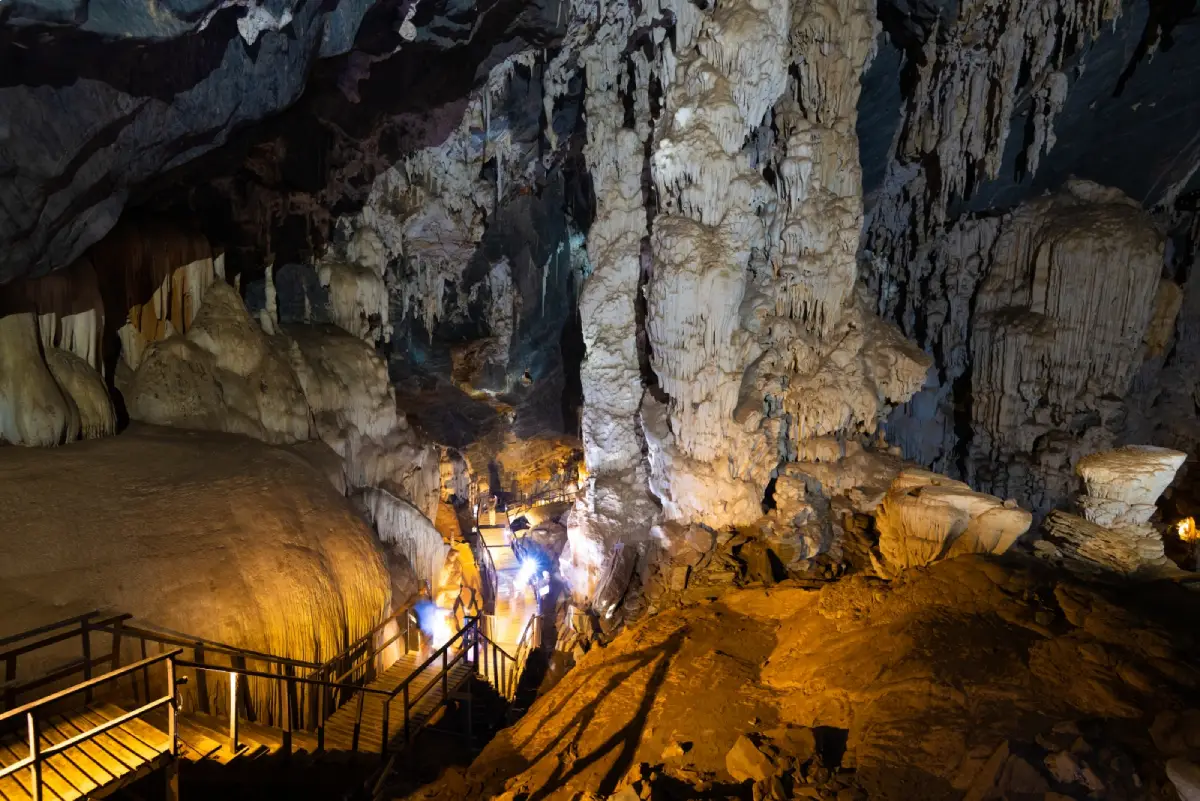
Phu Pha Phet Cave in Satun Province is a large limestone cave located in Moo 9, Ban Pa Phon and Ban Khuan Din Dam, Palm Phatthana Subdistrict, Manang District. It is one of Satun’s most important inland natural attractions, known for its vast chambers, high ceilings, wooden walkways, illuminated cave route, and glittering stalagmites and stalactites that sparkle like diamond flakes under the light. The cave is also significant for archaeology, geology, and local history, with evidence of prehistoric human activity dating back around 3,000 years and more than 20 named chambers such as the Curtain Room, Coral Room, Mushroom Room, Chedi Room, Diamond Stone Dome Room, Phu Pha Phet Room, and Emerald Light Room.
The appeal of Phu Pha Phet Cave lies not only in its size, but also in the way several layers of meaning come together in one place. Travelers encounter tropical forest around the approach, limestone mountains linked with the Banthat Range, a cool and shadowy cave atmosphere, and mineral formations that have taken a very long time to develop. Once inside, the reflections from calcite surfaces and moisture on the cave formations explain why the cave is associated with the image of diamonds hidden inside a mountain. The experience feels like entering a separate underground landscape shaped by water, stone, mineral deposits, and time.
Phu Pha Phet Cave is widely described as the largest cave in Thailand and the fourth-largest cave in the world, with an interior area of more than 50 rai. The cave is mostly a semi-dry limestone cave, with broad chambers, a high roof, and many smaller rooms connected along the visitor route. Its scale makes the cave feel open compared with narrow cave systems, but visitors still need to walk carefully, stay on the designated route, and follow local guidance. Some areas include stairs, wooden platforms, uneven levels, and damp surfaces.
The cave was formerly known by several names, including Tham Lot, Tham Yao, and Tham Phet. These earlier names reflected its long and winding character and the sparkling appearance of its formations. The later official name, Phu Pha Phet, directly expresses the image of a diamond-like mountain. When light touches the cave walls, mineral surfaces, and droplets on the stalagmites and stalactites, small reflective points appear across the rock. This visual character has become the defining image of the cave and the reason many travelers remember it as one of the most striking caves in southern Thailand.
The story of the cave’s discovery is linked to Luang Phlaeng, also known as Luang Ta Phlaeng, a wandering monk who practiced in the mountain area and told local residents about large hidden chambers inside the long cave. Later, villagers and local authorities explored the area more seriously. In 1997, local residents and government representatives carried out an important survey. In 1998, archaeologists from the 10th Office of Archaeology and National Museums in Songkhla surveyed the cave area in detail. After that, Phu Pha Phet Cave was gradually developed as a tourist attraction under the care of Palm Phatthana Subdistrict Administrative Organization.
Phu Pha Phet Cave has archaeological value as well as scenic value. Evidence found in the cave includes parts of a human skull, animal bones, shell remains, turtle shell, cord-marked pottery fragments, and pedestal-shaped pottery. These finds indicate that the cave area was associated with prehistoric human activity about 3,000 years ago. For travelers, this means the cave is not only a place to admire underground scenery. It is also a site where natural history and human history meet, preserving traces of early life in southern Thailand.
Geologically, Phu Pha Phet Cave is located in a karst landscape, where limestone has been shaped by water over a long period. The rock belongs to the Thung Song Group from the Ordovician period, around 438–505 million years old. The area includes limestone, stromatolite-bearing rock, and fossils of ancient marine life such as nautiloids and crinoid stems. These features show that the present-day mountain and cave landscape has a deep connection with ancient marine environments. For geology-focused travelers, the cave offers a clear example of how sea-related rock layers can become inland limestone mountains and caves.
The stalagmites and stalactites inside the cave formed from mineral-rich water slowly depositing carbonate minerals on ceilings, walls, and floors. Stalactites hang from the ceiling, while stalagmites rise from the cave floor. In some areas, the two grow toward each other and become columns. Many of these formations are made largely of calcite, and their surfaces can reflect light in small sparkling points. This process is slow and delicate, which is why the formations must never be touched, climbed on, scratched, or broken.
The cave contains about 20 smaller chambers, many of which have names based on their shapes or atmosphere. The Curtain Room has layered formations that resemble hanging fabric. The Coral Room contains formations that look like underwater coral. The Mushroom Room is named for stalagmites shaped like mushrooms. The Chedi Room has formations that resemble small stupas. The Naga Room features connected formations that suggest the body of a great serpent, while the Diamond Stone Dome Room emphasizes the feeling of a high and impressive limestone chamber. These named sections help visitors understand and remember the cave as a sequence of distinct natural rooms rather than one continuous dark space.
The Phu Pha Phet Room is one of the main highlights. This section is known for formations that glitter strongly when light reaches the rock surface. The Emerald Light Room is another memorable chamber located deeper inside the cave. Its ceiling includes an opening where natural light can enter and strike green-toned formations, creating an emerald-colored effect on the chamber floor. The strongest light effect is generally associated with May and June, around 15.00–15.20, on days when weather and sunlight conditions are suitable.
Beyond the famous named rooms, the cave contains many detailed forms worth observing slowly. Stalagmite forms include mushroom-like shapes, arch-like formations, diamond-ring shapes, flowing-water forms, naga-head shapes, lotus-bud forms, and other imaginative figures. Stalactite forms include dome-like, jellyfish-like, and curtain-like structures. There are also many columns, known locally as diamond pillars or sun-supporting columns, and flowstone formations that resemble steps, basins, and a concert-stage surface. These details make Phu Pha Phet Cave especially rewarding for visitors who enjoy careful observation rather than quick sightseeing.
The visitor route has been developed with wooden walkways and lighting, making it easier to explore than a completely undeveloped cave. Even so, a visit still requires physical effort. Before reaching the cave entrance, visitors need to climb several hundred steps through a forested hillside. Shoes with good grip are essential, especially after rain or when the ground is damp. Sandals with smooth soles are not recommended. Travelers should move at a steady pace, use handrails where available, and avoid rushing inside the cave.
The approach to the cave is part of the experience. The forest around the cave entrance creates shade and humidity, and the shift from outdoor heat into the cooler cave interior is immediately noticeable. As visitors enter the mouth of the cave, the sound, light, and temperature change. This transition helps convey the size and power of the limestone landscape. It is a good moment to adjust to the darker environment before continuing along the inner walkway.
The surrounding ecosystem also adds value to the site. Forest around the cave helps maintain the moisture balance of the cave environment, while the cave itself provides habitat for animals adapted to dark and humid conditions, including bats, spiders, and crickets. Visitors should keep noise low, avoid shining lights directly at animals for a long time, and stay out of restricted or unmanaged areas. Responsible behavior helps reduce disturbance to the cave ecosystem.
The most important rule at Phu Pha Phet Cave is to look without touching. Stalagmites and stalactites take a very long time to form. Oil, sweat, and pressure from human hands can damage the mineral surface and affect further growth. Visitors should never touch, climb on, scratch, write on, or remove any rock material from the cave. Food should not be eaten inside the cave, and all trash must be carried out. Cave conservation depends on every visitor following these simple rules.
Phu Pha Phet Cave suits many types of travelers. Nature lovers can enjoy the limestone landscape and cave formations. History-focused visitors can learn about prehistoric evidence from Satun. Photographers can capture dramatic views of high chambers, wooden walkways, light on calcite, and the contrast between shadow and illuminated rock. Families can visit with children when adults supervise them closely. Older travelers or visitors with knee problems should assess their condition before the trip because the staircase and cave route require effort.
The best practical time to visit is from morning to early afternoon, giving enough time to climb up, enter the cave, walk through the route, and return without rushing. Visitors hoping to experience the Emerald Light Room effect should plan for the afternoon and ask local guides for the right timing. For a more comfortable general visit, morning is often easier because the climb is less hot and there is still time to continue to nearby waterfalls or other attractions later in the day.
Preparation should focus on mobility and safety. Wear breathable clothing, bring drinking water for before and after the climb, and carry a small flashlight or phone light as a backup even though lighting is installed inside the cave. Avoid carrying heavy bags because the route includes stairs and narrow walkway sections. For photography, use a secure camera strap or a small protective bag so that both hands remain free when balance or handrails are needed.
Getting There from Satun town covers about 76 km. Travelers can go by private car or public transport toward Manang District, then continue to Palm Phatthana Subdistrict and Ban Pa Phon. Direction signs are available along the route. At the cave area, visitors will find parking and the path leading up to the cave entrance. Travelers coming from Trang or Phatthalung can connect through routes near the Banthat Range toward Manang District, but road and weather conditions should be checked during the rainy season.
For a half-day itinerary, Phu Pha Phet Cave can be the main destination because the climb, cave walk, and rest time already require a meaningful part of the day. For a full-day nature route, travelers can combine the cave with Wang Tai Nan Waterfall, Chet Khot Cave, Wang Sai Thong Waterfall, Thara Sawan Waterfall Forest Park, or Than Plio Waterfall. This kind of route gives visitors a broader view of Manang and nearby districts, combining caves, forest, waterfalls, and limestone scenery.
Wang Sai Thong Waterfall is one of the most popular nearby attractions to combine with Phu Pha Phet Cave. It is a limestone waterfall with layered pools and a shaded natural setting. Chet Khot Cave is suitable for travelers who want more cave and nature exploration. Wang Tai Nan Waterfall offers a quieter forest-and-stream atmosphere close to the cave area. Thara Sawan Waterfall Forest Park and Than Plio Waterfall add more options for travelers with enough time and energy. It is better to choose a realistic number of stops rather than crowding too many attractions into one day.
Overall, Phu Pha Phet Cave deserves a slow and attentive visit. Its value lies in the scale of the cave, the named chambers, the glittering calcite, the archaeological evidence, the ancient limestone geology, and the surrounding forest landscape. A careful visit helps travelers understand that the cave is not only a beautiful photo spot, but also a natural archive of geological time, prehistoric human activity, and local conservation work in Satun Province.
Phu Pha Phet Cave also broadens the way travelers understand Satun. The province is often associated with islands, beaches, and the Andaman Sea, but inland Satun has limestone mountains, caves, fossils, waterfalls, and forests that are equally important. Visiting Phu Pha Phet Cave reveals this deeper side of the province. With good preparation, respect for the rules, and responsible behavior, the cave offers one of the most memorable inland nature experiences in southern Thailand.
| Name | Phu Pha Phet Cave |
| Former Names | Tham Lot, Tham Yao, Tham Phet |
| Category | Limestone Cave, Natural Attraction, Geological And Archaeological Learning Site |
| Location | Moo 9, Ban Pa Phon / Ban Khuan Din Dam, Palm Phatthana Subdistrict, Manang District, Satun Province, Thailand |
| Local Authority Address | Palm Phatthana Subdistrict Administrative Organization, 225 Moo 1, Palm Phatthana Subdistrict, Manang District, Satun 91130, Thailand |
| Coordinates | 7.124750, 99.997883 |
| Highlights | A vast cave with more than 50 rai of interior space, high ceilings, glittering stalagmites and stalactites, and more than 20 named chambers |
| History / Importance | Prehistoric evidence such as human bones, cord-marked pottery fragments, animal bones, and shell remains dating back around 3,000 years has been found in the cave |
| Name Origin | The name refers to the cave formations and limestone surfaces that sparkle like diamonds when light reflects on them |
| Distinctive Features | A semi-dry limestone cave in a karst landscape, with wooden walkways, interior lighting, high chambers, many named rooms, and calcite-rich formations |
| Travel Information | About 76 km from Satun town; accessible by private car or public transport toward Manang District, then onward to Palm Phatthana Subdistrict and Ban Pa Phon |
| Current Status | A local natural site and major tourist attraction of Palm Phatthana Subdistrict, Manang District, Satun Province |
| Open Days | Daily |
| Opening Hours | 08.30 – 15.30 |
| Facilities | Wooden walkways inside the cave, route lighting, parking area, restrooms, and local cave guides |
| Main Areas / Zones | Cave approach, cave entrance, interior wooden walkway, Curtain Room, Coral Room, Mushroom Room, Chedi Room, Naga Room, Diamond Stone Dome Room, Phu Pha Phet Room, and Emerald Light Room |
| Caretaker / Local Authority | Palm Phatthana Subdistrict Administrative Organization |
| Main Contact Number | 074-774505, Local Cave Guide 092-889-5563 |
| Official Website / Official Page | Palm Phatthana Subdistrict Administrative Organization Website |
| Nearby Tourist Attractions | 1. Wang Tai Nan Waterfall, about 7 km 2. Chet Khot Cave, about 12 km 3. Wang Sai Thong Waterfall, about 16 km, Tel. 061-226-4337 4. Thara Sawan Waterfall Forest Park, about 29 km 5. Than Plio Waterfall, about 29 km 6. Tham Le Stegodon, about 35 km |
| Nearby Restaurants | 1. Krua Tua Tor Khao Tom 5 Baht, about 20 km, Tel. 064-8452190 2. Jaibaan Manang, about 21 km, Tel. 087-8918802 3. NOBICHA Manang, about 22 km, Tel. 088-3975344 4. Flying Fish Pla Bin, about 32 km, Tel. 093-5550946 5. Laew Tae Pu The Orange Cafe, about 33 km, Tel. 083-1965337 6. Nai Fan Bakery La-ngu, about 36 km, Tel. 081-7668688 |
| Nearby Accommodations | 1. Phukao Homestay Phu Pha Phet Cave, about 1 km, Tel. 081-2754833 2. Wang Sai Thong Resort Manang, about 16 km, Tel. 084-1955208 3. Thanthida Resort Manang, about 22 km, Tel. 080-3613764, 084-3130794 4. Engthan at Satun, about 30 km, Tel. 085-4778688 5. Thung Wa Resort, about 35 km, Tel. 087-8376331 6. Ban Rai Homestay Godon, about 36 km, Tel. 080-5448528 |
Frequently Asked Questions (FAQ)
Q: Where is Phu Pha Phet Cave located?
A: Phu Pha Phet Cave is located in Moo 9, Ban Pa Phon and Ban Khuan Din Dam, Palm Phatthana Subdistrict, Manang District, Satun Province.
Q: What makes Phu Pha Phet Cave special?
A: It is a very large limestone cave with more than 50 rai of interior space, high ceilings, glittering stalagmites and stalactites, and more than 20 named chambers.
Q: What are the opening hours of Phu Pha Phet Cave?
A: Phu Pha Phet Cave is open daily from 08.30 to 15.30. Visitors should arrive early enough to climb the stairs and explore the cave without rushing.
Q: What are the main chambers inside Phu Pha Phet Cave?
A: Important chambers include the Curtain Room, Coral Room, Mushroom Room, Chedi Room, Naga Room, Diamond Stone Dome Room, Phu Pha Phet Room, and Emerald Light Room.
Q: Why is Phu Pha Phet Cave archaeologically important?
A: The cave contains prehistoric evidence such as human bones, cord-marked pottery fragments, animal bones, and shell remains dating back around 3,000 years.
Q: What should visitors prepare before visiting Phu Pha Phet Cave?
A: Visitors should wear shoes with good grip, bring drinking water, carry a small flashlight, wear comfortable clothing, and avoid heavy bags because the route includes many stairs and cave walkways.
Q: What nearby attractions can be visited after Phu Pha Phet Cave?
A: Nearby attractions include Wang Tai Nan Waterfall, Chet Khot Cave, Wang Sai Thong Waterfall, Thara Sawan Waterfall Forest Park, Than Plio Waterfall, and Tham Le Stegodon.
Q: Is Phu Pha Phet Cave suitable for children and older travelers?
A: Children can visit with close adult supervision. Older travelers or visitors with knee or mobility issues should assess their physical condition because the visit requires climbing many steps and walking through a natural cave environment.
 Category: ●Nature and Wildlife
 Group: ●Caves
Last Update : 2 MonthAgo
 Last Update : 2 MonthAgo
 Click to Access the Navigation Map GPS
Phu Pha Phet Cave Map
Recommend

 Art, Culture and Heritage
 Historical Sites and Monuments(1)
 Landmarks and Memorials(1)
 Art, Craft Centres, Tradition(5)
 Museums(3)
 Places of Worship
 Temple(3)
 Mosque(27)
 Other Sacred Sites(1)
 Suburban Living
 Village, Community(1)
 Local Market(2)
 National Parks and Marine Reserves(7)
 Mountain (Doi)(1)
 Dam, Reservoir, Lake(2)
 Waterfalls(9)
 Hot Springs(1)
Caves(9)
 Bays and Beaches(10)
 Islands(16)
 Other natural attractions(5)
 Entertainment and Agricultural
 Zoos and Aquariums(1)
 Farms, Parks and Ecotourism(4)
 Outdoor and Adventure Activities(1)
 Travel Articles, Recipes
 Travel Review, Food Review(1)


