
lovethailand home >South Travel Attractions >Ranong Travel Attractions >Muang Ranong >Khao Niwet > Ranong City Pillar Shrine
TL;DR: Ranong City Pillar Shrine is located at Phoemphon Road, opposite Ranong Municipality Office, Khao Niwet Subdistrict, Mueang Ranong District, Ranong Province 85000, open Daily, hours 08.00 – 17.00.
Ranong City Pillar Shrine
Open Days: Daily
Opening Hours: 08.00 – 17.00
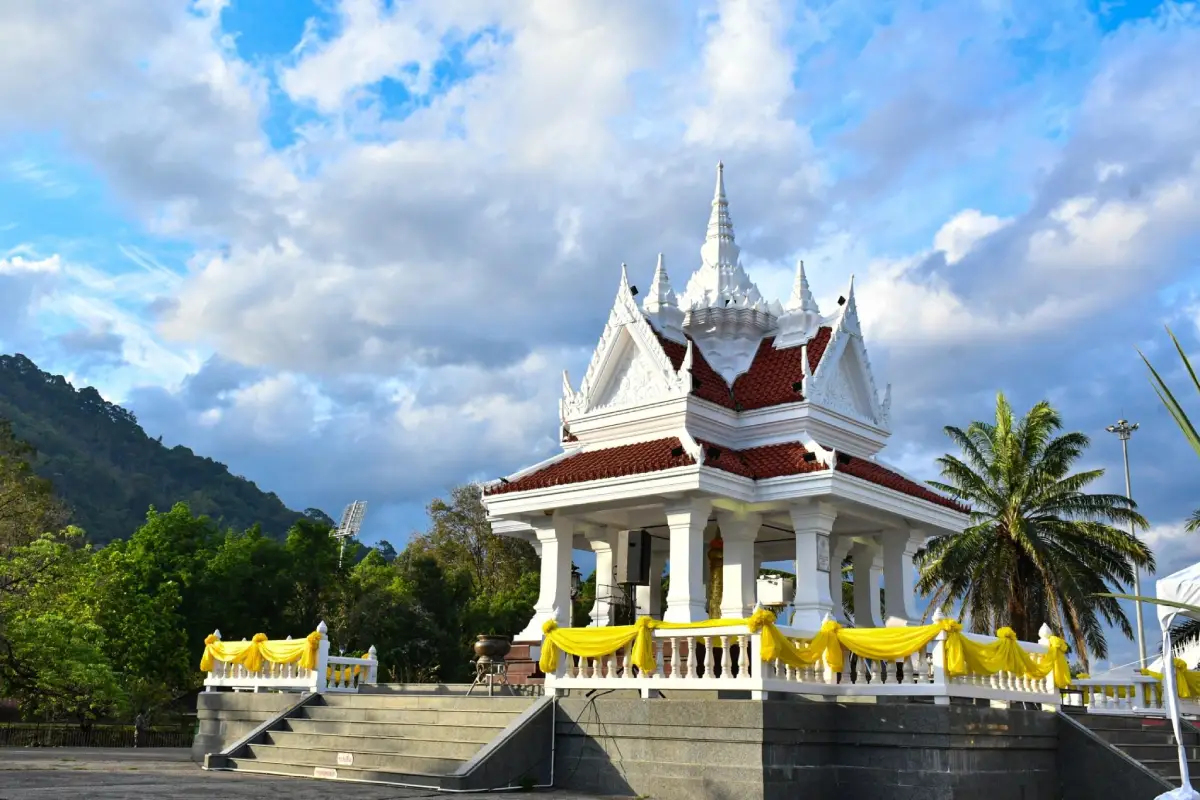
Ranong City Pillar Shrine is one of the most important sacred landmarks in Ranong Province. It is located on Phoemphon Road, opposite Ranong Municipality Office in Khao Niwet Subdistrict, Mueang Ranong District. The shrine is a central place of worship for local residents and a meaningful first stop for travelers arriving in Ranong. People come here to pay respect, pray for auspiciousness, and begin their journey through the city with a sense of blessing. The shrine stands out with its white Thai-style four-gabled pavilion, five spires, open structure, mountain backdrop, and close connection with Hat Som Paen Canal and the nearby statue of Phraya Damrong Sucharit Mahison Phakdi, also known as Kho Su Chiang, one of the most important figures in Ranong’s history.
The location of Ranong City Pillar Shrine is highly significant. It stands in the central area of Ranong town, close to Ranong Municipality Office, Ranong Hospital, Hat Som Paen Canal, the Kho Su Chiang monument, and the historic urban quarter of Khao Niwet. This area works as a civic, cultural, and spiritual core of the city. Visitors can pay respect at the city pillar, continue to the monument of the former ruler of Ranong, walk along the canal-side path, or extend the route to Rattanarangsan Palace and Ruangrat Road within the same town itinerary.
The shrine is deeply respected by the people of Ranong because it represents the spiritual foundation and symbolic stability of the province. In Thai belief, a city pillar shrine is associated with the establishment of a city, protection of the community, and the collective faith of local people. Paying respect at the Ranong City Pillar Shrine is therefore not only a personal act of prayer, but also a gesture of respect toward the city, its ancestors, and the people who shaped Ranong from a tin-mining settlement on the Andaman coast into an important province of southern Thailand.
The history of the shrine begins with an important fact: although Ranong was elevated to the status of a fourth-class town directly under Bangkok on 21 July 1862, existing records do not show that the town had a city pillar before the modern period. Ranong Municipality therefore initiated a project to build a city pillar shrine in 1987, with the purpose of creating a sacred place for public worship and a spiritual anchor for the people of the province.
The chosen site also carries historical meaning. The shrine was built on land that had once been the residence of Phraya Rattana Sethi, a former ruler of Ranong. This makes the shrine more than a modern sacred structure from the reign of King Rama IX. It stands on land directly connected with the historical roots of Ranong. The nearby Kho Su Chiang monument, the city pillar, and the old town area together form a compact zone of memory related to local governance, tin mining, settlement, and the formation of Ranong’s identity.
The foundation stone ceremony took place on 21 February 1988 at 09.09. Ranong Municipality carried out the construction on behalf of the province and requested support from the Fine Arts Department for architectural design and skilled craftsmen. This gave the shrine a formal and well-proportioned appearance, with a distinctly Thai architectural identity adapted for a southern provincial city pillar shrine.
The city pillar was made from an almost 100-year-old golden shower tree. The tree was donated by Pin Rimthaisong, who was then the Kapoe District assistant district chief. Golden shower is a culturally meaningful and auspicious tree in Thailand. Its use as the city pillar adds symbolic meaning of prosperity, stability, and good fortune to the shrine.
After the pillar had been shaped, the installation ceremony was held on 21 July 1990. The governor of Ranong at that time presided over the ceremony to enshrine the city pillar in the shrine. The top section of the pillar was presented for the royal placement of the city horoscope gold sheet, ceremonial sprinkling, and royal anointing before being installed at the shrine. This stage completed the pillar’s sacred and ceremonial status.
The most important royal ceremony took place on 21 August 1990. His Majesty the King graciously assigned the Crown Prince to preside over the raising of the city pillar top and the official opening of Ranong City Pillar Shrine. During the same royal visit, the ceremony for the provincial Phra Phuttha Nawarat Bophit image and its district replicas was also performed. This gives the shrine an important place in the religious, ceremonial, and administrative history of Ranong Province.
The architecture of the shrine is a Thai-style four-gabled pavilion with five spires. The central spire is the largest. The overall form is inspired by Phra Borommathat Chaiya, but with a lower and more compact proportion. The shrine measures about 6 by 6 metres and rises about 13.6 metres from the ground to the top. Stairways lead up from all four directions, and worship offerings are placed near the entrances. The open-sided structure gives the shrine a bright and airy quality while allowing it to connect visually with Ranong’s mountain and urban landscape.
The city pillar inside the shrine is a slender round pillar, about 27 centimetres in diameter and about 2.7 metres high. Its top is shaped like a lotus bud. The pillar is now covered with thick layers of gold leaf and decorated with garlands near the top. This image of a gilded pillar covered by continuous offerings reflects the devotion of local people and visitors who have paid respect here over many years.
At the front of the shrine are paired naga figures facing each other. This design is closely related to local belief. Ranong is known as a city of mineral water, heavy rainfall, and former tin mining, where water played an essential role. The naga therefore symbolizes water, fertility, protection, and sacred power. This feature gives the Ranong City Pillar Shrine a distinctive identity connected with the province’s natural and cultural character.
Behind the shrine is Hat Som Paen Canal, also known in some references as Khlong Rong Hat. Ranong Municipality has developed the area into a canal-side walkway and public space where residents can walk, exercise, and relax. This setting means the city pillar area functions not only as a sacred place, but also as a public urban space where spirituality and everyday life meet.
Beside the shrine is the monument of Phraya Damrong Sucharit Mahison Phakdi, or Kho Su Chiang na Ranong. He was a major figure in the development of Ranong, especially in relation to tin mining, taxation, and local administration. The monument was created to honor his contribution to the city and local society. The proximity of the city pillar shrine and the Kho Su Chiang monument allows visitors to pay respect to both the spiritual pillar of the city and the historical figure who helped shape Ranong.
The shrine remains active through annual ceremonies. Ranong Municipality, the province, and local agencies hold the annual city pillar worship and celebration ceremony for public auspiciousness and unity. Before the annual “Ab Nam Rae Lae Ranong” festival, ceremonies are also held at the city pillar shrine and the Kho Su Chiang monument to seek blessings for the success of the festival. These activities show that the shrine continues to play a living cultural role in the province.
Visitors should approach the shrine respectfully. Common offerings include flowers, incense, candles, garlands, and gold leaf. People often pray for auspiciousness, safe travel, family wellbeing, career progress, and smooth beginnings. Visitors should keep the area tidy, avoid blocking the stairways, speak quietly, and take photographs respectfully because the shrine is an active sacred place for the people of Ranong.
Ranong City Pillar Shrine works well as the first stop in a Ranong town itinerary. Travelers with limited time can pay respect at the shrine, walk to the Kho Su Chiang monument, and continue along Hat Som Paen Canal. Those with more time can extend the route to Rattanarangsan Palace, Wat Suwan Khiri Wihan, Ruangrat Road, Ranong Walking Street, and Raksa Warin Hot Spring within the same day.
Rattanarangsan Palace is one of the best nearby places to visit with the shrine. Located in the Khao Niwet area, the palace is connected with Ranong’s royal and administrative history during the reign of King Rama V. The present replica palace presents stories of Thai monarchs who stayed in Ranong, as well as the growth of the province through trade and local development. Combining the shrine with the palace gives visitors both spiritual and historical context.
Wat Suwan Khiri Wihan, also known as Wat Na Mueang, is another important site in Ranong town. It received a royal name from King Rama V and is linked with the old town area near Hat Som Paen Canal. Travelers who start at the city pillar shrine can continue to this temple for Buddhist worship and a deeper look at one of Ranong’s significant urban temples.
Raksa Warin Hot Spring is a major Ranong attraction located a short drive from the city pillar shrine. The natural hot spring area includes three principal hot spring sources known as Bo Pho, Bo Mae, and Bo Luk Sao. The water temperature is around 65 degrees Celsius, and the surrounding area has been developed as a public park and wellness destination. A route that begins with the city pillar shrine and continues to Raksa Warin Hot Spring combines auspicious worship with relaxation and health tourism.
Ruangrat Road and Ranong Walking Street are also convenient to combine with the shrine. This part of town reflects Ranong’s old urban character through local food, accommodation, cafes, shops, and street life. Ranong Walking Street takes place on Saturday evening, making it suitable for travelers who want to visit the shrine in the afternoon and continue with food, shopping, and local atmosphere in the evening.
Getting There is straightforward. From Bangkok, take Highway 4 south. At the Chumphon–Ranong junction, turn toward Ranong Province, then continue into Ranong town and follow the route to Phoemphon Road. The shrine stands opposite Ranong Municipality Office. Within the city, travelers can reach it by private car, rental car, local taxi, or on foot from nearby accommodation in the Khao Niwet and Ruangrat Road areas.
Travelers arriving at Ranong Airport can use a rental car, taxi, or local transfer into Ranong town and visit the shrine before checking in to accommodation or before continuing to Raksa Warin Hot Spring. Those staying around Ruangrat Road, Phoemphon Road, or Khao Niwet can reach the shrine easily because it is close to the municipality office and central civic area.
The best times to visit are morning and late afternoon. The weather is more comfortable, the light is suitable for photography, and visitors can continue to the canal-side walkway or the Kho Su Chiang monument without strong midday heat. Evening visits are also pleasant when nearby markets or public activities are taking place around the municipal area.
The shrine is suitable for many types of travelers: worshippers, first-time visitors to Ranong, cultural travelers, old-town walkers, and people who want a calm stop in the city center. Its strength is the concentration of meanings within a compact space. The city pillar, former ruler’s monument, canal-side walkway, old town, local food, and civic landscape are all close to one another.
Overall, Ranong City Pillar Shrine is one of the most meaningful landmarks in Ranong town. It connects the elevation of Ranong as a town in 1862, the modern city pillar project of 1987, the foundation ceremony of 1988, the official opening in 1990, the five-spired Thai pavilion, the golden shower wood city pillar, naga symbolism, Hat Som Paen Canal, and the Kho Su Chiang monument. Visitors who pay respect here can experience sacred faith, architecture, public space, and the historical foundation of Ranong in one concise and highly accessible place.
| Name | Ranong City Pillar Shrine |
| Location | Phoemphon Road, opposite Ranong Municipality Office, Khao Niwet Subdistrict, Mueang Ranong District, Ranong Province 85000 |
| Address | In front of Ranong Municipality Office, Phoemphon Road, Khao Niwet Subdistrict, Mueang Ranong District, Ranong Province 85000 |
| Coordinates | 9.962262, 98.640564 |
| Place Type | City Pillar Shrine, Sacred Landmark, Memorial Site, And Cultural Attraction In Ranong Town |
| Responsible Agencies | Ranong Municipality And Ranong Province |
| Ranong Municipality Contact Number | 077-811-422 |
| Highlights | White Thai-Style Four-Gabled Pavilion, Five Spires, Golden Shower Wood City Pillar, Naga Figures, Hat Som Paen Canal Walkway, And Nearby Kho Su Chiang Monument |
| History / Period | The city pillar project began in 1987. The foundation stone ceremony was held on 21 February 1988, the city pillar was enshrined on 21 July 1990, and the shrine officially opened on 21 August 1990. |
| Significance | A spiritual anchor of Ranong, a symbol of city stability, and a sacred place of worship for local residents and visitors |
| Shrine Architecture | Thai-style four-gabled pavilion, about 6 x 6 metres, about 13.6 metres high, with five spires and stairways from all four directions |
| City Pillar Features | A slender round pillar about 27 centimetres in diameter and about 2.7 metres high, with a lotus-bud top and thick layers of gold leaf |
| Main Areas And Nearby Zones | City Pillar Pavilion, Four Stairways, Front Worship Area, Naga Figures, Kho Su Chiang Monument Plaza, Hat Som Paen Canal Walkway, And Nearby Health Garden |
| Recommended Activities | Paying Respect, Praying For Auspiciousness, Viewing Thai Architecture, Taking Respectful Photos, Walking Along Hat Som Paen Canal, And Visiting The Kho Su Chiang Monument |
| Traditions / Important Events | Annual Ranong City Pillar Worship Ceremony And Blessing Ceremony With The Kho Su Chiang Monument Before The Ab Nam Rae Lae Ranong Festival |
| Current Status | Open As A Sacred Place, Spiritual Center, And Cultural Attraction In Central Ranong, With Ongoing Provincial Ceremonies And Community Use |
| Open Days | Daily |
| Opening Hours | 08.00 – 17.00 |
| Admission Fee | No Admission Fee |
| Facilities | Nearby Parking Areas, Worship Area, Hat Som Paen Canal Walkway, Health Garden, And Urban Resting Spaces |
| Travel Information | From Bangkok, take Highway 4 south. At the Chumphon–Ranong junction, turn toward Ranong Province, continue into Ranong town, and proceed to Phoemphon Road opposite Ranong Municipality Office. |
| Nearby Tourist Attractions | 1. Kho Su Chiang Monument, about 0.1 km 2. Hat Som Paen Canal Walkway And Health Garden, about 0.1 km 3. Rattanarangsan Palace, about 1 km 4. Wat Suwan Khiri Wihan / Wat Na Mueang, about 1.5 km 5. Ruangrat Road And Ranong Walking Street, about 1.5 km 6. Raksa Warin Hot Spring, about 2.5 km |
| Nearby Restaurants | 1. Tod Long Tao, about 1 km, Tel. 077-822-964 2. JaJaa Coffee, about 1.5 km, Tel. 077-821-100 3. Jae Lek Khao Rat Kaeng Soi 9, about 1.5 km, Tel. 064-835-5141 4. Ranong O Cha, about 2 km, Tel. 077-822-101 5. Khun Lin Restaurant, about 2.5 km, Tel. 077-822-863, 081-892-3455 |
| Nearby Accommodations | 1. Numsai Khaosuay Resort, about 0.8 km, Tel. 077-989-855, 077-989-856, 087-222-8886 2. The B Ranong Trend Hotel, about 1.2 km, Tel. 077-823-111, 081-326-2366 3. Rueangrat Hotel, about 1.3 km, Tel. 092-279-9919 4. Sook Hotel Ranong, about 1.5 km, Tel. 077-812-555-8, 093-581-2500 5. FarmHouse Hotel Ranong, about 1.7 km, Tel. 087-278-4224 6. The Iconic Hotel Ranong, about 2 km, Tel. 077-880-866, 093-750-8686 |
Frequently Asked Questions (FAQ)
Q: Where is Ranong City Pillar Shrine located?
A: Ranong City Pillar Shrine is located on Phoemphon Road, opposite Ranong Municipality Office, Khao Niwet Subdistrict, Mueang Ranong District, Ranong Province 85000.
Q: What are the opening days and hours of Ranong City Pillar Shrine?
A: Ranong City Pillar Shrine is open daily from 08.00 to 17.00.
Q: Is there an admission fee for Ranong City Pillar Shrine?
A: No. Ranong City Pillar Shrine has no admission fee.
Q: When was Ranong City Pillar Shrine built?
A: The project began in 1987. The foundation stone ceremony was held on 21 February 1988, the city pillar was enshrined on 21 July 1990, and the shrine officially opened on 21 August 1990.
Q: What are the main highlights of Ranong City Pillar Shrine?
A: The main highlights are the white Thai-style four-gabled pavilion, five spires, golden shower wood city pillar, naga figures, Hat Som Paen Canal walkway, and the nearby Kho Su Chiang monument.
Q: Who is responsible for Ranong City Pillar Shrine?
A: Ranong Municipality and Ranong Province are responsible for the shrine. Ranong Municipality can be contacted at 077-811-422.
Q: What nearby places can be visited with Ranong City Pillar Shrine?
A: Nearby places include the Kho Su Chiang monument, Hat Som Paen Canal walkway, Rattanarangsan Palace, Wat Suwan Khiri Wihan, Ruangrat Road, Ranong Walking Street, and Raksa Warin Hot Spring.
Q: How do travelers get to Ranong City Pillar Shrine?
A: From Bangkok, take Highway 4 south. At the Chumphon–Ranong junction, turn toward Ranong Province, continue into Ranong town, and proceed to Phoemphon Road opposite Ranong Municipality Office.
 Category: ●Places of Worship
 Group: ●Other Sacred Sites
Last Update : 2 MonthAgo
 Last Update : 2 MonthAgo
 Click to Access the Navigation Map GPS
Ranong City Pillar Shrine Map
Recommend

 Art, Culture and Heritage
 Historical Sites and Monuments(4)
 Landmarks and Memorials(1)
 Royal Palace(1)
 Art, Craft Centres, Tradition(4)
 Educational Places
 Educational Gardens, Farm(1)
 Temple(12)
Other Sacred Sites(2)
 Suburban Living
 Village, Community(2)
 Nature and Wildlife
 National Parks and Marine Reserves(6)
 Mountain (Doi)(4)
 Waterfalls(15)
 Hot Springs(3)
 Caves(4)
 River, Canal(2)
 Bays and Beaches(10)
 Islands(8)
 Other natural attractions(3)
 Travel Articles, Recipes
 Travel Review, Food Review(1)


