
lovethailand home >South Travel Attractions >Phang Nga Travel Attractions >Muang Phang Nga >Tham Nam Phut > Phang Nga Province City Pillar Shrine
TL;DR: Phang Nga Province City Pillar Shrine is located at Tham Nam Phut Subdistrict, Mueang Phang Nga District, Phang Nga Province, open Daily, hours 07.30 – 18.00.

Phang Nga Province City Pillar Shrine
Open Days: Daily
Opening Hours: 07.30 – 18.00
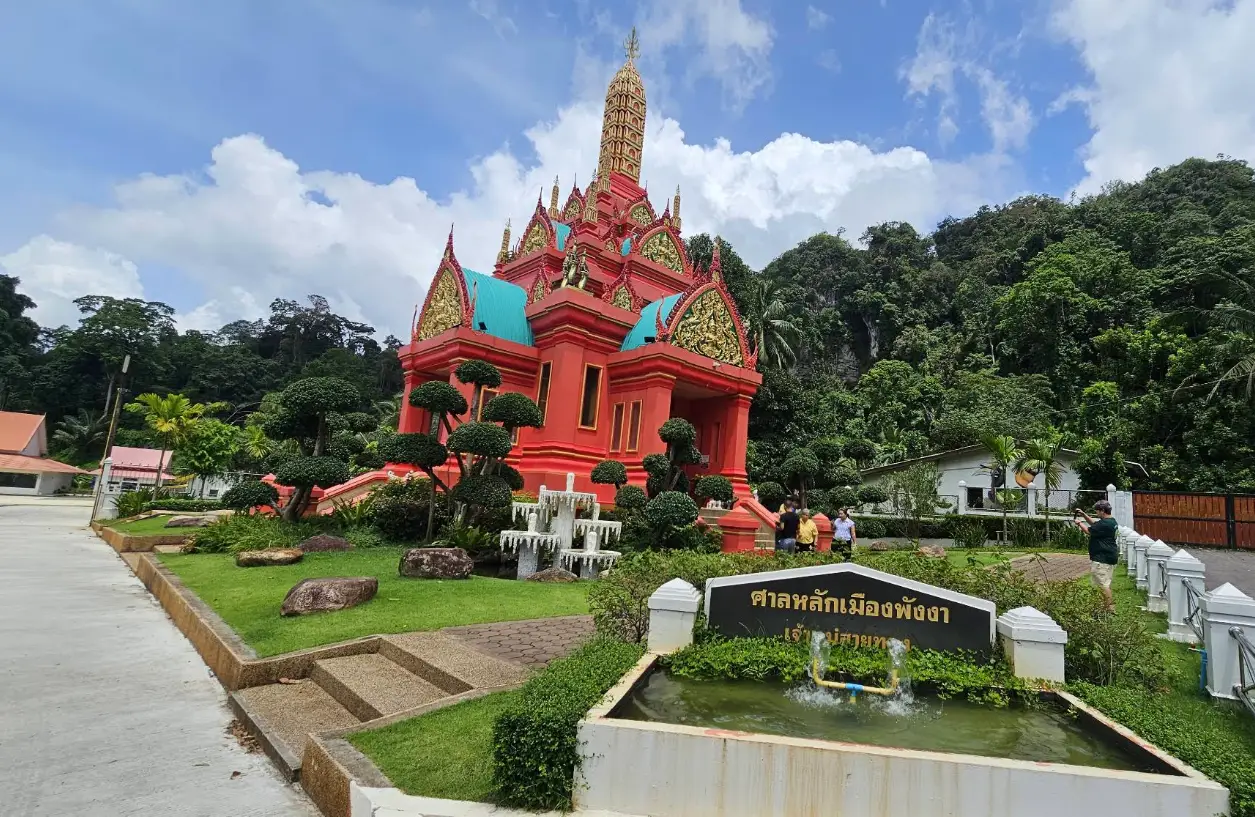
Phang Nga Province City Pillar Shrine, also widely known as Chao Mae Sai Thong Shrine, is one of the most meaningful sacred landmarks in Phang Nga Town. Located along Phetkasem Road in Mueang Phang Nga District, the shrine combines local belief, city-protection symbolism, the legend of Chao Mae Sai Thong, and a distinctive four-sided shrine building topped with five prangs. It is a compact but culturally rich stop for travelers who want to understand Phang Nga beyond its beaches, islands, and limestone scenery.
The shrine is important because it functions as a spiritual center for Phang Nga Province. Local residents visit Phang Nga City Pillar Shrine to pay respect, ask for blessings, and mark important moments in life. Travelers can visit the shrine as part of a short route through Phang Nga Town before continuing to nearby attractions such as Wat Tham Ta Pan, Phung Chang Cave, Khao Chang, Rusi Sawan Cave and Luk Sua Cave, and Ao Phang Nga National Park.
Phang Nga Province City Pillar Shrine is closely connected with the local legend of Chao Mae Sai Thong. According to the story passed down in the community, a woman named Sai Thong, who was 3 months pregnant, heard someone calling her while she was alone at home. She thought the voice belonged to her husband and answered immediately. The legend says she was then taken for an ancient city-pillar ritual. This story has become central to the identity of the shrine, and many people in Phang Nga continue to refer to the site as Chao Mae Sai Thong Shrine.
For cultural travelers, the legend should be understood as local oral history and belief rather than as a simple ghost story. The story of Chao Mae Sai Thong explains why the shrine carries such emotional weight for the local community. It links one woman, the protection of the city, the idea of a guardian spirit, and the collective memory of Phang Nga people. This is why the site feels more personal than many other city pillar shrines in Thailand.
Another important part of the shrine’s story concerns its location. A former governor of Phang Nga, Anan Sanguannam, once considered moving the shrine to Somdet Phra Srinagarindra Park because the original access road was narrow and inconvenient for visitors. According to the local account, Chao Mae Sai Thong expressed through a spiritual medium that she would remain at the original site. This story reinforces the belief that the shrine’s current location has special spiritual meaning for the city.
Inside the shrine area, visitors associate the site with the mound believed to be connected to Chao Mae Sai Thong. This element gives the shrine a stronger identity than a standard city-pillar monument. The place is not only a symbolic city marker; it is also treated as a living sacred space where local residents maintain a relationship with a guardian figure of Phang Nga.
The architecture of Phang Nga Province City Pillar Shrine is one of its strongest visual features. The present shrine structure began construction on 15 November 2001 and took about 3 months to complete. The base measures about 16 x 16 meters. From the ceremonial platform to the top of the main prang, the structure reaches about 17.99 meters, while the platform rises about 1.60 meters from the base level to the building floor.
The shrine uses a four-sided building plan with stairways on all 4 sides. Marble covers the building floor and stairways, giving the space a formal ceremonial appearance. The base reflects Srivijaya influence, while the main building shows Rattanakosin elements. The roof form draws on Khmer-style castle architecture linked to the Devaraja concept, and the prangs reflect Lopburi-style influence. The central prang is surrounded by smaller directional prangs, creating the five-prang composition known as benchaprang.
A normal visit takes about 20 to 40 minutes. Travelers can pay respect, observe the four-sided building plan, view the main prang and surrounding prangs, and take photographs of the shrine against the mountainous backdrop of Phang Nga Town. Morning and late afternoon are the most comfortable times to visit because the light is softer and the weather is easier for walking.
Phang Nga City Pillar Shrine remains an active cultural and ceremonial site. The annual Phang Nga City Pillar Shrine Festival brings together local residents, government agencies, cultural groups, and visitors. The festival includes worship ceremonies, Buddhist chanting, traditional performances, local products, community activities, and ceremonial dances dedicated to Chao Mae Sai Thong. The 217th anniversary celebration was held from 22 to 30 May 2026, showing that the shrine continues to play an active role in the province’s public cultural life.
The shrine is also associated with an annual worship event on 5 January, when the local community pays respect to the city pillar and makes merit according to long-held belief. Travelers who want to see the living cultural side of the shrine should check the provincial event calendar before visiting, especially around the annual festival period.
Visitors should dress respectfully because the shrine is a sacred place. Modest clothing is recommended, and visitors should avoid loud behavior, climbing on shrine structures, or disturbing ongoing ceremonies. Photography is normally suitable in the surrounding area, but it should be done with respect, especially when local people are praying or presenting offerings.
Getting There is straightforward by private car, rental car, local taxi, or town transport. From Phang Nga Town, follow Phetkasem Road toward Ban Nab Pring. The shrine is close to the town center and can be combined with a short local route that includes Wat Tham Ta Pan, Phung Chang Cave, Khao Chang, Rusi Sawan Cave and Luk Sua Cave, and Ao Phang Nga National Park. Travelers arriving from Phuket International Airport can drive north to Phang Nga Province and continue into Mueang Phang Nga District.
The best way to appreciate Phang Nga Province City Pillar Shrine is not to treat it as a quick photo stop. The site becomes more meaningful when viewed through its 3 main layers: the legend of Chao Mae Sai Thong, the mixed architectural language of the shrine building, and the ongoing annual ceremonies that keep the shrine connected to the people of Phang Nga. For foreign travelers, it is a compact but valuable introduction to the spiritual identity of Phang Nga Town.
| Name | Phang Nga Province City Pillar Shrine / Chao Mae Sai Thong Shrine |
| Location | Tham Nam Phut Subdistrict, Mueang Phang Nga District, Phang Nga Province |
| Address | 158 Phetkasem Road, Tham Nam Phut, Mueang Phang Nga District, Phang Nga 82000, Thailand |
| Coordinates | 8.4708, 98.52931 |
| Highlights | Sacred city landmark of Phang Nga, Chao Mae Sai Thong legend, four-sided shrine building, and five-prang architectural form |
| History | The shrine is linked to the long-standing local legend of Chao Mae Sai Thong. The present shrine building began construction on 15 November 2001 and took about 3 months to complete. |
| Name Origin | The name Chao Mae Sai Thong comes from the local legend of Sai Thong, who is revered as a guardian spirit of Phang Nga. |
| Distinctive Features | Srivijaya-style base, Rattanakosin-style main building, Khmer-inspired roof form, Lopburi-style prangs, and a five-prang composition |
| Main Areas / Zones | Worship area, city pillar, Chao Mae Sai Thong mound area, four-sided shrine building, stairways on 4 sides, ceremonial platform, and five-prang roof composition |
| Travel Information | Accessible by private car, rental car, local taxi, or local transport from Phang Nga Town via Phetkasem Road toward Ban Nab Pring |
| Current Status | Open for public worship and still used for Phang Nga’s annual City Pillar Shrine Festival |
| Open Days | Daily |
| Opening Hours | 07.30 – 18.00 |
| Fees | Free admission |
| Facilities | Parking area, worship area, and nearby restroom facilities |
| Related Traditions / Ceremonies | Annual worship on 5 January and the annual Phang Nga City Pillar Shrine Festival |
| Nearby Tourist Attractions | 1. Wat Tham Ta Pan, about 2 km 2. Tham Khao Ngum, about 3 km 3. Phung Chang Cave, about 3 km 4. Khao Chang, about 4 km 5. Rusi Sawan Cave and Luk Sua Cave, about 4 km 6. Ao Phang Nga National Park, about 8 km |
| Nearby Restaurants | 1. Mee Pa Si Na San Lak Mueang, about 0 km, Tel. 098-1584076 2. Mae Sri Khao Moo, about 1 km, Tel. 083-6486554 3. Duang Phang Nga Restaurant Branch 1, about 2 km, Tel. 093-4944564, 088-9415146 4. Gin Arai Ko Dai, about 2 km, Tel. 084-6288640 5. Pinto, about 2 km, Tel. 076-410586 |
| Nearby Accommodations | 1. Khaowong Resort Phangnga, about 0 km, Tel. 098-7258299 2. Thaweesuk Heritage Homestay / Thaweesuk Hotel, about 1 km, Tel. 089-4896842 3. Lukmuang 2 Hotel, about 2 km, Tel. 076-411500 4. The Sleep Phang-nga, about 2 km 5. Phu-Nga Hotel, about 3 km, Tel. 076-481222 |
Frequently Asked Questions (FAQ)
Q: Where is Phang Nga Province City Pillar Shrine located?
A: Phang Nga Province City Pillar Shrine is located on Phetkasem Road in Tham Nam Phut Subdistrict, Mueang Phang Nga District, Phang Nga Province.
Q: Why is Phang Nga City Pillar Shrine also called Chao Mae Sai Thong Shrine?
A: The shrine is closely linked to the local legend of Chao Mae Sai Thong, who is revered as a guardian spirit of Phang Nga.
Q: What are the opening hours of Phang Nga Province City Pillar Shrine?
A: The shrine is open daily from 07.30 to 18.00.
Q: Is there an admission fee?
A: No. Admission is free, although visitors may present flowers, garlands, or offerings according to personal faith.
Q: What is special about the shrine architecture?
A: The shrine combines Srivijaya, Rattanakosin, Khmer, and Lopburi influences, with a four-sided building plan and a five-prang roof composition.
Q: Is there an annual festival at the shrine?
A: Yes. The Phang Nga City Pillar Shrine Festival is held annually and includes worship ceremonies, Buddhist chanting, cultural performances, ceremonial dances, local products, and community activities.
Q: What nearby attractions can travelers visit after the shrine?
A: Nearby attractions include Wat Tham Ta Pan, Phung Chang Cave, Khao Chang, Rusi Sawan Cave and Luk Sua Cave, and Ao Phang Nga National Park.
 Category: ●Places of Worship
 Group: ●Other Sacred Sites
Last Update : 2 MonthAgo
 Last Update : 2 MonthAgo

 Click to Access the Navigation Map GPS
Phang Nga Province City Pillar Shrine Map
Recommend

 Art, Culture and Heritage
 Historical Sites and Monuments(2)
 Landmarks and Memorials(6)
 Art, Craft Centres, Tradition(3)
 Temple(18)
Other Sacred Sites(8)
 Suburban Living
 Village, Community(3)
 Nature and Wildlife
 National Parks and Marine Reserves(12)
 Mountain (Doi)(8)
 Waterfalls(21)
 Hot Springs(2)
 Caves(12)
 River, Canal(4)
 Bays and Beaches(28)
 Islands(11)
 Other natural attractions(7)
 Entertainment and Agricultural
 Animal camps and shows(2)
 Farms, Parks and Ecotourism(2)
 Waterpark(3)
 Outdoor and Adventure Activities(3)
 Travel Articles, Recipes
 Travel Review, Food Review(1)
 Southern Food Menu, Southern Food Recipes(1)


